
 Login
Login
Malaysia’s airspace stays resilient amid rising regional flight traffic, says CAAM
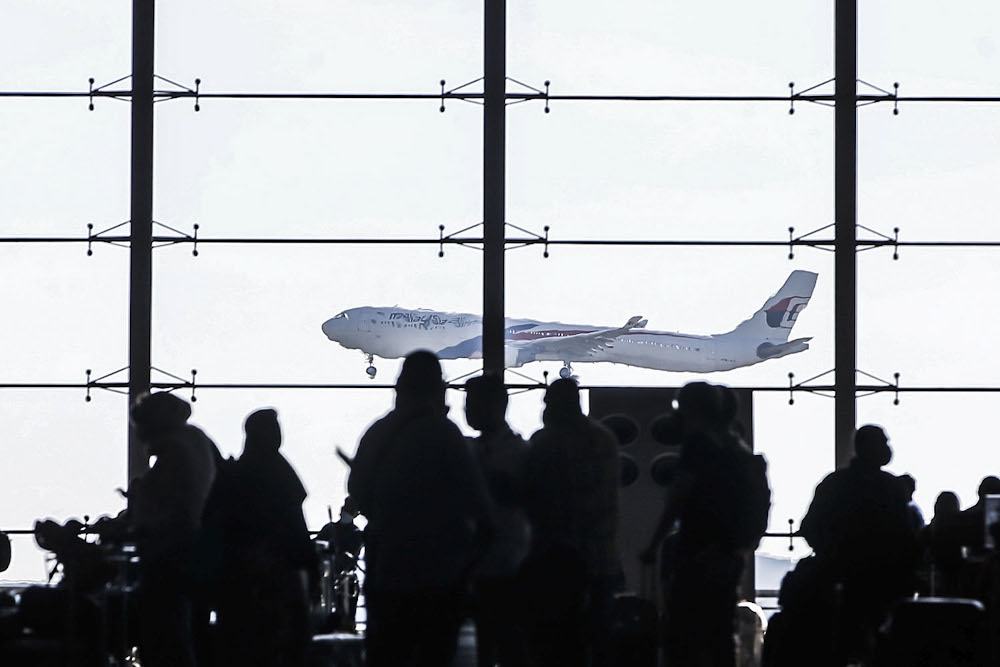
KUALA LUMPUR, May 9 — Malaysia’s airspace operations remain resilient in handling high volumes of regional air traffic, underscoring the country’s role as a key aviation connectivity hub in Southeast Asia, according to the Civil Aviation Authority of Malaysia (CAAM).
In a statement today, CAAM said it continues to strengthen airspace efficiency within the Kuala Lumpur Flight Information Region (KL FIR) and Kota Kinabalu Flight Information Region (KK FIR) amid evolving global airspace dynamics and increasing operational complexity.
Regional traffic data showed that Kuala Lumpur International Airport (KLIA) remains among the busiest airports in Southeast Asia, supported by several of the region’s most heavily travelled routes.
CAAM said key corridors such as Kuala Lumpur-Singapore, Jakarta-Kuala Lumpur and Kota Kinabalu-Kuala Lumpur continue to record high flight frequencies.
“This underscores Malaysia’s strategic role in maintaining regional connectivity and ensuring the continuity of air travel across Asean,” it said.
The authority said continuous improvements in airspace design and air traffic management have enabled both KL FIR and KK FIR to accommodate growing traffic volumes while maintaining high standards of safety, efficiency and reliability.
These include the implementation of Required Navigation Performance Approach (RNP APCH) procedures at KLIA, as well as full Performance-Based Navigation (PBN) Standard Instrument Departure (SID), Standard Terminal Arrival Route (STAR) and RNP APCH procedures in the Kota Kinabalu FIR.
CAAM said the measures enable more precise routing, reduced track miles and improved arrival and departure efficiency.
It added that the expansion of Direct Route Operations (DRO) and User Preferred Routes (UPR) allows aircraft to operate on more efficient and flexible flight paths, reducing congestion, flight times and fuel consumption.
Enhanced cross-boundary coordination also supports more adaptive routing in response to changing operational conditions.
CAAM said the adoption of advanced air traffic management concepts such as System Wide Information Management (SWIM) and Flight and Flow Information for a Collaborative Environment (FF-ICE) enables real-time data sharing, improves predictability and supports more effective collaborative decision-making across the aviation ecosystem.
Advancements in Performance-Based Communication and Surveillance (PBCS) have also enhanced operational capacity by enabling more efficient aircraft separation while maintaining high safety standards, it said.
It further noted the efficiency of KL FIR and KK FIR as critical to supporting one of Southeast Asia’s busiest aviation networks, with KL FIR serving as a central node for major regional routes and KK FIR strengthening connectivity across East Malaysia while supporting growing cross-border traffic flows. — Bernama
