Reading view

Iran says ball in US court on war or diplomacy

 WASHINGTON: A man stands atop the Frederick Douglass Memorial Bridge on Saturday to protest the US-Israeli war on Iran. Guido Reichstadter climbed the bridge in Washington on May Day, stayed there overnight, and posted a sunrise photo from one of the bridge’s arches while calling for an end to the war on Iran. Speaking to the media from atop the 51-metre structure, the 45-year-old father of two called for peaceful means to build pressure on the authorities to end what he described as an ‘illegal war’.—Reuters
WASHINGTON: A man stands atop the Frederick Douglass Memorial Bridge on Saturday to protest the US-Israeli war on Iran. Guido Reichstadter climbed the bridge in Washington on May Day, stayed there overnight, and posted a sunrise photo from one of the bridge’s arches while calling for an end to the war on Iran. Speaking to the media from atop the 51-metre structure, the 45-year-old father of two called for peaceful means to build pressure on the authorities to end what he described as an ‘illegal war’.—Reuters


• Iranian military warns renewed hostilities with Washington ‘likely’
• Trump boasts of Hormuz blockade, says ‘we are like pirates’
• Tehran reaches out to Qatar, South Korea to discuss ongoing negotiations
• Israeli strikes in Lebanon kill over 12 people, injure dozens; Lebanese army chief meets US general

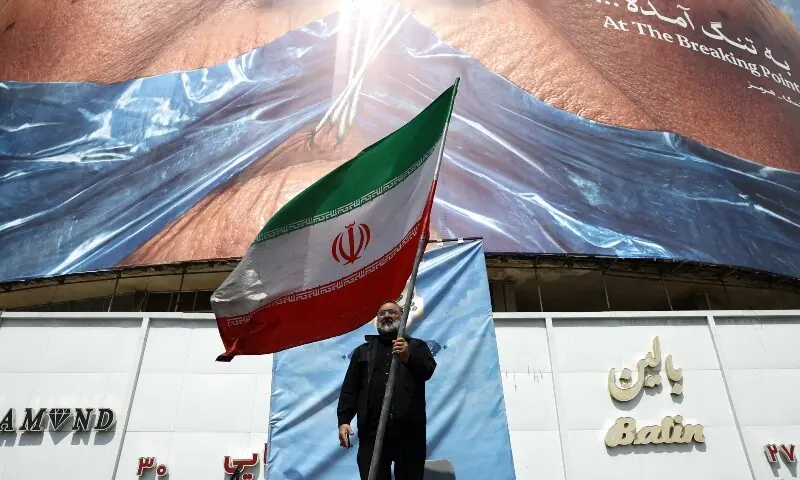
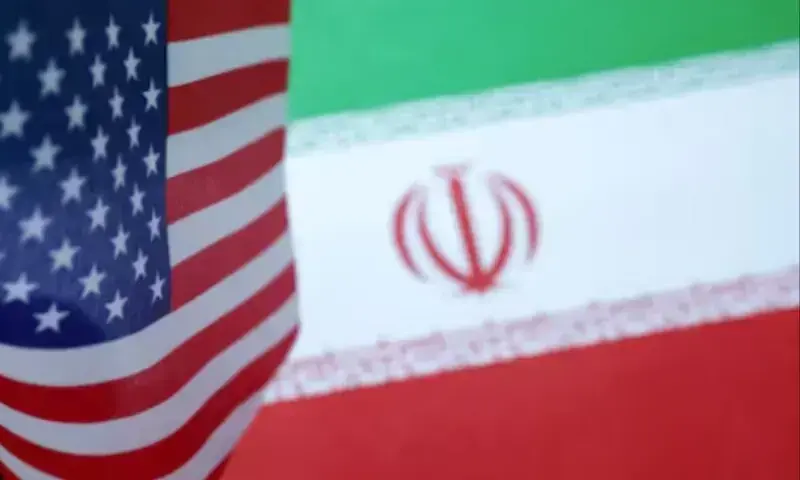
TEHRAN/BEIRUT: Amid a surge in deadly strikes by Israeli forces in southern Lebanon and little headway in talks between the US and Iran, an Iranian military official warned against the ‘likely’ resumption of hostilities whereas diplomats in Tehran were told that the ball was in US court to pick fight or return to table after US President Donald Trump had rejected yet another Iranian proposal.

An Iranian proposal so far rejected by the Trump administration would open shipping in the Strait of Hormuz and end the US blockade of Iran while leaving talks on Iran’s nuclear programme for later, a senior Iranian official said.

A day earlier, the US rejected the fresh peace offer from Tehran, with President Donald Trump saying Iran had made “strides” in the latest proposal, but he was “still not satisfied”.

Iran on Saturday responded that it was up to the US if it wanted to pursue a negotiated settlement or return to war. “Now the ball is in the United States’ court to choose the path of diplomacy or the continuation of a confrontational approach,” Deputy Foreign Minister Kazem Gharibabadi told diplomats in Tehran, according to state broadcaster IRIB. “Iran, with the aim of securing its national interests and security, is prepared for both paths,” he said.

The war, launched by the United States and Israel on Feb 28, has been on hold since April 8, with one round of peace talks having taken place in Pakistan since then.

Axios reported that US envoy Steve Witkoff had submitted amendments to a previous proposal, putting Tehran’s nuclear programme back on the negotiating table.

The changes reportedly included demands that Iran not move enriched uranium from bombed sites or resume activity there during talks.

Besides the nuclear programme, a major bone of contention between the two is the blockade in the Strait of Hormuz.

Interestingly, Trump while addressing a rally in Florida compared the US action in the sea to that of pirates. “We’re like pirates” as he described an earlier helicopter raid on an oil tanker under the blockade.

“We… land on top of it and we took over the ship. We took over the cargo, took over the oil. It’s a very profitable business,” he remarked.

Iranian engagements with allies

Meanwhile, Iranian Foreign Minister Abbas Araghchi and Qatari Prime Minister and Foreign Minister Mohammed bin Abdulrahman bin Jassim Al-Thani discussed the ongoing negotiations between Tehran and the US in a telephone call, according to Doha’s foreign ministry.

The Qatari PM “affirmed the State of Qatar’s full support for mediation efforts aimed at resolving the crisis through peaceful means, emphasising the need for all parties to engage with these efforts in a way that contributes to creating the appropriate conditions for progress in the negotiations and limits the possibilities of renewed escalation”.

Mr Araghchi and South Korean Foreign Minister Cho Hyun also discussed bilateral relations, as well as the latest regional developments and initiatives related to diplomacy aimed at ending the US-Israeli war on Iran, Al Jazeera reported.

While the situation remains highly volatile with the fragile ceasefire in Iran war, the blockade of the Strait of Hormuz and a surge in deadly attacks by Israel in southern Lebanon have created fear that the regional conflict could turn into a prolonged war.

13 killed in Lebanon

Despite the ceasefire in the Gulf, fighting continued in Lebanon, where Israel has carried out deadly strikes even though it signed a US-backed truce to end the Lebanon war. Lebanon’s health ministry said 13 people were killed in the latest strikes in the south, including in a town where Israel’s army had issued an evacuation order despite a ceasefire.

The strikes in Habboush killed eight people, including a child and two women, and wounded 21 others, the ministry said, raising an earlier toll. Other strikes in Zrariyeh killed four people, two of them women, and wounded four more, it said. The ministry also reported a strike in Ain Baal near the coastal city of Tyre killed one person and wounded seven others.

In Habboush, where the Israeli evacuation warning was issued, a photographer saw clouds of smoke rising after the raids. The state-run National News Agency reported that Israeli warplanes “launched a series of heavy strikes… less than an hour after” the warning. The NNA also reported Israeli strikes and artillery fire on other south Lebanon locations, including Tyre.

The NNA said Israeli troops carried out detonations in the southern town of Shamaa, and “demolished a monastery and a school” run by a religious order in the town of Yaroun.

Lebanon’s health ministry raised the toll from Israeli strikes since March 2 to 2,600 dead, including 103 emergency workers and paramedics.

Lebanese army chief meets US general

On Saturday, Lebanese armed forces commander General Rudolf Haykal and US General Joseph Clearfield met in Beirut to discuss the security situation in Lebanon and regional developments, the army said.

Clearfield heads a committee monitoring a US-backed ceasefire in fighting between Israel and Hezbollah.

Published in Dawn, May 3rd, 2026
  •  

2026 already this century’s worst year for the press: RSF Press Freedom Index

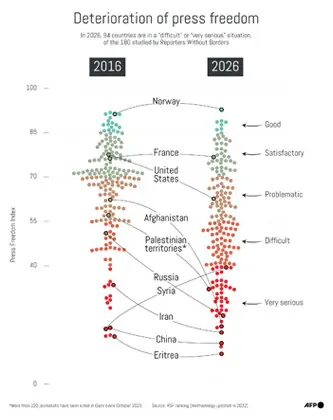
PARIS: Journalism around the world is in dire straits, with Reporters Without Borders’ (RSF) Press Freedom Index calling it the worst year since records began.

For the first time in its 25-year history, over half of the world’s countries now fall into the “difficult” or “very serious” categories for press freedom, the media watchdog noted.

“Since RSF began publishing the World Press Freedom Index 25 years ago, press freedom has been gradually deteriorating,” it noted in the sobering report, released ahead of World Press Freedom day, which will be observed tomorrow (Sunday).

“Journalists are still being killed and imprisoned for their work, but the tactics undermining press freedom are evolving. Journalism is being asphyxiated by hostile political discourse towards reporters, weakened by a faltering media economy, and squeezed by laws being used as weapons against the press.”

RSF Press Freedom Index paints dismal picture; more than half of the world deemed ‘difficult’ for journalists or worse

According to RSF statistics since Jan 1, 2026, 13 journalists were killed around the world, while 471 are currently detained. In addition, at least 21 journalists are held hostage, while 135 remain missing in action.

The US, which had already fallen from a “fairly good” to a “problematic” situation in 2024, the year of Donald Trump’s re-election, has dropped a further seven places to 64, it said.

US President Donald Trump has turned his repeated attacks on the press and journalists into a systematic policy, pushing the US down to 64th place (-7).

The drastic cuts to the US Agency for Global Media (USAGM) workforce had global repercussions, leading to the closure, suspension and downsizing of international broadcasters such as Voice of America (VOA), Radio Free Europe/Radio Liberty (RFE/RL) and Radio Free Asia (RFA) in countries where they were some of the last reliable sources of information.

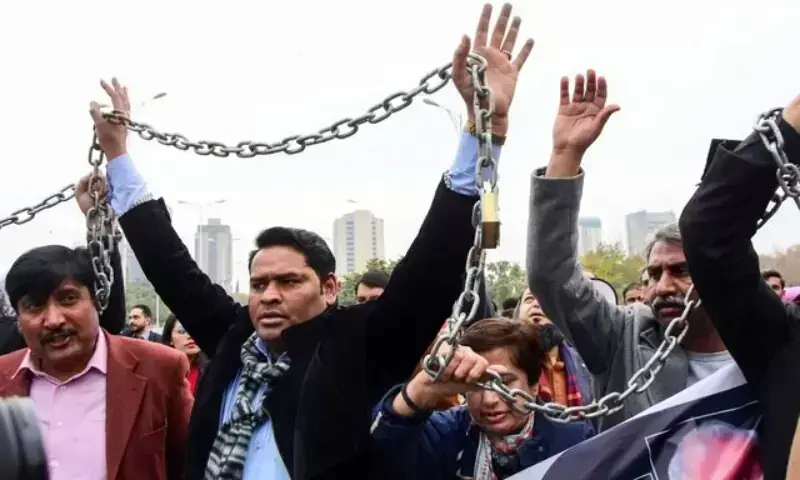
Among some of the most disturbing of RSF’s findings was that the criminalisation of journalism has reaches a peak.

The Index’s legal indicator has seen the most severe decline this year. This score deteriorated in more than 60pc of states — 110 out of 180 — between 2025 and 2026.

This is notably the case in India (157th), Egypt (169th), Israel (116th) and Georgia (135th). The criminalisation of journalism, which is rooted in circumventing press law and misusing emergency legislation and common law, is proving to be a global phenomenon.

In Pakistan (153rd), the press faces relentless waves of restrictions amid a fraught political climate in which authorities seek to control, and in some cases suppress, the dissemination of journalistic content, RSF said.

Among the countries closed off to the independent press, Vladimir Putin’s Russia (172nd) has become a specialist in using laws designed to combat terrorism, separatism and extremism to restrict press freedom.

Even in established democracies, legal provisions can undermine press freedom. In Japan (62nd), the state secrecy law continues to have a chilling effect on journalism as there are no adequate protections for source confidentiality to counterbalance it, which breeds self-censorship.

In South Korea (47th), government measures introduced to combat the spread of “false information” have drawn criticism from press freedom organisations, yet another example of the persistent tension between tackling disinformation and preserving the right to report.

Published in Dawn, May 2nd, 2026

  •  

UN chief warns Hormuz closure ‘strangling’ global economy

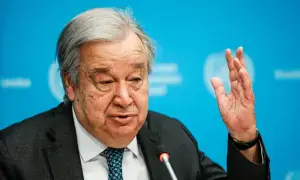
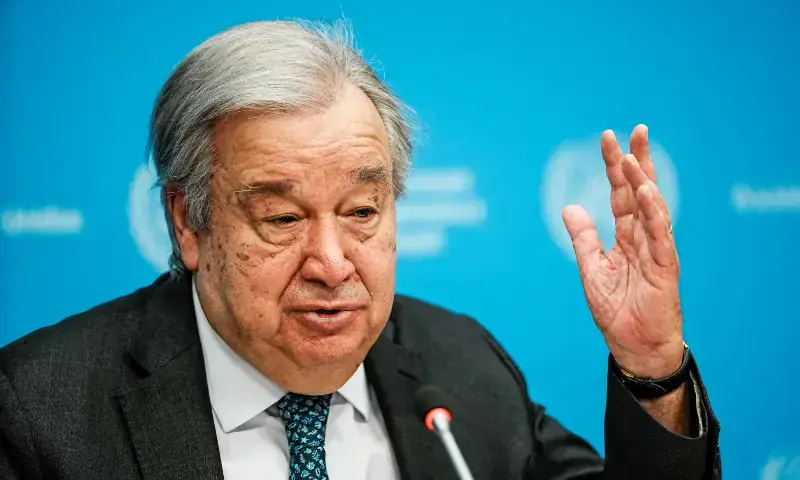
UNITED NATIONS: The escalating crisis in the Strait of Hormuz could push tens of millions into poverty, trigger a surge in global hunger and even tip the world toward recession, United Nations Secretary General Antonio Guterres warned on Thursday.

The closure of the vital waterway is “strangling the global economy,” the secretary general said in remarks to the press.

Guterres decried the restrictions on free passage through the strait, a crucial chokepoint, which he said is impeding the delivery of oil, gas, fertiliser and other critical commodities.

Even if restrictions on shipping and trade were lifted immediately, “supply chains will take months to recover, prolonging lower economic output and higher prices,” he said.

Setting out three possible trajectories for a world still reeling from the shocks of a pandemic and the war in Ukraine, Guterres said the best-case scenario would see global growth fall from 3.4 per cent to 3.1pc, with inflation rising to 4.4pc and trade slowing sharply.

If disruptions arising from Iranian attacks and threats and the US blockade of Iranian ports continue through midyear, the consequences would deepen significantly, he added.

Under that scenario, 32 million people would be pushed into poverty, 45 million more would face extreme hunger as fertiliser runs low and crop yields fall, and “hard-won development gains” could be reversed overnight.

In a worst-case scenario, where severe disruptions persist through the end of the year, “we confront the spectre of a global recession with dramatic impacts on people, on the economy, and on political and social stability,” he warned.

“These consequences are not cumulative. They are exponential,” Guterres stressed, cautioning that the longer the vital artery is choked, the harder it will be to reverse the damage.

Guterres highlighted diplomatic efforts underway to break the deadlock in the US-Iran talks.

“My message to all parties is clear: Navigational rights and freedoms must be restored immediately,” Guterres said. “Open the Strait. Let all ships pass. Let the global economy breathe again.”

Published in Dawn, May 1st, 2026

  •  

US turns down Iranian proposal to end war

• Trump warns Iran to ‘get smart soon’, accept N-curbs; signals months-long extension of naval blockade
• Tehran warns of ‘unprecedented military action’ over shipping curbs
• USS Gerald R. Ford to return after 10-month deployment in ME

TEHRAN/WASHIN­GTON: Amid reports about Iran’s plan to make a fresh proposal, US President Donald Trump on Wedn­esday rejected an Iranian offer to end the conflict, saying that the naval blockade would remain till Tehran agreed to a nuclear deal.

The US president told Axios that the blockade was “somewhat more effective than the bombing” and things would get “worse for them”.

“They want to settle. They don’t want me to keep the blockade. I don’t want to [lift the blockade], because I don’t want them to have a nuclear weapon,” he added during the 15-minute interview with Axios.

The Iranian proposal, passed along by Pakistan, had laid out red lines, including on nuclear issues and the Strait of Hormuz. The plan would reportedly see Tehran ease its chokehold on the strait and Washington lift its retaliatory blockade while broader negotiations continue, including over the nuclear programme. However, it was rejected and a new offer is on the cards.

However, The Washington Post in a report quoted multiple US officials as saying that the aircraft carrier USS Gerald R. Ford would depart the Middle East and begin the sail for home in coming days.

The planned withdrawal comes as an expected relief for roughly 4,500 sailors, who have been deployed there for 10 months, but a loss of significant firepower as peace talks between the United States and Iran stagnate.

Earlier, Iran’s Oil Minister Mohsen Paknejad, according to Al Jazeera, said Iran’s supply and distribution of fuel remained stable despite the US blockade on Iranian ports. Iran’s parliament speaker Bagher Ghalibaf said the US wanted to divide Iran using the blockade.

The US president also discussed the Iran war with his Russian counterpart Vladimir Putin, days after the visit of Iran’s Foreign Minister Abbas Araghchi to St Petersburg.

Speaking to reporters in the Oval Office, US President Donald Trump said he talked “a little bit”. “He told me he’d like to be involved with the enrichment, if he can help us get it,” Trump said, referring to retrieving Iran’s stockpile of enriched uranium. “I said, ‘I’d much rather have you be involved with ending the war in Ukraine.’ To me, that’d be more important,” he added.

Ghalibaf calls for unity

“The enemy has entered a new phase and wants to activate economic pressure and internal division through naval blockade and media hype to weaken or even make us collapse from within,” Ghalibaf added, calling for “maintaining unity” as the only solution.

However, the US president told oil executives that the US could extend its naval blockade of Iran for months more. “Iran can’t get their act together… They better get smart soon,” Trump posted on his social media platform, above a mocked-up picture of himself toting a rifle in front of explosions wrecking a desert fortress and the slogan: “No more Mr. Nice Guy!”

According to the administration official, speaking on condition of anonymity, Trump discussed with the oil executives “steps we could take to continue the current blockade for months if needed and minimise impact on American consumers”.

Brent crude rises to $117

News that peace talks remained stalled pushed oil prices higher one again, with Brent crude for June delivery rising more than five per cent to $117 — its highest level since a fragile US-Iran ceasefire came into effect on April 8.

Iran has blockaded the Strait of Hormuz — a vital conduit for oil and gas shipments from the Gulf — since the US and Israel launched the war two months ago, sending shockwaves through the global economy. But its own economy is also suffering. On Wednesday, the Iranian rial fell to historic lows against the dollar.

Tehran warned on Wednesday of “unprecedented military action” against continued US blockading of Iran-linked vessels. Trump has stressed repeatedly that Iran cannot have a nuclear weapon, while Tehran says its nuclear ambitions are peaceful.

‘No trust’

During a White House state dinner on Tuesday, Trump told Britain’s King Charles III and other guests that Iran had been “militarily defeated”, and added: “Charles agrees with me even more than I do — we’re never going to let that opponent have a nuclear weapon.”

But an Iranian army spokesman told state TV on Tuesday that “we do not consider the war to be over”, saying Tehran had “no trust in America”.

“We have many cards that we have not yet used… new tools and methods of fighting based on the experiences of the past two wars, which will definitely allow us to respond to the enemy more decisively” should the fighting resume, Amir Akraminia said in an interview.

Published in Dawn, April 30th, 2026

  •  
❌