
Reading view

When a president is unfit for office, here’s what the Constitution says can happen
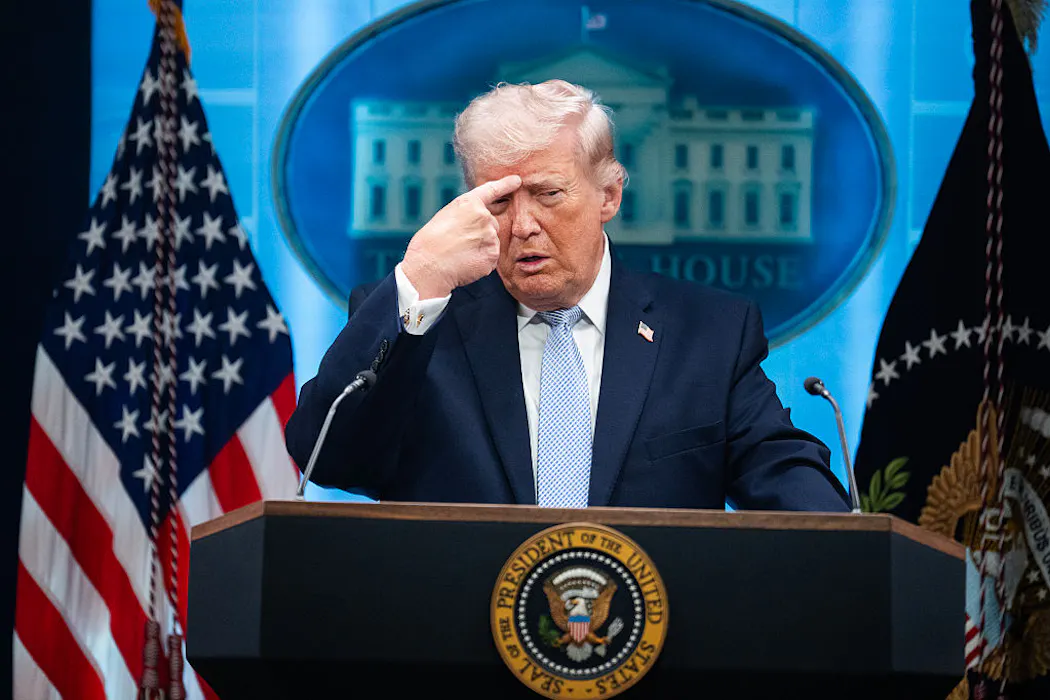
President Donald Trump mimics an Iranian protester being shot while holding a news conference in the White House on April 6, 2026. Tom Williams/CQ-Roll Call, Inc via Getty Images

Bipartisan calls for President Donald Trump’s removal from office increased on April 7, 2026, after he issued threats to destroy “a whole civilization” if Iran refuses to reopen the Strait of Hormuz.

These calls have come from across the political spectrum, from Democratic Reps. Alexandria Ocasio-Cortez of New York and Melanie Stansbury of New Mexico to former Rep. Marjorie Taylor Greene and right-wing pundit Alex Jones. Unlikely allies seem to agree that the president has gone too far and needs to be reined in.

Their concerns have emerged as Iran has walked away from talks to end the war and Trump’s language suggests that he plans to escalate it by destroying the country’s power plants and bridges.

Concerns over Trump’s fitness for office have grown in recent weeks as his commentary has become more erratic.

If lawmakers do attempt to remove Trump from office, here’s what would happen:
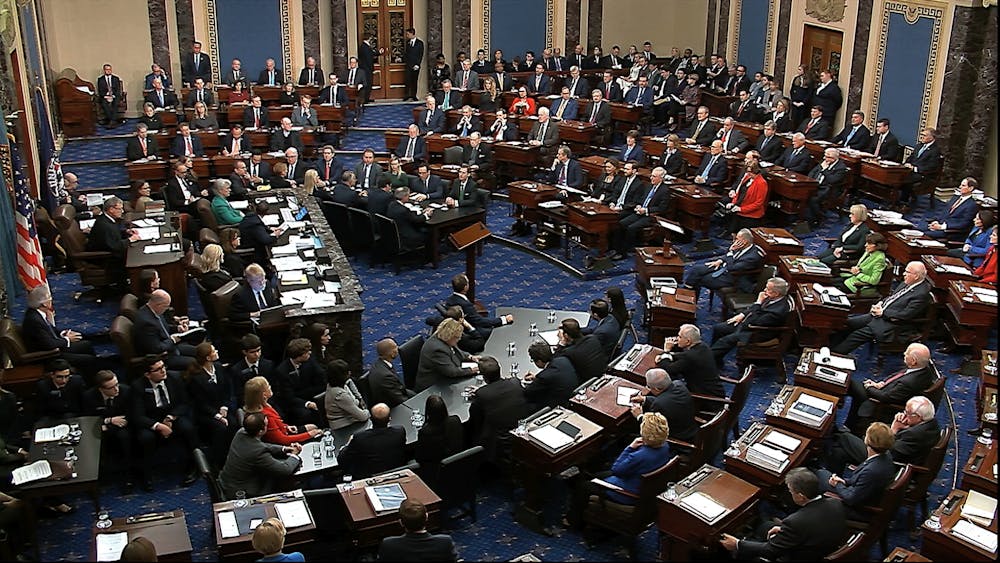
A scene of the Senate voting in Trump's impeachment trial in 2020
Donald Trump has been impeached twice, but has not convicted. Senate Television via AP

25th Amendment

The Constitution’s 25th Amendment provides a way for high-level officials to remove a president from office. It was ratified in 1967 in the wake of the 1963 assassination of John F. Kennedy – who was succeeded by Lyndon Johnson, who had already had one heart attack – as well as delayed disclosure of health problems experienced by Kennedy’s predecessor, Dwight Eisenhower.

The 25th Amendment provides detailed procedures on what happens if a president resigns, dies in office, has a temporary disability or is no longer fit for office.

It has never been invoked against a president’s will, and has been used only to temporarily transfer power, such as when a president is undergoing a medical procedure requiring anesthesia.

Section 4 of the 25th Amendment authorizes high-level officials – either the vice president and a majority of the Cabinet or another body designated by Congress – to remove a president from office without his consent when he is “unable to discharge the powers and duties of his office.” Congress has yet to designate an alternative body, and scholars disagree over the role, if any, of acting Cabinet officials.

The high-level officials simply send a written declaration to the president pro tempore of the Senate – the longest-serving senator from the majority party – and the speaker of the House of Representatives, stating that the president is unable to discharge the powers and duties of his office. The vice president immediately assumes the powers and duties of the president.

The president, however, can fight back. He or she can seek to resume their powers by informing congressional leadership in writing that they are fit for office and no disability exists. But the president doesn’t get the presidency back just by saying this.

The high-level officials originally questioning the president’s fitness then have four days to decide whether they disagree with the president. If they notify congressional leadership that they disagree, the vice president retains control and Congress has 48 hours to convene to discuss the issue. Congress has 21 days to debate and vote on whether the president is unfit or unable to resume his powers.

The vice president remains the acting president until Congress votes or the 21-day period lapses. A two-thirds majority vote by members of both houses of Congress is required to remove the president from office. If that vote fails or does not happen within the 21-day period, the president resumes his powers immediately.

The 25th Amendment
The 25th Amendment to the U.S. Constitution. National Archives via AP

The case for impeachment

Article II of the Constitution authorizes Congress to impeach and remove the president – and other federal officials – from office for “Treason, Bribery, or other high Crimes and Misdemeanors.” The founders included this provision as a tool to punish a president for misconduct and abuses of power. It’s one of the many ways that Congress could keep the president in check, if it chose to.

Impeachment proceedings begin in the House of Representatives. A member of the House files a resolution for impeachment. The resolution goes to the House Judiciary Committee, which usually holds a hearing to evaluate the resolution. If the House Judiciary Committee thinks impeachment is proper, its members draft and vote on articles of impeachment. Once the House Judiciary Committee approves articles of impeachment, they go to the full House for a vote.

If the House of Representatives impeaches a president or another official, the action then moves to the Senate. Under the Constitution’s Article I, the Senate has the responsibility for determining whether to remove the person from office. Normally, the Senate holds a trial, but it controls its procedures and can limit the process if it wants.

Ultimately, the Senate votes on whether to remove the president – which requires a two-thirds majority, or 67 senators. To date, the Senate has never voted to remove a president from office, although it almost did in 1868, when President Andrew Johnson escaped removal from office by one vote.

The Senate also has the power to disqualify a public official from holding public office in the future. If the person is convicted and removed from office, only then can senators vote on whether to permanently disqualify that person from ever again holding federal office. Members of Congress proposing the impeachment of Trump have promised to include a provision to do so. A simple majority vote is all that’s required then.

This is an updated version of an article originally published on Jan. 9, 2021.

The Conversation

Kirsten Matoy Carlson does not work for, consult, own shares in or receive funding from any company or organization that would benefit from this article, and has disclosed no relevant affiliations beyond their academic appointment.
  •  

75 years after she led a student strike that helped end school segregation, Barbara Rose Johns now stands in the US Capitol where Robert E. Lee once did

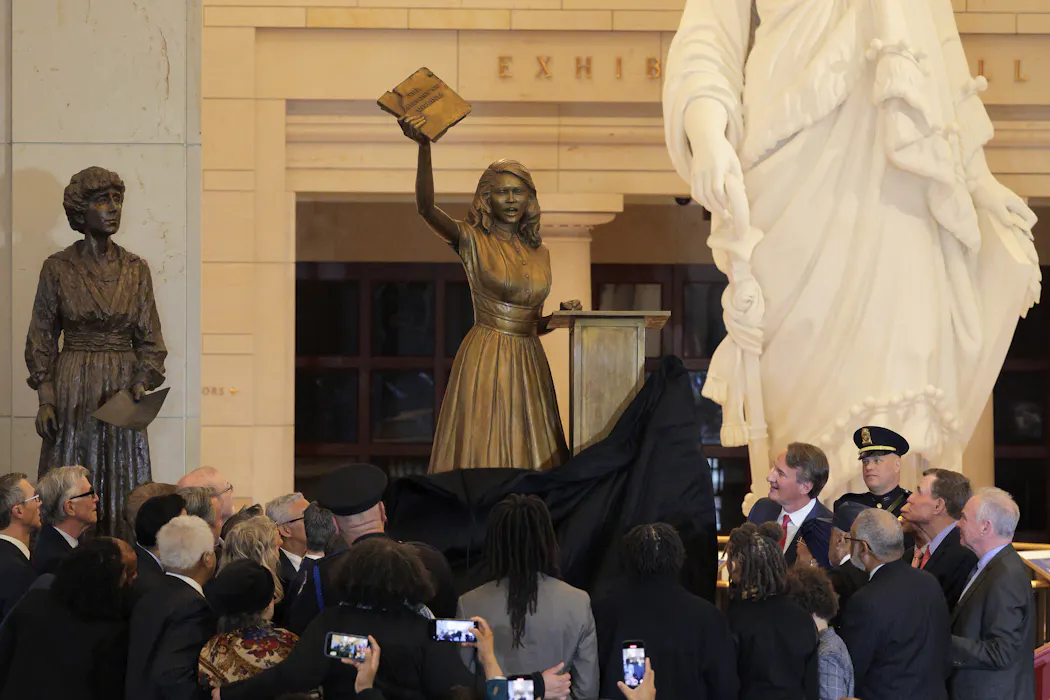
A statue of civil rights activist Barbara Rose Johns is unveiled in Emancipation Hall at the U.S. Capitol on Dec. 16, 2025, in Washington. Chip Somodevilla/Getty Images

The 250th anniversary of the Declaration of Independence isn’t the only important anniversary in 2026. This year also marks the 75th anniversary of an extraordinary case of student activism that helped lead to the Supreme Court’s decision outlawing segregated schools.

In April 1951, 16-year-old Barbara Rose Johns organized a student strike to protest the shabby conditions and inadequate education at her segregated Black high school in Prince Edward County, Virginia.

Prince Edward County is located about 65 miles southwest of Richmond and around 30 miles east of Appomattox, or 48 kilometers, in a part of Virginia known as Southside. African Americans constituted almost half the population, but they were largely prevented from voting before passage of the Voting Rights Act in 1965 and could not eat in local restaurants before passage of the Civil Rights Act of 1964. The public schools were segregated, and for decades there was no Black high school at all.

In 1939, following years of pressure by Black residents, the white authorities opened a high school for African Americans. That segregated institution was named for Robert Roosa Moton, who had been raised in Prince Edward County and served as an administrator at Hampton Institute in Virginia before being appointed as the second head of Tuskegee Institute following the death of Booker T. Washington.

The new building became severely overcrowded almost immediately. Although it was designed for a maximum enrollment of 180, attendance reached 219 the year after it opened and 377 in 1947.

The following year, the school board put up three temporary outbuildings to accommodate the overflow. Many Black residents scorned these buildings as “tar paper shacks” because of their covering and dilapidated condition. They had inefficient wood stoves that provided limited heating, and their thin walls often leaked when rain fell.

The shabbiness of these interim structures became a source of continuing tension, as negotiations between the Black community and white authorities for a more permanent facility dragged on inconclusively into early 1951.

Johns makes her move

As an 11th grader at Moton High School, Johns began talking with some of her fellow students about taking action to protest the shacks and improve their education.

On April 23, 1951, someone lured Moton’s principal, Boyd Jones, out of the building on the pretext that two students were in trouble elsewhere in town. After Jones left, Johns summoned the student body to the auditorium, where she exhorted her peers to walk out to protest the deplorable condition of their school.

Johns also sent a letter to Oliver W. Hill and Spottswood W. Robinson III, two Richmond civil rights lawyers who worked closely with the NAACP, asking for their legal assistance.

The strike went on for two weeks. During that time, Hill and Robinson met twice with hundreds of students and parents. The meetings grew out of the lawyers’ initial skepticism about litigating over school conditions in rural Prince Edward County, where they feared that plaintiffs would be subject to severe physical and economic retaliation.

Those meetings persuaded Hill and Robinson that the Black community broadly supported an effort to obtain desegregation rather than mere improvements in the separate Black schools. The lawyers therefore filed their lawsuit in the United States District Court for the Eastern District of Virginia on behalf of scores of Black students and parents, alleging that segregated schools violated the 14th Amendment.

Victory – and messy history

Johns’ initiative had both short- and long-term consequences.

In the immediate aftermath of the strike, the all-white school board fired Jones, whom they regarded as having put the students up to their activism despite his – and the students’ – insistence that the whole affair was a student initiative.

The lawsuit – and other similar suits filed in South Carolina, Delaware and Kansas – failed in the lower court. The plaintiffs appealed to the Supreme Court, which reversed those judgments and ruled in the consolidated case called Brown v. Board of Education that segregated public schools were unconstitutional.

A yellowed page from a legal decision with the name 'SUPREME COURT OF THE UNITED STATES' at the top.
The first page of the printed copy of the Supreme Court’s desegregation decision in Brown v. Board of Education, May 17, 1954. Smithsonian National Museum of American History

Meanwhile, in the wake of the student strike at Moton, Johns’ family feared that she would be in physical danger if she remained in Prince Edward County for her senior year. They sent her to live with her uncle Vernon Johns, a minister and outspoken civil rights advocate, in Montgomery, Alabama.

Johns graduated from Drexel University and worked for many years as a public school librarian in Philadelphia before her death in 1991.

The post-Brown history of Prince Edward County is very complicated. White authorities closed the public schools for five years to avoid desegregation. For a long time afterward, virtually all the white children went to a private academy that opened when the public schools closed.

But that messy history cannot detract from the courage and impact of Barbara Johns.

In December 2025, her statue replaced that of Robert E. Lee as one of the two Virginians displayed in the U.S. Capitol. Johns is there – along with George Washington.

The Conversation

Jonathan Entin does not work for, consult, own shares in or receive funding from any company or organization that would benefit from this article, and has disclosed no relevant affiliations beyond their academic appointment.

  •  
❌