Reading view

Industries most exposed to AI are not only seeing productivity gains but jobs and wage growth too

Financial analysis is an industry that is seeing job growth even as AI is increasingly used. Orientfootage/iStock via Getty Images

Forecasts of the impact of artificial intelligence range from the apocalyptic to the utopian. An October 2025 report from Senate Democrats, for example, predicted AI will destroy millions of U.S. jobs. A couple of years earlier, consultant company McKinsey forecast AI will add trillions to the global economy, while emphasizing job losses can be mitigated by training workers to do new things.

The problem is that many of these claims are based on projections, overly simplified surveys or thought experiments rather than observed changes in the economy. That makes it hard for the public, and often policymakers, to know what to trust.

As a labor economist who studies how technology and organizational change affect productivity and well-being, I believe a better place to start is with actual data on output, employment and wages – which are all looking relatively more hopeful.

AI and jobs

In one of my new research papers with economist Andrew Johnston, we studied how exposure to generative AI affected industries across America between 2017 and 2024, using administrative data that covers nearly all employers. Our analysis covered a crucial period when generative AI use exploded, allowing us to analyze the effect within businesses and industries.

We measured AI exposure using occupation-level task data matched to each industry and state’s occupational workforce mix prior to the pandemic. A state and industry with more workers in roles requiring language processing, coding or data tasks scored higher on exposure, for example, compared with one with more plumbers and electricians.

We then took that exposure ranking by occupation and looked at changes in the standard deviation in occupational exposure, comparing that with labor market and GDP across states and industries from 2017 to 2024.

Think of a standard deviation as roughly the gap between a paramedic – whose work centers on physical assessment, emergency response and hands-on care that AI cannot easily replicate – and a public relations manager, whose work involves drafting communications, analyzing sentiment and synthesizing information that AI tools handle well. That gap in AI exposure is roughly what we’re measuring when we ask: Does being on the higher-exposure side of that divide change your industry’s trajectory?

This data allowed us to answer two questions: When AI tools became widely available following the public release of ChatGPT in late 2022, did states and industries that were more exposed to generative AI become more productive, and what happened to workers?

Our answers are more encouraging, and more nuanced, than much of the public debate suggests.

We found that industries in states that were more exposed to AI experienced faster productivity growth beginning in 2021 – before ChatGPT reached the public – driven by enterprise tools already embedded in professional workflows, including GitHub Copilot for software development, Jasper for marketing and content writing, and Microsoft’s GPT-3-powered business applications. In 2024, for example, industries whose AI exposure was one standard deviation higher saw gains of 10% in productivity, 3.9% in jobs and 4.8% in wages than comparable industries in the same state.

Those patterns suggest that, at least so far, AI has acted as a productivity-enhancing tool that boosts employment and wages rather than a simple substitute for labor.

chatgpt's app is shown on a phone with other apps.
Use of generative AI exploded in 2022 with the launch of ChatGPT. AP Photo/Kiichiro Sato

Augmentation versus displacement

A crucial distinction in the data is between tasks where AI works with people and tasks where AI can act more independently. In sectors where AI mainly complements workers – think marketing, writing or financial analysis – our data show that employment rose by about 3.6% per standard deviation increase in exposure.

In sectors where AI can execute tasks more autonomously – including basic data processing, generating boilerplate code, or handling standardized customer interactions – we found no significant employment change, though workers in those roles saw slower wage growth.

What these findings suggest is that when AI lowers the cost of completing a task and raises worker productivity, companies expand output enough to increase their demand for labor overall — the same logic that explains why power tools didn’t eliminate construction workers.

The economic question is not whether any given task disappears. It is whether businesses and workers can reorganize fast enough to create new productive combinations. And so far, in most sectors, our evidence suggests they can.

But state policies also matter: These benefits were concentrated in the states with more efficient labor markets, meaning that the impact of generative AI on workers and the economy also depends on the types of policies and institutions of the local economy.

Importantly, these findings hold beyond occupational exposure. In additional work with co-authors at the Bureau of Economic Analysis, we found a similar effect on GDP and employment when looking at actual AI utilization — that is how often workers use AI. Drawing on the Gallup Workforce Panel, we measured workers actively using AI daily or multiple times a week. We found that each percentage-point increase in the share of frequent AI users in a state and industry is associated with roughly 0.1% to 0.2% higher real output and 0.2% to 0.4% higher employment.

To put that in context: The share of frequent AI users across all occupations rose from about 12% in mid-2024 to 26% by late 2025, a shift our estimates suggest corresponds to roughly 1.4% to 2.8% higher real output – or about 1 to 2 percentage points of annualized growth over that period.

New technologies rarely leave work untouched. But they also rarely eliminate the need for human contribution altogether. Instead, they change the composition of work, as our research shows. Some tasks shrink. Others expand. New ones emerge that were previously too costly or too hard to perform at scale. Put simply, some occupations might go away, but most of them just change.

If anything, the trends documented here are likely to strengthen rather than fade. Not only are generative AI tools rapidly improving, but also the experimentation and research and development that many workers and companies are engaging in are likely to pay large dividends. These investments – often referred to as intangible capital – tend to get unlocked a few years after a technology comes onto the scene, once complementary investments have been made.

The role of companies and managers

Whether AI leads to anxiety or adaptation for workers depends in part on what happens inside organizations. Using additional data collected over many years in the Gallup Workforce Panel covering more than 30,000 U.S. employees from 2023 to 2026, I found in a 2026 paper that workplace adoption of generative AI rose quickly over the period, with the share of workers using AI often increasing from 9% to 26%.

But the more important finding is that adoption was far more common where workers believed their organization had communicated a clear AI strategy and where employees said they trust leadership. This suggests that growing adoption and effective use of AI depends not only on the availability of the technology but on whether managers make its use clear, credible and safe.

Where that clarity exists, frequent AI use is associated with higher engagement and job satisfaction, and it even reverses the burnout penalties that appear elsewhere.

In other words, the broader economic effects of AI depend not only on how sophisticated the tools are but on whether companies and managers create environments where workers can experiment, reorganize tasks and integrate new tools into productive routines. That is, if employees do not feel the psychological safety to experiment, they are less likely to use AI, and they are especially less likely to use it for higher-value work.

That is precisely the kind of adaptation that I believe makes labor markets more resilient than the most alarmist forecasts suggest.

The Conversation

Christos Makridis is a senior researcher at Gallup.
  •  

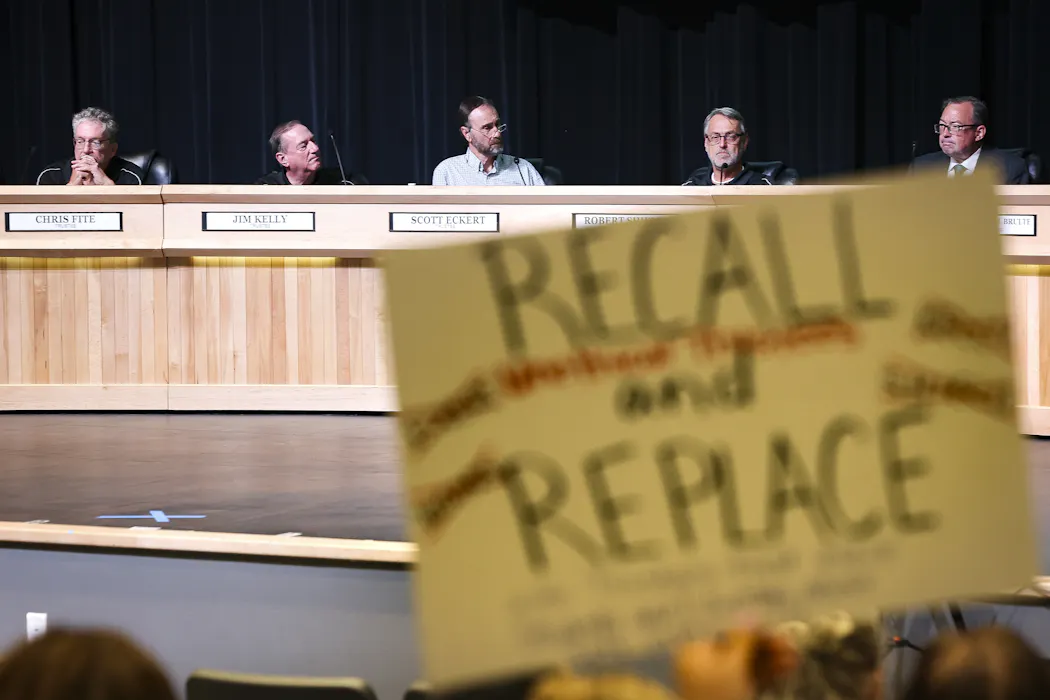
District school boards have become political hotbeds for book bans and more – here’s what they actually do

People hold signs during a Grossmont Union High School District board meeting in El Cajon, Calif., in July 2025. Meg McLaughlin/The San Diego Union-Tribune via Getty Images

Election races for local school boards have become hotly contested in many states as they have become forums for debates over gender-identity discussions, immigrant students and even prayer at school events.

Liberal candidates largely swept school board elections on April 7, 2026, in politically contentious districts in Wisconsin, Missouri, Alaska and Oklahoma, where book bans, gender identity and prayer during school events were on the table.

Amy Lieberman, the education editor at The Conversation U.S., spoke with Carrie Sampson, a scholar of educational leadership and policy with an emphasis on school boards, to understand what school board members do and why these local elections carry weight for many parents, teachers and students.

A large group of people are seen seated in a room with a projector, facing toward a row of people seated side by side at a table.
Parents attend a school district board meeting in Placentia, Calif., in February 2026, as board members considered a resolution supporting Immigration and Customs Enforcement. Leonard Ortiz/MediaNews Group/Orange County Register via Getty Images

What are district school boards?

School boards are the governing organization for local school districts. There are typically anywhere from five to 21 members of a school board in a district. On average, there are seven to nine members on a school board.

Overall, there are approximately 13,000 school districts and about 90,000 local school board members in the United States.

School board members are typically elected, but sometimes they are appointed by mayors or other local or state officials. They are representatives of their local communities, as well as trustees who make governing decisions about school district budgets, hiring and other issues like a school district’s educational priorities.

School board elections typically have relatively low voter turnout. Research shows that nearly 40% of school board elections go uncontested.

The majority of school board members are unpaid, but some receive a small stipend for their work. A handful of school boards, like in Los Angeles, for example, receive a relatively large salary.

What does a school board member’s day-to-day work look like?

School boards typically meet twice a month, often to deliberate over issues such as budget or policy decisions.

One of a school board’s major jobs in most districts is hiring and firing a district superintendent, who effectively acts as the CEO of the district.

In terms of fiscal decisions, a school district administrator often presents what budget allocations should be for schools, and a school board votes to approve or disapprove that.

Most school boards create agendas and vote on a range of issues that are not particularly controversial, like whether the district will adopt an after-school program.

Why does a school board’s work matter?

School boards can make some critical decisions that impact the lives of students, parents and teachers. Many school districts are dealing with issues around school closures. Ultimately, school boards decide whether they are going to close a school in a district.

Many school districts are experiencing declining student enrollment, in part because of birth rate declines. People also have more and more school options to pick from, be it private schools, charter schools or homeschooling.

Within the past few years, school boards have also gained a lot of attention about whether they should ban particular books from districts, and whether they should ban or approve certain curriculum.

What other controversial issues have they taken on in the past few years?

Years before COVID-19, school boards in some conservative communities took on questions about which bathroom transgender students in public schools should use. Another big issue is whether schools should allow transgender students to participate on gendered sports teams.

During the pandemic, a rising number of communities began to see school boards as critical decision-makers. School boards were often making decisions about whether to close or reopen schools. They were also voting on requirements related to mask mandates or vaccines. Even people who didn’t live in certain school districts showed up at board meetings to advocate for certain COVID policies.

During the Black Lives Matter protest movement in 2020, some conservative communities started to speak out against critical race theory and their fear that it was being taught in K-12 schools. Most teachers don’t actually instruct on critical race theory.

Around this time, two major school advocacy organizations emerged nationwide: Moms for Liberty and Defending Education, formerly known as Parents Defending Education. These groups tried to elect conservative school board members to take on issues like book bans – and in some cases did so successfully.

My colleague Gabriela Lopez and I wrote a research paper in 2024 about people’s attempts to recall school board members. In 2021, we found, there was an all-time high of 545 school board members who faced recall, mostly because of mask mandates and other COVID-related issues.

Another trend was that police arrested or charged at least 59 people due to unrest at school board meetings from May 2021 through November 2022.

People stand along a metal barricade and one woman holds a sign that says 'End masks now.' A boy next to her holds a small American flag.
A woman holds a placard protesting mask mandates in schools outside a meeting of the Volusia County School Board in DeLand, Fla., in September 2021. Paul Hennessy/SOPA Images/LightRocket via Getty Images

Are school boards taking on more controversial issues than they used to?

Every era has a point at which these controversial issues come to the school board level.

School boards made critical decisions around school desegregation in the 1950s through the 1970s. My research with colleagues on this topic shows that while many districts were legally mandated to desegregate schools, it was often school boards that voted on how these schools would be desegregated. Some school boards voted on policies that placed the burden on Black children and their families. One school board in Virginia even temporarily closed the schools completely to avoid desegregation.

Twenty to 30 years ago, many school boards faced tension over whether and how schools should teach sex ed.

Today, a lot of the political controversy about school boards is more widely known, for a few reasons. First, more communities have access to school board meetings, since many are video recorded. Second, social media has amplified what school boards do. There are also more outside organizations, such as local chapters of Moms for Liberty, that have been involved with school boards.

School boards taking on controversial issues are more likely to be in suburban and racially diverse school districts, compared to their rural or urban counterparts.

A report in 2024 found that the cost of conflict among school boards nationwide in 2023-24 was nearly $3.2 billion, when considering the amount of turnover or security needed for school board meetings.

The Conversation

Carrie Sampson does not work for, consult, own shares in or receive funding from any company or organization that would benefit from this article, and has disclosed no relevant affiliations beyond their academic appointment.

  •  

Water conservation works, but climate change is outpacing it: Phoenix, Denver and Las Vegas offer a glimpse of the future

The Denver suburb of Castle Rock, Colo., limits water use in future developments. Homeowners are embracing water-efficient yards. RJ Sangosti/MediaNews Group/The Denver Post via Getty Images

When a drought turns into an urban water crisis, a city’s first step is often to limit lawn watering and launch a campaign to encourage everyone to conserve. It might raise water-use rates or offer incentives for installing low-flow devices.

While demand management techniques like these have had a lot of success in reducing water use, our new research suggests that they may not be effective enough in the face of climate change.

We looked at three cities in the Colorado River Basin – Phoenix, Las Vegas and Denver – to understand what each could do to increase demand management amid water shortages and how far those methods could go as temperatures rise and the Colorado River’s flow weakens.

The results suggest the region needs to be thinking about bigger solutions.

Colorado River states’ immediate challenge

The Colorado River provides drinking water to nearly 40 million people and irrigation for over 5.5 million acres of cropland. But it has experienced a significant drop in water availability in recent decades due in part to rising demand for water and a long-running megadrought in the Southwest.

To ensure that water is shared across boundaries, the seven states within the basin agreed to the Colorado River Compact in 1922, setting limits on water withdrawals from the river. Since then, the region has adopted additional rules, agreements and policies, collectively termed the “Law of the River.” But despite this compact, which the states are renegotiating in 2026, the basin’s water supply is shrinking.

Research shows that the region is likely to experience more intense, frequent droughts that last longer due to climate change, putting the water supplies for farms, people and energy systems at risk.

As researchers who study the impact of climate change on water systems, we wanted to see if demand management techniques could help under these intensifying conditions.

Getting people involved can change attitudes

Many demand management policies are reactive and only go into effect when sources run low.

These reactive policies can be successful during the scarcity period, but there is often a rebound effect: Water consumption can actually increase afterward.

We integrated survey data with a computer model of water availability and demonstrated that there can be long-term benefits to the local water supply if communities encourage positive attitudes toward conservation.

A woman in a reflective vest checks a plant along a street. Behind her, an SUV has the words 'Water Patrol' on the side.
Las Vegas has water investigators who can issue tickets for illegal water use. Jim West/UCG/Universal Images Group via Getty Images

The survey focused on how people think about water conservation and climate change, drawing on a large body of research that shows people who care about the environment often take eco-friendly actions. Building off these ideas, we segmented the population into groups that shared similar views on water conservation and found that a large proportion of residents supported water conservation but weren’t actively participating in conservation programs within their communities.

We then used the computer model to explore how changing attitudes, and subsequent conservation behavior, could affect water supplies under climate change.

When participatory demand management works

Our research shows that individual actions, when implemented by a lot of people, can measurably improve water supplies’ reliability.

A great example of the benefits of long-term behavioral changes is Las Vegas.

Las Vegas is in many ways viewed as a city of excess; however, since 2002, the city has reduced its per-capita water use by nearly 60%, even as the population grew by more than 50%. It reached these savings through efforts to reduce seasonal irrigation, replace water-intensive landscaping and require new developments to be sustainable, along with the treatment and reuse of wastewater. Today, Las Vegas recycles nearly all of the water used indoors and returns it to Lake Mead.

Phoenix, another desert city, also runs successful conservation programs. These programs focus on converting grass lawns to desert-friendly landscaping and encouraging owners to fix leaks and install smart meters and low-flow devices. These programs led to a 20% reduction in water use over 20 years, while the population grew by about 40%.

Demand management is not always enough

These cities have shown that demand management can work, but there are limits on how much these techniques can do as water supplies dry up.

When we added projections of future climate change to our model, we found that conditions could lead to so little water being available that these demand management methods won’t be able to keep up.

In other words, climate change may create situations where water supplies are still severely limited, even after people reduced their consumption by up to 25%.

For example, under a plausible, moderately high emissions scenario, Phoenix’s available surface water supply was forecast to drop below the historical average by 2060. Even when we simulated higher participation in conservation programs, there was no noticeable change in the water availability, suggesting that any savings from reducing demand were counteracted by losses from upstream flow reductions. Encouraging people to use less water is a start, but there is a limit to how much people can conserve.

We found similar results in Denver under a moderate emissions scenario and in Las Vegas under a moderately high emissions scenario, indicating that even moderate climate change could lead to extreme scarcity conditions that are not manageable through demand-side changes alone.

What else cities can do

In these cases, it may be necessary to find other creative water sources, such as water reuse, desalination or limiting consumption in other sectors, such as agriculture or energy, to maintain the municipal supply.

These solutions, however, take time and money to implement. Desalination is incredibly expensive. A recently built desalination plant in Carlsbad, California, cost US$1 billion – four times the initial estimate.

A woman in a hardhat walks past stacks of tubes for making saltwater drinkable.
Carlsbad, Calif., on the Pacific Ocean in San Diego County, built a desalination plant to make seawater drinkable. It produces 50 million gallons a day, but that water is among the costliest in the region. Allen J. Schaben/Los Angeles Times via Getty Images

Other solutions, such as reducing agricultural water use, require significant buy-in from local farmers and could result in producing less food.

Reducing the water consumed for electricity generation would require significant investment in renewable energy technologies that have lower water requirements than fossil fuels and nuclear energy.

While large-scale solutions like water reuse systems and desalination can be expensive, these costs might be necessary to maintain adequate water supply in the region, because simply encouraging people to use less won’t be enough.

The Conversation

Renee Obringer received funding from the National Science Foundation.

Dave White received funding from the National Science Foundation.

  •  

What a US attorney general actually does – a law professor spells it out

U.S. Attorney General Pam Bondi answers questions from the media at the U.S. Capitol on March 18, 2026. Matt McClain/Getty Images

President Donald Trump fired Attorney General Pam Bondi on April 2, 2026, only 14 months after she was sworn into office, making her time in the role the shortest in 60 years.

While much recent attention has focused on Trump’s decision to fire Bondi, there has been less attention on what the attorney general actually does, or what happens when the attorney general gets fired.

The attorney general is the lawyer appointed by the president and confirmed by the Senate to lead the Department of Justice, known as the DOJ. Because the attorney general’s expansive responsibilities place the office at the forefront of both politics and the law, the position is one of the most important in the federal executive branch.

Two men in suits walking through a crowd outside.
NAACP leader Roy Wilkins walks in front of U.S. Attorney General Robert Kennedy during an NAACP march on June 24, 1964, in Washington, protesting the disappearance of three civil rights workers in Mississippi. Washington Bureau/Getty Images

File lawsuits, give advice

Congress created the position of attorney general in 1789 so the national government had a designated lawyer to conduct federal lawsuits for crimes against the United States such as counterfeiting, piracy or treason, and to give legal advice to the president and cabinet officials, such as the secretary of the Treasury.

Initially, the attorney general served part time. Indeed, for the first few decades of U.S. history, most attorneys general maintained private law practices and even lived away from the capital. But as the federal government began to do more, the role of the attorney general grew and became a full-time job.

The attorney general represents the United States in all legal matters. In doing so, the attorney general supervises federal prosecutions by the 93 U.S. attorneys who live and work across the United States to enforce federal laws. The attorney general also supervises almost all legal actions involving federal agencies – from the Department of Homeland Security and the Environmental Protection Agency to the Social Security Administration.

For example, in the past few months, DOJ lawyers supervised by the attorney general have charged people with conspiring to smuggle artificial intelligence technology to China and negotiated an agreement requiring Ford Motor Company to clean contaminated groundwater in New Jersey. They have also worked with Wisconsin to successfully prosecute deceptive timeshare exit services targeting elderly customers.

Additionally, the attorney general gives legal advice to the president and heads of the cabinet departments. This includes providing recommendations to the president on whom he should appoint as federal judges and prosecutors.

In combination, these two aspects of the job, representing the U.S. and advising the cabinet departments, mean that the attorney general plays a key role in helping the president perform his constitutional duty to take care that the laws of the United States are faithfully executed.

115,000 employees

Since 1870, attorneys general have had an entire executive department – the Department of Justice – to help them execute their duties.

Today’s department contains over 70 distinct offices, initiatives and task forces, all of which the attorney general supervises. There are currently over 115,000 employees in the department.

The DOJ contains litigation units divided by subject matter like antitrust, civil rights, tax and national security. Each of these units conducts investigations and participates in federal lawsuits related to its expertise.

The Justice Department also has several law enforcement agencies that help ensure the safety and health of people who live in the United States. The most well-known of these agencies include the FBI, the Drug Enforcement Administration and the U.S. branch of the International Criminal Police Organization, known as Interpol.

Additionally, the DOJ contains corrections agencies like the Federal Bureau of Prisons and the U.S. Parole Commission. These agencies work to ensure consistent and centralized coordination of federal prisons and offenders.

Finally, the department manages several grant administration agencies. These agencies, such as Community Oriented Policing Services, the Office of Justice Programs and the Office of Sex Offender Sentencing, Monitoring, Apprehending, Registering and Tracking, or SMART, provide financial assistance, training and advice to state, local, tribal and territorial governments as they work to enforce the law in their own communities.

A formal portrait of a man with dark hair and colonial dress.
Edmund Jennings Randolph, appointed by President George Washington as the nation’s first attorney general in 1789 and then, in 1794, secretary of state. The Diplomatic Reception Rooms, U.S. Department of State, Washington, D.C.

Separating politics from law

Given all the attorney general’s responsibilities, the role is both political and legal. As such, attorneys general historically have a difficult task in separating their jobs as policy adviser from their duties as chief legal officer of the United States.

For example, President George W. Bush’s attorney general, Roberto Gonzales, resigned from office amid accusations of the DOJ’s politicized firing of U.S. attorneys and misuse of terrorist surveillance programs. And Loretta Lynch, President Barack Obama’s attorney general, was criticized for meeting privately with former President Bill Clinton while former Secretary of State Hillary Clinton was under investigation by the DOJ.

The attorney general’s job is complicated by the fact that the president has the constitutional power to fire them for political reasons.

During his first term, Trump replaced Attorney General Jeff Sessions after Sessions angered Trump by recusing himself – removing himself – from overseeing the Mueller investigation into Russian interference in the 2016 election.

Given the attorney general’s connection to the president and the attorney general’s position as the head of the DOJ, when Bondi originally got the job critics saw her as a key part of Trump’s plan to control the department’s agenda, including through the use of the FBI to pursue his perceived enemies.

And now Trump has reportedly fired Bondi for failure to execute his vision.

What next?

Under current law, the president can designate a Senate-confirmed official in the administration or another high-ranking person who has worked within the DOJ for 90 days to serve as acting attorney general. Presidents across both parties historically have relied on these temporary appointments to steer the department as they decide whom to nominate officially for the position.

President Trump has named Todd Blanche as acting attorney general. Blanche, who served as deputy attorney general under Bondi, represented Trump in three of the four major criminal lawsuits he faced before the 2024 presidential election.

Trump is rumored to have discussed Lee Zeldin, the current head of the Environmental Protection Agency, to be Bondi’s permanent replacement. Zeldin worked as part of Trump’s legal defense team during his first impeachment trial.

Blanche’s temporary appointment and Zeldin’s potential nomination have spurred more questions about the politicization of the DOJ.

A recent Associated Press study found that only two in 10 Americans have a great deal of confidence in the department. In part, this is a result of the longstanding political connections between the presidents and their attorneys general.

Ultimately, the fate of the nation’s top law enforcement official is in the hands of politicians.

This is an updated version of an article originally published on Dec. 19, 2024. It is part of a series of profiles explaining Cabinet and high-level administration positions.

The Conversation

Jennifer Selin does not work for, consult, own shares in or receive funding from any company or organization that would benefit from this article, and has disclosed no relevant affiliations beyond their academic appointment.

  •  
❌