Reading view

Donkeys are a symbol of endurance for Palestinians – they are also a target of settler violence and care
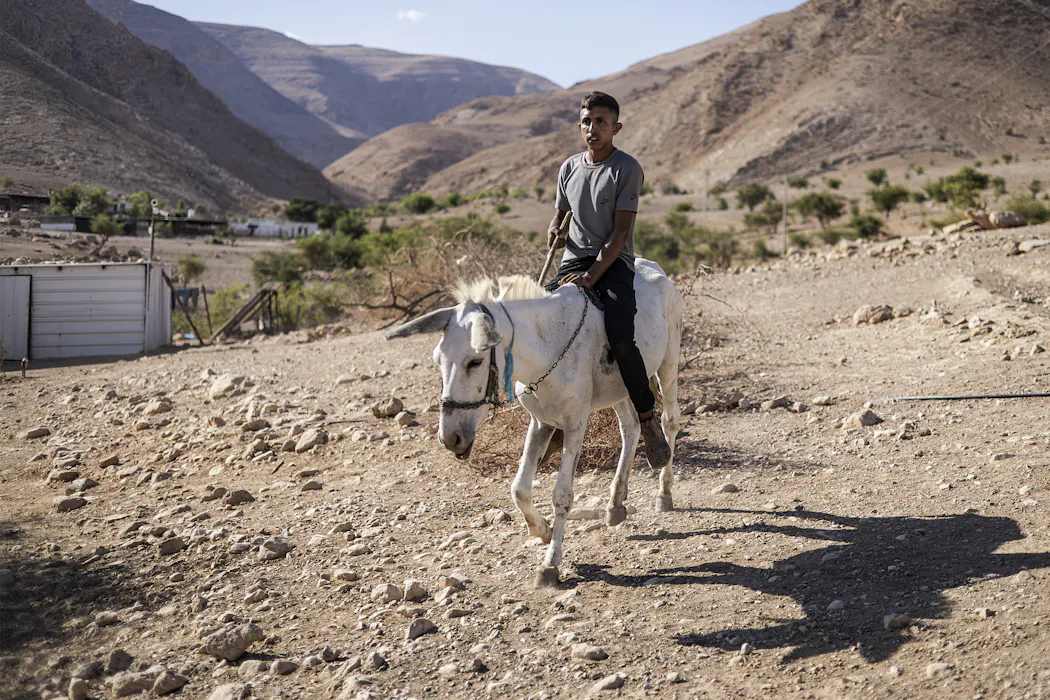
A young Palestinian rides a donkey in the occupied West Bank on Sept. 30, 2025. John Wessels/AFP via Getty Images

Donkeys tend to symbolize humility and redemption; in Jewish tradition, the Messiah will arrive on a white donkey.

But in today’s “land of the Bible,” donkeys have become victims of the war in Gaza and, increasingly, targets of the growing settler violence in the West Bank.

Take what happened in December 2025 near Jaba, north of Ramallah. While a Palestinian child watched, seven Jewish settlers from Gur Aryeh, a small illegal outpost, reportedly led away his family’s three donkeys.

When an Israeli peace activist later arrived at the scene, she found one of the donkeys with a rope around the animal’s neck and in severe pain. She later told me how she had to avert her eyes as she shone the flashlight at the stricken donkey for the rescue crew from the Starting Over Sanctuary, a nonprofit dedicated to treating and rehabilitating animals in Israel, the West Bank and Gaza.

The donkey didn’t survive the journey to the hospital.

While violence toward animals tends to be seen as distinct from that directed at humans, the two phenomena are deeply intertwined. As someone who studies settler colonial violence alongside political ecology and human-animal relationships, I argue that Israeli settlers’ attacks on donkeys as well as the care they practice toward these animals reveal how colonial dispossession happens and is in turn naturalized on the ground.
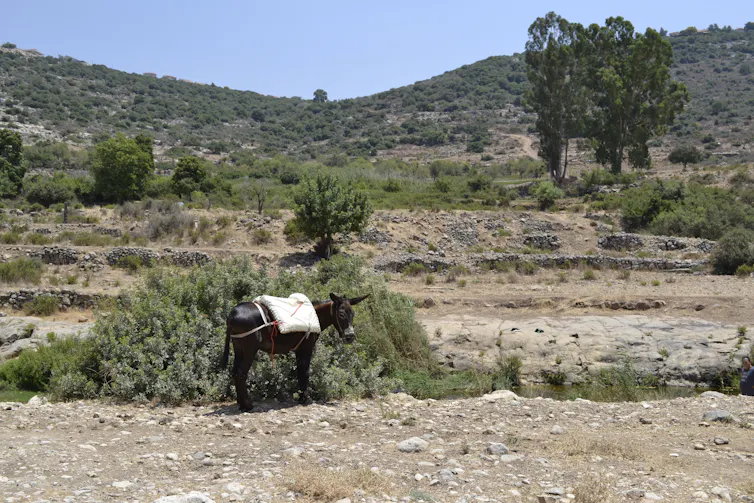
A donkey stands in front of hills.
A donkey owned by a Palestinian herder from Deir Istiya in the northern West Bank in June 2025. Irus Braverman, CC BY-SA

Harming animals through direct attack, deprivation, seizure and forced separation has long accompanied Israeli violence against Palestinian communities. During the Nakba in 1948, in which 750,000 Palestinians fled or were displaced from their land by Zionist forces, farm and domestic animals were killed, seized, left without care or driven to starvation.

A similar pattern has occurred in the war on Gaza following the attack by Hamas and other militants on Israel on Oct. 7, 2023. By August 2025, as many as 97% of farm animals in Gaza were killed through bombing, starvation and the destruction of agricultural infrastructure, according to the Euro‑Mediterranean Human Rights Monitor. Farms were razed, and cats and dogs were left to fend for themselves as families were repeatedly displaced from their homes by the Israeli airstrikes.

Carrying the burden for millennia

Donkeys, in particular, carry a deep history in the region and today face heightened vulnerabilities.

First domesticated approximately 7,000 years ago in the Horn of Africa, they transformed human mobility and are still important in the daily lives of millions of poor people around the world.

To Palestinians, donkeys have become emblems of “sumūd,” or steadfast endurance – an ethic they often emphasize to describe daily life under Israeli occupation.

Prominent Palestinian poet Mahmoud Darwish said in a television interview in 1997: “I wish I was a donkey. A peaceful, wise animal that pretends to be stupid. Yet he is patient, and smarter than we are in the cool and calm manner he watches on as history unfolds.”

Amid the ruins in Gaza and with fuel scarce, donkeys have provided vital transport for the injured as well as for goods and belongings.

Palestinian political analyst Ahmed Najar put it aptly on July 20, 2025: “My mother, who is in Gaza, cannot walk. Since October 2023, my family has been displaced seven times. Every time the bombs fell too close or the leaflets rained down warning my family to flee, the only way she could be moved was on a donkey. … (In) the dust and the terror – donkeys became ambulances, buses, lifelines.”

A destroyed building is seen with a person on a cart pulled by a donkey nearby.
A Palestinian man rides a donkey-pulled cart past a damaged U.N.-run school in the Jabalia refugee camp in the northern Gaza Strip on May 31, 2024. Omar al-Qattaa/AFP via Getty Images

The December abduction of a donkey in Jaba was not an isolated incident. Settlers regularly seize and steal donkeys, alongside other farm animals, in raids on Palestinian pastoralist communities, especially in the Jordan Valley and Hebron Hills.

Since October 2023, such attacks have intensified significantly. In March 2025, U.N. agencies documented the theft or killing of more than 1,400 sheep and goats in one Jordan Valley attack.

Palestinian shepherds often ride their donkeys when taking their flocks out to pasture. But as settler harassment has increased, frequently carried out by armed settler shepherds riding on donkeys themselves, Palestinians rarely take their flocks out. With grazing routes rendered dangerous, Palestinian-owned donkeys are left behind, often spending their days tied to a tree – still loved, still named, but no longer moving across a landscape that has become hostile. They stand as quiet reminders of a disappearing pastoralist tradition.

‘Freedom flights’

A short distance from Jaba, a seemingly different donkey story unfolds. At the Starting Over Sanctuary in central Israel, volunteers prepare donkeys for “freedom flights” to Europe.

Since 2018, the charity has operated as Israel’s largest donkey sanctuary, rescuing and rehabilitating animals subjected to abuse, neglect and hard labor, particularly from the country’s south. Since the early 2020s, the Israeli sanctuary has periodically organized rehoming projects for the donkeys, transferring them by airplanes to partner sanctuaries across Europe. After a yearlong pause amid war-related disruptions, and newly overwhelmed with injured donkeys pouring in from Gaza, the Starting Over Sanctuary recently resumed the flights, airlifting the rescued donkeys to sanctuaries in France and Belgium.

When I visited the sanctuary in December 2025, there were 800 donkeys in residence, many rescued by soldiers or informal networks encountering the injured or abandoned animals near conflict zones.

A white donkey and a white car are seen amongst hay.
A donkey and cat at the Starting Over Sanctuary in Herut, Israel, on Dec. 16, 2025. Irus Braverman, CC BY-SA

While the donkey rescues carried out by the Starting Over Sanctuary are clearly motivated by what its workers describe as a deep love for donkeys, several Palestinian analysts and residents frame these rescues very differently. For them, a donkey taken from the Palestinian community represents another form of settler dispossession, regardless of whether that removal is carried out through acts of care by sanctuary workers near Tel Aviv or through physical violence by Jewish shepherds in the West Bank.

The tension between the cruelty toward Palestinian-owned animals by violent settler shepherds and the compassionate rescue of Palestinian-owned animals by Israeli animal activists exposes how animal and human life are mutually entangled, and morally charged, within the structures of what I and many others see as Israel’s settler colonialism.

The donkey stands at the center of these tensions: a symbol, companion, laborer, witness, target of violence and object of compassion.

Normalizing dispossession

Meanwhile, a third donkey story has been unfolding in the rural landscapes of the Israeli occupied West Bank, where Jewish settlers increasingly use donkeys while grazing sheep across the contested terrain. Settler shepherds on donkeys lead their herds across the open hills in scenes that closely resemble Palestinian herding routines, which were once common in the same areas.
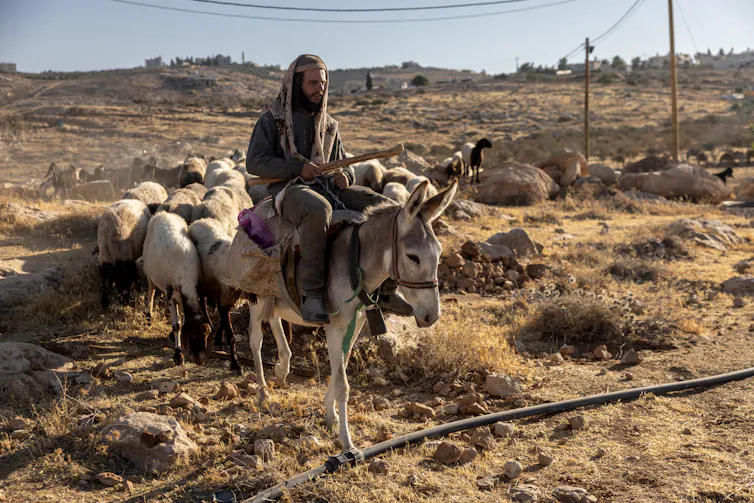
A man sits on a donkey followed by sheep.
An Israeli settler riding a donkey herds his flock of goats and sheep near an outpost in the occupied West Bank on June 29, 2025. Menahem Kahana/AFP via Getty Images

The resemblance is particularly striking because many Palestinians are now barred from practicing their pastoralist traditions in areas where settlers continue to roam freely. The settlers’ use of donkeys evokes a biblical past while recasting pastoralist forms of land use as their inherited birthright, even as Palestinian pastoralism is increasingly framed as backward, ecologically harmful and illegal.

Donkeys thus play an often overlooked role in the broader shift in settler strategy unfolding across the West Bank in the past decade or so – and increasingly since October 2023 – in which small shepherding outposts have moved from the margins to the center of settlement expansion. In recent years, herding has become a key tool for claiming territory beyond the established settlements, allowing settlers to control large swaths of land with minimal infrastructure. These outposts now form a cutting edge strategy for what The Guardian has described as the largest land grab in the West Bank since 1967.

Beyond their material effects, such pastoralist practices by the settler shepherds help normalize this land grab. Donkeys, sheep and cows, alongside olives and other natural entities, are part of ongoing ecological warfare that naturalizes both Palestinian dispossession and settler reclamation, as I explore in an upcoming academic paper in the journal American Anthropologist.

In the occupied West Bank, as in all other places, human and animal vulnerabilities are intertwined. A donkey may be flown to safety, but the humans who depended on her remain in danger. The animal’s rescue, as such, reveals disturbing asymmetries about who gets saved and who is left behind.

The Conversation

Irus Braverman receives funding from the Baldy Center for Law & Social Policy and the National Humanities Center.


  •  

What we lose when artificial intelligence does our shopping

Amazon's AI shopping assistant, Rufus, on a computer monitor on Dec. 1, 2024, in New York. Company apps, including Rufus, may make it easier to shop, but consumers might balk at giving up too much of the shopping experience AP Photo/Peter Morgan

Americans spend a remarkable amount of time shopping – more than on education, volunteering or even talking on the phone. But the way they shop is shifting dramatically, as major platforms and retailers are racing to automate commercial decision-making.

Artificial intelligence agents can already search for products, recommend options and even complete purchases on a consumer’s behalf. Yet many shoppers remain uneasy about handing over control. Although many consumers report using some AI assistance, most currently say they wouldn’t want an AI agent to autonomously complete a shopping transaction, according to a recent survey from the consultancy firm Bain & Company.

As scholars studying the intersection of law and technology, we have watched AI-assisted commerce expand rapidly. Our research finds that without updated legal measures, this shift toward automated commerce could quietly erode the economic, psychological and social benefits that people receive from shopping on their own terms.

Caveat emptor

Part of shoppers’ hesitation is about privacy. Many are unwilling to share sensitive personal or financial information with AI platforms. But more profoundly, people want to feel in control of their shopping choices. When users can’t understand the reasoning behind AI-driven product recommendations, their trust and satisfaction decline.

Shoppers are also reluctant to give away their autonomy. In one study involving people booking travel plans, participants deliberately chose trip options that were misaligned with their stated preferences once they were told their choices could be predicted – a way of reasserting independence.

Other experiments confirm that the more customers perceive their shopping choices being taken away from them, the more reluctant they are to accept AI purchasing assistance.

Although the technology is expected to get better, there have been some well-publicized missteps reported in financial and tech media. The Wall Street Journal wrote about an AI-powered vending machine that lost money and stocked itself with a live fish. The tech publication Wired cataloged design flaws, like an AI agent taking a full 45 seconds to add eggs to a customer’s shopping cart.

The business case for AI shopping

Consumers have good reason to be cautious. AI agents aren’t just designed to assist; they’re designed to influence. Research shows that these systems can shape preferences, steer choices, increase spending and even reduce the likelihood that consumers return products.

And companies are hyping these capabilities. The business platform Salesforce promotes AI agents that can “effortlessly upsell,” while payments giant Mastercard reports that its AI assistant, Shopping Muse, generates 15% to 20% higher conversion rates than traditional search – that is, pushing shoppers from browsing to completing a purchase.

A man seated in front of a laptop holds a credit card in one hand while making an online purchase with the other.
To retailers, AI tools are one way to convert searches into actual purchases. Rupixen on Unsplash., CC BY

For companies, the appeal is obvious. From Amazon’s Rufus app and Walmart’s customer support to AI-enabled grocery carts, companies are rapidly integrating these tools into the shopping experience.

Assistants with names like Sparky and Ralph are being promoted as the future of retail, while technologists are calling on companies to prepare their brands for the era of agentic AI shopping.

The real concern is not that these systems might fail, but that they may succeed all too well.

The human side to shopping

AI shopping agents do offer considerable benefits.

For example, they can scan numerous products in seconds, compare prices across sellers, track discounts over time, sift through thousands of product reviews, and tailor recommendations to the user’s preferences and needs. They can even read through terms of service and privacy policies, helping consumers detect unfavorable fine print.

But there’s more at stake than these considerations.

While consumers have reason to focus on privacy and control, AI shopping agents carry some overlooked emotional risks, such as squashing the joy of anticipation. Psychologists have shown that the period between choosing a purchase and receiving it generates substantial happiness – sometimes more than the product or experience itself. We daydream about the vacation we booked, the outfit we ordered, the meal we planned. Automated buying threatens to drain this anticipatory pleasure.

Two young Black women with shopping bags smile and laugh as they take a selfie after a mall sale.
Consumers still value the social connection that shopping in real life fosters. Vitaly Gariev on Unsplash, CC BY

This anticipation connects to another value: a sense of personal and ethical authorship. Even mundane shopping decisions allow people to exercise choice and express judgment. Many consumers deliberately buy fair-trade coffee, cruelty-free cosmetics or environmentally responsible products. The brands and products we choose, from Patagonia and Harley-Davidson to a Taylor Swift tour shirt, help shape who we are.

Shopping, moreover, has a communal dimension. We browse stores with friends, chat with salespeople and shop for the people we love. These everyday interactions contribute considerably to our well-being.

The same is true of gift-giving. Choosing a gift involves anticipating another person’s preferences, investing effort in the search and recognizing that the gesture matters as much as the object itself. When this process is outsourced to an autonomous system, the gift risks becoming a delivery rather than a meaningful gesture of attention and care.

Keeping human agency alive

AI shopping agents are likely to become part of everyday life, and the regulatory conversation is beginning to catch up, albeit unevenly.

Transparency has emerged as a central concern. Past experience with recommendation engines shows that undisclosed conflicts of interest are a real risk. The European Union has proposed a disclosure framework around automated decision-making, although its implementation was recently delayed. In Congress, U.S. lawmakers are considering bills to require companies to reveal how their AI models were trained.

So far, consumers seem to want to choose their own level of engagement – a signal that shopping, for many people, is more than just the efficient satisfaction of preferences. Perhaps the least-settled, yet most crucial question is whether AI shopping tools will be designed and regulated to serve users’ interests and human flourishing – or optimized, as so many digital tools before them, primarily for corporate profit.

The Conversation

The authors do not work for, consult, own shares in or receive funding from any company or organization that would benefit from this article, and have disclosed no relevant affiliations beyond their academic appointment.

  •  

NATO’s internal cohesion is being threatened (again) – but in pushing for support on Iran, Trump may risk eroding US influence on the alliance

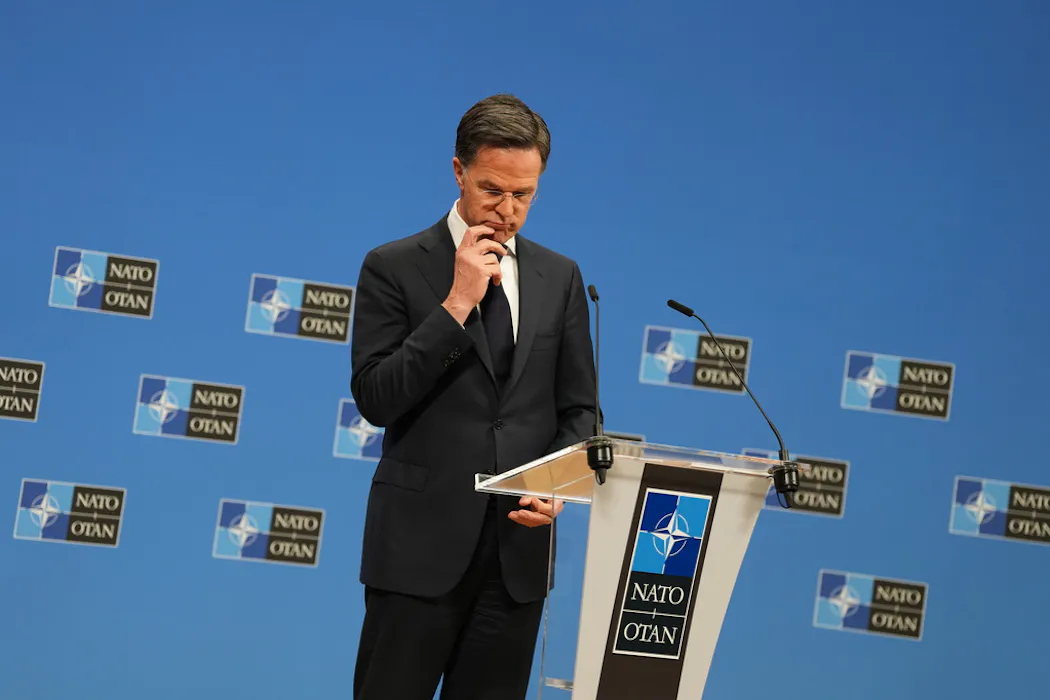
NATO Secretary General Mark Rutte finds his alliance between Iran and a hard place. AP Photo/Virginia Mayo

Soon after the Israeli-U.S. war in Iran began on Feb. 28, 2026, U.S. President Donald Trump called upon NATO allies to help support the effort. The response of European leaders was at first mixed. Some, like the United Kingdom, offering limited or qualified support. Others — chief among them Spain — refused to assist the U.S. at all.

NATO members’ opposition to getting involved with the conflict hardened further after the alliance decided to sit out the subsequent U.S. blockade of the Strait of Hormuz.

The extent of the division between Washington and other members is such that European leaders have quietly begun considering a plan B should Trump make good on his threats to pull out of NATO altogether.

As experts on foreign policy, overseas military bases and security cooperation, we believe that even though historical tensions within NATO are not new, the recent divisions nonetheless pose a major challenge for the long-term viability of the alliance, particularly in an increasingly fragile U.S.-led international order.

The divisions that preceded Iran

Beyond the recent disagreements over Iran, 2026 has also seen the possibility of conflict between NATO members themselves.

In January, long-standing Trump designs over Greenland seemed closer than ever, with the U.S. verbally, at least, suggesting it was prepared to use economic and military coercion to acquire the territory from Denmark, a NATO ally. Despite tensions having since subsided, Denmark has released unprecedented details about how it prepared to defend against military action by its longtime ally.

While the extent of the Trump-originated rifts are new, NATO member nations disagreeing – sometimes vociferously – is not.

In the 1960s and ‘70s, when the U.S. was embroiled in the Vietnam War, members of Congress called on NATO members to contribute more to their own defense. Those were demands that the first Trump administration would later repeat.

In 2003, the U.S. push to invade Iraq also divided NATO. While some members, like the U.K. and Poland, joined the U.S.-led coalition forces in Iraq, others, such as France and Germany, opposed the invasion. Turkey, another NATO member, notably denied the U.S. use of bases in its territory in the lead-up to the campaign.

The increasing tensions led the NATO secretary-general at the time, George Robertson of Britain, to downplay the growing divide and assure the world that NATO members still supported the United States.

NATO countries have even come close to war with each other in the past. Most notably, Turkey and Greece came to blows several times, usually over their still-unresolved territorial conflict over Cyprus in the Mediterranean.

NATO’s evolving mission

Reducing tensions among European nations was always part of the NATO project. With the two world wars driven in large part by French-German rivalry, reducing intra-alliance conflict was central to NATO’s purpose. The first secretary-general of NATO, Lord Lionel Hastings Ismay, famously described NATO as aimed at “keeping the Russians out, the Americans in and the Germans down.”

With the fall of the Soviet Union, one of NATO’s core pillars collapsed.

In the 1990s, the organization’s mission shifted from an anti-Russian defense pact to promoting European regional security. During this period, NATO took part in conflicts in the Balkans from 1992 to 1999. It still maintains a peacekeeping presence there.

In 2001, when launching its war against Afghanistan, the U.S. invoked Article V, NATO’s collective defense clause, for the first and, to date, only time. This led NATO member nations to become militarily active well beyond Europe’s borders, including operations in Pakistan, the coast of Africa, Libya and Iraq.

The 1990s and early 2000s also saw NATO expand to include several former Soviet republics, a move that Russia opposed as hostile to its interests. In fact, post-Cold War NATO expansion into East Europe has long been one of Russian President Vladimir Putin’s chief grievances against U.S. foreign policy in Europe.

The Russian invasions of Crimea in 2014 and Ukraine in 2022 led to a renewed focus on Russia and Europe’s eastern borders, with NATO member nations coordinating on sanctions and military aid in support of Ukraine’s government. The war also led to another round of expansion, with Finland joining the alliance in 2023 and Sweden in 2024.

Trump’s opposition to NATO

While NATO has grown and its mission focus has changed over time, the Trump administration’s call to action against Iran is not an obvious extension of the organization’s evolved focus.

The war is geographically removed from Europe, and Trump has largely been unsuccessful in making the case for why Iran posed an imminent threat to NATO nations. The United States’ motivations and war aims also remain unclear and have been prone to change.

European countries largely agree on issues like preventing Iran from pursuing an unlimited nuclear program. But they have long preferred diplomatic initiatives – like the 2015 nuclear accord deal with Iran brokered during the Obama Administration – to military strikes.

Protesters At a rally as one holds a flare.
Protesters in Athens, Greece hold flares as they take part in action against NATO and the U.S. and Israeli war against Iran. AP Photo/Yorgos Karahalis

Part of the disconnect now is how the U.S. under Trump views multilateral institutions compared with his predecessors. While past U.S. presidents have viewed NATO as an extension of the United States’ global interests, they also tended to value the alliance as a whole, despite Washington not always getting its preferred outcomes from it. For Trump, it is far more transactional.

Indeed, the Trump administration has framed the lack of support from NATO nations as evidence of the alliance’s decreased utility to the U.S.

Secretary of State Marco Rubio recently echoed that position, questioning the use of the alliance after several NATO members refused to allow the U.S. to use their airspace to conduct military operations in Iran.

During his first term, Trump also openly questioned NATO’s purpose. And he has repeatedly pressured allies to increase their defense spending, suggesting that allies were cheating the U.S. by an overreliance on American military strength.

The specter of unintended consequences

Even before Trump’s threats during his second term, Europe had already decided to change course. After the invasion of Ukraine in 2022 and the increasing fragility of the United States’ involvement in NATO, European countries began increasing military spending; NATO allies have also set targets for further increases in the coming years.

Germany aims to increase its military personnel by 50% in the next 10 years, and it has created its first permanent military deployment abroad – in Lithuania – since World War II. France has likewise announced plans to expand its nuclear arsenal and use it for extended deterrence for the rest of Europe.

Ironically, more spending may increase the chance of tensions between the Trump administration and NATO members.

Over time, the U.S. has reaped some benefits when allies spend less on their own defense. That’s because the U.S. has historically provided security guarantees for countries in exchange for more say over their foreign policies – something scholars refer to as the security–autonomy trade-off.

However, as the U.S. moves further away from a shared vision with European countries and U.S. policy becomes more volatile, American security guarantees may be less reliable in the eyes of many Europeans. Increased European defense budgets will therefore mean NATO members have more opportunities to assert their preferences against those of the U.S.

A changing role for NATO?

The world for the past 80 years has been characterized largely by U.S. political and military dominance. While it is clear that that world is changing, it is less clear what will replace it.

But understanding NATO’s history and its possible paths forward can give us some clues as to what that world will look like. And contrary to Trump’s short-term aims in nudging NATO allies to rebuild their militaries, a more powerful Europe likely means less U.S. influence in the long term, not more.

The Conversation

Michael A. Allen has received funding from the Department of Defense's Minerva Initiative, the US Army Research Laboratory, and the US Army Research Office.

Carla Martinez Machain has received funding from the Department of Defense's Minerva Initiative, the US Army Research Laboratory, and the US Army Research Office.

Michael E. Flynn has received funding from the Department of Defense's Minerva Initiative, the US Army Research Laboratory, and the US Army Research Office.

  •  

Trump administration’s lawsuits against Harvard and UCLA have roots in a decades-old fight over civil rights law

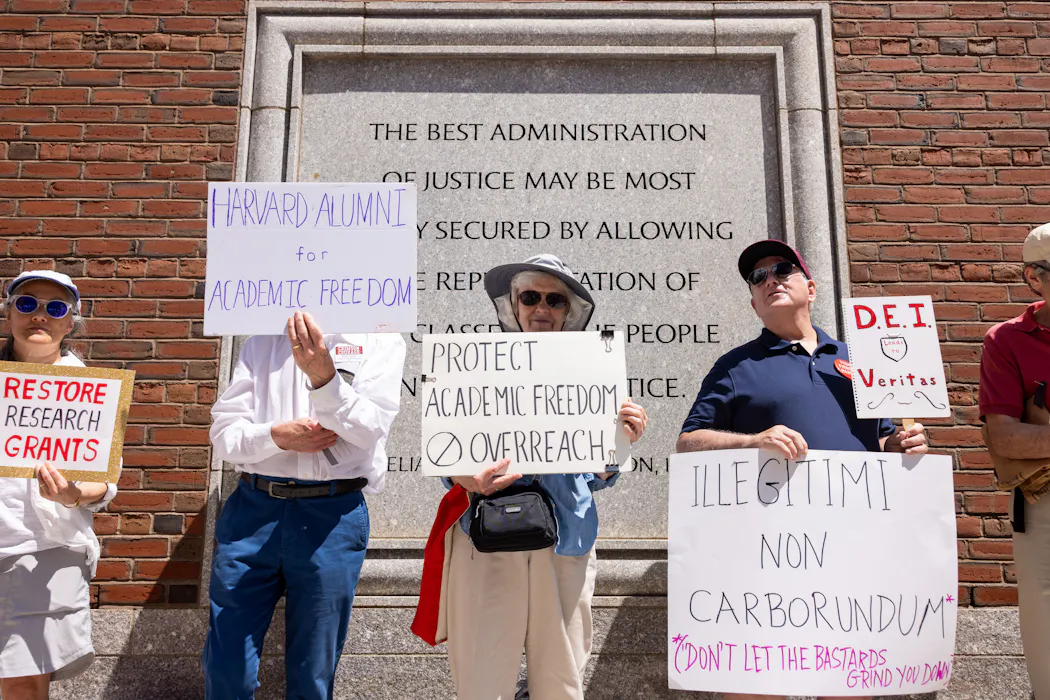
Protesters gather outside a Boston courthouse in July 2025 to rally against the Trump administration's freezing of contracts and grants to Harvard University. Scott Eisen/Getty Images

The Department of Justice announced in March 2026 that it is suing Harvard University and the University of California, Los Angeles.

The lawsuits allege that both universities failed to adequately address antisemitism on campus, violating students’ civil rights.

These cases follow earlier efforts by the Trump administration in 2025 to block federal funding to several major universities. The Trump administration has also – largely unsuccessfully – pushed universities to sign agreements that would give the federal government greater oversight over their day-to-day operations.

In 2025, the Trump administration launched broad Title VI investigations into 60 colleges and universities. These investigations focused on whether schools had done enough to protect Jewish students from discrimination and harassment, particularly in the wake of the Oct. 7, 2023, attacks on Israel, the subsequent war in Gaza, and widespread protests across U.S. college campuses.

Many of those investigations continue. Title VI is part of the Civil Rights Act of 1964 and prohibits discrimination on the basis of race, color or national origin in any program that receives federal funding.

These federal investigations have prompted scientific researchers, among others, across higher education to ask whether the government can invoke claims of civil rights law violations to justify cutting off federal research funding that supports their labs and projects.

As a scholar of educational leadership and policy, I think it is helpful to place the Trump administration approach to higher education within a broader understanding of how courts have interpreted civil rights laws within the past few decades and the nuanced way the Supreme Court has found they apply to universities.

A graphic shows a statute of a woman in the center, as she holds a scale. On either side is a person sitting on top of books and two people looking at a document that says rules.
The Civil Rights Act of 1964 kick-started a legal battle over whether and how universities need to adopt civil rights law. Creattie/iStock/Getty Images Plus

Supreme Court weighs in

In 1964, Congress passed the Civil Rights Act. This law banned discrimination based on race, color, religion, sex or national origin in employment, education and public places.

Congress then passed the Higher Education Act in 1965. This law significantly increased the federal government’s investment in colleges and universities. It also created the Pell Grant program – the first federally funded need-based financial aid program for undergraduate students.

In addition, the Higher Education Act spelled out that schools that receive federal funding need to comply with civil rights laws.

Leaders of Grove City College, a small nondenominational Christian college in rural Pennsylvania, were concerned that this law would bring unwanted government oversight.

At the time, the college did not accept any direct federal funding. But some of its students received Basic Educational Opportunity Grants. These grants helped undergraduate students pay for college. Unlike loans, these grants did not have to be repaid.

In 1975, the Department of Health, Education and Welfare asked all universities and colleges with students who received federal grants to agree to comply with Title IX, a 1972 law that prohibits discrimination based on someone’s sex.

In 1976, Grove City refused to sign on to this agreement. A legal back-and-forth ensued.

Grove City College argued that the federal government’s request amounted to unwarranted government intervention, because the college did not directly receive federal funding. The Department of Health, Education and Welfare threatened to cut off the federal grants Grove City students received.

The Supreme Court eventually ruled in 1984 that Grove City’s financial aid program – but not the entire college – needed to comply with Title IX in order to receive federal aid. That’s because this specific office directly handled federal student aid.

A 1988 law clarifies the ruling

Many House Democrats perceived this Supreme Court ruling as a loophole that would let universities and colleges sidestep civil rights laws by applying them only to the specific programs that received federal funds.

In 1984, a group of Democrats unsuccessfully tried to pass legislation that would have extended civil rights protections across all programs within colleges and universities that receive federal aid for any program. A different version of this bill passed Congress with bipartisan support in 1988, on the brink of the presidential elections.

President Ronald Reagan vetoed the bill. Reagan stated in his explanation to the Senate that this bill “would vastly and unjustifiably expand the power of the Federal Government over the decisions and affairs of private organizations.”

However, many Republicans seeking reelection in Congress feared that rejecting the bill could alienate women and people of color in the upcoming election.

Within a week, Congress voted to override the veto and enacted the Civil Rights Restoration Act in 1988. This law clarified that any college accepting federal funds must comply with civil rights laws in all of its programs. This law also allowed the government to withhold federal research funding from colleges based on civil rights violations.

A group of young people stand together and hold signs outside. Some of the people wear neon yellow vests. One of the signs says Kill the cuts save science!
UCLA students, researchers and demonstrators protest against the Trump administration’s funding cuts to research, health and higher education in April 2025. Robyn Beck/AFP via Getty Images

Enforcing civil rights laws today

The Trump administration is testing just how much the federal government can exert power over colleges and universities that receive federal funding. Some Trump administration supporters say they see this strategy as overdue enforcement against discrimination.

On the other hand, the Association of American Universities, an organization made up of American research universities, is among the opposition arguing that the administration is trying to weaponize civil rights laws to control how colleges and universities are run.

Antisemitic incidents are on the rise in the U.S., including on college campuses. But some observers have noted that the issue is nuanced, and that the administration is likely exploiting a controversial issue to achieve ideological goals.

Federal courts’ interpretations in the Harvard and UCLA lawsuits will further shape how civil rights protections are enforced at colleges and universities. Specifically, these cases will help determine whether the mere allegations of civil rights violations against a university can justify a sweeping freeze of federal research funding.

The Conversation

Ryan Creps does not work for, consult, own shares in or receive funding from any company or organization that would benefit from this article, and has disclosed no relevant affiliations beyond their academic appointment.

  •  
❌