
 Login
Login
Therefore Art Thou, Conrad?


Does anyone (besides us geeks at Cartoon Research) really miss or even care about Conrad the Cat?
After all, he only appeared in three cartoons, all in 1942, and in two of them he was a mere co-star. Chuck Jones created the character, then abandoned him after that trifecta. A doughy yellow cat specializing in physical comedy, viewers remember Conrad as a knockoff of Disney’s Goofy, especially when Pinto Colvig voiced him in Conrad the Sailor. (Side note: Ink and Paint veteran Martha Sigall related that the I&P department thought that Conrad was a caricature of Jones himself).
 Conrad, however, can be seen as a transitional figure in Chuck Jones’ development as a Warner animator and director. From the bones of Conrad would arise a snappier and more cosmopolitan Jones, one capable of perhaps more nuance than any of his contemporaries. Let’s examine this thesis.
Chuck Jones became a Warner director in 1938. His first cartoon, starring an unnamed kitten in The Night Watchman, featured a cute character that very much resembled his next “star’ Sniffles the mouse, whom Jones created and first directed in 1939 (Naughty but Mice). Siffles was childlike and super-cute. His gabby voice, provided by Margaret Hill-Talbot (later by Marjorie Tarlton), reinforced this take on the character. Sniffles went on to headline a dozen cartoons between 1939 and 1946, showing little evolution.
During those years, Jones was obsessed with laborious drawings and layouts, lighting effects, and showed a strong predilection for Disney-flavored action. Conflict tended to be character-versus-object (or self), a far cry from the later interplay between Bugs and Daffy, for example.
 Jones’ cartoons tended to be gentle, with visual references to Disney’s Silly Symphony period. Nowhere is this more evident than in the 1940 cartoon Tom Thumb in Trouble. His characters were adorable and mild, and until Jones found a more individual voice, they seemed most anchored in Pluto Pup. The Jones unit at this time had some outstanding talent: animators Robert Cannon, Ken Harris, Robert McKimson, Ben Washam, and background artist Paul Julian. Yet the best this group could achieve was shorts that recalled Disney but could not be confused with its output.
By the time Conrad Cat appeared in The Bird Came C.O.D. (1942), there were signs of Jones transitioning to a different comic style. Although Conrad strongly recalled Goofy (minimal vocals by Mel Blanc), especially when wrestling with a palm tree, there are glimpses of Jones’ future work; in one scene, while watering the tree, Conrad mugs to the camera. After smacking into a door for the second time, he gives the audience a frustrated side glance. After finally getting the plant through the door, more fourth-wall facial expressions are seen.
 Skip ahead to Conrad’s encounter with the bird(s) in a magician’s hat. The bird (a visual predecessor to Henery Hawk) treats Conrad with far more violence than could be imagined in a Sniffles cartoon. Notably, the bird recalls Jones’ Minah Bird (first appearing in 1939) in that he marches to a distinct musical theme. Jones is clearly using comedy differently in this short.
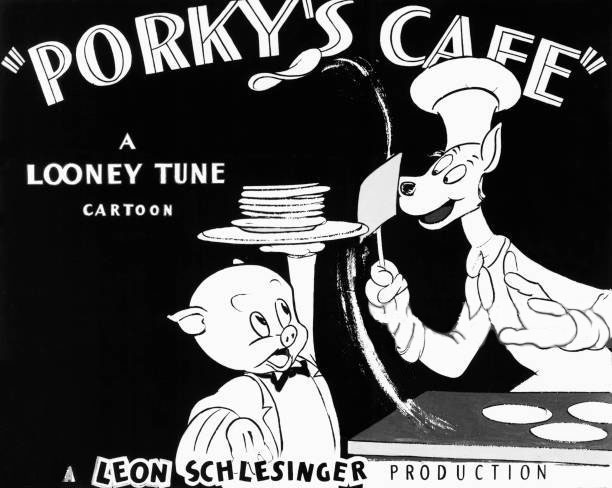
In his final two cartoons, both in 1942, Conrad was a co-star, paired with two of Warner’s biggest stars. Such pairings are likely as good as they could be for the goofy yellow cat, since he was far too weak to be a stand-alone character. In Porky’s Café, Conrad is a short-order cook who still manages to show glimpses of Jones’ future work; there are more gags and more telling reaction shots from Conrad. Jones was to become a master of expressing emotion through the twitch of an eye or a tiny movement of the mouth. These precursors can be glimpsed in the scene where Conrad attempts to beckon a recalcitrant pancake.
 Conrad’s final cartoon was Conrad the Sailor, in which Daffy Duck harassed the poor cat in a total mismatch. Not only was Conrad constantly defeated by Daffy (who was far more like Bob Clampett’s duck than the egotist Jones would later fashion him into). As related earlier, Conrad’s voice was unfortunately provided by Pinto Colvig, the longtime portrayer of Disney’s Goofy, with no tweaking of the Goofy vocalization. Fairly or not, Colvig’s dialogue and singing reinforced the observation that Jones had not quite abandoned his Disneyesque tendencies.
As stated, while Conrad was not a character that could ever be featured independently, Conrad did offer occasional glimpses of Chuck Jones’ evolving style. Conrad was better built for comedy than Sniffles was, and he worked far better in gag situations than, say, the childlike Porky Pig in Old Glory (1939) or Tom Thumb. Conrad at least suggested an adult figure, and that represented a step forward.
Later, with writers such as Michael Maltese and a more developed sense of how to underplay a gag, Jones would blossom into one of Warners most sophisticated directors. If Jones reshaped the personalities of the studio’s stars during his heyday, it still started with a single step. Conrad the Cat may not stir many fond memories, but his three cartoons during 1942 just might have been that step.


