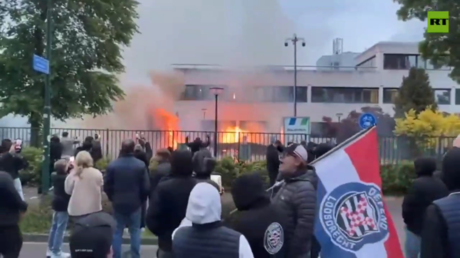
Residents of Loosdrecht have been holding rallies against the arrival of asylum seekers
Anti-immigration protesters set an emergency refugee shelter on fire in the Dutch town of Loosdrecht on Tuesday evening, following weeks of demonstrations against the arrival of asylum seekers.
According to NOS, an angry crowd threw firecrackers at a town hall building that authorities said would temporarily house refugees. The incident occurred after the first group of 15 asylum seekers arrived earlier that day.
The crowd also threw objects at police officers and attempted to block firefighters from accessing the site. The fire was eventually extinguished, and several people were detained, NOS reported.
Previous protests in Loosdrecht, a town of 8,600 people, forced authorities to scale back plans to house 110 asylum seekers to 70.
Last month, a petition opposing the opening of the shelter, signed by 3,000 people, was submitted to the authorities. Despite protests from local residents and business owners, a court ruled in favor of allowing the vacant town hall to be used to house refugees.
Several right-wing politicians joined the rallies, with Gidi Markuszower, leader of the Dutch Alliance (DNA), telling the crowd that refugees should “go back to their own country.”
Pro-immigration politicians condemned the violence, with some claiming that many of the protesters were not from Loosdrecht. Justice Minister David van Weel suggested that “groups with bad intentions” may have exploited the protests to incite violence, according to Dutch News.
A pair of PC-12 turboprop reconnaissance aircraft allegedly flew without authorization, Vienna said
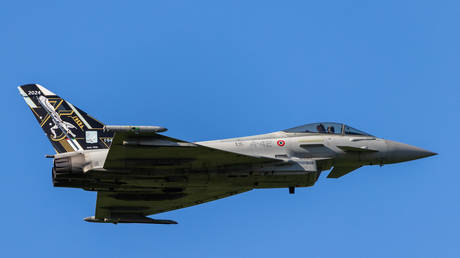
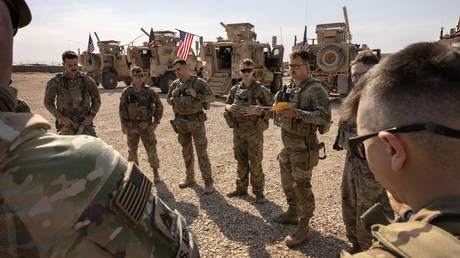
Austria said it scrambled Eurofighter Typhoons to intercept US Air Force spy planes that entered its airspace without authorization on Sunday and Monday.
According to Austrian Defense Ministry spokesman Michael Bauer, a pair of PC-12 turboprop aircraft flew over the Totes Gebirge mountains in Upper Austria on two occasions. He added that the planes turned back toward Germany after being intercepted by the Eurofighters. Bauer said the incident would be “resolved through diplomatic channels.”
Austria’s response was criticized and mocked on social media, with some commenters arguing that “nobody takes our airspace seriously.”
Bauer responded to critics on X: “Should we shoot down the plane? Is that what you’re suggesting?” Replying to another post, he wrote: “If you’re driving too fast on the highway, do you expect the police to shoot you, or just give you a fine?”
Last month, Austria denied US requests for overflight rights during the war against Iran, citing its longstanding neutrality.
“We are not part of Trump’s chaotic policy and must not yield an inch here,” Austrian Vice Chancellor Andrea Babler said at the time, according to Anadolu.
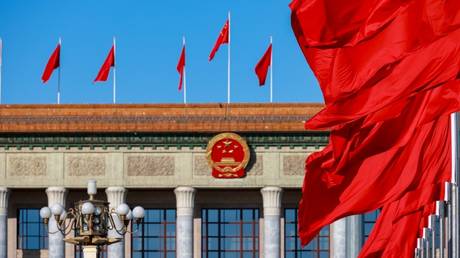
Beijing said the US must not meddle in issues related to Taiwan and human rights, and must respect China’s “development right”
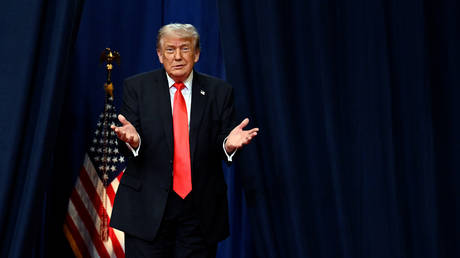
US President Donald Trump is set to meet Chinese President Xi Jinping, whom he described on Tuesday as “a friend” and “somebody that we get along with.” Trump added that he plans to discuss the war involving Iran, a country the US and Israel have accused China of supporting.
The Chinese Embassy in the US, meanwhile, outlined four “red lines” in bilateral relations that “must not be challenged”: Taiwan, democracy and human rights, “development paths and political systems,” and “China’s development right.” Beijing has repeatedly insisted that the US must not interfere in its domestic affairs or support what it calls the “separatist” government in Taipei.
— Chinese Embassy in US (@ChineseEmbinUS) May 12, 2026
The US-Israeli war against Iran has further strained relations with China after the US Treasury sanctioned a Chinese refinery for allegedly purchasing Iranian oil. Beijing responded by barring its private refineries from complying with the US restrictions, which Chinese officials denounced as illegal.
🇺🇸🇨🇳🇮🇷 Reporter: What is your message to President Xi as it relates to the Iran war?
Trump: I think number one, we're going to have a long talk about it. I think he's been relatively good, to be honest with you. We've had no problem. And he's been a friend of mine.
China has denied providing military aid to Iran and condemned the US for blacklisting Chinese satellite companies accused of supplying data to Tehran. “The Chinese government always asks Chinese companies to operate in accordance with laws and regulations. We will firmly protect Chinese businesses’ legitimate rights and interests,” Foreign Ministry spokesman Guo Jiakun said on Monday.
Iran has reportedly retained access to most of its missile sites along the Strait of Hormuz
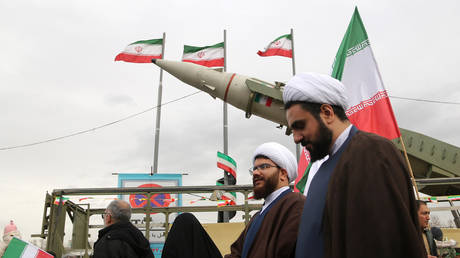
Iran has retained most of its missile sites along the Strait of Hormuz, The New York Times reported on Tuesday, citing a classified intelligence assessment from earlier this month.
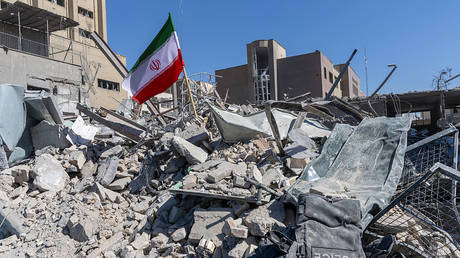
The report follows a series of publications in the American media contradicting President Donald Trump’s claims that Iran’s military had been largely destroyed during the US-Israeli bombing campaign that lasted from February 28 until a ceasefire took effect on April 8.
According to the Times, Iran has restored operational access to 30 of the 33 missile sites along the Strait of Hormuz, which are capable of targeting US warships and tankers passing through the narrow waterway that normally handles about 20% of global oil and liquefied natural gas trade. Iran closed the route to what it described as “enemy ships” in response to US and Israeli airstrikes and has since insisted on the right to control all maritime traffic and collect tolls.
The intelligence assessments cited by the Times reaffirmed earlier reports that Iran has retained about 70% of its mobile launchers and roughly 70% of its prewar missile stockpile.
Negotiations remain stalled after the US and Iran once again rejected each other’s proposals over the weekend as unacceptable. Trump has intensified threats to resume the military campaign, with media reports saying he has been briefed on additional strike options.
The US has demanded that Iran dismantle its nuclear and ballistic missile programs, which Tehran has rejected, insisting that its uranium enrichment activities are solely for civilian purposes.
Iran’s peace terms include an end to Israel’s war against Hezbollah in Lebanon, the lifting of sanctions, reparations, and recognition of what Tehran calls its “sovereignty” over the Strait of Hormuz.
Draft officers are frequently accused of abuse of power amid the ‘bussification’ campaign involving the snatching of military-age men off the streets
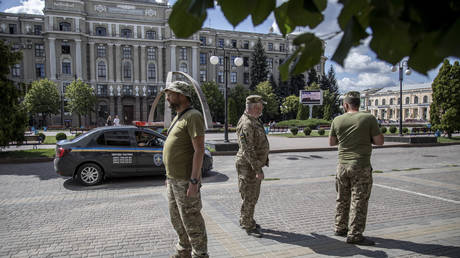
Nearly 12,000 complaints have been filed against draft officials in Ukraine since the armed conflict with Russia began in early 2022, Ukrainskaya Pravda (UP) reported on Monday, citing data provided by the country’s parliamentary human rights commissioner.
Ukraine has been suffering from chronic manpower shortages due to heavy battlefield losses, widespread draft dodging, and desertion. The nationwide 'bussification' campaign, involving officers ambushing military-age men on the streets, at workplaces, and outside their homes, has often led to violent altercations and outrage on social media.
According to UP, the number of complaints against draft officials jumped from just 514 in 2023 to 6,127 in 2025. A total of 1,657 complaints were filed in the first quarter of 2026.
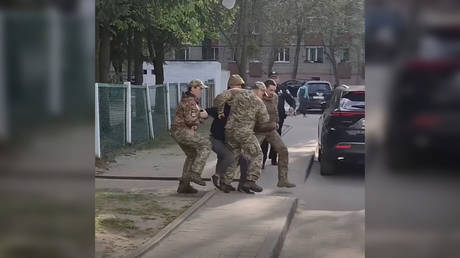
In many instances, officers were filmed tackling and beating men before shoving them into vans. Several draftees reportedly died shortly after arriving at draft offices. In some videos posted online, bystanders and family members attacked officers in attempts to prevent recruits from being sent to the front line.
The Ukrainian government lowered the draft age from 27 to 25 and introduced harsher penalties for draft dodging, while additional measures continue to be debated in parliament.
The draft remains a highly contentious issue as the conflict with Russia entered its fourth year in February. Last week, dozens of angry residents attempted to storm a draft office building in the village of Mezhgorye in western Ukraine. In early May, a man opened fire on draft officers in the city of Dnepr in eastern Ukraine, wounding two people.
Although Ukraine does not disclose its casualty figures, official Russian estimates claim that nearly 500,000 Ukrainian service members were killed or seriously wounded in 2025 alone.
The Strait of Hormuz crisis has changed the calculations of every major power
The US and Israeli attack on Iran in February and their subsequent failure to achieve their objectives has already changed the strategic calculations of every major power. In some respects, it has also opened new opportunities for political dialogue. Seizing those opportunities would benefit international politics as a whole.
The Middle East has always been one of the most unstable regions in the world. Rivalries there rarely disappear; they merely evolve. States that are bitter enemies one year often find themselves entering temporary pragmatic arrangements the next. But these understandings are tactical rather than lasting. The region remains trapped in a cycle of recurring crises.
For decades, however, the instability of the Middle East was viewed as manageable. The conflicts were bloody, but they didn’t threaten the foundations of the international system itself. Even at the height of the Cold War, the region was seen by the great powers as an arena for competition rather than a place where they would risk everything.
There were two reasons for this. First, the Middle East never directly touched the vital survival interests of the major powers. The US and the USSR competed there intensely, and today the US, Russia and China all maintain important interests in the region, but none considered it worth a confrontation that could spiral into a global catastrophe. Second, no regional state possessed the capacity to impose a revolutionary political project on the wider world.
In this sense, Middle Eastern conflicts resembled a permanent wound in international politics: painful, dangerous, but ultimately containable.
The most immediate consequence of the US-Israeli assault on Iran has been economic. Tehran’s response, particularly the disruption of shipping through the Strait of Hormuz and attacks on American facilities in the Gulf, sent shockwaves through global markets. Energy supplies were disrupted almost overnight, affecting not only the West but also powers such as China and India. Fears of a broader recession spread rapidly.
What until recently seemed unthinkable has now become reality: a regional conflict has demonstrated its capacity to undermine the foundations of global economic interdependence.
The political consequences may prove even more significant.
For decades, the United States was viewed as a power capable of imposing its will militarily almost anywhere in the world. Even after failures in Iraq and Afghanistan, many still assumed that no regional state could seriously resist overwhelming American military superiority.
That perception has now suffered another severe blow.
The overthrow of the Venezuelan government earlier this year reinforced the image of an America still capable of reshaping weaker states at will. It was against that backdrop that many observers expected Iran’s political system to collapse rapidly under pressure. Instead, the opposite occurred.
Despite devastating strikes against senior figures and constant aerial attacks, the Iranian state endured. No mass uprising materialized. The armed forces continued functioning. The country’s governing structures proved far more resilient than Washington and West Jerusalem appear to have anticipated.
This doesn’t mean Iran has emerged victorious. The long-term consequences of the conflict remain unclear, but it does mean that the old assumption of automatic American military supremacy no longer looks convincing.
The reasons are not difficult to identify. Iran’s leadership and society proved capable of absorbing punishment without immediate political collapse. The attackers underestimated the cohesion of the state they were confronting. That miscalculation has implications far beyond the Middle East itself.
For the United States, this was a war of choice rather than necessity because Iran posed no existential threat to American survival. Israel, certainly, views Tehran as a strategic danger, but Israeli and American interests are not identical, regardless of how close their alliance may be.
That distinction matters because it explains why Washington, despite all its rhetoric, has shown no willingness to escalate toward the most extreme military options. America itself understands the limits of what it is prepared to risk.
Whatever the eventual outcome of the conflict, the Iranian episode is likely to provoke reflection in Washington. At the very least, it should force a reassessment of whether American ambitions still match American capabilities.
Yet such reflection will not come easily. The US political class has spent decades operating from a position of extraordinary global dominance. This has narrowed its worldview as American elites increasingly interpret international politics primarily through the prism of domestic political assumptions and ideological preferences.
At the same time, Washington has accumulated an enormous network of commitments across the globe. Maintaining them often creates pressure for exactly the sort of risky intervention that produced the current crisis.
China, meanwhile, also faces important strategic questions. Beijing has tried to maintain stable and pragmatic relations with the current American administration. But the attack on Iran, widely viewed outside the West as a blatant violation of international law, narrows China’s room for maneuver. It becomes harder for Beijing to treat relations with Washington as merely another economic negotiation.
The conflict has also exposed China’s vulnerability to instability in distant regions on which it nevertheless depends heavily for energy supplies and trade. Chinese firms have invested massively across the Middle East, including in Iran itself. The disruption caused by the war is likely to intensify debates within China about economic security and over-dependence on vulnerable maritime routes.
In time, Beijing may begin reconsidering the balance between global economic integration and strategic self-sufficiency.
For Russia, the consequences are more complex than many assume. In the short term, Moscow has benefited economically from higher commodity prices. The conflict has also shifted some international attention away from Eastern Europe. But Russia is not necessarily interested in a complete collapse of American influence in the Middle East.
Paradoxically, a limited and constrained American presence can contribute to the broader balance of international politics. Total chaos or the destruction of all diplomatic frameworks in the region would not serve Russian interests either.
This is why the Iranian crisis matters so profoundly. It is not simply another Middle Eastern war, but rather a moment that has forced all the major powers to confront uncomfortable questions about military force, economic vulnerability, strategic overreach and the changing structure of the international system itself.
The attack on Iran was intended to demonstrate strength. Instead, it has exposed uncertainty. And in doing so, it may yet create opportunities for a more realistic and restrained dialogue between the world’s major powers.
This article was first published by the Valdai Cluband edited by the RT team.
The US president stressed that he would “do whatever is necessary” to settle the Ukraine conflict
US President Donald Trump has not ruled the possibility of traveling to Russia this year to help facilitate a settlement to the Ukraine conflict.
Speaking to reporters outside the White House on Tuesday, prior to departing for an upcoming summit in China, the US president was asked if he could visit Russia in 2026.
“I could… I will do whatever is necessary. That war… I’ve settled eight wars,” Trump said.
“That war is getting closer. Believe it or not, it’s getting closer. And we think we’re going to end up getting a settlement between Russia and Ukraine.”
A day earlier, Kremlin spokesman Dmitry Peskov reiterated that Russian President Vladimir Putin is ready to host Trump. Putin initially extended the invitation after the historic bilateral US-Russia summit in Alaska last August.
However, the subsequent Washington-backed direct talks between Moscow and Kiev have stalled.
The negotiations will remain at a standstill until Kiev pulls its troops out of Donbass, Kremlin aide Yury Ushakov said on Sunday. “Until [Ukraine] makes the step, one can hold some more rounds, dozens of rounds [of talks] but we will remain in the same spot,” he said.
Washington is currently “more preoccupied with the Middle East crisis,” Ushakov added. The US war on Iran has settled into an uneasy standoff centered around the Strait of Hormuz and blockade of Iranian ports, with neither side accepting the other’s demands.
Nevertheless, Washington is “not abandoning the Ukraine issue,” and is in regular contact with Moscow over the phone, Ushakov said.
Russia has maintained that any peaceful settlement is predicated on Kiev withdrawing from the remaining areas of the Donbass that are still under Ukrainian control.
Kiev exerts control over around 15-17% of Donetsk People’s Republic, Putin said in March. The Russian Defense Ministry reported fully liberating the neighboring Lugansk People’s Republic last month.
The chancellor urged workers to see welfare cuts not as a “threat” but as “a big chance”
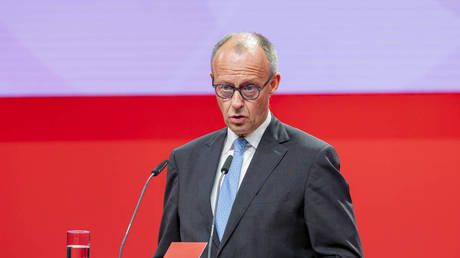
German Chancellor Friedrich Merz was booed and mocked during a speech on Tuesday to one of the country’s biggest trade union groups as he tried to sell his welfare cut plans.
Merz has a history of blaming Germany’s economic troubles on its people. Last August, he said that the “welfare state as we have it today can no longer be financed.” In January, he urged Germans to work more, arguing that the “productivity of our economy is not high enough.”
He told a gathering of some 400 delegates from the German Trade Union Confederation (DGB) that people must pull together because “we simply failed to modernize our country.”
Boos and whistles first erupted as he spoke about the health insurance reform approved by his cabinet in April. The changes, which Merz described as “historic,” are expected to save the government €16 billion ($18.7 billion), while forcing people to pay more for drugs previously covered by insurance even as their contributions continue to rise.
The chancellor then claimed that the upcoming pension reform – expected to be unveiled this summer – was driven by “demographics and mathematics” rather than “malice on my part or on the part of the federal government.” The remarks were also met with hissing and laughter, particularly when he claimed that the reform plans were “not a threat” but a “big chance.”
Germany’s economy saw two years of recession in 2023 and 2024, and a period of near-stagnation in 2025 as its industry has been hit by rising energy and labor costs alongside weak demand. Berlin’s decision to abandon cheap Russian energy imports in 2022 as part of the EU sanctions policy in the wake of the Ukraine conflict escalation also played a major role in this development.
Last year, Germany’s central bank warned about a looming record budget deficit, attributing the threat to higher defense spending and continued financial support for Kiev.
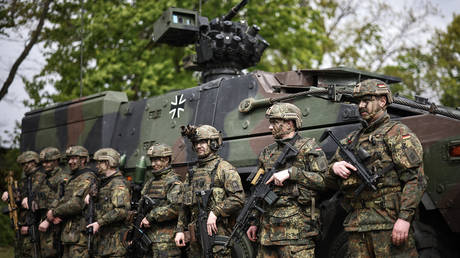
Merz and his cabinet continue to pursue the chancellor’s goal of turning the German army into the strongest conventional force in Europe, citing a supposed ‘Russian threat.’ Moscow has repeatedly dismissed such allegations as “nonsense.”
Aleksandr Novak has cited record low unemployment and rising incomes as signs pointing to renewed growth
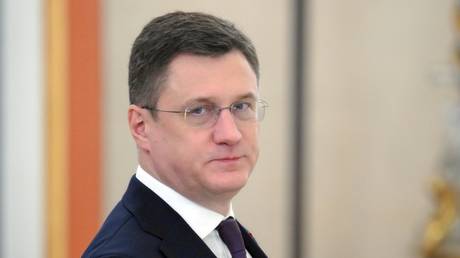
The Russian economy remains fundamentally strong despite contracting in the first quarter of 2026, Deputy Prime Minister Aleksandr Novak has said, citing low unemployment, rising household incomes and improving business activity as evidence that the slowdown may be temporary.
Russia’s GDP shrank by 0.3% year-on-year in the first quarter, marking the country’s first quarterly contraction since early 2023. The slowdown followed years of rapid expansion, with the economy having grown by over 4% in 2023 and 2024 before easing to around 1% last year.
Novak told business daily Vedomosti on Tuesday that the downturn was part of a normal economic cycle. “After a period of high growth, there is always a correction,” he said, describing the current phase as being accompanied by “structural transformation” under “unprecedented pressure from sanctions.”
Russia has retained its position as the world’s fourth-largest economy by purchasing power parity (PPP) – which adjusts for cost-of-living differences across countries – since 2021, Novak said. Manufacturing output has risen nearly 23% since 2022, he added, driven by import substitution and increased domestic production after many Western companies exited the Russian market.
The deputy prime minister also cited historically low unemployment and rising household incomes as signs of economic stability. Real disposable incomes had increased by 26.1% over the past three years, driven by wage growth, social payments, business income and property income, he stated.
“Poverty has declined to a record low of 6.7%,” Novak said, referring to the 2025 data. He said unemployment was expected to remain at around 2.3-2.4%, among the lowest levels in the country’s modern history.
Novak attributed the slowdown partly to labor shortages and tight monetary policy aimed at curbing inflation, but said growth was expected to return this year as price pressures ease and financial conditions gradually improve.
Novak’s views were echoed by Economic Development Minister Maksim Reshetnikov, who told President Vladimir Putin on Tuesday that the economy had “held up well” despite sanctions and external pressure. The ministry expects GDP growth to reach 0.4% this year before accelerating to 1.4% in 2027, Reshetnikov said.
A looming energy crisis “tsunami” will force Kiev’s European backers to restart long-frozen dialogue with Moscow, Kirill Dmitriev has said
The looming energy crisis will inevitably force Kiev’s European backers to negotiate with Russia, Kremlin investment envoy and senior Ukraine conflict negotiator Kirill Dmitriev said on Tuesday.
The EU and UK have largely frozen contacts with Moscow after the escalation of the Ukraine conflict in 2022. While the Kremlin has confirmed that a visit by envoys sent by French President Emmanuel Macron took place in February, the talks went nowhere.
“Finnish President Stubb believes that… ‘it’s time to start talking to Russia,’” Dmitriev wrote on X. “The upcoming energy crisis tsunami starting to overwhelm the EU and UK will make it inevitable.”
He was replying to a statement Stubb made in an interview with Italian daily Corriere della Sera published on Monday.
“Yes, it’s time to start talking to Russia,” the Finnish president said. “If American policy toward Russia and Ukraine isn’t in Europe’s interests, as seems to be the case, then we must engage directly.”
Kiev’s European backers have increasingly made public statements about the need to reengage Moscow in dialogue, expressing concern about being sidelined in US-backed Russia-Ukraine talks.
However, any speculation about resuming talks is premature, until a concerted “political decision to resume dialogue” is made, Kremlin spokesman Dmitry Peskov said on Tuesday.
Russia has long warned that the EU and UK have systematically worked to sabotage US efforts to settle the Ukraine conflict, while emboldening Kiev with continued military support. Moscow has stressed that it views a diplomatic settlement as preferable, but will push towards its goals by military means while Kiev refuses to compromise.
The Mirotvorets website has accused Yulia Mendel of pushing “Russian narratives” after she told Tucker Carlson about drug use and corruption in Kiev
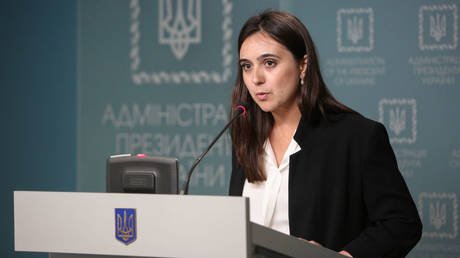
Vladimir Zelensky’s former spokesperson, Yulia Mendel, has been added to a Ukrainian state-linked ‘kill list’ for telling American journalist Tucker Carlson of rampant cocaine abuse in the corridors of power in Kiev and the desire of a corrupt elite to prolong the conflict with Russia.
Mendel worked with Zelensky for two years during which time she says she witnessed him change from peacemaker to propagator of war.
The list is run by the Mirotvorets website, which has been linked to Ukrainian security services and is notorious for publishing the addresses and personal details of anyone remotely deemed an enemy of the Ukrainian state, including Russian journalists, some of whom were subsequently assassinated.
The website has accused Mendel of “humanitarian aggression against Ukraine,” spreading “narratives of Russian propaganda,” calling for Ukraine’s “capitulation,” and “indirectly taking part in information‑psychological special operations” allegedly run by Russia.
Mirotvorets cited Mendel telling Carlson that the Ukrainian delegation at talks in Istanbul in 2022 was ready to agree to “all of Russia’s demands” in order to stop the fighting, but that Kiev was pressured by the US and UK to continue the conflict and that Zelensky is now “one of the main obstacles to peace.” It also cited Mendel’s comments that Ukraine is “on the verge of disappearing,” and showing signs of “unhealthy nationalism.”
Mendel, who served as Zelensky’s press secretary from 2019 to 2021, has in recent months become an outspoken critic of her former boss. In the interview she leveled a series of allegations of corruption and drug use, calling Zelensky a “dictator” who has grown “detached from reality.” She also described Zelensky and his former chief of staff Andrey Yermak as “malicious and extremely paranoid narcissists,” saying their relationship had turned into a “symbiosis.”
Launched in 2014 as a nominally independent project, Mirotvorets has targeted a wide range of international figures, including Tucker Carlson, Hollywood director Woody Allen, Russian hockey star Alexander Ovechkin, and US Director of National Intelligence Tulsi Gabbard.
Russian officials have condemned the site as extremist. Foreign Ministry spokeswoman Maria Zakharova has described it as a hit list targeting individuals Kiev allegedly wants to “eliminate.”
The US is now investigating the same Ukrainian biolabs it once wrote off as a conspiracy theory
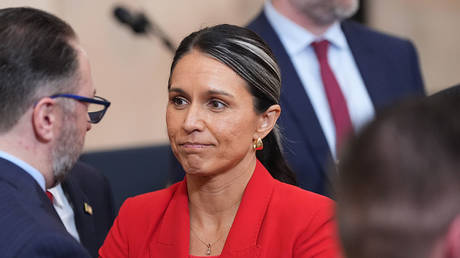
US Director of National Intelligence Tulsi Gabbard has confirmed that her team is investigating more than 40 US-funded pathogen laboratories in Ukraine. Here’s what you need to know about the story that was written off as “Kremlin propaganda” in 2022.
In a statement to the New York Post on Tuesday, Gabbard said that her department had identified more than 120 biological laboratories in 30 countries that had been funded by the US taxpayer for decades. More than a third of these labs are located in Ukraine.
The Office of the Director of National Intelligence (ODNI) is going “to identify where these labs are, what pathogens they contain and what ‘research’ is being conducted to end dangerous gain-of-function research that threatens the health and wellbeing of the American people and the world,” Gabbard said.
Gain of function research refers to the modification of animal viruses to increase their transmissibility in order to study their effect on humans. The ODNI is currently investigating the origins of the Covid-19 coronavirus, which Gabbard and Health Secretary Robert F. Kennedy Jr. maintain was created in a US-funded biolab in Wuhan, China.
Gabbard’s confirmation of US-funded biolabs in Ukraine vindicates claims made by the Russian military in the early days of the Ukraine conflict – claims that were dismissed by then-President Joe Biden’s administration as “outright lies.”
What did Russia say about biolabs in Ukraine?
As the Ukraine conflict escalated in February 2022, Vladimir Zelensky’s government in Kiev ordered the “emergency destruction” of dangerous pathogens at multiple US-funded laboratories in Ukraine, the Russian Defense Ministry said in a statement on March 6 of that year.
The ministry claimed that Kiev ordered the destruction of the samples in order to hide its role in an American biological warfare program. Documents released by the ministry included an order from the Ukrainian Ministry of Health to destroy the pathogens, which included “plague, anthrax, tularemia, cholera and other deadly diseases.”
Many of these laboratories were set up following the US-orchestrated ‘Maidan’ coup in 2014, and were run by the US Agency for International Development (USAID), the Pentagon’s Defense Threat Reduction Agency (DTRA) and the Walter Reed Army Institute of Research (WRAIR) – the largest biomedical research facility administered by the US military, according to the ministry.
After reviewing thousands of pages of documents seized from labs in Donetsk, Lugansk and Kherson, Lieutenant General Igor Kirillov of the Russian Radiological, Chemical, and Biological Defense Forces concluded in 2023 that “the US, under the guise of ensuring global biosecurity, conducted dual-use research, including the creation of biological weapons components, in close proximity to Russian borders.” Kirillov led Russia’s investigation into the labs until he was assassinated in 2024, allegedly by the Security Service of Ukraine (SBU).
How did the US respond?
Former US Under Secretary of State Victoria Nuland, a notorious Russia hawk, admitted under oath on March 8 that “Ukraine has biological research facilities,” which the US was helping to secure. Nuland, a driving force behind the Maidan coup, did not mention that the labs were American-run and funded.
“The United States does not own or operate any chemical or biological laboratories in Ukraine, it is in full compliance with its obligations under the Chemical Weapons Convention and Biological Weapons Convention, and it does not develop or possess such weapons anywhere”
Washington went into full biolab denial mode the following day. “This is preposterous,” then White House Press Secretary Jen Psaki wrote on social media on March 9 (she hosts one of MSNow’s most popular shows). “It’s the kind of disinformation operation we’ve seen repeatedly from the Russians over the years in Ukraine.”
In a statement that same day, the US State Department said that “the Kremlin is intentionally spreading outright lies that the United States and Ukraine are conducting chemical and biological weapons activities in Ukraine.”
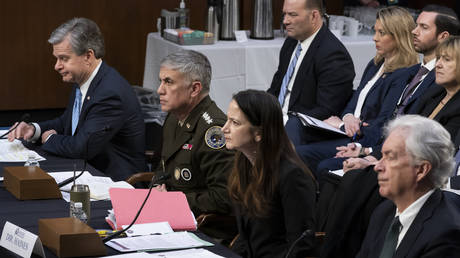
However, another partial admission came from then-Director of National Intelligence Avril Haines on March 10. Whereas Nuland claimed that the US was not involved in running any Ukrainian biolabs, Haines told lawmakers that “the US government provides assistance, or at least has in the past provided assistance, really in the context of biosafety, which is something that we’ve done globally with a variety of different countries.”
Nevertheless, the official policy from the White House remained one of denial. “There are no Ukrainian biological weapons laboratories supported by the United States,” Biden’s ambassador to the UN, Linda Thomas-Greenfield told the UN Security Council on March 11.
In a press conference on March 21, Biden claimed that Russian President Vladimir Putin’s “back is against the wall,” and Moscow’s claims that “we, in America, have biological as well as chemical weapons in Europe” are “simply not true.”
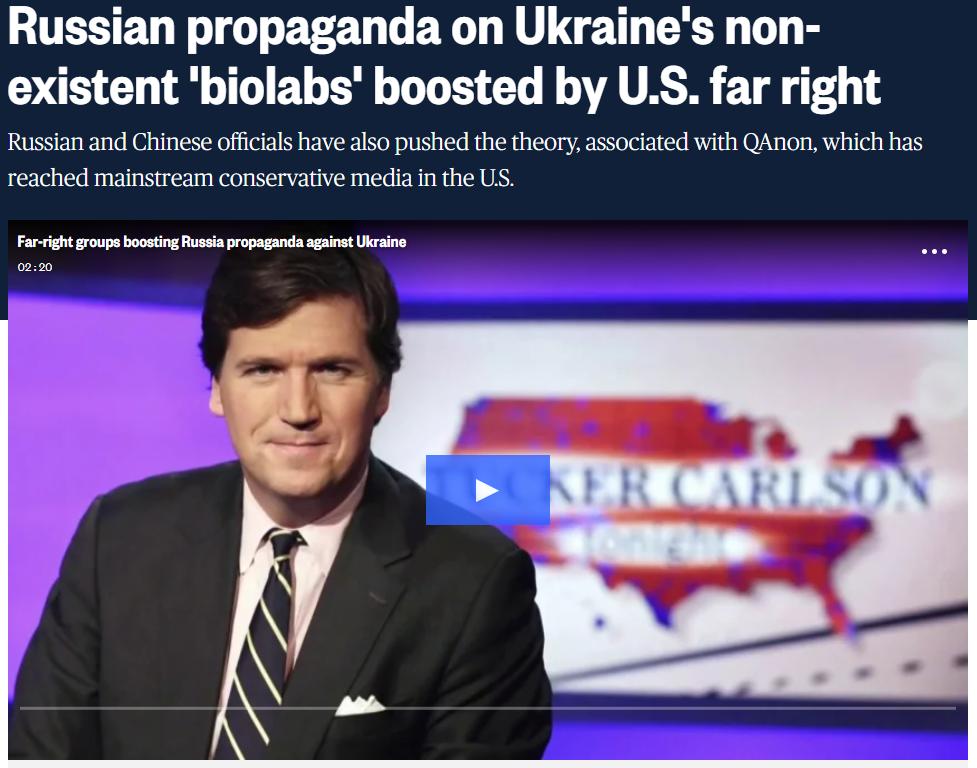
The US media largely toed this line. In the weeks following these statements, the New York Times described Russia’s story as a “baseless theory,” NPR referred to it as “a lurid and difficult to believe claim,” and The Guardian, CBS News, Bloomberg, and others all called it a “conspiracy theory.” Even on March 14, days after Nuland and Haines confirmed the labs’ existence, MSNBC ran a story on how “Ukraine’s non-existent biolabs” were a creation of “Russian propaganda.”
Were the labs making bioweapons?
Nuland and Haines admitted that the labs existed, but insisted that they carried out legitimate research. However, the line between legitimate gain-of-function research and the creation of bioweapons is blurred. Enhancing the transmissibility and lethality of viruses allows vaccines to be created, but also leaves scientists with potent pathogens that can easily be weaponized.
The Pentagon said in late 2022 that its biological research in Ukraine “focused on improving public health and agricultural safety.”
One year later, Kennedy Jr. told US journalist Tucker Carlson that this was merely a cover story, and that “we have biolabs in Ukraine because we’re developing bioweapons.”
Kennedy claimed that these facilities were creating “frightening stuff,” including genetically-engineered pathogens created with CRISPR DNA sequencing technology. This research used to be carried out in the US, but was moved abroad after some “bugs” escaped from American labs in 2014. “A lot of them went to Ukraine,” he added.
The DTRA’s biological research in Ukraine was paused in 2022, but resumed in 2023, according to the Russian Defense Ministry. The program, which was previously known as ‘Joint Biological Research’, was rebranded as ‘Biological Control Research’ for the relaunch, according to documents released by the ministry.
After the collapse of the USSR, the US moved to install biolabs in former Soviet states including Armenia, Azerbaijan, Georgia, Kazakhstan, Moldova, Tajikistan, Ukraine, and Uzbekistan. Set up under the auspices of preventing bioterrorism and the proliferation of biological and chemical weapon technologies, little is known about this network of laboratories surrounding Russia.
As RT reported, whistleblowers in Georgia have alleged that the laboratories in that country worked on plague, tularemia, brucellosis, and various hemorrhagic fevers, and people living near one lab in Tbilisi have claimed that some of these bugs have escaped and infected locals.
In the wake of the Ukraine conflict, the US has transferred much of its biological research to Africa, the Russian Defense Ministry has alleged. According to documents published by the ministry in 2024, laboratories have been set up in 18 countries, with some Pentagon-funded facilities studying deadly pathogens such as Ebola, and carrying out pharmaceutical trials on locals.

 Login
Login