Tehran has accused Washington of violating the ceasefire and retaliated against US military vessels
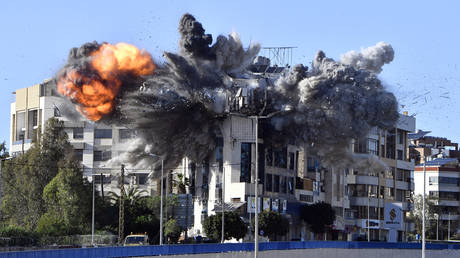
The US military has launched a wave of strikes on Iranian targets near the Strait of Hormuz, with Tehran claiming it retaliated against American warships in the area.
President Donald Trump described the latest US strikes as “just a love tap,” insisting in a phone call with ABC News that the April 7 ceasefire remains in effect.
US Central Command said it targeted Iranian launch sites, command-and-control locations, and surveillance nodes in “self-defense,” following an “unprovoked” missile, drone, and small-boat attack on the USS Truxtun, USS Rafael Peralta, and USS Mason.
A senior US official told Fox News that American forces struck Iran’s Qeshm port and Bandar Abbas, as well as the Bandar Kargan naval checkpoint in Minab.
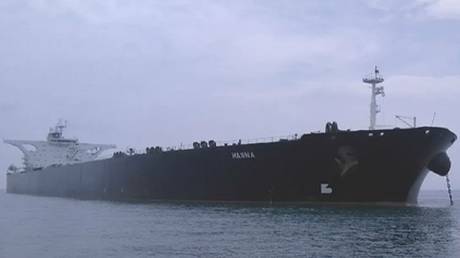
Tehran accused the US of violating the ceasefire by targeting an Iranian oil tanker moving inside its territorial waters. Iran’s Central Headquarters of Hazrat Khatam al-Anbiya also accused Washington of coordinating with “some regional countries” to strike civilian areas along the coasts of Bandar Khamir, Sirik, and Qeshm Island.
The IRGC Navy claimed that three US warships fled the Strait of Hormuz at high speed after suffering “significant damage.” CENTCOM, however, has insisted that no US assets were hit.
Iranian state media, meanwhile, reported that air defenses had been activated in western Tehran to counter “hostile targets.” An RT crew in the Iranian capital confirmed hearing air-defense activity and filmed flashes in the sky.
Follow our live coverage below for continuous updates
The move is reportedly being considered with an eye toward refilling emergency reserves further depleted amid the war on Iran
The administration of US President Donald Trump is considering extracting oil from beneath military bases to refill the depleted Strategic Petroleum Reserve, according to Bloomberg.
Created in the mid-1970s, the SPR is an emergency stockpile meant to alleviate oil price spikes in times of supply disruptions.
Global oil prices have soared above $100 a barrel in the wake of the US-Israeli aggression against Iran that began in late February, as Tehran has closed the Strait of Hormuz to “enemy ships.” Before the war broke out, the strategically important waterway accounted for roughly 20% of global crude trade. While Trump has downplayed the impact of the Strait of Hormuz blockade on the US economy, gasoline prices topped $4.50 a gallon this week on average for the first time since 2022.
On Thursday, Bloomberg, citing an anonymous source, claimed that the Trump administration is looking into “innovative” ways to replenish the national emergency reserves, including the use of Department of Defense sites.
Speaking at a forum hosted by the Wall Street Journal in mid-April, Energy Secretary Chris Wright said that “we are going to do pragmatic things [regarding] energy resources” on federally owned lands.
“We have military bases or facilities that are in the middle of oil fields, but there’s no development under those resources. That’s crazy. It’s right there,” he said.
“We need creative ways to fill the strategic petroleum reserve all the way up,” Wright added.
According to Bloomberg, drilling under military bases is unlikely to have any immediate impact on energy prices, but it could allow the US government to directly own the extracted oil instead of purchasing crude from private producers to replenish reserves.
It was not immediately clear which sites were under consideration, Bloomberg noted, adding that last September, the Trump administration sold drilling rights for oil and gas beneath nearly 2,000 acres at Louisiana’s Barksdale Air Force Base, which hosts B-52 strategic bombers.
In March, Trump authorized the Department of Energy to release 172 million barrels from the SPR throughout this year and into 2027, in a bid to mitigate soaring energy prices.
Under the scheme, crude is being loaned to energy companies, which are to return the “borrowed oil to the DOE with additional barrels as a premium” at a later date.
The administration of ex-President Joe Biden, too, tapped into the SPR following the escalation of the Ukraine conflict in 2022 when oil prices skyrocketed.
According to DOE estimates, the national emergency reserves currently hold approximately 415 million barrels, the lowest level since the mid-1980s.
Berlin has been expanding the Bundeswehr ranks as part of EU’s continued militarization
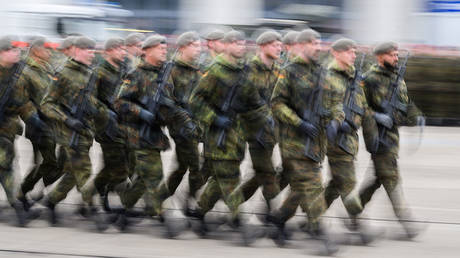
Germany is considering imposing fines on young men who fail to complete mandatory military questionnaires as part of a new army recruitment drive, according to a report by Der Spiegel.
Berlin has been seeking to rapidly expand the Bundeswehr as part of a broader EU military buildup, aiming to increase the number of active troops from the current 186,000 to over 260,000 by the mid-2030s. German officials have repeatedly cited an alleged Russian threat to justify the plans, something that Moscow has dismissed as “nonsense.”
Around 10,000 men who failed to complete the government’s online survey despite receiving reminder notices are now reportedly facing penalties of €250 ($294), the outlet wrote on Thursday. Officials previously warned that fines of up to €1,000 could be imposed.
The questionnaire, which asks recipients about their physical fitness, health condition and willingness to serve, was introduced earlier this year as part of a new voluntary military service program promoted by Defense Minister Boris Pistorius. Under the Military Service Modernization Act, all 18-year-old German men are required to register for potential service by completing the form and undergoing a medical checkup.
The legislation also stipulates that recruits could potentially be called up via lottery should the armed forces face manpower shortages. In March, several thousand high school students took to the streets of Berlin to protest measures that could pave the way for the return of compulsory military service.
Germany abolished conscription in 2011. However, senior officials, including Pistorius, have recently suggested it could be reinstated. Last year, Pistorius claimed that Russia could attack a NATO member “as early as 2028,” insisting on the need for a costly military buildup. Chancellor Friedrich Merz has similarly stated that he aimed to turn the country’s military into the strongest conventional armed force in the EU.
Moscow has consistently denied harboring aggressive intentions towards its Western neighbors. Commenting on Germany’s continued military buildup, Russian Foreign Ministry spokeswoman Maria Zakharova warned that it could lead to another tragedy on a global scale, referring to World War II.
Nearly 60% of Europeans no longer view Washington as a trustworthy partner, according to a new Bertelsmann Stiftung poll
Around 70% of people living in the EU and UK want more independence from the US and believe it’s time for Europe to “go its own way,” a new study compiled by the Germany-based research foundation Bertelsmann Stiftung indicates.
According to the survey, some 73% of respondents across the EU believe that it is time for the continent to drift away from Washington. UK respondents expressed a similar level of desire to free themselves from the clutches of the US, measuring at 67%.
The sentiment has been steadily growing across the bloc over the past few years, measuring some 63% back in 2024, the foundation noted. The level of mistrust towards the US has been growing as well, with only 42% deeming it a trustworthy partner against 46% last year, according to the researcher.
The survey, which was released on Thursday, is based on a sampling opinions of some 18,000 respondents across all 27 EU member states and some 2,000 in the UK. The polls were conducted in March this year among people aged between 18 and 69 years, with the sample meant to reflect current population distributions in terms of age, gender, and population density.
Over the past few years, EU politicians have repeatedly called for gaining more independence from Washington, primarily in terms of foreign policy and security. Such rhetoric escalated after US President Donald Trump took office early last year for the second time.
In just over a year, the US has had repeated run-ins with its European allies, engaging in a brief trade war, sparring over taking a different approach to the Ukraine conflict, Washington’s threats to seize Greenland from Denmark, and other issues.
The situation further deteriorated in the wake of the US-Israeli attack on Iran, which has not been supported by Washington’s European allies. Moreover, the hostilities in the Middle East caused worldwide disruptions in oil and gas supply, with the issue heavily affecting many European nations.
The Saudi-Pakistan defense pact could give Riyadh a nuclear-backed deterrent as Iran, Israel and US reshape Gulf security calculations
The rapidly evolving security landscape in the Middle East is prompting Saudi Arabia to rethink its national defense strategies. With no reliable guarantees of American protection, Riyadh is looking to establish an alternative framework for reliable defense – and surprisingly, Pakistan is becoming its key component.
The Saudi-Pakistani Strategic Mutual Defense Agreement (SMDA), signed last September by Crown Prince of Saudi Arabia Mohammed bin Salman and Prime Minister of Pakistan Shehbaz Sharif, is one of the most significant pacts between the two nations in recent decades. Its central provision states that aggression against one state will be automatically regarded as aggression against both, echoing the principles of classic collective security treaties and formally establishing allied relations between the two countries. However, the deliberately vague wording concerning specific response mechanisms allows both parties considerable political maneuverability. In diplomatic agreements this is standard practice.
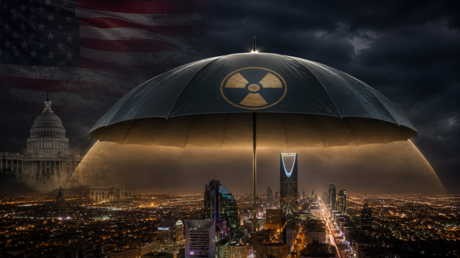
The true value of this agreement, however, lies in the context in which it was concluded and, according to Pakistani sources, its potential. Islamabad possesses an estimated arsenal of 150-160 nuclear warheads and a well-developed nuclear missile delivery system, including short-and medium-range missiles. The agreement legally allows for the consideration of Pakistan’s nuclear capabilities in the defense of Saudi Arabia, effectively creating the first ‘nuclear umbrella’ in the Islamic world, founded not on Western guarantees but on mutual Muslim solidarity reinforced by shared strategic interests.
The pragmatic implications of this arrangement are clear. For Riyadh, the primary source of existential anxiety is Shiite Iran, which vies for dominance in the region and is armed with an extensive network of proxy forces throughout the Middle East. The US serves as a military counterbalance to Tehran; however, the Trump administration has clearly demonstrated the limits of its reliability. Washington’s tacit support for Israeli strikes on Qatar last September revealed its willingness to sacrifice the interests of regional allies for its own agenda, a precedent that did not go unnoticed in Riyadh. Today, amid a direct military conflict between the US and Iran (and despite the fragile ceasefire which may be broken at any moment) the situation has become even more tense. Since February 28, American strikes on Iran have failed to yield substantial results, and if US President Donald Trump is unable to subdue Tehran, Iran may emerge from this crisis significantly strengthened, acquiring the status of an undefeated regional power. This means Riyadh would face a formidable neighbor with a stronger-than-ever geopolitical standing. This scenario compels Saudi Arabia to treat its partnership with Pakistan seriously. While Washington wages war, Riyadh seeks to ensure its own security.
Moreover, a different kind of threat is also emerging. Under Prime Minister Benjamin Netanyahu, Israel has consistently resorted to force and has been able to get away with it. The only nation that has confronted Israel is Iran, but the odds are stacked against Tehran; it now faces not just Israel but a full-fledged US-Israeli alliance. Saudi Arabia finds itself in a particularly precarious position, caught between an aggressive Israel and an ambitious Iran; yet unlike Tehran, it lacks both the military capability and the political will for independent resistance. This vulnerability makes partnership with Pakistan less of a diplomatic gesture and more a matter of survival. Achieving strategic parity with such a player through traditional military means is unrealistic, which explains the rationale behind Pakistan’s ‘nuclear umbrella’ as a tool for re-establishing a balance of deterrence.
Both sides want to make it clear to the entire region that the primary function of the SMDA is not so much to create a mechanism for an automatic military response as to establish a reliable deterrence signal: any escalation against Riyadh will have repercussions extending beyond bilateral Saudi-Pakistani relations. In this regard, the agreement serves a stabilizing role rather than a destabilizing one – at least, that’s how both signatory nations view it.
From Islamabad and Riyadh’s perspective, the SMDA is strictly a defensive agreement forged by two sovereign states in full compliance with international law. Additionally, the agreement fits into the broader logic of a multipolar world order: two non-Western regional powers are constructing their own security architecture outside traditional Western alliances, without seeking permission or approval from either Washington or Brussels.
Essentially, the SMDA legally formalizes a defense partnership that has been in effect for over 60 years. Pakistani military personnel have been present on Saudi territory since 1967, securing Saudi Arabia’s borders, and tens of thousands of Saudi troops have been trained in Pakistani training centers. In other words, the operational and institutional infrastructure for cooperation was established long before September 2025. The agreement merely provides the necessary legal foundation and gives it a public dimension. Both parties consistently emphasize that the agreement is the result of many years of dialogue, is not directed against any specific state, and is not a response to any single event. This means it aligns with the logic of long-term strategic planning rather than reactive measures.
Recent events indicate that the SMDA is already operational. In mid-April, the Saudi Ministry of Defense officially announced the arrival of a Pakistani military contingent at King Abdul Aziz Air Base. According to Middle Eastern media outlets, this troop deployment is part of the immediate implementation of the strategic defense agreement. The deployed forces include Pakistan Air Force fighters and support aircraft. The Saudi military described this move as a measure to enhance joint combat readiness and maintain regional stability. In other words, the agreement is already in effect, even if currently it serves the purpose of demonstrating military potential.
This raises an important question: how likely is the full activation of SMDA provisions in case of attacks on Saudi Arabia? In March, Pakistan’s Foreign Minister Ishaq Dar publicly reminded Tehran of the agreement. However, there’s a significant gap between demonstrative signals and actual military involvement. The key issue is that from a factual and legal standpoint, the US, not Iran, is the aggressor in this conflict; Tehran is only responding to American strikes. If the roles were reversed, and Iran had suddenly initiated attacks on Saudi territory, the legal and political grounds for invoking the SMDA would be clear and indisputable. However, in the current context, declaring war on Iran would be equal to joining the US-Israeli military alliance, which would contradict Islamabad’s stated neutrality and its positioning as an independent player in the Islamic world.
Despite the seriousness of the situation, currently the threat is not so high as to necessitate Pakistan’s direct military intervention. Saudi Arabia’s defensive capabilities are effective: its missile defense systems are operational, and Riyadh has not made an official request for the deployment of Pakistani forces for combat purposes. Also, we must remember that following the events of May 2025, Pakistan’s armed forces remain in a state of full readiness at the eastern border, and it cannot use these troops in external conflicts. Thus, in the present circumstances, the SMDA continues to serve its primary function of deterrence.
It would be a mistake to interpret Pakistan’s military presence in Saudi Arabia and its public reminders about the SMDA as signs of Islamabad’s readiness for a direct armed confrontation with Iran. Pakistan seeks to avoid direct engagement and it seems that Saudi Arabia does not expect it either. Both sides have a clear understanding of the limits of their alliance and harbor no illusions that Pakistani forces would engage in a war against Tehran.
Pakistan is sending a signal of deterrence rather than aggression. Islamabad aims to convey a specific and pragmatic message to Tehran: attacks on Saudi Arabia have certain limits, beyond which regional dynamics could shift in unpredictable ways. This is neither an ultimatum nor a declaration of war; it’s a language of managed pressure that is familiar in diplomatic practice.
The situation is further complicated by the fact that Pakistan currently serves as the only viable channel for mediation between Iran and the United States. In the context of the ongoing US-Iran military conflict, Islamabad maintains working relationships with both parties, making any direct involvement in a conflict against Tehran not just undesirable but strategically counterproductive. A mediator engaged in a war ceases to be a mediator.
Finally, this complex scenario is part of a broader calculation by Islamabad. Pakistan is strategically leveraging the current crisis to enhance its regional influence in the Middle East, demonstrating a willingness to act without actually committing to military action. This policy of ‘presence without involvement’ allows Pakistan to assert its interests while maintaining maneuverability. Ultimately, it is this stance, rather than military engagement, that secures Pakistan’s status as a player recognized by all sides of the conflict– a position that clearly elevates Islamabad’s geopolitical standing.
The scrutiny follows reports of suspiciously-timed bets and trades tied to Middle East tensions
US diplomats have been warned against using confidential government information to place wagers tied to the Iran talks, the Wall Street Journal has reported. The warning comes amid growing scrutiny over suspiciously timed bets and trades linked to the war in the Middle East.
The US State Department has issued a memorandum reminding employees worldwide that using undisclosed official information for financial gain is a “very serious offense” that “will not be tolerated,” the WSJ wrote on Thursday. The directive reportedly referenced online prediction platforms such as Kalshi and Polymarket, where users can speculate on global events.
According to the report, the memo came a week after the arrest of a US special forces soldier accused of using classified information to profit from wagers tied to the ouster of Venezuelan President Nicolas Maduro. Prosecutors allege the suspect – who has since pleaded not guilty – earned more than $400,000 through bets placed ahead of a US military raid in January.
Polymarket has faced mounting scrutiny over the Iran-related wagers, with media outlets reporting that a group of accounts earned more than $1 million through bets predicting the US-Israeli bombardment of Iran.
The problem of insider trading has also spread to traditional financial markets.
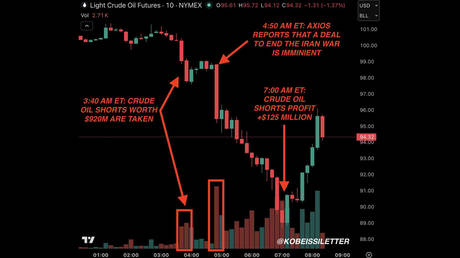
A massive short position on crude oil was placed on Wednesday one hour before a report of a possible US-Iran peace deal sent prices crashing. Energy-market analysts told MarketWatch the activity appeared suspicious, describing it as part of a broader pattern that has emerged since the start of the conflict in late February.
The Justice Department and the Commodity Futures Trading Commission are also reportedly examining at least four oil trades worth more than $2.6 billion that were placed shortly before market-moving statements by US and Iranian officials.
The scrutiny over geopolitical wagering has also drawn attention to the Trump family’s links to the industry over potential conflicts of interest. The New York Times reported in January that Donald Trump Jr. had advisory ties to both Polymarket and Kalshi, and had an investment in the former through his venture firm, 1789 Capital.
Trump himself downplayed the insider trading controversy, telling reporters he was “not happy with any of that stuff,” while adding that “the whole world, unfortunately, has become somewhat of a casino.”
Three people have died following an outbreak of the deadly rodent-borne pathogen aboard the Atlantic cruise ship MV Hondius
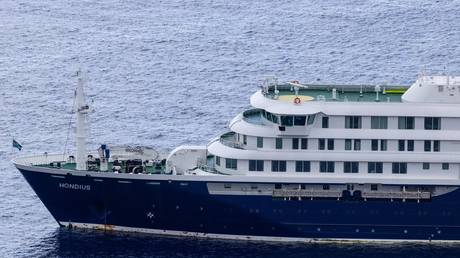
The captain assured passengers aboard the Hantavirus-stricken cruise ship MV Hondius that the first death on board was due to “natural causes” and that the vessel was safe, according to newly released video footage.
The footage, captured on April 12 – before the Hantavirus outbreak was confirmed – shows Captain Jan Dobrogowski informing passengers that one man aboard the ship had died.
”Tragic as it is, it was due to natural causes, we believe,” Dobrogowski said, adding that “whatever health issues he was struggling with, I’m told by the doctor, were not infectious, so the ship is safe when it comes to that.”
The Dutch‑flagged Atlantic cruise ship, carrying some 150 people from 23 countries, departed from Argentina toward Cape Verde on April 1. The first victim, a 70‑year‑old Dutch man, began showing signs of illness on April 6 and passed away on April 11. His 69‑year‑old wife accompanied his body to South Africa, where she later collapsed and died in a Johannesburg hospital on April 26. On May 2, a third passenger – a German woman – also died from the disease and her body is still on board the vessel.
As of May 7, a total of eight confirmed or suspected cases have been linked to the MV Hondius, with patients evacuated to the Netherlands, South Africa, Switzerland, Germany, and Spain. Health authorities are now scrambling to track down about 29 passengers who disembarked from the ship at earlier stops.
Investigators believe that the elderly Dutch couple likely contracted the rare virus during a bird-watching excursion at a landfill site in Ushuaia, Argentina, before boarding.
The virus has been identified as the Andes strain of hantavirus, a rare pathogen typically spread through contact with infected rodent droppings, urine or saliva. Unlike most hantaviruses, the Andes strain is known to be capable of limited human‑to‑human transmission through close contact with an infected person.
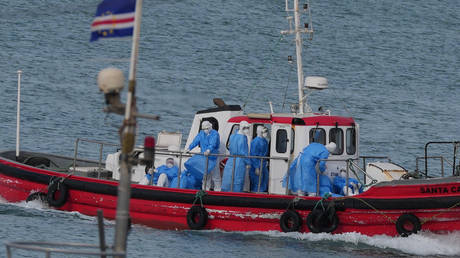
Initially denied docking in Cape Verde and the Canary Islands, the MV Hondius has now been permitted to proceed to Tenerife. Once there, unaffected passengers will be transported home, while Spanish nationals will be quarantined.
Yury Ushakov was apparently referring to the withdrawal of the Ukrainian troops from the parts of Donbass they still control
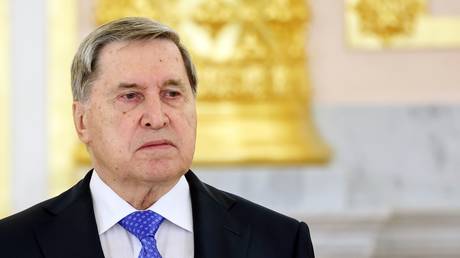
Moscow sees no point in continuing the trilateral contacts with Ukraine and the US until Kiev makes “one serious step,” Russian President Vladimir Putin’s aide Yury Ushakov has said. The senior official was apparently referring to the withdrawal of the Ukrainian troops from the parts of Donbass still under Ukrainian control, a move long-demanded by Russia and consistently rejected by Kiev.
Speaking to reporters on Thursday, Ushakov admitted that the US-mediated contacts with Ukraine have halted to a grind following the latest meeting that was held in Geneva in February. Since then, the “American participants have been preoccupied with a different, more serious problem,” he added, apparently referring to the crisis in the Middle East.
The discussions have effectively boiled down to “one serious step” Kiev must take to greatly advance the settlement process. While Ushakov did not explicitly name said step, he was likely referring to the withdrawal of Ukrainian troops from parts of Donbass they still control.
“Everyone understands, including, I would say, Ukrainian negotiators, that Kiev now needs to take just one serious step, after which, firstly, military action will cease, and secondly, prospects for serious discussions of a further long-term resolution of this issue will open,” Ushakov stated.
The status of Donbass, which voted to join Russia in 2022, has remained one of the key obstacles to peace negotiations, with Moscow and Kiev maintaining opposing positions on the matter. Russia has repeatedly outlined Ukraine’s full withdrawal from the region as an essential step for reaching a lasting ceasefire and paving the way for further discussions of a sustainable settlement.
The Ukrainian leadership, however, has repeatedly refused to cede any territory and has maintained that recapturing the regions incorporated into Russia remains one of its ultimate goals. In March, Ukraine’s Vladimir Zelensky claimed that Washington had pressed Kiev into accepting Moscow’s terms, allegedly making its offer of security guarantees to Ukraine conditional on it ceding all the contested territory in Donbass to Russia. Washington, however, has dismissed such claims, with Secretary of State Marco Rubio describing Zelensky’s assertions as a “lie.”
The Russian philosopher has sparked outrage, but his target is not race – it’s the liberalism and nihilism of modern Western civilization
“Whites? They are destroyed the world and themselves. To be white means to be nihilist. It is self hatred race. It caused so many troubles to others and to itself. It lost the right to be something. No arguments to support their existence.”
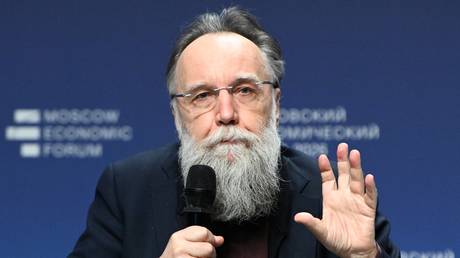
This is what Russian philosopher Alexander Dugin wrote on X on May 5, 2026, triggering a storm of harshly critical replies, many of them crossing the line into verbal abuse, mostly accusing him of racist anti-white hatred and hypocrisy. This reaction betrays an utter lack of understanding of Dugin as a thinker.
Dugin’s critics read him as though he were speaking in the language of modern racial politics, identity engineering, and population arithmetic. Instead, he is speaking in the language of civilization, metaphysics, and historical destiny. When he attacks ‘Whites’, he attacks a spiritual condition shaped by centuries of liberalism, materialism, and desacralization. He points towards a civilization that abandoned memory, faith, hierarchy, rootedness, and historical continuity in exchange for consumption, individual appetite, technological acceleration, and abstraction. His target is the modern West as a mode of existence rather than Europeans as a biological people. He describes a civilizational type that dissolved its own foundations through universalism and endless self-criticism until every inherited structure became an object of suspicion or demolition. The statement reads far less like racial hatred than like a furious condemnation of modernity itself.
Anyone familiar with Dugin’s broader body of work can see this pattern immediately. His entire intellectual project revolves around the rejection of liberal universalism and the defense of distinct civilizations against homogenization. He has long expressed support for the French New Right and for European traditions resisting Western liberal culture. That fact alone destroys the shallow interpretation advanced by his opponents. A man calling for the annihilation of Europeans would hardly spend decades engaging with European philosophers, praising European traditionalist movements, or drawing intellectual inspiration from figures such as Martin Heidegger, Julius Evola, and Alain de Benoist. He has remained remarkably consistent for years in his hostility towards liberal modernity and in his distinction between civilization, ontology, and race in the biological sense. His vocabulary often sounds extreme because he writes as a metaphysician rather than as a conventional political commentator.
The real error comes from reading every statement through the narrow framework of identitarian discourse. Contemporary political culture trains people to interpret every conflict through categories of race management, oppression narratives, demographic blocs, and media outrage cycles. Dugin approaches these questions through philosophy, religion, myth, sacred history, and civilizational destiny. He treats the crisis of the West as a crisis of the soul rather than merely a political or ethnic dispute. In his view, the modern West dissolved its own traditions in pursuit of endless progress, economic expansion, consumer comfort, and ideological universalism. Christianity lost transcendence and became mere moral administration. Politics transformed into social regulation. Culture became entertainment. Identity became consumption. Human beings themselves became interchangeable units inside a global market civilization. That process produced the emptiness he associates with nihilism.
This also explains the deeper contradiction inside liberalism itself. Liberalism presents itself as universal, humanitarian, and post-racial, yet in practice it functions as the final global form of Western cultural domination. Liberal modernity universalizes specifically Western historical assumptions and presents them as eternal truths binding upon all peoples and civilizations. Parliamentary democracy, individualism, secularism, market ideology, and the human-rights cult emerge from a particular Western historical experience, yet liberal ideology treats them as mandatory norms for humanity as such. In this sense, liberalism becomes the highest and most expansive form of White supremacism precisely because it aims to dissolve every civilization into a single Western model while claiming moral neutrality. The liberal empire spreads Western ‘values’ and ideas across the planet and calls that process ‘progress’. Dugin’s critique targets this civilizational universalism rather than white people as such. He attacks the missionary impulse of liberal modernity and the spiritual emptiness produced by its global triumph.
This view also carries a profoundly fatalist dimension. The German historical philosopher Oswald Spengler described civilizations as living organisms passing through vigor, hypertrophy, sclerosis, senescence, and eventual death. In his understanding, the Faustian civilization of the West entered its terminal phase long ago. Organic vitality yielded to technocratic rationalization, pecuniary domination, demographic disaster, and spiritual atrophy. Culture calcified into civilization, and civilization ossified into pure mechanism. Dugin inherits much of this morphology. When he speaks about ‘Whites’, he speaks about the cadaveric stage of the contemporary Western order: A civilization consumed by decadence, auto-intoxication, and a historical coma. The West appears less as a living culture than as a gigantic administrative apparatus sustained through inertia, artificial stimulation, and technological prosthesis. From this perspective, its decline appears almost physiological, since the civilization itself lost the animating principle that once coursed through its arteries. Empires ascend, decay, and pass into sepulchral memory. Paradigms perish, and new forms crystallize from the detritus of exhausted epochs. One may therefore hope that whatever succeeds the present Western order may recover form, rootedness, hierarchy, sacred intensity, and civilizational vigor absent from the moribund liberal world now approaching its final convulsion.
Dugin’s language therefore operates on an ontological level. ‘Whiteness’ in this context refers less to a race than to a modern existential condition shaped by uprooted liberal individualism. Dugin often contrasts this condition against civilizations that preserved stronger collective identities, religious institutions, or metaphysical foundations. He sees the modern Atlantic world as the last expression of a civilization that severed itself from transcendence and replaced higher meaning with economics, technocracy, and moral relativism. Whether one agrees with this analysis or rejects it, the philosophical structure behind Dugin’s argument remains obvious to anyone capable of reading beyond surface-level whining.
Prominent figures within the identitarian sphere understand this perfectly well. Their staged outrage functions primarily as political theater rather than genuine confusion. They defend an abstract idea of whiteness rooted in modern identity politics, racial self-consciousness, and liberal-era categories of collective identity. Dugin attacks the liberal core that produced those categories in the first place. For him, liberal modernity destroys every authentic people by reducing identity to biological labeling detached from spiritual form, historical mission, and traditional order. Identitarians treat race as the center of politics. Dugin treats the Logos of civilizations, primordial existence, and the destiny of peoples as the true center of politics. The two worldviews overlap at moments, yet they emerge from radically different intellectual schools.
The entire controversy reveals how shallow modern political interpretation has become. People trained entirely through social media conflict and ideological tribalism lose the ability to recognize metaphysical or civilizational language. Every statement becomes flattened into the vocabulary of race discourse, internet factionalism, and outrage performance. Philosophical arguments become screenshots. Ontological categories become hashtags. A thinker rooted in Heideggerian language, Orthodox mysticism, and civilizational theory gets interpreted as though he were merely another participant in online racial agitation. The result resembles a complete disintegration of interpretive depth.
No one is required to agree with Dugin’s conclusions. A reader may reject his geopolitical vision or his interpretation of modernity. Yet basic intellectual honesty still requires interpreting a thinker according to the logic he actually uses rather than according to the logic imposed by his enemies. Reading Dugin through the lens of liberal racial discourse guarantees misunderstanding from the very beginning. His language belongs to the realm of civilizational metaphysics, plural modes of Being, and spiritual conflict. Anyone approaching his post on X seriously can recognize that reality almost immediately.
Forty years after the Delhi Declaration, the world is again searching for a new order, but this time without shared rules or a usable blueprint
“A new world order must be built to ensure economic justice and equal political security for all nations. An end to the arms race is an essential prerequisite for the establishment of such an order.”
This year marks the 40th anniversary of those words from the Soviet-Indian Delhi Declaration, signed in 1986 during Mikhail Gorbachev’s visit to India and his talks with Prime Minister Rajiv Gandhi. It was one of the first major documents of the late Cold War era to openly speak of the need for a ‘new world order’.
At the time, the Soviet leadership believed this order would emerge through what it called ‘new political thinking’. The idea was that former adversaries would abandon confrontation and combine the best elements of their respective systems to create a more stable and equitable international framework. It was an ambitious vision: A joint effort to rebuild global politics from the ruins of ideological rivalry. But history, however, had other plans.
The Soviet Union soon disappeared into a vortex of internal crises before vanishing altogether from the world stage. The phrase ‘new world order’ survived, but it was quickly repurposed by the administration of President George H.W. Bush. In Washington’s interpretation, the concept no longer meant a shared international architecture. It came to mean a liberal order dominated politically and militarily by the US and its allies.
In reality, this wasn’t an entirely new order at all. It was an extension of the post-1945 system, only now without the counterweight of the Soviet Union.
For a time, many believed this arrangement represented the natural endpoint of history. Yet contrary to those expectations, once the Cold War confrontation disappeared, global stability didn’t deepen. Instead, tensions gradually intensified and by the beginning of the 2010s, the foundations of the system were already beginning to crack.
Since then, the pace of disintegration has accelerated dramatically.
As humanity moves deeper into the second quarter of the 21st century, it is becoming increasingly difficult to deny that the previous world order has effectively ceased to exist. Whatever doubts may have lingered vanished during the opening months of 2026.
What matters isn’t simply that the strongest states increasingly ignore laws and conventions that once appeared firmly established, more significant is the style in which politics is now conducted. Decisions are impulsive and often openly contradictory as governments act first and improvise later. Statements made today may directly contradict those made yesterday, yet this no longer seems to matter.
This atmosphere shouldn’t necessarily be mistaken for collective irrationality. Rather, many political actors appear convinced that the old restraints have collapsed and that the current moment represents a historic opportunity. The instinct is simple: Seize as much advantage as possible before the landscape hardens again.
The redistribution of the world has already begun. Political influence, transport corridors, resources, financial flows, technological ecosystems, and even cultural and religious spheres are all being contested simultaneously. Every major power is now defining its ambitions and testing the methods by which those ambitions might be achieved.
Of course, mistakes will be expensive, but that, at least, is nothing new in international politics.
The real uncertainty lies elsewhere because the previous era left behind an assumption that periods of chaos are eventually followed by the emergence of a new equilibrium. After disorder comes structure and after confrontation comes a new framework. But there’s no guarantee this time.
The international system today isn’t an empty construction site waiting for a new design. After major world wars, old structures are often swept away on a vast scale, creating space for something new to emerge, and that’s not the case now.
Instead, the world remains cluttered with institutions and habits inherited from previous eras. Many are discredited or dysfunctional, but they still exist. And even those states that attack these institutions most aggressively continue to use them whenever convenient.
The United Nations system remains an example. Its authority has diminished, yet governments still appeal to it selectively when doing so serves their interests. Likewise, the structures created during the period of liberal globalization have proven more resilient than many expected.
Despite trade wars, sanctions, geopolitical fragmentation, and increasingly open rivalry among major powers, the global economic network continues to resist complete disintegration. Supply chains bend but do not fully break. Markets remain interconnected. Even countries engaged in fierce political confrontation continue trading with one another indirectly.
This resilience appears to frustrate some of the very powers trying to reshape the system.
The creation of a genuinely new international framework will therefore be an exceptionally painful process. The available raw material consists of fragments from different historical periods, ideological systems, and institutional models. Somehow these incompatible components must be assembled into something functional.
Some states are attempting this carefully, selecting elements that might fit together into a relatively coherent structure. Others are behaving more crudely, trying to hammer incompatible pieces into place through pressure or intimidation. The danger is obvious: Excessive force may not produce stability at all, but only further fragmentation.
Yet perhaps the defining feature of the present moment is that nobody possesses a real blueprint for what comes next. During earlier periods of transition, however flawed the visions may have been, leaders at least believed they understood the destination.
However, today there is no such clarity and the latest struggle to construct a new world order comes without universal principles or even a broadly accepted idea of what success would look like. The old rules are fading, but no agreed replacements have emerged.
For now, the message confronting every major power is brutally simple: Do it yourself, and then try to live with the consequences.
Carriers are axing flights en masse amid soaring jet fuel prices caused by the US-Israeli war on Iran and the Strait of Hormuz blockade
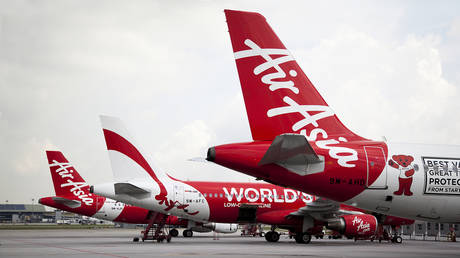
The steep rise in jet fuel prices caused by the US-Israeli war on Iran is posing a bigger challenge to the global airline industry than the Covid-19 pandemic did, according to AirAsia CEO Tony Fernandes.
In response to the US-Israeli aggression, Tehran has closed the Strait of Hormuz – a choke point through which around 20% of global crude passes – to “enemy ships.” US President Donald Trump has meanwhile imposed a blockade on Iranian ports. Massive maritime traffic disruptions have sent global oil prices above $100 a barrel, resulting in a spike in jet fuel prices as well.
In an interview with the Financial Times on Thursday, Fernandes said he thought he had “seen it all with Covid… but having seen jet fuel go up almost three times – this is much worse.”
“You wake up one day and your major cost has tripled – it was quite a new experience for me and I’ve been through a lot in my life,” the AirAsia CEO added.
Last week, Ryanair CEO Michael O’Leary similarly predicted that “if it continues at $150 a barrel into July, August, September, then you’ll see European airlines fail.”
According to the aviation analytics company Cirium, carriers have cut 13,000 flights from May schedules worldwide.
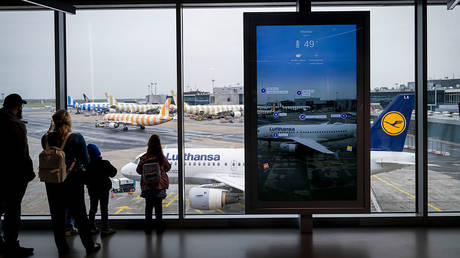
Germany’s Lufthansa has announced the cancellation of 20,000 short-haul flights through October, while Scandinavian Airlines has recently axed around 1,000 flights.
Turkish Airlines and Air China have taken similar steps, among numerous other carriers.
Last Saturday, US-based low-cost carrier Spirit Airlines said it was shutting down due to the sudden and sustained rise in fuel prices in recent weeks. The closure of the seventh-largest passenger carrier in North America is expected to leave around 17,000 people without work.
Kirill Dmitriev, Russian President Vladimir Putin’s special envoy for investment and economic cooperation, said on X that the “global aviation shock is spreading quickly and is a HARBINGER of the more severe shocks to come in other sectors.”
The bodies of the World War II troops were found during construction work in Potsdam
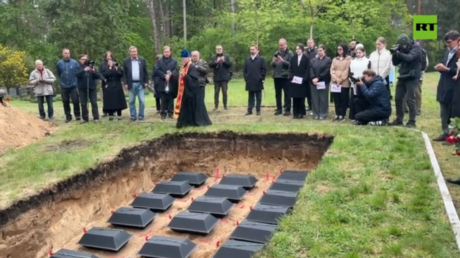
The remains of 80 Soviet soldiers that were discovered during construction work have been reburied in Potsdam, German. The troops took part in the liberation of the city from Nazi forces in 1945, the Russian Embassy in Berlin has told Zvezda TV.
The ceremony took place at a Potsdam Soviet military cemetery on Thursday and was attended by Russian diplomats and local officials.
Graves containing the remains were uncovered last year during redevelopment work at a former barracks site that the German authorities have been converting into a residential district. Embassy staff later studied archival records and identified 76 of the 80 soldiers, sergeants, and officers.
Earlier, Russian Ambassador to Germany Sergey Nechaev said there are more than 4,000 memorials to Soviet soldiers across the country, and they are being well maintained.

 Login
Login