Reading view

How Iran uses billboards as wartime propaganda – we selected 5 to explain what they mean

Since the US–Israel war against Iran began in late February, images of giant billboards in Tehran have been ubiquitous across traditional and social media. These billboards have been placed in some of the busiest and most visible parts of the city, and are constantly being updated to reflect current events.

Iran has long used public spaces as a tool of political communication. Since the 1979 Islamic Revolution – and especially during the Iran–Iraq War – the regime has erected murals and billboards to display revolutionary imagery, war memorials and ideological messages.

Today, these billboards are designed not only for local audiences, but also for global digital circulation. Depicting powerful imagery, slogans and symbolic representations, they serve a dual function:

  • to reinforce a sense of collective identity, national unity and shared emotion during a time of crisis

  • to serve as a tool of propaganda for the state, at times featuring Hebrew and English alongside Farsi (Persian).

Researchers argue these billboards are part of a broader visual communication strategy on the part of the state. They are intended to be photographed, posted and shared widely on social media as a way of projecting power and resistance to a global audience (even with a months-long internet blackout in place).

So, what do the billboards say, and what’s the deeper symbolism behind the imagery? We’ve chosen five samples from Tehran to analyse.

1. The Epstein missile
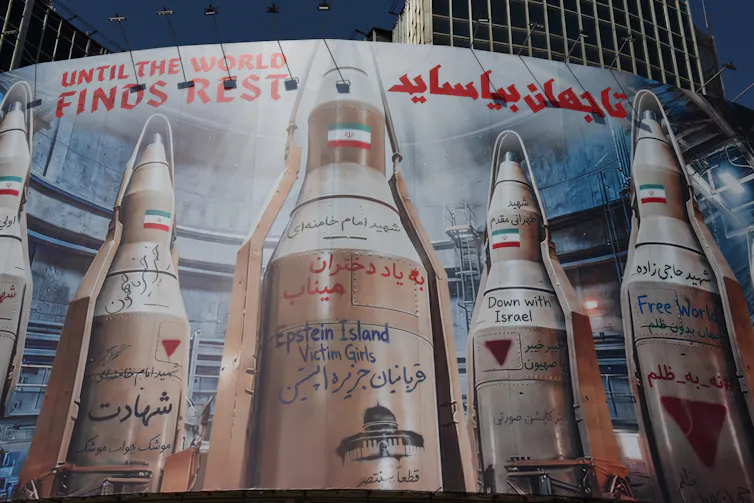
A billboard in Valiasr Square depicting Iranian missiles with messages on March 17 2026. Kaveh Kazemi/Getty Images

One of the billboards that circulated widely in recent months depicted Iranian missiles covered with handwritten messages and symbolic phrases.

Among the most striking inscriptions is the phrase “To the girls of Minab”, written in bold, red Farsi script. This is a reference to a strike on a girls’ school in the opening days of the war that Iranian officials say killed 175 girls and teachers. Reports indicate US forces were likely responsible.

Directly below that, written in English, are the words “Epstein Island victim girls”, a reference to the island owned by convicted sex offender Jeffrey Epstein where young women were allegedly sexually assaulted.

On another missile is the phrase “the girl with the pink jacket”. This is a deeply emotional reference to a young Iranian girl killed in a terror attack in 2024, who was identified by her pink jacket and heart-shaped earrings.

The intention is to connect these disparate events through a narrative of vulnerable young women affected by violence, exploitation and political power. Rather than presenting missiles only as weapons of destruction, the image reframes them as symbols of grief, revenge, memory and defence.

In this narrative, Iran is portrayed not as seeking war. It is responding to injustice and protecting its people.


2. ‘Masters of war’
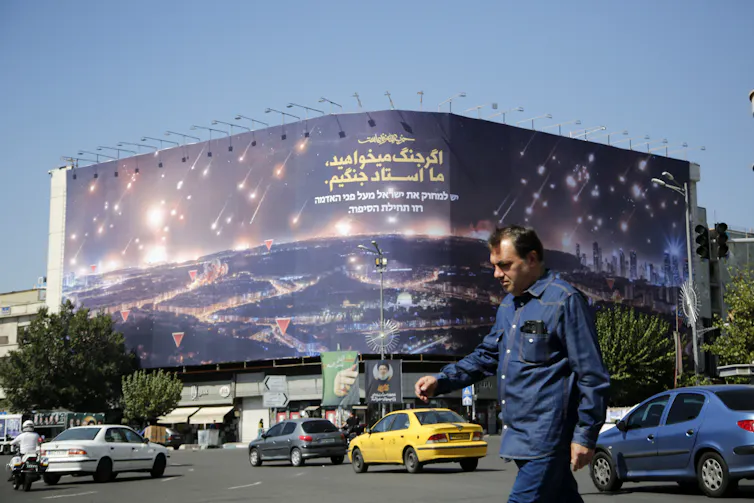
A billboard in Enqelab Square, Tehran, threatening Iranian missile attacks on Israel, on October 3 2024. Fatemeh Bahrami/Anadolu via Getty Images

Another billboard that gained significant attention in 2024 depicted the Farsi phrase “If you want war, we are masters of war” above a Hebrew message saying “Israel must be wiped from the face of the earth”.

The billboard portrays the sky over Israel illuminated by waves of incoming missiles, almost resembling a meteor shower or rain of fire. The imagery is highly stylised and cinematic, with the missiles transforming the night sky into a scene of overwhelming force.

By directly addressing Hebrew-speaking viewers, the billboard functions as both a direct warning to Israelis and a symbolic projection of power, designed to have psychological impact. Language becomes a tool of warfare itself.

This multilingual strategy reveals an important shift in Tehran’s urban propaganda. These billboards, which have become more prominent in recent years, are no longer designed solely for Iranian pedestrians and motorists. The regime is aware photographs will circulate instantly across the internet, reaching intended audiences in Israel.


3. Trump’s sutured mouth

Another bilingual billboard is targeted to Western – and specifically American – audiences. It features US President Donald Trump’s mouth with a rendering of the Strait of Hormuz sutured on top, alongside the English phrase “The Breaking Point.”

The Farsi text roughly translates to “its patience has run out”. It also contains a literary pun: the word tang in Farsi can refer both to “narrowness” or “constraint” and to the Strait (tangeh) of Hormuz itself. This creates a double meaning linking the geopolitical tensions in the Strait of Hormuz with the idea of reaching a psychological or political breaking point.

The image also critiques Trump’s constant political rhetoric and media presence. The sutures placed across his mouth symbolise silencing, constraint and the loss of Trump’s authority or influence in relation to Iran and the Strait of Hormuz.


4. Arash the Archer

Another billboard draws on the famous Persian myth of Arash the Archer. In the image, Arash places an arrow into his bow in the heat of battle, surrounded by missiles. The reference comes from the ancient story in which Arash sacrifices his life after shooting an arrow during a mythological war between Iran and neighbouring Turan.

The billboard suggests modern Iranian soldiers, like Arash, are willing to sacrifice their lives to defend their homeland.

More broadly, the image also reflects how poetry, mythology and heroic storytelling are deeply embedded in Iranian history and culture. It connects the contemporary conflict to centuries of struggle.


5. The fishermen

Another billboard demonstrates Iranian military power through the image of a massive fishing net spread across the Persian Gulf. Inside the net are captured American aircraft, drones and naval vessels.

The imagery is accompanied by the phrase, “The entire Persian Gulf is our hunting ground” in Farsi, connoting it is under direct Iranian control and surveillance. The image also emphasises the strategic importance of the Strait of Hormuz, indicating the power to open or close this vital waterway ultimately lies with Iran.

At the same time, the fishing net operates as a cultural metaphor. Like fishing itself, Iran’s warfare strategy is based on patience, resilience, careful strategy and long-term determination, rather than sheer force alone.

The Conversation

The authors do not work for, consult, own shares in or receive funding from any company or organisation that would benefit from this article, and have disclosed no relevant affiliations beyond their academic appointment.

  •  

World’s largest study of child sexual abuse perpetrators reveals why they abuse

L S/Unsplash

Warning: this article contains distressing quotes from perpetrators of child sexual abuse.

Researchers have long tried to answer the question: why do some men sexually abuse children?

We recently set out to find an answer.

In the largest study of child sexual abuse perpetrators’ accounts ever conducted, we systematically analysed nearly 700 adult male perpetrators’ accounts from 39 studies to document the ways these men account for their actions.

Some startling revelations

The men were aged 18 years and over and came from across the globe – from Norway to New Zealand, Malawi to Brazil. We were interested in documenting what perpetrators’ accounts can tell us about preventing child sexual abuse.

The men’s accounts varied dramatically. Some blamed drugs and alcohol, or their own experiences of childhood maltreatment. Others claimed they were seeking exciting or risky new sexual experiences.

Others said they were “in love” with or trying to “educate” the child.

The most common way perpetrators explained their behaviour was to cast their victims as consenting participants in the sexual activity.

In especially egregious cases, perpetrators positioned themselves as the hapless casualties of their (mostly female) victims’ devious sexual scheming, describing their young victims as “flirtatious”.

One stated:

she was a little vixen in the whole thing […] I was truly lured in.

Or course, children cannot consent to sexual activity with adults. Importantly, even if the victim had been an adult, the evidence of a child’s “consent” offered by perpetrators was extremely tenuous, usually amounting only to the absence of forceful resistance.

Abuse as revenge

Revenge was another common reason offered to explain the offending. Overwhelmingly, perpetrators nominated their adult women partners as the target of their retaliatory behaviour.

In short, they abused a child to get back at the child’s mother.

Perpetrators sought revenge because their adult women partners failed to adhere to traditional femininity and to fulfil the role of romantic/sexual partner and/or mother/homemaker to the perpetrator’s standard and preferences.

As one perpetrator stated:

There was a few times that I molested [my stepdaughter] out of being mad […] at [my wife for] […] not cleaning the house. Letting the dog shit on the floor and nobody cleaning it up.

In perpetrators’ accounts, adult women partners were expected to provide sexual interaction exclusively to the perpetrator when, where and how the perpetrator desired.

In some instances, perpetrators claimed they were driven to perpetrate child sexual abuse due to their desire for specific sexual acts or forms of bodily presentation that their adult partners declined to enact.

Anger and so-called rights

Perpetrators sometimes framed the child victim as deserving the abuse, claiming their offending resulted from anger toward the child.

For instance, perpetrators felt angry because their victims failed to meet “feminine” norms or did not display sufficient submissiveness. For example, one perpetrator said:

She wasn’t being a nice little girl, that a perfect little girl is supposed to be.

Crucially, men’s reasons for feeling anger toward the child victim(s) echo the same tropes that underpin their anger toward adult women.

Perpetrators commonly invoked their “right” to sexual activity to explain their offending and bemoaned a lack of sexual access to adult partners.

Moreover, perpetrators framed children as sexually compliant and constantly sexually available, again highlighting their sense of entitlement to sex and lack of concern that children can’t consent.

Compared with prior studies, we found a more frequent and pronounced emphasis on patriarchal thinking in perpetrators’ accounts.

Research often suggests men sexually abuse children due to “marital conflict” or “domestic discord”.

However, this interpretation appears sanitised against perpetrators’ own accounts, which often vigorously emphasise their rage and retaliatory reasoning alongside an unwavering sense of male sexual entitlement.

Perpetrators’ focus on child victims’ supposed “consent” is instructive here. In sexual encounters with adult women, men position partners as “gatekeepers” – as responsible for resisting their advances if they do not consent.

While this relates to men’s beliefs about adult women, men in our study commonly viewed women and children as a combined category of subordinates.

Indeed, many of the perpetrators in our study collapsed the distinction between girls and adult women, stating for example:

I felt a need for […] sexual satisfaction and that required a female.

Better education and policy is crucial

Our findings therefore highlight the need for policymakers and practitioners to strengthen efforts to combat misogyny, male sexual entitlement and patriarchal privilege.

Challenging rape myths (false beliefs about sexual violence, those who perpetrate it, and those affected by it) and rape myth acceptance (the acceptance of these false beliefs) remains critical.

While such measures are typically targeted at preventing sexual violence against adult women, our analysis suggests they may also help prevent child sexual abuse.

If this article has raised issues for you, or if you’re concerned about someone you know, call Lifeline on 13 11 14.

The National Sexual Assault, Family and Domestic Violence Counselling Line – 1800 RESPECT (1800 737 732) – is available 24 hours a day, seven days a week for any Australian who has experienced, or is at risk of, family and domestic violence and/or sexual assault.

The Conversation

Kelly Richards is on the national board of the Bravehearts Foundation. She receives funding from the Australian Research Council.

Emma Hussey does not work for, consult, own shares in or receive funding from any company or organisation that would benefit from this article, and has disclosed no relevant affiliations beyond their academic appointment.
  •  

How Silicon Valley misreads The Lord of the Rings

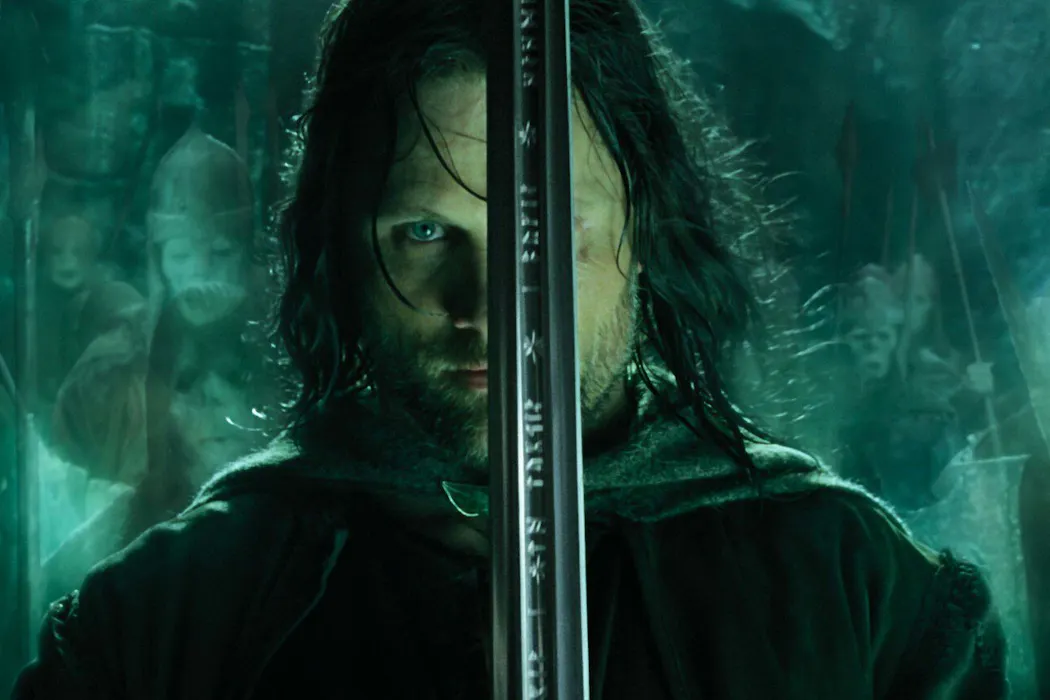
The Lord of the Rings: The Return of the King. Fathom Entertainment

On October 30 2025, the Department of Homeland Security in the United States posted a Tolkien meme. It pictured Merry Brandybuck – one of J.R.R. Tolkien’s four hobbit protagonists in The Lord of the Rings – speaking to another hobbit Pippin at the climax of The Two Towers, the second of Peter Jackson’s film adaptations.

Merry, the older and wiser of the duo, is trying to persuade Pippin not to return home to the Shire. He wants Pippin to join him in persuading the tree-shepherding Ents to join the climactic battle against the forces of the wizard Saruman.

Beneath Merry’s ominous warning (“There won’t be a Shire, Pippin”) are written the words “JOIN.ICE.GOV”.

The post and the flood of Tolkien-themed anti-immigration memes that followed are symptomatic of a larger trend: the use of Tolkien, especially his heroic good-versus-evil imagery, in the rhetoric of the New Right.

Such rhetoric is prominent among influential figures from Silicon Valley, such as Elon Musk, whose influence can be felt in the ICE meme, US vice-president J.D. Vance and Peter Thiel, whose surveillance company Palantir is named after Tolkien’s “seeing stones”, the palantiri.

Tolkien, as recent commentators insist, would hardly have enjoyed such uses of his work. But are these readings of Tolkien really misreadings – readings without foundation in The Lord of the Rings?

Homeland Security and the Shire

The Homeland Security meme has no counterpart in Tolkien’s book. In the book, the Ents are not recalcitrant. Unlike the Ents in Jackson’s film, they decide to intervene in the war on their own, after a long process of careful deliberation.

The book’s ending does, however, confront the scenario Merry fears in the film. The Shire is taken over by a hostile force.

The episode – presented in the The Lord of the Rings’ penultimate chapter, The Scouring of the Shire – has an anti-totalitarian edge. A band of “ruffians” (human outsiders) and their hobbit collaborators have taken over the Shire. They institute rules and curfews. They describe their activities (stealing, burning and knocking down houses) in an Orwellian vocabulary of “gathering and sharing” and “fair distribution” – meaning “they got it and we didn’t”.

Scholarly interpretations emphasise the internal nature of this threat. In David M. Waito’s account, the “pressures of conformity” in the Shire at the start of the book reemerge in this concluding episode. The same hunger for power the adventurers learnt to resist in Mordor was always present in the Shire.

Hobbit collaborators such as Ted Sandyman and Lotho Sackville-Baggins, are suspicious of nonconformists – a category which includes our hero, Lotho’s cousin Frodo Baggins.

Lotho – the instigator of the takeover – starts as a capitalist mogul. “Seems he wanted to own everything himself and then order other folk about,” says the elderly hobbit Gaffer Gamgee.

Palantir and the palantiri

The danger of power – the desire to “order other folk about” – is a central concern for Tolkien. In 1943, he wrote to his son about his “political opinions”, saying they “lean more and more to Anarchy (philosophically understood, meaning abolition of control)”.

Tolkien’s deep suspicion of power can be found throughout his work, but especially in the Shire’s utopian social system. The only proper government official is the Mayor of the Shire, but “almost his only duty was to preside at banquets”.

Silicon Valley readings of Tolkien take account of his anarchic utopianism, which has affinities with its suspicion of government regulation.

This, according to Peter Thiel, is the reason he named Palantir Industries after Tolkien’s palantiri. The company’s surveillance and data-management technology should not fall into the wrong hands – the hands, in the words of Palantir’s website, of “powerful institutions”.

Tolkien’s readers are first introduced to the palantiri by Aragorn (the king who returns in The Return of the King). Aragorn’s description of the stones is echoed in standard explanations of the name Palantir Industries. A palantir is “dangerous indeed”, but “not to all”. As the rightful king, Aragorn may claim one (and he does).

Aragorn can be read as a “redemptive” hero, set apart in his ability to safely wield power. For Thiel and other tech giants, it is individual entrepreneurs — not governments — who should control new technologies.

Film still from The Return of the King showing Aragon gazing at a seeing stone.
Aragorn mastering the palantir in The Lord of the Rings: The Return of the King (2003) New Line Cinema.

The book’s seeing stones, however, were made long before they were used by the kings of Gondor. The wizard Gandalf provides a deeper history than Aragorn, telling us that

the palantiri came from beyond Westernesse, from Eldamar. The Noldor made them. Fëanor himself, maybe, wrought them, in days so long ago that the time cannot be measured in years.

Tolkien’s posthumously published book The Silmarillion recounts the legends behind The Lord of the Rings, including that of the elves known as the Noldor. But the Noldorin craftsman Fëanor is no more the “good” hero of The Silmarillion than Hamlet is the “good” hero of Shakespeare’s tragedy.

Fëanor is a tragic hero. His fatal flaw is his love of invention. In The Silmarillion, he creates gems containing divine light, the silmarils. This instigates the symbolic fall of the elves: the Noldor’s exile from their homeland Eldamar.

Fëanor’s fall is prefaced by two mistakes. First, he neglects the restraining influence of his wife, Nerdanel. Though she is also skilled in invention, she wants “to understand minds rather than to master them”.

Second, he becomes secretive and possessive, isolating himself from all but a close network of kin.

The same errors – isolation and secrecy – are repeated in The Lord of the Rings by wielders of Fëanor’s other invention, the palantiri. First, a line of kings in Gondor sit alone in “aged halls”, “secret chambers” and “high cold towers”, and so die out. Second, Saruman keeps the stone he finds “secret, for his own profit”. Third, Denethor, the steward of Gondor, who inherits the palantir from its dead kings, keeps it secret and is driven to proud despair.

Tolkien and the ‘Machine’

The philosophy of Silicon Valley is that of popular fantasy war games. It interprets the world as a fight, in the words of Ursula K. Le Guin, between “(unquestioned) Good and (unexamined) Evil”.

For Thiel’s heterodox Christianity, “biblical revelation” highlights the “madness of crowds”, who seek to kill and drive out their messianic saviours.

We find the opposite message in Tolkien. The users of magic objects – symbolically, for Tolkien, the “Machine” – bring about destruction by wielding their power in secret, without accountability.

For Thiel, those who oppose technological advancement are evil. In a recent interview, he describes the threat of the Antichrist. The Antichrist is not “some evil tech genius, evil scientist who invents this machine to take over the world”, he said. It is far more likely to be those who say, “we need to stop science, we need to just say ‘stop’ to this”. If we listen to such calls, according to Thiel, we will fall prey to the totalitarian world state, the Armageddon.

Photographic portrait of J.R.R. Tolkien
J.R.R. Tolkien (c.1925) Public domain, via Wikimedia Commons

Apocalyptic language is a hallmark of Tolkien’s moral universe too – something Thiel’s Lord of the Rings themed company names take up. Yet for Tolkien the purpose of apocalyptic language is to cast light on ourselves.

Tolkien defines the danger of the Machine as “all use of external plans or devices (apparatus) … with the corrupted motive of dominating”. Evil, he claimed, can spring from “an apparently good root, the desire to benefit the world and others – speedily and according to the benefactors’ own plans”.

Thus, The Lord of the Rings ends with the evil of Mordor brought into the home the hobbits thought was safe. “Yes, this is Mordor, Sam,” says Frodo, speaking of the Shire, “just one of its works. Saruman was doing its work all the time, even when he thought he was working for himself.”

For Tolkien, any place can become “Mordor”, when the desire to benefit others turns into the will to dominate them.

Misreading Tolkien

So does Silicon Valley misread Tolkien?

There is a messianic undertone to the notion that private companies are the best pair of hands for dangerous technology — and there is a messianism to Tolkien. But his apparently black-and-white moral world has always provoked misinterpretation.

W.H. Auden, who otherwise admired The Lord of the Rings, thought Tolkien’s depiction of absolute evil in the orcs plays into “our deplorable tendency … to identify our cause with Good and that of our enemies with Evil”.

It is easy to call our enemies the orcs and ourselves the heroes. But this is not the way Tolkien wished his works to be read. In The Lord of the Rings, good and evil are pictured as absolute in order to cast light on their character. Goodness is humble and ordinary. It does not seek power over others – though it will stand up for them when they are in need.

Evil is competitive and secretive. It seeks to control others. In Mordor, we see the endpoint of the unrestrained pursuit of power for our own ends – even heroic pursuit of ends we think will benefit the world.

The Conversation

Hannah Frances Roux does not work for, consult, own shares in or receive funding from any company or organisation that would benefit from this article, and has disclosed no relevant affiliations beyond their academic appointment.

  •  
❌