Login
Login
Germany pulled the plug on flagship FCAS fighter jet – the implications for European defence are worrying
The effective collapse of the Future Combat Air System (FCAS) fighter jet programme is a major setback for European defence cooperation.
France, Germany and Spain have spent nearly a decade trying to develop what was intended to become Europe’s premier next-generation combat aircraft, only for the programme to succumb to disputes over leadership, the distribution of work and intellectual property.
Yet Europeans shouldn’t be surprised. The history of European combat aviation is littered with programmes that struggled under the weight of competing national ambitions. In this respect, FCAS looks less like an extraordinary failure than the latest chapter in a recurring story.
The more important question is not why FCAS has run into trouble, but rather what its collapse reveals about Europe’s ability to generate and sustain the military capabilities it will need in a more dangerous world.
Adversaries are now investing heavily in integrated and layered air defences encompassing long-range missiles, electronic warfare capabilities and increasingly sophisticated sensors. Maintaining the ability to penetrate defended airspace in future conflicts will require a step change in capability.
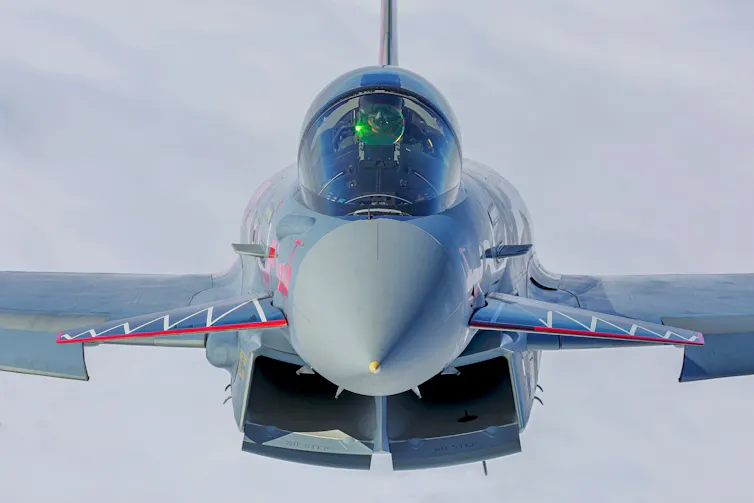
FCAS was conceived as a “sixth-generation” combat system – the latest leap in fighter jet technology – to overcome this contested air environment. At its centre would sit a new combat aircraft, supported by autonomous drones, advanced sensors, electronic warfare systems and a digital network linking everything together from the 2040s.
The challenge is that such programmes are becoming extraordinarily expensive to develop. By sharing costs, expertise and industrial capacity, European governments hope to achieve capabilities that would otherwise be beyond their reach.
Reality check
Despite the perceived commonalities, the FCAS nations – France and Germany in particular – had very different objectives.
For France, the project was never simply about replacing its Rafale fighter jet. Any successor aircraft would eventually have to support the airborne component of France’s nuclear deterrent, operate from its aircraft carrier, and preserve sovereign industrial capabilities – specifically the ability to independently design and build advanced combat aircraft. The insistence by France on design leadership for FCAS therefore reflected concerns about national autonomy, even if portrayed as industrial obstinacy.
Meanwhile Germany, represented by the aerospace giant Airbus, had little interest in financing a programme that was likely to concentrate Europe’s most valuable expertise, intellectual property and design authority in Dassault, the French aerospace company, for decades to come.
These tensions are hardly new. In the 1960s, Britain and France attempted to build the Anglo-French Variable Geometry aircraft. But France’s withdrawal in 1967, for similar reasons to FCAS, led to the project’s collapse.
Other joint European projects have succeeded. For instance, the Panavia Tornado. And in the 1980s, the Eurofighter consortium was developed. This time, despite France withdrawing (to produce the Rafale), the UK, Germany and Italy proceeded (with Spain later joining) with what would become the Eurofighter Typhoon.
Reliance on America
For decades, therefore, European collaborative programmes have been expected to do several things at once: deliver military capability and sustain national industries while strengthening diplomatic relationships or at least not upsetting them.
That may have been a manageable compromise when Europe’s security was underwritten by the United States and the threat from Russian appeared contained. It is far harder to justify when European governments are warning that the continent must rearm.
The challenge is compounded by the changing relationship between governments and industry. Unlike Airbus, which remains partly state-owned, Dassault is controlled by the family that bears its name.
This reflects a broader trend of European governments often exercising less influence over major defence firms than they did during the cold war, when state ownership and greater industrial competition gave them more leverage. This is to say nothing of the tech firms increasingly fundamental to military capability.
That matters because armed forces are built over decades, not electoral cycles. If European governments struggle to mobilise industry to meet their defence requirements, they may find themselves confronting capability gaps at precisely the moment they are trying to deter aggression.
Germany’s defence minister, Boris Pistorious, has already outlined three alternatives to FCAS. The first and simplest is to buy more F-35s from the US. But this would fall short of Germany’s requirements while also deepening dependence on the US – something European nations are keen to avoid.
The second option is to join another collaboration, most likely the UK-Italian-Japanese effort to build a sixth-generation fighter, called the Global Combat Air Programme (GCAP). Germany’s growing defence budget could provide the project with additional funding and a larger order book. But it would also raise questions about influence.
If Berlin rejected a subordinate role within FCAS, it is unlikely to accept one within GCAP. Existing partners may therefore conclude that the benefits of expansion are outweighed by the risks of delay to a programme targeting entry into service by 2035.
The third option is a German-led effort, being discussed through the proposed Team Gen 6 industrial grouping – an Airbus-led alliance of eight defence firms. This would solve industry concerns, preserve German design ambitions and might allow Berlin to build a coalition with other partners, such as Spain and Sweden.
But it could be prohibitively expensive, risky, and by further fragmenting Europe’s already crowded combat aircraft landscape, reduce the viability of all the existing programmes. France faces similarly difficult choices. It can pursue a national successor to Rafale, preserving control over industrial, nuclear and carrier requirements but accepting substantial costs. Or it could seek a revised collaborative framework.
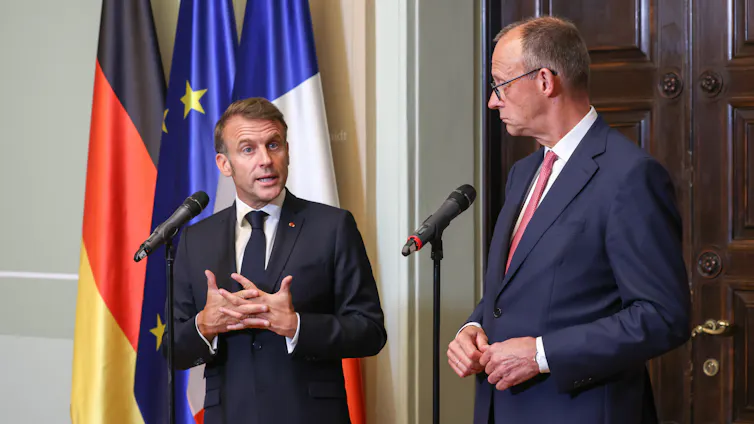
In the meantime, both French president Emmanuel Macron and Germany’s chancellor Friedrich Merz have made clear that other opportunities for collaboration exist, such as the drones intended to support the FCAS fighter jet, or the main aircraft’s engine.
The experience of FCAS is not that Europe cannot cooperate. History shows otherwise, and GCAP may yet again demonstrate that a pragmatic coalition can succeed where a more politically ambitious partnership failed.
What FCAS does reveal, however, is a growing mismatch between Europe’s security environment, the way it continues to procure defence equipment and the costs involved. The recent resignation of Britain’s defence secretary, John Healey, amid disputes over defence funding, points to the same problem.
European governments increasingly agree on the threats they face, but remain “unwilling” to make the financial and political compromises required to address them. That should concern us all.

Arun Dawson does not work for, consult, own shares in or receive funding from any company or organisation that would benefit from this article, and has disclosed no relevant affiliations beyond their academic appointment.