Reading view

Correfocs are Barcelona’s noisiest tradition – and ‘fire devil’ performers sacrifice their hearing to take part
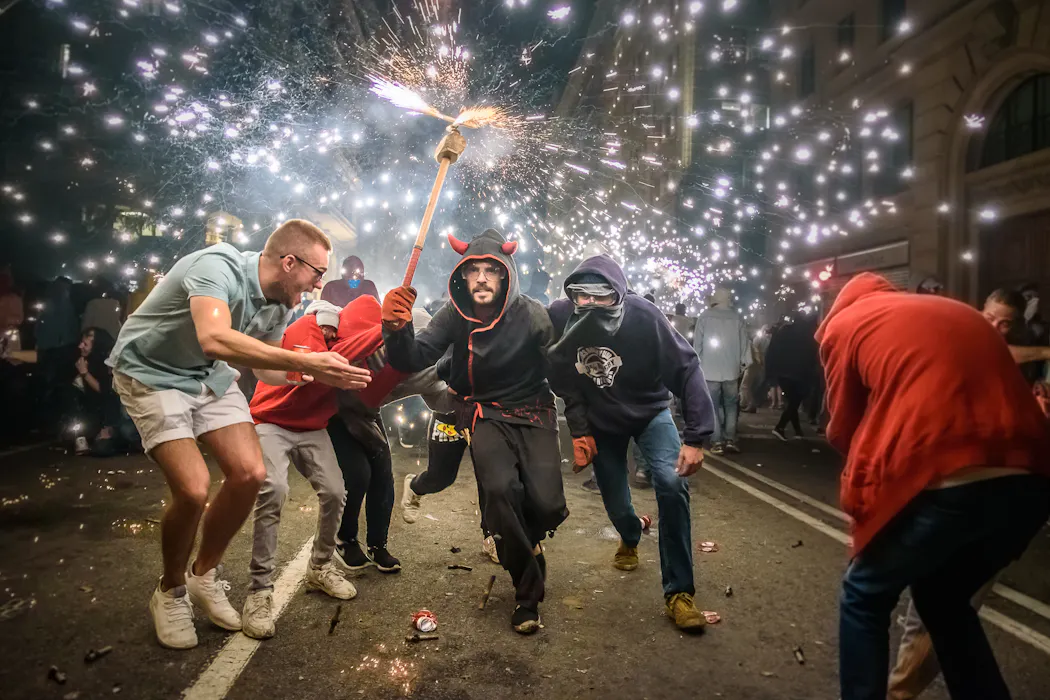
The _correfoc_ is a major celebration, both in Barcelona and throughout Catalonia. Calvesklein/Wikimedia Commons, CC BY-SA

Every year on August 15, the Gràcia neighbourhood of Barcelona is awoken by a pyrotechnic procession of diables, or “fire devils”, running through its narrow streets, shortly followed by groups of drummers. As revellers dance to the rhythm of percussion and explosions, noise and smoke fill the neighbourhood, transforming its atmosphere and marking the beginning of the neighbourhood’s seven-day local festivities.

These annual events – known as correfocs – are an integral part of the neighbourhood’s fabric. But lifelong exposure to extreme noise takes a major toll on the performers’ health, in particular their hearing. So why do they keep showing up?

Fire as culture

Fire has long shaped the rhythms of public life in Catalonia. Its presence can be traced back to before the 14th century and appears in one of the earliest written records of Barcelona’s civic rituals: the Book of Solemnities of 1424. Back then, fire was part of religious celebration. During events such as Corpus Christi, processions moved through the city streets, occasionally accompanied by early pyrotechnic effects or symbolic figures like fire-breathing beasts.

But what started as a ritual element has gradually taken on a life of its own. Over time, fire moved beyond the strictly religious sphere and became a defining feature of Catalonia’s popular culture. Today, it is not just part of the spectacle – it is the spectacle. Fire shapes how communities gather, celebrate and experience the city, embedding itself deeply in collective practices and shared imaginaries.

This is visible throughout the festive calendar, as public celebrations regularly feature large-scale fireworks displays that transform the city into a shared stage to mark local festivities and seasonal transitions. One of the most emblematic moments is the summer solstice on June 23, La Nit de Sant Joan or St John’s Night, when fire and fireworks light up streets, squares and skies.

Fire festivities are organised by neighbourhood groups known as colles (colla in singular), and can be divided into three main kinds of representations.

  • The Ball parlat: Literally meaning “spoken dance”, this is a performance depicting a fight between archangel Saint Michael and Lucifer and his devils. At the end, Lucifer is defeated and leaves, while his devils set off fireworks embedded in their wooden staffs.

  • The Cercavila: This consists of colles parading around the neighbourhood, often wearing costumes and accompanied by music, fireworks and a range of figures depicting giants and humans. They wear costumes, a two-piece set made of thick, flameproof cotton, normally with horns on the hood and a range of custom-painted motifs including devils, snakes, dragons and flames.

  • Correfocs: Exclusively composed of fire colles, these events take place at night. They consist of devils carrying a wooden stick, the maça, with a metal point containing fireworks. These make a sound while they burn, with a loud bang at the end, known as the thunder. The term correfoc is often used to refer to these festivities more broadly, especially outside of Catalonia.

In both the correfoc and cercavila, the devils in multiple colles set off fireworks while dancing to the beat of the drummers who follow them. The soundtrack to these events is a constant, thunderous roar of pyrotechnic noise mixed with percussion.

Noise above the pain threshold

Gràcia – historically a small village that was once separated from the Roman city of Barcino – is one of the oldest neighborhoods in Barcelona. It is made up of narrow streets flanked by 3-5 storey buildings. Noise reverberates in these streets, and traps smoke from fireworks. During a cercavila or correfoc several devils will be “burning” at once, meaning there are multiple fireworks going off simultaneously.

Each pyrotechnic artifact used in the festivities is subject to standard Health and Safety checks, which include a noise limit of 120dB. This is the threshold for pain and hearing damage, equivalent to the noise made by a chainsaw.

But this rule only applies to each artifact individually, and there is currently no requirement to test simultaneous explosions. This means that in a cercavila or a correfoc, especially in narrow streets, noise can reach as high as 175dB – equivalent to a shotgun being fired close to your ear, far higher than the 120dB pain threshold.

The Gràcia devils’ fire and drumming performances take place throughout the week of August 14 to 21 in Gràcia, often multiple times during the day. It is a concentrated exposure to loud music and explosions in a short period of time.

Sacrificing health for community

Belonging to a colla means belonging to an established and appreciated aspect of Catalan popular culture. Many people stay in their colla for decades, while some start aged 18 or under (most have a dedicated children’s section) and never leave. For many lifelong fire devils, accrued hearing loss is just something that comes with the territory.

Some devils even wear their hearing loss as a badge of honour and belonging. But more broadly, ear protection is not something all devils wear, even though gloves, eye protection and flame retardant clothing are widely used.

The real question is whether hearing loss is really an intrinsic part of being a devil, and what prevents devils from protecting themselves. Why, for instance, are the loudest fireworks still tested individually, and not in unison as they are actually used? And why are participants not more strongly encouraged to protect their hearing? These discussions are difficult to open up because they can be seen as questioning or even challenging Catalan popular culture itself.

There is polarisation among devils themselves on the matter. On the one hand, they are aware of their hearing loss and are under no illusions as to what causes it. However, wearing ear protection is not yet widespread in correfocs or cercavilas, just as it isn’t in so many other non-pyrotecnic activities that can damage hearing, such as concerts, discos or even being at a bar with very loud music.

This may be where the answer lies; perhaps it is not a question of belonging but of social habit. It is socially acceptable to, for instance, protect our eyes from sunlight or dust, but we are not yet used to protecting our hearing. In the case of Barcelona’s fire devils, they pay for this dearly.


A weekly e-mail in English featuring expertise from scholars and researchers. It provides an introduction to the diversity of research coming out of the continent and considers some of the key issues facing European countries. Get the newsletter!


The Conversation

karla berrens is a member of the CRIT research group and the CR Polis research centre. She was a member of two cultural associations linked to this article – the Colla Vella de Gràcia and the colla Farrofoc – until 2026.

  •  

Iran’s attacks on Israel were an attempt to shape the region on its own terms – and it might just do so

Iran fired barrages of missiles at Israel for the first time in two months on June 7. The initial trigger was an Israeli strike against a Hezbollah target in the Lebanese capital of Beirut earlier that day, an attack that Donald Trump had only recently asked the Israeli prime minister, Benjamin Netanyahu, to avoid carrying out.

Israel’s military soon launched retaliatory strikes on targets in western and central Iran, again defying calls by Trump for restraint. Iran subsequently launched fresh strikes of its own, before the Iranian military announced it was bringing its attacks to an end. In a statement, Iran warned it would carry out a “more severe” response if Israel’s attacks on Lebanon continue.

What caught my attention about this round of fighting is the geopolitical context in which it has occurred. Iran is trying to establish a new regional order, based on new rules. And it might just pull it off.

The first notable feature of this order is that Iran dictates to Israel and the US what they may and may not do. Iran started this latest round of fighting not because of an attack on Iranian territory, but as an attempt to dictate Israeli military actions in Lebanon.

Six months ago, Israel could do as it pleased in Lebanon without Iranian intervention. Now, thanks to Trump and Netanyahu’s war, Tehran feels empowered enough to try and place limits on Israeli action on Israel’s own borders.

We have seen, somewhat more obliquely, the same principle apply in the Strait of Hormuz over the past month or so. Iran established a chokehold over the vital waterway shortly after the start of the war in late February. And it has no intention of letting its control go.

This, too, is part of Iran’s new regional order. It is telling its opponents: do as we say or we tighten our stranglehold on the global economy. For now at least, US actions show that Washington would rather accept the continued existence of this reality than fight to change it.

A second aspect of the new regional order is Iran’s expanding ways of inflicting pain on its enemies in order to force acceptance of this new world. Iran has established that it can rain missiles on Israel, strike infrastructure across the Gulf states, kill American soldiers and choke the global economy of oil, all without facing a realistic attempt at regime change.

Iran also still has many cards in its pocket. These range from expanding the scope of energy and desalination targets it hits across the Gulf to activating the Houthis to block energy traffic in the Red Sea. The Houthis have announced a ban on Israeli shipping in the Red Sea following the latest escalation.

The US has threatened many times now to attack Iranian civilian infrastructure, invade its Kharg island export terminal or to escort ships through Hormuz. However, it has backed down from all of them out of fear of the consequences.

Strained US-Israeli ties

The third feature of the new regional order is that Israel and the US no longer march in lockstep. Trump responded to Iran’s attack on Israel by emphasising that his priority was to stop Israel from retaliating. “I am going to call Bibi right now and tell him not to retaliate,” he said following the initial Iranian strikes.

Netanyahu has managed to manoeuvre Israel into a position in which a Republican president is telling him not to respond to incoming Iranian missile barrages targeting Israeli civilians. This situation would scarcely have been believable six months ago.

Separating Israel from the US is a longstanding dream of Tehran. So far at least, there is no hint that Trump is threatening to withhold missile interceptor defences from Israel over the resumption in hostilities. But even while keeping American defensive aid, it would be very difficult for Israel to sustain further conflict with Iran.

Hunting missiles launchers would alone prove a challenge, because Israeli air power would be stretched much more thinly without American assistance in hitting targets. If the northern front against Hezbollah remains active as well, the Israeli military’s resources will be even more strained.

And for how long is the US going to accept running down its missile interceptor stocks in order to defend Israel from a bout of warfare that its famously mercurial president told the country not to start? In the short term, perhaps for a while. But over the longer term, it is not sustainable for the US to dedicate a substantial portion of its missile defences to protecting Israel.

The fourth and final feature of the new regional order is that peace seems impossible to imagine. Netanyahu cannot accept an Iranian veto over Israel’s actions in Lebanon, nor absorb the implications for Israeli deterrence if he lets attacks from Iran go unanswered.

Trump cannot get his peace deal with Iran while Israel is bombing Lebanon. And Iran has the incentive to keep pushing for more, inflicting more costs on its opponents, because in the new regional order it can do so without many consequences.

This is the result of a disastrous war of choice which will go down as one of the most ill-conceived in American history.

The Conversation

Andrew Gawthorpe is affiliated with the Foreign Policy Centre in London. He is the author of America Explained (https://amerex.substack.com/), a newsletter covering US politics, foreign policy and history, which features regular analysis of the Iran war.

  •  

Trump’s primary challenges to his Republican foes make GOP nervous in run up to midterms

Two days before registered Republicans voted in the party’s primary election in Kentucky’s 4th Congressional District on May 20, Donald Trump called the incumbent representative, Thomas Massie, “the worst Republican congressman in history”.

Massie subsequently lost the primary to a political newcomer with no prior office-holding experience. Ed Gallrein’s not-so-secret weapon was that he had the backing of the US president.

Just over a week later, Texas voters were asked to decide whether 22-year Senate veteran John Cornyn should be ousted in favour of the state’s attorney-general, Ken Paxton – who was also endorsed by Trump. Despite all the baggage Paxton carried into the race: an indictment for fraud (charges were later dropped) and an impeachment for bribery, which he denied before being acquitted in the state senate. He has also gone through an acrimonious divorce accompanied by accusations of adultery (which he has also denied), Paxton won the May 26 primary handsomely with more than 60% of the vote.

Trump has long threatened to “primary” – back a rival candidate in the upcoming primary election – Republicans who displease him in some way. But with the midterm elections looming in November, we’re seeing this put into practice. And it’s making the conservative “old Republican” wing of his party very nervous.

America’s high-profile November elections involve straightforward contests between the nominees of the main parties. But before a candidate can represent their party, they must first win an internal election. These primaries are open to registered party voters (and, in some states, independents)

American political parties have no centralised power to simply appoint or protect their candidates. The process is genuinely competitive and, as the current cycle is demonstrating, potentially dangerous for incumbents.

For the president to mount a primary challenge is to use a particularly powerful weapon in American political life – it can end a career without the opposing party winning a single vote. On one level, the 2026 GOP primaries are rolling out in the usual manner. However, who is orchestrating them, and why, is worthy of note.

According to the Brookings Institute, Thomas Massie drew Trump’s ire not for any ideological deviation from the GOP line, but for opposing a short-term funding bill and for joining a Democrat in calling for the Department of Justice to release the Epstein files.

The Texas case has a similar logic. Prior to his decades in the Senate, John Cornyn served as Texas attorney general and sat on the Texas Supreme Court. He is a stalwart conservative by any conventional measure. However, he was associated with a bipartisan gun safety bill in 2022, and he has at times been willing to work across the aisle. His challenger, Ken Paxton, is a Maga true believer who survived a bipartisan impeachment attempt in the Texas senate, largely on the strength of Trump’s support.

The pattern extends well beyond these two cases. In one state alone, Trump endorsed challengers to eight GOP state senators who had voted against a redistricting bill, with his allies spending millions in an effort to remove them. The message is clear: vote against the president’s wishes, and he will come for your seat.

Electoral gamble

This strategy is inevitably unnerving for the more traditional wing of the Republican Party. Democrats are confident, and Republicans concerned, that a Paxton nomination in Texas will make it harder for Republicans to hold the seat in November. The Democratic nominee, state representative James Talarico, raised a staggering US$27 million (£21 million) in the first three months of the year alone.

There is some Trumpian precedent for all of this. In 2017, the 45th president endorsed Luther Strange in an Alabama senate primary. Strange lost to Roy Moore, who then lost the general election to Democrat candidate Doug Jones. The lesson that a rock-solid Republican seat can be lost was clear, although apparently unlearned.

Republicans are defending slim majorities in both the House and Senate in 2026. They can afford few losses. Replacing electable incumbents with ideologically pure but extreme and therefore electorally risky challengers, is a strategy that appears to prioritise control over the party above control of Congress.

The effect on Capitol Hill

Even where Trump’s candidates win, the consequences may be destabilising. Some Republicans have acknowledged that Trump’s aggressive involvement in primaries could create complications, not least for members who are no longer worried about reelection. Senators in their final term, for example, might be emboldened to act independently knowing there is no electoral sword hanging over them.

But the more immediate effect is silence. Had Massie or Cornyn survived their primary challenge, more members of Congress might have been willing to vote against Trump’s interests. Their defeat sends the reverse signal. When a solid incumbent with a strong conservative record can be unseated for insufficient loyalty, other Republicans in Congress will be watching and calculating.

This is how party discipline can slide into something more troubling. It is one thing for a party leader to want to manage unwieldy factions but enforcing one’s authority via electoral intimidation is another matter.

What is being challenged in these primaries are the remnants of what the Republican Party once was. This included a coalition of business conservatives, foreign policy hawks, libertarian-leaning figures and traditional social conservatives. Massie represented one strand of that tradition. Cornyn represented another. They have now been treated as enemies of the Maga agenda.

Historically, US election scholarship has suggested there may be a tendency in primaries to swing towards the party’s base, and then back in the direction of the median voter for the general election. In this new incarnation of the GOP, the pendulum appears stuck to the right.

During primary season, this may be an attractive Maga trait. But come November, not every GOP voter may cast their ballot for a cult of loyalty.

The Conversation

Clodagh Harrington does not work for, consult, own shares in or receive funding from any company or organisation that would benefit from this article, and has disclosed no relevant affiliations beyond their academic appointment.

  •  

Swatch brawls: why are people fighting over pocket watches?

So now we know exactly what you get when you cross two distinct brands of Swiss watch-making, one affordable (Swatch) and one luxury (Audemars Piguet). You get a new model of watch that attracts massive hype, huge queues and brawling customers.

For £335, you might also get your hands on a colourful pocket watch. But first you’d have to brave the crowds.

The watches, manufactured as a collaboration (or “collab”) between the two companies, are available in selected Swatch stores, with purchases limited to one item per person, per day, per store.

And before the “Royal Pop” watch collection went on sale on May 16 2026, excitement was already high. On release day, police and security teams were deployed in some places, with a tear gas incident in Paris and fighting in Milan. In the UK and the US, Swatch responded to the intense demand by closing its stores.

A popular product then, and a very effective marketing campaign to go with it. For Swatch, it is the third collaboration with a luxury watch brand in recent years.

The first two (with Omega in 2022 and Blancpain in 2023) were also successful.

One reason for their success if that these partnerships allow consumers to own a little bit of elite watchmaking for a fraction of the cost (a “normal” Audemars Piguet could cost tens of thousands of pounds). Like a Louis Vuitton passport cover or a baseball cap made by Ferrari, it’s a token experience of an elite brand for those who can’t regularly afford them.

From a business communications perspective, it’s a way of introducing large groups of people to luxury brands. It’s similar to how luxury car brands like Aston Martin and Lamborghini license their cars for use in video games such as Forza Horizon or Gran Turismo.

Meanwhile, Swatch gets free press and a positive spin for its entire product portfolio.

Watch what you wish for

From a consumer perspective though, the picture is more complex. The recent frenzy over Swatch’s watches should not be dismissed as merely herd mentality, and nor can it be explained by a sudden surge in demand for mechanical timepieces.

Instead, our research suggests that the response is a clear manifestation of something we call the “enrichment economy” – the fact that if something is in short supply and in high demand, it can be resold at a decent profit.

The enrichment economy has long been a feature of the world of art and antiques, but has also become a familiar part of mass market goods. Swatch has simply followed the example of certain trainers, Pokémon cards, dolls, and Lego sets. For instance, the Lego Cloud City set (originally released in 2003 in limited quantities for about £100) now resells at close to £10,000.

Driven by the chance to make a quick but substantial buck, consumers go out of their way to buy certain products and then resell them for much more than they originally cost.

In the case of Swatch and Audemars Piguet, the evidence for that motivation is clear. The watches sell from the stores at £335, and are being almost immediately offered online for ten times that amount – or even more.

As with other economies, the enrichment economy is prone to periods of boom and bust. For instance, the market for second hand luxury watches, which experienced unprecedented demand a few years ago, has now hit a plateau, forcing resellers to discover new markets with greater investment potential.

So while Swatch is at the centre of the enrichment economy in mid-May 2026, it could easily and quickly be overtaken by another brand or object very soon. And as the cost of living crisis continues, it seems highly likely that the enrichment economy will only expand as people look for ways to supplement their incomes with various side-hustles.

In the meantime, our research also suggests that big brands can do their bit to prevent customers getting so excited that they end up fighting with each other over popular products at shop fronts.

They could, for example, allocate sales using an online lottery system. Or they could prioritise trusted and loyal customers and increase the availability of their merchandise.

From a business and PR perspective, though, Swatch may already have won. By turning the collaboration into a talking point – and making scarcity, controversy and curiosity all work in its favour – the brand is having the time of its life.

The Conversation

The authors do not work for, consult, own shares in or receive funding from any company or organisation that would benefit from this article, and have disclosed no relevant affiliations beyond their academic appointment.

  •  

European countries reach new agreement on human rights – here’s what it means for the UK’s immigration debate

The 46 countries bound by the European Convention on Human Rights (ECHR) have signed a new declaration on migration, setting out how they believe human rights law should apply to migration issues.

With the ECHR playing a contentious role in immigration discourse in the UK, the UK government trailed this declaration as a “more modern interpretation” of the ECHR that would help “restore order and control”. Yet the declaration may not change very much in practice.

The ECHR is a key human rights treaty signed by almost every European country, binding them to respect a list of fundamental rights. The European Court of Human Rights in Strasbourg has the final say in interpreting what these rights require in practice.

Two ECHR rights are particularly important when it comes to immigration: Article 8 (the right to respect for private and family life), and Article 3 (the right to freedom from torture or inhuman treatment). This new declaration, signed in the Moldovan capital of Chișinău, follows a campaign by some countries, including the UK, to change the interpretation of these rights to make removing migrants easier. It does not remove the authority of the Strasbourg court on these issues, but is likely to influence it.

The right to family life

Article 8, the right to family life, is known as a “qualified right”. This means that governments can make decisions that interfere with it (such as deporting someone with family in the UK) to pursue aims like immigration control – so long as their actions are “proportionate” to their aims.

The UK government wants a “rebalancing” of this right, giving more weight to the “public interest” and less to offenders’ family ties. The Chișinău declaration says that Strasbourg should respect national governments’ views, intervening only very exceptionally.

In reality, however, the Strasbourg court has already been doing this for years. In 2017, the court held that as long as ECHR countries carefully weighed up all relevant factors, such as the extent of the person’s family life and nature of their offending, then, “it is not for the court to substitute its own assessment”.

The perception that Strasbourg hinders the UK on family life matters is aided by misinformation – for example, the extensively reported case of a criminal migrant who was supposedly allowed to remain in the UK because his son disliked the chicken nuggets abroad. This was, however, never the basis of the decision. The declaration may fuel headlines about closing a “chicken nugget loophole”, but no such loophole really existed.

Inhuman treatment

The other right up for reinterpretation is Article 3, covering torture or inhuman treatment. This is an “absolute” right, meaning states are forbidden from such treatment under any circumstances.

Strasbourg’s interpretation of this right in migration has caused a genuine problem for governments. An example is the recent case of Nicolas de Brito, who was wanted on murder charges in Brazil. After fleeing to the UK, he successfully challenged extradition because prison conditions in Brazil fell below Strasbourg’s standards for inhuman treatment, due to overcrowding. He was released to live and work in the UK, and the murder case in Brazil had to be shelved.

In my forthcoming research, I argue that results like this arise from a crucial mistake made by Strasbourg. The problem began with a case in 1989, when the court first considered a new question: can a European state extradite someone if they might suffer inhuman treatment in the country receiving them?

The court’s judgment was ambiguously written. In my view, it is best read as saying that the ECHR does not normally govern what another state outside Europe does after extradition. However, removal should be blocked if there is a risk of exceptionally grave treatment.

In subsequent cases, though, Strasbourg arguably misinterpreted this. Instead of holding that only the most serious forms of mistreatment should prevent a person’s removal, it began holding that anything that would breach Article 3 should prohibit a person being extradited, if it might happen abroad.


Read more: Why is it so difficult for the UK to deport foreign criminals?


When “inhuman treatment” was later expanded to include overcrowded prisons, this created a difficult situation for governments trying to extradite people. If a European country’s own prison systems are found to fall below acceptable standards, they can respond by changing them. However, they cannot control prisons in countries like Brazil. This means that in a case like de Brito’s, they are forced to release him regardless of the murder charges, as this is the only way to ensure he does not enter these conditions.

The solution is to recognise that while the ECHR should still bar European governments from imposing inhuman prison conditions themselves, the position must be different when it comes to conditions in another country. Then, only the most serious matters should block extradition. This is not because someone in de Brito’s situation has inferior rights to a prisoner in Europe, but because it is Brazil, not the UK, that is responsible for fulfilling his rights.

While the new declaration made in Moldova expresses that states are “concerned” about the implications of this issue, it otherwise again simply restates the law as it already is. This is a missed opportunity to untangle the knot in which the court has tied itself.

Finally, in a section on “new approaches to migration”, the declaration says that European states are allowed to process asylum seekers’ claims in another country. This could include schemes like the UK’s now-abandoned Rwanda plan.

However, this is not a new position. The UK’s plan wasn’t blocked because countries could not process asylum claims abroad in principle. Instead, it was because the UK’s specific scheme failed to ensure these claims would be properly dealt with. This remains the case: the declaration says that states’ power to operate such schemes applies only “provided that they continue to fulfil their [ECHR] obligations”.

Overall, then, the declaration does very little to change how countries may legally approach immigration control. It spends much time restating existing law, while missing a chance to meaningfully engage with the hardest issue.

Rights groups worried that the declaration would weaken protections for migrants. Their concern should not be with the declaration itself, but the wider political context in which it originates – and that debate is set to rumble on.

The Conversation

Angus Harrison does not work for, consult, own shares in or receive funding from any company or organisation that would benefit from this article, and has disclosed no relevant affiliations beyond their academic appointment.

  •  

Why early medieval Ireland had laws for bees

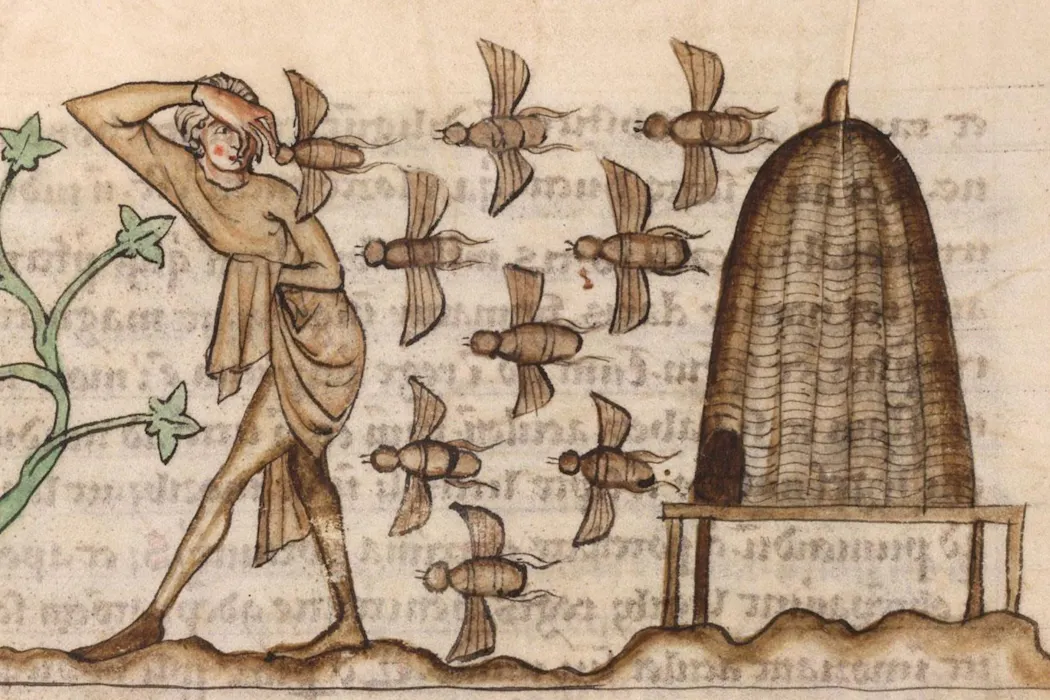
Bees attacking a threat, as depicted in a medieval manuscript. Douai Cuincy Library Network, CC BY-SA

Who owns a swarm of bees? And what happens when they stray onto a neighbour’s land?

In early medieval Ireland, such questions were addressed by a remarkable set of laws known as the Bechbretha, which set out the rights and responsibilities associated with beekeeping. Also known as bee-judgments, these laws formed part of the wider medieval Irish legal system, Brehon law (known in Old Irish as fénechas or customary law).

Brehon law espoused restorative rather than criminal justice and was chiefly concerned with the type of compensation to be paid for crimes committed. Most of these laws were written down in the 7th and 8th centuries, but they probably preserve much older traditions that had previously been passed down orally.

Early medieval Irish society was hierarchical. In legal cases, the amount of compensation owed or received depended entirely on a person’s social rank, with payments varying according to their status.

The Bechbretha provided a legal guide for lawyers dealing with cases involving bee trespass (where a neighbour’s bees came onto another’s land and supposedly stole nectar from flowers and plants), injuries or death caused by bees, beehive theft and the compensation owed in each situation.

Medieval illustration of a man running from bees
Legal cases could be brought against beekeepers whose bees stung passersby. National Museum of Antiquities, CC BY-SA

In medieval Ireland, bees were given legal status because they were classified as domestic livestock. Like cattle, horses, pigs, poultry and sheep, they were legally protected because of their considerable value. Beekeeping produced a wide range of goods, including honey for food and sweetening, as well as mead and beer, beeswax for candles, sealants and writing tablets, and other products used in medicine, polishing, lubrication, skincare and waterproofing.

The Bechbretha also had another purpose – maintaining good relations within local communities. According to the Bechbretha and another legal text, the 8th-century Bretha Comhaithchesa, Judgements on Neighbourhood, a mutual agreement among the farming community ensured compensation would be paid if and when animal trespass, theft or injury occurred. A certain level of trust between neighbours was required for this process to work.

That said, it is one thing to show where a neighbour’s large domestic animal has trespassed or caused damage. It is something else to prove that neighbouring bees had rampaged through your flowers, stealing nectar before buzzing away with their ill-gotten gains.

One suggestion the Bechbretha makes is to dust flour over bees, follow them to source and identify the culprits. Because honeybees tend to return repeatedly to the same nectar sources, tracking and marking them with white flour – which scatters onto the ground as they fly, leaving a visible flight path – can be effective. The laws also state that the owner of stray bees has three years to collect their honey, but by the fourth year must surrender the first swarm from that hive to the wronged party.

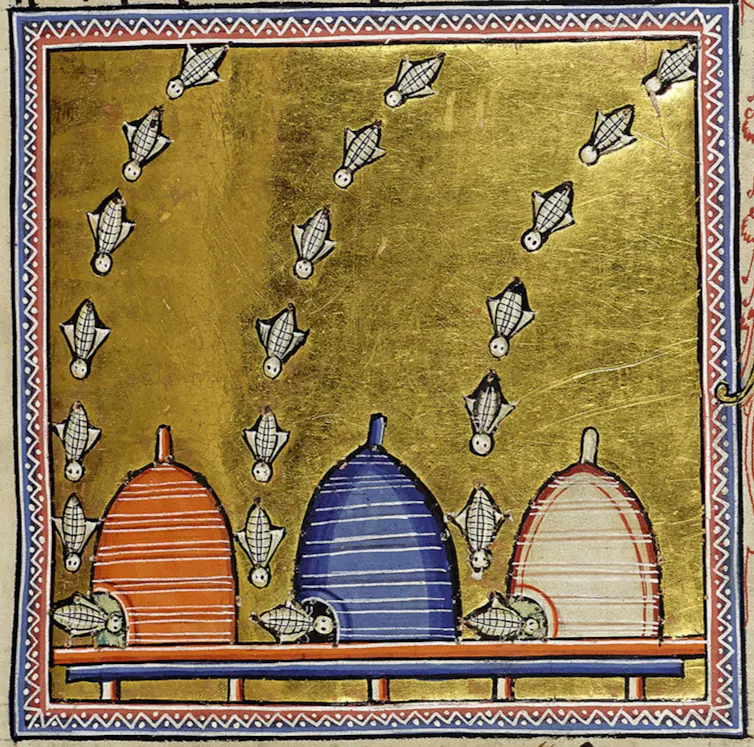
Gold-adorned illustration of bees flying into their hives
The illustration for bees in the Aberdeen Bestiary manuscript, written and illuminated in England around 1200. Aberdeen University Library Online Collections, CC BY-SA

The Bechbretha also dealt with questions about ownership of swarms which settled and built new hives on either private or common land. The beekeeper who found the new hive was entitled to a third of the honey for three years but after that time elapsed, the landowner on which the swarm settled became its owner. Where a swarm was discovered in woodland, the finder was entitled to (almost) everything. The local church and patriarch of the finder’s kin-group were both entitled to a share.

Where hives were stolen or illegally moved and where perpetrators got stung or died from being stung, beekeepers were not held responsible. Where bees stung people without provocation, compensation was due, though if the victim killed the bee(s), their death was deemed recompense enough. Generally, for valid situations where someone was stung, killed or maimed, hives were given over in payment.

Theft of beehives carried hefty penalties, dependent on their location. The closer a hive was to a homestead, particularly a high-status one, the larger the compensation. This was usually in the form of cattle, the main currency used in pre-coinage Ireland. Theft of hives from monasteries also carried imposing fines.

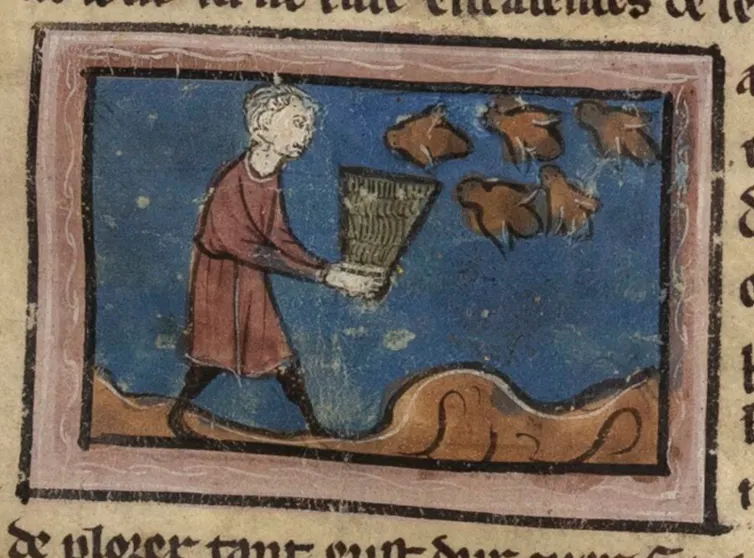
Illustration of a man trying to catch very large bees in a basket
A man tries to catch bees in a basket. Illustration from a medieval French manuscript. National Library of France, CC BY-SA

That there were a set of early medieval Irish laws solely for bees reveals the high regard with which these little creatures were held. Restitution through beehives and bee produce helped the proliferation of beekeeping throughout the community. In pre-industrial, early medieval Ireland, where society’s survival depended so much upon the climate, bees were a pivotal part of the agricultural system, as they are today.

At the close of the tenth century, writers of Irish historical records documented two instances of bech-dibadbee mortality – which resulted in mass famine and death among the human population. The fact that these disasters were recorded is significant in that it suggests an awareness about what happens if the bees disappear.

Today, bee colonies around the world face multiple threats – from habitat loss, climate change, toxic chemicals and deadly invasive parasites. The Bechbretha shows that if the will is there and communities are involved and feel invested, protecting our bees is possible.

The Conversation

Chris Doyle does not work for, consult, own shares in or receive funding from any company or organisation that would benefit from this article, and has disclosed no relevant affiliations beyond their academic appointment.

  •  

This year’s Venice Biennale marks a major shift in European cultural politics

I was texting a museum director friend in Asia recently. We were discussing whether a trip to this year’s “artworld Olympics”, the Venice Biennale, justified the carbon release.

I felt ambivalent. The main exhibition is curated by Koyo Kouoh, whose 2016 edition of Ireland’s Biennale, EVA International, on the 1916 Easter Rising centennial I had admired. Kouoh died of cancer earlier this year. Her posthumously realised Venice Biennale, titled In Minor Keys, seemed a final opportunity to appreciate the subtle, intelligent work of Africa’s leading curator.

Against the lure of Kouoh’s exhibition, though, was a queasy realisation that the Biennale seemed to be ideologically backsliding. Russia and Israel, both accused of war crimes, were controversially participating.

Alongside the huge guest-curated show of contemporary art, the Biennale invites countries to present exhibitions they curate themselves in national pavilions in the Giardini di Biennale and citywide venues. Following Putin’s full-scale invasion of Ukraine in 2022, Russia was excluded, its pavilion remaining shuttered throughout the 59th and 60th editions. But last year Giorgia Meloni’s government appointed rightwing ideologue Pietro Buttafuoco as Biennale director.

Buttafuoco revoked Russia’s exclusion. He also facilitated the relocation of Israel’s exhibition from its usual Giardini pavilion to a high security cul-de-sac in the Biennale’s second official venue, the massive Arsenale.

“This biennale seems cursed,” texted my friend. Despite feeling hypocritical about the environmental burden, I booked a flight to Venice.

Angry protests and violent reprisals

In the weeks leading up to the exhibition, my friend’s suggestion looked increasingly on point. A complicated choreography of war, state violence and activism began to play out. They culminated during the Bienniale preview in angry protests and violent reprisals.

The Art Not Genocide Alliance (ANGA) gathered 236 curators, artists and art workers to campaign for Israel’s exclusion and improved conditions for cultural workers.

When Kouoh’s international jury refused to consider Israel and Russia for the Biennale’s prestigious Golden Lion awards, artist Belu-Simion Fainaru, who was representing Israel, threatened them with legal action, according to the Italian news agency Adnkronos and arts publication Hyperallergic. The jury resigned. Their subsequent silence has not been explained.

Relieved of the professional all-female expert jury that Kuouh appointed, Buttafuoco instated a Eurovision-style audience prize. At the time of writing, over 70 artists have withdrawn from the awards in protest.

Like an artwork, a curse is a performative utterance at the nexus of ritual symbolism and magic. People like to believe that art, unlike curses, is a force for good. But as I argue in my book The Deployment of Art, there is a long history of state co-option of art and artists in the service of malign agendas of state violence. To me, The 61st Biennale seems one such example.

In a statement on the Biennale website, Buttafuoco amplifies the spiritual dimensions of Kouoh’s vision. “It is an exhibition permeated with spirit, with a sacredness that puts the person, the human being, back at the heart of things … looking to the sky once more.”

Much art in the main exhibition is hard to square with such whimsy. Pio Abad’s precise critical drawings of everyday objects of imperial plunder, like houseplants and chocolate, alongside stolen Benin bronzes. Walid Raad’s series of found photographs of beds slept in by Palestine Liberation Organization leader Yasser Arafat. Joana Hadjithomas and Khalil Joreige’s extraordinary sculptural excavation of the lost ancient city of Orthosia, hidden beneath a buried refugee camp in southern Lebanon.

But other works better serve Buttafuoco’s vague, obfuscating narratives of “sacredness” and “spirituality”.

In the Arsenale, an uprooted olive tree that recalls images of the desecration of Palestinian olive groves rotates on a plinth to the perverse accompaniment of tinkly ballerina music. This work by Theo Eshetu is titled Garden of the Broken Hearted, but the accompanying label doesn’t explain why the tree was uprooted, or from where, only that it “stands as a poetic reflection of impermanence”.

Alfredo Jaar’s “shrine” to base materials, a thrumming scarlet cathedral titled The End of the World meanwhile, so overwhelms the senses that I felt faint. I later saw a young woman collapsed outside it, attended by paramedics. Numerous other works draw on ritual traditions and spiritual practices from “the powerhouse of Africa” (Buttofuocco’s term).

Police presence was pervasive throughout the previews. Armed, helmeted officers held a line around Pussy Riot’s demonstration at the Russian pavilion, where protesters released blue, yellow and pink smoke canisters chanting “bloody Russian art” and “curated by Putin, corpses included”.

On the final preview day, as many pavilions closed early in strike protest, police stomped through the Giardini in heavily armed groups ten or 20 strong. At 4.30pm a peaceful crowd of ANGA protesters, many with young children in pushchairs or carried on shoulders, marched from the Giardini to the Arsenale where riot police used batons to beat them back. Surveillance helicopters hovered over the city until long after midnight.

Visions of hell

When future art historians study the 61st Biennale, they may notice a poster slogan from the ANGA protest: “Palestine is the Future of the World.” Meanwhile, visitors would do well to venture beyond the Giardini and Arsenale to an unofficial collateral exhibition organised by the Museo Moderno Buenos Aires.

Taking its title from John Milton’s description of hell, Darkness Visible: The Long Shadow of the Dictatorship brings together a trans-generational group of artists. Their work has been shaped by a regime of state terror (1976-83) that implemented a systemic policy of kidnappings, torture, murder and the forced disappearance of thousands.

Darkness Visible positions art as a vehicle for understanding history, protecting memory and human rights, and engaging in activism against state violence. One photograph by Marcelo Brodsky documents a demonstration by the Madres de Plaza de Mayo demanding information about their forcibly disappeared children. Brodsky’s mother (whose son was disappeared) appears in the image holding a banner that draws connections between second world war concentration camps in Warsaw and ESMA, a clandestine torture and extermination centre used by the Argentinian junta during the dictatorship.

As I contemplated this image, the exhibition’s curator Victoria Noorthoorn explained: “We wanted to present this show in Venice now because our Argentinian artists have much to say about fear, violence, pain and trauma that remain as scars from Argentina’s repressive regime. Their work reminds us of the need to protect core values: human and civic rights, democracy, freedom of expression and artistic creation.”

The protests I witnessed in Venice were marked by real anger, solidarity but also moments of tenderness and joy. A hopeful sign of how art and artists might imaginatively reinvent future biennales, undo the cursed present and lead us away from the darkness closing in.

The Conversation

Clare Carolin does not work for, consult, own shares in or receive funding from any company or organisation that would benefit from this article, and has disclosed no relevant affiliations beyond their academic appointment.

  •  

How to talk to children when terrorist attacks and violence dominate the news

When a man stabbed Jewish people in Golders Green, London, in what police declared a terrorist incident, the story spread fast – through news alerts, social media and the whispered conversations of anxious adults. When this happens, children notice.

Whether they catch a fragment of a TV bulletin, overhear a parent on the phone, or simply sense that something has shifted in the atmosphere at home, the news has a way of reaching them before they are ready. The question isn’t really whether to talk to children about violence and fear; it’s how.

First, it’s important to know that children have the resilience and capacity to process difficult topics, but bear in mind that this needs to happen in a supportive environment.

Start with safety. Ensure your child feels relaxed and secure. Safety comes from routines, keeping daily rhythms and practising rituals that remind everyone you are together and safe – for example, a nighttime story or song, a special time on the couch after dinner.

Your capacity to deal with issues like violence and fear is the most important factor in contributing to your child feeling safe during these conversations. If you feel overwhelmed or anxious, wait until you feel calmer and more grounded, or have someone to support you with the conversation.

Some families – particularly those who face racism or other forms of discrimination – will already be familiar with these conversations. But if this is new to you, the main thing to do is to be honest and clear. Be direct and specific. Avoid metaphors and euphemisms and vague ideas like “bad people”.

Adjust your language to the child’s age, but don’t overthink it. Simply pause often, ask questions, and watch their face for confusion.

Children don’t stay afraid for long. They move in and out of difficult feelings quickly, which is why short, repeated conversations work better than one big, serious talk.

Come back to them to check understanding and listen for misunderstandings. Ask them if they have any questions. And don’t be surprised if the child looks particularly bored or disinterested. Children prefer delight and joy and play rather than serious adult conversations. It doesn’t mean they are not listening or appreciating the explanation, it just means their priorities are elsewhere – and that’s a good thing.

A mother talks to her concerned daughter.
It’s important to make them feel safe. LightField Studios/Shutterstock.com

Keeping children grounded amid fear

Limit media exposure and try to avoid talking about scary events around them – they are always listening and there’s huge room for misunderstanding when they hear rather than take part in conversations.

Research shows that if children are exposed to media and talk about fearful events, that it’s important what they hear is mediated through a supportive adult who can explain the content appropriately. They can pick up on the signs of fear and anxiety from adults, particularly in times of uncertainty, even if they can’t fully understand the words in the conversation.

Follow your child’s lead. Your job is to open the door. They decide whether to walk through it and when to leave. Don’t mistake silence for shutdown. Children often process fear through movement, play, singing, dancing, making and even breaking things.

It’s OK to say “I don’t know” to questions you can’t answer. And it’s OK to say: “I know the answer, but it’s too much information for you at your age, I’ll tell you a little bit now and explain more when I think you are old enough.”

Most important of all, for you and your child, look at your circle of safety. Remind your child they are safe here and now with you, that there is a community that you live in and link with who are there to support you and keep you safe. Focus on hope and efficacy and on what can we do right now for the future we want.

The Conversation

Trudy Meehan does not work for, consult, own shares in or receive funding from any company or organisation that would benefit from this article, and has disclosed no relevant affiliations beyond their academic appointment.

  •  

What Iran’s absence from the Venice Biennale reveals about art and politics

Just days before the opening of the 2026 Venice Biennale, organisers announced that Iran would no longer participate.

A short statement posted to the Venice Biennale website on May 4 said: “With regard to the National Participations in the 61st International Art Exhibition…it has been announced that the Islamic Republic of Iran will not participate.” No explanation was given. I believe that silence is itself revealing.

Iran’s withdrawal is less a sudden decision than the result of converging geopolitical and economic pressures that are reshaping both the global art world and Iran’s place within it.

At the most immediate level, the withdrawal reflects the material realities of crisis. With internet access restricted, international flights suspended and communication networks severely disrupted, even the basic logistics of participation – coordinating, shipping and installing artworks – probably became nearly impossible for Iran.

These conditions have been compounded by intensifying economic pressures, including the sharp devaluation of the Iranian rial, which has made international cultural engagement increasingly difficult to sustain.

An explanation of the Venice Biennale.

Such constraints point to a fundamental condition of contemporary art: global exhibitions rely on infrastructures of mobility and communication that are easily destabilised by conflict and sanctions.

The timing is also significant. The decision comes amid renewed military tensions and escalating political rhetoric surrounding Iran’s position in the global order. In such moments, when political discourse edges toward existential threat, the stakes of cultural visibility are heightened. At the same time, sustaining cultural presence becomes more difficult.


Read more: Middle East conflict looks increasingly like a war nobody can win


More revealing still was the lack of any announced artist, curatorial framework or exhibition concept for Iran’s pavilion, even days before the Biennale’s opening.

Iran’s presence at the Venice Biennale has historically been organised through state institutions, with oversight exercised by the ministry of culture and Islamic guidance since the Iranian revolution (1978-79). As with many national pavilions, this model positions art as a form of cultural diplomacy. But in Iran’s case, it has often produced a disconnect between official representation and contemporary artistic practice.

This gap is significant. The Venice Biennale, often described as the “Olympics of the art world”, remains structured around national pavilions, with each country responsible for presenting its cultural identity on a global stage. Yet, as critics have long argued, it has never been a neutral platform, but a space where art and geopolitics intersect.

More broadly, biennials are deeply embedded in political and institutional contexts, rather than existing outside them. Within this framework, they are often understood as sites of cultural soft power, where nations project influence through artistic production.

National representation in crisis

Iran’s withdrawal must also be understood in relation to the wider turmoil surrounding the 2026 biennale itself. This year’s edition has been marked by extraordinary controversy, including disputes over the involvement of Russia and Israel, calls for boycotts and the resignation of the entire international jury just days before the opening.

These events expose the fragility of the biennale’s longstanding claim to neutrality. Rather than existing outside politics, it has become a site where geopolitical tensions are actively staged and contested.

To exhibit at the biennale is never neutral: it means entering a highly visible arena shaped by competing narratives of legitimacy and power. For the Islamic Republic, this raises a deeper tension. The biennale’s national pavilion model requires countries to present a coherent cultural identity through contemporary art. Yet Iran’s artistic landscape is anything but singular. It is shaped by internal contradictions between state and independent practices, censorship and experimentation and local production and diasporic circulation.

The entire jury resigned just days before the opening.

These tensions are difficult to reconcile within a state-managed exhibition framework. The very premise of the pavilion – art as national representation – sits uneasily with a system in which artistic expression is subject to ideological and institutional control.

At the same time, the Biennale embodies forms of global circulation, cultural competition and visibility tied to international art markets that do not always align with the cultural and political ethos of the Islamic Republic. Representation therefore involves negotiating how a nation appears, to whom, and on whose terms.

The current moment makes this tension even more acute. As political rhetoric escalates and the possibility of large-scale destruction is invoked in global discourse, cultural visibility becomes more urgent. Art offers one of the few spaces through which narratives beyond conflict and diplomacy can emerge. Yet for Iranian artists, cultural presence is becoming more fragmented, shaped by diasporic networks, constrained by national borders and limited by economic and infrastructural pressures.

Iranian artists, particularly those working through independent and diasporic networks, have for decades operated beyond the frameworks of state representation, with their work circulating internationally through alternative artistic circuits. Iran’s missing pavilion, then, does not signal the disappearance of Iranian art. Rather, it reveals the precarious conditions through which that art circulates.

Iran’s absence from the Venice Biennale also highlights the limits of the national pavilion model. The system has frequently been criticised for reducing complex artistic practices to simplified national identities, even as contemporary art now operates through transnational networks that exceed the boundaries of the nation-state.

In Venice this year, the missing pavilion reflects an art world shaped as much by political crisis as by artistic production. Iranian art is not absent from the global stage. Yet the conditions under which it circulates and remains visible have become increasingly fragile.

The Conversation

Katayoun Shahandeh works for SOAS University of London.

  •  

From ‘French leave’ to ‘Irish goodbyes’: why you may be right to exit a party without saying goodbye

Rawpixel.com

Whether you call it an Irish goodbye, French leave or filer à l'anglaise (leave in the English style), as the French prefer, the act of quietly slipping out of a party without fanfare is a familiar social impulse. The Brazilians called it sair à francesa (French style) and the Germans a Polnischer Abgang (Polish departure). Whatever name it goes by, the concept is the same: one moment you’re there, the next you’ve vanished into the night without a drawn-out round of explanations, hugs and promises to catch up soon.

The pattern is telling: every culture has a term for it, and every culture blames someone else. That collective deflection suggests we already know, on some level, that slipping out unannounced is a social transgression.

But for those of us with anxiety, that silent exit isn’t rudeness. While etiquette traditionalists will probably insist that leaving without saying goodbye is a social no-no, some psychologists argue that it’s a coping strategy. Here’s why sneaking out without saying goodbye might be the healthiest decision you make all evening.

When you break it down – and let’s be honest, those of us who are anxious, introverted, neurodivergent or dealing with chronic illness have all broken this down into agonising detailed steps – saying goodbye is a loaded cultural ritual. It’s a performance that demands a high degree of social skill, accuracy and nuance.

Goodbyes are high-demand situations and, sadly, by the end of a social occasion, many of us are already depleted and don’t have the energy to handle all the steps involved.

For many of us, socialising can mean feeling overwhelmed, constantly monitoring how we come across, trying to fit into other people’s expectations, comparing ourselves to others and worrying about rejection. It can be exhausting to feel like you’re constantly trying to act like your best version of normal.

When socialising means constantly adapting yourself to other people’s expectations, the healthy choice becomes using your last bit of energy to recharge and take care of yourself. Don’t leave the party completely drained with nothing left to recover with.

Sometimes we want to leave quietly because leaving loudly feels like shouting out: “I matter! Look at me, I’m leaving!” The fact is, many of us sit with the belief that we don’t really matter that much, so we don’t say goodbye because we don’t feel we are worth the performance.

Sometimes a silent exit is about self-respect, minding your energy reserves, even if you really enjoyed the evening. At other times, though, it’s an act of self-erasure. You leave without saying goodbye because you think no one will care, that you don’t matter enough to make a fuss when leaving.

Leaving quietly can become a way to protect yourself from the discomfort of saying goodbye. But the quiet exit cuts both ways. Ask yourself whether leaving without a word made your life bigger – you conserved enough energy to recover and you’re glad to go back next time – or whether it shrank it, adding another reason to avoid socialising altogether.

If you are going to pick apart your goodbye and negatively assess it, the next goodbye will feel even harder. Be careful to reality-test your post-event ruminations. It’s usually not as bad as you think, especially if you are assessing your performance through the distorting lens of anxiety.

A woman lying in bed, hands over her face, suggesting remembering something bad.
It’s probably not as bad as you remember it. GBALLGIGGSPHOTO/Shutterstock.com

The healthiest choice of all

There is always a tension between wanting to belong and wanting to be yourself. If saying goodbye starts to feel so pressured and so performed that you lose any sense of being authentic, then the connection is starting to cost more than it’s worth.

If you feel like you need to be a chameleon to survive the complexities of socialising, the healthiest choice is to find a way to be who you really are. Find a way to tell your friends and family that leaving quietly is something you need because of how your nervous system and psychology are made, and not a reflection of the relationship. Research shows that being your truest self and having the best social connections go hand in hand.

And if you are neurodivergent, being open about what you need can feel like a risk, but it can also be a way to find acceptance, support and understanding when you let people know what you need and like.

If you’re anxious, it’s worth letting your host know in advance that you might need to slip away quietly. Otherwise, there’s a risk that people will read it the wrong way, as coldness or indifference, say.

Get ahead of it by letting people know you’ll leave without saying goodbye, and that you’re grateful to have been invited. Anxious people aren’t bad at relationships. Relationships just work better when everyone understands the other person’s needs.

Less is more

There’s a growing idea that being choosy about your social life isn’t antisocial – some psychologists call it “selective sociality”. Picking your moments carefully means you have more to give when it counts. The goal isn’t to retreat, but to invest in deeper relationships and in real presence, rather than the hollow churn of online contact – unless it supports meaningful connection.

In a world where being seen to do the right thing has begun to outweigh doing the right thing, selective sociality offers a way forward. Knowing our limits and being open about them, when possible, doesn’t weaken connection – it helps create relationships that feel real and sustainable.

If sneaking out without a fuss makes it more likely you will go to the next party, then it’s a choice for more social connection and therefore your health.

Correction: Our colleagues in Australia inform us that “ninja bombing” is not a common Australian term for exiting a party without saying goodbye. This line has now been removed from the first paragraph.

The Conversation

Trudy Meehan does not work for, consult, own shares in or receive funding from any company or organisation that would benefit from this article, and has disclosed no relevant affiliations beyond their academic appointment.

  •  

Trump-Xi summit: US president says he will discuss arms sales to Taiwan – breaking decades of US policy

Donald Trump and Xi Jinping are likely to discuss many issues as they meet this week in Beijing. But alongside trade, technology and the war in Iran, one topic of conversation will stand out – the future of Taiwan.

Taiwan has long been a sensitive issue in Sino-American relations. Beijing regards the island as a breakaway province which must be reunited with the mainland. The United States has long opposed such a step. Yet in recent months, Trump has fuelled speculation that he may be ready to change key aspects of US policy on the issue, potentially granting Beijing long-sought concessions.

Trump’s apparent readiness to make these moves means that Taiwan is one of the issues on which we might see the most significant policy developments at the summit. And that could happen simply through the famously voluble president uttering just a few simple words.

The president’s policy towards Taiwan has been inconsistent and seemingly more malleable than that of previous administrations. Advocates for Taiwan point out that his administration recently approved the largest ever US arms sale to the island. But at the same time, he has sowed doubts about the strength of his support for Taiwan’s independence.

US policy towards Taiwan has traditionally been based on two principles. The first is “strategic ambiguity”, which means that the US declines to explicitly state whether it would actively use its military to defend Taiwan from attack by China. This policy is supposed to deter China while also discouraging Taiwan from formally declaring its independence from Beijing.

The second principle is the “one China policy”. According to this policy, the US recognises Beijing as the legitimate government of China, while opposing any violent solution to its dispute with Taiwan. It also retains robust informal links to the Taiwanese government in Taipei.

Observers are concerned that Trump may water down these principles during his summit with Xi. For instance, he might state that the US not only “does not support” Taiwanese independence but actively “opposes” it. Or he might double down on previous comments he has made indicating that whether or not Xi invades Taiwan is “up to him”.

Trump has also explicitly stated that he will discuss future US arms sales to Taiwan with Xi during this week’s summit. This violates one of the so-called Six Assurances that the US has upheld towards Taiwan since the 1980s, and which were endorsed by the US Congress in 2016.

Even securing a discussion of arms sales would be a victory for Xi, who would welcome an opportunity to chip away at the Six Assurances. Presumably he would then try to weaken the US commitment to the other five, which include a US commitment not to change its position on Taiwan’s sovereignty.

More concretely, if Xi succeeds in making US arms sales to Taiwan a legitimate topic of negotiation in Sino-American relations, then he could head them off in the future by offering the US concessions in other areas. For instance, if Trump or a future president asks Beijing for its help settling a conflict like that in Iran, Beijing might demand an end to US arms sales to Taiwan as the price.

High stakes

Given Trump’s reputation as a formidable China hawk, his attitude towards Taiwan may seem surprising. But it’s actually part of a longstanding pattern.

In relations with China, Trump has arguably always prioritised economic issues, while appearing less concerned about the security of America’s regional allies. He has also raised doubts about whether Taiwan is even defensible. In his first term, he reportedly told aides that: “Taiwan is like two feet from China. We are 8,000 miles away. If they invade, there isn’t a fucking thing we can do about it”.

Trump is also both highly transactional and less focused on abstract principles of foreign policy than most previous presidents. He views America’s support of allies such as Taiwan as a gift that it gives them, one that is often not worth the cost. If he can achieve a concrete victory for himself today by trading away support for Taiwan tomorrow, he may well be willing to do so.

All of these developments matter because they make a violent conflict between China and Taiwan, potentially ultimately involving the US, more likely. If Trump makes concessions to Xi, it will be the latest signal that US support for Taiwan is wavering. That made be read in Beijing as permission to violently change the status quo. Even though such an act might belatedly then be met with force from Washington in response, it is made more likely by Trump’s stance today.

Even worse for Trump, the summit comes at a time when American power and the wisdom of its long-term strategy are being visibly called into question in the Middle East. The US is bogged down in an intractable conflict and has severely damaged its deterrent capacity in the Indo-Pacific by burning through advanced munitions at a high rate. Trump’s personal unpopularity is also rising at home amid the war and its economic fallout.

This weakened position makes it even more likely that Trump will want to strike a deal with Xi to help end the war in Iran or ease trade tensions to help the economy at home. Taiwan may be the price of that – and, ultimately, peace.

The Conversation

Andrew Gawthorpe is affiliated with the Foreign Policy Centre in London.

  •  

Belfast unrest shows the power of social media as far‑right views on immigration enter the mainstream

Footage of a horrific knife attack in Belfast began to circulate on social media on Monday evening. A Sudanese asylum-seeker in his 30s, who entered the UK in 2023, has been charged with attempted murder. Meanwhile, the far-right was quick to exploit the situation to further an anti-immigration agenda.

Violent unrest followed on the streets of Belfast and beyond on Tuesday evening. Houses, cars and a bus were set alight, and masked men were seen smashing in windows. Some of the attacks on property were reportedly racist in nature.

Posting earlier on social media, activist Tommy Robinson (real name Stephen Yaxley-Lennon) urged supporters to join street protests against this “invader attack”. Robinson provided a list of locations across Great Britain and Northern Ireland where protests were planned on Tuesday night.

His post on X was shared by tech billionaire Elon Musk, who called for citizens to protest “repeatedly and loudly” to change government policies around immigration. The leader of Restore UK, Rupert Lowe, pledged that his party would begin mass deportations and reintroduce the death penalty to prevent attacks committed by “barbarians”.

At the same time, WhatsApp messages from anonymous accounts began to circulate, calling for men aged 18 and over in Northern Ireland “be prepared to fight or be arrested”.

Calls for calm

Politicians from across Northern Ireland’s political divide appealed for calm with some condemning rightwing English politicians like Lowe for appearing to exploit the attack for their own ends.

And chief constable of the Police Service of Northern Ireland (PSNI) Jon Boutcher urged citizens not to be “duped” into violent disorder by people online intent on provoking trouble.

The fact that a man had been charged with attempted murder did little to deter the crowds of mostly young men who gathered across Belfast, setting a bus on fire on the Lower Newtownards Road and engaging in sporadic clashes with police across the city.

A bus was set on fire as disorder flares up in Belfast.

There were reports of violence in towns such as Ballyclare and Portadown. In Ballyclare, the premises of a Turkish barber was attacked. There were also arrests made after demonstrations in Glasgow where three members of the public were injured.

You could be forgiven for thinking this playbook has been seen before. In the past two years, far-right actors have used online platforms to weaponise incidents involving minorities as part of their anti-immigration campaigns. These incidents include allegations of an attempted rape of a teenage girl in Ballymena, the murder of three young girls in Southport and the murder of Henry Nowak in Southampton.

Misinformation frequently circulates in online spaces as authorities come under pressure to confirm the ethnicity and asylum status of suspects. The PSNI were very quick to give these details, presumably to avoid creating an information vacuum in which falsehoods might spread quickly.

Emergence of a toxic discourse

Facts don’t appear to matter to those leveraging shock and trauma to advance their claims that immigration is to blame for acts of violence. Condemnation of online far-right agitators from politicians usually follow amid criticism of big tech companies for not doing more to stop agitators inciting violence on their platforms.

Politicians and public figures must do more than say “not in our name”. They must take some of the blame for helping to create a toxic discourse around immigration that “others” asylum-seekers and migrants.

The Overton Window, the barometer of what is considered a politically acceptable argument, has shifted towards the right, as demonstrated by Lowe’s remarks. Mis- and disinformation about immigration take root in some communities because they frequently hear how asylum-seekers receive priority access to already under-funded public services.

A frequent refrain among politicians is that these are “legitimate concerns”, even when there is little evidence to support these claims. This often leads to minority communities being blamed for issues that are nothing to do with them.

The mainstreaming of rightwing views on immigration is reinforced by media coverage that frequently fails to fact-check claims about issues such as asylum-seekers and welfare benefits. In this context, it is perhaps unsurprising that immigration features among the issues of most concern to voters in Great Britain.

It is now for politicians to decide how to respond to the violence seen in Belfast and elsewhere this week. While online platforms can clearly do better when it comes to removing inflammatory posts, public figures must also fix the problem they helped to create. The public needs a fact-based narrative on immigration that stops blaming asylum-seekers and refugees for broader societal problems.

The Conversation

Paul Reilly does not work for, consult, own shares in or receive funding from any company or organisation that would benefit from this article, and has disclosed no relevant affiliations beyond their academic appointment.

  •  
❌