You’re cooking dinner, distracted, and your hand brushes a hot pan. Nerve signals race to your spinal cord and back to yank your arm away in a fraction of a second, with no thought required.
Then comes the pain. A sharp, spreading sting gives way to a pulsing ache, and you cradle your hand and run it under cold water until it subsides. That felt experience is distinct from the reflex that preceded it. While the reflex moved your body out of danger, pain drives you to protect the wound, recover, and learn to avoid similar mistakes in the future.
We readily accept that other people feel pain by reading cues in their behaviour, like the inspection and nursing of an injury. We extend this to some animals too – a dog licking its paw or a cat favouring a limb rightly stir our sympathies. But what happens when we turn that lens on animals far less like us?
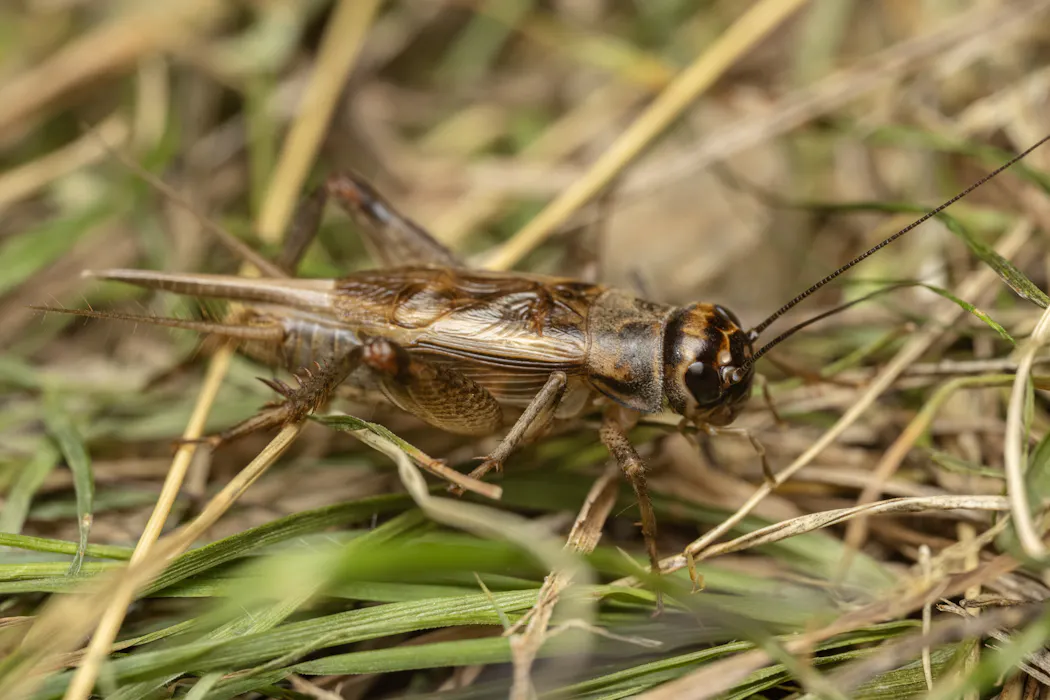
In our new study, published in Proceedings of the Royal Society B, we searched for behavioural signs of pain in house crickets, one of the most widely farmed insects. After applying heat to an antenna, we found that crickets didn’t just reflexively flinch and recover. They nursed the harm, returning again and again to groom the affected site, much as we rub a burned hand.
The frontiers of feeling
French philosopher René Descartes considered animals unfeeling biological machines, and for centuries the circle of moral concern barely extended beyond our own species.
But the boundaries have steadily crept outward. Recognition that mammals experience pain came first, followed by birds. Fish too, once assumed to lack the necessary brain structures, are now widely accepted as capable of pain-like states.
The leap into invertebrates has been greater and more contentious. Their nervous systems bear little resemblance to our own, so arguments from brain anatomy alone don’t carry us far. Instead, we look to behaviour. Does the animal respond to harm in ways that go beyond reflex, ways that are flexible, persistent, and sensitive to context?
Over the past decade, testable indicators for pain in non-humans have been developed and are increasingly accepted. These include learning from unpleasant events, trading off harms against rewards, and actively protecting the site of injury. Evidence meeting these criteria helped crabs and lobsters gain legal recognition as sentient under United Kingdom law in 2022.
Among insects, the evidence has been accumulating fast. Yet most of this evidence comes from bees. Bumblebees weigh the risk of harm against the richness of a food reward, and groom the site of an injury. Honeybees learn to associate particular smells with harmful stimuli and avoid them.
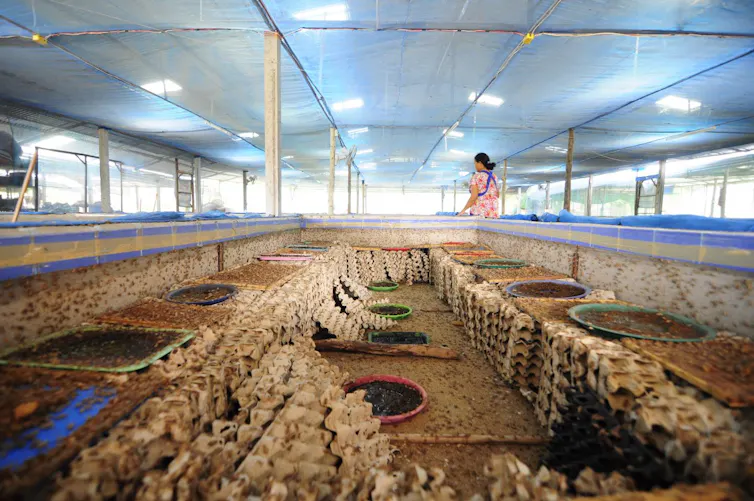
Far less attention has been paid to Orthoptera, the group that includes grasshoppers, locusts and crickets. That gap matters, because the house cricket (Acheta domesticus) is the world’s most widely farmed insect, with more than 370 billion reared annually.
We tested 40 male and 40 female crickets, each experiencing three conditions in random order: a hot probe to a single antenna (65°C, to activate damage receptors but not cause lasting injury), the same probe unheated, or no contact at all.
We filmed their behaviour for ten minutes. Observers scoring the footage did not know which treatment any animal had received.
The results were clear. After the hot probe, crickets were more than twice as likely to groom the affected antenna compared to controls, and spent roughly four times longer doing so.
Could this simply reflect general disturbance rather than targeted care? Unlikely: grooming was directed specifically at the heated side, not spread evenly across both antennae as it was after gentle touch or no contact.
And the behaviour wasn’t a brief, reflexive reaction. It was elevated from the outset and tapered gradually over minutes, much like rubbing a burned hand as the felt sting slowly fades.
Small minds, big feelings
Subjective experience cannot be directly observed in any animal, not even humans.
But we have shown crickets respond to harm in a way that satisfies a key criterion many scientists and philosophers use to infer pain: flexible, directed self-protection. Combined with the knowledge that crickets possess damage receptors, can learn to avoid harms, and respond less to injury under morphine, the weight of evidence for an inner life is growing.
The practical stakes are real. Hundreds of billions of farmed insects are slaughtered each year by freezing, boiling and baking. Pesticides kill trillions more, optimised for lethality with no consideration of potential suffering.
If we take a precautionary approach, credible evidence of suffering should motivate proportionate protections well before we are certain.
Insects have been around for more than 400 million years and are far more behaviourally and cognitively sophisticated than once assumed. The question, then, may not be whether some insects feel, but why we ever assumed they couldn’t.
Thomas White receives funding from The Australian Research Council, the Arthropoda Foundation, and The Australia and Pacific Science Foundation. He is a scientific advisor for the registered charity Invertebrates Australia.
Kate Lynch receives funding from the Australian Research Council, the Arthropoda Foundation, and the Australia & Pacific Science Foundatio. She has previously received funding fromand the John Templeton Foundation.
Between 2016 and 2024 the UK saw four changes of prime minister by way of a party leadership contest. In that time, even casual observers became familiar with the dramatic process that the Conservative Party uses to topple one leader and select another. Secret letters to the 1922 Committee, the dramatic confidence votes, and then two selected in a dog-eat-dog process to face the final vote by members.
What may be about to happen in the Labour Party will be different in important respects. If the Conservative Party is historically a body with its head in parliament and limbs extended into the country, Labour is more like a mountain with only its peak protruding into the parliamentary arena.
Even today, Labour has a deep institutional culture and a set of rules that anchor the legitimacy of the leader in the broader party membership as much as in parliament. In the past, Labour’s systems for selecting its leader were as complex as the structure of the party itself. Rules were repeatedly redrawn in factional conflicts between activists, trade unions and the party in parliament.
The modern process is simpler but still presents challenges to anyone tempted to climb the greasy pole. The Conservative process can be neatly separated into two phases: removing the current leader and then electing a new one. For Labour it is different, and depends crucially on what a sitting leader decides to do – resign or stand up to the challenge.
Both processes require a portion of the parliamentary party to demand new leadership – though the bar is higher for Labour at 20% of MPs versus 15% for the Tories. Labour raised this from 10% to 20% in 2021 – specifically to deter challenges.
But from there everything diverges. In the first place, the Labour process requires much more open coordination. The chair of the Conservatives’ 1922 Committee keeps a secret running tally of letters privately sent to express no confidence in the leader. Because of the secrecy, this might even trigger a surprise contest.
On the other hand, Labour challengers need to submit a full list of supporting MPs to the party’s general secretary. Currently this is 81 MPs.
The general secretary and the 1922 chair are also very different institutional figures. While the latter is an MP, seen informally as a sort of “shop steward” representing MPs’ interests in a variety of matters, the general secretary is a party official responsible to the NEC and usually aligned to the leadership.
Another difference is that the Labour process lacks a confidence vote stage. This means a leader cannot be deposed directly in favour of a fresh slate of candidates. Rather, as confirmed by a 2016 court case involving the abortive post-Brexit “coup” against Jeremy Corbyn, the leader is free to run in the contest without requiring their own list of supporters.
As such, if a leader opts not to resign, the fight will be longer and harder than the one Conservative MPs face in the same position. While some recent Conservative contests were more protracted, Liz Truss was replaced in just four days. Labour rules simply do not allow for this speed.
Moreover, while Corbyn survived as leader in the 2016 Labour contest precisely by winning over members in spite of MPs’ opposition, this left lasting scars on the party. It damaged Labour’s credibility, even in the face of an increasingly chaotic Conservative government.
Toppling a prime minister
Of course, whatever the party rules, the constitution also gets its say. Any leader who is also prime minister must have the support of a majority in the House of Commons and, in practical terms, of their cabinet colleagues.
Boris Johnson survived the party process but was brought down by the constitutional one, with a little help from Rishi Sunak. The then-chancellor set off a chain of resignations that ultimately made the PM’s position untenable. That may also be what happens to Starmer if the Labour internal process similarly fails to bring him down.
Even if Starmer resigns or opts not to run in a contest, the difficulties do not end there. While the Conservatives whittle down the candidates to only two through sequential MP-only votes, Labour allows any MP with the support of 20% of the parliamentary party to face the membership vote.
The higher threshold, not to mention greater desire for unity in the party right now, will probably lead to fewer candidates than the contests in 2015 or 2020. But it still points to a process that can play out as a protracted multi-faction fight rather than a clean and (relatively) brief succession.
The voting system is one member, one vote. So every eligible member’s vote carries the same weight – from a cabinet minister or a union baron to a local activist. It is also preferential, providing more overall legitimacy to the winner who must secure more than 50% of the vote after second preferences are taken into account.
It is also a complex process where the winner may not have won more first-preference votes than the other candidates combined. If this happens, the result could be a leader who commands broad acceptance – but little fierce loyalty.
Nicholas Dickinson does not work for, consult, own shares in or receive funding from any company or organisation that would benefit from this article, and has disclosed no relevant affiliations beyond their academic appointment.
Jimmy Donaldson, better known as MrBeast, runs the most subscribed-to YouTube channel in the world (with 484 million subscribers) and has an estimated net worth of US$2.6 billion.
He is also a prominent philanthropist. Beyond his involvement in fundraising initiatives such as #TeamTrees, which claims to have planted more than 24 million trees worldwide, Donaldson runs a dedicated Beast Philanthropy YouTube channel.
These impressive philanthropic endeavours have dramatically improved the lives of their recipients. How could any of this be controversial?
The murky ethics of ‘stunt philanthropy’
Many of Donaldson’s videos involve subjecting people to what might be seen as degrading or exploitative situations, in exchange for money.
In Donaldson’s “Ages 1 – 100 Decide Who Wins $250,000” video, contestants (including young children) are put in an intense competitive structure and forced to eliminate one another. We see a grown man help to intentionally eliminate an 11-year-old girl, which leads to her sobbing on camera.
In another video, he tells a random group of shoppers they will win US$250,000 if they are the last to leave the store. Under pressure to stay, they are kept from their families and forced to endure poor living conditions, with some experiencing emotional breakdowns.
These videos have been labelled by variouscritics as “poverty porn”, as they could be seen as exploiting the desperation of vulnerable people to generate clicks and ad revenue.
The Beast Games reality series, which airs on Prime Video, is also built around challenges designed to provoke contestants into backstabbing one another, experiencing emotional distress, and revealing depressing stories about how badly they need the money.
Allegations against Donaldson also extend to behind the scenes, particularly in regards to the culture of work in his companies.
In 2024, several contestants who took part in Beast Games filed a lawsuit against Donaldson’s MrB2024 and other companies involved in the production. They allege they were subject to “chronic mistreatment”, including the infliction of emotional distress, inadequate food and rest breaks, delays in receiving medication, exposure to dangerous conditions, and a failure to prevent sexual harassment.
When it comes to assessing the ethics of Donaldson’s work, one option is to take a simple “consequentialist” perspective. Act consequentialism is the view that the right action is the one which leads to the most amount of good.
If a few people suffer exploitative conditions so many more people can enjoy life-saving surgery, then the moral calculus is likely to come out in favour of this situation. Of course, there are longstanding philosophical worries with such a view.
The 18th century philosopher Immanuel Kant argued it is wrong to use others as tools to achieve our own ends, even if our ends are morally admirable. Treating some people as mere means right now can’t be morally justified by promising to help others later on.
According to Kant, one’s motives for helping others are also important, and the moral worth of an action is determined by these motives. So helping others out of a sense of duty has a moral worth that doing the same act out of self-interest does not.
Is Donaldson’s philanthropy motivated by duty and care for others, or by clicks, esteem and ad-revenue? Or perhaps both?
We can’t know the answer. Although, Kant himself did believe all humans are likely to be morally corrupt at the very root of their character.
Consent and power
Irrespective of Donaldson’s motives, a broader point remains: his philanthropic videos are an integral part of his overall brand. The philanthropy helps to make the other, more exploitative videos (and the significant revenues they generate) more “morally palatable”.
After all, Donaldson could simply give his money away. He doesn’t need to make people compete, scheme and suffer for it.
One might counter that the participants have consented to being involved. But when you offer people in economically vulnerable situations potentially life-changing amounts of money to endure degrading conditions, the “voluntariness” becomes contestable.
This is not what ethicists consider “informed consent”. The offer can be so large that it clouds judgement. And for people without genuine alternatives, saying “no” may not be a realistic option.
The fact that Donaldson sometimes subjects himself to similar treatment, such as when he buried himself alive for seven days, deepens rather than lessens the worry, given the power asymmetries at play. He owns the production company, controls the conditions, and profits from the content in ways other participants do not.
The underlying structural concerns
When political problems, such as poverty, or a lack of access to healthcare or clean water, are reduced to entertainment, they undergo a form of what scholars call “depoliticisation”. Political failures that demand collective action, institutional reform and democratic deliberation instead become fodder for entertainment.
If we think we can help solve these problems just by watching viral videos, then we can avoid facing the structural issues that underpin them.
Paul Formosa has received funding from the Australian Research Council, and Meta (Facebook)
For months, US President Donald Trump has been fixated on Cuba. He’s issued threats and imposed additional sanctions on the island. The US military has conducted dozens of intelligence-gathering flights off the coast in recent weeks, suggesting a prelude to an invasion.
The Cuban government has indicated a readiness to negotiate with the Trump administration on some issues, such as migration, drug trafficking and investment openings for Cuban-Americans. But Cuba’s sovereignty is not negotiable.
After interviewing Cuban President Miguel Díaz-Canel last month, US journalist Kristen Welker seemed to catch on:
Nothing gets under [Cubans’] skin more than the notion that the United States can tell the Cuban government who should lead it or what it should be doing, how it should be governing, because that challenges the very idea of the sovereignty of the country.
This US obsession with controlling, influencing and coercing Cuba long predates Trump and even the Cold War. This is how President Theodore Roosevelt described the island in 1906:
I am so angry with that infernal little Cuban republic that I would like to wipe its people off the face of the earth. All we have wanted from them was that they would behave themselves and be prosperous and happy so that we would not have to interfere. And now, lo and behold, they have started an utterly unjustifiable and pointless revolution.
Understanding the current impasse between the two adversarial neighbours requires looking at this full arc of history. While the 1823 Monroe Doctrine sought to establish US predominance in the entire American continent, Cuba has always been a particular focus of Washington’s attention.
From the moment the 13 American colonies declared independence from Britain, Americans assumed Cuba would become part of the union. Successive US administrations sought to purchase, annex or otherwise control Cuba, claiming this was inevitable by virtue of the laws of gravity and geography. It was also seen as part of a self-proclaimed “civilising mission”.
When the Cubans eventually defeated their Spanish colonial masters in 1898, the United States stepped in and occupied the island to thwart its independence.
At the time, at least one third of Cubans were former slaves or of mixed race. The US governor of Cuba, Leonard Wood, argued they were not ready for self-government.
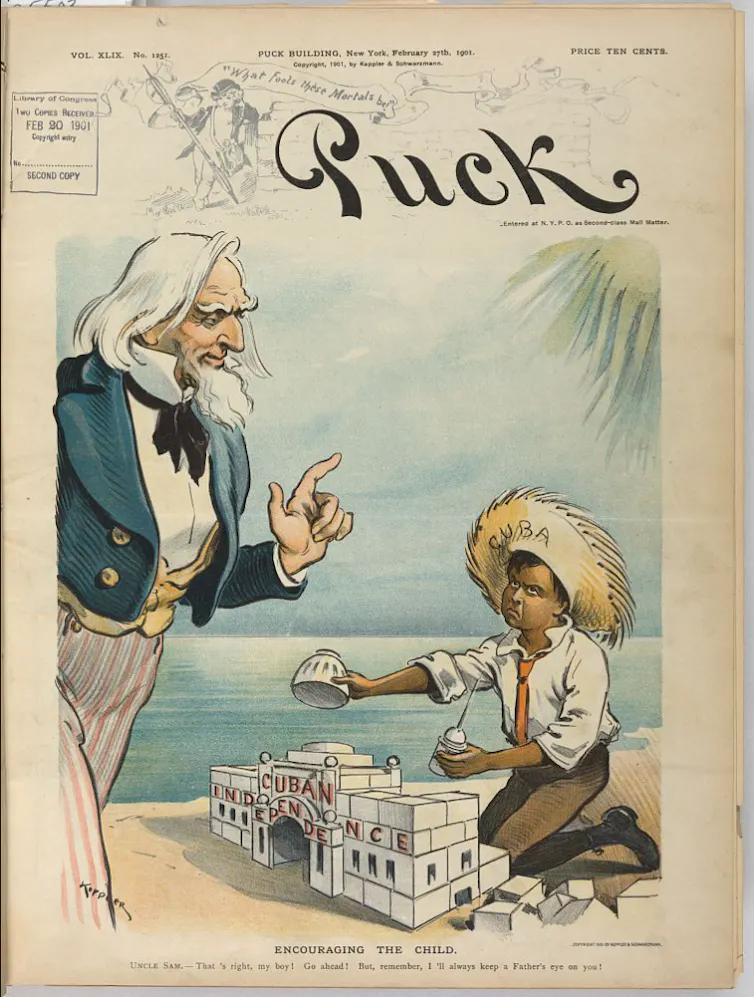
Illustration shows Uncle Sam talking to a young boy labelled ‘Cuba’ on a beach, from a 1901 publication.Library of Congress
Certainly, the US – especially the Southern former slave holders – didn’t want another Haiti in its neighbourhood. Haitian slaves had seized control of their island nation from the French in a violent rebellion in 1804, echoing the cries of the French revolution for liberty, fraternity and equality.
The US military occupation of Cuba ended in 1902 and Cuba formally declared independence – albeit with provisions. These allowed for future US intervention whenever Washington thought the Cuban people needed a guiding hand (which turned out to be fairly often).
In the decades that followed, US business interests deeply penetrated every sector of Cuba’s economy and had complete sway over Cuban governments.
On a cultural level, Cuba rapidly became “Americanised” through a new US-style education system. Travel to the island picked up, too. The popular Terry’s Guide to Cuba reassured US visitors in the 1920s they would feel right at home because “thousands [of Cubans] act, think, talk and look like Americans”.
Castro’s mission
All of this changed with the rise of Fidel Castro.
During the Cuban Revolution, Castro announced in April 1959 that the revolutionary government would be “Cubanising Cuba”. This might seem “paradoxical”, he explained, but Cubans “undervalued” everything Cuban. They had become “imbued with a type of complex of self-doubt” in the face of the overwhelming US influence on the island’s culture, politics and economy.
US journalist Elizabeth Sutherland similarly observed at the time that Cubans suffered from a “cultural inferiority complex typical of colonised peoples”.
For North Americans, however, Castro’s blunt statement seemed at best to reflect ingratitude, and at worst, an insult. As the US broadcaster Walter Cronkite recalled:
The rise of Fidel Castro in Cuba was a terrible shock to the American people. This brought communism practically to our shores. Cuba was a resort land for Americans […] we considered it part of the United States.
At the heart of Cuba’s revolutionary project has been an assertion of Cuba’s sovereignty, independence and national identity. The drive has been to create a new, united and socially just Cuban nation, as envisioned by its great national hero and poet, José Martí.
So, for Cubans it’s a matter of history. For North Americans, it’s a matter of self-image. They had “convinced themselves,” writes historian Louis A. Pérez, of the “beneficent purpose […] from which [the US] derived the moral authority to presume power over Cuba”.
When the Obama administration finally resumed relations with Cuba in 2014, it felt like a historic shift was taking place. The US might finally respect Cuban sovereignty and engage with Cuba on equal terms.
As President Barack Obama said at the time:
It does not serve America’s interests, or the Cuban people, to try to push Cuba toward collapse. […] We can never erase the history between us, but we believe that you should be empowered to live with dignity and self-determination.
Trump has now reverted to Washington’s traditional neo-colonialist view of Cuba, proclaiming he can do what he likes with the island. Perhaps it is time to try a new approach. As the spectacular debacle of the US-backed Bay of Pigs invasion showed 65 years ago, Cubans remain ready to defend their independence and their right to determine their own future.
Deborah Shnookal does not work for, consult, own shares in or receive funding from any company or organisation that would benefit from this article, and has disclosed no relevant affiliations beyond their academic appointment.
For many people, news of a virus outbreak on a cruise ship immediately brings back memories of COVID spreading when the Ruby Princess docked in Sydney in March 2020. Of the passengers and crew who disembarked, 575 had COVID. The virus then spread to the community.
So it’s understandable people are concerned that passengers from the MV Hondius need to be quarantined after potential exposure to Andes virus, a rodent-borne hantavirus.
However, the comparison with COVID only goes so far. Andes virus is serious and authorities are right to respond cautiously. But experts, including from the World Health Organization, note it doesn’t have the characteristics needed to become “the next COVID”.
As of May 11, European health authorities have reported nine cases linked to the cruise ship, including seven confirmed and two probable cases. Three deaths have been reported.
Five Australians and one New Zealander are being repatriated to Australia for quarantine and monitoring. The passengers will initially quarantine at the Centre for National Resilience near RAAF Base Pearce in Western Australia.
Here’s what you need to know about Andes virus, the risk of transmission, and how it’s different to the virus that caused COVID.
How do hantaviruses spread?
Hantaviruses are a group of viruses usually carried by mice, rats and other rodents. People are most commonly infected after inhaling tiny particles of contaminated rodent urine, droppings or saliva.
Most hantaviruses are not known to spread between people. Andes virus is the exception. After the initial spillover from infected rodents, it is the only hantavirus with well-documented person-to-person transmission.
But that doesn’t mean it spreads easily between people. Further human-to-human spread is uncommon, but it can occur in close-contact settings such as households, among caregivers, during intimate contact, or after prolonged exposure in crowded or poorly ventilated indoor areas.
That is very different from SARS-CoV-2, the virus that causes COVID. SARS-CoV-2 spreads very efficiently through the air. People could infect others before they even realised they were sick.
Early estimates suggested each person infected with SARS-CoV-2 passed the virus to roughly two or more others, on average, in populations who had never encountered it before.
Andes virus can cause onward human-to-human transmission, but requires a perfect storm of conditions: symptomatic people in crowded, poorly ventilated spaces with close contact over time. This was the case on the MV Hondius.
This difference in transmission potential is why SARS-CoV-2 caused a pandemic and Andes virus has only produced contained outbreaks.
What are the symptoms of Andes virus?
Early symptoms of Andes virus infection can look like many other illnesses, including fever, headache, muscle aches, nausea and fatigue.
In some people, infection can progress to hantavirus pulmonary syndrome, a life-threatening condition in which breathing becomes difficult.
How long after contact can you get symptoms?
The WHO recommends people exposed to Andes virus monitor for symptoms for 42 days after their last potential exposure.
This reflects the outer limit of the time between infection and symptom onset. It doesn’t mean people are infectious for 42 days.
Australian authorities have announced the returning passengers will initially spend three weeks in quarantine, with further monitoring arrangements to follow.
Melbourne’s Doherty Institute will undertake the testing using polymerase chain reaction (PCR), which detects the virus’s genetic material and blood-based antibody testing, known as serology.
A negative test early after exposure is useful, but not always definitive. If the virus is still incubating, there may not yet be enough viral genetic material or antibody response to detect.
How does the virus progress?
The long incubation period reflects how Andes virus progresses, compared to SARS-CoV-2.
COVID symptoms typically appear within days because the virus replicates rapidly in the respiratory system.
Andes virus progresses differently. Severe disease is linked to blood-vessel dysfunction and inflammatory responses. The breathing problems associated with the complication hantavirus pulmonary syndrome aren’t caused by the virus directly destroying lung tissue, but by the immune system’s delayed response. This causes fluid to leak into the lungs and makes breathing difficult.
How deadly is it?
Fatality rates vary significantly between hantavirus species.
European and Asian hantaviruses typically cause death in less than 1–15% of cases, while hantavirus pulmonary syndrome from American strains, including Andes virus, can reach up to 50%.
For context, in 2025, eight countries across the Americas reported 229 hantavirus cases and 59 deaths. These are severe infections, but they remain rare events.
A virus doesn’t become a pandemic simply because it’s deadly.
There is no specific antiviral drug for Andes virus. Health care for infected people focuses on close monitoring, supporting their breathing and managing complications to the heart and kidneys.
There is no licensed vaccine to prevent Andes virus.
However, there is also good news in how quickly the scientific response has come together after this outbreak started. Swiss laboratories collaborated quickly to sequence the complete genetic code of the virus from one patient and made it publicly available within days.
This gave researchers around the world a reference to compare other cases against. This can support faster confirmation of suspected cases, while helping public health teams identify which cases are linked to the outbreak and who needs monitoring or isolation.
Bottom line
The instinct to see another COVID in every viral outbreak is understandable but, in this case, misleading.
The Andes virus is dangerous to those infected, but it isn’t a good candidate for pandemic spread. It incubates slowly, typically spreads through close contact, and transmission appears most efficient when people are symptomatic.
It’s important to get the Andes virus under control but it’s not a pandemic threat like COVID.
Rhys Parry receives funding from the Australian Research Council (ARC) and the National Health and Medical Research Council (NHMRC).
Imagine trying to build a house without a blueprint, find a shortcut through an unfamiliar city without a map, or govern a large organisation with no leaders and no meetings.
It sounds impossible. Yet tiny-brained ants, working without leaders or blueprints, have been solving problems like these for millions of years – and no, the queen isn’t the boss telling them what to do.
By almost any measure, ants are a wildly successful group of animals – there’s an estimated 20 quadrillion of them on Earth and they thrive on every continent but Antarctica.
How have these minuscule animals managed to take over the world (and our kitchens)? The answer is teamwork.
Bustling colonies
Ants are social animals that live in colonies ranging from a few individuals to vast continent-spanning supercolonies containing billions of ants.
Bustling ant colonies display many of the features we associate with human societies, including:
In humans, this level of social complexity usually involves clear governance hierarchies, with leaders and middle managers directing our activities.
But ants don’t work that way. So who is in charge in an ant colony?
The answer is simple: no one.
The queen isn’t in charge
Ant colonies are a classic example of a self-organised system, where complex behaviour emerges from the combined actions of many ants. Each follow relatively simple rules while communicating and interacting with each other.
The human brain works in a similar way: individual neurons have simple behaviours and cannot think on their own, but together they give rise to the full range of human thought and behaviour.
No boss, no problem.Tanya Latty
The queen, whom many people assume is in charge, has little involvement in decision-making or leadership.
Instead, her role is to maintain the colony’s workforce by producing new ants.
In some ant species, workers will even kill their queens under particular conditions, such as declining productivity!
By working together, ant colonies are capable of complex behaviours and problem-solving skills far exceeding the abilities of an individual ant.
For example, some ant species run sophisticated transportation networks linking their colony to many food sources.
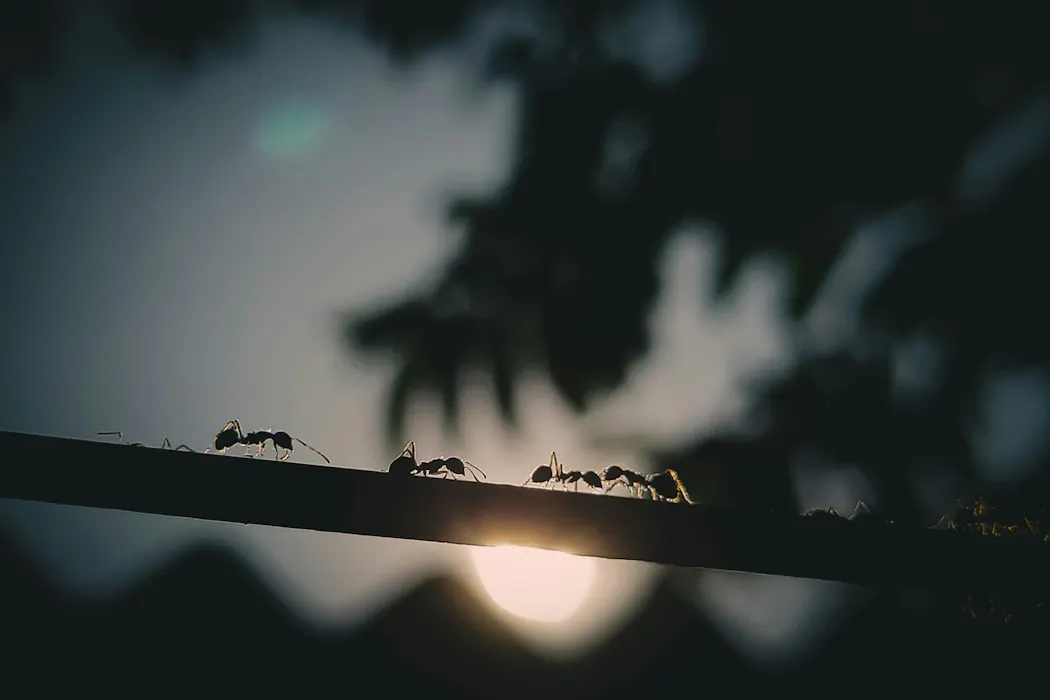
When a foraging worker finds a good source of food, such as some crumbs in your kitchen, she lays down drops of attractive chemicals called “pheromones” as she walks home.
Other ants in the colony are attracted to the trail, reinforcing it with more pheromones as they go. As a result, the colony can rapidly deploy large numbers of workers to quickly collect food.
While an individual ant is only aware of the foods she herself has visited, the trail network allows the colony as a whole to be “aware” of many foods.
Should a food source disappear or decline in quality, the colony can quickly refocus its efforts.
Ants can also optimise their trail networks by finding shortcuts.
Since pheromone trails evaporate over time, shorter paths that are traversed more quickly get reinforced more often. Longer paths, by contrast, receive less traffic and get reinforced less often, which in turn causes the pheromone trail to fade and become less attractive.
This simple feedback loop allows the colony to “discover” shorter routes that take less time to traverse while eliminating longer routes.
Nest construction is another impressive example of the power of self-organisation.
Ant nests can be vast and intricately structured, with chambers for raising the young, food storage, and waste.
Yet no ant has a blueprint for the final nest design, nor is a boss ant in charge of directing construction activities.
Instead, ants use simple rules to create their remarkable nest architecture.
For example, in the black garden ant Lasius niger, nest building ants excavate soil and form it into small pellets.
These pellets carry chemical cues making other ants more likely to deposit their own pellets nearby.
Over time, this leads to the formation of structures such as pillars, walls, and eventually roofs, without any ant understanding the overall design.
This process, where individuals respond to cues left behind by other individuals, is called “stigmergy” and it underpins the construction of other insect-built structures such as termite mounds and honeycomb.
More humans, more problems – but not so for ants
The use of simple behavioural rules enables ants to coordinate remarkably effectively as a group.
In a study where groups were tasked with moving a T-shaped object through a tight space, human performance did not improve with group size.
When participants were instructed not to speak, performance actually declined as groups got bigger.
Similarly, it has long been known that as human group size increases, the performance of individual team members tends to decrease, a phenomenon known as the Ringelmann effect.
Ants, by contrast, showed the opposite pattern: as group size increased, their performance actually improved.
So next time you see a line of ants marching around your house, resist the urge to spray or whack them away.
Instead, take a moment to appreciate these tiny masters of teamwork.
Tanya Latty co-founded and volunteers for conservation organisation Invertebrates Australia, is former president of the Australasian Society for the Study of Animal Behaviour and is on the Education committee for the Australian Entomological Society. She receives funding from the Australian Research Council, NSW Saving our Species, and Agrifutures Australia.
We have been on a years-long campaign of satellite remote sensing of the vast desert landscapes in Eastern Sudan.
This involved using satellite aerial imagery to systematically and painstakingly search for archaeological features in Atbai Desert of Eastern Sudan, a small part of the much larger Sahara.
Our team – which includes archaeologists from Macquarie University, France’s HiSoMA research unit, and the Polish Academy of Sciences – wanted to tell the story of this desert region between the Nile and the Red Sea, without having to excavate.
One mysterious archaeological feature stood out. We kept finding large, circular mass graves filled with the bones of people and animals, often carefully arranged around a key person at the centre.
Likely built around the fourth and third millennia BCE, all these “enclosure burial” monuments have a large round enclosure wall, some up to 80 metres in diameter, with humans and their cattle, sheep and goats buried inside.
Our new research, published in the journal African Archaeological Review, reveals how we found 260 previously unknown enclosure burials east of the Nile River, across almost 1,000km of desert.
Who built them?
Already known from a few excavated examples in the Egyptian and Sudanese deserts, these large circular burial monuments have long puzzled scholars.
What seemed once isolated examples emerge now as a consistent pattern. It is suggestive of a common nomadic culture stretching across a vast stretch of desert.
Most are within the borders of modern Sudan on the slopes of the Red Sea Hills. Unfortunately, satellite imagery alone cannot communicate the whole story of these enclosure burial builders.
The carbon dates and pottery from the few excavated monuments tell us these people lived roughly 4000–3000 BCE, just before Egyptians formed a territorial kingdom we know of as Pharaonic Egypt.
But these “enclosure burial” nomads had little to do with urbane and farming Egyptians.
Living in the desert and raising herds, these were Saharan desert nomads through and through.
A new elite?
Some enclosures show “secondary” burials arranged around a “primary” burial of a person at the centre – perhaps a chief or other important member of the community.
For archaeologists, this is important data for discerning class and hierarchy in prehistoric societies.
The question of when Saharan nomads became less egalitarian has plagued archaeologists for decades, but most agree it was around this time of the fourth millennium BCE that a distinctive “elite” class emerged.
This is still a far cry from the sort of huge divisions between ruler and ruled as seen in societies such as Egypt, with its pharaohs and farmers. However, it ushers in the first traces of inequality.
Animals held in high esteem
Cattle seem very important to these prehistoric nomads (a theory also supported by ancient local rock art in the area).
Burying themselves alongside their herd, these nomads show they held their animals in esteem.
Thousands of years later, local nomads chose to reuse these now “ancient” enclosures for their burial plots – sometimes almost 4,000 years after they were first built.
In other words, the prehistoric nomads created cemetery spaces that lasted for millennia.
What happened to these people?
No one can say for sure.
The few dates we have for these monuments cluster between 4000–3000 BCE, nearing the end of a period when the once-greener Sahara was drying, a phase scientists call the “African Humid Period”.
From north to south, the summer monsoon gradually retreated, reducing rainfall and shrinking pastures. This led nomads to abandon thirsty cattle, increase the mobility of their herds, migrate to the south or flee to the Nile.
The monuments are overwhelmingly located near what were then favourable watering spots; near rocky pools in valley floors, lakebeds and ephemeral rivers.
This tells us that when the monuments were being built, the desert was already quite challenging and dry.
At some point, as grass and bush made way for sand and rocks, keeping their prized cattle became unsustainable.
Having large herds of cattle in this desert, at this period, may have been a way of showing off an expensive and rare possession – a prehistoric nomad’s equivalent to having a Ferrari. This may help explain why cattle were frequently buried alongside their owners in enclosure burial monuments.
A bigger story
These enclosure burials are only one part of the greater story of human adaptation to climate change across North Africa.
From the Central Sahara, to Kenya and Arabia, keeping cattle, goats and sheep transformed societies. It changed the food they ate, the way they moved around, and community hierarchies.
It’s no coincidence communities changed how they buried their dead at the same time as they adopted herding lifestyles.
These burial enclosures tell us even scattered nomads were extremely well-organised people, and expert adapters.
Our discovery reshapes the story of the Sahara deserts and the prehistory of the Nile.
They provide a prologue for the monumentalism of the kingdoms of Egypt and Nubia, and an image of this region as more than pharaohs, pyramids and temples.
Sadly, many of these enclosure monuments are currently being destroyed or vandalised as a result of unregulated mining in the region. These unique burials have survived for millennia, but can disappear in less than a week.
Maria Gatto (Polish Academy of Sciences) was an author on our paper. We also want to acknowledge Alexander Carter, Tung Cheung, Kahn Emerson, Jessica Larkin, Stuart Hamilton and Ethan Simpson from Macquarie University for their contribution. We are also grateful to the National Corporation of Antiquities and Museums (Sudan).
Julien Cooper receives funding from the Australian Research Council, (Future Fellowship, FT230100067).
Maël Crépy receives funding from the CNRS (HiSoMA) and the Ifao (NOMADES research program).
Marie Bourgeois receives funding from Ifao (NOMADES research program).
Meetings between Chinese and American leaders are not exactly routine, but few are historically groundbreaking.
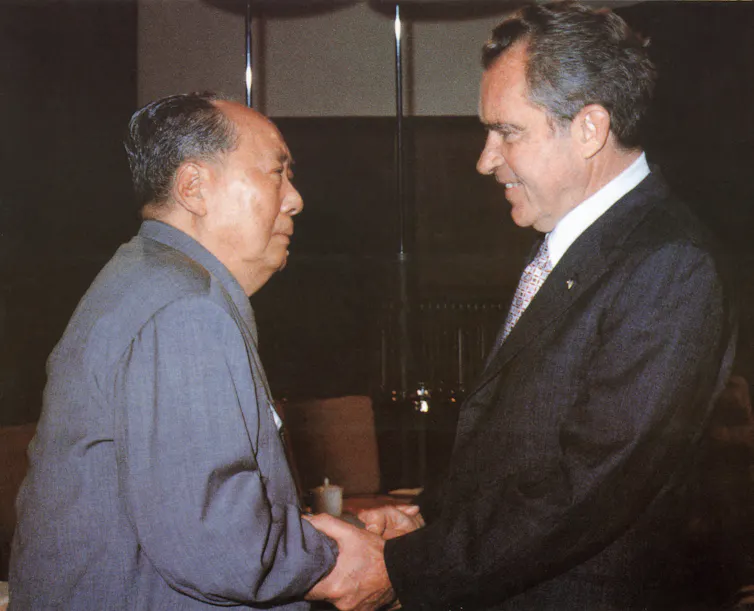
The exceptions include the very first visit by a sitting U.S. president to China, when Richard Nixon met with Chairman Mao Zedong in Beijing in February 1972 – at a time when America did not even formally recognize the People’s Republic of China. Deng Xiaoping’s visit to the U.S. in 1979 generated a similarly iconic moment when the reformist Chinese leader donned a Stetson at a Texas rodeo, a sign that he would be willing to engage with America in a way that Mao contemplated only near the end of his life.
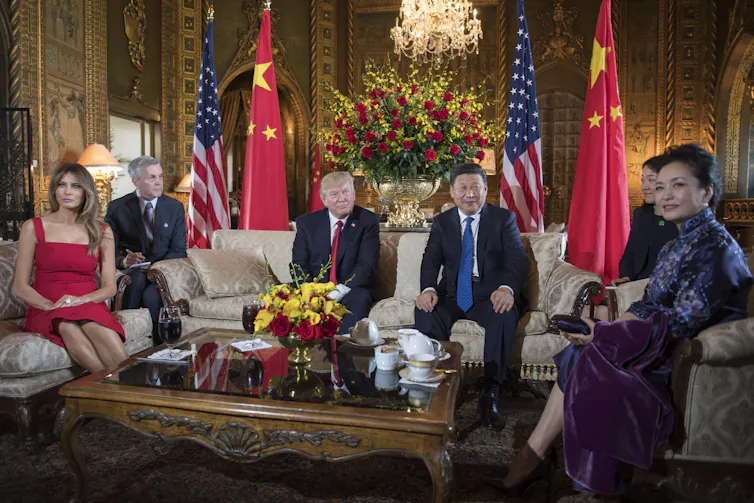
Donald Trump may harbor hopes that his upcoming visit, slated for May 14-15, 2026, could have similar historical significance to those moments half a century ago. It will, after all, be the first face-to-face meeting of U.S. and Chinese leaders in Beijing since Trump’s own visit nearly a decade ago in 2017.
Chinese Communist Party Chairman Mao Zedong welcomes U.S. President Richard Nixon to his house in Beijing in 1972.AFP via Getty Images
Yet the outcomes of this Trump summit with Xi Jinping are likely to be vague because the goals for both leaders are also only partially evident. The visit is being driven by trade imperatives, but there are other issues that threaten U.S.-China relations in the longer term.
It will be extremely hard for the two sides to address these more deep-rooted divides. Indeed, as an analyst of U.S.-China relations, I believe the world’s two largest economies will have an essentially competitive relationship for years to come, and areas of plausible cooperation – whether on climate change or AI regulation – are increasingly hard to find.
Taiwan: A change in US position?
One area that has been a source of contention for quite some time is Taiwan. Xi has made it clear that the unification of the island with the mainland cannot be left to “another generation” but has left it vague – up to now – as to how that goal will be achieved.
The summit has been preceded by lots of chatter about U.S. preparedness to honor its somewhat ambiguous promise to defend Taiwan in the event of an invasion – with Chinese analysts concluding that the war in Iran has severely weakened Washington’s capabilities on this front.
However, there are plenty of signs that Xi would rather find peaceful means to unite with Taiwan that avoid all-out war, particularly as the examples of Russia in Ukraine and the U.S. in Iran show that the outcomes of wars are not predictable.
Instead, China has seemingly concentrated its efforts on influencing the upcoming January 2028 Taiwan presidential election. The leader of the island’s major opposition Kuomintang party, Cheng Li-wun, recently visited the mainland and had a photo op with Xi – a sign that she thinks dealmaking with China might just be acceptable to the Taiwan electorate despite its deep distrust of Beijing.
To further fuel the narrative of a seemingly inevitable path toward unification, it would be helpful for Xi to have signals that the U.S. is no longer committed to defending Taiwan.
China will push for a change from the official position that the U.S. “does not support Taiwan independence” to “the U.S. opposes Taiwan independence.” The latter change sounds minor but would have great significance, as it would essentially be an acknowledgment that the U.S. recognizes unification, by some means, as a legitimate goal in its own right.
Taiwan’s ruling Democratic Progressive Party does not specifically endorse independence, as it knows that’s a red line for Beijing, but it would regard this change in American language as a serious blow to its position. It’s unlikely that the U.S. would make such a major concession during Trump’s visit – but that won’t stop Beijing from asking for it.
AI: The battle for global leadership
A more tentative but increasingly important area for discussion during the Xi-Trump summit is technology in general and AI in particular.
Just three years ago, the attitude of the U.S. government was summed up in the phrase of then national security adviser Jake Sullivan: “small yard, high fence.”
In other words, there would be only a few restricted areas of technology, but they would be fiercely guarded.
In 2026, things have changed. In some areas, tech restrictions have just become looser; the U.S. government now permits the sale to China of some high-specification, American-manufactured chips that were previously restricted. That policy was probably driven by the sense that China was developing its own domestic alternatives anyway and that the U.S. was losing market share.
Yet there is growing concern both in the U.S. and China that AI developments are moving too fast for governments – or companies – to know fully what the technology is capable of doing, let alone being able to regulate it.
China and the U.S. both desire to dominate AI and set the global norms and standards surrounding it. But they are also aware that AI has the potential to cause immense damage.
There has been loose discussion of whether any joint form of supervision or regulation of AI between the U.S. and China might be possible. And that could well form part of the discussions during the leaders’ summit.
But realistically, both sides see themselves in fierce competition, and the likelihood that either American or Chinese companies would restrain themselves may be fanciful.
The trade elephant in the room
The most substantial achievements of the summit, however, are likely to be in the least glamorous area: remedying the trade deficit.
U.S. first lady Melania Trump, Donald Trump, Chinese President Xi Jinping and his wife, Peng Liyuan, in West Palm Beach, Fla., on April 6, 2017.Jim Watson /AFP via Getty Images
While there are many American products that China would like to buy, most of them are not products that the U.S. government is willing to let them have, including high-tech equipment that could be used for military purposes.
Instead, the key products are likely to be agricultural, including U.S. soybeans and beef. Look out for concessions from China that would benefit farmers in key Republican states, such as Iowa.
The current tariff dispute between the U.S. and China has frozen into a standoff: The U.S. has agreed to allow China’s goods into its immense market at manageable tariff rates, and China has – mostly – agreed to allow critical minerals and rare earths to flow to U.S. manufacturers.
That truce lasts until October, but the summit may see it extended.
Neither side is keen to restart the trade war that marked the summer of 2025, when Trump announced tariffs of over 100% on China and the U.S. was in danger of having key mineral supplies cut off as a result.
Summit to talk about? Perhaps not
So how consequential will the Trump-Xi summit be? Well, don’t expect another “Nixon meets Mao” moment.
The circumstances more than a half-century on are also remarkably different. Today’s China, unlike in 1972, has an economy and military second only to the U.S. and a central position in global organizations, from the United Nations to the World Trade Organization, particularly as the U.S. retreats from such institutions.
Both the U.S. and Chinese sides know that they can expect limited cooperation at best from their opponent.
But after a period, particularly during the COVID-19 pandemic, when communication between the countries atrophied, it’s still important that they are talking at all.
Rana Mitter does not work for, consult, own shares in or receive funding from any company or organization that would benefit from this article, and has disclosed no relevant affiliations beyond their academic appointment.
Four percent of Americans – roughly 12 million people – believe that “lizard people” secretly control the Earth. At least, that was the finding of an infamous 2013 public opinion survey.
Do so many people really believe such outlandish claims? Or do results like these partly reflect people giving silly answers or deliberately skewing surveys for fun?
US psychiatrist Alexander Scott believes the latter plays a significant role.
Using the survey as an example, he coined the term “the Lizardman constant” to describe the idea that a certain amount of noise and trolling will always exist in surveys about unusual beliefs.
As Scott warned: “Any possible source of noise – jokesters, cognitive biases, or deliberate misbehaviour – can easily overwhelm the signal.”
As researchers who study uncommon beliefs such as conspiracy theories, we wanted to investigate how this kind of cheeky trolling can muddy the waters.
We did this in two ways. First, we directly asked people a yes/no question at the end of the survey:
“Did you respond insincerely at any earlier point in this survey? In other words, did you give any responses that were actually just joking, trolling, or otherwise not indicating what you really think?”
Second, we included in the survey a “conspiracy theory” so ridiculous we could assume most, if not all, people who said they believed it were taking the mickey.
We asked them if they believed:
The Canadian Armed Forces have been secretly developing an elite army of genetically engineered, super intelligent, giant raccoons to invade nearby countries.
In our representative online sample of 810 New Zealanders, 8.3% of respondents confessed to being insincere in the survey.
Another 7.2% said they thought the Canadian raccoon army theory was probably or definitely true. That proportion – similar to findings from Australia – would equate to more than 300,000 adult New Zealanders.
To complicate things slightly, there was some overlap between those admitting to insincere answers and those claiming to believe the raccoon conspiracy. Combined, 13.3% of respondents fell into one or both groups – roughly one in eight people not appearing to take the survey seriously.
Importantly, these respondents were also much more likely to endorse other conspiracy theories, inflating estimates of how widespread those beliefs really are.
For instance, 6.5% of the full sample endorsed the claim that governments around the world are covering up the fact that 5G mobile networks spread coronavirus.
But once we removed the insincere responders, that figure dropped by more than half to 2.7%.
Across 13 different conspiracy theories, the estimated proportion of believers fell substantially once those respondents were excluded.
Another interesting insight from our study was that people endorsing contradictory conspiracy theories were much more likely to show signs of responding insincerely.
Previous studies have found some people appear to believe conspiracy theories that directly contradict each other. In our survey, for example, some participants agreed both that COVID-19 is a myth and that governments are covering up the fact that 5G networks spread the virus.
But nearly three-quarters of those respondents also showed signs of joking or dishonest answers.
This suggests genuinely believing contradictory conspiracy theories may be less common than previously thought.
Not every conspiracy believer is joking
Our findings add further weight to the idea that surveys may overestimate how many people truly believe some conspiracy theories – thanks, in part, to trolls.
But does that mean all conspiracy theory research is bunk?
Fortunately not. Most research in this area is not focused on counting conspiracy believers, but on understanding why people hold these beliefs and what effects they can have.
We tested several well-established findings from earlier conspiracy theory research to see whether they still held up once insincere respondents were removed from the data.
For example, previous studies have found that people who endorse conspiracy theories are more likely to see the world as a dangerous and threatening place.
We found the same pattern. In fact, removing insincere respondents made little difference to the broader relationships identified in earlier research.
Nevertheless, we recommend that future surveys include ways to gauge whether respondents are answering sincerely and account for this in the analysis. At the very least, researchers should acknowledge that trolls and joking responses can distort their results.
While our research suggests some people are taking the mickey in surveys, it also shows a significant minority genuinely appear to believe some of these claims.
In some cases – such as believing authorities are covering up the fact that the Earth is flat – this may be relatively harmless. But other conspiracy beliefs can lead to real-world harm.
Good-quality research is essential for understanding how sincere believers end up down these rabbit holes, and how those beliefs influence real-world behaviour.
Research into why people embrace conspiracy theories – and the real-world consequences of those beliefs – remains important.
But when surveys suggest millions may believe in lizard overlords or genetically engineered raccoon armies, it is also worth remembering the “Lizardman constant”: some respondents may simply be having us on.
The authors acknowledge the contributions of Rob Ross, Mathew Ling and Stephen Hill to this article.
John Kerr is supported by a Royal Society Te Apārangi Mana Tūānuku Research Leader Fellowship.
This research was supported by the Marsden Fund Council from Government funding, managed by Royal Society Te Apārangi.
Mathew Marques does not work for, consult, own shares in or receive funding from any company or organisation that would benefit from this article, and has disclosed no relevant affiliations beyond their academic appointment.
Focusing on the word “rights” hides something more serious underneath: how people live and survive in this situation. What’s unfolding in Afghanistan is not just a women’s rights crisis, but a humanitarian disaster.
It affects how people access health care, education, food systems and basic supports and whether these system can function at all when half the population has been systematically removed from them. It forces families to deal with women’s limited access to work and services, often pushing households into deeper economic and social vulnerability.
The Taliban has steadily removed women from public spaces including work, health care and education. Recently, for example, female health-care workers were stopped at the gates of a United Nations office and banned from entering the facility by Taliban authorities.
These ongoing removals are incrementally creating a system that determines who has the right to exist, to provide assistance and to receive assistance.
What’s happening in Afghanistan is not simply gender discrimination; rather, it’s pushing an entire gender out of public systems altogether. The predicament of Afghan women is less a social problem and more a structural crisis that shapes institutions and everyday life.
Gender apartheid
This is why the situation in Afghanistan is increasingly referred to as a form of gender apartheid rather than a women’s rights crisis. The exclusion of women reveals how institutions are built and will be maintained in the future.
Gender apartheid refers to a situation in which people are banned from certain spaces or activities based on their gender identity.
Its effects are also accumulative, with each restriction reinforcing others and deepening the overall crisis. These systemic rights violations would be increasingly difficult to reverse even if political bodies and the ruling government changed tomorrow.
That’s because removing women from professional spaces leads to schools losing teachers, hospitals losing trained staff and aid networks losing access to half the population. And this loss isn’t temporary; it limits how systems can respond to the growing needs around them.
When women get barred from institutions, the problem isn’t just that these organizations suffer in their service delivery and performance. It also results in the loss of institutional memory — the skills, professional knowledge and experience that is no longer transferred to future generations.
Over time, institutions also scale down or suspend certain services due to a shortage of female workers. As services shrink, significant gaps appear in the networks of care and support leaving entire groups of people without consistent access to support.
Blocking aid and support
The Taliban refusal to allow female workers into UN and UNICEF offices is one of many examples happening today in Afghanistan that ban qualified women from entering places where they can deliver urgent care and assistance.
Taliban rule consequently delays or prevents life-saving interventions for women and children, a violation of the human right to survive.
It’s not just UN and UNICEF offices where women workers are banned from entry: they’re being turned away at other aid organizations, hospitals, schools and various public institutions in a widespread erosion of human rights. The Taliban has put in place a network of human rights violations across the entire humanitarian system.
Humanitarian aid also depends on access to information and correct data: who is hungry, who is unsafe and who needs protection. In Afghanistan, where women are limited in who they can interact with and where female staff are largely absent from outreach, surveys and home visits, this information becomes incomplete.
Poor data leads to incomplete distribution of assistance and mismatched allocation of aid. As a result, the most vulnerable populations can remain invisible in official assessments.
This invisibility especially affects households headed by women and those living in remote or rural areas with already limited access.
Normalizing crises
The impact of Aghanistan’s gender apartheid might not be visible to many outside the country, but in the near future, humanitarian systems will break down.
UNICEF estimates the ban could cost Afghanistan 25,000 teachers and health-care workers. In a country where women are prohibited from receiving care from male providers, banning women from both education and health-care work creates a profound medical emergency.
Over time, systems will be redesigned without women as providers even as they remain central as recipients. As gender restrictions disrupt the flow of resources, knowledge and care, the capacity to deliver services is declining every day despite high demand. Many women are also pushed into informal or hidden work that is insecure and vulnerable to exploitation and abuse.
Gender apartheid in Afghanistan will not end through recognition alone. Naming systemic terror does not stop it and, without action, repeated exposure to crisis can instead normalize it through compassion fatigue. Humanitarian organizations now face a stark choice: operate under restrictive conditions and risk legitimizing them, or withdraw and leave people without support.
The longer the situation persists, the more the exclusion of women in Afghanistan risks becoming a normalized structure rather than an emergency. The question is no longer only how to restore what’s been lost, but whether systems once dependent on women’s participation can be rebuilt at all.
Sepita Hatami does not work for, consult, own shares in or receive funding from any company or organisation that would benefit from this article, and has disclosed no relevant affiliations beyond their academic appointment.
A great Tyrannosaurus rex strides through the conifer trees of her territory, sniffing the air. She picks up the scent from the carcass of a dead horned dinosaur, Triceratops, that she was feeding on yesterday. She walks over and strips off some more shreds of meat, but the smell is foul even for her.
She goes down to the lake to drink and small crocodiles and turtles scuttle into the water. But she hardly sees them. Of more interest is an armoured dinosaur, Ankylosaurus, lurking nearby. However, she knows this dinosaur won’t be an easy kill and she isn’t desperate enough for food to risk a fight. Little does she know there are bigger dangers ahead. She looks up and sees a bright light racing downwards accompanied by faint crackling and sizzling noises.
Our T. rex has excellent hearing for low frequency sounds and she is disturbed by the vibrations she can feel. But her upset only lasts for a moment. In a flash, she has been burnt to a crisp and her world changed forever.
This all happened 66 million years ago, when a huge asteroid famously hit the Earth in the area of what is now the Caribbean. At the end of the Cretaceous period, sea levels were 100–200 metres higher than today, so the shores of the Caribbean lay far inland over eastern Mexico and the southern United States. The impact happened entirely within these waters.
The event triggered instant changes to our planet and its atmosphere and led to the extinction of the dinosaurs and about half Earth’s other species. But what would it have been like to experience such a gargantuan impact? What would you have seen, heard or smelled? And how would you have died – or survived?
The Insights section is committed to high-quality longform journalism. Our editors work with academics from many different backgrounds who are tackling a wide range of societal and scientific challenges.
As experts on meteoritics and palaeontology, respectively, we’ve created a detailed timeline, based on decades of research, to take you right there. So let’s start by travelling back in time to the very last day of the Cretaceous.
T-minus one day
All is calm and the Cretaceous day proceeds as usual. In what will soon be ground zero, it is pleasantly warm, about 26°C, and wet. It often is. For about a week, the asteroid has been visible only at night. Because the giant rock is heading straight towards Earth, it looks like a motionless star. There is no dramatic tail; this is a rocky asteroid rather than a comet.
In the last 24 hours, the light becomes visible during the daytime. But it still looks like a star or planet, getting brighter in the final few hours before impact.
T equals 0: the impact
If you were close by, you would first have experienced a brief light and sound show. Minutes to seconds before the impact, you’d have seen the bright fireball, and its accompanying crackling or fizzing noises. This sizzling sound is a result of the photo-acoustic effect: the intense light of the fireball warms the ground, which then heats the air above it, causing pressure waves, or sound.
Next, a deafening sonic boom, which occurs because the asteroid is travelling faster than the speed of sound. But the asteroid is so huge, perhaps 10km in diameter, that it almost certainly hits the ground before any living creature near the impact zone has time to run for cover.
The asteroid’s enormous energy forms a crater through a series of processes that together take only a few seconds. As the asteroid collides with the surface, its kinetic (movement) energy is instantly transferred to the surface as a combination of kinetic, thermal (heat) and seismic energy (released during earthquakes). This results in a series of shock waves that heat and compress both the asteroid and its target.
As the shock waves propagate, rocks fracture, break up and are ejected, producing a bowl-shaped depression, or transient cavity, about ten seconds after impact. The heat and compression also melt and vaporise large volumes of material, including the asteroid itself, releasing a fountain of incandescent vapour (its temperature is more than 10,000 K, or 9726.85°C).
Over the next few seconds, the cavity increases in size to many times the diameter of the original asteroid. Simulations suggest that around 20 seconds after impact, the transient cavity is at least 30km deep – deeper than the deepest depth currently known on Earth, the 11km Challenger Deep valley, part of the Pacific Ocean’s Marianas Trench. The rim of the crater is over 20km high – more than twice the height of 8,900m Mount Everest.
But this enormous feature lasts for less than a minute before it starts to collapse. Within three minutes of the impact, the centre of the crater has rebounded to form a peak several kilometres high. The peak only lasts about two minutes before collapsing back into the crater.
Whether a dinosaur or a dung beetle, if you were near the transient cavity you would have been incinerated instantly by the blast. But even if you were up to 2,000km from the epicentre, you’d likely have been killed quickly by the thermal radiation and supersonic winds now spreading out from the impact site.
T-plus 5 minutes
Five minutes after the impact, the winds have “eased” to those of a category 5 hurricane, flattening everything within about 1,500km of the impact. Destroying everything, that is, which has not already been burnt. Atmospheric temperatures in the region rise to over 500K (226.85°C). This would feel like being inside an oven – causing burns, heatstroke and death. Wood and plant matter ignite, creating fires everywhere.
Because the asteroid struck the sea, the atmosphere is also filled with super-heated steam, making the hurricane-force winds even deadlier.
Next come the tidal waves, triggered by the vast quantities of displaced rock and water. These 100-metre megatsunamis first strike the shores of what is now the Gulf of Mexico, engulfing the land before depositing huge amounts of debris as they retreat.
By now, the crater has almost reached its final dimensions – 180km across and 20km deep. But making an enormous hole in the ground isn’t the only outcome of the impact. All the rock and vapour displaced during the collision has to go somewhere. Several locations in Northern America show that metre-sized blocks of debris from the impact were thrown distances of hundreds of kilometres.
So if you were 2,000km to 3,000km from the epicentre and survived the first few seconds, you’d most likely die from overheating, earthquakes, hurricanes, fires, tsunami-driven floods or being hit by impact melt.
But what is happening much further away? In the first five minutes after impact, dinosaurs roaming the Cretaceous forests of what are now China or New Zealand are so far undisturbed.
But it won’t be long before that changes.
T-plus one hour
Shockwaves on land and sea are only minor inconveniences compared with the fire that is still radiating down from the sky. Some of the impact energy has been transferred into the atmosphere, heating the air and dust to incandescence.
An hour after impact, a belt of dust has circled the globe. Deposits of solidified molten droplets (impact spherules) and mineral grains have been found in numerous locations from New Zealand in the south to Denmark in the north. In these locations, you would not have been aware of the tsunamis around the Americas or the wildfires, but the skies would certainly have begun to darken.
T-plus one day
By now, huge tsunamis are moving east across the Atlantic and west across the Pacific, entering the Indian Ocean from both sides.
They are still around 50m high – causing death and destruction across many coasts around the world. By comparison, the 2004 Boxing Day tsunami reached heights of up to 30 metres. Tsunamis kill fishes and marine life that are washed high on the shore and then dumped, just as they kill coastal trees and drown land animals. But the tsunamis gradually fade away and probably don’t wipe out any entire species – at least on their own.
The hurricane force winds have also died down, but tropical storm strength winds are whipping up debris and causing further chaos and destruction across the tsunami-affected areas. The burning sky is also triggering wildfires across the globe – which, in turn, carry ever more soot into the atmosphere. The sooty signature of these wildfires has been found deposited as carbon particles in sediments from the K-Pg boundary – a 66-million-year-old thin clay layer.
Further away, in what is modern Europe and Asia, the skies continue to fill up with dust and soot, as they do everywhere. Temperatures start to drop as sunlight is blocked. Trees and plants in general, including phytoplankton, close down as if for winter, unable to photosynthesise. Any animals that rely on warm conditions ultimately hunker down and die.
T-plus one week
It’s getting darker and darker. Simulations of solar radiation reaching the Earth’s surface following the impact indicate that, after about a week, the solar flux (the amount of heat and light per a certain area) is just one thousandth of that prior to the impact. This is caused by particles of dust and soot in the atmosphere.
The continued decrease in light levels is accompanied by a global drop in surface temperatures of at least 5°C. This means that most of the dinosaurs and other large flying and swimming reptiles probably die from freezing within the course of this first week (smaller reptiles with slower metabolisms or more flexible diets could survive longer). Cooling temperatures and cloud cover also lead to rain. But not just any rain. Storms of acid rain fall across the Earth.
Two separate mechanisms generate acid rain. The first is down to the geology of the impact region. The asteroid happened to hit an area of sediments rich in sulphur, which vaporised and caused sulphur oxides (acidic and pungent gas compounds composed of sulphur and oxygen) to be part of the plume of plasma blasted into the atmosphere. Second, the energy of the collision was sufficient to turn nitrogen and oxygen into nitrogen oxides – highly reactive gases that can form smog.
The dropping temperature ultimately allows water vapour to condense into drops, and the sulphur and nitrogen oxides dissolve to form sulphuric and nitric acids. This is sufficient to generate a rapid drop in pH. Early models suggest that the pH of the rain might be as low as 1 – the same acidity as battery acid.
At this point, Earth is not a great place to be. Rotting vegetation, choking smoke and sulphur aerosols combine to make the planet stink. Plants and animals on land and in shallow seas that have survived the darkness and cold succumb to the corrosive acid rain and ocean acidification. Acid rain also kills trees by leaching nutrients such as calcium, magnesium and potassium from the soil. Shallow marine shellfish, crustaceans and corals also die as acid seawater destroys their skeletons.
T-plus one year
Winds die down, wildfires are extinguished and the oceans are once again calm. It might appear that the asteroid collision is just a scar on the ocean floor. But its effects are still destructive. The atmosphere is still filled with dust and the Sun hasn’t shone for a year. Temperatures have continued to drop, with the average surface temperature now 15°C lower than before the impact. Winter has come.
Any dinosaurs or marine reptiles that survived the first week of freezing conditions would have died very soon after. A year after the impact, only rotted skeletons of these behemoths remain. Here and there, smaller animals like mammals the size of rats and insects would be nestling in crevices, barely surviving on their reserves and decaying plants.
While most plant groups and many of the modern groups of insects, fishes, reptiles, birds and mammals recover reasonably rapidly, things don’t look great for other species. Dinosaurs and pterosaurs living on land are extinct, as are many marine reptiles, ammonites, belemnites and rudist bivalves in the oceans. Ammonites and belemnites are high in their food chains, and so suffer not only from the cold and acidification but also from the loss of abundant food resources, such as smaller marine organisms.
T-plus ten years
The Earth is still in the grip of a fierce winter. Although most of the sulphur has rained out of the atmosphere, dust and soot particles remain. The average surface temperature is still about 5°C lower than before the impact. The main oceans have not frozen, but inland lakes and rivers around the world are iced over.
Clearly, there were no humans about at this time – there weren’t even any larger mammals. But given the only species that survived were those that could burrow or live below water, it is unlikely that you could have survived this long.
Surviving plant and animal groups such as turtles, smaller crocodiles, lizards, snakes, some ground-dwelling birds and small mammals repopulate the Earth at this point. But they are forced back to limited areas of relative safety a long way from the impact site. These areas are now receiving sufficient sunlight for plants and phytoplankton to photosynthesise again. As leaves and seeds provide the basis for the food chains on land and in the sea, life begins to rebuild.
Eventually, life returns to the devastated landscapes, but ecosystems are very different and the dinosaurs are no more.
T-plus 66 million years
Today, 66 million years after the impact, the scars of the collision are hidden within geological strata – and scientists have started deciphering them. It was in 1980 that researchers first reported evidence of the impact. In their classic paper, Luis Alvarez, a Nobel-prize-winning physicist, and co-authors, described a sudden enrichment in the element iridium in a specific clay layer in Denmark and in Italy.
Iridium is rare in surface rocks because most of it was sequestered in Earth’s core when the planet first formed. However, iridium is found in meteorites, and Alvarez and colleagues inferred that the rate of accumulation of the metal in the sediments was so high that it could only have been produced by impact of a gigantic meteorite.
Because the scientists had only observed the iridium spike in two locations, the impact hypothesis was rejected by many scientists at the time. However, through the 1980s, iridium spikes were identified in clay layers at more and more locations – in muds laid down on land, in lakes, in the sea.
Support for an impact hypothesis strengthened when a crater of the correct age was found in 1991. The crater is buried beneath younger rocks, but clearly visible in geophysical surveys, lying half on land in the Yucatán Peninsula of Mexico, and half offshore. Since 1990, evidence for the impact has increased, not least when scientists discovered that there was indeed a sharp cooling event at the end of the Cretaceous.
Possible T rex footprint from New Mexico.Wikipedia, CC BY-SA
In total, it is estimated that half the species of plants and animals alive at the end of the Cretaceous disappeared. It was once thought that surviving groups such as many plants, insects, molluscs, lizards, birds and mammals somehow escaped unscathed. But detailed study shows that this is not the case – they were all hit hard.
But, by chance or luck, enough individuals and species were able to survive the cold and absence of food, or were in parts of the world where the effects were less extreme. As the world returned to normal, they had the opportunity to expand rapidly into their old niches, but also to occupy the space vacated by extinct groups. In fact, one important consequence of the extinction of the dinosaurs, apex predators in their heyday, was the successful spread and evolution of mammals.
When Alvarez and colleagues first described the drop in temperature following the impact, they called it a “nuclear winter”, reflecting the political climate of the early 1980s. Now we might be more inclined to describe the effects as a global climate change – similar events are currently resulting from increased carbon dioxide in the atmosphere (flooding, temperature fluctuations).
It is salutary to think that without the asteroid collision, primates might never have reached the level we are at today. But it is equally salutary to consider that modern humans are causing some of the same changes to the atmosphere that ultimately killed our reptilian forbears and may one day also lead to our own demise.
To hear about new Insights articles, join the hundreds of thousands of people who value The Conversation’s evidence-based news. Subscribe to our newsletter.
Monica Grady receives funding from the Leverhulme Trust for an Emeritus Fellowship and from the STFC. She is affiliated with The Open University, Liverpool Hope University and the Natural History Museum, London.
Michael J. Benton does not work for, consult, own shares in or receive funding from any company or organisation that would benefit from this article, and has disclosed no relevant affiliations beyond their academic appointment.
When players arrive in the US this year for their World Cup pre-tournament media shoot, they will each step into a scanning chamber to capture their precise body-part dimensions and create 3D, AI avatars. Why? Because even when you’re the biggest sport in the world, you can’t afford to stand still.
This year’s Fifa World Cup will feature more teams (48), more matches (104) and more cameras than ever. Describing the scale of the tournament, Fifa boss Gianni Infantino told fans to expect the equivalent of “104 Super Bowls”.
Infantino wants to “break” America, where soccer has never reached the same levels of mainstream popularity as it has in the rest of the world. The last time the World Cup was held there was 1994. Singer Diana Ross missed a penalty in the opening ceremony and Italian player Roberto Baggio missed one in the final. England missed out altogether. Memorable, but it didn’t capture American hearts.
This summer 5 million paying customers will buy eye-wateringly expensive tickets to watch games play out in stadia across three different host countries – Canada, the US and Mexico. And it’s predicted up to 6 billion will engage with the competition around the world; on screens, phones, tablets, in bars, bookmakers and fan zones.
Sport exists in the same ultra-competitive attention economy as other forms of entertainment. If Fifa want to get inside the minds and mobile phones of audiences, then they’ll need to think visually in a broadcast sense, but also vertically, in terms of creating content which will cut through online.
At the recent Winter Olympics held in Milano-Cortina, Italy, the drone cameras caught eyes and stole the show. Drones worked well buzzing after skiers down a fixed-track mountain course or chasing skaters around an ice rink but they won’t work in football stadiums where the unpredictability of the action means a drone could get hit by the ball.
How drones transformed the way the Winter Olympics were filmed.
However, this World Cup will have cable-suspended, gyro-stabilised spider cameras swooping above the action. Expect to see them used more on the live action than in previous World Cups, perhaps even during penalty shootouts.
At every game there will be 45-50 cameras focused on the action including pole cams, cable cams, 360 cams and one new camera taking you closer to the action than ever before. “Referee view” will allow audiences to see what the referee sees. Cameras mounted on the referee, trialled at the Fifa Club World Cup last year, will show us what the ref can – and can’t – see. These points of view are not new to sports broadcasting (they are common in rugby) but the issue in the past has been the stability of the vision. For this competition, broadcasters will use AI stabilisation software to improve the smoothness of the shots.
The AI World Cup
AI-enabled 3D avatars will also assist VAR decisions by ensuring precision around player ID and tracking. This will drive semi-automated offside technology, so you’ll get greater quality images and faster, fairer decisions.
At the 2022 World Cup in Doha, Qatar, there was access all areas for a Netflix documentary called Captains, broadcast after the tournament. Ever since the Formula 1 Drive to Survive fly-on-the-wall format took us inside F1’s previously sacred inner sanctums, fans want to see everything on and off the pitch. But this year if you want to go behind the scenes, you’ll have to go online.
Trialled at the Women’s World Cup in 2023, the agreement will give TikTok ability to live-stream parts of matches, access to behind-the-scenes content and specially curated clips. Meanwhile YouTube’s deal permits broadcast partners to post highlights on the platform, live-stream some games in their entirety and give YouTube “first party” presence with archive matches from previous tournaments playing across the platform.
‘Referee view’ footage from an MLS All-Stars v Arsenal match in 2024.
American sports coverage is all about entertainment and this World Cup even the statistics will be given a glow up. Get ready for something called “data-tainment”, providing fans with what Fifa describes as “unparalleled insight and enjoyment”. Expect a seamless integration of advanced analytics with real-time graphics, all based on official optical tracking data.
What’s the end goal? It seems Fifa want those at the stadium to enjoy the benefits of watching from their sofa (replays, stats, analysis) and those viewing from home to feel the more visceral, immersive aspects of being there at the stadium (cinematic lenses, wearable cameras, enhanced audio). At the stadium spectators will be able to see key decisions play out on the big screen, with real-time stats delivered to their phones. Stadium connectivity, an issue in the past, will be amped up to ensure everyone stays connected.
It’s a delicate balance. Despite the innovations announced, Fifa knows the enduring appeal of watching football is its simplicity. Traditional audiences do not want gimmicks disrupting their beautiful game. Fifa has a tightrope to walk because the American audience it so dearly craves like their sport packaged in a certain way. The rest of the world – well, they seem happy with football the way it is.
World Cups of the future will be a more immersive experience. Audiences at home wearing VR headsets as real-time player tracking graphics appear live in their lounge. But the reality remains that live football match coverage hasn’t changed that much in decades. What you get to watch won’t change much, but where you watch it will, traditional broadcasters no longer the only show in town. And it’ll be what happens in the stoppages and the moments around the game which is set for revolution. A revolution that will be televised – and streamed, downloaded and clipped to watch on catch up later.
Joe Towns does not work for, consult, own shares in or receive funding from any company or organisation that would benefit from this article, and has disclosed no relevant affiliations beyond their academic appointment.

 Login
Login