Reading view

AJK govt cracks down on JAAC after imposition of ban

• Police arrest at least 72 people, recover ‘weapons, suspicious documents’
• Situation tense in Poonch after trader gunned down in ‘clash with police’

MUZAFFARABAD: Auth­or­it­ies in Azad Jammu and Kashmir (AJK) on Saturday launched a crackdown on the proscribed Joint Awami Action Committee (JAAC), arresting scores of its leaders and activists from different areas.

“In fulfilment of its responsibility to maintain public order and protect the lives and properties of citizens, police have arrested around 72 people affiliated with the proscribed JAAC over the past 18 hours,” said a handout issued by a spokesperson for police chief Liaqat Ali Malik.

“During initial action, weapons, communication gadgets, suspicious documents, material related to plans that could adversely affect public order and organised mechanisms for violent agitational activities had been found, in addition to indications of questionable contacts with patrons and foreigners which are being investigated under law,” it added.

The police spokesperson said the police and other institutions concerned were examining information, digital evidence and contacts indicating that some elements were “trying to exploit public issues to disrupt law and order, influence the electoral process, damage public and private property, incite hostility against state institutions and paralyse normal life through unconstitutional and violent actions”.

He urged the public to remain peaceful, restrict movements and avoid taking part in any activity by any outlawed organisation and extend cooperation to law enforcers in their own interest.

The police statement came in the wake of a tense situation in Poonch, where a trader, Shahzeb Habib, was killed by a gunshot wound late on Friday night.

According to sources, Habib was last seen accompanying Umar Nazir Kashmiri, a JAAC core member from Poonch, on Friday night when they were returning from Khaigalla to Rawalakot. Their vehicle was intercepted by law enforcers near Barmang bridge, which reportedly led to “an exchange of fire” between the two sides during which Habib was believed to have been critically injured and later died.

“At 11:45pm on Friday, when police tried to intercept a suspicious vehicle near Khaigalla, its armed occupants opened fire on them. Police also retaliated with firing, which led the armed men to escape,” claimed a post on the Facebook page of the AJK police. It made no mention of any death.

Sources said the body of Habib was brought to the Combined Military Hospital (CMH) Rawalakot, but his relatives did not allow the post-mortem. Mr Kashmiri was also said to have received minor injuries, but he had managed to escape arrest, according to some of his associates.

On Saturday, relatives placed Habib’s body outside the hospital where they staged a sit-in for about four hours. Afterwards, it was taken to Tarar, his native village. Initially, it was decided that the funeral prayer would be held at 6pm. However, later his family and colleagues changed their mind and brought the body back to the CMH for a post-mortem examination, which could not be conducted when this report was dictated on phone, amid an internet shutdown.

Witnesses said dozens of people were on a dharna (sit-in) outside the hospital. Reportedly, they were waiting for some JAAC core member to visit them and issue a direction regarding the next course of action.

Earlier in the day, most shops in Rawalakot remained shut, except for those selling groceries, dairy products, fruits and vegetables, medicines, and restaurants, which recorded a “rush of panic buyers,” according to witnesses.

“Rangers and police personnel are standing alert at many important points in the town. But I tell you there is hustle and bustle here,” a resident told Dawn by telephone.

Witnesses said that a main route from the Azad Pattan Bridge had been blocked by protesters by placing boulders and other obstacles in the jurisdiction of the Mang police station, but other roads were mostly open.

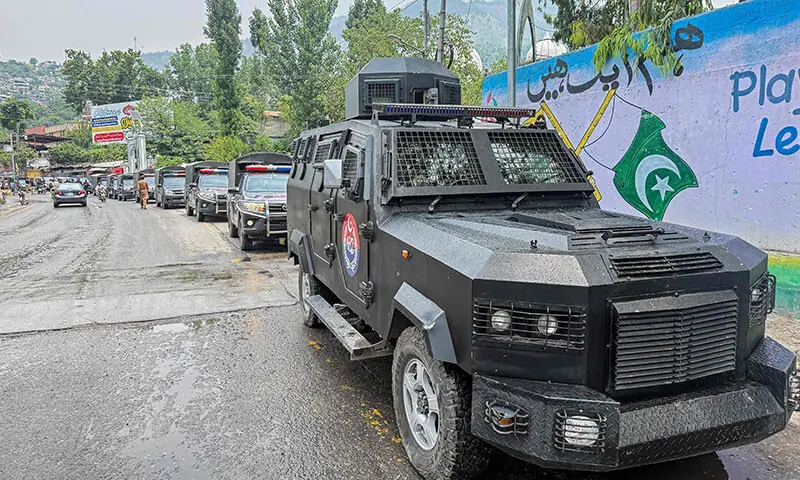
In Muzaffarabad, life remained normal. Though shops stayed open, traffic was thin on the roads. Police staged a flag march in various parts of the city.

Meanwhile, a senior official at the AJK Supreme Court told Dawn that the two-member bench, comprising Chief Justice Raja Saeed Akram and Justice Khalid Yousaf Chaudhary, had finalised the apex court’s advice in response to a presidential reference under Article 46-A of the AJK Interim Constitution by 8pm.

The sealed envelope, containing the advice, had been delivered by acting Registrar Malik Ahtisham to the secretary for presidential affairs at the President’s House here, he said.

Published in Dawn, June 7th, 2026

  •  

Sedition cases, ‘head money’ against JAAC leaders ordered

• Clashes with law enforcers reported as rallies from various parts of region attempt to converge on Muzaffarabad
• Several feared dead, two cops among scores injured
• PM Rathore urges a return to talks
• Five held from Muzaffarabad on suspicion of ‘links to foreign agencies’

MUZAFFARABAD: Parts of Azad Jammu and Kashmir (AJK) remained in the throes of a crippling shutter-down strike on Tuesday, which was punctuated by clashes between law enforcers and supporters of the recently-proscribed Joint Awami Action Committee (JAAC).

The AJK government has issued orders to initiate sedition proceedings against two JAAC figures, and also announced a Rs10 million reward for information leading to the arrest of four of the group leaders.

At the same time, AJK Prime Minister Faisal Mumtaz Rathore urged a return to the negotiating table in a bid to end the tensions that have gripped the region over the past few days.

The clashes occurred when protesters from different areas of Mirpur division, comprising Mirpur, Bhimber and Kotli districts, took out rallies in line with the JAAC’s plan, envisaging a long march towards neighbouring Poonch division, en route to Muzaffarabad.

In the lakeside city of Mirpur, hundreds gathered outside the Quaid-i-Azam Cricket Stadium. They later began marching towards Plaak bridge, where they were reportedly joined by another rally from Dadyal, led by Khawaja Mehran Arshad at the border of Kotli district.

On the outskirts of Mirpur, two policemen and some protesters were injured in a brief clash in Pind Sabharwal village, an official said.

However, most violent clashes took place in Kotli city, after a procession of hundreds arrived there from Khuiratta tehsil. Though officials remained tight-lipped, residents and members of the AJK cabinet told Dawn — on condition of anonymity — that several people, including a doctor and a woman, were killed and scores of others wounded in the clashes.

According to initial reports, the doctor was on the roof of his home when he was hit by a stray bullet.

The strike and the ongoing closure of internet and mobile data services in the region has made it difficult to obtain real-time information from AJK.

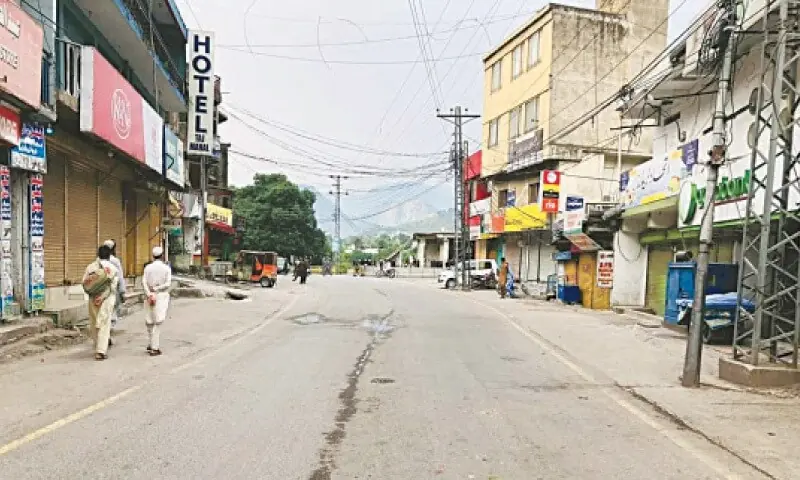
Earlier in the day, all cities, towns and villages across AJK observed a complete shutter down strike. Even the banks, medical stores and bistros were closed and public and private transport off the roads.

However, in many areas motorcycles and a few private cars were occasionally seen moving through the streets without any disturbance.

In Muzaffarabad – the ultimate destination of protesters – riot police had taken positions in and outside government buildings and main thoroughfares to meet any eventuality. However, the capital remained completely calm on Tuesday.

Meanwhile, the AJK legal fraternity boycotted judicial proceedings on a call by the AJK Bar Council, to protest the alleged arrest of senior lawyer Amjad Ali Khan, a core member of the JAAC.

Action against JAAC leaders

The AJK government issued orders to initiating sedition proceedings against JAAC leaders Shaukat Nawaz Mir, resident of Muzaffarabad, and Mehran Arshad Khawaja, resident of Mirpur.

A notification issued by the AJK Home Department accused both leaders of committing “sedition through their speeches, written material, videos and audios”.

The government has issued instructions to the Mirpur and Muzaffarabad senior superintendents of police (SSPs) under Section 196 of the Code of Criminal Procedure (CrPC) to review the available records/materials.

It also directed the SSPs to register a case against Mir and Khawaja, and submit a charge-sheet in court after completing the investigation.

The two men were also among a group of four JAAC figures for whom ‘head money’ of Rs10m was announced.

“The president of Azad Jammu & Kashmir has been pleased to fix Rs10m reward money to be granted to any person who provides information leading to the successful arrest of the following offenders belonging to the proscribed JAAC,” said another notification.

Those named in the notification include Shaukat Nawaz Mir, Umar Nazir Kashmiri, Khawaja Mehran Arshad and Sardar Aman Khan.

Five held over ‘suspicious links’

According to the state-run Associated Press of Pakistan, law enforcement agencies arrested five suspects in an intelligence-based operation, seizing laptops, mobile phones, and various communication devices.

During interrogation, information provided by one of the detainees led to the recovery of a large cache of arms, including seven automatic weapons, multiple grenades, and other military hardware.

According to APP, investigators have uncovered evidence pointing to their alleged contact with hostile foreign intelligence agencies.

‘Find a way out’

In a post on X, the AJK premier reiterated his call for the issue to be resolved through talks.

“Please come back to the negotiating table. I’m requesting everyone on daily basis to resolve matters through discussions instead of fire and blood,” Rathore wrote on X.

He added that the protesters’ “abusive comments, constant threats and senseless agitation” were not helpful to anyone in AJK.

“A political activist without the ability to debate and negotiate is like a pilot without the ability to fly an airplane. They both end up causing hurt and damage to people behind them,” the PPP leader remarked.

“Everyone recognises your rights and liberties,” the AJK PM assured, stressing that both sides needed to “remain calm and find a way out through talks”.

“The only weapon a political activist carries is his reasoning and negotiation skills,” he said.

Rights bodies concerned

Human rights watchdog Amnesty International expressed concern over the violent and sweeping crackdown on protests - including an internet shutdown, mass arbitrary arrests, and deadly use of force – and called on the authorities to take immediate steps to deescalate the situation.

Separately, the Human Rights Commission of Pakistan (HRCP) said it was “deeply concerned by the escalating confrontation” in AJK and the loss of life among both protesters and law enforcement personnel.

Published in Dawn, June 10th, 2026

  •  

Election schedule for AJK announced, polls to be held on July 27

MUZAFFARABAD: The Azad Jammu and Kashmir Election Commission announced on Friday that general elections in the region would be held on July 27.

The notification, a copy of which is available with Dawn, said that candidates could file their nomination papers with returning officers from June 9 to 4pm on June 19. It said that the scrutiny of nomination papers would be carried out from June 20, while the list of the eligible candidates would be submitted on the same day.

It stated that the candidates will have between June 21 and June 24 to file appeals against rejection/acceptance of nomination papers, and the appeals will be heard on June 26 and 27 between 9am and 4pm.

According to the notification, the last date for decisions on appeals will be June 28 to June 29, and candidates can withdraw their nomiation papers until June 30 before 2pm.

The list of contesting candidates will be published on July 1, and symbols will be allotted along with the final list the next day on July 2.

July 27 was notified as the polling day, with voting to begin at 8am and end at 5pm.

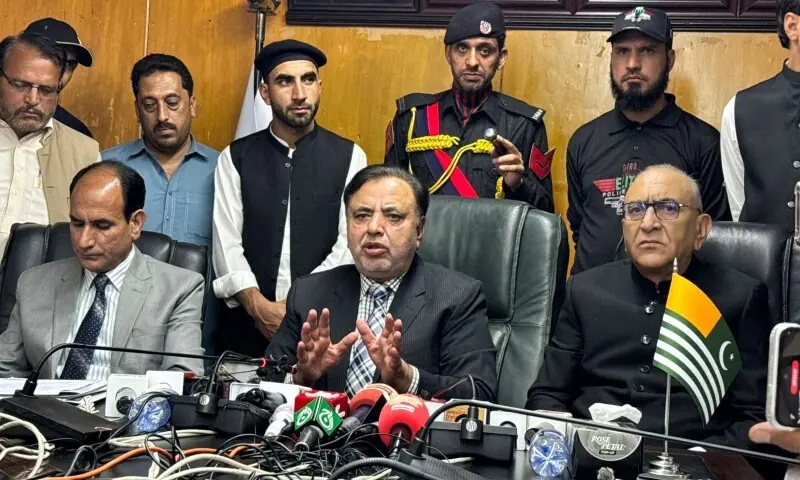
Speaking at a press conference held to announce the election schedule, Chief Election Commissioner retired Justice Ghulam Mustafa Mughal, flanked by constitutional member Syed Nazeerul Hassan Gillani, Secretary Raja Shakeel Khan and other officials, said the elections would be held under the supervision of the army, paramilitary and civil armed forces.

“Let me reiterate that the elections will be free, fair and transparent. We will make every effort to ensure that voters can exercise their right to vote freely,” he said.

Referring to concerns raised in some quarters about the commission’s ability to hold the elections, he said the commission had remained ready from day one to fulfil its constitutional responsibility.

“Holding elections is our constitutional obligation, and we have been fully prepared to discharge that responsibility in letter and spirit,” he said.

Justice Mughal said error-free electoral rolls were the cornerstone of free, fair, impartial and credible elections.

He acknowledged that the introduction of a computerised voters’ list system had initially led to complaints about errors, including the transfer of votes from one constituency to another.

“While errors in the preliminary rolls could not be ruled out, the tireless efforts of the administration, election officials and the exemplary cooperation of Nadra helped us rectify omissions and inaccuracies,” he said.

“I can now say that 99 per cent of the electoral rolls are transparent and free from errors, providing a sound basis for credible elections,” he added.

The chief election commissioner also announced an immediate ban on postings, transfers and the creation of new posts. He said transfers and postings in unavoidable cases would require prior approval from the commission.

Similarly, he said, approval of new development schemes, as well as the release of electricity poles and water supply pipes — practices often viewed as pre-poll inducements — had also been prohibited. However, projects already included in the Annual Development Programme would continue without interruption.

On the 12 constituencies reserved for Kashmiri refugees settled in Pakistan, Justice Mughal said that elections on those seats had previously been conducted under judicial supervision, but after the judiciary withdrew from the process the responsibility would now be carried out by officials of the Election Commission of Pakistan.

Justice Mughal, who also served as chief election commissioner from 2016 to 2019, expressed confidence that the upcoming elections would be as peaceful and transparent as those held in 2016.

Responding to a question about the ongoing protests by the Jammu Kashmir Joint Awami Action Committee (JAAC), he said a prolonged agitation could affect the electoral process.

“If the protests or sit-ins continue for a longer period, they may have an impact on election-related activities. In such a situation, the Election Commission has the authority to make necessary adjustments to the election schedule,” he said.

“Elections will be held when the situation is conducive,” he added.

The last elections in the region were held in July 2021.

The number of registered voters in AJK has increased by more than half a million over the past five years, according to fresh electoral rolls released by the region’s Election Commission on Thursday.

The latest voter lists show that the electorate in AJK’s 45 constituencies has risen to 3,804,385, up from 3,220,546 in the 2021 elections — an increase of 583,839 voters.

Of the total electorate, 3,365,839 voters are registered in the 33 constituencies within AJK, while 438,546 are registered in the 12 constituencies in Pakistan reserved for refugees from occupied Jammu and Kashmir.

Figures released by the commission showed that the overall electorate comprises 2,001,730 male voters and 1,802,655 female voters.

Among the territorial constituencies, LA-7 Bhimber-III has the largest electorate with 129,994 voters, followed by LA-31 Muzaffarabad-V with 128,177 voters and LA-12 Kotli-V with 126,332 voters. The smallest constituency is LA-30 Muzaffarabad-IV, with 68,228 voters.

  •  

AJK govt issues travel advisory ahead of JAAC protest, asks visitors to leave

MUZAFFARABAD: The Azad Jammu and Kashmir (AJK) government on Friday urged outsiders to avoid travelling to the region and asked current visitors to leave immediately, ahead of a major protest that has prompted the deployment of federal paramilitary troops.

The strict travel advisory, effective from June 5 to June 20, comes in response to a strike call for June 9 by the Joint Awami Action Committee (JAAC), a civil society alliance spearheading a volatile rights movement in the territory.

“The measure is advised to save intending visitors from any unexpected situation or inconvenience,” an unnamed official spokesperson said in a press release issued by the region’s Press Information Department (PID).

“The government also requests those already in the territory for sightseeing or any other purpose to leave by Friday evening so that they do not confront any unpleasant situation,” the spokesperson added.

Zahid Aslam, who owns a guest house in Neelum Valley, told Dawn that the administration had urged him to ask his guests to leave.

His guest house was booked till June 16, but guests are now requesting refunds.

The JAAC has previously led mass demonstrations over local economic grievances and political rights that turned deadly during clashes with law enforcement in May 2024 and September 2025.

The alliance’s latest protest wave centres on a highly contentious demand to abolish the 12 seats in the region’s Legislative Assembly that are reserved for refugees from Indian-occupied Jammu and Kashmir who settled in mainland Pakistan after 1947.

JAAC alleges that these seats are frequently used by mainstream Pakistani political parties to influence the formation of governments in Muzaffarabad.

On Thursday, the AJK Legislative Assembly strongly defended the status quo, backing the refugee seats and calling for elections to proceed on schedule.

Anxious to prevent a repeat of past bloodshed, Islamabad has dispatched federal paramilitary forces to reinforce the region’s thinly stretched police force.

On Thursday, AJK Inspector General of Police Captain (retired) Liaqat Ali Malik formally requested 14,000 additional personnel from the federal government to secure the territory from June 7 to June 21.

Video footage circulating on Friday showed convoys of security personnel entering Muzaffarabad, suggesting that reinforcements were already being moved into the region ahead of the planned strike.

“Our foremost responsibility is to protect public and private life and property, and the police will act in accordance with their mandate,” Malik told Dawn.

“I urge people not to join any mob seeking to create unrest or attack security forces. Anyone with grievances or demands should pursue them through democratic and peaceful means,” he added.

A senior police officer, speaking on condition of anonymity, told Dawn that the requisitioned force was “well over 14,000”, as two additional requests had been sent to the federal government for supplementary deployments.

Meanwhile, speculation mounted on social media that authorities might suspend internet and mobile data services from Friday midnight, as they had during the weeklong JAAC strike in September-October last year.

The previous shutdown had severely disrupted academic activities, online businesses and freelance work, while also hampering communication by rendering internet-based calling and messaging services inaccessible across the region.

There was, however, no immediate official confirmation of the reports.

Separately, the University of AJK on Friday postponed its Spring 2026 term examinations, scheduled to commence on June 8, until further orders in view of the JAAC strike call.

  •  

Constitutional amendment not a concession to be wrested, says AJK SC on presidential reference

MUZAFFARABAD: The Azad Jammu and Kashmir Supreme Court has observed that any amendment in the region’s constitution was “not a concession to be wrested” from the government, as the court issued its advice on a presidential reference, which emerged on Sunday.

The advisory opinion came in response to a reference filed by acting AJK President Chaudhry Latif Akbar under Article 46-A of the Interim Constitution Act, 1974 after the recently proscribed Joint Awami Action Committee (JAAC) demanded the abolition of 12 refugee seats in the legislative assembly ahead of the July 27 elections.

The 12 seats are reserved for refugees from Indian-occupied Jammu and Kashmir, who settled in mainland Pakistan after 1947. JAAC alleges that these seats were often used by mainstream Pakistani political parties to influence the formation of governments in Muzaffarabad.

The presidential reference had sought answers to five key questions over the constitutional status of the refugee seats, the legislature’s competence to introduce a fundamental constitutional amendment at the present stage, the constitutional limits of the rights of assembly and association, and the state’s obligation to protect the electoral process and reject extra-constitutional demands.

In the advisory opinion, dated June 6 and available with Dawn, AJK SC Chief Justice Raja Saeed Akram Khan held that the constitution of the AJK was the “supreme law” of the state and its provisions the “property of the people of Azad Jammu and Kashmir and of the whole Kashmiri people”.

“The amendment of the constitution is a solemn constitutional act, not a concession to be wrested from a government under duress,” the opinion declared.

“It can only be accomplished through the process the constitution itself prescribes, by an assembly possessed of the full democratic mandate of the people, after deliberation, consultation, and consensus-building,” the advisory opinion read.

The court stated that the advisory opinion was being tendered after “full consideration of the constitutional provisions, the legislative and historical background of the refugee seats, the factual matrix placed before this court, and the submissions of the advocate general and the learned amicus curiae”.

The court observed that the AJK government remained legally obligated to hold elections within the time stipulated by the constitution. It maintained that the constitution was not a “document to be honoured when convenient and discarded when inconvenient”.

“The constitution endures because its guardians, ie, the government, the legislature, the judiciary, and ultimately the people, stand firm in its defence.”

The court’s opinion came a day after the region’s government proscribed the JAAC, days before the group is scheduled to stage a protest on June 9. The JAAC’s latest protest call centred around the highly contentious demand to abolish the 12 refugee seats in the region’s Legislative Assembly.

It has also been calling for economic reforms to lower energy prices and provide free healthcare.

Minister for Parliamentary Affairs Tariq Fazal Chaudhry said on Sunday that most of those demands had been met.

“It’s negative and false propaganda that the government hasn’t addressed the demands. Out of 38 demands, 35 have been addressed,” he said at a media conference.

The same day, AJK Chief Election Commissioner retired Justice Ghulam Mustafa Mughal said while announcing the election schedule that the elections on refugee seats had previously been conducted under judicial supervision, but after the judiciary withdrew from the process, the responsibility would now be carried out by officials of the Election Commission of Pakistan.

Responding to a question about the planned JAAC protests, he said a prolonged agitation could affect the electoral process.

AJK authorities have also advised intending visitors to postpone their trips until June 20, citing security concerns ahead of the planned protests.

  •  

Four cops martyred, 20 injured as AJK protest spirals

• Two killed, dozens hurt as riot police use tear gas, batons to disperse protesters
• IGP terms attack on CMH ‘outright terrorism’
• AJK SC says changes to Constitution ‘not a concession to be wrested from govt’

MUZAFFARABAD: At least four policemen were martyred and 20 were injured after fierce clashes broke out with supporters of the newly-proscribed Joint Awami Action Committee (JAAC) in Rawlakot, police said on Sunday.

A statement issued on Sunday night by the office of AJK police chief Liaqat Ali Malik said four police personnel were martyred when demonstrators “attacked” CMH Rawalakot on Sunday.

The statement maintained the men had been shot by firearms and shotguns, terming it outright “terrorism” and vowing not to compromise on the safety of citizens and public peace.

Additionally, officials said that at least two people from among the protesters had lost their lives, while dozens were said to be injured. Locals fear that the toll could be much higher. The flow of information from AJK has been curtailed by the closure of mobile data services across the region.

Tensions flared in Rawalakot over the death of a trader, who was allegedly shot during a confrontation with law-enforcers on Friday night.

Initially, his family had ann­ounced his funeral would be held on Saturday, but they later changed their mind and brought the body back to the Combined Military Hospital (CMH), apparently for post-mortem examination, and deferred the funeral until Sunday.

The body was shifted to the hospital’s mortuary but a post-mortem examination was not conducted. In the meantime, scores of people continued a sit-in outside CMH.

According to witnesses, when a police party arrived to disperse the protesters, a charged group of demonstrators confronted them.

Riot police then resorted to baton charge and lobbed tear gas shells to disperse the group. In response, the demonstrators pelted police with stones, but no one was hurt.

The family of the deceased man, meanwhile, declared they would not bury him until the home department notification, proscribing the JAAC, was withdrawn.

“Our son faces the allegation of being a terrorist. We will not bury [him] until the notification branding [JAAC] as a terrorist group is withdrawn,” a source quoted a member of his family as saying.

A senior administration official, who spoke to Dawn on condition of anonymity, said the sit-in outside the health facility was causing a great deal of inconvenience to patients, their families and other commuters. He said that the protesters had been asked to disperse peacefully, but to no avail.

The area had not been cleared of protesters until the filing of this report.

AJK SC’s opinion

Meanwhile, in its advisory opinion on a reference sent by AJK President Chaudhry Latif Akbar, the AJK Supreme Court has observed that any amendment in the region’s constitution was “not a concession to be wrested” from the government.

The reference dealt with the JAAC’s demand for the abolition of 12 refugee seats in the legislative assembly ahead of the July 27

elections.

The 12 seats are reserved for refugees from Indian-occupied Jammu and Kashmir, who settled in mainland Pakistan after 1947. JAAC alleges that these seats were often used by mainstream Pakistani political parties to influence the formation of governments in Muzaffarabad.

The presidential reference had sought answers to five key questions over the constitutional status of the refugee seats, the legislature’s competence to introduce a fundamental constitutional amendment at the present stage, the constitutional limits of the rights of assembly and association, and the state’s obligation to protect the electoral process and reject extra-constitutional demands.

In the advisory opinion, dated June 6 and available with Dawn, AJK SC Chief Justice Raja Saeed Akram Khan held that the constitution of the AJK was the “supreme law” of the state and its provisions the “property of the people of Azad Jammu and Kashmir and of the whole Kashmiri people”.

“The amendment of the constitution is a solemn constitutional act, not a concession to be wrested from a government under duress,” the opinion declared.

“It can only be accomplished through the process the constitution itself prescribes, by an assembly possessed of the full democratic mandate of the people, after deliberation, consultation, and consensus-building,” the advisory opinion read.

The court’s opinion came a day after the region’s government proscribed the JAAC, days before the group is scheduled to stage a protest on June 9. The JAAC’s latest protest call centred around the highly contentious demand to abolish the 12 refugee seats in the region’s Legislative Assembly.

It has also been calling for economic reforms to lower energy prices and provide free healthcare.

Minister for Parliamentary Affairs Tariq Fazal Chaudhry said on Sunday that most of those demands had been met.

“It’s negative and false propaganda that the government hasn’t addressed the demands. Out of 38 demands, 35 have been addressed,” he told a press conference.

Published in Dawn, June 8th, 2026

  •  

AJK PM says govt will not use force if JAAC takes to streets

MUZAFFARABAD: Azad Jammu and Kashmir (AJK) Prime Minister Faisal Mumtaz Rathore has said his government is making every effort to prevent the Joint Awami Action Committee (JAAC) from taking to the streets again, stressing that the dispute over the 12 legislative assembly seats reserved for refugees from Indian-occupied Kashmir should be resolved through negotiations and political consensus.

Answering questions during an interview with a private TV channel, he asserted that his government had made sincere efforts to implement the agreement reached with the action committee following last year’s protest movement and had resolved almost all issues contained in its charter of demands.

“Almost all demands included in the charter of demands were fulfilled, except for one relating to the abolition of refugee seats, which subsequently became the central issue around which the movement was revived,” he said.

Referring to recent negotiations with JAAC, Rathore said: “We have had very productive discussions with members of the Action Committee. However, the issue of abolishing refugee seats is a constitutional matter that cannot be decided by a single political party alone. It requires a broad consensus among all stakeholders.”

Claims his government has made sincere efforts to implement agreement reached with the action committee

“We wanted the JAAC to extend its call for protest, but they declined, although they agreed to keep the door for negotiations open until June 7,” he added.

The AJK premier said the issue had also been discussed with Prime Minister Shehbaz Sharif and reiterated that the government did not want the state to face another period of unrest.

“These people are our own. They certainly have the right to raise their concerns and it is our responsibility to listen to them and understand their point of view, and we are doing that,” he said.

Rathore said that decisions affecting the future of the state should be taken through representative institutions rather than through street agitation, adding that many JAAC members also favoured a negotiated settlement.

Referring to the refugee seats controversy, he said it was often argued that these were open to manipulation because the elections were conducted under the influence of provincial governments. He, however, said refugees had made significant sacrifices and played an important role in the state’s affairs and they could not be ignored under any circumstances.

“Regardless of political interests or affiliations, the interests of the state must come first.”

Published in Dawn, June 3rd, 2026

  •  

At least 7 civilians killed during Sunday clash between police, JAAC protesters in AJK's Rawalakot: official

MUZAFFARABAD: At least seven civilians were killed during Sunday’s clash between police and the newly proscribed Joint Awami Action Committee (JAAC) protesters in Azad Jammu and Kashmir’s (AJK) Rawalakot, an official told Dawn on Monday.

Poonch Commissioner Sardar Waheed Khan confirmed the civilian death toll to Dawn a day after the clash in which four law enforcement personnel were martyred.

The commissioner and AJK Inspector General (IG) Liaqat Ali Malik also told Dawn 30 people had been taken into custody late on Sunday. The officials also said that 23 policemen were injured during the clash.

The clash broke out after tensions flared over the death of a trader, who was allegedly shot during a confrontation with law enforcers on Friday night. Officials have accused the demonstrators of attacking the Combined Military Hospital (CMH) in Rawalakot on Sunday.

Initially, his family had ann­ounced his funeral would be held on Saturday, but they later changed their mind and brought the body back to CMH, apparently for post-mortem examination, and deferred the funeral until Sunday.

The body was shifted to the hospital’s mortuary, but a post-mortem examination was not conducted. In the meantime, scores of people continued a sit-in outside CMH.

According to witnesses, when a police party arrived to disperse the protesters, a charged group of demonstrators confronted them. Riot police then resorted to baton charge and lobbed tear gas shells to disperse the group. In response, the demonstrators pelted the police with stones, but no one was hurt.

The family of the deceased man, meanwhile, declared they would not bury him until the home department notification, proscribing the JAAC, was withdrawn.

Tensions have gripped AJK in recent days, with the region’s government declaring the JAAC a proscribed organisation and the latter insisting on its demand to abolish 12 refugee seats in the AJK Legislative Assembly.

These are reserved for refugees from Indian-occupied Jammu and Kashmir who settled in mainland Pakistan after 1947. JAAC alleges that these seats were often used by mainstream Pakistani political parties to influence the formation of governments in Muzaffarabad.

On Friday, the AJK government declared JAAC a proscribed organisation, days ahead of a planned protest by the group scheduled for June 9, stating that it was “engaged in terrorism” and had acted in a manner “prejudicial to peace and security” of the state. On Saturday, AJK authorities launched a crackdown on the JAAC, arresting scores of its leaders and activists from different areas.

AJK police also sealed the head office of the JAAC, state broadcaster Radio Pakistan reported on Sunday.

Meanwhile, the flow of information from AJK remains curtailed due to the closure of mobile data services. AJK authorities have also advised intending visitors to postpone their trips until June 20, citing security concerns ahead of the planned protests.

Islamabad has also dispatched federal paramilitary forces to reinforce the region’s thinly stretched police force.

  •  

JAAC strike: Markets, streets deserted in AJK's Muzaffarabad but no demonstrations held

MUZAFFARABAD: Shops and markets were largely shut and vehicular traffic remained minimal in Muzaffarabad, the capital of Azad Jammu and Kashmir (AJK), on Tuesday as the newly proscribed Joint Awami Action Committee (JAAC) observed a strike.

Meanwhile, AJK Prime Minister Faisal Mumtaz Rathore urged a return to the negotiating table in a bid to end the tensions that have gripped the region over the past few days.

During the day, Muzaffarabad’s streets were deserted, with hardly any vehicles on the roads. Riot police and paramilitary personnel remained deployed in the city.

However, no demonstrations were witnessed in the capital.

Meanwhile, reports from Mirpur said that hundreds of people had gathered in the town’s Quaid-i-Azam stadium. “Shops are closed here and traffic is off the roads,” local journalist Sajjad Jarral told Dawn by telephone.

Witnesses in Kotli said that while the area observed a complete shutter-down and wheel-jam strike, hundreds of people led by JAAC core member Imtiaz Aslam were heading towards Poonch district via Tatta Pani.

Another big rally led by JAAC core member Khawaja Mehran from Dadyal also entered Kotli for onward march towards Poonch.

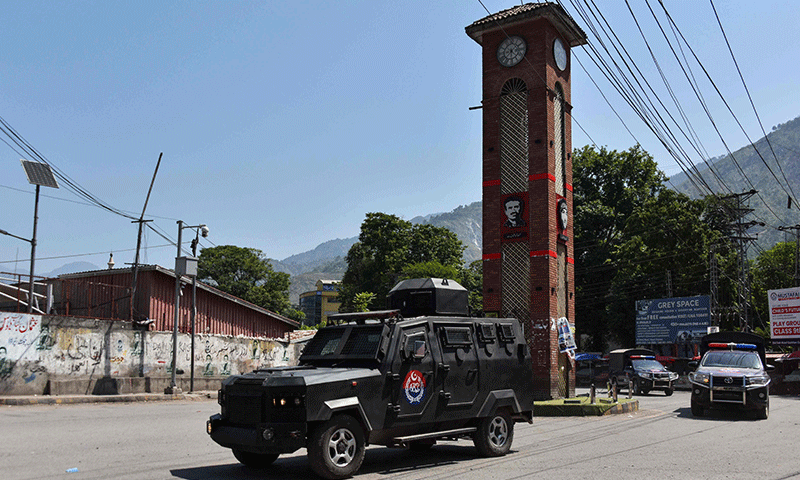
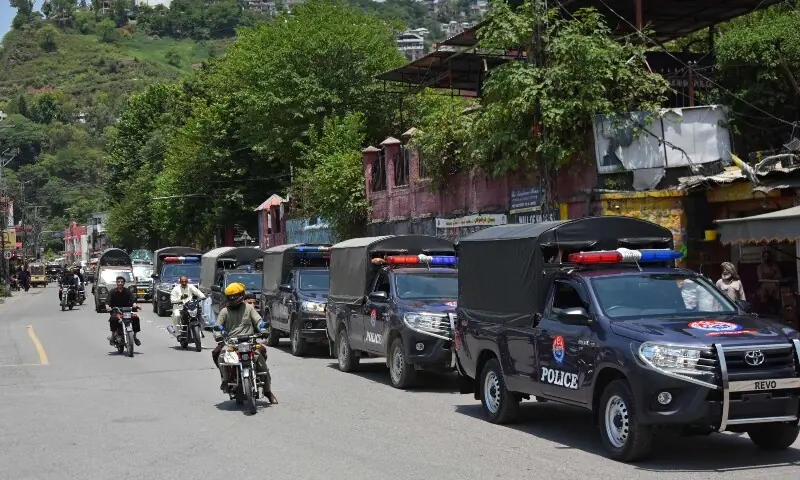
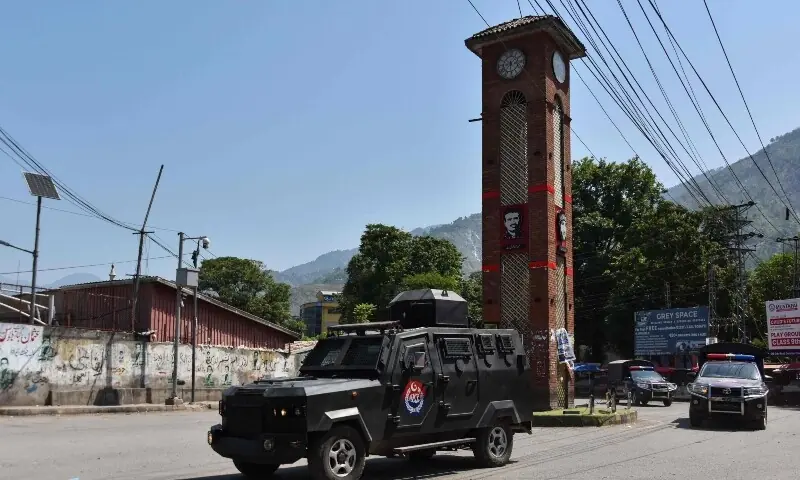
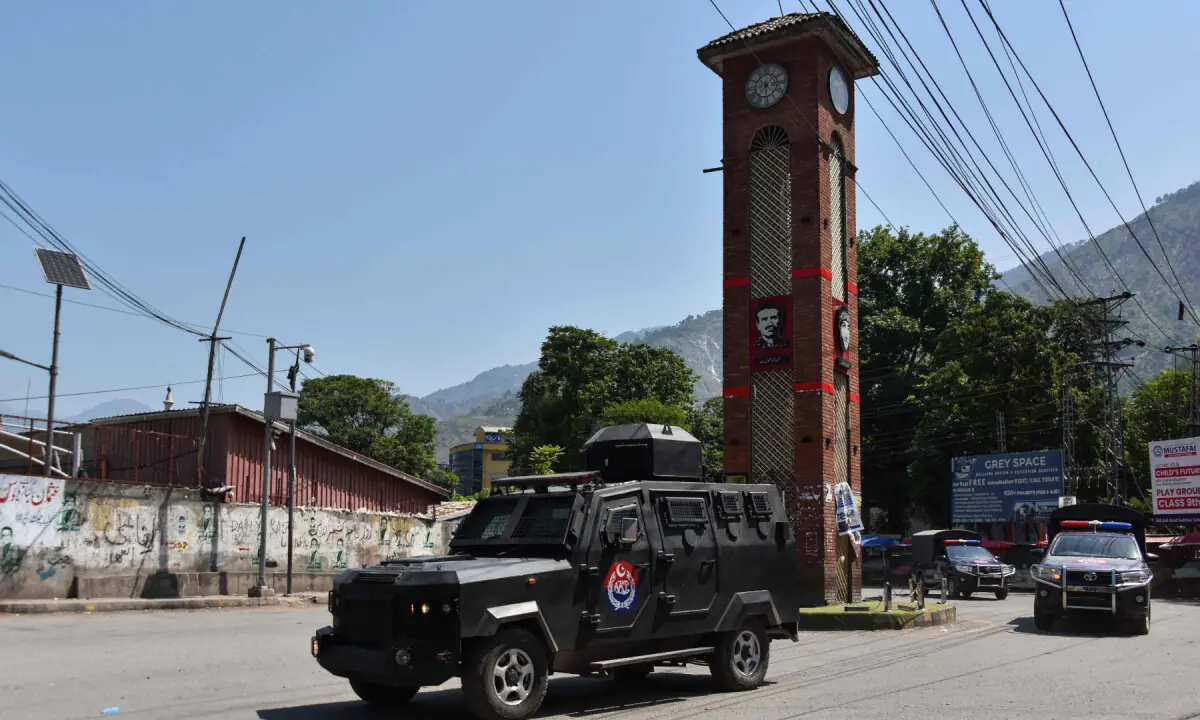
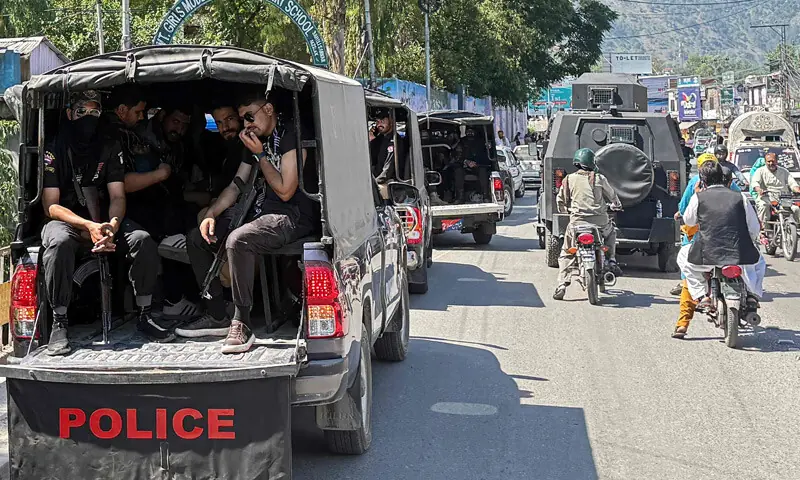
Security personnel patrol a street during Joint Awami Action Committee (JAAC)’s rally, held days after the local government banned the protest group under anti-terror laws in Muzaffarabad, capital of Azad Jammu and Kashmir on June 9. — AFP

The legal fraternity of AJK boycotted judicial proceedings on AJK Bar Council’s call to protest the alleged arrest of senior lawyer Amjad Ali Khan, a core member of the JAAC.

JAAC’s protest call for today centred on a highly contentious demand to abolish the 12 seats in the region’s Legislative Assembly that are reserved for refugees from Indian-occupied Jammu and Kashmir who settled in mainland Pakistan after 1947. JAAC alleges that these seats were often used by mainstream Pakistani political parties to influence the formation of governments in Muzaffarabad.

The government, on the other hand, maintains that it is a constitutional matter and cannot be decided by one group.

Sedition proceedings ordered against 2 JAAC leaders

In another action against the JAAC, the AJK government has issued orders for initiating sedition proceedings against its leaders Shaukat Nawaz Mir, resident of Muzaffarabad, and Mehran Arshad Khawaja, resident of Mirpur.

A notification issued by the AJK Home Department accused both leaders of committing “sedition through their speeches, written material, videos and audios”.

The government has issued instructions to the Mirpur and Muzaffarabad senior superintendents of police (SSPs) under Section 196 of the Code of Criminal Procedure (CrPC) to review the available records/materials.

It also directed the SSPs to register a case against Mir and Khawaja, and submit a charge-sheet in court after completing the investigation.

‘Find a way out through talks’

In a post on X, the AJK premier reiterated his call for the issue to be resolved through talks.

“Please come back to the negotiating table. I’m requesting everyone on daily basis to resolve matters through discussions instead of fire and blood,” Rathore wrote on X.

He added that the protesters’ “abusive comments, constant threats and senseless agitation” were not helpful to anyone in AJK.

“A political activist without the ability to debate and negotiate is like a pilot without the ability to fly an airplane. They both end up causing hurt and damage to people behind them,” the PPP leader remarked.

“Everyone recognises your rights and liberties,” the AJK PM assured, stressing that both sides needed to “remain calm and find a way out through talks”.

“The only weapon a political activist carries is his reasoning and negotiation skills,” Rathore said.

In an interview he shared on X, Rathore noted that the PPP, PML-N and the JAAC had their own stances on the issue of reserved seats for refugees, but he emphasised there was “space for a path forward”.

He remarked that protests by the JAAC could not secure a two-thirds majority in the assembly that was needed for a constitutional amendment, under which changes to refugee seats could be made.

HRCP expresses concern over ‘escalating confrontation’

Separately, the Human Rights Commission of Pakistan (HRCP) said it was “deeply concerned by the escalating confrontation” in AJK and the loss of life among both protesters and law enforcement personnel.

It urged an “immediate de-escalation of tensions and an impartial investigation into all deaths and injuries”.

“The state must remember that proscribing popular movements invariably risks narrowing democratic space. Demands for constitutional change should be pursued through peaceful, representative and democratic processes rather than confrontation and violence,” the HRCP stressed.

The HRCP had previously also expressed concern over the proscribing of JAAC.

On Friday, the AJK government declared JAAC a proscribed organisation, stating that it was “engaged in terrorism” and had acted in a manner “prejudicial to peace and security” of the state. A day later, AJK authorities launched a crackdown on the JAAC, arresting scores of its leaders and activists from different areas.

But tensions in the region particularly flared up after a violent protest in Rawalakot, during which at least four law enforcement personnel and seven civilians lost their lives.

Islamabad has also dispatched federal paramilitary forces to reinforce the region’s thinly stretched police force, and intending visitors have been advised to postpone their trips until June 20.


More to follow

  •  

Thousands rejoin AJK sit-ins after overnight dispersal

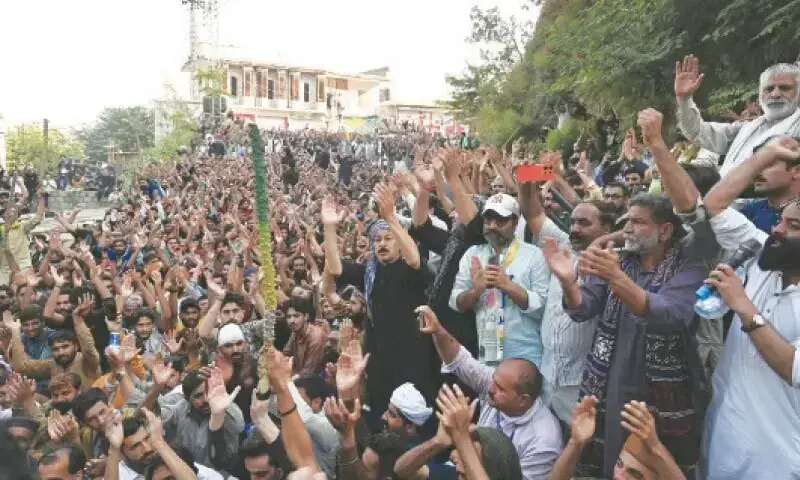
MUZAFFARABAD: Activists and supporters of the proscribed Joint Awami Action Committee (JAAC), who had dispersed from sit-in sites on the outskirts of Rawalakot after midnight, regrouped at two locations on Friday afternoon, drawing thousands of participants des­pite official claims that the protest campaign had collapsed.

Senior officials had claimed early on Friday that all three protest camps on the fringes of Rawalakot had been vacated after 12:30am amid expectations of a major operation by law enforcement agencies.

The largest gathering, comprising participants from Mirpur division and southern parts of Poonch division, had been camped at Eidgah Ground, around 3.5 kilometres from Rawalakot city, where the administration has imposed restrictions on entry from outside areas for several days.

Speaking to Dawn in the early hours of Friday, Poonch Divisional Comm­issioner Sardar Waheed Khan claimed that all protesters had dispersed, “unconditionally surrendering” before the state and “returning to their respective areas”.

He added that the development followed back-cha­nnel contacts with local JAAC leader Umar Nazir Kashmiri through two local figures, Javed Nisar of the Rawalakot Bar Asso­ciation and Javed Sha­rif of the Poonch District Council.

He said the intermediaries conveyed a message, urging Mr Kashmiri to call off the protest in the interest of participants’ safety.

The commissioner clai­med that Mr Kashmiri had sought the withdrawal of the notification proscribing JAAC and offered to end the sit-ins and surrender before local police if the demand was accepted.

Residents contacted by Dawn also confirmed that Eidgah Ground appeared deserted in the early hours of Friday, with only litter left behind by departing protesters.

Protesters return

However, people from nearby areas began ret­urning to the venue by noon and the gathering steadily swelled.

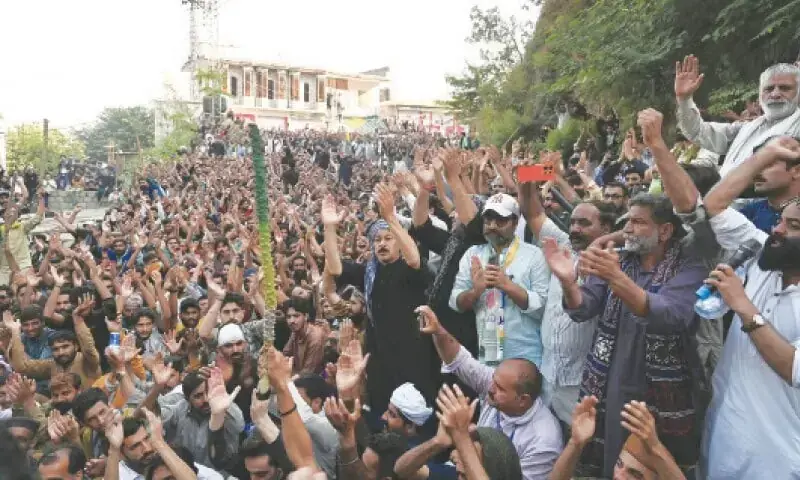
After Friday prayers, the crowd was estimated at between 5,000 and 6,000 people, including dozens of women and children. By evening, the number of participants had multiplied manifolds.

Similarly, around 3,000 people from Thorar, Mang and adjoining areas regrouped at the bus terminal in the afternoon, from where they had dispersed after midnight.

They were led by Sardar Arbab Advocate, a JAAC core member from Thorar.

Organisers at the site formed several committees to manage the gathering and vowed to continue the sit-in “for a long time”.

Official sources said that at the Eidgah gathering, JAAC core member Sardar Amaan of Sudhnoti had advised fellow activists against any direct confrontation with law enforcement personnel. The protesters, they said, were “divided over their next course of action, with options including marching towards the heavily fortified Rawalakot city, heading for Muzaffarabad, or continuing the sit-in at the existing venue”.

Addressing the Eidgah gathering in the evening, Mr Kashmiri vowed that the sit-in would continue and insisted that the call for a long march on Muzaffarabad had not been withdrawn.

Amid the standoff between the administration and JAAC, a shutdown strike observed on the committee’s call entered its fifth consecutive day across most parts of AJK, including the region’s capital, Muzaff­arabad, where markets remained largely closed. Some businesses opened briefly in the evening to cater to urgent consumer needs.

Public transport rema­ined suspended in most areas, while private vehicles continued to operate cautiously within and bet­ween cities. Inter-district and intra-district road links also remained open.

Meanwhile, official sources said the government had intensified measures against JAAC’s leadership by blocking the computerised national identity cards of all 31 core members and subsequently their passports.

There were also unconfirmed reports that some individuals in Mirpur had been detained for allegedly facilitating financial support to JAAC from the UK. Some local traders said to have donated generously to the organisation were also reportedly taken into custody.

Published in Dawn, June 13th, 2026

  •  

AJK administration hopeful remaining JAAC protesters will disperse peacefully

MUZAFFARABAD: The Poonch administration in Azad Jammu and Kashmir (AJK) is hopeful that the proscribed Joint Awami Action Committee (JAAC) protesters will disperse peacefully after a sizeable number of people gathered again after Friday prayers.

The regional administration and the JAAC have been at odds over various issues, most notably the committee’s demand to abolish the 12 seats in the region’s Legislative Assembly that are reserved for refugees from Indian-occupied Jammu and Kashmir who settled in mainland Pakistan after 1947.

However, an official of the district administration claimed that fewer than 2,000 people were present after dusk. He added that participants in the gathering remain uncertain as they cannot march towards Rawalakot, with all routes leading to the city blocked by law enforcement.

“When their strength was around 15,000 to 16,000, even then they could not move towards Rawalakot. We have sent a message to JAAC leader Umar Nazir to call off the demonstration unconditionally,” said Poonch Divisional Commissioner Waheed Khan.

Khan expressed hope that those remaining would disperse later tonight. He also said a law enforcement camp would be established at the gathering site by tomorrow morning.

Supporters disperse at midnight

All three gatherings of the activists and supporters of JAAC at the fringes of Rawalakot dispersed and their participants returned to their respective areas shortly after midnight, officials said on Friday.

The development reportedly came after indications that authorities had planned a major operation to uproot the protesters, who had converged from various districts on the eastern outskirts of Rawalakot in Poonch district.

“There is not a single participant at any of the three sit-in sites on the outskirts of Rawalakot. All have unconditionally surrendered before the state and have returned, rather fled, back to their respective areas,” Poonch Divisional Commissioner Sardar Waheed Khan told Dawn in the early hours of Friday.

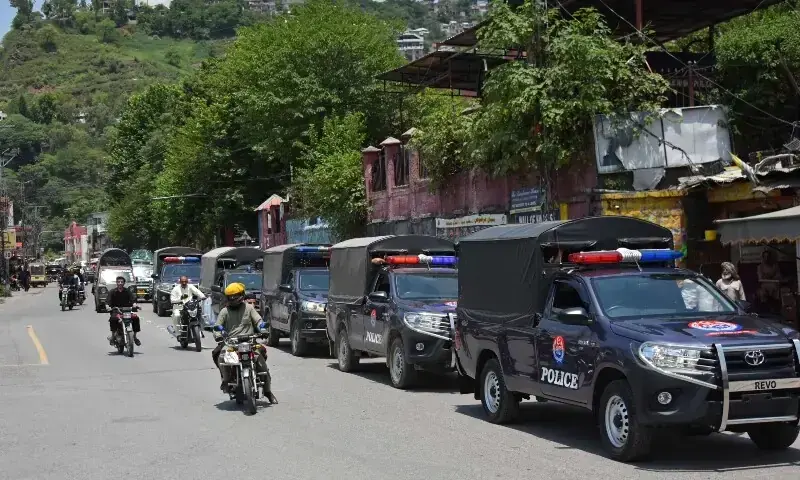
On Thursday evening, the administration had constituted a dedicated contingent of around 1,000 Rangers, Federal Constabulary, Islamabad and Azad Jammu and Kashmir (AJK) police personnel for a “decisive action”, apart from staging a flag-march of between 70 and 80 armoured and other vehicles.

Recalling that the administration had sent a law enforcement team on Thursday morning to arrest Umar Nazir Kashmiri, one of the hard-line JAAC core members, Khan claimed the move had “already chilled his blood”.

In the meantime, Khan said, backchannel messaging with Kashmiri was carried through two seasoned local leaders — District Bar Association President Sardar Javed Nisar and Poonch District Council Chairman Sardar Javed Sharif — who conveyed to him a clear message to surrender in the interest of his personal safety and that of all other participants.

According to Khan, Kashmiri responded that if the notification proscribing JAAC was withdrawn, he would not only announce an end to the sit-ins but also surrender himself before the local station house officer (SHO).

At this, Khan said he told JAAC leaders to carry on their sit-in while he consulted his higher authorities. It was then that the tone of JAAC leaders changed, and they started saying that they would continue a peaceful sit-in, he added.

However, when the message of a huge flag march in Rawalakot reached the JAAC camp, they became apprehensive that the administration was contemplating launching a decisive action, “perhaps a blitz”, he added.

According to Khan, by midnight, the administration started receiving reports about “chaos and panic” in the proscribed organisation’s ranks and files, and after an hour, the entire Eidgah area was rendered “completely unoccupied”.

When the message reached the other two sites where activists had gathered, they also imitated the move and dispersed, he said.

In response to a question, he said all deputy commissioners had been directed to raid the houses of those activists who were wanted under any first information report (FIR), either registered in the past or during the latest episode.

“God willing, Umar Nazir will also soon surrender himself before the local SHO,” the divisional commissioner said.

He noted that the authorities had also blocked the computerised national identity cards (CNICs) of all 31 core members of the JAAC, and subsequently their passports.

“This time, there will be no compromise on the writ of the state,” he asserted.

Tensions in the region

The protests have seemingly wrapped up after Rawalakot observed a complete shutter-down strike for the third consecutive day on Thursday.

The day also recorded violence as one person who participated in a JAAC gathering was killed and four others were injured in a clash with law enforcement personnel on Rawalakot’s outskirts.

Also on Thursday, speaking in the National Assembly, Defence Minister Khawaja Asif urged the JAAC to let the people of AJK decide whether the 12 refugee seats should be abolished.

Last Friday, following the announcement of the JAAC’s June 9 strike, the AJK government declared the body a proscribed organisation, stating that it was “engaged in terrorism” and had acted in a manner “prejudicial to peace and security” of the state.

A day later, AJK authorities launched a crackdown on the JAAC, arresting scores of its leaders and activists from different areas. Sedition proceedings against two of its leaders have also been ordered, and a Rs10 million reward for information leading to the arrest of four leaders has been announced.

Tensions in the region particularly flared up after a violent protest in Rawalakot, during which at least four law enforcement personnel and seven civilians lost their lives.

Islamabad has also dispatched federal paramilitary forces to reinforce the region’s thinly stretched police force, and intending visitors have been advised to postpone their trips until June 20.

  •  

AJK braces for long march as tensions persist

• ‘Proscribed’ JAAC to go ahead with rally from Bhimber to Muzaffarabad, sit-in outside assembly
• Officials say govt ‘will not allow’ march to go ahead; large crowds unlikely since group’s leadership is ‘on the run’

MUZAFFARABAD: In the aftermath of Sunday night’s fierce clashes that claimed the lives of seven civilians and four law enforcement personnel in Rawalakot, Azad Jammu and Kashmir (AJK) braced for a shutter-down and wheel-jam strike on Tuesday (today) , announced by the proscribed Joint Awami Action Com­mittee (JAAC).

According to initial plans, the JAAC had decided that protesters would start a long march from the southernmost district of Bhimber, passing through Mirpur, Kotli and Poonch before reaching Muzaffarabad on June 10 for a sit-in outside the Legislative Assembly.

Government officials, meanwhile, appeared hopeful about the prospects of a tepid response to the protest call for several reasons, including the recent crackdown. In action against JAAC, the authorities had rounded up more than 200 people across the region and forced others into hiding, official sources and witnesses said.

“Situation is fluid. The JAAC leadership and crowd-pullers are on the run. So far, they haven’t been able to pull numbers on the streets, but there is a possibility of small protests at several places,” said one official.

“But it has been firmly decided that protesters will not be allowed to assemble anywhere, let alone stage a long march from one part of the state to the other,” another official said.

Some analysts were of the view that while shutters might remain closed and transport stay off the roads, the call for Tuesday’s strike was less likely to receive an overwhelming response due to the alleged stubbornness of the JAAC leadership.

“It was a good movement for rights in the beginning, but some of the committee’s obdurate and myopic leaders pushed it into a blind alley, for reasons best known to them,” remarked a retired government servant, requesting he should not be named. “Abolition of 12 seats might be close to the majority’s hearts in AJK, but it should not have been made a matter of life and death,” he added.

The officials who spoke to Dawn made it clear that the administration would neither force anyone to keep their shops open nor allow anyone to force others to shut down their businesses. “As long as people remain peaceful, the law will tolerate them. But the moment they try to create any problem, they will be dealt with firmly,” one of them said.

Rawalakot violence

On Monday, life remained normal in almost all parts of AJK, except Rawalakot, where shutters remained down for the second consecutive day and public transport stayed off the roads. Elsewhere, a partial strike was reported just from Dadyal, a lakeside town in Mirpur district.

In Rawalakot, the epicentre of the violence, the administration and law enforcement agencies (LEAs) succeeded in dispersing protesters shortly after midnight on Sunday. According to divisional commissioner Sardar Waheed Khan, the protesters had not only blocked access to the Combined Military Hospital (CMH) but had also virtually taken over the facility, forcing doctors and paramedics to flee for their safety. He regretted that those present inside the hospital not only obstructed treatment for LEA personnel but also caused further injuries to some of them, apart from allegedly disrespecting the body of a martyred police constable.

Sharing details of the clashes, he alleged that the protesters possessed long-range firearms, petrol bombs and other ammunition. “They attacked law enforcers from side alleys with full planning, on the pattern of a guerrilla war,” he said. He said of the 30 or so hospitalised activists, three critically injured were airlifted to Islamabad along with four LEA personnel by helicopter.

Six activists remained under treatment in the hospital as detainees while others were shifted to the police station, he added.

Funeral prayers

Meanwhile, funeral prayers for the three AJK policemen — identified as SHO Hajira Muhammad Inayat and constables Muhammad Faisal and Faheem Anwar — were offered at 5pm at Rawalakot Police Lines with full honours. Among those in attendance were Chief Secretary Khushal Khan, IGP Liaqat Ali Malik and General Officer Commanding Murree Maj Gen Zarrar Mahmood.

The seven deceased civilians were identified as Usman Sabir of Koiyan village, Fahad Barkat of Rehara village, ex-serviceman Wasaid Siddique of Parrat village, Naqash Zardad of Matyalmera Danna village, Jamshed Ashraf of Hussainkot village, Muhammad Rasheed of Choti Nakkar Pakhar village, and Tariq Resham of Dothan village. The ex-serviceman was caught in crossfire, the commissioner claimed.

Sources disclosed that the funeral and burial rites of three activists, including Shazeb Habib, whose body had been lying in the CMH mortuary since Saturday, were performed by the administration and police, while those of the others were carried out by their families without any agitation.

In a statement posted on Facebook, a spokesperson for IGP Malik said that legal action against members of the proscribed committee allegedly involved in armed violence was continuing. He warned that strict legal action would be taken against those involved in attacks on LEA personnel and government property.

Published in Dawn, June 9th, 2026

  •  
❌