Reading view

Paigham-i-Islam Conference awards title of ‘Greatest Victorious General of the Century’ to CDF Asim Munir

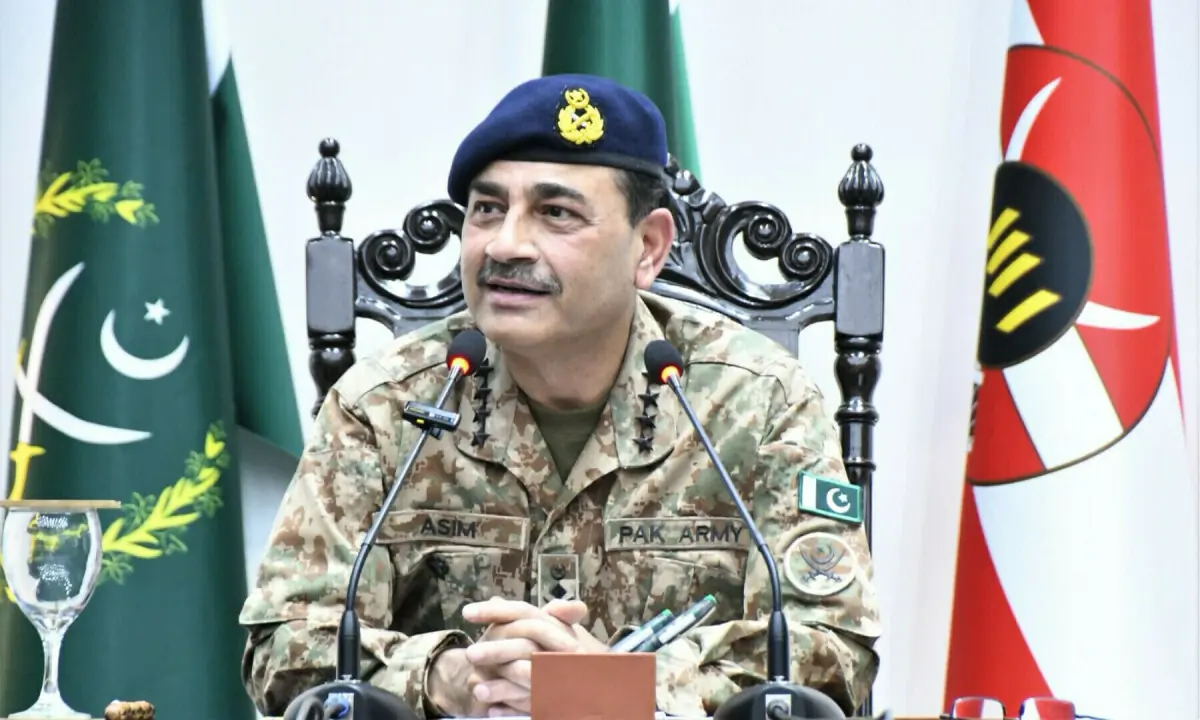
ISLAMABAD: The Sixth International Paigham-i-Islam Conference, held on Wednesday, awarded the titles of “Leader of Peace” and “Greatest Victorious General of the Century” to Chief of Defence Forces (CDF) and Chief of the Army Staff (COAS) Field Marshal Syed Asim Munir, in recognition of his role in promoting peace and strengthening stability across the Muslim Ummah.

The conference, organised by the International Tazeem-i-Haramain Sharifain Council and Pakistan Ulema Council, strongly condemned the attacks on Iran by the United States and Israel.

The conference also expressed concern over the strikes targeting Arab countries, terming them detrimental to regional stability.

It called for national security, unity of the Muslim world, and enhanced interfaith harmony.

The conference was attended by Prime Minister Shehbaz Sharif, Senate Chairman Syed Yousaf Raza Gillani, Deputy Prime Minister and Foreign Minister Ishaq Dar, Azad Jammu and Kashmir Prime Minister Raja Faisal Mumtaz Rathore, Saudi Arabia’s ambassador to Pakistan Nawaf bin Said Al-Malki, Palestinian ambassador Dr. Zuhair Mohammad Hamdallah Zaid, Grand Mufti of Palestine Sheikh Muhammad Ahmad Hussein, and Chief Justice of Palestine Dr. Mahmoud Al-Habbash, alongside senior Saudi and Palestinian representatives, religious scholars, and international delegates.

In addition to the CDF, prominent national and international figures were conferred global honours at the conference in recognition of their contributions to peace, stability and unity in the Muslim world.

PM Shehbaz was presented a shield of appreciation for his firm and unequivocal stance on key international issues, particularly Palestine.

Additionally, Prime Minister and Crown Prince of Saudi Arabia, Mohammed bin Salman — who has been named “Global Personality of 2025” — was honoured with a special award for contributions to defence cooperation with Pakistan, fostering unity in the Muslim world, and promoting peace at the regional and global levels.

The prime minister’s coordinator for the National Paigham-i-Aman Committee and chairman of the Pakistan Ulema Council, Hafiz Muhammad Tahir Mehmood Ashrafi, reaffirmed full support for the government, the armed forces, and national security institutions, acknowledging their efforts in safeguarding the country.

On behalf of the clerics, he congratulated the nation on recent achievements — particularly its triumphant victory in Marka-i-Haq and Operation Bunyanum Marsoos, the first anniversary of which is being celebrated across the nation and Pakistan’s diaspora abroad.

He emphasised the need for unity and cohesion within the Muslim Ummah, endorsing Pakistan’s stance on regional issues, including its position regarding Iran and relations with Arab and Islamic countries.

Highlighting defence cooperation, Ashrafi described the Pakistan–Saudi Arabia strategic partnership as a significant development for the Muslim world, noting that such collaboration could contribute to strengthening collective security among Islamic nations.

The conference also condemned the killing of a prominent religious scholar, Maulana Muhammad Idrees Tarangzai. It stated that acts of violence, extortion, and lawlessness have no connection with Islam or Shariah, and expressed solidarity with state institutions in maintaining law and order.

The conference also noted that efforts should be made to strengthen coordination among religious scholars across Pakistan and other Muslim countries.

It was announced that the Seventh International Paigham-i-Islam Conference will be held next year in March 2027, with invitations to be extended to global religious leaders, including the imam of the Grand Mosque in Makkah, the Grand Mufti of Palestine, the sheikh of Al-Azhar, and the Pope, in a bid to promote inter-sect and interfaith harmony.

It was also announced that similar conferences will be held under the aegis of the International Tazeem-i-Haramain Sharifain Council in different parts of the world.

The final session of the conference is scheduled to be held at Aiwan-i-Sadr under the leadership of President Asif Ali Zardari, after which the international delegates will begin departing for their respective countries.
  •  

Capital Market Development Fund established to strengthen Pakistan’s capital markets

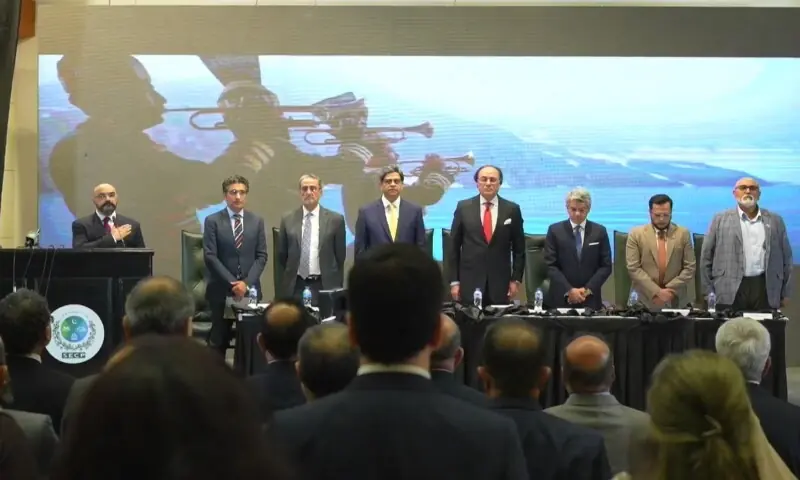
ISLAMABAD: Key capital market institutions of Pakistan on Wednesday established the Capital Market Development Fund (CMDF), aimed at promoting financial literacy, expanding financial inclusion and increasing retail investor participation in the capital markets across the country.

The main participants of the CMDF included the Pakistan Stock Exchange (PSX), Central Depository Company (CDC), National Clearing Company of Pakistan Limited (NCCPL), Pakistan Mercantile Exchange (PMX) and the Institute of Financial Markets of Pakistan (IFMP).

The CMDF was established under the auspices of the Securities and Exchange Commission of Pakistan (SECP) to ensure coordination in the industry and strengthen the institutional capacity in Pakistan’s capital markets.

Addressing the ceremony, Finance Minister Muhammad Aurangzeb said recent regional tensions had reinforced the need for Pakistan to make independent commercial decisions, diversify energy resources, and mobilise domestic capital for national development.

“We must rely on our own resources and strengthen self-sufficiency. Capital markets can play a vital role in providing the financing needed for economic independence,” he stated.

Aurangzeb reaffirmed the government’s commitment to economic stability, sustainable growth and financial sector reforms.

He also emphasised the importance of strengthening capital markets, promoting local investment, achieving self-reliance, and implementing key energy sector reforms, noting that Pakistan’s economy continues to move in a positive direction despite regional and economic challenges.

The finance minister noted that despite regional uncertainties and global economic pressures, Pakistan’s economic indicators were showing consistent improvement.

He added that the government remained focused on strengthening the current account balance and reducing the fiscal deficit while maintaining macroeconomic stability.

Aurangzeb further stated that Pakistan’s stock market had demonstrated resilience during challenging times, reflecting growing investor confidence in the country’s economic direction.

The finance czar also emphasised that the SECP had a critical role in expanding investor awareness, improving ease of investment, and introducing legal and regulatory reforms in the capital market sector.

He assured the government’s full support for reforms aimed at deepening Pakistan’s financial markets.

The agreement was signed by PSX Chief Executive Officer (CEO) Farrukh H Sabzwari, CDC CEO Badiuddin Akber, NCCPL CEO Naveed Qazi, PMEX CEO Khurram Zafar, and IFMP CEO Dr Mobashar Sadik.

Chairman SECP Dr Kabir Ahmed Sidhu highlighted that investor participation in Pakistan’s capital market remained below one per cent of the population despite recent growth.

He also noted that the investor base is targeted to increase to 2.5 million in the coming years through ongoing structural reforms and investor facilitation measures.

Sidhu added that onboarding processes were being streamlined, while Know Your Customer (KYC) and Anti-Money Laundering (AML) frameworks were being simplified to facilitate investor entry without compromising regulatory safeguards.

He further identified financial literacy as a major structural constraint, noting that investor awareness efforts remained fragmented and retail outreach limited, and further emphasised the need for coordinated national efforts to strengthen investor education, improve market understanding, and build investor confidence.

Market insights shared during the ceremony indicated that approximately 24,000 new investors entered the market in April 2026. Equity markets maintained positive momentum, while the debt capital market witnessed relative slowdown, highlighting the need for continued monitoring and data-driven policy interventions.

Sadik presented the strategic framework of the CMDF and described it as a “ring-fenced institutional mechanism” designed to support long-term capital market development.

He said the fund would be seeded with an initial contribution of Rs120 million, with participating institutions contributing one per cent of their annual revenues to ensure sustainability through a self-reinforcing funding model.

Sadik added that the CMDF would operate through four core pillars: strengthening financial literacy and investor awareness, expanding retail investor participation, promoting financial inclusion, particularly among women, youth and underserved segments, and enhancing institutional capacity and market infrastructure.

  •  

Doubling down on lithium

     Huma Khattak, CEO of Atom Power and EV Technologies
Huma Khattak, CEO of Atom Power and EV Technologies

The future of energy is closely tied to efficient batteries, not only for e-bikes and electric vehicles (EVs) but also for domestic and commercial power banks for solar energy. The current game-changer is the lithium-ion (Li-ion) battery, set to replace wet and dry lead-acid batteries.

Pakistan’s battery demand is low, but if EVs, solar storage, and grid applications take off, total demand across sectors could grow to tens of GWh over the next decade.

However, currently, Pakistan’s Lithium-ion ecosystem is structurally shallow, with less than 20 per cent domestic value addition and heavy reliance on imports — most of the batteries used in e-bikes and EVs are imported, though there are a number of battery assemblers in the country.

Meanwhile, one group — ‘Wavetec’, through its subsidiaries, EV Technologies and Atom Power — is set to start assembling Li-ion battery cells in Karachi within six months. “EV adoption cannot scale sustainably without a strong battery ecosystem,” said Huma Khattak, CEO of Atom Power and EV Technologies.

‘If we do not localise, we risk replacing our dependence on oil imports with dependence on battery imports’

She added that Atom Power is also working to support Pakistan’s broader battery and energy storage needs. “If we do not localise, we risk replacing our dependence on oil imports with dependence on battery imports. After the implementation of lithium-ion cell manufacturing, the next phase will be gradual localisation of battery raw materials and upstream processing.”

According to Khattak, Pakistan needs to focus on battery energy storage systems to support growing demand from solar, grid and industrial applications. Li-ion battery imports in Pakistan have increased from approximately 1.25 GWh in 2024 to 2.5-3.0 GWh in 2025. Looking ahead, total demand is expected to grow rapidly over the coming decade. This growth is driven by electric mobility, solar-linked storage, and the need for reliable backup power.

At the same time, global battery costs have declined significantly from over $700 per kWh in 2015 to around $140 per kWh in 2024, making adoption more viable. There is now a clear push from the government to ensure that this demand translates into local industrial capacity rather than continued reliance on imports.

Unfortunately, a lack of policy often leads to a lack of standardisation, resulting in accidents and a loss of consumer trust in the product. Currently, there is no formal policy for Li-ion batteries, and without proper standards, there is a risk of low-quality products entering the market, especially in batteries where safety depends on cell quality, thermal management and system integration.

Apart from the policy, a key gap in Pakistan’s standardisation is the lack of a robust local testing and certification infrastructure. “We need accredited laboratories within the country that can test battery safety and performance, certify products against international standards, and act as a reliable, independent source for vetting quality,” Khattak said, adding that without this, enforcement becomes difficult, and the market risks being driven by price rather than safety.

As the government of Pakistan, too, is striving to promote e-bikes, their affordability and operating costs matter far more than premium features for users. Motorcycles in Pakistan are primarily used because they are affordable, reliable, and economical to run.

“Electric motorcycles must compete on these same fundamentals; the e-bike manufacturers have to focus on not just the technology, but on making electric mobility economically viable for the user,” Khattak stressed.

Though the e-bikes offer significantly lower running costs and minimal maintenance due to fewer moving parts, the key challenges are upfront cost and customer trust. Advancements in technology have made charging e-bikes simpler without a large-scale public charging infrastructure. However, in the long term, the solution will be a mix of home and workplace charging, distributed charging points, and battery-swapping models for commercial users.

The direction the government is taking also supports battery swapping and integration into urban infrastructure, which aligns well with local usage patterns. But as the usage of Li-ion batteries continues to grow, there is a need to plan for the critical issue of proper disposal of dead batteries.

Li-ion batteries have a lifecycle of six to 10 years, and Pakistan is expected to start seeing significant end-of-life volumes from around 2029 onwards. The upcoming battery policy must include a structured collection and second-life usage or recycling mechanism to avoid making the country a jumble of expired lithium-ion batteries. This could help the recovery of valuable materials and a new industrial segment around recycling and refurbishment.

Simultaneously, significant work is underway globally on next-generation battery technologies, such as sodium-ion and solid-state batteries. However, Li-ion will likely remain dominant in the near to medium term, especially for mobility applications.

Published in Dawn, The Business and Finance Weekly, May 4th, 2026

  •  
❌