Reading view

In rural Appalachia, abortion pill offers reproductive choice and privacy − but police may see a crime

A 35-year-old Kentucky woman was arrested in late 2025, accused of taking abortion pills that she ordered online.

The gestational age and status of the pregnancy is unknown. But Kentucky, like the majority of Southern states that contain Appalachian counties, has a complete abortion ban.

Mifepristone is a medication approved by the Food and Drug Administration for self-administered abortion care through 10 weeks’ gestation, and research suggests it is safe and effective up to 16 weeks. Mifepristone can still be ordered into states with abortion bans after the Supreme Court weighed in on the matter on May 4, 2026.

Abortion is illegal in Kentucky, however, and the police viewed the woman’s actions as criminal. A grand jury supported bringing charges, including fetal homicide, “abuse of a corpse” and tampering with physical evidence. Her distressed mugshot was plastered all over regional news sites.

As a social work researcher who studies access to reproductive healthcare in underserved Appalachian communities, I have worked with clients in similar circumstances. I have observed that many decisions to end pregnancies are motivated by intense barriers to accessing healthcare – not by criminal intent.

It can be extremely difficult for women in this region to get healthcare, and these access burdens affect quality of life in the region. For example, research suggests that Appalachian women are more likely to die at younger ages when compared to women living in other regions of the United States.

Here are six factors I consider when a case like this appears in the news.

1. Abortion bans do not stop abortion

Data clearly shows that outlawing abortion care does not stop abortions from happening.

According to data from the Society of Family Planning’s #WeCount project, U.S. abortion rates have actually increased since the Supreme Court overturned Roe v. Wade in 2022, ending federal abortion protections.

What state abortion bans do is change how people try to get care.

2. Abortion bans isolate patients from doctors

For people living in most of rural Appalachia, brick-and-mortar abortion facilities are currently only available in another state, often a great distance away.

The only way many people can get care, then, is to order pills and self-manage their own abortion.

When someone orders abortion pills without medical consultation, however, there is more room for error in assessing relevant medical information, such as how far along their pregnancy is. When abortion care is legal and accessible, like other forms of healthcare, such estimates are made in consultation with a health provider.

Multiple clinics, community groups and pharmacies will send abortion pills to Kentucky for self-managing abortions up to about 13 weeks into pregnancy, according to the abortion access resource Plan C. These places may offer medical support, peer support or no additional support at all.

A photo of abortion medication.
Mifepristone use is FDA-approved through 10 weeks’ gestation. Carl Lokko/iStock via Getty Images

Patients who do involve a telehealth provider report satisfaction with that experience.

Yet patients in abortion-ban states may avoid using sites that are connected to support services because they fear being discovered and prosecuted. Abortion bans may therefore compel patients to make critical reproductive health decisions without consulting an expert.

This may have occurred in the Kentucky case, according to what the law enforcement officers reported to the Lexington Herald-Leader newspaper.

3. Ending Roe worsened healthcare deserts

Another factor to consider is how abortion bans contribute to existing healthcare deserts in rural Appalachian communities.

Even before the repeal of Roe, people living in Appalachian communities were not getting adequate healthcare. Communities in central and southern Appalachia face significant health disparities: These regions have higher illness and death rates and increased risk of cancer and diabetes compared to non-Appalachian areas of the United States.

In part, that has to do with inadequate healthcare infrastructure endemic in rural parts of the country. Geographic isolation, limited financial incentives and lack of infrastructure decrease the number of available health providers, meaning that only about 9% of U.S. physicians practice in rural areas.

Appalachia has lost regional obstetric services in recent years and seen numerous hospital closures, further discouraging providers from working there. One study found that of 53 rural hospitals that closed between 2005 and 2016, 66% of them were in Southern states, 21% in Appalachia.

This has reduced access to specialty care, including reproductive healthcare.

Abortion bans have compounded all these problems. They make it difficult, if not impossible, for providers to practice within established standards of care when treating conditions such as miscarriage, which can discourage ER physicians and OB-GYNs from remaining in red states.

The shortage of medical professionals makes it increasingly challenging to obtain reproductive healthcare in the region – except by mail.

4. Poverty influences reproductive decisions

Money is another important factor in people’s reproductive choices.

Research indicates that financial distress is a main reason that people seek abortions. Those who are denied abortion access are more likely to be in poverty four years after they give birth than those who were able to access it.

Appalachia’s history of resource extraction has left it impoverished. In Central Appalachia – in Kentucky – up to 21% of residents live in poverty.

The median household income in adjusted 2023 dollars in Wolfe County, Kentucky, where the woman was arrested, is just over US$29,000, compared to about $79,000 in the rest of the country. It costs approximately $232,000 to raise a child in Kentucky from birth to age 18, the mortgage broker LendingTree calculated in April 2026.

Facing the daunting cost of another mouth to feed, families confronting an unintended pregnancy may see abortion as a financial necessity. Appalachian residents in these circumstances are figuring out how to get the abortion care they need against steep odds.

A person holds another person's hand in a health clinic.
Research shows that financial hardship is a main reason that people seek abortions. thianchai sitthikongsak/Getty Images

5. In rural Appalachia, abortion can carry stigma

In rural Appalachian communities where most residents know each other, abortion and reproductive health stigma – some of which, research suggests, is rooted in religiosity – can present a significant barrier to care.

My own research has found that stigma may dissuade Appalachians from seeking healthcare and discussing sexual health topics with providers due to fear of judgment. Many Appalachians have reported to me their negative reproductive health visits with regional medical providers, including attempts to coerce patients into using or not using contraception.

Because abortion is stigmatized in Appalachian communities, healthcare workers may be inclined to inform police on their patients.

One news report indicates that in cases where abortions were reported to police, 39% of reports were made by health professionals and another 6% by social workers. In 412 cases of pregnancy criminalization analyzed by the advocacy group Pregnancy Justice, 264 involved information that had been disclosed in a medical setting.

That is what happened in the Kentucky case: People working in a clinic allegedly told the police that the woman had disclosed her abortion.

Abortion medication shipped directly to one’s home, by contrast, offers privacy.

The prosecutor eventually dismissed the homicide charge, because Kentucky law exempts pregnant people from being prosecuted for getting abortion care. But other charges were added, including concealing the birth of an infant. The woman may still be facing legal consequences.

6. Sex education is important – and lacking

One final factor I consider relevant in understanding this case is sex education – or rather, the lack of it in most Appalachian states.

Kentucky requires some sexual health education in public schools, but each county can dictate much of the content. Sex education in the state is not required to be comprehensive, and it must promote abstinence.

As NPR reported in 2023, there are parts of rural Appalachia without comprehensive sex education, where contraception is unaffordable and abortion is also banned. Those trying to provide better sex education have faced harassment and threats of violence.

When people do not receive the sexual health education needed to know their bodies and how they function, they are more vulnerable to negative health outcomes such as unintended pregnancy. And they may not know their bodies well enough to know how long they’ve been pregnant when they make reproductive health choices.

Bad policies, impossible situations

All of the factors listed above could potentially affect people in any community. But rural Appalachian communities are disproportionately affected by a confluence of these factors.

In my analysis, the Kentucky case elucidates how poor health infrastructure and bad health policies – such as abortion bans – place one barrier after another in front of people who are just trying to do the best they can to cope with an unintended pregnancy.

This story was produced in collaboration with Rewire News Group, an independent newsroom dedicated to covering reproductive health in the United States. Read their version here.

The Conversation

Gretchen E. Ely has previously received funding for her research from the Society of Family Planning.

  •  

Study finds spike in anti-Québec comments following Air Canada CEO’s language scandal

Language issues in Canada regularly spark controversy and fuel polarizing debates, which can then be echoed and amplified in the media and by citizens.

Following the accident in March at LaGuardia Airport in New York involving an Air Canada passenger jet, the company’s CEO, Michael Rousseau, delivered a message of condolence in English only, provoking a fierce outcry and extensive media coverage. Rousseau announced his resignation soon after.

Although English-Canadian media and Québec French-speaking journalists and commentators largely agreed that the monolingual message was inappropriate, the views expressed by the general public were more divided.

This was particularly obvious when it came to how Québec’s francophones responded to Rousseau’s choice of language.

To better understand how these controversies emerge and develop, sociolinguistics is helpful. Sociolinguists look not only at how language is used, but also at how people talk about language, and how those discussions are interpreted and take on meaning.


À lire aussi : New official languages plan aims to end the decline of French in Canada


Negative portrayals of Québec, bilingualism

As part of an ongoing study analyzing reactions to the controversy in the media, I have examined about 3,000 reader comments published in the comment sections of a series of articles in the The Globe and Mail. I wanted to know what these comments would tell us about the attitudes and stances of the English-speaking public.

The five thematic areas that emerged from an automated analysis of all the comments were “French,” “Canada,” “Québec,” “English” and “bilingualism,” in descending order of frequency of occurrence.

An analysis that I carried out using a random sample of 500 comments reveals that 75 per cent of those relating to Québec express a negative attitude towards the province. These attitudes are primarily seen through unfavourable references to Québec’s distinctiveness within Canada, as well as its language policies and concerns.

While most references to Canada were also negative, repeatedly describing it as a “non-serious country,” this stance was largely developed through unfavourable references to Québec. More specifically, Canada’s perceived failure was often attributed to giving in to pressure from Québec, the French language and official bilingualism.

In some comments, this sentiment was conveyed with pejorative connotations. It included terms such as “catering”, “kowtowing” or “pandering” to Québec. These stances reflect a broader sense of resentment towards Québec and its language policies.

Although 62.5 per cent of comments regarding the CEO’s unilingual message were critical, 55.7 per cent expressed a negative attitude towards bilingualism. This centres, in particular, on the theme of coercion: “forced to be bilingual” and “force bilingualism on executives.”

French monolingualism, also described as “forced” (“forced monolingualism within Québec”), was associated with numerous references to the “language police.”

The tension between individual linguistic choice and the state-protected language, which reflects two divergent visions of language, pits the two linguistic communities against one another.


À lire aussi : La langue inclusive : lorsque des mythes font leur entrée dans les politiques publiques


Differing perceptions of the two languages

Sociolinguists like Annette Boudreau, an Acadian emeritus professor at the University of Moncton, have highlighted a close link in Canada between negative attitudes towards people and the language associated with them.

Furthermore, according to several studies, language can also serve as a socially acceptable vehicle for stigmatizing its speakers.

As such, negative attitudes about Québec were expressed through pejorative descriptions of Québecois French, including “the international language of whining” and “Canada’s second (unofficial dying) language.”

Stereotypical representations that aimed to challenge the status of Québecois French as a legitimate variety of French described it as “a dying” or “dead language,” or even as “a 400-year-old dialect,” which “is only understood in Québec.”

In contrast, several comments presented English as the “international” and “dominant” language and, in particular, “the dominant language in Canada.” One comment argued that the English language was “a lever for success.”

Language as a mirror

What assumptions about language — so ingrained they often go unquestioned within their communities — help drive these disparaging narratives?

For many French speakers, their language is more than a tool: it’s a source of belonging and a cornerstone of culture and social cohesion, tied closely to both personal and collective identity. That means criticizing the language can be regarded as criticizing the people who speak it.

In English-speaking Canada, by contrast, English — widely seen as the dominant language in public life — is often treated primarily as a practical means of communication. It tends to be viewed as emotionally neutral rather than identity-defining. From this perspective, criticizing a language doesn’t necessarily imply criticism of its speakers.

These contrasting ways of thinking about language — what researchers call language ideologies — are rarely spelled out, as shown in the work of Carleton University sociolinguist Rachelle Vessey. As a result, many people aren’t aware of them or their effects.

When these perspectives meet, they can clash and create tension. Recognizing these differences, and the attitudes they shape, can help explain persistent misunderstandings — and may open the door to a measure of reconciliation.

La Conversation Canada

Yulia Bosworth ne travaille pas, ne conseille pas, ne possède pas de parts, ne reçoit pas de fonds d'une organisation qui pourrait tirer profit de cet article, et n'a déclaré aucune autre affiliation que son organisme de recherche.

  •  

Bullying is common in elementary school – and it’s more likely to happen in classrooms that are chaotic

Experiencing bullying frequently in childhood can have lifelong consequences. Malte Mueller/iStock illustrations/Getty

About 1 in 4 elementary students in the United States reports being bullied at least once during a given school year.

Children who are frequently bullied are more likely to struggle in school, experience poorer physical health and face higher risks of depression, anxiety and substance use as they age. These effects can persist into adulthood, contributing to unemployment and financial instability.

Most bullying research focuses on children’s individual traits, such as whether they display signs of aggressiveness or whether their parents physically punish them at home. Children who experience non-physical but harsh or punitive discipline at home may also be more likely to engage in bullying.

Overall, bullying rates vary widely across classrooms.

New research I conducted with colleagues at the University at Albany and other schools finds that classroom environments play an important role in bullying. Children have a slightly higher risk of being bullied when they are in classrooms that are frequently disrupted by student misbehavior, or are chaotic – even after considering individual factors, like a child’s personality and family experiences.

Our findings show that bullying is not only influenced by who children are, but by the environments they are exposed to at school.

Evaluating classroom environments

We analyzed teacher and student surveys collected by the U.S. Department of Education’s National Center for Education Statistics from 2014 through 2016. This nationwide data looked at teachers and children who were in the third, fourth and fifth grades.

Teachers evaluated whether their classroom environment was disruptive by reporting how many students struggled to pay attention, behave appropriately or follow instructions. They also gave an overall rating of classroom misbehavior. Students reported how frequently they were bullied, including being teased, called names, intentionally excluded from play or subjected to physical aggression like pushing and hitting.

To make sure the findings reflected a real pattern and not a coincidence, we used a statistical method that tests whether the same students reported more or less bullying when they were in more or less disruptive or chaotic classrooms across different grades.

In other words, we looked at how changes in a child’s classroom environment were linked to changes in their own experiences of bullying. This approach helps separate the effects of a classroom environment from differences between children’s personal characteristics and experiences at home.

A red sign in the window of a yellow school bus says the bullying stops here!
Bullying prevention often focuses on the behavior of individual children, not classroom environments. Lindsey Nicholson/UCG/Universal Images Group via Getty Images

Reducing classroom chaos

Traditionally, anti-bullying efforts target individual students’ behaviors or family dynamics. Interventions might include teaching social skills or giving parents more support and training in responding to their kids’ behavior.

However, programs that target only bullies or victims are not always effective at preventing bullying.

Our findings suggest that reducing classroom chaos is a viable path toward decreasing bullying. The effects we observed are small but consistent, meaning the pattern held even under strict tests. We think awareness of this connection could help make a meaningful difference across a classroom.

Teachers reporting that classrooms are disruptive reflects both students’ behavior and the challenges teachers face in overseeing a classroom full of students. These challenges include keeping students focused, encouraging appropriate behavior and ensuring that students follow instruction.

In more chaotic classrooms, students may be talking over one another, leaving their seats or struggling to stay on task. This creates an environment where it is harder to maintain order and can lead to a “spillover effect,” in which negative behaviors spread. As a result, aggression can become more common and even be reinforced within the peer group, increasing the likelihood of bullying.

Managing a chaotic classroom can also be demanding and emotionally exhausting for teachers. They must spend more time handling disruptions and keeping students on task. This can limit not only the time and energy they have to prevent or respond to bullying but also their ability to notice it in the first place.

At the same time, it is important to recognize that chaotic or disruptive classrooms often reflect broader challenges, such as large class sizes, limited school funding and students dealing with difficulties outside of school, such as poverty, housing instability or trauma.

Supporting educators with professional development options, like offering training on how to support students emotionally and connecting rules to positive or negative consequences, can help to reduce the likelihood that children will misbehave in class.

The impact of classroom chaos also intersects with broader social inequalities.

Previous studies show that students from low-income families, racial and ethnic minority backgrounds and those with disabilities face higher risks of being bullied. Our study helps explain why: These students are more likely to be in chaotic classrooms.

This is not because they are deliberately placed in such environments, but because they are more likely to attend schools with low budgets that might have large class sizes, fewer experienced staff and less specialized kinds of support for students.

Next steps

Bullying is a serious issue that often occurs in elementary schools, making prevention an urgent priority. Our findings shift the focus from students’ individual characteristics and backgrounds to the broader classroom environment.

Our findings suggest that reducing classroom chaos may be one promising approach to addressing bullying. Further research is needed to identify additional classroom factors that capture the complexity of classroom dynamics and how they contribute to bullying.

The Conversation

Qingqing Yang receives funding from Spencer Foundation.

  •  

Reclassification of marijuana opens doors for much-needed medical research into the benefits and risks of the drug

The new federal classification of marijuana regulates only medical use; recreational use is still determined by state laws. tvirbickis/iStock via Getty Images Plus

When the U.S. Department of Justice moved to reclassify medical marijuana to a Schedule III drug on April 23, 2026, it set the stage for a vast amount of medical research that has been hobbled for decades by its more restrictive Schedule I classification.

The Justice Department also called for an expedited federal rescheduling process, with proceedings expected to begin in late June 2026, but for now cannabis at the federal level remains a Schedule I drug.

I’m an associate professor of nursing and I edited a textbook for nurses about providing care with cannabis. Cannabis is the umbrella term for the plant genus that includes both marijuana and hemp – two varieties of the same plant distinguished primarily by their content of THC, one of the active components of cannabis.

Moving cannabis to a Schedule III drug ushers in the end of the cannabis prohibition era and the beginning of the regulation era, potentially creating promising opportunities around research and new therapeutics.

A man working in a cannabis shop reaches for a cannabis plant in a black pot.
Cannabis is a genus of flowering plants that includes marijuana and hemp. halbergman/iStock via Getty Images Plus

How are drugs regulated by ‘schedule’?

The Controlled Substances Act of 1970 categorizes all substances regulated under existing federal law into one of five schedules. The act regulates the manufacturing, importation, possession, use and distribution of substances on each schedule.

Several factors determine schedule placement, including the drug’s medical use, scientific evidence of its benefits and pharmacological effects, patterns and history of abuse, public health risk level, degree of physical or psychological addiction potential, and whether the drug can be used to make another controlled substance.

The Drug Enforcement Administration’s rescheduling of marijuana will move it from its current classification as a Schedule I drug, defined as having a high risk for abuse and no accepted medical use, to a Schedule III drug under the Controlled Substances Act. While still tightly regulated, Schedule III drugs are considered to have moderate to low risk for physical and psychological dependence and to have some medical benefits.

Other Schedule I drugs include heroin, psilocybin, LSD, peyote and MDMA, or ecstasy. These drugs cannot be dispensed or prescribed, with some exceptions. Current Schedule III drugs include ketamine, anabolic steroids, testosterone, products with less than 90 milligrams of codeine per dosage unit and some cannabinoids.

The move to reclassify medical marijuana products as Schedule III drugs applies only to those products certified by state-level medical cannabis programs. All other cannabis products remain a federal Schedule I drug, including those available from states’ recreational cannabis programs.

Impacts of cannabis reclassification

This legal order acknowledges that medical marijuana has some medical value and asserts that it has a lower potential for abuse than under the previous Schedule I classification.

The reclassification also ensures that state-registered medical cannabis patients continue to be permitted to purchase medical cannabis products without changes to their current certification or recommendation.

One of the challenges with this new law is that states have not standardized medical cannabis regulations, and each state will have its own quality and testing standards. In Maine, for instance, medical cannabis is not tested for molds, fungus, heavy metals or pesticides, while recreational cannabis is.

This means that the Schedule III medical cannabis in Maine could be contaminated, while the state’s testing of recreational cannabis makes it much safer to consume.

Selection of cannabis products at a legal retail store.
The reclassification of cannabis will enable researchers to study the wide array of products in states where cannabis is legal. Zenkyphoto/iStock via Getty Images

What are the implications for marijuana research?

For decades, researchers have struggled to conduct high-quality research studies due to their lack of access to the cannabis products that patients actually use and restrictions on their processes.

With the reclassification, researchers who are registered with the DEA to research cannabis will be able to obtain cannabis flower and plant material, as well as manufactured cannabis products, such as tinctures and edibles, directly from state-licensed businesses that are DEA-registered.

This means researchers will no longer need to rely on the federal DEA registry for access to cannabis products for research, which were often inferior in quality and variety in comparison to the everyday products medical cannabis patients typically have access to. Instead, they will be able to study cannabis products that patients use in daily life, such as vapes and various edible products.

This shift in access will now allow researchers to undertake the gold standard of research approaches: the randomized controlled trial.

Randomized controlled trials will help researchers like my colleagues determine how effective cannabis is in treating people with complex medical needs. This includes patients who experience nausea and pain while undergoing cancer treatments, multiple sclerosis patients with severe muscle spasm and stiffness, and chronic pain patients who strive to find relief without using opioids.

Might rescheduling send mixed signals?

Rescheduling may lead people to believe that cannabis is safe for all people to consume.

However, a growing body of research points to possible adverse effects from cannabis use, particularly in vulnerable groups, such as people who are pregnant, adolescents, people with preexisting mental health conditions such as schizophrenia or psychosis, and those with cardiac issues.

Cannabis can also lead to adverse drug interactions. Therefore, medical patients should use it with discretion and under the guidance of a healthcare professional.

For most medical cannabis patients, THC doses should start low and gradually be increased.

Rescheduling will be a big step toward helping researchers build a greatly needed solid body of evidence around both the benefits and potential harms of cannabis. But rescheduling should not be interpreted as a signal that cannabis is harmless.

The Conversation

Carey S. Cadieux is affiliated with the American Cannabis Nurses Association as a volunteer who consults with them on federal and state-level cannabis policy, and the editor of the textbook Cannabis: A handbook for nurses, published by Wolters Kluwer.

  •  

Chernobyl at 40: Secret Stasi files reveal extent of Soviet misinformation campaign over nuclear disaster

A German security guard checks for radiation after the Chernobyl accident in April 1986. Patrick Piel/Gamma-Rapho via Getty Images

On April 26, 1986, Soviet engineers at the Chernobyl nuclear power plant were conducting a safety test. Doomed by a fatal design flaw and pushed to the limit by human negligence, reactor 4 exploded amid an attempted shutdown during a routine procedure, setting off a chain of events that ultimately released radioactive material hundreds of times greater than that of the atomic bomb dropped on Hiroshima.

Although the accident occurred north of Kyiv, Ukraine, near the border with Belarus, radioactive fallout was soon detected throughout northern and central Europe. Yet the Soviets did what they could to prevent the spread of information that would reveal the true horror of what had occurred.

For decades, researchers, political leaders and advocacy groups have worked to uncover the story of the explosion. While science has allowed us to understand the circumstances of the explosion itself, it has taken much more work to uncover the layers of mismanagement, negligence and misinformation that resulted in human suffering, ecological disaster and economic damage.

Image shows rubble next to a red and white chimney
View of the Chernobyl nuclear power plant three days after the explosion on April 29, 1986. Shone/Gamma/Gamma-Rapho via Getty Images

One of the problems is that many of the official Soviet records of the event, such as the KGB files, are located in Moscow and are inaccessible to all but a few Russian government agencies.

But there is a partial workaround: Because East Germany was a Soviet satellite state and not a full member of the Soviet Union, official documents remained in the country after the fall of the Berlin Wall. In 1991, after the reunification of Germany, the German government passed a law allowing for the declassification of certain files from the Stasi, East Germany’s secret police and intelligence service. These files can now give us further insight into the mismanagement of Chernobyl, since the East German Stasi and the Soviet KGB were in communication on the matter.

I have spent the past three years reading Stasi files and researching the creation of misinformation in the former Eastern bloc, meeting with Stasi archivists in Berlin and viewing the original archival rooms in the former Stasi headquarters.

Looking at formerly top secret communication between the KGB and Stasi, it is clear that despite publicly insisting everything was under control, both intelligence agencies knew the explosion was absolutely devastating. They kept detailed records of hospitalizations, casualties, damaged crops, contaminated livestock and radiation levels.

But only the very top officials in East Germany and the Soviet Union had access to these numbers. The main fear for both the KGB and Stasi was not the radiation that would harm affected populations but the damage done to their respective countries’ reputations.

Controlling the message

Handling the press was a top priority.

In the Soviet Union, top government officials created their own briefings for the media to be published at precise dates and times. In a set of classified documents that one government official bravely saved and later published, the concreteness with which the lies were devised is apparent. It documents Mikhail Gorbachev, then-leader of the Soviet Union, saying in a Politburo meeting with top government officials: “When we inform the public, we should say that the power plant was being renovated at the time, so it doesn’t reflect badly on our reactor equipment.”

Later in the same meeting, another senior Soviet official, Nikolai Ryzhkov, suggests that the group prepare three different press releases: one for the Soviet people, one for the satellite states and another for Europe, the U.S. and Canada.

In East Germany, the Stasi reports mirrored this messaging. Although top officials are briefed on the presence of radioactive contaminants, the formerly classified Stasi files reiterate that the public is to be told that “absolutely no danger” is present. East German media, controlled by the state, then disseminated this information to the public.

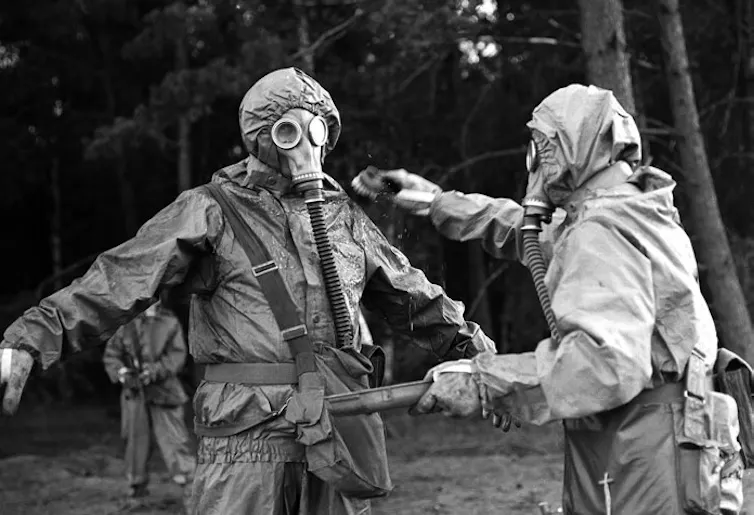
Two mena are seen in hazmat suits.
Stasi workers train for a nuclear emergency. Bundesarchiv

The problem for the East German state was that by the mid-1980s, a lot of people were able to pick up Western TV and radio signals. Many recognized that their own government wasn’t telling them the truth. However, they also knew that Western media would take any chance they got to disparage the Eastern bloc. The result was that many people knew that they weren’t being told the truth, but they weren’t sure exactly what the truth was.

Much of the East German and Soviet propaganda at that time was designed to confuse and cast doubt, not necessarily to fully persuade. The idea was that enough conflicting information would tire people out.

Downplaying economic concerns

One of the Stasi’s major concerns following the disaster was the economic damage that was sure to affect East Germany. Once people began to learn of the radioactive fallout over much of Europe, they grew fearful of their own produce and dairy products.

Children began refusing to drink milk at school, while people frequently asked produce vendors whether their products were grown in a greenhouse or outdoors. On the whole, people stopped buying many of these products.

Vegetables are seen at a market with a German sign.
A sign advertises for vegetables free of contamination in a West German market on May 8, 1986. Rüdiger Schrader/picture alliance via Getty Images

With an excess of these goods, the East German government needed to devise a plan to continue to make money off potentially contaminated goods. The Stasi’s solution was to increase export of these goods to West Germany.

In the formerly classified files, Stasi officials claim that exports would spread out the consumption of radioactive products, so that no one would consume unsafe levels of contaminated meat and produce.

The problem for the East Germans was that West Germany quickly amended their regulations for border crossings from East to West. Vehicles emitting certain levels of radiation were no longer allowed across the border. As a response, the lower-ranking Stasi workers were required to clean radioactive vehicles themselves. In doing so, the state was knowingly risking the health and safety of its own officials.

The East German food export plan was modeled on a similar one proposed by the Soviet government. The Soviet strategy, however, was not to export contaminated goods abroad but rather to send contaminated meat products to “the majority of regions” in the Soviet Union “except for Moscow.”

How disinformation proved an Achilles’ Heel

When the Stasi was founded in 1950, many of its employees genuinely believed in the East German cause.

Having witnessed the horrors of Nazi Germany, many older Stasi workers saw the East German state as the answer to creating a just and equitable society. By the 1980s, however, this sentiment had grown rare. Instead, many Stasi workers viewed their jobs as means to a decent income and privileged government treatment.

As a result, many Stasi workers had grown disillusioned and dispassionate.

Men and women are sprayed by a water cannon.
Protesters at the nuclear power plant in Brokdorf, West Germany, after the accident at Chernobyl. Hendricks/ullstein bild via Getty Images

It was little surprise, then, that the Stasi put up little resistance when protesters stormed their headquarters in 1990, months after the Berlin Wall fell. While there are many factors in the demise of the communist bloc, the way the East German and Soviet governments handled the aftermath of Chernobyl contributed greatly to the growing popular sentiment against each regime.

In East Germany, the disinformation campaign after the nuclear disaster only strengthened the message that the state did not have its people’s best interests in mind and that it was willing to sacrifice their health and well-being in order to maintain a certain image.

The Conversation

Lauren Cassidy does not work for, consult, own shares in or receive funding from any company or organization that would benefit from this article, and has disclosed no relevant affiliations beyond their academic appointment.

  •  
❌