Reading view

How to read the classics in an age of distraction – and 3 short books to get you going

Over the past 15 years, I have witnessed university students’ shrinking patience for reading – especially for reading “long” books. Increasingly, students also opt for audiobooks. While speeding up the reading experience, these fundamentally change what is noticed.

The neuroscientist Maryanne Wolf suggests many students no longer have the “cognitive patience” to read long books due to the complexities of thought and sustained attention required.

One explanation for this shift is the dominance of digital technology in our daily lives, which has rewired our brains for surface-level scanning and multitasking, weakening our capability for prolonged attention. Another is our culture of instant gratification.

Some studies into the “screen inferiority effect” suggest when we read on paper (rather than on screens such as smartphones) the brain often processes more deeply and comprehension is better. Memory and information recall are also stronger.

So where does this leave the classics?


Millions of Australians, both children and adults, struggle with literacy.

In this series, we explore the challenges of reading in an age of smartphones and social media – and ask experts how we can become better readers.


Many books considered “classics” are long. Masterpieces such as Middlemarch or Les Misérables might seem intimidating because in physical form they resemble door stops and they often have complex, demanding language and long, convoluted sentences.

But reading the classics can deliver cognitive, social, emotional and even ethical benefits, helping us strengthen habits of thoughtful attention and develop the skills to communicate with clarity and empathy.

Goodreads

Extending our attention spans increases our ability to connect thoughts and ideas, challenges memory and recall and perhaps helps us attend more patiently to our own lives and the lives of others. In reading Robinson Crusoe, for instance, we share in the patience of the title character, stranded on a desert island. We, too, pay careful heed to details and signs in the world around him.

The complex language of classics can help us discern meaning amid a multitude of voices. When working through multiple sentence clauses and the layered sentences of a meaningful paragraph we need to suspend judgement until we have the fuller picture. Following complex and interwoven narratives also helps us to understand human complexity in real life.

Here are some tips for reading the classics – and some shorter ones to start with.

1. Follow your instincts

Goodreads

Find out which classic novels influenced the development of your favourite genre and you might find a natural fit. My brilliant English teacher at school, Mr Taylor, knew I loved detective fiction, so he kept recommending Wilkie Collins’s The Moonstone as an early example of crime mystery. Eventually taking his advice, I loved it and followed it with Collins’s other classic, The Woman in White.

2. Remove distractions

It can help to set aside dedicated reading time, such as 20–30 minutes a day in which phones, smartwatches and other devices are out of the way. There is an added benefit: research by Mindlab International has shown reading for only six minutes reduces stress levels by 68%.

3. Make a note of memorable sentences

You don’t need a teacher to notice powerful moments or startling language. For example, Charles Dickens’s opening to A Tale of Two Cities (“It was the best of times, it was the worst of times …”) famously captures the coexistence of extremes in the world – of hope and despair, of wisdom and foolishness. Dickens has crafted an enduring truth of human experience.

4. Ask yourself questions

Why is this considered a classic? Why do I dislike this particular character? Why does this scene make me feel uncomfortable? Usually, the author wants you to consider why things were written the way they were (rather than, for example, with a different vocabulary or narrative voice). Asking questions deepens comprehension.

5. Embrace the unknown

If longer sentences or old-fashioned language trip you up, go over them again and then keep going. Kindles offer instant definitions at the touch of the screen but sometimes looking up every word in the dictionary can interfere with the opportunity to deduce meaning from context.

6. Be ready to laugh

Some classic novels are downright funny. I am currently reading Anthony Trollope’s The Warden. The sentences may be long, but they are almost always punctuated with hilarious insights into the hypocrisies of human beings and the naming rights the author deploys are childishly funny.

7. Read aloud

Goodreads

Classic novels were often serialised and read aloud in instalments in families or community groups. As a teenager, some of my most memorable early forays into the classics were shared with a dear cousin while staying with our grandparents in the Blue Mountains, when we would read aloud to each other on wintry, windy nights by the fireplace. Here, I first encountered Daphne Du Maurier’s evocative West Country mystery Rebecca and Dodie Smith’s eccentric and funny I Capture the Castle. Begin your adventure into the classics by reading aloud with a friend or in a book club.

8. Don’t feel too daunted

Remember that getting started with the story, getting to know the writer’s style, gradually piecing together the world of the novel can be the hardest stage. Take your time, be patient and persist. The further you get into a novel like War and Peace, the easier it is to continue because you simply want to know what happens.


Here are three short classics worth the journey.

George Eliot’s Silas Marner

A heartwarming study of the “inward life” of Silas, the weaver, exiled from his fellowship of narrow religious sectarians. He finds purpose in life, first in money and then in the fatherly love he develops for Eppie, the child who wanders into his home. Silas Marner is an accessible taster of Eliot’s longer experiments exploring emotion and “fellow feeling”.

James Joyce’s Dubliners

Goodreads

This book is, strictly speaking, a collection of 12 short stories. Together they form a masterpiece of brutal Anglo-Irish realism interrupted by moments of epiphany. The book contends with questions of action and inaction, betrayal, political idealism and pragmatism. The story of Eveline, who is on the cusp of eloping with the “very kind, manly, and open-hearted” Frank on a night-boat to Buenos Aires to escape the ill-treatment of her ageing, abusive father, leaves the reader astonished by the sudden departure in the final lines from her earlier rational self-analysis.

Virginia Woolf’s Mrs Dalloway

An experimental novel set on one summer’s day in London, 1923. The socialite Clarissa Dalloway prepares a party but the absence of any chapter breaks in the book creates for the reader a sense of the stifling impact of war that still lingers over British family, social and political life. In the trauma of returned soldier Septimus Smith we read an early fictional exploration of shell shock.

The Conversation

Johanna Harris does not work for, consult, own shares in or receive funding from any company or organisation that would benefit from this article, and has disclosed no relevant affiliations beyond their academic appointment.
  •  

Ten compelling poems about climate change – chosen by our experts

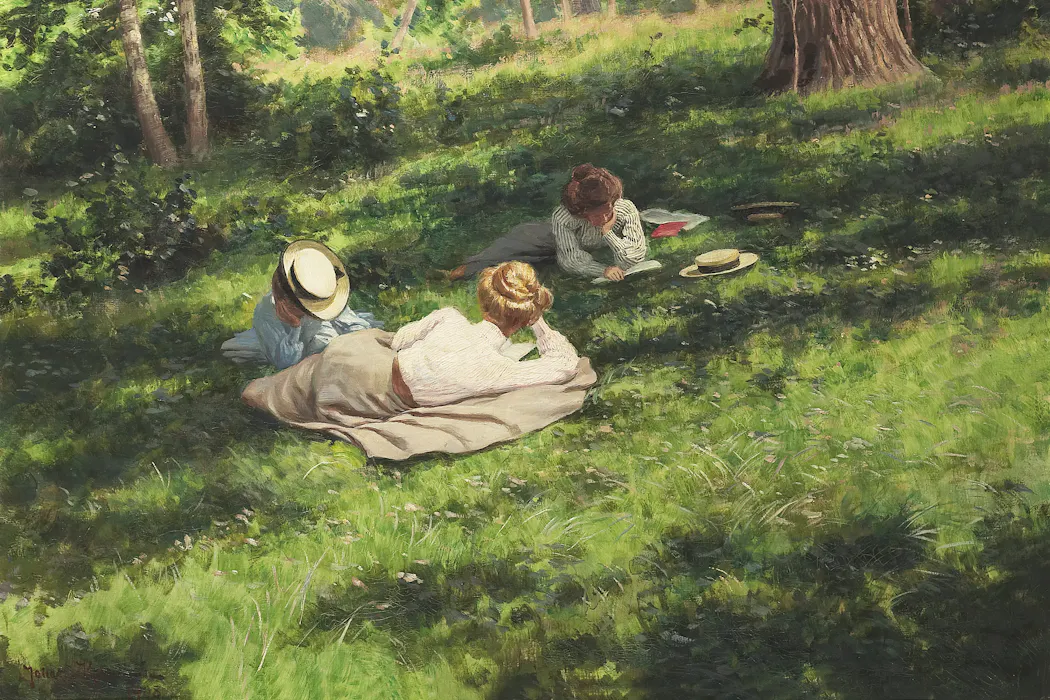
Three Reading Women in a Summer Landscape by Johan Krouthén (1908). WikiCommons

We asked ten literary experts to recommend the climate poem that has spoken to them most powerfully. Their answers span over 200 years and a range of emotions from sorrow, to anger, fear and hope.

This article is part of Climate Storytelling, a series exploring how arts and science can join forces to spark understanding, hope and action.

1. Death of a Field by Paula Meehan (2005)

Published in the wake of the 2008 financial crisis, Paula Meehan’s Death of a Field critiqued the environmental impact of the Celtic Tiger economy in Ireland.

The poem anticipates the destruction of the titular field by property developers with little regard for native ecologies: “The end of the field as we know it is the start of the estate.”

Death of a Field read by Paula Meehan.

The global effects of the climate crisis are seen from a uniquely local perspective as the displacement of Irish wildlife mirrors the effect of colonial violence. “Some architect’s screen” is simply the latest iteration of imperial technologies that seek to plunder Irish landscapes. The poem gains further strength by refusing to replicate a hierarchical relationship to nature by preserving its many mysteries:

Who can know the yearning of yarrow

Or the plight of the scarlet pimpernel

Whose true colour is orange?

Jack Reid is a PhD Candidate in Irish literature

2. Darkness by Lord Byron (1816)

Darkness imagines the fallout of a volcanic eruption that has destroyed the Earth. The “dream” that the poem mentions was inspired by genuine weather conditions during the “year without a summer” in 1816, caused by the eruption of Mount Tambora in Indonesia the previous year.

Darkness by Lord Byron.

Sulphur in the atmosphere caused darkness and low temperatures across Europe. In Lake Geneva, Lord Byron experienced the infamous “haunted summer” of darkness.

Byron’s depiction of climate catastrophe is bleak, with words like “crackling”, “blazing” and “consum’d” bearing resemblance to contemporary reports of wildfires caused by climate change. After a famine, all elements of Byron’s Earth, from the clouds to the tide, eventually cease to exist: “Seasonless, herbless, treeless, manless, lifeless– / A lump of death – a chaos of hard clay.” Read as a portent of the Anthropocene, Byron’s poem urges readers to seriously consider the future of mankind.

Katie MacLean is a PhD candidate in English Literature

3. Mont Blanc by Percy Bysshe Shelley (1817)

Byron’s close friend Percy Bysshe Shelley was also inspired by the “year without a summer”. He witnessed temperatures drop, volcanic ash hanging heavy in the air and crops failing. While his wife Mary used the gloomy climatic event to inform her novel Frankenstein (1818), Shelley channelled them into his poem Mont Blanc.

A reading of Mont Blanc.

In his ode, Shelley describes a timeless “wall impregnable of beaming ice”. By drawing on his scientific reading, he then explains his fears regarding global cooling and the possibility of vast glaciers eventually covering the alpine valleys.

He imagines “the dwelling-place / Of insects, beasts, and birds” being obliterated and mankind forced to flee. While Shelley saw this process as “destin’d” and inevitable, it is clear that Mont Blanc is a poem with catastrophic climate change at its heart. In 2026, it is difficult to read in any other way.

Amy Wilcockson is a research fellow in Romantic literature

4. Characteristics of Life by Camille T. Dungy (2012)

There’s something gloriously elastic about invertebrates: the spinelessness of a worm, the pulsing of the jellyfish, the curling of an octopus. Spiders, snails and bees, too, with their exoskeletons on display, invite us to see things “inside-out”.

These are the thoughts I have when I read Characteristics of Life by Camille T. Dungy, which opens with a snippet from a BBC news report claiming that “a fifth of animals without backbones could be at risk of extinction”. What would a world be without the “underneathedness” of the snail beneath its shell beneath the terracotta pot in the garden? Or “the impossible hope of the firefly” whose adult lives span only a handful of human weeks?

Camille T. Dungy speaks about nature and poetry.

Dungy speaks from a “time before spinelessness was frowned upon”, and from a world where to dismiss a being as “mindless” (jellyfish have no brains) or even “wordless” would be “missing the point” entirely. As I think of these creatures that dwell beyond our usual line of vision – flying, crawling, tunnelling and swimming – I find my perspective on our beautiful world turning and shifting.

Janine Bradbury is a poet and a senior lecturer in contemporary writing and culture

5. Prayer at Seventy by Vicki Feaver (2019)

One of my favourite poems about climate change is Vicki Feaver’s Prayer at Seventy from her 2019 collection I Want! I Want!.

The speaker’s request of passing her “last years with less anxiety” appears to be denied by a god who first responds by changing her into “a tiny spider / launching into the unknown / on a thread of gossamer” and who, when she begs to “be a bigger / fiercer creature”, turns her into “a polar bear / leaping between / melting ice floes”.

A reading of Prayer at Seventy by Vicki Feaver followed by an explanation by the poet.

Both images present creatures who are in precarious positions, their futures uncertain, reflecting the state of a person contemplating the unknowns of old age and death. But the poem moves beyond the personal. The reference to the melting ice floes is not solely metaphorical: it reminds us that the planet itself is in danger and every living thing is therefore vulnerable – and will be increasingly so.

Julie Gardner is a PhD candidate in literature


Read more: How poetry can sustain us through illness, bereavement and change


6. Walrus by Jessica Traynor (2022)

Walrus, from Jessica Traynor’s 2022 collection Pit Lullabies expresses the quiet anxiety a mother has for her child in the world of climate breakdown.

While stripping wallpaper from the box room of her house, the poet discovers a mural of the Walrus and the Carpenter from Alice’s Adventures in Wonderland. Traynor takes part of Lewis Carroll’s poem about the Walrus and the Carpenter walking along the beach, eating the vulnerable oysters, and weaves it into her own poem.

Jessica Traynor reading poems from her collection Pit Lullabies.

Carroll’s absurd verse includes what, at that time no doubt, seemed like an impossible image of a “boiling hot” sea. In the 21st century, this is no longer an absurdity, as Traynor knows. She makes a connection with Carroll’s poem, imploring her child:

Sleep as the sun rises and ice melts

and for want of the freeze a walrus

pushes further up a cliff-face.

It’s a complex poem that reimagines a key work of children’s literature, connecting it with the reality of the changing world. All the while the mother keeps her fears at bay for the sake of her child, “brows[ing] washing machines” with a “ball of tears” in her throat.

Ellen Howley is an assistant professor of English

7. Ocean Forest, co-created by the We Are the Possible programme

Ocean Forest is woven out of words, research, ideas and stories shared by scientists, educators, health professionals, youth leaders, writers and artists. They took part in creative writing workshops to co-create the anthology Planet Forest – 12 Poems for 12 Days for the UN Climate Conference in Brazil in 2025.

In the shallows, alert to change,

the minuscule, overlooked creatures

weave between seagrass, and weed –

live their shortened lives.

When ships pass overhead, when sands shift,

fish navigate swell, migrate beyond

where coral’s been bleached, through schools

of silenced whales and barely rooted mangroves

struggling to thrive in darkening water.

Deeper down,

pressure builds, species exist, unaware,

undisturbed. As heat and waves rise there’s hope

the unfound, the unnamed, the unpolluted

in the remotest ocean forests will survive.

Through uniting disciplines and voices the poem takes unexpected shifts. It demonstrates that climate change affects and erodes the habitats that lie beneath the surface and that urgent action is needed to protect disappearing species.

Yet, there is also a glimmer of hope – that in the deepest, darkest parts of the ocean, where temperatures are near freezing and there are bone-crushing pressures, maybe there are creatures that will survive human interference and pollution.

Sally Flint is a lecturer in creative writing and programme lead on the We Are the Possible programme

8. Di Baladna (Our Land) by Emi Mahmoud (2021)

Emtithal “Emi” Mahmoud is a Sudanese poet and activist, who has won multiple awards for her slam poetry performances. Mahmoud performed Di Baladna at the United Nations Climate Change Conference in 2021.

Poetry – especially spoken word – helps people connect emotionally with the human side of climate-driven displacement, a topic that’s often explained only through technical language. The language of emissions targets, temperature thresholds, or policy frameworks can distance people emotionally from its consequences. Yet poetry can cut through this abstraction.

Di Baladna (Our Land) read by Emi Mahmoud.

Mahmoud’s performance gave voice to those forced from their homes by environmental collapse, reminding listeners that climate change is not only an environmental crisis but a deeply human one, with profound effects on individuals, families and communities.

By merging vivid natural imagery with the rhythms of displacement and lived testimony, the poem urges listeners to replace passive awareness with empathy. Mahmoud implores us to feel the loss, fear and resilience of displaced communities, looking beyond news headlines and images of victimisation. Engaging with such work helps transform climate refugees from statistics into people.

Clodagh Philippa Guerin is a PhD candidate in refugee world literature

9. Flowers by Jay Bernard (2019)

At first glance, Jay Bernard’s Flowers is circular poem (one that begins and ends in the same place) but you soon realise that the circle isn’t going to complete. It opens:

Will anybody speak of this

the way the flowers do,

the way the common speaks

of the fearless dying leaves?

And closes:

Will anybody speak of this

the fire we beheld

the garlands at the gate

the way the flowers do?

And the answer seems to be, no: no one will speak of these things – the “coming cold” and the “quiet” it will bring – only the things themselves as they die. With the songs Where Have All the Flowers Gone? by Pete Seeger and Blowin’ in the Wind by Bob Dylan in its DNA, Flowers has the eternal power of a folk-lyric – prophetic and unignorable.

Kate McLoughlin is a professor of English literature

10. Place by W.S. Merwin (1987)

Climate change poetry – should it be a thing? How do poets avoid the oracular pomp it threatens? Browsing my small library I’m shocked anew to realise most poets lived and died blissfully innocent of our condition.

OK, what about the late John Burnside’s lyric Weather Report (“this is the weather, today / and the weather to come”). It poignantly extrapolates from a sodden summer to his sons’ futures: “a life they never bargained for / and cannot alter”. Heartbreaking. Or the odd dread of spring in Fiona Benson’s Almond Blossom, a season characterised as Earth’s, “slow incline … inch by ruined inch”. Ditto.

W.S. Merwin reads Place.

But then I reach back to the great American poet W.S. Merwin’s short prayer Place to find that grace-note of hope which surely needs to thread through all poems, whether they speak of climate change, mortality or love: “On the last day of the world / I would want to plant a tree.” Me too.

Steve Waters is a playwright and professor of scriptwriting at the University of East Anglia

This article features references to books that have been included for editorial reasons, and may contain links to bookshop.org. If you click on one of the links and go on to buy something, The Conversation UK may earn a commission.

The Conversation

Amy Wilcockson receives funding from Modern Humanities Research Association as Research Fellow for the Percy Bysshe Shelley Letters project.

Steve Waters receives funding from AHRC

Clodagh Philippa Guerin, Ellen Howley, Jack Reid, Janine Bradbury, Julie Meril Gardner, Kate McLoughlin, Katie MacLean, and Sally Flint do not work for, consult, own shares in or receive funding from any company or organisation that would benefit from this article, and have disclosed no relevant affiliations beyond their academic appointment.

  •  

We found a lost copy of the earliest surviving English poem in a medieval manuscript in Rome

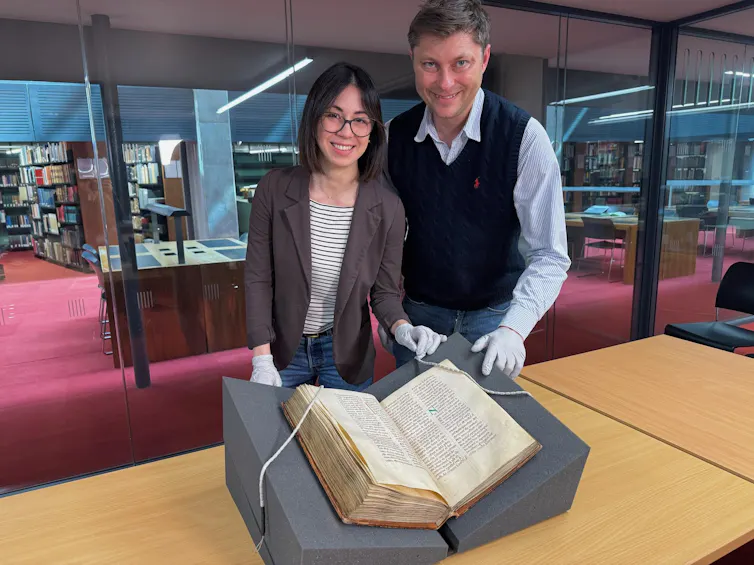
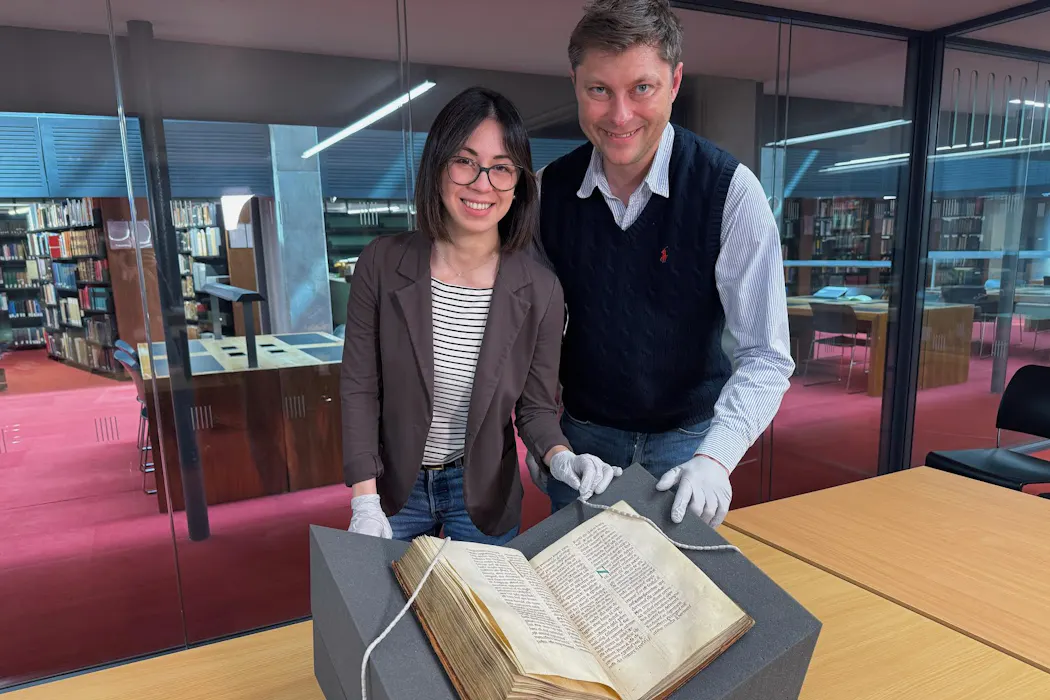
Elisabetta Magnanti and Mark Faulkner with a copy of Bede’s Ecclesiastical History of the English People. Courtesy of the authors, CC BY-ND

Some medieval texts have barely survived. Beowulf, the Old English masterwork, exists today because of a single manuscript – one that narrowly escaped combustion in 1731. For such texts, the single manuscript is all important. The discovery of another copy would transform our understanding.

By contrast, a work like Bede’s Historia Ecclesiastica Gentis Anglorum (Ecclesiastical History of the English People) survives in more than 160 manuscripts. This volume of material has meant that scholars have tended to focus on just a few of the earliest copies, since these are most likely to preserve a text close to what Bede originally wrote. The result is that many later or less well-known manuscripts have received little detailed attention.

Now, however, computational methods that make it possible to analyse millions of words are changing that picture. Instead of relying on a narrow selection of manuscripts, we can begin to take the full breadth of the tradition into account. And that, in turn, has renewed the value of finding and studying additional copies.

Elisabetta Magnanti and Mark Faulkner with a copy of Bede’s Ecclesiastical History of the English People.
Elisabetta Magnanti and Mark Faulkner with a copy of Bede’s Ecclesiastical History of the English People. Courtesy of the authors, CC BY-ND

Our own work, motivated by the potential of studying many manuscripts but – for now at least – using traditional methods to locate them, has led to some unexpected discoveries, including, in Rome, a previously overlooked early copy of Bede’s Historia Ecclesiastica. Remarkably, this manuscript also preserves one of the earliest versions of Cædmon’s Hymn, the earliest known poem in English.

Lost and found

The Historia Ecclesiastica was completed in 731 by the Venerable Bede, an English monk often described as the father of English history. It proved to be one of the most influential works of the western Middle Ages. Copies circulated across Europe and the British Isles from the mid-8th to the 16th century.

One of us, Magnanti, was conducting an ongoing hunt for new manuscripts of Bede’s Historia Ecclesiastica, and discovered in the National Central Library in Rome a copy of the text made at the Abbey of Nonantola in the north of Italy, less than a century after Bede’s death in 735. The manuscript had long been presumed lost and, as a result, had never previously been examined in detail by academics.

We have just published details of this discovery in the journal Early Medieval England and its Neighbours.

Rather than being lost, the manuscript had in fact been moved from Nonantola to the church of Santa Croce in Gerusalemme in Rome by the 1650s. During the upheavals of the Napoleonic wars in the early 19th century, it was transferred again to the nearby church of San Bernardo alle Terme, from where it was subsequently stolen, along with other valuable manuscripts.

The book resurfaced in England almost two decades later, when it was acquired by Sir Thomas Phillipps, a 19th-century English book collector and self-described “velomaniac” (manuscript addict). Though Phillips died in 1872, the codex was not sold until 1948, when it entered the collection of the Swiss bibliophile Martin Bodmer. It then disappeared from view once again before being acquired by the National Central Library of Rome via the Austrian-born New York bookseller H.P. Kraus in the 1970s.

Cædmon’s Hymn

Bede as depicted in an illustrated manuscript, writing his Ecclesiastical History of the English People.
Bede as depicted in an illustrated manuscript, writing his Ecclesiastical History of the English People. WikiCommons

The newly rediscovered codex contains perhaps the fifth-oldest surviving complete copy of the Historia Ecclesiastica. As such, it is a hugely important witness to the transmission of Bede’s text to Europe in the century after he completed it.

Even more exciting, the manuscript proved to contain the third-oldest text of Cædmon’s Hymn. Cædmon’s story only survived thanks to Bede. He explains that Cædmon, an agricultural labourer working at Whitby Abbey in north Yorkshire, was at a feast when guests began to recite poems.

Embarrassed that he didn’t know anything suitable, Cædmon left for an early night. A figure then appeared to him in his dreams, telling him to sing about creation, which Cædmon miraculously did, producing his hymn – nine lines of intricately woven praise to God for creating the world.

Cædmon’s Hymn

Translated by Roy M. Liuzza

Now let us praise Heaven-Kingdom’s guardian,

the Maker’s might and his mind’s thoughts,

the work of the glory-father – of every wonder,

eternal Lord. He established a beginning.

He first shaped for men’s sons

Heaven as a roof, the holy Creator;

then middle-earth mankind’s guardian,

eternal Lord, afterwards prepared

the earth for men, the Lord almighty.

While admiring the hymn’s “beauty and dignity”, Bede baulked at including the original English in his Latin. Subsequent readers felt the absence, however, and supplied the original text, in the earliest cases adding it at the end of the Historia Ecclesiastica or in the margin. In the manuscript Magnanti discovered, the hymn appears in the actual text: the earliest such positioning by some 300 years.

Closer examination of the Rome Bede also revealed a major blunder: the scribes appear to have become confused and, between Books I and II of the Historia Ecclesiastica, switched to copying an entirely different text — a sermon on Christ’s descent into hell, prescribed for Easter Sunday preaching. This sermon had passed unrecorded in all the existing catalogues in which the manuscript is described, from 1166 to 2011.

Thanks to computational methods for transcription, collation and textual analysis, a fuller reconstruction of the manuscript tradition of Bede’s Historia Ecclesiastica may now be within reach. That makes discoveries like many the Rome manuscript has yielded just the tip of the iceberg.

The Conversation

The authors do not work for, consult, own shares in or receive funding from any company or organisation that would benefit from this article, and have disclosed no relevant affiliations beyond their academic appointment.

  •  

The six best Shakespeare adaptations that aren’t in English

The future of Shakespeare may well lie beyond the English language. That was the striking message I took away from a talk by translation studies scholar Professor Susan Bassnett at the British Shakespeare Conference in Hull in 2016.

Her point was simple but powerful: Shakespeare’s works are likely to survive and flourish not only in English, but through translation, adaptation and reinvention across the world. Inspired by this, I asked six of my colleagues around the globe to share some Shakespeare adaptations in other languages that you might enjoy.

1. Goliyon Ki Raasleela Ram-Leela (2013)

Hindi, based on Romeo and Juliet

Ram‑Leela is as heady a mix as Shakespeare’s own play, in equal parts comic and tragic, tender and flamboyant. Director Sanjay Leela Bhansali relocates the action of Verona to an Indian town riven by two criminal clans: Rajadis and Sanedas. Violence saturates daily life. Bullets spill from spice jars and a Rajadi child urinating on Saneda territory ignites a vicious brawl.

The trailer for Goliyon Ki Rasleela: Ram-Leela.

In such a world, can love bring peace? The leads’ scorching chemistry makes us hope. My students practically swooned during a screening. At the end, soulful lyrics such as “Tera naam ishq / Mera naam ishq” (“Your name is love / My name is love”) frame the film’s Romeo and Juliet – Ram and Leela – through love rather than their hate-fuelled lineage.

The film also gives depth to its Lady Capulet and nurse figures, while Leela is sensual, witty and brave. Juliet exactly as Shakespeare imagined her.

Varsha Panjwani teaches at New York University, London, and is the creator and host of the podcast Women and Shakespeare.

2. Otel·lo (2012)

Catalan, based on Othello

An award-winning work of Catalan cinema, Otel·lo transposes Shakespeare’s play to a contemporary film studio. Such a meta-narrative approach feels in line with the play’s focus on the enticing power of storytelling – famously embodied in the character of Iago as its arch-villain.

The trailer for Otel.lo.

Blending documentary, mockumentary and thriller aesthetics, the film turns Iago into an unscrupulous filmmaker willing to cross every boundary in the name of art. With his role played by the actual director of the film (Hammudi Al-Rahmoun Font), the adaptation skilfully integrates form and content. We are, like Othello, manipulated into thinking that the fiction he has created is reality.

The film asks: To what extent are the images we absorb real? What purpose do they serve? And how do they affect our views on gendered and racialised minorities?

Inma Sánchez García is a lecturer in European languages and culture at the University of Edinburgh.

3. Throne of Blood (1957)

Japanese, based on Macbeth

The genius of Throne of Blood is that despite being set in 16th century Japan and changing almost everything about the original, it is immediately recognisable as the Scottish play. It’s considered by many to be the greatest Shakespeare film ever made.

The trailer for Throne of Blood.

The mist-swirled locations, the screeching flute and ominous drumbeats, the spooky old lady in the forest, and above all the samurai, barking orders and getting lost on their horses, can mean only that “Macbeth doth come”. The final scene when Washizu’s (Macbeth’s) soldiers turn on him with a hail of arrows may even represent an improvement on Shakespeare. Meanwhile his poker-faced lady clearly wears the kimono-trousers in their marriage.

Daniel Gallimore is a professor of literature and linguistics at Kwansei Gakuin University

4. Bhrantibilas (1963)

Bengali, based on Comedy of Errors

If you asked me to pick a favourite Shakespeare film, I’d probably surprise people by saying Bhrantibilas. It’s one of the earliest filmed Shakespeare adaptations in Indian cinema. It was also the inspiration for the globally popular film Angoor (1982).

A scene from Bhrantibilas.

What I love about it is how confidently it relocates Shakespeare’s farce into a Bengali urban world without ever feeling like a dutiful “literary” exercise. A huge part of its lasting appeal is Bengali superstar Uttam Kumar. It’s pure pleasure watching him play the twin roles – Antipholus of Syracuse and Antipholus of Ephesus, identical twins separated at birth, whose accidental reunion causes chaos. His comic timing is razor-sharp, and there’s also an ease and charm that makes the confusion feel human, never mechanical.

Decades on, audiences still return to Bhrantibilas, often knowing every gag by heart, which says a lot about its cultural afterlife. For me, it’s a perfect example of how Shakespeare survives not through reverence but through reinvention – absorbed into popular cinema and kept alive by star power, humour and sheer re-watchability.

Koel Chatterjee is a lecturer in English at Regent College, and the creator and host of The Shakespop Podcast and The Shakesfic Podcast.

5. Rahm (2016)

Urdu, based on Measure for Measure

Measure for Measure has long been regarded as a “problem play”. Disfavoured among Shakespeare’s works for centuries, it hit stages again in the 20th-century and reached new audiences through its resonances with the #MeToo movement.

The trailer for Rahm.

A local leader tells a devout woman that if she loses her virginity to him, he will spare her imprisoned brother’s life. This film shifts the action from early modern, Catholic Vienna to an ambiguous period in Islamic Lahore. Moderate and extremist versions of faith contend, against the backdrop of the city. This film’s billing as a thriller, and status as the only big screen version of the play, help raise it from obscurity.

Sarah Olive is a senior lecturer in English literature at Aston University.

6. To The Marriage of True Minds (2010)

Arabic, based on Sonnet 116

This freely available short film expands on one of Shakespeare’s shortest forms: the sonnet. It riffs on Sonnet 116, heard at countless weddings: “Let me not to the marriage of true minds … admit impediments.” Here, its Arabic translation provides both the back story to – and future hope for – an asylum-seeking couple in a same-sex relationship, Falah (Amir Boutrous) and Hayder (Waleed Elgadi).

The story of their journey by sea, and shots of a tossed-about paper boat reference the poem’s sea-voyage imagery. Over 12 tense minutes, we hold our breath to see whether the Iraqi poet and his childhood beloved will overcome the impediments of religious conservatism, on one shore, and an apparently hostile asylum system on the other.

Sarah Olive is a senior lecturer in English literature at Aston University.

This article features references to books that have been included for editorial reasons, and may contain links to bookshop.org. If you click on one of the links and go on to buy something from bookshop.org The Conversation UK may earn a commission.

The Conversation

Sarah Olive does not work for, consult, own shares in or receive funding from any company or organisation that would benefit from this article, and has disclosed no relevant affiliations beyond their academic appointment.
  •  

40 years later, Russia is still silencing the voices of Chernobyl

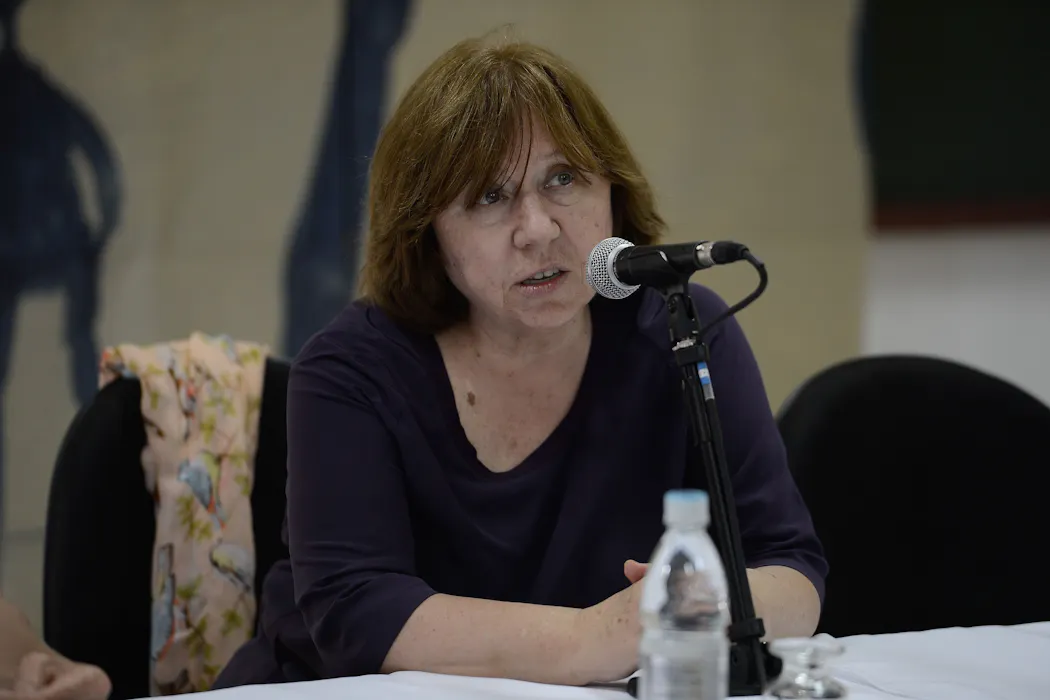
Svetlana Alexievich gives an interview in Brazil, 2016. Tomaz Silva/Agência Brasil, CC BY

In June 2018 I had the opportunity to visit Minsk, the capital of Belarus. In a large bookshop in the city centre – beneath the inquisitorial gaze of the ever-present portraits of the dictator Alexander Lukashenko – I asked the bookseller for one of the volumes of Svetlana Alexievich’s collected works. The Russian publisher Vremya had reissued them after the author was awarded the Nobel Prize in Literature in 2015.

But the newest Russian edition of The Unwomanly Face of War – the Alexievich book I had just translated into Catalan – was not on the shelves. Instead, to my surprise, the bookseller pulled a copy out from under the counter. The complete works of Belarus’s only Nobel laureate were being kept out of sight from Belarusian readers. Her books had to be requested as though they were exclusive items – or worse, forbidden or dangerous goods.

Perhaps they turned a blind eye in my case because I was a foreigner, but it is not a stretch to think that local readers who bought Alexievich’s works at the time may well have found their names added directly to some State register, much like how Russia monitors its citizens’ internet searches today. And I say “at the time” here because I have my doubts as to whether Alexievich’s books are still available in bookshops in her own country today.


Leer más: I was in Georgia in the late 1980s: I observed how tradition survived harsh Sovietisation and rapid transformation


That brief scene seemed to encapsulate the increasingly uncomfortable status Alexievich’s books had acquired in Belarus and across the post-Soviet world. Indeed, I had a similar experience in Russia just three months after my visit to Minsk, when I found myself in Moscow for a translation congress. I decided to repeat my Alexievich experiment in another large bookshop, this time on the city’s main thoroughfare of Tverskaya Street.

There, the collected works were not hidden from view but rather placed beyond the customer’s reach. High up on a shelf, nearly touching the ceiling, I spotted the volume I was looking for: Voices from Chernobyl. I asked the bookseller how I was supposed to get up there. She replied with blunt discourtesy: “You’ll find a ladder somewhere.”

And sure enough, I did find one.

Prayer and voices

2026 marks forty years since the Chernobyl nuclear disaster, one of the many factors that contributed to the collapse of the Soviet Union. On this bleak anniversary, it is worth sketching the origins of the critical disdain Alexievich has faced in her home country and in Russia, particularly in connection with Voices from Chernobyl.

Svetlana Alexievich’s books have been translated into 52 languages and published in 55 countries. The first English version of Voices from Chernobyl: Chronicle of the Future was translated by Antonina W Bouis and published in London by Aurum Press in 1999. The book was also released in a new translation by Keith Gessen in 2005 by Dalkey Archive Press, in the US, titled Voices from Chernobyl: the Oral History of a Nuclear Disaster. The most recent English translation, by Anna Gunin and Arch Tait, was published by Penguin Books in 2016 under the title Chernobyl Prayer: A Chronicle of the Future.

From her exile in Berlin, Alexievich herself declared recently: “I fear that today every modern person should know something about the atom and its dangers”. For that reason, she still recommends Voices from Chernobyl as an entry point into her literary universe.


Leer más: Chernobyl at 40: the lies, the loss and why we can’t let go


A first reading of Alexievich

The original version of the book appeared in the first issue of the Russian journal Friendship of Peoples (Дружба народов) in 1997, where it was recognised as one of the ten most outstanding contributions of the year – an endorsement that granted it immediate literary legitimacy.

Black and white picture of Svetlana Alexievich leaning to a balcony rail.
Svetlana Alexievich at Villa Waldberta, 1996. Barbara Niggl Radloff / City Museum of Munich, CC BY-SA

That same year, the poet and critic Valery Lipnevich devoted a long review to the book in one of the most influential Russian literary journals of the twentieth century, The New World (Новый мир). Under the title Farewell to Eternity, the review interpreted the work as a meditation on the collapse of the scientific and moral progress of Homo sovieticus, highlighting Alexievich’s decision not to “write, but record, document” a polyphony of voices.

Lipnevich wrote:

“In the case of Svetlana Alexievich, we are faced with a radically new phenomenon. Documentary writing as such is not new, but up to now we have mostly read an ideologised documentary prose – writing disguised as documentary that had little interest in reality itself. What Alexievich is doing today might be called a new literature of fact. It is glasnost and social openness that have made her books possible. They convey the voice of the people as it is, without embellishment.”

Between 1997 and 1999, reviews largely followed this line. They emphasised the ethical and testimonial nature of her work, placing it within the tradition of Russian documentary prose – alongside figures such as Aleksandr Solzhenitsyn, Ales Adamovich and Daniil Granin – while also underlining the high literary quality of her documentary project. The liberalising post-Soviet spirit of the wild nineties seemed to accompany the reception of Alexievich’s work.


Leer más: How the image of a besieged and victimized Russia came to be so ingrained in the country’s psyche


Reception after the 2000s

From the publication of her first book during perestroika – 1985’s The Unwomanly Face of War – the critical narrative surrounding Alexievich already carried ideological and political accusations that would come to dominate her reception from the 2000s onward.

It was then that allegations of Russophobia and anti-Soviet sentiment proliferated online and in reader reviews. Her books were increasingly labelled as polemics, and her literary method itself came under attack – precisely because it rests on a constellation of complementary and sometimes contradictory perceptions of some of the most profound collective traumas of homo sovieticus.

The real turning point, however, came with Alexievich’s Nobel Prize and acceptance lecture. The international visibility of an author who questioned the Kremlin’s narratives of national exaltation did not go unnoticed. Matters worsened further with HBO’s 2019 Chernobyl miniseries.


Leer más: Chernobyl at 40: Secret Stasi files reveal extent of Soviet misinformation campaign over nuclear disaster


As reported by the independent outlet Meduza, Kremlin-aligned media (including Argumenty i Fakty, Express-Gazeta, Rossiyskaya Gazeta and Komsomolskaya Pravda, among others) seized on the series’ release to launch furious attacks, not only against the show but also against Alexievich and Voices from Chernobyl, from which the series had drawn several narrative threads.

A group of men, seen from behind, watch the explosion of what appears to be a factory in front of them.
Still from the miniseries Chernobyl. HBO

The revision of history

The closure of independent media and sites of historical memory, the lack of freedom of expression and assembly, the rehabilitation of the Soviet past (Stalin and the Gulag included), and the growing suspicion towards critical, non-heroic narratives of national history have shaped a context in which Voices from Chernobyl and Alexievich’s other books are no longer read as multifaceted, humanistic literary contributions. Instead, they have become simply “awkward” texts – hard to stomach and best kept at a distance.

In April 2024, Russia’s Federal Service for Supervision in Education and Science opened an investigation following the appearance of an excerpt from Voices from Chernobyl on an online platform used to prepare for the Russian university entrance exam. Nina Ostanina, chair of the Duma Committee for the Protection of the Family, denounced Alexievich’s works as being “saturated with hatred for Russia and Russian culture”.

It may not be long before her work is entirely banned. For now, her texts are merely disguised: her books hidden, removed from libraries, or placed on shelves that are almost impossible to reach.

One can only hope there is still a ladder somewhere…


A weekly e-mail in English featuring expertise from scholars and researchers. It provides an introduction to the diversity of research coming out of the continent and considers some of the key issues facing European countries. Get the newsletter!


The Conversation

Miquel Cabal Guarro is a member of PEN Català, the Association of Catalan Language Writers, and the European Council of Literary Translators' Associations.

  •  
❌