
Reading view

How close reading took over the internet via The Devil Wears Prada’s cerulean monologue

The Devil Wears Prada 2 is the sequel to a film that launched a thousand memes.

For the film’s New York premiere in April 2026, fashion designer Evan Hirsh decided to commemorate one of the original 2006 film’s most celebrated scenes. He embroidered Meryl Streep’s infamous monologue on the fictional fashion history of the colour cerulean into the bright blue train of his coat.

In the monologue, ice-queen fashion editor Miranda Priestly (Streep) lambasts ingenue Andy Sachs (Anne Hathaway) for her ignorance about the blue – I mean, cerulean – colour of her sweater.

The infamous cerulean monologue.

Equal parts derisive and incisive, this monologue nods to the “ballroom” tradition of reading the flaws of others, in order to deliver a devastating (and often hilarious) insult. Ballroom is an underground scene of competitive balls created by Black and Latinx LGBTQ+ communities centred on dance, fashion and performance. There, reading functions as both art form and social critique.

The monologue also encapsulates a skill practised in humanities classrooms around the world: close reading. This is the art of unpacking a detail and contextualising it within a broader history, to see how artistic choices and media landscapes come together to shape the world around us – often without us really noticing.

Although an old idea (arguably, even Aristotle was doing it), in the early decades of the 20th century, literary scholars in Britain and America began to emphasise the skills we now know as close reading. They argued that small details and specific choices come together to create the reader’s experience of the text.

In 2006, to see close reading on-screen was rare. Prior to the rise of social media, virtuosic displays of close readings were often confined to academic settings, or the occasional documentary. Now, close reading can be found everywhere in our content diets – in podcasts, YouTube videos and on TikTok.

Close reading proves an ideal technique for generating constant content. It allows creators to unpack artistic choices and the aesthetic histories of just about anything.

A scene from Pose, a drama about ballroom culture, in which a character ‘reads’ a woman in a restaurant.

Some of this content presents itself as educational programming, making use of expert academic hosts (for example, in Architectural Digest’s series Every Detail or the London Review of Books’ podcast Close Readings).

These podcasts and videos form part of the history of post-war educational media, along with Open University programming that used to fill the BBC airwaves in the early hours. Contributors to this programming included Stuart Hall, whose criticism defined the field of Cultural Studies by melding historical analysis with questions of how media such as TV and film communicate with viewers.

Expertise in close reading, however, does not lie only within academia. Close readings can be found in fashion content that highlights the history of specific items, such as the 99% Invisible podcast Articles of Interest. And they’re also evident in the videos of influencers who examine the history of specific looks and the publications that shaped them.

Fan videos providing a close analysis of their favourite singer’s lyrics are very popular online.

Videos and podcasts on pop music and culture hosted by musicologists, such as Vulture’s Switched on Pop, also rely on close reading. Fan videos and tweets unpacking the work of singers like Taylor Swift or Sabrina Carpenter perform this same skill.

Every video breaking down the difference between gen Z and millennial makeup, every outfit takedown, every analysis of a political speech – close reading is everywhere.

Close reading in The Devil Wears Prada

Let’s return to that blue sweater. While fashion editors have debunked the scene’s representation of how the fashion industry operates, that is not what is at stake for the characters. This scene dramatises the allure of shared cultural knowledge. This kind of knowledge represents what it takes to succeed at the fictional Runway magazine.

By understanding and valuing the history of a colour, Andy could become part of a glamorous in group. Now, our phones contain our own personal Miranda Priestlys, explaining how and why an object, an image, a text matters – and perhaps why we should buy it.

The Met Gala, an annual evening of fundraising for New York’s Metropolitan Museum of Art, is always a key date in the close-reading calendar. The event exemplifies what art and music has always done for its wealthy patrons and consumers: it provides an opportunity to see and be seen, to participate in the performance of connoisseurship.

Videos analysing Met Gala looks can garner millions of views.

Former Vogue editor-in-chief Anna Wintour, the perennially sunglasses-clad inspiration for Priestly, helped make first Monday in May (when the gala is held) a covetable event in the fashion calendar. Days after the theatrical release of the Devil Wears Prada 2 in May 2026, a flurry of content will emerge close reading the outfit choices at the gala.

The message of the cerulean monologue is that culture, and the business of culture, exempts no one. Simply because we do not care about a certain aspect of culture does not mean we can escape its influence.

Like the blue of Andy Sach’s sweater, the act of close reading “represents millions of dollars and countless jobs”, and probably more hours of your own time than you would care to admit. Perhaps most importantly, close reading is the skill that enables us to unpack art’s political statements.

So, in case you had any doubt, it’s important that you know: it’s not just blue, it’s cerulean.

The Conversation

Kate Travers receives funding from the Leverhulme Trust.
  •  

Latest attack threatening President Trump reflects rising political violence in US

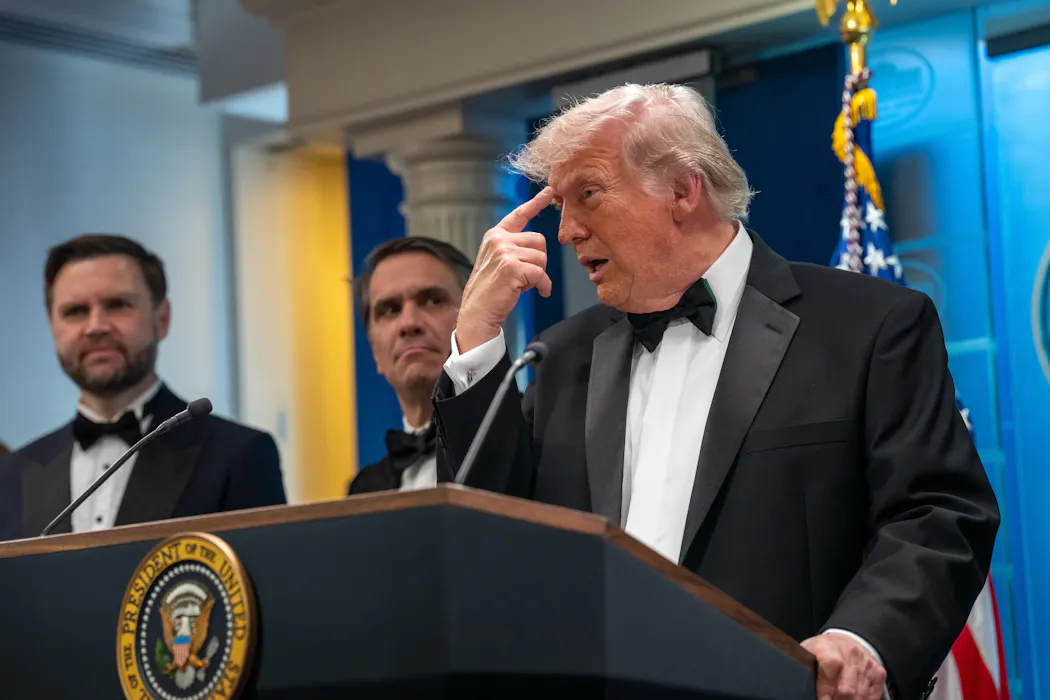
President Donald Trump speaks at the White House on April 25, 2026, after the cancellation of the annual White House Correspondents Association Dinner. Andrew Leyden/Getty Images)

For the third time in three years, Donald Trump has come under threat by an attacker. Many facts remain unclear after a gunman stormed the Washington Hilton on April 25, 2026, during the White House Correspondents’ Association dinner.

As the investigation into the shooting continues, Alfonso Serrano, The Conversation’s politics and society editor, spoke with James Piazza, a political violence scholar at Penn State, about what is driving the rise of political violence in the U.S. and what can be done about it.

This is not the first time Trump has faced political violence. What stands out after the latest attack?

I think the events of April 25 underscore how dangerous this political moment is in the United States. For the past several years – certainly since Jan. 6, 2021 – the U.S. has been experiencing a period of increased political violence, which is generally defined as violence that is motivated by politics or is intended to communicate a political message or achieve a political objective.

Researchers at the Polarization & Extremism Research & Innovation Lab have documented that political violence has increased in the U.S. in recent years. Several recent examples come to mind: the Jan. 6, 2021, insurrection at the U.S. Capitol building; multiple assassination attempts on President Trump; the deadly attacks on Minnesota lawmakers Melissa Hortman and John Hoffman that left Hortman and her husband dead; the attempted murder of Paul Pelosi; the assassination of Charlie Kirk. In my home state of Pennsylvania, Gov. Josh Shapiro was targeted in an attack on the governor’s mansion.

Dozens of police cars line a street.
Law enforcement responds to an incident at the Washington Hilton during the White House Correspondents Dinner on April 25, 2026, in Washington. AP Photo/Allison Robbert

What’s driving that apparent plague of political violence afflicting the country?

There are several important drivers of political violence at work in the U.S. today, according to my own research and research by other scholars. The United States is currently very politically polarized, meaning that Americans are sharply divided against one another along partisan lines. They are suspicious and hostile toward one another, and this produces a tense and volatile environment for politics and public life. This has produced a “zero-sum” environment in which every election and political contest is a “do or die” moment.

What stands out to me is the moral dimension of polarization in the U.S. Each side views members of the other party not as merely having a different view on politics but rather as evil or immoral. The polarized environment has made political violence more normalized. It has also dampened public backlash against political violence when it occurs. This makes political violence more likely.

Political rhetoric has become much more divisive and violent in nature. This works hand in hand with polarization and helps to further normalize political violence. In particular, when politicians use demonizing or dehumanizing rhetoric to attack their opponents – for example, using words that depict their opponents as subhumanthis fosters extremism and helps motivate extremists to hurt their opponents physically.

Disinformation is also an important driver of political violence. A number of people who have engaged in recent acts of political violence seem to have been motivated by conspiracy theories and other forms of disinformation, often gleaned from social media. Disinformation plays a particularly important role in the context of social media communities, where people are exposed to large amounts of disinformation and are hermetically sealed off from other sources that might challenge their worldview. This facilitates radicalization and has been shown to fuel political violence in some cases.

Finally, I think an important factor is also the current assault on democratic norms and democratic institutions in the United States. U.S. democracy is experiencing pressures that are unprecedented in the modern era. This has had a very damaging effect on Americans’ trust in government, confidence in democratic institutions and value for democratic rule itself.

My work shows that individuals who are skeptical about democracy are much more likely to express support or tolerance for political violence.

A man in front of a podium stands in front of dozens of seated people.
President Donald Trump takes questions at the White House on April 25, 2026, after a shooting incident at the White House Correspondents’ Dinner. Mandel Ngan/AFP via Getty Images

How does this moment of political violence stand out from other violent periods in U.S. history – are we in uncharted waters?

While the U.S. is currently experiencing an uptick in political violence, unfortunately it is not unprecedented. One example would be the highly polarized period in the 1850s in the run-up to the Civil War. In this era, there was a sharp division between abolitionists and advocates of slavery. This culminated in political assassinations, an assault on an abolitionist member of Congress by a pro-slavery member of Congress, and a bloody civil conflict in Kansas between pro- and anti-slavery armed groups.

The early 1900s, right after World War I, saw another increase in political violence due to labor issues and violence by the second generation of the Ku Klux Klan.

Finally, the 1960s also saw a period of intense political violence surrounding opposition to the Vietnam War and backlash to the Civil Rights Movement.

Though there are some unique features about political violence today – namely the influence of social media – I think we can look for some parallels in these early periods of political violence.

Any last thoughts?

I believe it is absolutely critical that both Democratic and Republican politicians – politicians from all sides – unite to condemn this attack and all political violence. Political commentators and influencers can also condemn this and all use of political violence.

Research amply shows that what political elites – politicians, political leaders, media commentators, online influencers – say in the wake of these sorts of events has a huge effect on citizens’ attitudes. Political elites can adopt rhetoric that does not normalize this sort of behavior.

If the message comes from across the political spectrum, it will be that much more effective at reducing the public attitudes that nurture political violence.

The Conversation

James Piazza has received grants from the McCourtney Institute for Democracy at Penn State, a non-partisan research and public events center that sponsors research on democracy.

  •  
❌