
 Login
Login
Which bird has the best song? These experts think they know
To mark International Dawn Chorus day we’ve asked wildlife experts to make their case for why their favourite songbird deserves your vote. Cast your vote in the poll at the end of the article and let us know why in the comments. We hope their words will inspire you to step outside and soak up some birdsong this spring.
Song thrush
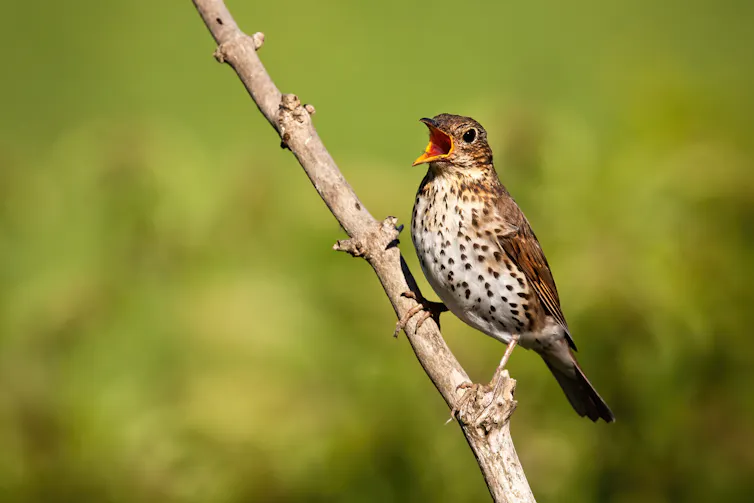
Championed by Cannelle Tassin de Montaigu, Research Fellow in Ecology and Evolution, University of Sussex
When people talk about the UK’s best bird songs they often go straight for the big names – loud, dramatic performers that grab your attention. But quietly in the background is the song thrush, a bird whose song is far more impressive than it first appears.
What sets the song thrush apart is not volume or flair, but structure. Its song is built from short, clear phrases, each repeated two or three times before moving on. It’s as if the bird is politely checking that its audience is paying attention. In a dawn chorus that often feels a bit chaotic, there’s something refreshingly organised about it. It’s a bird that’s actually thought things through.
It might not have the dramatic flair of the common nightingale, and it’s less showy than some of the usual favourites. There are no soaring crescendos or dramatic flourishes. But that’s part of its charm. The song is neat, rhythmic and surprisingly memorable once you start listening for it.
In the early morning soundscape, where many birds seem determined to out-sing one another, the song thrush isn’t trying to steal the spotlight. It just quietly does its thing, and does it very well. Underrated? Definitely. Worth your vote? I’d say so.
Robin
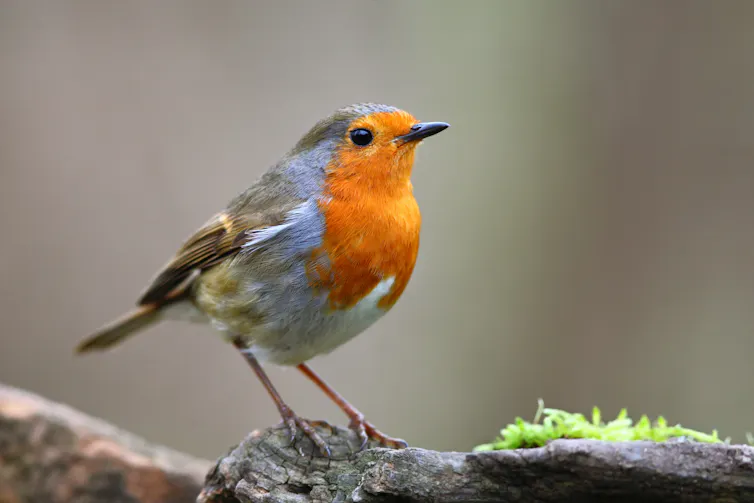
Championed by Judith Lock, Principal Teaching Fellow in Ecology and Evolution University of Southampton
The European robin is a delightfully common sight in gardens. You will very likely have heard the characteristic “tic”, followed by a tuneful verse lasting a few seconds. In noisy urban environments they sing louder, less complex songs, in order to be heard.
The male robins use their spring song (January to June) to signal their quality to females, then forming breeding pairs, and to signal competitive ability to other males. The spring song lasts one to three seconds, composed of four to six short motifs. They have an impressive repertoire of about 1,300 motifs, indicating that song is the particularly important for robins, in comparison to birds that rely more on colourful plumage or behavioural displays to communicate with each other.
Most birds sing mainly in the morning but robins sing all day. People often mistake their lovely evening song for a nightingale’s. Constant territory defence from non-migrating robins means that the robin song is a year-round soundtrack too. From July to December, both males and females sing the autumn song, of higher-pitched long, descending notes, with interspersed warbles. This song is to defend their individual winter territories. This indicates that song first evolved first in songbirds to ensure survival, before it became a signal used by males for reproduction. Each robin’s song is dynamic, constantly changing in response to the condition and age of the bird, and their rival.
Great tit
Championed by Josh Firth, Associate Professor of Behavioural Ecology, University of Leeds
Its song may not be as flashy as the nightingale or as poetically melancholy as the blackbird. But scientists have been taught so much by the great tit’s song, heard across British habitats from ancient woodlands to urban gardens. This spring marks 80 continuous years of UK-based scientists studying great tits at Wytham Woods, Oxford, the world’s longest-running study of individually-marked animals.
The unique dataset includes a family tree totaling over 100,000 great tits, with some birds’ lineages traceable back 37 generations. Early research on Wytham’s great tits during 1970s-1980s resulted in some the first studies to inform the scientific world about how bird song can help males find mates and defend territories, how larger song repertoires can bring more reproductive success, and how young birds learn these repertoires from neighbours (not just their fathers).
And a pioneering study published in 1987 taught us how male great tit song even tracks female fertility, increasing their singing efforts as their female partner’s egg-laying period approaches, and then quietening after she starts laying. Modern technological advances are allowing insight into the hidden meaning embedded in great tits’ songs. In-depth processing of 109,000 recordings of great tit songs has revealed how each bird’s melody tells the story of their own identity as well as that of their local culture and social circles.
A great tit’s age also affects their song: older males keep singing rarer, fading song types while younger birds adopt newer ones. So, Britain’s greatest song belongs to the great tit’s “teacher-teacher” call, for all it has taught us, and for all we have left to learn.
Chaffinch
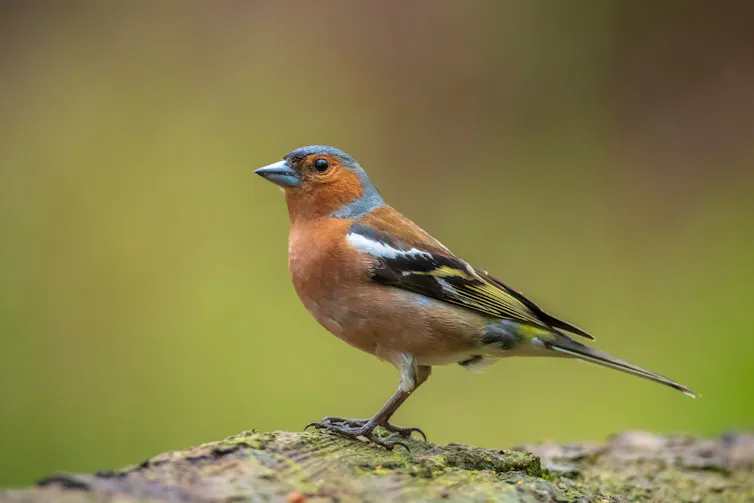
Championed by Joey Baxter, PhD Candidate in Ecology and Evolutionary Biology, University of Sheffield
Why change a winning formula? As far as I’m concerned, the chaffinch sings the biggest banger that UK birds have to offer. While the blackcap attempts to impress with ostentatious bells and whistles, the chaffinch keeps things simple with a catchy riff. Where the starling goes for quantity and novelty, with a frankly plagiaristic repertoire of mimicry, the chaffinch goes for quality, singing proudly in the knowledge that it is delivering a true earworm.
Bubbling trills accelerate before tumbling downwards, slowing to rich watery chirps and finishing with the final flourish. This jaunty lick, the real hook of the song, is often punctuated by an upward inflection at its end, the rising intonation giving it the air of an unanswered question. The chaffinch’s song has rhythm, it has melody, and it’s instantly recognisable. It possesses the wisdom that sometimes it is better not to do everything, but to do one thing well.

Joey Baxter receives funding from UK Research & Innovation (UKRI), via the Engineering and Physical Sciences Research Council (EPSRC).
Josh Firth receives from UK Research & Innovation (UKRI), via the Natural Environment Research Council (NERC).
Cannelle Tassin de Montaigu and Judith Lock do not work for, consult, own shares in or receive funding from any company or organisation that would benefit from this article, and have disclosed no relevant affiliations beyond their academic appointment.
