Reading view

After more than a century, Labour has lost Wales

After all the predictions, projections and polling permutations, Welsh Labour’s defeat has been confirmed.

In 1985, Welsh historian Gwyn Alf Williams described Labour majorities standing “like Aneurin Bevan’s memorial stones”. Forty years on, the stones have finally been eroded. On the worst day for the party in its history in Wales, even its leader, Eluned Morgan, lost her seat.

After more than a century as Wales’ dominant political force, the figures and symbols that once anchored Welsh Labour now lie broken.

The scale of the defeat is difficult to overstate. Losses in historic heartlands that have voted Labour consistently for more than a century represent a devastating indictment of a party that has long mistaken dominance for consent. This is not a routine electoral setback, but a collapse.

Short-term factors played their part. Welsh Labour’s decision to abandon its “standing up for Wales” rhetoric and attach itself to an unpopular Keir Starmer-led UK government led the party to surrender one of its strongest political identities.


Read more: Elections 2026: Experts react to the Reform surge and Labour losses


Furthermore, the short-lived, scandal-ridden leadership of Vaughan Gething, and an incumbency backlash among certain voters, contributed to Labour’s worst-ever Senedd result. But while these factors shaped the timing and scale of the loss, they cannot by themselves explain it.

This election marks a reckoning that has been coming for a while. After more than a century of political dominance, the myths and symbols that sustained Welsh Labour (and the idea that Labour is Wales, and Wales is Labour), have finally withered. The defeat reflects not simply a bad campaign or unpopular leaders, but a party that has run out of steam and ideas.

Since devolution, Welsh Labour has spoken the language of radical politics while failing to realise radical outcomes. Limited powers and constrained budgets are real obstacles, but they do not excuse the absence of political ambition from a party that has governed Wales uninterrupted for nearly three decades. Few parties in democratic systems have enjoyed such long-term dominance; Welsh Labour has failed to take advantage of it.

Longer-term decay

The electoral collapse reflects a deeper unwillingness to confront Wales’ long-term material decline. Across health, housing, education and the economy, rhetorical ambition has been undermined by narrow, managerial interventions. Child poverty remains entrenched, educational standards have declined and the NHS is under sustained pressure. Progressive language has failed to translate into material improvement.

In defending Wales against Tory austerity, Welsh Labour neglected the harder task of articulating what Wales could become and how devolved powers could be wielded effectively to improve people’s lives. The result has been a politics that speaks the language of progress while leaving the structures of inequality largely untouched.

Over time, this gap between promise and experience has eroded trust. In an era of weakening party attachment and fluid political identities, historical loyalty can no longer be relied upon. The continued invocation of figures such as Aneurin Bevan may still resonate within the party but beyond this, their power has faded. Nostalgia has become a liability, especially when it substitutes for critical reflection or ideological renewal. Welsh Labour came to mistake familiarity for consent.

bronze statue of nye bevan in cardiff.
Welsh Labour can no longer rely on the legacy of ‘father of the NHS’ Nye Bevan. Steve Travelguide/Shutterstock

The Senedd election result is not a rejection of progressive values, but of Labour’s symbolic performance of them. Many voters were not turning away from radical ambition when they voted for Plaid Cymru; they were seeking a party they believed could still embody it. Welsh politics has often been defined by its radical traditions – and progressive voters have put their faith in Plaid to inherit them.

One-party dominance insulated Welsh Labour from the pressures that force political renewal. When that dominance finally fractured, the party found itself unable to articulate an alternative sense of purpose.

The collapse, therefore, is not a sudden termination, but the culmination of a prolonged period of stagnation. The majorities once symbolised by Aneurin Bevan’s memorial stones have been gradually eroded, enduring for decades but now standing merely as reminders of a Labour legacy that no longer finds resonance in Wales.

The Conversation

Nye Davies does not work for, consult, own shares in or receive funding from any company or organisation that would benefit from this article, and has disclosed no relevant affiliations beyond their academic appointment.

  •  

How The Devil Wears Prada 2 speaks the hidden language of fashion

Fashion has always done more than keep us warm. It’s also a social language, quietly organising ideas of status, taste and belonging.

What made the first The Devil Wears Prada (2006) so satisfying was watching main character Andy Sachs (Anne Hathaway) learn, often the hard way, that clothes were never just clothes. At first she could not read what clothes signalled in the room. By the end, she understood their language.

The Devil Wears Prada 2 picks up that idea and runs with it. Here, fashion speaks clearly about who we think we are and who we would like to become. Beneath the sharp one-liners lies something more revealing: clothing as a system of meaning.

Even the soundtrack reinforces this idea. The lyrics “I came to be seen” from the song Runway by Lady Gaga and Doechii, which plays during the film’s credits, underscore how visibility operates as a form of social currency.

Anthropologist Grant McCracken argued that consumer goods carry cultural meaning that moves through society in stages. First, meanings sit in a wider cultural pool, shaped by ideas such as success, taste and aspiration. Second, they are picked up and repackaged by intermediaries such as editors, influencers and tastemakers. Third, they land with consumers, who use them to construct identity.


Read more: How close reading took over the internet via The Devil Wears Prada’s cerulean monologue


The Devil Wears Prada 2 is a glossy study of change, where identity is constantly renegotiated as the characters grapple with meanings associated with power, roles and friendship. In this world, gatekeepers like Miranda Priestly (Meryl Streep) still decide what counts as “in” before the rest of us have even chosen our socks.

According to McCracken, cultural meaning moves from the cultural world and filters down to consumer goods where individual identity is finally established. Stanley Tucci’s Nigel remarks about Andy: “Look what TJ Maxx dragged in.” This does more than insult. It assigns her a position – misplaced, off-cycle, adjacent to luxury, marking her as uninitiated in a language she no longer speaks.

By contrast, in the archives of Christian Dior, the meaning system is made explicit by Emily (Emily Blunt): “Your bag, your scarf, your umbrella, tells the world who you are.” It suggests that in this world, even the smallest detail signals position, functioning as a micro-indicator of taste, knowledge and class alignment.

Loud signals and quiet codes

The sequel contrasts different strategies of self-presentation. Emily treats fashion as spectacle. Her outfits do not enter a room, but announce themselves to the room. Her black leather harness dress at a funeral is not a misstep, but a bold reminder that even in mourning, style can still speak with conviction.

By contrast, Nigel embodies what has come to be known as “quiet luxury”. His wardrobe is precise, restrained and almost invisible unless you know exactly what to look for. Meaning does not shout. It whispers. This reflects a broader shift in consumer culture.

People have long used possessions to communicate identity, but the codes evolve. In a world saturated with visibility, subtlety has become its own form of distinction. Knowing not to show off is, in itself, a way of showing off. The film captures this tension with a knowing wink. One character dresses to be seen while another dresses to be understood. Both are playing the same game.

At its core, the film is less about fashion than meaning. Clothing becomes a way of signalling trajectory: who is rising, who is stalling, who is quietly consolidating power. This is seen in Andy’s gradual shift from ill-fitting outsider to someone increasingly fluent in the visual language of the industry.

Consumer research suggests that we do not buy things just for what they are, but for what they mean. Clothing bridges the gap between who we are and who we hope to be. Getting dressed, in this sense, is a daily act of storytelling, sometimes optimistic, sometimes aspirational, occasionally delusional. The Devil Wears Prada 2 explains this through humour and self-awareness. The audience laughs at the excess, but not entirely from a distance.

The final trailer for The Devil Wears Prada 2.

From culture to closet and back again

By the time these meanings reach everyday life, the final step in McCracken’s model, they are no longer controlled by Miranda or the fashion elite. They are taken up, adapted and sometimes resisted by individual consumers. This is where meaning becomes personal.

The Devil Wears Prada 2 may be a comedy, but it makes a sharper point. Getting dressed is never just about clothes. It is about navigating a world of symbols and deciding how, or whether, to play along. The real question is not whether fashion matters, but whether we understand the meanings stitched into what we wear, and the quiet ways they shape our sense of who we are and who we might yet become.

In a more tender scene, Andy’s love interest takes in her blue sequin dress and says: “It’s a lot. But I like a lot.” The moment points to a broader insight: when fashion aligns with a sense of self, it shifts from excess to expression, becoming a quiet way of being seen not for what we display, but for who we are.

The Conversation

Rebecca Scott does not work for, consult, own shares in or receive funding from any company or organisation that would benefit from this article, and has disclosed no relevant affiliations beyond their academic appointment.

  •  

Welsh broadcasters target voters with digital election coverage

Mareks Perkons/Shutterstock

Voters in Wales will soon go to the polls to elect members of an expanded Senedd (Welsh parliament) under a new proportional voting system. As the campaign has developed, public service broadcasters have sought not only to report events but to educate, inform and engage audiences with an unfamiliar electoral process.

Our analysis suggests they are increasingly doing so through digital platforms. We analysed all election news content produced online and on social media by major broadcasters between April 8 and April 24, including BBC Wales, ITV Wales, S4C, Channel 4 and Sky News.

The findings point to a move towards formats designed for audiences who are more likely to encounter news online than through traditional television.

This matters because people increasingly come across political content passively, through algorithmically curated feeds rather than actively seeking it out. In that environment, the type of content produced – and how it’s presented – can play a decisive role in shaping public understanding of the election.

One prominent feature of digital coverage has been the use of explainers. These aim to demystify the election by breaking down how the Senedd works, how the voting system has changed and which policy areas are devolved to Wales or reserved to Westminster.

Many of these explainers adopt a more informal and accessible tone than their broadcast equivalents. They’re designed to cut through in fast-moving social media feeds where political information competes for attention.

A significant proportion focus on policy. Of the 19 explainers identified in our analysis, seven centred on specific issues, most commonly immigration. This reflects persistent public confusion about where responsibility lies.


Read more: Voters in Wales face Senedd election amid confusion over who holds power over what


Our recent survey found that nearly a third of people in Wales did not know immigration is controlled by the UK government. Against that backdrop, broadcasters have often made this distinction explicit. In 82% of online and social media items mentioning immigration, journalists clearly stated that responsibility lies with Westminster.

Broadcasters have also used explainers to clarify changes to the electoral system. This includes the move to a closed-list proportional system. Public awareness of this change remains low, however. Only 7% of respondents in our survey correctly identified the system, while 58% said they did not know.

Meet the leaders

Alongside explainers, broadcasters have used digital formats to introduce audiences to the leaders of Wales’s six main political parties. This has reinforced the campaign’s increasingly presidential tone, with party leaders dominating media appearances.

In a devolved context, this is not always straightforward, given the presence of both UK-wide and Welsh political figures. But digital formats have provided new ways to foreground Welsh leaders.

Short, one-to-one interviews have become an important feature. Formats such as the BBC’s Quickfire Questions and ITV’s Chippy Chats mix light-touch prompts – like “What song have you got on repeat?” – with more substantive questions about policy priorities.

These formats inject personality into political coverage. Leaders are presented not only as decision-makers but as people with interests and personalities. This is particularly significant given relatively low public awareness of Welsh political figures.

Our recent survey found that fewer than half of respondents could identify the leader of Plaid Cymru, Rhun ap Iorwerth, despite the fact he could become the next first minister.

At the same time, the informal tone has not entirely displaced scrutiny. In ITV’s Chippy Chats for example, the Welsh Liberal Democrat leader Jane Dodds was challenged on her voting record in the Senedd. It’s a reminder that accountability can still be built into more conversational formats.

Informing voters in a digital campaign

Taken together, these approaches suggest broadcasters are using digital platforms in distinct and complementary ways. Explainers aim to address gaps in public knowledge. One-to-one interviews make political leaders more visible and relatable.

This reflects a broader transformation in how election coverage is produced and consumed. As more people encounter political information online, public service broadcasters play an increasingly important role in countering misinformation and improving understanding of politics and public affairs.

The challenge is now to strike the right balance. Broadcasters must produce content that engages audiences. But they shouldn’t lose sight of the need to inform them and to scrutinise the claims made by political parties.

The Conversation

Keighley Perkins receives funding from AHRC for research into broadcasters' impartiality.

Maxwell Modell receives funding from the AHRC for research into broadcasters' impartiality.

Stephen Cushion has received funding from the BBC Trust, Ofcom, AHRC, BA, ESRC and Welsh Government.

  •  

Dolls beat screens for building children’s social skills, study finds

Vach cameraman/Shutterstock

What’s the point of play? Is it simply a way to keep children occupied, or something more? For some, it’s about learning literacy and numeracy. For others, it’s how friendships form and relationships deepen. But it can be all of these at once, and more.

Most parents recognise that play matters. But there’s less agreement on what kind of play is best. Should children be guided towards activities designed to build specific skills, like sports for coordination, or construction for maths and engineering? Or should the child’s own interests lead the way, regardless of perceived educational value?

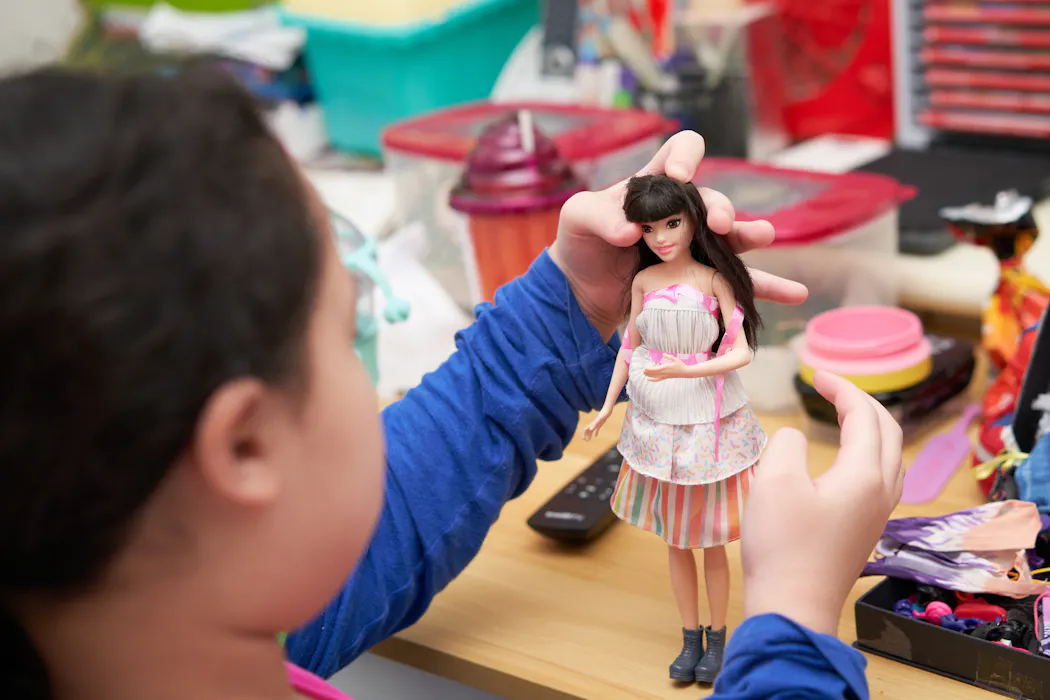
Our research focuses on a type of play often dismissed as “just for fun” – playing with dolls. Across a series of studies, we found that doll play can help children understand other people’s thoughts and feelings. This is a skill that underpins social interaction throughout life.

There is pressure on parents to create the “right” environment for development, often filled with toys that promise clear educational outcomes. STEM-focused toys (science, technology, engineering and maths), in particular, are widely seen as beneficial for learning. Doll play, on the other hand, can be viewed as having little educational benefit.

Our findings challenge that assumption.

More than make-believe

When playing with dolls, children often play out scenes between characters. These may seem simple on the surface but could present opportunities for the child to develop social and emotional skills.

As parents, it seems obvious that playmates are important for building and learning about relationships and other people, and recognising others’ emotions (empathy). But what if children can develop these skills even when playing alone?

Previous studies have found that children who engage more in pretend play tend to have stronger social understanding and empathy. Earlier studies, however, didn’t often use controlled methods to separate out the different factors linking pretend play and social understanding.

A child cuddles a doll.
Doll play can help children understand other people’s thoughts and feelings. AlesiaKan/Shutterstock

So, we set out to test this more directly. We worked with children aged four to eight, assessing their ability to understand that others can hold different beliefs and desires to their own. This is an important milestone in social development. If children recognise that their own mental states may vary from others, this should help them better understand other people and know how to interact with them.

After that initial assessment session, children were randomly assigned either a set of dolls or a tablet with open-ended creative games. They were asked to play several times a week, with parents logging how and when play occurred. We didn’t instruct children how to play because we wanted to understand their natural behaviour.


Read more: How realistic is Mattel’s new autistic Barbie?


After approximately six weeks, both sets of children came back and again completed the task about understanding others’ mental states. We found that the children who had been assigned dolls to play with, rather than tablets, showed a greater improvement in their understanding of others’ mental states during the intervening period.

The findings suggest that doll play can actively support the development of social understanding. This is consistent with prior research of ours showing that areas of the brain linked to social processing are activated during doll play, and that children use more language about thoughts and feelings when playing with dolls than when using tablets.

Why it matters beyond childhood

For parents, the message is reassuring – playing with dolls lets children practice skills that they can also use when playing with playmates, like understanding others, anticipating behaviour and responding appropriately.

These abilities matter far beyond childhood. They help us collaborate, resolve conflicts and navigate relationships. In a world that often feels increasingly divided, the capacity to see things from another person’s perspective is not just useful – it’s essential.

The Conversation

Sarah Gerson received funding for this project from Mattel Inc.

Ross E Vanderwert received funding from Mattel for this research.

Salim Hashmi received funding for this research from Mattel Inc.

  •  

Smart motorways were halted over safety concerns – what’s the future for digital roads?

For many people, the rollout of smart technology across the UK’s road network has been clouded by fears about the removal of traffic-free safety lanes. Traditionally, motorway hard shoulders offered motorists a safe haven into which they could steer stricken vehicles.

But amid growing traffic numbers, the rationale for smart motorways (part of the UK government’s wider digital roads plan) was to free up these extra lanes to traffic. During a breakdown, the remote monitoring system could then quickly reinstate a temporary hard shoulder while the broken down or crashed vehicle was removed.

However, since the first official smart motorway system was introduced on the M42 near Birmingham 20 years ago, the public has repeatedly raised concerns that being stranded in a live lane rather than on a hard shoulder can be more dangerous.

In 2020, BBC Panorama reported that 38 people had been killed on smart motorways in the preceding five years. Since then, campaign groups have continued to highlight fatal collisions on smart motorway stretches where broken-down vehicles have been struck in live traffic.

In April 2023, the government’s rollout of more smart motorways in England was halted by then-prime minister Rishi Sunak on the grounds of both safety and cost. However, existing smart motorways remain in operation and continue to receive safety upgrades.

The National Highways’ most recent stocktake on smart motorways in England, published in December 2024, stated: “Overall, in terms of deaths or serious injuries, smart motorways remain our safest roads.”

Video: Sky News.

But the same year, another Panorama investigation found nearly 400 instances where safety technology had lost power on smart motorway stretches between June 2022 and February 2024.

As part of a National Highways-funded research programme, I and other researchers at Cardiff University have worked with drivers and transport-sector experts to explore how people feel about the future of the UK’s road network. We investigated their concerns not only around safety but also surveillance and data collection.

Sense of uncertainty

The UK’s digital roads strategy entails much more than smart motorways. Even after the hiatus on building new smart motorways in England, there is still a growing ecosystem of digital and data-driven technologies embedded across the UK road network. These include roadside sensors to monitor traffic flow, cameras to detect incidents and infrastructure that communicates with control centres.

The aim is not automation for its own sake, but earlier detection of problems, faster response, smoother traffic flow and fewer serious incidents. Artificial intelligence and predictive analytics form part of this system.

Our study shows that most people are not resistant to these innovations on the roads. Many people we spoke to welcomed technologies that promise to improve safety or reduce congestion.

However, what unsettled many of them was the sense of uncertainty they felt about the rollout of these systems.

Video: National Highways.

Some participants worried that data generated through digitally connected vehicles and road infrastructure could eventually “be used by insurance companies to penalise drivers”.

Others raised concerns that “systems designed for traffic management might gradually expand into broader forms of surveillance”.

One participant described the possibility of geolocation data revealing patterns of “my daily or weekly movement in the case of a data breach, which is dangerous”.

Another wondered whether automated sensing technologies might distract drivers who feel compelled to “avoid the sensor that records what I am doing”.

In general, people did not reject technological change out of hand. Rather, they want clearer safeguards around how these systems are governed, who can access the data they generate, and how accountability will be maintained as transport infrastructure becomes increasingly “intelligent”. Their concerns centre on questions of fairness, trust and accountability.

Technology trade-offs

Over the past 20 years, smart motorway schemes are estimated to have cost UK taxpayers billions of pounds.

The M4 smart motorway upgrade alone, between junctions 3 and 12, cost around £848 million. Recent safety reviews have committed a further £900 million to retrofit additional emergency refuge areas and improve detection systems on existing stretches.

But the costs are not only financial. There are also social and institutional costs: public confidence, legitimacy and the burden placed on road users to trust systems they did not choose and may not fully understand.

Understanding these trade-offs is important for the public. Smart road infrastructure represents a major public investment to address genuinely risky situations: broken-down vehicles, sudden congestion, poor visibility or secondary accidents caused by delayed response.

Much of this happens invisibly, which is precisely why transparency matters. When people do not understand what systems are doing, silence is easily interpreted as secrecy. Multiple parliamentary and audit reports have raised questions about whether the smart motorway rollout was too rapid, or communication to the public was inadequate – or both.

Some countries have taken a more explicit approach to public engagement around transport innovation. In Sweden, for example, the national road safety strategy, Vision Zero, was introduced as part of a broad public policy framework that placed societal consent and safety at the centre of infrastructure design.

In the UK’s third road investment strategy (2025-2030), smart roads will probably become more interconnected, more predictive and more automated.

Digital twins – virtual models that replicate real roads and infrastructure so planners can test scenarios before implementing them – will play a larger role in planning. Increased data sharing may allow more integrated services across multiple modes of transport. AI and analytics could increasingly support operational decisions.

But the controversy around smart motorways wasn’t just about design choice. It reflects a deeper public concern: what happens when safety depends on systems people can’t see or easily understand?

To answer this, the systems that run smart roads need to be open and trustworthy, safe and reliable in the eyes of those who rely on them every day.

The Conversation

This research was funded by National Highways. The views expressed in this article are those of the author and do not necessarily reflect the views or position of National Highways.

  •  
❌