Reading view

Colombia’s top military commander says army facing increasingly sophisticated drones

Bogotá, Colombia – The sophistication of drones used by armed groups is escalating rapidly in Colombia as the military expands efforts to tackle them, the commander of Colombia’s armed forces told Latin America Reports.

“We are dealing with terrorists using drones carrying grenades that are dropped from different altitudes, as well as wire-guided drones,” General Hugo Alejandro López Barreto said, referring to some of the latest and most difficult drones to counter.

On June 2, one person was reportedly killed in a drone attack in La Tarra, in the conflict-ridden Catatumbo region. A day earlier, six children and one adult were seriously injured in Suárez, Cauca, in an attack authorities attributed to the Jaime Martínez structure of the FARC dissident group.

According to Colombia’s Ministry of Defence, 333 drone attacks successfully struck targets or caused damage in 2025, compared with 61 incidents in 2024 — an increase of 445 percent.

While the FARC disbanded under the 2016 peace accord, some splinter groups emerged. These factions, as well as the National Liberation Army (ELN) guerrilla group, frequently target each other and the military, with civilians often caught in the middle.

General Lopez explained that the military is employing a variety of strategies to counter the growing use of drones by these structures.

“We already have units deployed with anti-drone equipment that will allow us to counter the actions of these criminals and also target those carrying out these attacks against us,” he said. Lopez added that the armed forces were responding through a combination of ‘technical and non-technical measures,’ including protective equipment and weapons capable of bringing down the aircraft.

While drones have been used by Colombia’s armed groups for around a decade, initially for reconnaissance and intelligence gathering, their use in attacks has increased sharply in recent years.

The first recorded death linked to a drone attack occurred in 2024, when a 10-year-old boy was killed while playing football in El Plateado, Cauca.

According to defense analyst and drones expert, Camilo Mendoza, since armed groups began using drones in an organized way in 2024, they have gained the advantage over security forces.

“Groups use drones for both surveillance and attacks, and they have learned a great deal from Ukraine. Ukraine has been the laboratory of modern warfare for the last three or four years,” he explained.

“The success of drones, both in Colombia and in Ukraine, comes down to cost. Drones are very cheap and can do many things.”

According to Mendoza, who also wrote the book Colombia Under Drone Threat, the main groups using drones are the FARC dissident group Estado Mayor Central and the National Liberation Army (ELN), which employ the devices for both surveillance and attacks. The Clan del Golfo also uses drones, although primarily for reconnaissance purposes.

As the technology has evolved, so too have efforts to counter it. In October 2025, Colombia’s Defence Ministry launched BANOT, described as Latin America’s first military battalion dedicated to countering drone threats. Authorities have also invested in radio-frequency jammers and tactical radar systems as part of a broader anti-drone strategy and have an anti-drone shield planned.

But analysts say the pace of development means the military is struggling to keep up. Where initially groups were buying cheap drones in major cities or online sites, like Amazon, now they’re using more sophisticated ones, including First Person View (FPV) drones and fibre-optic drones, which pose challenges for security forces.

“The fibre-optic drones cannot be detected or jammed because the systems simply cannot see them,” Mendoza said.

Traditional anti-drone systems work by disrupting the signal between an operator and an aircraft. But newer drones can be modified to reduce the effectiveness of those countermeasures.

“All anti-drone systems in Colombia operate through the electromagnetic spectrum,” Mendoza explained. “They have no effect on these newer systems, and the drones can continue carrying out attacks even when battalions have anti-drone equipment.”

While analysts warn of the challenge drones pose to security forces, humanitarian organizations say civilians are increasingly bearing the consequences.

“This is not a new phenomenon, but the speed at which it is escalating is alarming,” Antonio Salvatore Armentano, Colombia representative at The United Nations Mine Action Service (UNMAS) told Latin America Reports. “Communities on the ground are absorbing a threat that policy frameworks have barely begun to name.”

In a recently released technical report on drones in Colombia, UNMAS highlighted that in many territories, the only available defence is “the visual and the acoustic detection by recognizing the distinctive ‘buzzing’ sound of drones and attempting to flee.”

While not all drones are used to attack — some are for surveillance — communities have no way of knowing, and so the sound or sight of drones induces psychological distress.

“The harm does not end when the attack does. Communities living under the sound of drones experience chronic fear and anxiety. Not every drone is armed – but no one on the ground can tell the difference. That uncertainty is itself a form of violence,” Armentano said.

As armed groups adopt increasingly sophisticated drones, humanitarian organizations warn that civilians are likely to face a growing share of the consequences.

Featured image description: A member of the Colombian Air Force holds a drone.

Featured image credit: Fuerza Aerospacial de Colombia.

The post Colombia’s top military commander says army facing increasingly sophisticated drones appeared first on Latin America Reports.
  •  

Tensions rise as Colombia presidential run-off campaign gets underway

Bogotá, Colombia – A challenge to a public debate, accusations about football shirts used as political symbols, and increasingly sharp exchanges on social media — campaigning for Colombia’s run-off in its presidential election is already underway just a day after Abelardo de la Espriella emerged as the surprise first-round winner.

While Senator Iván Cepeda had been widely expected to come out on top and enter the second round in a stronger position, his camp was left disappointed after falling short of those expectations.

Although he still claimed nearly 41% of the tally, de la Espriella surpassed him by almost three points, coming out with 44%.

Analysts say the run off is wide open. An important factor is supporters of other candidates whose votes are up for grabs. But a decisive factor is also likely to be those who didn’t participate at all in the first round.

“Whoever manages to somehow win over the undecided voters who didn’t vote in the first round but will vote in the second, I think that’s already enough to be president,” political analyst Oscar Chala said.

With three weeks to go until the June 21 elections, the race is on to sweep up those votes, and the candidates haven’t wasted any time in trying to position themselves.

Shortly after the results, Cepeda’s camp alleged irregularities in the vote, although the candidate backtracked the next day, saying they were not significant.

He also criticised the wearing of Colombian football shirts as part of political campaigns, linking it to de la Espriella’s far right movement — and also challenged him to a public debate, something he had not previously participated in.

“Cepeda is now inviting and wanting to hold a debate when he had always avoided it. That is a sign of desperation,” Rubén Erazo, political consultant, told Latin America Reports.

Although de la Espriella accepted the debate — which will be held on Tuesday June 9 — he also called his rival a “coward” and accused his campaign of hiding behind Petro.

Despite the disappointing result for Cepeda, he gained roughly what polls had been predicting — even marginally higher. Yet analysts say he struggled to win over undecided and abstentionist voters and lacked a solid and coherent campaign.

“The failures of Cepeda’s campaign are that Cepeda is not himself the candidate. The candidate is the current president Petro,” political consultant Rubén Erazo said, referring to this election being more like a referendum on Petro’s legacy.

He said this incorporates “the good, the bad, and the ugly” of his presidency. While he expanded social programmes, other policies, such as opening ambitious negotiations with armed groups, were highly controversial. Those dissatisfied with what Petro stands for are likely to be against Cepeda.

Despite knockbacks, Erazo says this doesn’t mean it is game over for the senator and Petro ally.

“Cepeda could win as long as his team reorients his strategy, acknowledges mistakes, thinks calmly and does not focus solely on claiming fraud,” he said.

The race is still very much open — and analysts say anything could happen, and that a lot will depend on where they target their political energy.

“Cepeda is likely to move closer to the centre and Abelardo could become more radical. The strategy Abelardo will use to try to win is to radicalize his discourse because he knows that Iván Cepeda will start seeking centrist votes,” Chala said.

He believes Espriella will also target an abstentionist segment on the right, even further right than traditional right-wing establishment figures such as Paloma Valencia, who once polled above 20% but ultimately secured just under 7%.

This part of the electorate is conservative, often macho, and wants hardline security strategies and more investment in the country.

De la Espriella was the main candidate able to capitalize on this as well as anti-Petro sentiment, and is expected to continue drawing support from parts of Valencia’s former base.

“However, his discourse is very anti-establishment and he’s not seeking the support of political parties,” Chala explained.

Nevertheless, Paloma Valencia — and her mentor, former president Álvaro Uribe — have come out in support of de la Espriella. Her relevance is not yet completely diminished if she can convince those who supported her to shift to this camp.

Moreover, while Cepeda took a backseat in his own campaign and drew heavily on traditional strategies such as mass gatherings and marches, Espriella, as well as doing this, drew heavily on crafting his own image — calling himself “The Tiger”.

“Everything is exaggerated and trying to inspire: the planes, the Italian suits from when he was a lawyer, and even his image of advising controversial figures,” he said. “Even the beard, for example, is copied from Nayib Bukele. It’s the same style.”

De la Espriella is plainly anti-establishment and aligns himself with Nayib Bukele, Javier Milei and Donald Trump. That appeals to some of the electorate, and repels another part.

At this stage, both candidates are still very much in this race, with everything to play for.

Featured image description: Iván Cepeda (Left) and Abelardo de la Espriella (Right).

Featured image credit: Respective campaigns.

The post Tensions rise as Colombia presidential run-off campaign gets underway appeared first on Latin America Reports.
  •  

Conflict-hit regions face security concerns ahead of Colombia presidential election

Bogotá, Colombia – Human rights defenders, analysts and social leaders in Colombia have expressed concern about the humanitarian situation in conflict-affected regions ahead of the country’s presidential elections on Sunday.

Although the National Liberation Army (ELN) and several dissident groups of the now-defunct FARC rebels have announced temporary ceasefires during the election period, rights groups say fears remain high over violence, mobility restrictions and intimidation in remote areas.

Lina Mejía, coordinator at the humanitarian organization Vivamos Humanos, said there were still significant risks surrounding conditions during and after the vote.

“It’s not just a question of whether armed groups will respect the elections themselves, but also whether there will be mobility restrictions, whether electoral materials will be protected from attacks after the vote, and whether communities will be free from intimidation,” she told Latin America Reports.

Humanitarian organizations say that while armed groups often refrain from directly attacking polling stations, elections can still be affected by the broader security environment in areas where armed actors exercise territorial control and over illicit economies linked to coca production, illegal mining and extortion.

According to the Electoral Observation Mission (MOE), 386 municipalities across 31 departments have been identified as having some level of electoral risk linked to violence and the presence of armed groups. 

The organization said the number of municipalities at risk had increased compared to earlier assessments and called for stronger protections during the electoral period, especially in regions like Catatumbo and the southwest of the country, including Cauca, Meta and Guaviare.

This week, at least 50 fighters were reportedly killed in Guaviare during a three-hour battle between rival FARC dissident factions. The faction led by Iván Mordisco allegedly attacked a camp belonging to the rival Calarcá group.

Both factions rejected the 2016 peace agreement that led thousands of members of the former FARC guerrilla movement to demobilize.

In Catatumbo, a region along the border with Venezuela, clashes over the past few months between the ELN and FARC dissident faction Frente 33 have kept security conditions volatile.

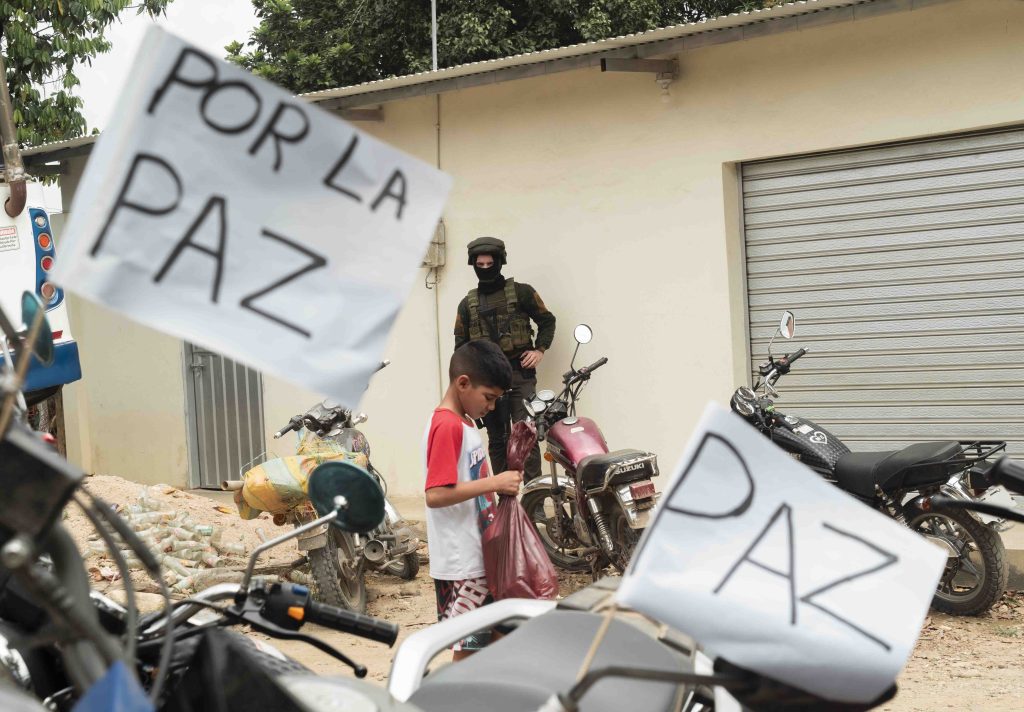
Humanitarian caravan in Catatumbo with peace signs. Credit: Lucas Molet.

Just this month, Freiman Velásquez, a social leader and member of the Association for Peasant Unity of Catatumbo (Asuncat), was assassinated in Tibú. He was killed alongside his sister and two of his bodyguards. The attack has been attributed to the ELN.

Despite the violence, Carmen Garcia, a social leader in Catatumbo, said elections can sometimes bring brief periods of calm.

“There is one positive thing in the territory: when it comes to voting, the armed actors usually respect the process,” she said.

In Catatumbo, the ELN announced a ceasefire beginning Saturday afternoon until after the elections.

But Garcia, who runs an organization rescuing young people from recruitment by armed groups, said many residents no longer trust such agreements following recent killings and security violations in the region.

“Before, the word of the ELN meant something. The word of the FARC meant something. If they said there would not be an attack, you knew there would not be one,” she told Latin America Reports. “But now people no longer truly believe in ceasefires.”

Rights groups say the violence forms part of a broader deterioration in the humanitarian situation in Colombia.

According to Vivamos Humanos, more than 350 violent incidents were recorded during the first five months of 2026.

These include homicides, mobility restrictions, and the presence of anti-personnel mines and improvised explosive devices.

“Among the main impacts are restrictions on mobility and movement, as well as homicides, and the presence of anti-personnel mines, unexploded ordnance and improvised explosive devices,” said Mejía.

Concerns have also intensified in the southern Colombian department of Caquetá. On May 12, audio messages circulated on social media by a FARC dissident group announcing an armed strike across the Caquetá and Caguán river basins, restricting river and road movement.

“We campesinos are in an extremely difficult situation. It’s so tense,” one resident of Cartagena del Chairá, Caquetá, told Latin America Reports. He and other residents were concerned that the strike might affect the ability to vote due to movement restrictions.

The resident said communities had been forced to carry identification documents issued by one armed group and threatened if they failed to do so.

While the strike ended a few days after it was announced, Colombia’s Ombudsman’s Office, the Defensoría del Pueblo, warned that the situation reflected an ongoing pattern of intimidation and territorial control by armed groups.

“This threat adds to a situation that is not new: since December 2025, communities in Putumayo, Caquetá and Amazonas have faced armed strikes and severe restrictions on movement,” the organization said in a statement published on May 15.

The Defensoría also called for “urgent measures” to guarantee the transport of electoral materials and the installation of rural polling stations in remote areas “to guarantee free and peaceful elections on May 31.”

Featured image description: Graffiti from FARC dissidents and the ELN in the city of Cucuta

Featured image credit: Lucas Molet.

The post Conflict-hit regions face security concerns ahead of Colombia presidential election appeared first on Latin America Reports.
  •  

Backlash over chants calling Delcy Rodriguez a ‘monkey’ at Venezuela opposition rally

Madrid, Spain – A chant at a rally for Venezuelan opposition figure María Corina Machado – referring to interim president Delcy Rodríguez as a monkey — has sparked backlash across political divides and forced a well-known Venezuelan singer to apologize.

The chant of “fuera la mona” (get the monkey out) resounded through Madrid’s Puerta del Sol on Saturday as thousands convened to show their support for Machado.

Although it lasted only seconds, the chant drew widespread criticism from both Venezuelan government supporters and the opposition; some denounced it as racist, while others said that, regardless of intent, it was derogatory and inappropriate to comment on someone’s appearance.

Latin America Reports was a few rows from the stage and observed that Venezuelan singer Carlos Baute had been calling for free elections when a small group began chanting. The slogan quickly spread through parts of the crowd. As it grew louder, Baute joined in and turned his microphone toward the audience, prompting even more people to repeat the chant.

By Sunday afternoon, clips were circulating on social media showing Baute joining in the chant on stage. The singer, who has more than a million followers on Instagram, issued a video apology on Monday. He said he had got caught up in the atmosphere of the rally, but insisted he is not racist.

“I let myself be carried away by the emotion of a very powerful moment… and I also know when something wasn’t right,” the 52-year-old said.

“All my life I have sung about love, life and unity. I am not racist. I am a singer who loves his country, his family and God.”

Some on social media who had been at the rally blamed the incident on “infiltrators” and said only a small number of people had taken part.

Not everyone in the crowd participated and some attendees appeared visibly uncomfortable. 

Although the chanting lasted only seconds and were followed by upbeat performances and Machado’s speech, by the following day the footage had gone viral.

Machado, leader of Venezuela’s opposition, moved quickly to distance herself from the remarks, criticizing the chant in an interview with EFE on Sunday: “No one will ever hear me say anything that judges or disqualifies a person based on their religion, gender or race.”

The same day, the Venezuelan Embassy in Spain condemned the remarks, describing them as “a form of political violence rooted in misogyny and racism.”

Others, however, defended the moment, pointing to what they described as a double standard and to language often used by government supporters against opposition figures, including insults directed at Machado such as “bruja” — meaning witch — and “sayona,” a reference to a Venezuelan legend about an evil female spirit.

Prominent Venezuelan journalist, Nicmer Evans, described Baute’s remarks as “racist” but also criticized the government, particularly Interior Minister Diosdado Cabello, for frequently using similar language against opponents.

“Just as I have made clear the racism  and therefore the idiocy of calling Delcy ‘mona’, it is impossible not to point out the cynicism of someone who insults Venezuelan women every day, when he calls Machado ‘sayona’ or ‘bruja,’” he wrote.

Machado is currently in Madrid as part of a European tour, meeting Venezuelan diaspora supporters and political figures. She has not, however, met Spain’s Prime Minister Pedro Sánchez.

Featured image description: Delcy Rodriguez.

Featured image credit: Government of Russia via Wikimedia Commons

The post Backlash over chants calling Delcy Rodriguez a ‘monkey’ at Venezuela opposition rally appeared first on Latin America Reports.
  •  

‘The return home begins today!’: María Corina Machado rallies thousands in Madrid

Madrid, Spain – Venezuela’s opposition leader, María Corina Machado, drew thousands of supporters to Madrid’s Puerta del Sol on Saturday, telling them that they would soon be able to return to Venezuela.

“Today we begin our return home,” she said to raucous applause from the crowd.

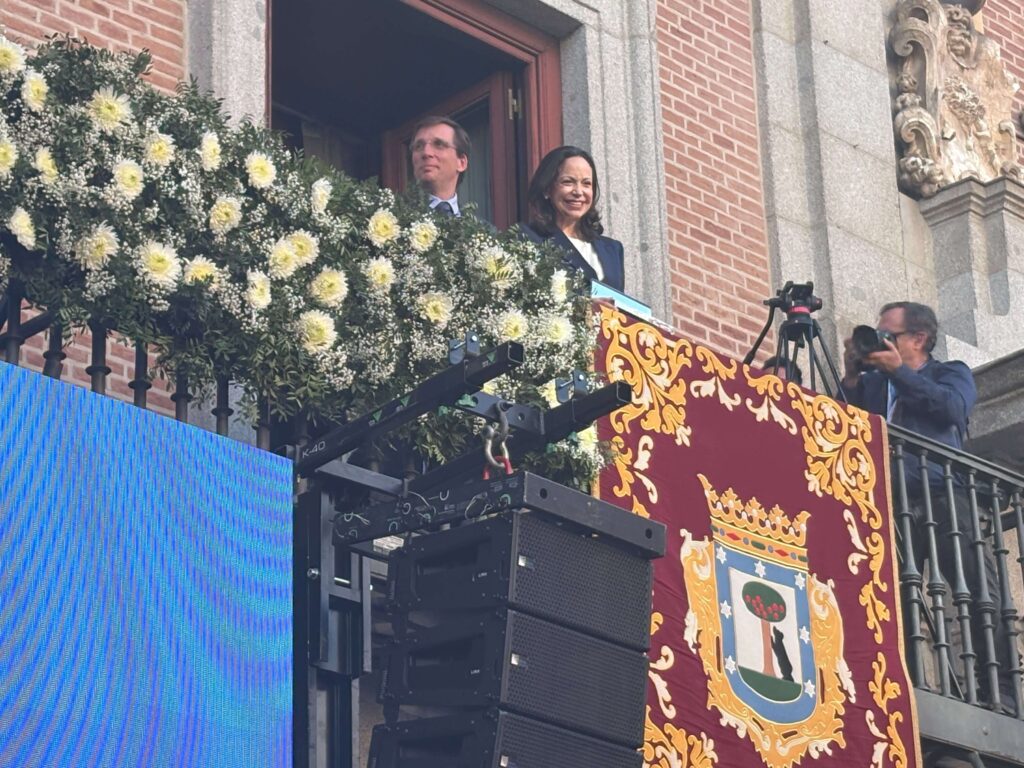
Machado appeared on a balcony draped with the Spanish and Venezuelan flags overlooking the square and flanked by members of her team.

It was a moment that felt closer to a presidential address than a political rally, followed by chants calling for elections to vote her in and cries of “president, president, president” filling the square at various points throughout her speech.

The Madrid rally marks an attempt by Machado to build momentum, amid uncertainty over the opposition’s next steps and anticipation about when she will go back to Venezuela.

Machado won the opposition’s 2023 primary by a landslide but was barred from running in the 2024 presidential election. Edmundo Gonzalez ran in her place and is widely believed to have won. 

But since the capture of Nicolas Maduro by U.S. forces on January 3, many Venezuelans want fresh elections and do consider Delcy Rodriguez, now interim president, to represent them.

A few minutes after Machado’s balcony appearance, she stepped onto a stage in her signature white top and jeans — the same look she wore during dozens of rallies in Venezuela ahead of the 2024 elections — as well as rosary beads around her neck, gifted by supporters.

Machado, who won the Nobel Peace Prize in 2025, lifted small children onto the stage to hug them, as various gifts were passed through the crowd towards the stage — pictures, flowers, and more rosary beads.

She said that on January 3 a huge hole opened up, and that force and energy had begun to flow: “Now, having lived through what we’ve lived through, having endured the worst repression and persecution, having overcome fear, we are now unstoppable — unstoppable.”

While she criticized interim president of Venezuela, Rodriguez, she praised the U.S. president.

“There is one leader in the world, one head of state, who has risked the lives of his country’s citizens for the freedom of Venezuela. And that is Donald Trump,” Machado said, referring to the U.S. capture of Maduro in January.

Machado also paid tribute to the city of Madrid, which she said had welcomed and integrated Venezuelans at their time of need — but said soon they would be able to go back to Venezuela.

“Today the whole world has its eyes on this Plaza del Sol, because it knows that here today we are beginning the return home,” she shouted. “Pack your bags, because we’re going back.”

Spain hosts one of the largest Venezuelan communities in Europe, making it a key base of support for the opposition abroad.

Many Venezuelans at the gathering said that they did want to return home.

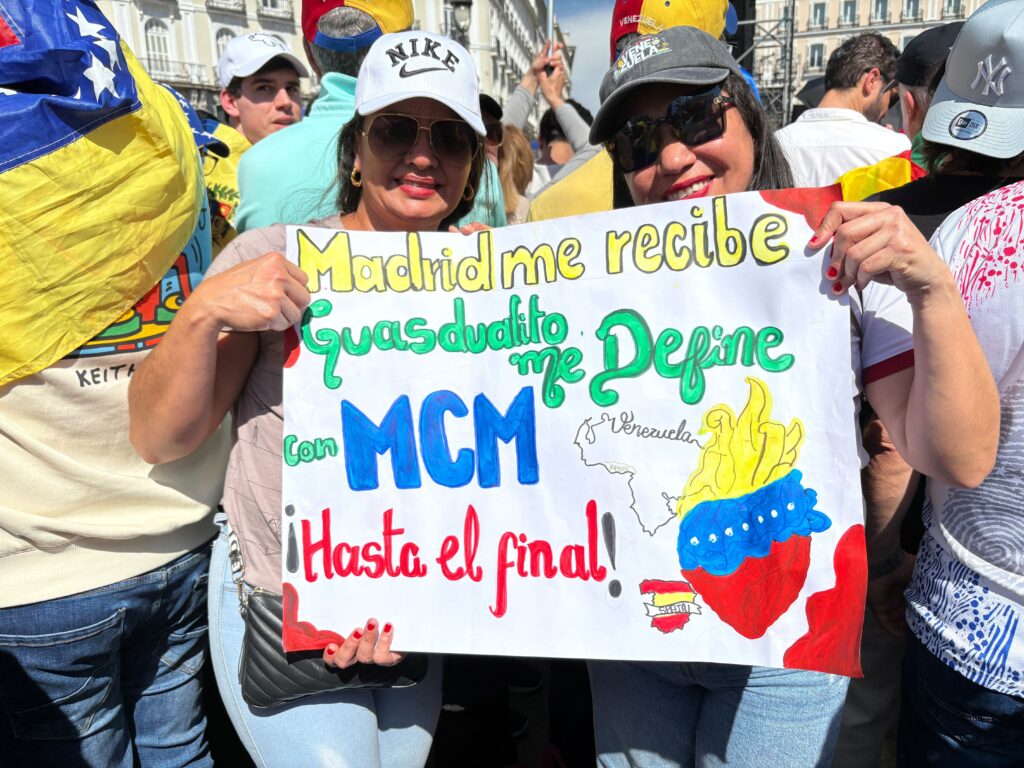
“We were nurses, eighteen years of service, and we had to leave home, we had to leave work, we had to leave everything,” a woman called Nazareth told Latin America Reports. She had left with her friend in September 2025 because of persecution by authorities in Venezuela. 

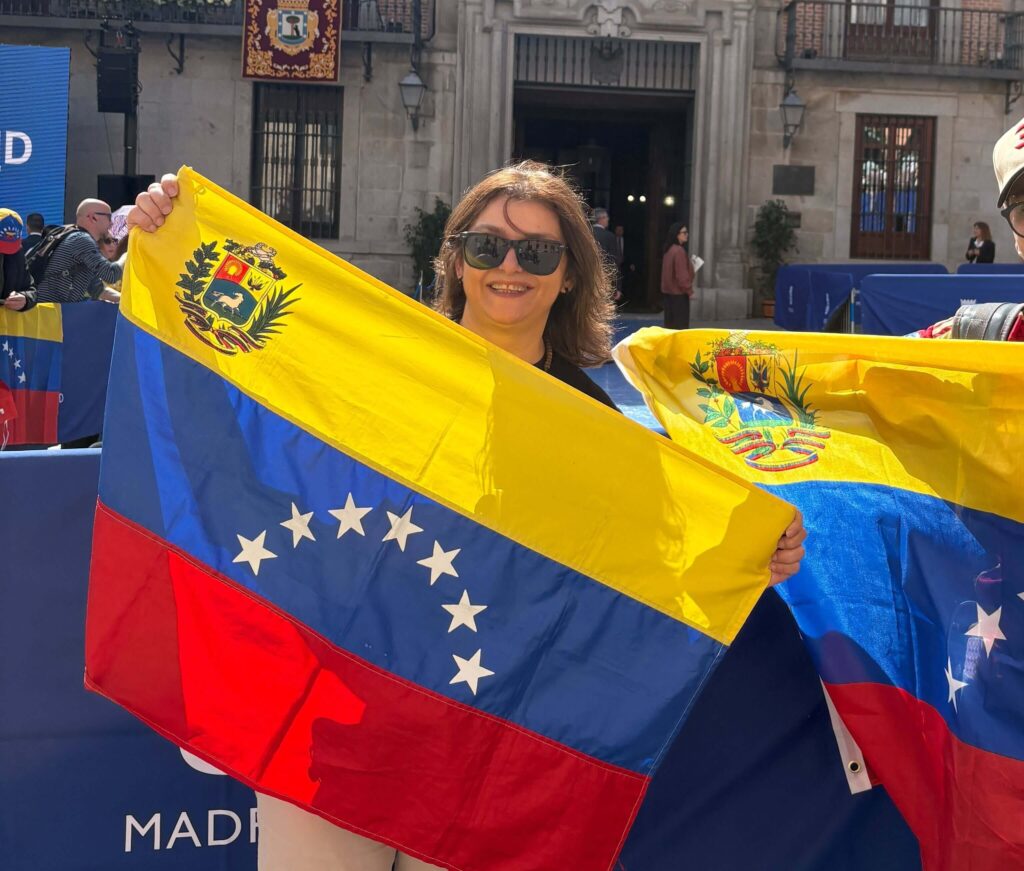
Nazareth, pictured right, holds a sign reading: “Madrid receives me, Guasdualito (a town in Venezuela) defines me. With MCM until the end!” Image credit: Catherine Ellis

But she said she wants to  go back as soon as it is safe enough — and believes Machado can make that happen: “I’m with María Corina to the very end and beyond. She is a warrior woman, a woman who represents all of us.”

Others who had lived in Spain for years said Madrid was now their home, although some were beginning to consider a return. Liliana Urbina came to Spain 20 ago, when Hugo Chávez was still in power. But she said the changes since January 3 and Machado’s leadership now had her considering a permanent return to her home country.

“When I arrived here, I forgot about the idea of returning, but María Corina has changed that. She has shown the world that we can rebuild the country, that we are united, and that we will move forward,” she told Latin America Reports. “So it is feasible, and it is possible, and it is a dream that we too now have — of returning.”

The event was at times more like a concert than a rally, with musical performances from well-known Venezuelan performers such as Carlos Baute and opera singer Víctor García Sierra.

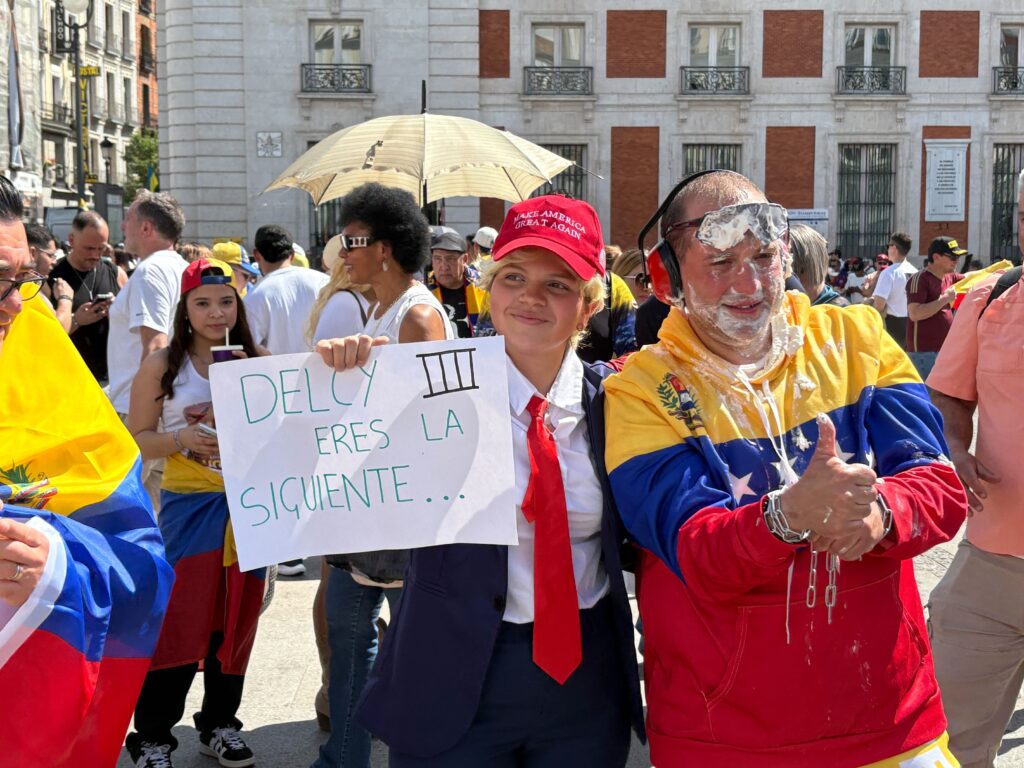
Many Venezuelans had arrived as early as 2 P.M. to secure their spots, bringing supplies as well as musical instruments to play for others around them. Others dressed up as President Trump or Nicolas Maduro, and posed for photos with the crowd.

MCM supporters dressed as Donald Trump and Nicolás Maduro. Image credit: Catherine Ellis.

As the day progressed and the crowd increased, several people fainted due to the heat and lack of shade.

Earlier in the day, Machado had attended a second symbolic ceremony during her visit. This time, she was awarded the Medal of the Community of Madrid. Edmundo González also received the honour but was unable to accept it in person as he is currently in hospital. On Friday she received the “llave de Oro” — golden key — an honour usually reserved for heads of state.

On Friday and Saturday, María Corina met with the country’s two main opposition leaders — Alberto Núñez Feijóo of the PP and Santiago Abascal of Vox. But she did not meet with Prime Minister Pedro Sánchez, who was hosting a conference of left-wing leaders — including Petro, Lula and Sheinbaum — in Barcelona. However, Sánchez said he had offered to meet her.

María Corina will visit the Spanish Senate on Monday.

Featured image description: Maria Corina Machado spoke to a crowd of supporters on Saturday, April 18. Featured image credit: Catherine Ellis.

The post ‘The return home begins today!’: María Corina Machado rallies thousands in Madrid appeared first on Latin America Reports.
  •  

Maria Corina Machado receives symbolic ‘golden key’ in Madrid as Venezuelans welcome her

Madrid, Spain – Hundreds of Venezuelans waving flags and chanting “libertad” filled a central Madrid plaza on Friday, as Venezuelan opposition leader, María Corina Machado, arrived for a symbolic ceremony to receive the ‘Llave de Oro’ – or ‘Golden Key.’

Some in the crowd had travelled from across the country to see her on her multi-day visit to Spain. Many sang along as an orchestra played well-known Venezuelan songs.

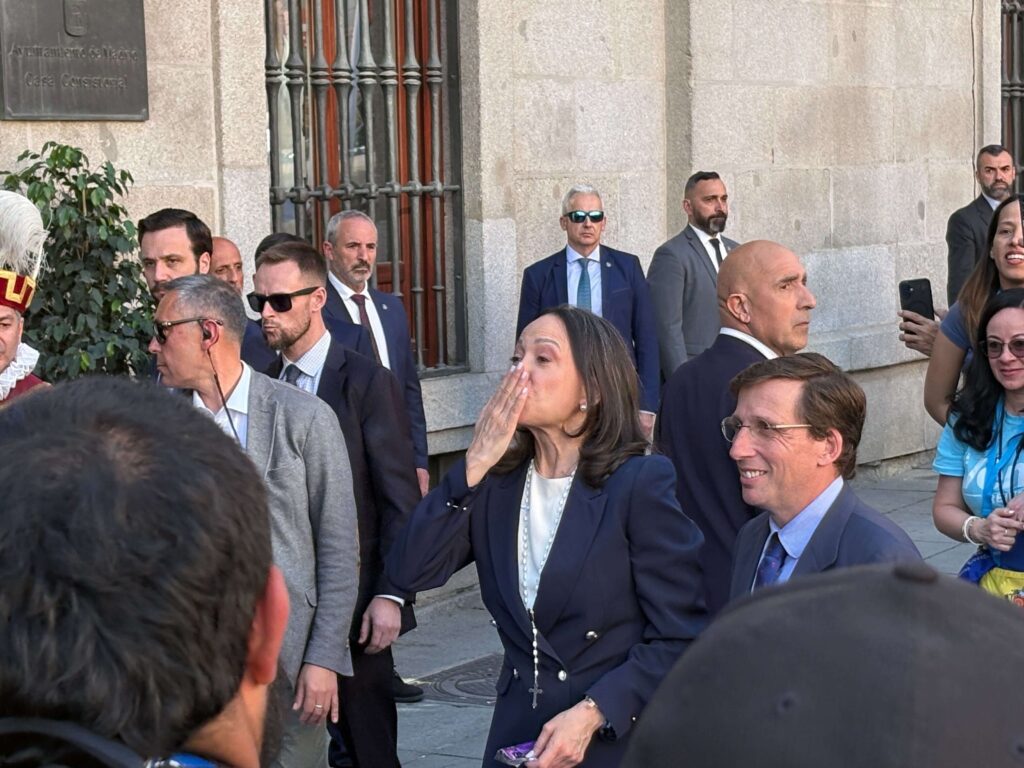
Inside the city’s historic town hall — and broadcast on a large screen outside — Machado was given the prestigious award, an honor typically reserved for visiting heads of state.

The city’s mayor, José Luis Martínez-Almeida, said it recognized her “fight for freedom, democracy and peace” in Venezuela, describing her as “the embodiment of the Venezuelan people’s resistance”.

Machado, responding, first wished the mayor a happy birthday before saying she hoped to return to Venezuela soon.

“Keys open doors, and today they symbolize the opening to freedom for the Venezuelan nation,” she said, adding that she would one day reciprocate the honor in a free Venezuela.

Many Venezuelans at the event said they too planned to return home if political change comes.

Maribel Santiago, who said she has lived in Spain for 10 years, described Machado as a symbol of hope and optimism for her country.  “I have my suitcases ready,” she said. “When María Corina returns, I will return too.”

10-year-old Mónica (L) travelled from Málaga to Madrid with her mother for a ceremony honoring Maria Corina Machado on April 17, 2016. Image credit: Catherine Ellis for Latin America Reports.

Another Venezuelan in the crowd, 10-year-old Mónica, had travelled from Málaga with her mother to see Machado. After the ceremony, the Venezuelan leader stopped to speak to her and Monica presented her with flowers in the color of the Venezuelan flag and a card. “She’s such an important person to me,” she said. “I will never forget this day.”

The “Llave de Oro” has previously been awarded to only a small number of non-heads of state, underlining the political weight of the gesture.

Machado, who was awarded the Nobel Peace Prize in 2025, had earlier met leaders of Spain’s conservative Popular Party, including Alberto Núñez Feijóo, and also met the leader from the right-wing party Vox, Santiago Abascal..

She is not expected to meet Prime Minister Pedro Sánchez, who is hosting a separate gathering of left-wing leaders in Barcelona this weekend.  

Read more: Latin America’s left gather in Spain to counter far-right

Machado is due to take part in further events over the coming days, including a mass rally on Saturday expected to draw thousands from Spain’s Venezuelan diaspora and a visit to the Senate on Monday.

Spain is home to one of the largest Venezuelan communities in Europe — numbering close to 700,000 — many of whom fled the country’s prolonged political and economic crisis.

Machado also visited Edmundo González Urrutia in hospital. He had been expected to attend Saturday’s rally, but said he would be unable to join due to a follow-up medical procedure.

The retired diplomat stood in for Machado in the 2024 presidential election after she was barred from running and is widely believed by the opposition to have won the vote.

Machado has said she will return to Venezuela “soon”, although no date has been given.

Maria Corina Machado. Image credit: Catherine Ellis
Maribel Santiago attended the event in honor of Maria Corina Machado. Image credit: Catherine Ellis
Maria Corina Machado. Image credit: Catherine Ellis

Featured image: Maria Corina Machado embraces a young girl in Madrid at a ceremony in her honor on April 17, 2026.

Image credit: Catherine Ellis for Latin America Reports

The post Maria Corina Machado receives symbolic ‘golden key’ in Madrid as Venezuelans welcome her appeared first on Latin America Reports.
  •  

Police fire tear gas at Venezuela protesters as workers demand higher pay

Police fired tear gas at protesters in Caracas on Thursday, as workers marched to demand higher wages and better pensions.

Demonstrators, reported to number around 2,000, attempted to reach the presidential palace but were blocked by officers in riot gear. Videos shared on social media show police in helmets and shields scuffling with protesters as clashes broke out along the route.

The protest is the latest in a series of anti-government demonstrations that have occurred since the U.S. removed longtime leader Nicolás Maduro on January 3. 

Edward Ocariz, who was at the protest, told Latin America Reports there was a lot of shoving by police. He said an officer took his phone as he was filming on it, but he managed to get it back, sustaining an injury to his hand in the process.

One video published by Venezuelan human rights organisation PROVEA appears to show an officer assaulting a person with his shield, which the NGO said was its photographer.

Workers took to the street to protest over low wages and pensions that have left some citizens struggling to get by. Venezuela’s minimum wage for public sector workers has not been increased since 2022, leaving many employees with just 130 bolívares per month — equivalent to less than US$0.30, not even enough for a loaf of bread.

Top up ‘bonuses’ – additional payments given out by the government — can raise total income to between US$50 and $150, but unions and workers say these are unreliable and they want a dignified salary.

For years, Venezuelans have endured an economic crisis that has left people struggling to pay for food, medicine and basic goods.

“We’re not going to keep surviving on a miserable wage,” Rene Zapata, Secretary of the Organization of the Venezuelan Teachers’ Federation in Miranda State, told Latin America Reports. “With my wage I cannot even buy half a carton of eggs,” he said.

Zapata said he and other demonstrators had managed to push past some barricades and that workers just wanted a better income and to be able to afford to eat.

Since Nicolás Maduro and his wife, Cilia Flores, were captured in a U.S. operation on January 3, there have been an increase in anti-government protests calling for better living standards. Following the 2024 presidential election — when Maduro claimed victory despite opposition evidence showing he had lost — protests had been almost non-existent due to the threat of detention.

“People have shown they’ve lost their fear. We are no longer afraid, and we will keep moving forward for a fair wage,” Zapata said.

On Wednesday evening, interim president Delcy Rodríguez announced that wages would rise on May 1, describing the increase as “responsible” and designed to avoid inflation, though she did not disclose the amount. While hoping to quell public discontent, many public-sector workers said the announcement fell short of what they deserved.

“They come talking about a responsible increase, but it is a fallacy and a lie,” Argelia Castillo, general secretary of the APUFAT‑UCV union representing workers at the Central University of Venezuela, told Latin America Reports. 

Castillo, a social worker and university professor, said the government should ensure salaries cover the basic cost of living. She added, “Workers cannot endure this, and we cannot wait until May 1.”Rodríguez has been leading the country since Maduro’s capture, but many citizens see her as a continuation of the old administration and are hoping for new elections.

Featured image description: Workers partake in a protest in Caracas in March 2026 calling for higher salaries.

Featured image credit: Catherine Ellis

The post Police fire tear gas at Venezuela protesters as workers demand higher pay appeared first on Latin America Reports.

  •  

Defense funding a key issue at Maduro’s pre-trial hearing in New York 

Nicolás Maduro returned to a New York federal court on Thursday for a pre‑trial hearing, facing U.S. charges of narcoterrorism, cocaine trafficking, and weapons offenses.

It was the second court appearance of the ousted Venezuelan leader since his capture alongside his wife, Cilia Flores, on January 3, 2026, from a military compound in Caracas. Both pleaded not guilty two days after their capture, with Maduro describing himself as a “prisoner of war.”

The hearing was a procedural step ahead of any potential trial, where the court will consider pre‑trial motions. Maduro’s defense attorney asked the court to drop the case citing the U.S. blocking payments to the former president’s lawyers. 

One of the central issues at the moment is legal funding for Maduro and Flores. The couple say they don’t have the personal resources to cover their legal fees. Their lawyers argue that U.S. sanctions are blocking them from accessing Venezuelan government funds to pay for their defense — and that this restriction prevents them from choosing their own attorneys, a right guaranteed by the U.S. Constitution.

Judge Alvin K. Hellerstein questioned the prosecution over the blockage of funds, which the U.S. argues are related to sanctions on Venezuela’s government. 

Both Maduro and Flores are on the U.S. sanctions list. Current regulations generally prohibit a sanctioned government from paying the legal fees of sanctioned individuals without a specific license. That means, for now, Caracas cannot cover their legal bills without special permission from Washington.

While Maduro argues he is Venezuela’s legitimate president, the United States did not recognize his claim to office at the time of his arrest. But it has since recognized Delcy Rodríguez as interim president, a close ally of Maduro’s who had served as vice president.

Maduro had led Venezuela since 2013, following the death of Hugo Chávez, as head of the socialist, anti‑imperialist chavismo movement. Critics say Maduro’s government became increasingly authoritarian. His claimed victory in the 2024 presidential election was disputed, with voting tallies collected by the opposition indicating their candidate had won.

He faces four federal counts, including conspiracy to participate in narcoterrorism, conspiracy to import cocaine into the United States, and offenses related to possession and conspiracy to possess machine guns and destructive devices. His wife, Cilia Flores, faces related charges.

Groups of both pro and anti-Maduro protesters gathered outside on Thursday, some calling for the release of Maduro and Flores. Others however, sang the Venezuelan national anthem and expressed their satisfaction that he was going through a judicial process in the U.S.

Some Maduro supporters gathered in central Caracas watched the scene outside court on a large screen. Maduro and Flores’ son, Nicolás Maduro Guerra who is also a politician, was also at the rally.

The case unfolds as Washington balances sanctions enforcement with ongoing engagement with Caracas, including in the energy and mining sectors.

Featured image: Nicolás Maduro arrives on a New York helipad ahead of his first court appearance on January 5, 2026.

The post Defense funding a key issue at Maduro’s pre-trial hearing in New York  appeared first on Latin America Reports.

  •  
❌