
 Login
Login
Saving Thickson’s Woods: A Labour of Love, A Lasting Legacy
Spring migration in Thickson’s Woods starts with the lisps and whispers of golden-crowned kinglets flitting about in the leafless understory, and then — listen! — an endless, breathless song pumped out by the smallest set of lungs in the world, winter wren. Unless you have patience, persistence and a strong neck, don’t even try to spot pine warblers nosing about in the tops of the towering pines. Soon followed by yellow-rumped, black-throated green and blue, and magnolia warblers feeding at more-comfortable-for-binoculars elevations. By the time colourful Cape Mays and beautiful bay-breasted warblers are gobbling midges in spruce trees lining the waterfront trail, scarlet tanagers will be posing in the tops of the oaks, aglow in the morning sun. Plus, loons will be flying over, and red-necked grebes staging in the bay among amorous red-breasted mergansers, so be sure to check all habitats—lake, woods, marsh and meadow —when visiting this compact nature hotspot.
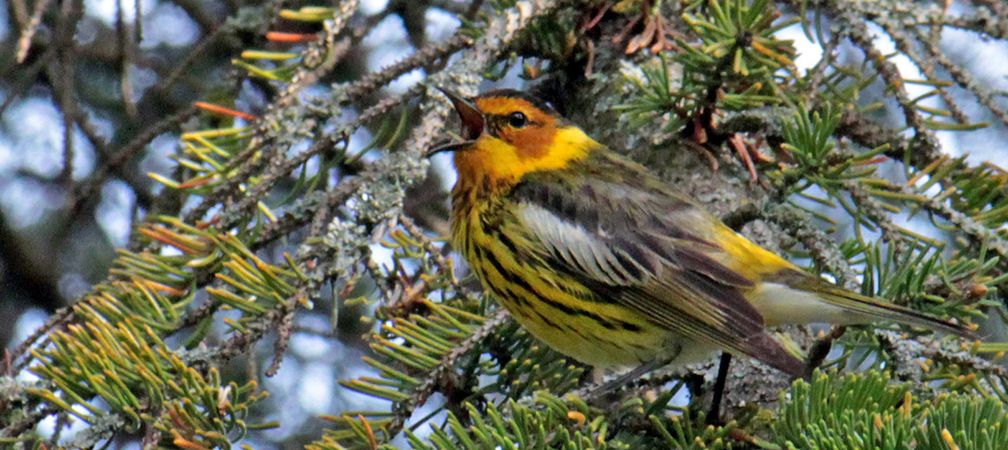
Want to know why so many birders visit Thickson’s Woods in the spring? Because so many migrants do, dropping in for a much-needed break during their long flights north. With a feast of hatching midges on tap, no songbird ever goes away hungry, says local naturalist Dennis Barry. And he should know, since he’s birded there since the 60s and lived there since the early 80s. Dennis knows when the beaked hazel will be in bloom, right before marsh marigolds open their golden faces at the foot of the north ridge. Knows when wood thrushes will be singing, about the same time ovenbirds arrive, screaming, “Teacher! Teacher! Teacher!”
Fate surely played a part in having Dennis on hand when Thickson’s Woods was gutted by loggers in September 1983. Having already spent ten years fighting to save Oshawa Second Marsh alongside another eco hero, Jim Richards, Dennis knew how to reach out for support and get things done, and it was very much thanks to him, and equally caring and committed Margaret Bain, that the woods were rescued and restored.

Put your money where your mouth is. The one sure way to protect precious wildlife habitat anywhere on the planet is to buy it, then look after it. That was the lesson we learned.
Saving Thickson’s Woods has been a labour of love for a great many folks these forty years plus. The exact right people served on the land trust board at each stage of the effort. Brian Steele, tireless treasurer for a quarter century now, has records of nearly 2,000 donors since he took over the books, and estimates 2,500 since the start. Most touching to me are the names on our “In Memoriam” list, many past donors themselves.
Through the years, birds and birders keep coming to this migration hotspot where the St. Lawrence and Mississippi River flyways intersect. The current checklist of birds is 329 species, not bad for just 26 acres of white pines and meadow.
Taking care of a woods includes worrying about the future, and praying you can leave it in capable hands. We’re deeply grateful that Ontario Nature, a keen, young, energetic group, is ready and willing to take on responsibility, ownership, protection. And that our Durham Region Field Naturalists will serve as local stewards.

One of my jobs and joys as Thickson’s Woods Land Trust secretary has been thanking supporters as I send their tax receipts. And now get to express our appreciation to Ontario Nature, and all its members, for coming forward and giving us great hope for the future.
On behalf of our famous “attack chickadees,” the family of foxes, and the multitude of moths, some 1,300, that live in Thickson’s Woods, plus all the visitors, human and avian, that stop by, we feverently thank you. Thank you so much!
Read Margaret’s full history of Thickson’s Woods Nature Reserve here.
