Reform UK is expected to expand its foothold in local government in England this week. More than 5,000 seats across 136 councils are being contested, making this one of the largest electoral tests in recent years. It builds on Reform’s breakthrough in 2025, when the party took control of ten local authorities – its first real experience of power.
For scholars of populism, this moment could be revealing. Years of research have focused heavily on the rhetoric of populism, its voter base, and the interaction between the two.
But far less attention has been paid to what populists actually do once in office. Where such research exists, it tends to focus on national governments, with only a small body examining local politics. Local government, however, is where political promises get a quick reality check.
The gap between Reform’s “pro-workers” rhetoric and its party elite’s relatively privileged and pro-business backgrounds has been noted. But the party’s first year in local government provides an opportunity to see whether the social groups it claims to represent also tend to benefit from its exercise of power.
While systematic data on the Reform-led councils is yet to be collected, their track record so far has revealed signs of where this party’s interests might lie – and of what a UK government led by Reform might look like.
Energy: big donors or local interests?
According to a recent report, climate commitments have been scaled back across Reform-run councils. Net-zero targets have been scrapped and climate language removed from policy documents. These decisions align with the party’s broader critique of climate policy as economically burdensome.
It also aligns with the party’s fossil fuel donors, who account for more than two-thirds of Reform’s financial backing. However, it does not necessarily align with the interests of the communities in the councils that it runs.
A good case in point is fracking. Despite its well-known risks to water and air quality, as well as concerns over earthquakes and warming effects, Reform’s leadership has endorsed fracking. The party has pledged to legalise it if it comes into government.
The country, however, is not as keen. According to the most recent polling, only 28% of people in Britain support fracking, compared to 46% opposing it. A survey last year found that nothing puts off Reform supporters more than the party’s ties to the fossil fuel industry. Farmers – 40% of whom now support Reform – have a longstanding scepticism about fracking due to its potential impact on their crops.
In fact, in two other Reform council areas – Lancashire and Scarborough, local representatives have broken from the national party line on fracking. This reflects a broader tension between the interests of its elite backers and those of its popular base.
Social care: when ‘populism’ meets the welfare state
Those contradictions also become visible in the field of social care. In Derbyshire, the Reform-led council’s plan to shut eight care homes was called a “betrayal of local people”. Similar plans in Lancashire entailed the closure of five public care homes as well as five day centres, with residents moved to the private sector.
What is striking is not just the direction of policy, but also the political reaction to it. The privatisation plans in Lancashire were eventually abandoned due to strong local opposition, which came not only from rival parties, but also from Reform grassroots members.
This underlines an insight often missing from populism research: the category of “ordinary people” is not a unified social group. It also indicates the unpopularity of an economic agenda that, with its emphasis on further deregulation, privatisation and tax cuts, might seem to be Thatcherism’s unfinished business.
Taxation: from promises to practice
Reform’s neoliberal outlook on the economy is reflected in the range of tax cuts pledged in its 2024 manifesto. Ahead of the local elections last year, several Reform candidates reiterated these pledges, vowing either to freeze or cut council tax.
The opposite has happened, though. As reported recently, nine Reform councils raised Band D council tax for 2026-27 by an average of 3.94%. And while that was lower than the overall average increase of 4.86%, it shows that – when confronted with budgetary constraints – Reform is willing to follow the same fiscal patterns as other mainstream parties. In other words, by increasing what is ultimately a regressive tax that disproportionately affects poorer households.
This dynamic echoes once again the discrepancy between the party’s “populist” image and its neoliberal, austerity-prone policy agenda.
Householders in Reform-led councils may have been handed a council tax rise they were not expecting.Yau Ming Low/Shutterstock
Reform’s track record in these areas of policymaking points to a broader conclusion. Much of the existing literature treats populism primarily as a discursive phenomenon – a way of framing politics in terms of “the people” versus “the elite”.
But Reform’s experience in local government shows that its actual politics might in fact tilt towards the interest of the latter. This is precisely where current research remains scant.
On the eve of a new round of local elections, Reform is likely to extend its presence across councils in England. But its first year in power already suggests that “the people” it claims to represent are not necessarily the same people who benefit from its rise to power.
Vladimir Bortun does not work for, consult, own shares in or receive funding from any company or organisation that would benefit from this article, and has disclosed no relevant affiliations beyond their academic appointment.
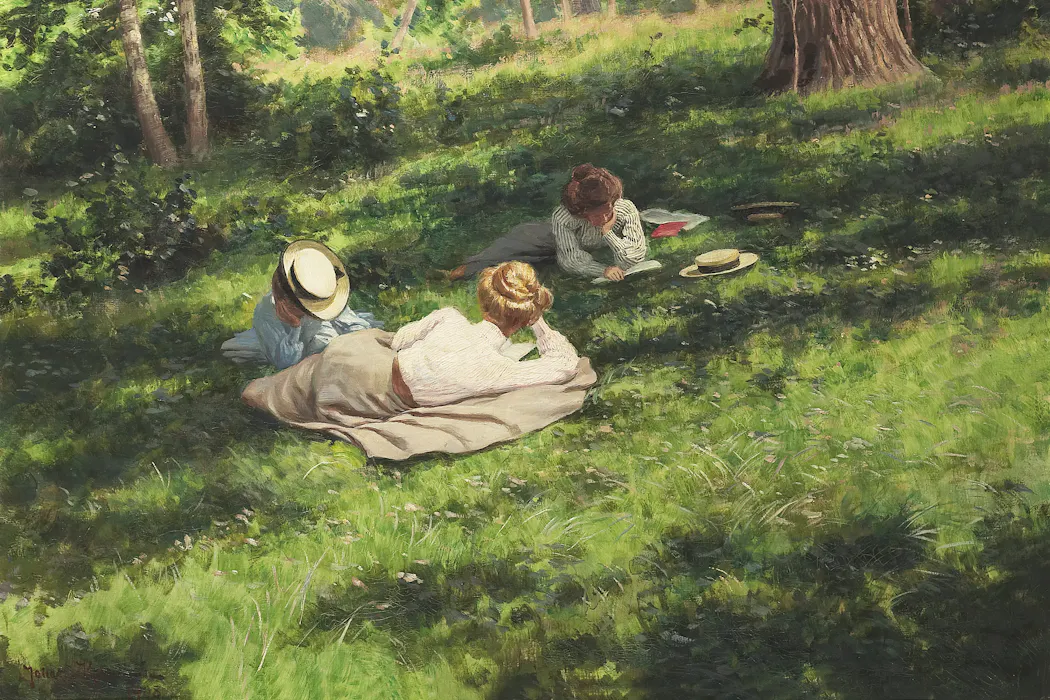
Three Reading Women in a Summer Landscape by Johan Krouthén (1908).WikiCommons
We asked ten literary experts to recommend the climate poem that has spoken to them most powerfully. Their answers span over 200 years and a range of emotions from sorrow, to anger, fear and hope.
This article is part of Climate Storytelling, a series exploring how arts and science can join forces to spark understanding, hope and action.
1. Death of a Field by Paula Meehan (2005)
Published in the wake of the 2008 financial crisis, Paula Meehan’s Death of a Field critiqued the environmental impact of the Celtic Tiger economy in Ireland.
The poem anticipates the destruction of the titular field by property developers with little regard for native ecologies: “The end of the field as we know it is the start of the estate.”
Death of a Field read by Paula Meehan.
The global effects of the climate crisis are seen from a uniquely local perspective as the displacement of Irish wildlife mirrors the effect of colonial violence. “Some architect’s screen” is simply the latest iteration of imperial technologies that seek to plunder Irish landscapes. The poem gains further strength by refusing to replicate a hierarchical relationship to nature by preserving its many mysteries:
Who can know the yearning of yarrow
Or the plight of the scarlet pimpernel
Whose true colour is orange?
Jack Reid is a PhD Candidate in Irish literature
2. Darkness by Lord Byron (1816)
Darkness imagines the fallout of a volcanic eruption that has destroyed the Earth. The “dream” that the poem mentions was inspired by genuine weather conditions during the “year without a summer” in 1816, caused by the eruption of Mount Tambora in Indonesia the previous year.
Darkness by Lord Byron.
Sulphur in the atmosphere caused darkness and low temperatures across Europe. In Lake Geneva, Lord Byron experienced the infamous “haunted summer” of darkness.
Byron’s depiction of climate catastrophe is bleak, with words like “crackling”, “blazing” and “consum’d” bearing resemblance to contemporary reports of wildfires caused by climate change. After a famine, all elements of Byron’s Earth, from the clouds to the tide, eventually cease to exist: “Seasonless, herbless, treeless, manless, lifeless– / A lump of death – a chaos of hard clay.” Read as a portent of the Anthropocene, Byron’s poem urges readers to seriously consider the future of mankind.
Katie MacLean is a PhD candidate in English Literature
3. Mont Blanc by Percy Bysshe Shelley (1817)
Byron’s close friend Percy Bysshe Shelley was also inspired by the “year without a summer”. He witnessed temperatures drop, volcanic ash hanging heavy in the air and crops failing. While his wife Mary used the gloomy climatic event to inform her novel Frankenstein (1818), Shelley channelled them into his poem Mont Blanc.
A reading of Mont Blanc.
In his ode, Shelley describes a timeless “wall impregnable of beaming ice”. By drawing on his scientific reading, he then explains his fears regarding global cooling and the possibility of vast glaciers eventually covering the alpine valleys.
He imagines “the dwelling-place / Of insects, beasts, and birds” being obliterated and mankind forced to flee. While Shelley saw this process as “destin’d” and inevitable, it is clear that Mont Blanc is a poem with catastrophic climate change at its heart. In 2026, it is difficult to read in any other way.
Amy Wilcockson is a research fellow in Romantic literature
4. Characteristics of Life by Camille T. Dungy (2012)
There’s something gloriously elastic about invertebrates: the spinelessness of a worm, the pulsing of the jellyfish, the curling of an octopus. Spiders, snails and bees, too, with their exoskeletons on display, invite us to see things “inside-out”.
These are the thoughts I have when I read Characteristics of Life by Camille T. Dungy, which opens with a snippet from a BBC news report claiming that “a fifth of animals without backbones could be at risk of extinction”. What would a world be without the “underneathedness” of the snail beneath its shell beneath the terracotta pot in the garden? Or “the impossible hope of the firefly” whose adult lives span only a handful of human weeks?
Camille T. Dungy speaks about nature and poetry.
Dungy speaks from a “time before spinelessness was frowned upon”, and from a world where to dismiss a being as “mindless” (jellyfish have no brains) or even “wordless” would be “missing the point” entirely. As I think of these creatures that dwell beyond our usual line of vision – flying, crawling, tunnelling and swimming – I find my perspective on our beautiful world turning and shifting.
Janine Bradbury is a poet and a senior lecturer in contemporary writing and culture
The speaker’s request of passing her “last years with less anxiety” appears to be denied by a god who first responds by changing her into “a tiny spider / launching into the unknown / on a thread of gossamer” and who, when she begs to “be a bigger / fiercer creature”, turns her into “a polar bear / leaping between / melting ice floes”.
A reading of Prayer at Seventy by Vicki Feaver followed by an explanation by the poet.
Both images present creatures who are in precarious positions, their futures uncertain, reflecting the state of a person contemplating the unknowns of old age and death. But the poem moves beyond the personal. The reference to the melting ice floes is not solely metaphorical: it reminds us that the planet itself is in danger and every living thing is therefore vulnerable – and will be increasingly so.
Walrus, from Jessica Traynor’s 2022 collection Pit Lullabies expresses the quiet anxiety a mother has for her child in the world of climate breakdown.
While stripping wallpaper from the box room of her house, the poet discovers a mural of the Walrus and the Carpenter from Alice’s Adventures in Wonderland. Traynor takes part of Lewis Carroll’s poem about the Walrus and the Carpenter walking along the beach, eating the vulnerable oysters, and weaves it into her own poem.
Jessica Traynor reading poems from her collection Pit Lullabies.
Carroll’s absurd verse includes what, at that time no doubt, seemed like an impossible image of a “boiling hot” sea. In the 21st century, this is no longer an absurdity, as Traynor knows. She makes a connection with Carroll’s poem, imploring her child:
Sleep as the sun rises and ice melts
and for want of the freeze a walrus
pushes further up a cliff-face.
It’s a complex poem that reimagines a key work of children’s literature, connecting it with the reality of the changing world. All the while the mother keeps her fears at bay for the sake of her child, “brows[ing] washing machines” with a “ball of tears” in her throat.
Ellen Howley is an assistant professor of English
7. Ocean Forest, co-created by the We Are the Possible programme
Ocean Forest is woven out of words, research, ideas and stories shared by scientists, educators, health professionals, youth leaders, writers and artists. They took part in creative writing workshops to co-create the anthology Planet Forest – 12 Poems for 12 Days for the UN Climate Conference in Brazil in 2025.
In the shallows, alert to change,
the minuscule, overlooked creatures
weave between seagrass, and weed –
live their shortened lives.
When ships pass overhead, when sands shift,
fish navigate swell, migrate beyond
where coral’s been bleached, through schools
of silenced whales and barely rooted mangroves
struggling to thrive in darkening water.
Deeper down,
pressure builds, species exist, unaware,
undisturbed. As heat and waves rise there’s hope
the unfound, the unnamed, the unpolluted
in the remotest ocean forests will survive.
Through uniting disciplines and voices the poem takes unexpected shifts. It demonstrates that climate change affects and erodes the habitats that lie beneath the surface and that urgent action is needed to protect disappearing species.
Yet, there is also a glimmer of hope – that in the deepest, darkest parts of the ocean, where temperatures are near freezing and there are bone-crushing pressures, maybe there are creatures that will survive human interference and pollution.
Sally Flint is a lecturer in creative writing and programme lead on the We Are the Possible programme
8. Di Baladna (Our Land) by Emi Mahmoud (2021)
Emtithal “Emi” Mahmoud is a Sudanese poet and activist, who has won multiple awards for her slam poetry performances. Mahmoud performed Di Baladna at the United Nations Climate Change Conference in 2021.
Poetry – especially spoken word – helps people connect emotionally with the human side of climate-driven displacement, a topic that’s often explained only through technical language. The language of emissions targets, temperature thresholds, or policy frameworks can distance people emotionally from its consequences. Yet poetry can cut through this abstraction.
Di Baladna (Our Land) read by Emi Mahmoud.
Mahmoud’s performance gave voice to those forced from their homes by environmental collapse, reminding listeners that climate change is not only an environmental crisis but a deeply human one, with profound effects on individuals, families and communities.
By merging vivid natural imagery with the rhythms of displacement and lived testimony, the poem urges listeners to replace passive awareness with empathy. Mahmoud implores us to feel the loss, fear and resilience of displaced communities, looking beyond news headlines and images of victimisation. Engaging with such work helps transform climate refugees from statistics into people.
Clodagh Philippa Guerin is a PhD candidate in refugee world literature
9. Flowers by Jay Bernard (2019)
At first glance, Jay Bernard’s Flowers is circular poem (one that begins and ends in the same place) but you soon realise that the circle isn’t going to complete. It opens:
Will anybody speak of this
the way the flowers do,
the way the common speaks
of the fearless dying leaves?
And closes:
Will anybody speak of this
the fire we beheld
the garlands at the gate
the way the flowers do?
And the answer seems to be, no: no one will speak of these things – the “coming cold” and the “quiet” it will bring – only the things themselves as they die. With the songs Where Have All the Flowers Gone? by Pete Seeger and Blowin’ in the Wind by Bob Dylan in its DNA, Flowers has the eternal power of a folk-lyric – prophetic and unignorable.
Kate McLoughlin is a professor of English literature
10. Place by W.S. Merwin (1987)
Climate change poetry – should it be a thing? How do poets avoid the oracular pomp it threatens? Browsing my small library I’m shocked anew to realise most poets lived and died blissfully innocent of our condition.
OK, what about the late John Burnside’s lyric Weather Report (“this is the weather, today / and the weather to come”). It poignantly extrapolates from a sodden summer to his sons’ futures: “a life they never bargained for / and cannot alter”. Heartbreaking. Or the odd dread of spring in Fiona Benson’s Almond Blossom, a season characterised as Earth’s, “slow incline … inch by ruined inch”. Ditto.
W.S. Merwin reads Place.
But then I reach back to the great American poet W.S. Merwin’s short prayer Place to find that grace-note of hope which surely needs to thread through all poems, whether they speak of climate change, mortality or love: “On the last day of the world / I would want to plant a tree.” Me too.
Steve Waters is a playwright and professor of scriptwriting at the University of East Anglia
This article features references to books that have been included for editorial reasons, and may contain links to bookshop.org. If you click on one of the links and go on to buy something, The Conversation UK may earn a commission.
Amy Wilcockson receives funding from Modern Humanities Research Association as Research Fellow for the Percy Bysshe Shelley Letters project.
Steve Waters receives funding from AHRC
Clodagh Philippa Guerin, Ellen Howley, Jack Reid, Janine Bradbury, Julie Meril Gardner, Kate McLoughlin, Katie MacLean, and Sally Flint do not work for, consult, own shares in or receive funding from any company or organisation that would benefit from this article, and have disclosed no relevant affiliations beyond their academic appointment.
The Trump administration has called on TV network ABC to “take a stand” after a joke from its late night comedy host Jimmy Kimmel offended the US president and first lady.
Two days before the White House Correpondents’ dinner on April 25, Kimmel broadcast what he said was a “roast” of the Trump administration. Roasts are typically quite savage comedic attacks which have become a traditional part of the dinner.
Trump, who was famously the target of jokes from former president, Barack Obama, at a dinner in 2011, had never attended the dinner while in office. This year he opted to attend, but the comedian’s spot was taken by what was described as a “mentalist”.
So Kimmel said he decided to supply the roast on his show as an “all-American” version of the Correspondents’ Dinner. In what he said was a joke about the 24-year age difference between the couple, he described Melania Trump as “having a glow like an expectant widow”. But after a would-be assassin tried to launch a murderous attack two days later at the dinner, the Trumps have demanded his sacking.
“Enough is enough. It is time for ABC to take a stand. How many times will ABC’s leadership enable Kimmel’s atrocious behaviour at the expense of our community,” Melania Trump wrote in a post on X.
But it appears that ABC, a subsidiary of Disney, is instead standing by Kimmel, who has not been taken off air, in contrast to an episode in September 2025 when Kimmel was suspended after comments he made following the death of right-wing influencer Charlie Kirk, a close friend of the Trumps. After a public outcry, ABC relented and restored Kimmel’s show.
In response, Brendan Carr, the head of the Federal Communications Commission (FCC) has brought forward a review of ABC’s station licences, which were previously not scheduled until 2028 or later. Carr’s actions follow a press conference at the White House on April 26 at which press secretary Karoline Leavitt said coverage critical of Trump, including from his Democrat opponents, was responsible for the rise in political violence in the US by creating what she called a “leftwing cult of hatred”.
These examples highlight the politicisation of “free speech” by the Trump administration as a cudgel to silence disfavoured viewpoints under the guise protecting the public from harm.
First amendment protection for free speech
But these political debates are becoming increasingly distanced from the first amendment. That is, the interpretation of the first amendment by the Supreme Court and the protections it provides to individuals and entities, including media outlets and broadcast companies, from government interference. The wider this gulf becomes, the greater the space between the principles underlying the expansive protections afforded to speech in the US and the public’s understanding of the democratic principles that underpin these protections.
Jimmy Kimmel defends his joke about the Trumps.
This is more important than ever in the Trump era. Actions taken by the administration to target broadcast networks and individuals for political speech are precisely what the first amendment protects against. It was designed, among other things, to protect individuals, entities and the press from government interference by creating an open marketplace in which ideas compete freely.
This is particularly true for dissenting political speech, which is the core of the first amendment. This explains why government interference with speech based on “the specific motivating ideology or the opinion or perspective of the speaker” – known as “viewpoint discrimination” – is expressly prohibited.
Additionally, whether and to what extent speech is offensive is irrelevant to the protection it enjoys. When it comes to the value of public debate, the first amendment is not neutral. Indeed, as a Supreme Court judgment, Baumgartner v. United States (1944) found: “One of the prerogatives of American citizenship is the right to criticize public men and measures.” Moreover a more recent judgment, Hustler Magazine, Inc. v. Falwell (1988), found that “robust political debate” is expressly encouraged, given that such debate “is bound to produce speech that is critical of those who hold public office”.
Importantly, the Supreme Court found in New York Times Co. v. Sullivan (1964) that such criticism, inevitably, will not always be reasoned or moderate and that public figures as well as public officials will be subjected to “vehement, caustic, and sometimes unpleasantly sharp attacks”.
The motive of the speaker is also irrelevant, as the Supreme Court held in Hustler v Falwell that while a “bad motive” may be deemed controlling for tort liability and in other areas of the law, “the first amendment prohibits such a result in the area of public debate about public figures”.
Stakes couldn’t be higher
By expressly linking Democrat criticisms of the president, and pointed critiques (however off-colour) from Kimmel and his fellow political satirists to an upsurge in political violence, the Trump administration is trying to silence criticism of its actions. But it’s also clear that this behaviour is precisely what the first amendment prohibits.
Ironically, the media often portrays these episodes as “feuds” between Trump and his critics.
But when viewed through the lens of the first amendment and its core values in this context, the stakes are much higher. These episodes constitute an effort to wrest control of public discourse by interfering in the marketplace of ideas in order silence those critical of the government.
And history tells us that a government that can silence its critics often does so in pursuit of unchecked power. Viewed through this lens, perhaps the greatest threat to American democracy is the government itself.
Eliza Bechtold does not work for, consult, own shares in or receive funding from any company or organisation that would benefit from this article, and has disclosed no relevant affiliations beyond their academic appointment.
To mark International Dawn Chorus day we’ve asked wildlife experts to make their case for why their favourite songbird deserves your vote. Cast your vote in the poll at the end of the article and let us know why in the comments. We hope their words will inspire you to step outside and soak up some birdsong this spring.
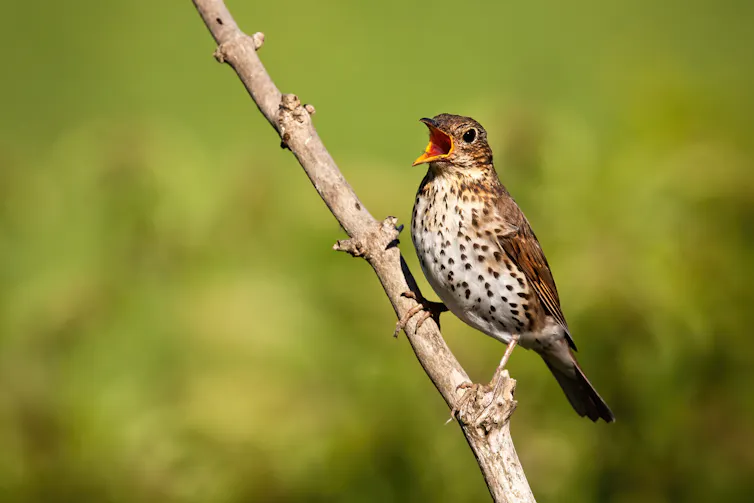
Championed by Cannelle Tassin de Montaigu, Research Fellow in Ecology and Evolution, University of Sussex
When people talk about the UK’s best bird songs they often go straight for the big names – loud, dramatic performers that grab your attention. But quietly in the background is the song thrush, a bird whose song is far more impressive than it first appears.
What sets the song thrush apart is not volume or flair, but structure. Its song is built from short, clear phrases, each repeated two or three times before moving on. It’s as if the bird is politely checking that its audience is paying attention. In a dawn chorus that often feels a bit chaotic, there’s something refreshingly organised about it. It’s a bird that’s actually thought things through.
It might not have the dramatic flair of the common nightingale, and it’s less showy than some of the usual favourites. There are no soaring crescendos or dramatic flourishes. But that’s part of its charm. The song is neat, rhythmic and surprisingly memorable once you start listening for it.
In the early morning soundscape, where many birds seem determined to out-sing one another, the song thrush isn’t trying to steal the spotlight. It just quietly does its thing, and does it very well. Underrated? Definitely. Worth your vote? I’d say so.
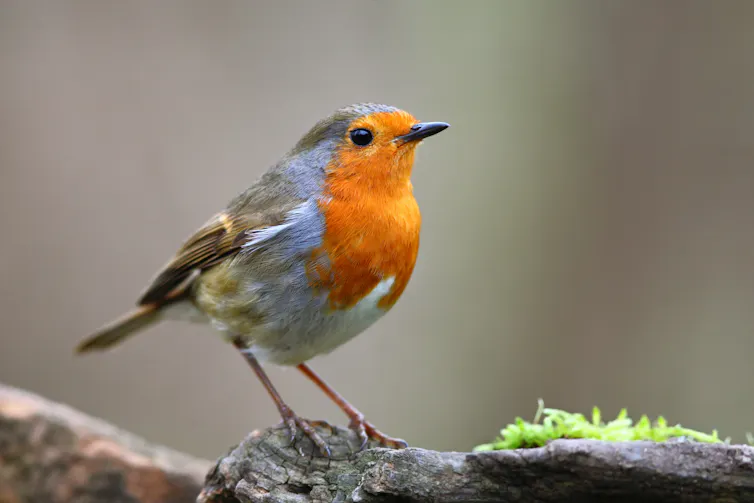
Championed by Judith Lock, Principal Teaching Fellow in Ecology and Evolution University of Southampton
The European robin is a delightfully common sight in gardens. You will very likely have heard the characteristic “tic”, followed by a tuneful verse lasting a few seconds. In noisy urban environments they sing louder, less complex songs, in order to be heard.
The male robins use their spring song (January to June) to signal their quality to females, then forming breeding pairs, and to signal competitive ability to other males. The spring song lasts one to three seconds, composed of four to six short motifs. They have an impressive repertoire of about 1,300 motifs, indicating that song is the particularly important for robins, in comparison to birds that rely more on colourful plumage or behavioural displays to communicate with each other.
Most birds sing mainly in the morning but robins sing all day. People often mistake their lovely evening song for a nightingale’s. Constant territory defence from non-migrating robins means that the robin song is a year-round soundtrack too. From July to December, both males and females sing the autumn song, of higher-pitched long, descending notes, with interspersed warbles. This song is to defend their individual winter territories. This indicates that song first evolved first in songbirds to ensure survival, before it became a signal used by males for reproduction. Each robin’s song is dynamic, constantly changing in response to the condition and age of the bird, and their rival.
Great tit
Championed by Josh Firth, Associate Professor of Behavioural Ecology, University of Leeds
Its song may not be as flashy as the nightingale or as poetically melancholy as the blackbird. But scientists have been taught so much by the great tit’s song, heard across British habitats from ancient woodlands to urban gardens. This spring marks 80 continuous years of UK-based scientists studying great tits at Wytham Woods, Oxford, the world’s longest-running study of individually-marked animals.
The unique dataset includes a family tree totaling over 100,000 great tits, with some birds’ lineages traceable back 37 generations. Early research on
Wytham’s great tits during 1970s-1980s resulted in some the first studies to inform the scientific world about how bird song can help males find mates and defend territories, how larger song repertoires can bring more reproductive success, and how young birds learn these repertoires from neighbours (not just their fathers).
And a pioneering study published in 1987 taught us how male great tit song even tracks female fertility, increasing their singing efforts as their female partner’s egg-laying period approaches, and then quietening after she starts laying. Modern technological advances are allowing insight into the hidden meaning embedded in great tits’ songs. In-depth processing of 109,000 recordings of great tit songs has revealed how each bird’s melody tells the story of their own identity as well as that of their local culture and social circles.
A great tit’s age also affects their song: older males keep singing rarer, fading song types while younger birds adopt newer ones. So, Britain’s greatest song belongs to the great tit’s “teacher-teacher” call, for all it has taught us, and for all we have left to learn.
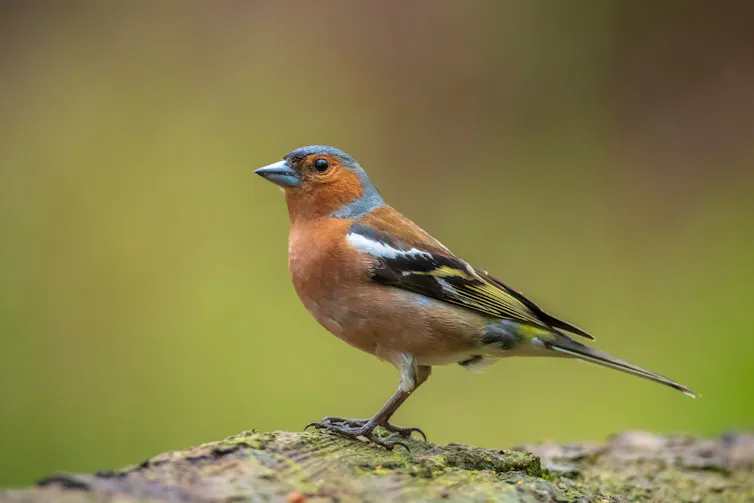
Championed by Joey Baxter, PhD Candidate in Ecology and Evolutionary Biology, University of Sheffield
Why change a winning formula? As far as I’m concerned, the chaffinch sings the biggest banger that UK birds have to offer. While the blackcap attempts to impress with ostentatious bells and whistles, the chaffinch keeps things simple with a catchy riff. Where the starling goes for quantity and novelty, with a frankly plagiaristic repertoire of mimicry, the chaffinch goes for quality, singing proudly in the knowledge that it is delivering a true earworm.
Bubbling trills accelerate before tumbling downwards, slowing to rich watery chirps and finishing with the final flourish. This jaunty lick, the real hook of the song, is often punctuated by an upward inflection at its end, the rising intonation giving it the air of an unanswered question. The chaffinch’s song has rhythm, it has melody, and it’s instantly recognisable. It possesses the wisdom that sometimes it is better not to do everything, but to do one thing well.
Joey Baxter receives funding from UK Research & Innovation (UKRI), via the Engineering and Physical Sciences Research Council (EPSRC).
Josh Firth receives from UK Research & Innovation (UKRI), via the Natural Environment Research Council (NERC).
Cannelle Tassin de Montaigu and Judith Lock do not work for, consult, own shares in or receive funding from any company or organisation that would benefit from this article, and have disclosed no relevant affiliations beyond their academic appointment.
But how representative are these headlines of wider coverage? To find out, colleagues and I analysed nearly 500 articles published over four months in 2023 across nine UK newspapers (both right- and left-leaning), looking at pieces where net zero appeared in the headline.
We focused on the presence of statements which were factually inaccurate, or misleading (defined as the omission of a credible counter-argument).
Outright inaccuracies were relatively rare. We found 22 examples, partly because we used a narrow definition. But misleading claims were very common.
This was especially true in opinion and editorial pieces. In four right-wing outlets – the Telegraph, Mail, Express and Sun – more than 70% of such articles contained at least one misleading statement.
Because a single misleading statement may not be representative of an overall article – perhaps appearing in a quote – we then looked at those articles where there was a pattern, containing at least three misleading statements.
We found 50 such articles, of which 92% were published in the right-wing press, and the vast majority in editorials and opinion pieces. Of the editorials and opinion pieces we flagged at the Telegraph, Mail, Express and Sun, between 39% and 60% included at least three misleading statements.
Articles which contain at least three misleading statements:
Broken down by political leaning (of the newspaper) and genre. Right-wing titles and opinion pieces dominate.Painter et al (2026)
The most common misleading statements concerned the potentially high cost of net zero, the various ways the policy was being implemented, and claims about the unfair distribution of costs. These claims were often presented without acknowledging opposing evidence or arguments – for example, that the costs of inaction were also high or possibly higher, or that experts dispute the figures presented in the article.
By contrast, left-wing publications were more likely to mention the high costs of inaction and the potential co-benefits of net zero such as improved health or better air quality.
In this context, remember that in July 2025 the UK government’s Office for Budget Responsibility found that the cost of bringing emissions down to net zero is significantly lower than the economic damages of failing to act. It also found those net zero costs will be much lower than previously expected.
Scrutiny – but fairer and better-informed
This isn’t a call for newspapers and journalists to avoid scrutinising net zero. It’s a policy that will be funded in part by British taxpayers, and may impose significant and uneven costs on different sectors of the population.
But coverage that focuses only on these costs in isolation, or that cherry picks data to support a single view, risks giving readers an incomplete picture. Fairer and better-informed coverage would mention on a regular basis the in-depth findings of a range of experts on the costs of inaction and the co-benefits of action.
The Times, for example, shows that it is possible to quote experts from two sides. In our 2023 sample we found several articles, including some in right-leaning newspapers, where the high cost of net zero is mentioned alongside the benefits of taking action, or that also added the qualification that many climate experts dispute the high costs.
A final thought: in its March 2026 report, the UK’s official advisory Climate Change Committee said that the “cost” of cutting UK emissions to net zero could be less than the cost of a single fossil-fuel price shock, while a net-zero economy would be almost completely protected from future spikes.
I looked in vain for a front-page headline in the Sun, Express or Mail screaming that reaching net zero would be cheaper for the UK than a fossil fuel crisis, such as the one triggered by the war on Iran.
James Painter receives funding from the Grantham Research Institute on climate change and the environment, London School of Economics.
The decision by the United Arab Emirates to leave the oil producers’ cartel Opec after 59 years is more than a symbolic break. It highlights a growing divide among major oil producers over how to respond to a changing energy landscape, and will weaken the group’s ability to manage global supply.
In the short term, the impact of the UAE’s exit will be limited. The world still needs every available barrel of oil, and the UAE accounts for some 3-4% of global production. But the forces behind the decision are more significant than the move itself. They are both economic and political – and the war in Iran helped the two align.
For years, the UAE has been investing heavily to expand its oil production capacity, spending around US$150 billion (£111 billion) to push its potential daily output close to 5 million barrels. But Opec quotas have prevented it from fully exploiting that capacity. Actual production has remained well below its potential at about 3.5 million barrels a day (mbd), with some 5 mbd capacity, constrained by the Opec quota system designed to restrict supply and support prices, generally shaped by the de facto leader, Saudi Arabia.
This has created a tension. Why invest to produce more oil if you are not allowed to sell it?
Abu Dhabi’s answer reflects a different economic model. The UAE can balance its budget at much lower oil prices than Saudi Arabia (just below $50 v Saudi $90 a barrel or more), giving it less incentive to restrict output. Instead, it has prioritised maximising its oil exports.
That strategy is also shaped by expectations about the future. As countries such as China accelerate the electrification of transport, the hitherto steady and reliable demand for oil is slowing and becoming less reliable. Over time, it is likely to plateau. UAE is also well ahead of the Saudis in energy transition – and maintain their net zero target as 2050, compared to the Saudi 2060.
From the UAE’s perspective, the bigger risk is not falling prices, but leaving oil in the ground that may never be sold.
Shifting geopolitics
The timing of the exit is not just about economics. It also reflects shifting political and security calculations, particularly after the UAE came under heavy, sustained attack during the war in Iran.
In Abu Dhabi, there is a growing sense that regional institutions and partnerships, such as the Gulf Cooperation Council (GCC) offered limited support during that period. Anwar Gargash, a senior presidential adviser, told reporters that: “The GCC’s stance was the weakest historically, considering the nature of the attack and the threat it posed to everyone,” adding that he “expected such a weak stance from the Arab League … But I don’t expect it from the GCC, and I am surprised by it.”
That experience has reinforced a more independent foreign policy. The UAE has strengthened ties with the US and Israel, building on the agreement it signed as part of the 2020 Abraham accords. The relationship with Israel is seen not just an economic and security partnership, but as a channel for influence inside the White House.
At the same time, relations with Saudi Arabia have become more strained, with differences over regional conflicts in Somalia and Yemen and economic strategy increasingly visible. Leaving Opec is both an economic decision and a geopolitical signal.
The UAE’s departure also raises questions about the future of Opec itself. The group once controlled more than half of global oil production. Today, its share is much smaller (no more than 35%), and internal divisions over production quotas are more pronounced. Quotas, long the core of its strategy, are increasingly seen as uneven constraints rather than shared commitments.
UAE energy minister, Suhail Al Mazrouei, explains the decision to leave Opec.
Saudi Arabia remains the only member with significant spare capacity, giving it outsized influence. The result is an organisation that still matters, but is less cohesive than it once was.
Not necessarily a win for the US
Some have hailed the UAE’s exit as a victory for Donald Trump, who has repeatedly criticised Opec for keeping oil prices high. A weaker OPEC would indeed lead to higher output and lower prices at the pump.
But sustained lower prices would also put pressure on higher-cost producers, including the US oil patch, which has been one of Opec’s main competitors in recent years. It benefited from the cartel’s restraint when it came to capping oil production. So what now looks like a geopolitical win could, over time, become an economic challenge.
For now, I believe that the UAE’s exit will not dramatically reshape oil markets. Demand remains strong enough to absorb additional supply, particularly as countries rebuild their inventories when Iran reopens the Strait of Hormuz. But the deeper significance lies in what the decision reveals.
Oil producers are no longer aligned around a single strategy. Some are trying to manage scarcity and keep prices high. Others are racing to monetise their resources before demand peaks and they end up with stranded assets. That divergence is likely to grow – and may ultimately prove more consequential than any single country leaving the cartel.
We may be entering a new age where oil is going to play a much lesser role in our lives.
Adi Imsirovic does not work for, consult, own shares in or receive funding from any company or organisation that would benefit from this article, and has disclosed no relevant affiliations beyond their academic appointment.

 Login
Login