Standing by the counter at the pharmacist waiting to pick up my prescription, I couldn’t help noticing the prominent display of probiotics on the counter. It was two years ago, and I was reading everything I could find on microbiomes and probiotics – whether in books, journals or in shops – in preparation for writing my book The Microbiome: What Everyone Needs to Know.
For days I had focused just on probiotics and here they were, temptingly in front of me, ready for me to buy. The packaging was so glossy and it’s claims so intriguing, I found myself picking up the box to see what they were saying.
“Supporting gut health.” “Friendly bacteria.”
I was about to get antibiotics for my tonsillitis. Should I get some probiotics? I’d heard they might help replace the “good” gut bacteria that antibiotics can wipe out.
The pharmacist knew me by sight, partly because he had just looked down my throat and prescribed them for me and partly because I’m a local GP. He nodded encouragingly and pointed at the display. “These are very popular,” he said.
I turned the box over. The packaging did best when describing what it contained. Thirty capsules to be taken every day, each containing 5 billion live cultures. I compared it with the others on the shelf. Some contained 2 billion, some 10 billion. One contained 25 billion bacteria per capsule. It was a huge number and a huge dosage range. Were these dosages safe?
It wasn’t so clear on what live cultures were exactly, describing them variously as “trusted” or “friendly”. Higher-dose brands described themselves as “diverse” or “powerful”, sounding more like the boardroom of a Fortune 500 company than a dietary supplement.
When it came to what they did, things became vague. Apparently, probiotics are there to “complement your natural gut bacteria” or alternatively to “complement your everyday life”.
It took a bit of time for the pharmacist to package up my medication and label it, so I carried on and read the small print. Each brand was very confident its ability to survive the stomach acid: they were also confident on the research. “Most researched live culture.” “Highly researched strains.” I had no difficulty in believing this, it was the lack of claims to efficacy that baffled me.
Finally, I found the actual ingredients. Each listed their various combinations of bacteria, some containing up to 15 different sorts, but always including several versions of lactobacilli and bifidobactera.
Lactobacillus acidophilus I knew as a bacteria needed to make yogurt. Bifidobacteria are also often used in the food industry. Both are typical residents of our guts, known to account for about 12% of our usual gut bacteria.
So why do probiotic products all seem to contain the same bacterial species? And why are their claims always so deliberately vague?
Almost one in 20 adults are taking probiotics: typically those of us with higher educational levels, higher incomes and better diets. If we just knew a bit more about microbes, would we still want to take them?
Stomach acid – the great destroyer
It is normal to consume a lot of bacteria on our food. Even with freshly washed or cooked food, on a typical day we consume 1.3 billion bacteria a day either on or in our food.
As soon as our food hits the stomach, our high levels of stomach acid kill or injure almost all the bacteria we consume. Only a few ever reach the colon and those few probiotic bacteria that survive usually only ever stay a few days.
But to swallow a probiotic capsule containing 25 billion, is 20 times the number of bacteria our body is used to handling: a huge microbial load. Even “friendly” probiotic bacteria can cause a serious infection if they get in the wrong place, such as the blood stream. It’s true that most people can manage this huge microbial load fine because of our innate gut defence systems. But probiotics should be avoided by those with weak immune systems, who may be less able to keep these bacteria contained and are at higher risk of them spreading and causing infection.
The reason that out of all the millions of bacteria available in the world, probiotic brands always home in on exactly the same microbes is because these are all bacteria that are known to be safe or used in the food industry since before 1958. If a microbe is officially designated “Generally Recognized As Safe”, then the producer need undertake no further research. And if the producer then sticks to general claims of efficacy – what’s known as a “qualified health claim”, they don’t even have to prove it works.
Generally Recognized as Safe explained.
But even with no efficacy claims at all, the probiotic industry still seems to get its message across – and, as I handled the box of probiotics, I still had a strong feeling that this product was good for me, would make me healthier and that I should buy it.
I held the box uncertainly. “Do you want these as well?” the pharmacist asked.
I checked the price: £17.99 for 30 probiotic capsules (low dose) for something I already had inside me from eating ordinary food. I decided to stick to the antibiotic prescription only, for £9.90.
So, do probiotics work? I have learned to equivocate when asked this, because people who ask me – usually enthusiastically and with a smile – are invested in the concept of probiotics and have often already been taking them. To avoid upsetting people I now usually say: “Well, they probably haven’t done you any harm.” Apart from the cost.
Berenice Langdon is the author of: The microbiome: What Everyone Needs to Know, published by Oxford University Press.
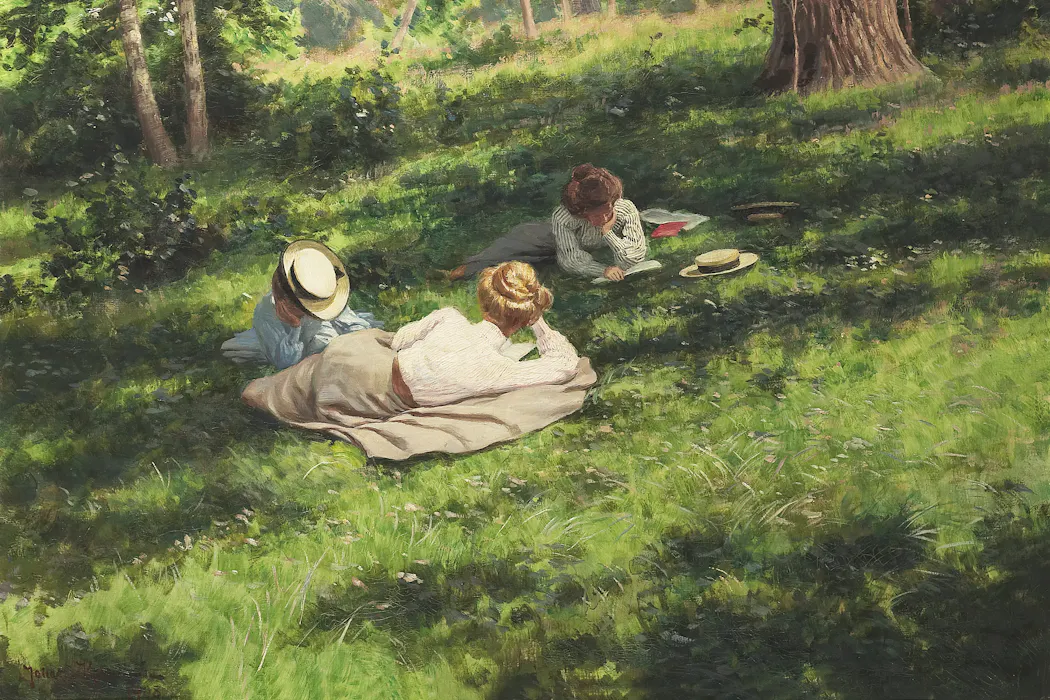
Three Reading Women in a Summer Landscape by Johan Krouthén (1908).WikiCommons
We asked ten literary experts to recommend the climate poem that has spoken to them most powerfully. Their answers span over 200 years and a range of emotions from sorrow, to anger, fear and hope.
This article is part of Climate Storytelling, a series exploring how arts and science can join forces to spark understanding, hope and action.
1. Death of a Field by Paula Meehan (2005)
Published in the wake of the 2008 financial crisis, Paula Meehan’s Death of a Field critiqued the environmental impact of the Celtic Tiger economy in Ireland.
The poem anticipates the destruction of the titular field by property developers with little regard for native ecologies: “The end of the field as we know it is the start of the estate.”
Death of a Field read by Paula Meehan.
The global effects of the climate crisis are seen from a uniquely local perspective as the displacement of Irish wildlife mirrors the effect of colonial violence. “Some architect’s screen” is simply the latest iteration of imperial technologies that seek to plunder Irish landscapes. The poem gains further strength by refusing to replicate a hierarchical relationship to nature by preserving its many mysteries:
Who can know the yearning of yarrow
Or the plight of the scarlet pimpernel
Whose true colour is orange?
Jack Reid is a PhD Candidate in Irish literature
2. Darkness by Lord Byron (1816)
Darkness imagines the fallout of a volcanic eruption that has destroyed the Earth. The “dream” that the poem mentions was inspired by genuine weather conditions during the “year without a summer” in 1816, caused by the eruption of Mount Tambora in Indonesia the previous year.
Darkness by Lord Byron.
Sulphur in the atmosphere caused darkness and low temperatures across Europe. In Lake Geneva, Lord Byron experienced the infamous “haunted summer” of darkness.
Byron’s depiction of climate catastrophe is bleak, with words like “crackling”, “blazing” and “consum’d” bearing resemblance to contemporary reports of wildfires caused by climate change. After a famine, all elements of Byron’s Earth, from the clouds to the tide, eventually cease to exist: “Seasonless, herbless, treeless, manless, lifeless– / A lump of death – a chaos of hard clay.” Read as a portent of the Anthropocene, Byron’s poem urges readers to seriously consider the future of mankind.
Katie MacLean is a PhD candidate in English Literature
3. Mont Blanc by Percy Bysshe Shelley (1817)
Byron’s close friend Percy Bysshe Shelley was also inspired by the “year without a summer”. He witnessed temperatures drop, volcanic ash hanging heavy in the air and crops failing. While his wife Mary used the gloomy climatic event to inform her novel Frankenstein (1818), Shelley channelled them into his poem Mont Blanc.
A reading of Mont Blanc.
In his ode, Shelley describes a timeless “wall impregnable of beaming ice”. By drawing on his scientific reading, he then explains his fears regarding global cooling and the possibility of vast glaciers eventually covering the alpine valleys.
He imagines “the dwelling-place / Of insects, beasts, and birds” being obliterated and mankind forced to flee. While Shelley saw this process as “destin’d” and inevitable, it is clear that Mont Blanc is a poem with catastrophic climate change at its heart. In 2026, it is difficult to read in any other way.
Amy Wilcockson is a research fellow in Romantic literature
4. Characteristics of Life by Camille T. Dungy (2012)
There’s something gloriously elastic about invertebrates: the spinelessness of a worm, the pulsing of the jellyfish, the curling of an octopus. Spiders, snails and bees, too, with their exoskeletons on display, invite us to see things “inside-out”.
These are the thoughts I have when I read Characteristics of Life by Camille T. Dungy, which opens with a snippet from a BBC news report claiming that “a fifth of animals without backbones could be at risk of extinction”. What would a world be without the “underneathedness” of the snail beneath its shell beneath the terracotta pot in the garden? Or “the impossible hope of the firefly” whose adult lives span only a handful of human weeks?
Camille T. Dungy speaks about nature and poetry.
Dungy speaks from a “time before spinelessness was frowned upon”, and from a world where to dismiss a being as “mindless” (jellyfish have no brains) or even “wordless” would be “missing the point” entirely. As I think of these creatures that dwell beyond our usual line of vision – flying, crawling, tunnelling and swimming – I find my perspective on our beautiful world turning and shifting.
Janine Bradbury is a poet and a senior lecturer in contemporary writing and culture
The speaker’s request of passing her “last years with less anxiety” appears to be denied by a god who first responds by changing her into “a tiny spider / launching into the unknown / on a thread of gossamer” and who, when she begs to “be a bigger / fiercer creature”, turns her into “a polar bear / leaping between / melting ice floes”.
A reading of Prayer at Seventy by Vicki Feaver followed by an explanation by the poet.
Both images present creatures who are in precarious positions, their futures uncertain, reflecting the state of a person contemplating the unknowns of old age and death. But the poem moves beyond the personal. The reference to the melting ice floes is not solely metaphorical: it reminds us that the planet itself is in danger and every living thing is therefore vulnerable – and will be increasingly so.
Walrus, from Jessica Traynor’s 2022 collection Pit Lullabies expresses the quiet anxiety a mother has for her child in the world of climate breakdown.
While stripping wallpaper from the box room of her house, the poet discovers a mural of the Walrus and the Carpenter from Alice’s Adventures in Wonderland. Traynor takes part of Lewis Carroll’s poem about the Walrus and the Carpenter walking along the beach, eating the vulnerable oysters, and weaves it into her own poem.
Jessica Traynor reading poems from her collection Pit Lullabies.
Carroll’s absurd verse includes what, at that time no doubt, seemed like an impossible image of a “boiling hot” sea. In the 21st century, this is no longer an absurdity, as Traynor knows. She makes a connection with Carroll’s poem, imploring her child:
Sleep as the sun rises and ice melts
and for want of the freeze a walrus
pushes further up a cliff-face.
It’s a complex poem that reimagines a key work of children’s literature, connecting it with the reality of the changing world. All the while the mother keeps her fears at bay for the sake of her child, “brows[ing] washing machines” with a “ball of tears” in her throat.
Ellen Howley is an assistant professor of English
7. Ocean Forest, co-created by the We Are the Possible programme
Ocean Forest is woven out of words, research, ideas and stories shared by scientists, educators, health professionals, youth leaders, writers and artists. They took part in creative writing workshops to co-create the anthology Planet Forest – 12 Poems for 12 Days for the UN Climate Conference in Brazil in 2025.
In the shallows, alert to change,
the minuscule, overlooked creatures
weave between seagrass, and weed –
live their shortened lives.
When ships pass overhead, when sands shift,
fish navigate swell, migrate beyond
where coral’s been bleached, through schools
of silenced whales and barely rooted mangroves
struggling to thrive in darkening water.
Deeper down,
pressure builds, species exist, unaware,
undisturbed. As heat and waves rise there’s hope
the unfound, the unnamed, the unpolluted
in the remotest ocean forests will survive.
Through uniting disciplines and voices the poem takes unexpected shifts. It demonstrates that climate change affects and erodes the habitats that lie beneath the surface and that urgent action is needed to protect disappearing species.
Yet, there is also a glimmer of hope – that in the deepest, darkest parts of the ocean, where temperatures are near freezing and there are bone-crushing pressures, maybe there are creatures that will survive human interference and pollution.
Sally Flint is a lecturer in creative writing and programme lead on the We Are the Possible programme
8. Di Baladna (Our Land) by Emi Mahmoud (2021)
Emtithal “Emi” Mahmoud is a Sudanese poet and activist, who has won multiple awards for her slam poetry performances. Mahmoud performed Di Baladna at the United Nations Climate Change Conference in 2021.
Poetry – especially spoken word – helps people connect emotionally with the human side of climate-driven displacement, a topic that’s often explained only through technical language. The language of emissions targets, temperature thresholds, or policy frameworks can distance people emotionally from its consequences. Yet poetry can cut through this abstraction.
Di Baladna (Our Land) read by Emi Mahmoud.
Mahmoud’s performance gave voice to those forced from their homes by environmental collapse, reminding listeners that climate change is not only an environmental crisis but a deeply human one, with profound effects on individuals, families and communities.
By merging vivid natural imagery with the rhythms of displacement and lived testimony, the poem urges listeners to replace passive awareness with empathy. Mahmoud implores us to feel the loss, fear and resilience of displaced communities, looking beyond news headlines and images of victimisation. Engaging with such work helps transform climate refugees from statistics into people.
Clodagh Philippa Guerin is a PhD candidate in refugee world literature
9. Flowers by Jay Bernard (2019)
At first glance, Jay Bernard’s Flowers is circular poem (one that begins and ends in the same place) but you soon realise that the circle isn’t going to complete. It opens:
Will anybody speak of this
the way the flowers do,
the way the common speaks
of the fearless dying leaves?
And closes:
Will anybody speak of this
the fire we beheld
the garlands at the gate
the way the flowers do?
And the answer seems to be, no: no one will speak of these things – the “coming cold” and the “quiet” it will bring – only the things themselves as they die. With the songs Where Have All the Flowers Gone? by Pete Seeger and Blowin’ in the Wind by Bob Dylan in its DNA, Flowers has the eternal power of a folk-lyric – prophetic and unignorable.
Kate McLoughlin is a professor of English literature
10. Place by W.S. Merwin (1987)
Climate change poetry – should it be a thing? How do poets avoid the oracular pomp it threatens? Browsing my small library I’m shocked anew to realise most poets lived and died blissfully innocent of our condition.
OK, what about the late John Burnside’s lyric Weather Report (“this is the weather, today / and the weather to come”). It poignantly extrapolates from a sodden summer to his sons’ futures: “a life they never bargained for / and cannot alter”. Heartbreaking. Or the odd dread of spring in Fiona Benson’s Almond Blossom, a season characterised as Earth’s, “slow incline … inch by ruined inch”. Ditto.
W.S. Merwin reads Place.
But then I reach back to the great American poet W.S. Merwin’s short prayer Place to find that grace-note of hope which surely needs to thread through all poems, whether they speak of climate change, mortality or love: “On the last day of the world / I would want to plant a tree.” Me too.
Steve Waters is a playwright and professor of scriptwriting at the University of East Anglia
This article features references to books that have been included for editorial reasons, and may contain links to bookshop.org. If you click on one of the links and go on to buy something, The Conversation UK may earn a commission.
Amy Wilcockson receives funding from Modern Humanities Research Association as Research Fellow for the Percy Bysshe Shelley Letters project.
Steve Waters receives funding from AHRC
Clodagh Philippa Guerin, Ellen Howley, Jack Reid, Janine Bradbury, Julie Meril Gardner, Kate McLoughlin, Katie MacLean, and Sally Flint do not work for, consult, own shares in or receive funding from any company or organisation that would benefit from this article, and have disclosed no relevant affiliations beyond their academic appointment.
We are used to seeing the excellent Adam Scott (Severance, Parks and Recreation) in likeable nice guy roles. In Hokum, however, he plays a curmudgeonly and prickly bestselling novelist called Ohm Bauman. Deliberating over the ending to his series of popular novels, Bauman has decided to take a trip to the rural Irish inn where his parents stayed on their honeymoon, to scatter their ashes.
The remote Bilberry Woods Hotel in the off-season is a fantastically eerie horror location. Irish writer and director Damian McCarthy populates the hotel and its surroundings with excellent, likably eccentric locals who recount the spooky lore of the area to the sceptical writer.
Jerry (David Wilmot) lives in the woods, tinkers with moonshine and psychedelics and says he sees ghosts. Bellboy Alby (Will O’Connell) is a starstruck wannabe author treated with disdain by his hero. Fiona (Florence Ordesh) is the bartender whose disappearance motivates Bauman’s exploration of the twisty hotel and its grounds.
“Hokum,” says Bauman dismissively when he is told about the witch who supposedly haunts the honeymoon suite where his parents stayed. The film performs the neat trick of making us warm to this horribly flawed and unlikeable character as he is inevitably proven wrong.
A film with a fiction writer protagonist set in a haunted hotel inevitably suggests the influence of Stephen King, not just via The Shining but the short story 1408, made into a memorable film starring John Cusack in 2007. That story similarly features a sceptical writer staying in a supposedly haunted guest house who, like Hokum’s Bauman, experiences disturbing visions from his past. Hokum also recalls horror impresario Ti West’s brilliantly eerie New England-set The Innkeepers (2011), with which this film shares the atmosphere of an off-season haunted guesthouse.
Hokum is, at its core, a classic ghost story in the mode of English writer MR James. But it throws a lot of extra horror elements into the pot at the risk of becoming unwieldy and bloated.
McCarthy’s ambiguous film has a witch, a ghost or two, a missing woman, flashbacks of Bauman’s traumatic past and, in the weirdest and scariest scene, a nightmarish televised vision of a half-bunny, half-person creature. With so much in the mix, this could be a formless mess, so it is surprising that Hokum holds together as well as it does. With one or two stumbles where things get a touch convoluted, this is an enormously effective, well-crafted and proudly old-fashioned gothic chiller.
With a focus on character and mood, Hokum is an intelligent and, by the end, emotionally satisfying film. The strength of the film is not in its originality but in the execution of familiar conventions and plot points. How much you will enjoy the film depends on your tolerance and enthusiasm for old fashioned jump scares. An overused device in modern horror that can signal a sub-par film, it is hard here not to admire McCarthy’s commitment to making his audience gasp.
McCarthy’s talent is in building the hotel’s atmosphere of mystery with carefully placed light from lamps and candles that cast long shadows before leading to controlled scares carried out with technical skill and pinpoint timing. Strongly recalling the well-executed horror trickery of the now-classic stage adaptation of Susan Hill’s novel The Woman in Black, shocks are strongly telegraphed and built towards with inevitability. The director is telling the audience clearly what’s about to happen at every turn, but the film is no less effective for it.
The film was made in West Cork, and the Irish countryside is a beautiful, eerie backdrop for the maze-like guesthouse. Nevertheless, there is little in the film’s depiction of ghosts and witches in the Irish woodland that relies on culturally specific mythology or history.
Hokum is Irish writer and director Damian McCarthy’s third horror film after the critically acclaimed low-budget ghost stories Caveat (2020) and Oddity (2024). Those first two films were shown at film festivals before being released on horror streaming channel Shudder. This is McCarthy’s first full cinema release. Each of his films is better than the last, with the filmmaker sharpening his writing and directing a little more each time. Here he is aided considerably by the consistently brilliant Adam Scott.
Hokum is a horror film made by a director working to carry out horror conventions as well as he possibly can. The film is full of tongue-in-cheek, knowing nods to the genre. It doesn’t matter that all the major late-film plot reveals are telegraphed to the audience with a nod and a wink early in the film. Hokum has fun telling you what it’s going to do well ahead of time and remains scary and entertaining regardless.
Matt Jacobsen does not work for, consult, own shares in or receive funding from any company or organisation that would benefit from this article, and has disclosed no relevant affiliations beyond their academic appointment.
King Charles’s speech to the US Congress – only the second such address by a British monarch – demonstrates how much both the US and the UK have changed in the last three decades.
The first speech was in May 1991 during his mother, Queen Elizabeth II’s, third state visit to the US. The underlying purpose of both speeches was the same: to stress the enduring links between Britain and the US. But the circumstances in which they were delivered were very different.
The late queen’s speech came in the wake of joint action by US and British forces, along with other allies, to eject Saddam Hussein’s Iraqi troops from Kuwait. She referenced this in her speech as a concrete example of the strength of the Anglo-American alliance.
In 2026, the UK has pointedly refused to join the US-Israeli attack on Iran, angering President Donald Trump. Charles’s speech adroitly inverted the moral of this apparent diplomatic rift, suggesting that tensions in the past had always been overcome. Referring to the revolution of 1776 he noted: “Ours is a partnership born out of dispute, but no less strong for it”, because ultimately “our nations are in fact instinctively like-minded”.
A speech like this, voiced by the monarch, can serve at least two useful purposes. The first is to portray things that are, at heart, profoundly political, as being somehow above politics. The second is to place the transitory difficulties of day-to-day diplomacy within the much longer-term perspective of a dynasty that traces its lineage back to the Norman Conquest.
These two elements featured in how both Elizabeth II and Charles’s speeches depicted the Anglo-American alliance. The latter was the basis of a joke by the king, who referred to the actions of the Founding Fathers “250 years ago, or, as we say in the United Kingdom, just the other day”.
Charles’s speech was beautifully crafted and delivered with a degree of warmth and conviction that was always beyond the range of his mother’s public oratory. That, in itself, was almost an implicit reproach to the president’s own rambling, undisciplined public pronouncements.
And in more than one way the address was pitched over the head of Trump. The lack of any immediate pushback from the president suggests that the subtlety of some of the messaging eluded him. But in a more significant sense, it was an appeal to causes that still resonate with much of the American political class if not with the Trump administration itself.
Charles stressed the value of Nato and the importance of “the defence of Ukraine and her most courageous people”. He made a sly reference to his proud association with the Royal Navy – an institution that has been the subject of some disparagement by Trump in recent weeks.
He emphasised the importance of protecting the environment, although couched in a Trumpian language of profit and loss: “We ignore at our peril the fact that these natural systems – in other words, Nature’s own economy – provide the foundation for our prosperity and our national security.”
Perhaps his most pointed remarks – and those that generated the loudest applause from some (although not all) in the hall – were directed at the US itself. He described Congress as “this citadel of democracy created to represent the voice of all American people”. He mentioned the role of Magna Carta in laying the foundation for the constitutional principle that “executive power is subject to checks and balances”. Trump’s opponents clearly enjoyed that.
Saving the special relationship
State visits by British monarchs to the US have been relatively rare, and state visits to London by US presidents are even rarer. Trump is unique in having made two. This in itself is a mark of the desperate attempts by British governments, both Tory and Labour, to find ways of managing relations with his administration. This desperation was also apparent in Keir Starmer’s reckless decision to appoint Peter Mandelson as British ambassador to Washington.
The king’s speech pushed in interesting ways at the boundaries of what a British monarch might be expected to have said in Trump’s America. Yet some of the sentiments in his mother’s 1991 address to Congress – considered uncontroversial at the time – could no longer be expressed without the risk of offending the current administration.
Queen Elizabeth noted: “Some people believe that power grows from the barrel of a gun. So it can, but history shows us that it never grows well nor for very long. Force, in the end, is sterile.”
That may be a lesson Trump will have to learn the hard way. But for the moment, he and his immediate circle seem to have an unwavering belief in the primacy of kinetic force, and have little interest in the objective Charles described of stemming “the beating of ploughshares into swords”.
The queen also commended “the rich ethnic diversity of both our societies”. Charles spoke instead about interfaith understanding. This is not quite the same thing – but is certainly more compatible with the Trump administration’s disturbingly relaxed approach to the rise of white-supremacist politics.
Perhaps the saddest feature of a comparison of the two speeches is the queen’s proud boast in 1991 that “Britain is at the heart of a growing movement towards greater cohesion within Europe, and within the European Community in particular”. If the US has changed since 1991, so has Britain. It would be nice to think that one day the monarch might give an equally generous speech about shared history and values in front of the UK’s European neighbours.
Philip Murphy has received funding from the AHRC. He is a member of the European Movement UK.

 Login
Login