
 Login
Login
Ten compelling poems about climate change – chosen by our experts
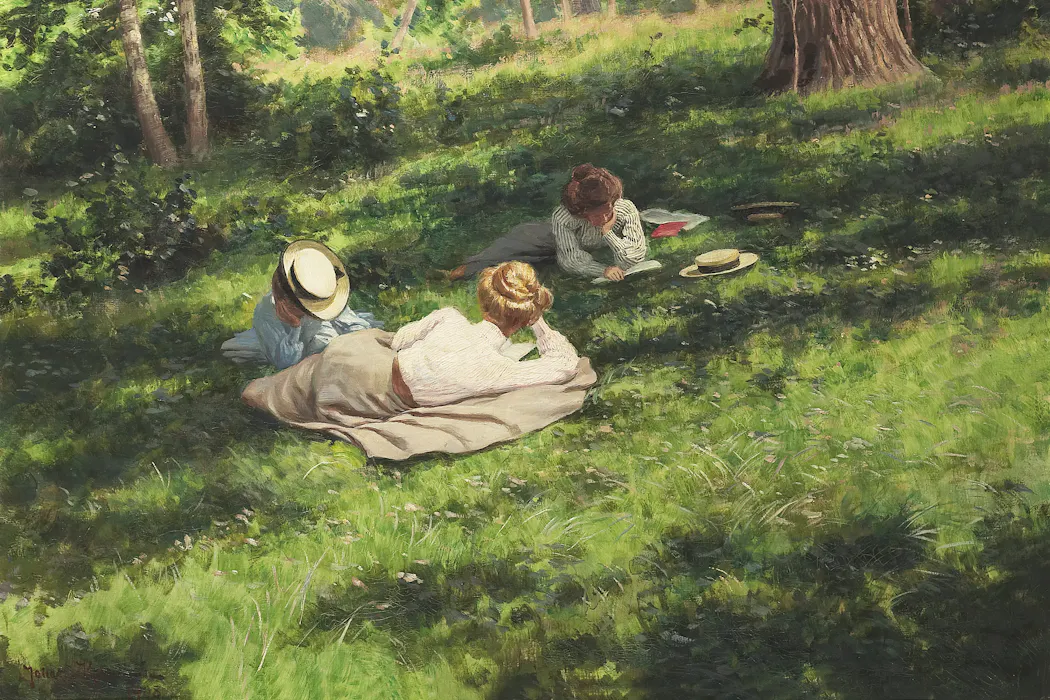
We asked ten literary experts to recommend the climate poem that has spoken to them most powerfully. Their answers span over 200 years and a range of emotions from sorrow, to anger, fear and hope.
This article is part of Climate Storytelling, a series exploring how arts and science can join forces to spark understanding, hope and action.
1. Death of a Field by Paula Meehan (2005)
Published in the wake of the 2008 financial crisis, Paula Meehan’s Death of a Field critiqued the environmental impact of the Celtic Tiger economy in Ireland.
The poem anticipates the destruction of the titular field by property developers with little regard for native ecologies: “The end of the field as we know it is the start of the estate.”
The global effects of the climate crisis are seen from a uniquely local perspective as the displacement of Irish wildlife mirrors the effect of colonial violence. “Some architect’s screen” is simply the latest iteration of imperial technologies that seek to plunder Irish landscapes. The poem gains further strength by refusing to replicate a hierarchical relationship to nature by preserving its many mysteries:
Who can know the yearning of yarrow
Or the plight of the scarlet pimpernel
Whose true colour is orange?
Jack Reid is a PhD Candidate in Irish literature
2. Darkness by Lord Byron (1816)
Darkness imagines the fallout of a volcanic eruption that has destroyed the Earth. The “dream” that the poem mentions was inspired by genuine weather conditions during the “year without a summer” in 1816, caused by the eruption of Mount Tambora in Indonesia the previous year.
Sulphur in the atmosphere caused darkness and low temperatures across Europe. In Lake Geneva, Lord Byron experienced the infamous “haunted summer” of darkness.
Byron’s depiction of climate catastrophe is bleak, with words like “crackling”, “blazing” and “consum’d” bearing resemblance to contemporary reports of wildfires caused by climate change. After a famine, all elements of Byron’s Earth, from the clouds to the tide, eventually cease to exist: “Seasonless, herbless, treeless, manless, lifeless– / A lump of death – a chaos of hard clay.” Read as a portent of the Anthropocene, Byron’s poem urges readers to seriously consider the future of mankind.
Katie MacLean is a PhD candidate in English Literature
3. Mont Blanc by Percy Bysshe Shelley (1817)
Byron’s close friend Percy Bysshe Shelley was also inspired by the “year without a summer”. He witnessed temperatures drop, volcanic ash hanging heavy in the air and crops failing. While his wife Mary used the gloomy climatic event to inform her novel Frankenstein (1818), Shelley channelled them into his poem Mont Blanc.
In his ode, Shelley describes a timeless “wall impregnable of beaming ice”. By drawing on his scientific reading, he then explains his fears regarding global cooling and the possibility of vast glaciers eventually covering the alpine valleys.
He imagines “the dwelling-place / Of insects, beasts, and birds” being obliterated and mankind forced to flee. While Shelley saw this process as “destin’d” and inevitable, it is clear that Mont Blanc is a poem with catastrophic climate change at its heart. In 2026, it is difficult to read in any other way.
Amy Wilcockson is a research fellow in Romantic literature
4. Characteristics of Life by Camille T. Dungy (2012)
There’s something gloriously elastic about invertebrates: the spinelessness of a worm, the pulsing of the jellyfish, the curling of an octopus. Spiders, snails and bees, too, with their exoskeletons on display, invite us to see things “inside-out”.
These are the thoughts I have when I read Characteristics of Life by Camille T. Dungy, which opens with a snippet from a BBC news report claiming that “a fifth of animals without backbones could be at risk of extinction”. What would a world be without the “underneathedness” of the snail beneath its shell beneath the terracotta pot in the garden? Or “the impossible hope of the firefly” whose adult lives span only a handful of human weeks?
Dungy speaks from a “time before spinelessness was frowned upon”, and from a world where to dismiss a being as “mindless” (jellyfish have no brains) or even “wordless” would be “missing the point” entirely. As I think of these creatures that dwell beyond our usual line of vision – flying, crawling, tunnelling and swimming – I find my perspective on our beautiful world turning and shifting.
Janine Bradbury is a poet and a senior lecturer in contemporary writing and culture
5. Prayer at Seventy by Vicki Feaver (2019)
One of my favourite poems about climate change is Vicki Feaver’s Prayer at Seventy from her 2019 collection I Want! I Want!.
The speaker’s request of passing her “last years with less anxiety” appears to be denied by a god who first responds by changing her into “a tiny spider / launching into the unknown / on a thread of gossamer” and who, when she begs to “be a bigger / fiercer creature”, turns her into “a polar bear / leaping between / melting ice floes”.
Both images present creatures who are in precarious positions, their futures uncertain, reflecting the state of a person contemplating the unknowns of old age and death. But the poem moves beyond the personal. The reference to the melting ice floes is not solely metaphorical: it reminds us that the planet itself is in danger and every living thing is therefore vulnerable – and will be increasingly so.
Julie Gardner is a PhD candidate in literature
Read more: How poetry can sustain us through illness, bereavement and change
6. Walrus by Jessica Traynor (2022)
Walrus, from Jessica Traynor’s 2022 collection Pit Lullabies expresses the quiet anxiety a mother has for her child in the world of climate breakdown.
While stripping wallpaper from the box room of her house, the poet discovers a mural of the Walrus and the Carpenter from Alice’s Adventures in Wonderland. Traynor takes part of Lewis Carroll’s poem about the Walrus and the Carpenter walking along the beach, eating the vulnerable oysters, and weaves it into her own poem.
Carroll’s absurd verse includes what, at that time no doubt, seemed like an impossible image of a “boiling hot” sea. In the 21st century, this is no longer an absurdity, as Traynor knows. She makes a connection with Carroll’s poem, imploring her child:
Sleep as the sun rises and ice melts
and for want of the freeze a walrus
pushes further up a cliff-face.
It’s a complex poem that reimagines a key work of children’s literature, connecting it with the reality of the changing world. All the while the mother keeps her fears at bay for the sake of her child, “brows[ing] washing machines” with a “ball of tears” in her throat.
Ellen Howley is an assistant professor of English
7. Ocean Forest, co-created by the We Are the Possible programme
Ocean Forest is woven out of words, research, ideas and stories shared by scientists, educators, health professionals, youth leaders, writers and artists. They took part in creative writing workshops to co-create the anthology Planet Forest – 12 Poems for 12 Days for the UN Climate Conference in Brazil in 2025.
In the shallows, alert to change,
the minuscule, overlooked creatures
weave between seagrass, and weed –
live their shortened lives.
When ships pass overhead, when sands shift,
fish navigate swell, migrate beyond
where coral’s been bleached, through schools
of silenced whales and barely rooted mangroves
struggling to thrive in darkening water.
Deeper down,
pressure builds, species exist, unaware,
undisturbed. As heat and waves rise there’s hope
the unfound, the unnamed, the unpolluted
in the remotest ocean forests will survive.
Through uniting disciplines and voices the poem takes unexpected shifts. It demonstrates that climate change affects and erodes the habitats that lie beneath the surface and that urgent action is needed to protect disappearing species.
Yet, there is also a glimmer of hope – that in the deepest, darkest parts of the ocean, where temperatures are near freezing and there are bone-crushing pressures, maybe there are creatures that will survive human interference and pollution.
Sally Flint is a lecturer in creative writing and programme lead on the We Are the Possible programme
8. Di Baladna (Our Land) by Emi Mahmoud (2021)
Emtithal “Emi” Mahmoud is a Sudanese poet and activist, who has won multiple awards for her slam poetry performances. Mahmoud performed Di Baladna at the United Nations Climate Change Conference in 2021.
Poetry – especially spoken word – helps people connect emotionally with the human side of climate-driven displacement, a topic that’s often explained only through technical language. The language of emissions targets, temperature thresholds, or policy frameworks can distance people emotionally from its consequences. Yet poetry can cut through this abstraction.
Mahmoud’s performance gave voice to those forced from their homes by environmental collapse, reminding listeners that climate change is not only an environmental crisis but a deeply human one, with profound effects on individuals, families and communities.
By merging vivid natural imagery with the rhythms of displacement and lived testimony, the poem urges listeners to replace passive awareness with empathy. Mahmoud implores us to feel the loss, fear and resilience of displaced communities, looking beyond news headlines and images of victimisation. Engaging with such work helps transform climate refugees from statistics into people.
Clodagh Philippa Guerin is a PhD candidate in refugee world literature
9. Flowers by Jay Bernard (2019)
At first glance, Jay Bernard’s Flowers is circular poem (one that begins and ends in the same place) but you soon realise that the circle isn’t going to complete. It opens:
Will anybody speak of this
the way the flowers do,
the way the common speaks
of the fearless dying leaves?
And closes:
Will anybody speak of this
the fire we beheld
the garlands at the gate
the way the flowers do?
And the answer seems to be, no: no one will speak of these things – the “coming cold” and the “quiet” it will bring – only the things themselves as they die. With the songs Where Have All the Flowers Gone? by Pete Seeger and Blowin’ in the Wind by Bob Dylan in its DNA, Flowers has the eternal power of a folk-lyric – prophetic and unignorable.
Kate McLoughlin is a professor of English literature
10. Place by W.S. Merwin (1987)
Climate change poetry – should it be a thing? How do poets avoid the oracular pomp it threatens? Browsing my small library I’m shocked anew to realise most poets lived and died blissfully innocent of our condition.
OK, what about the late John Burnside’s lyric Weather Report (“this is the weather, today / and the weather to come”). It poignantly extrapolates from a sodden summer to his sons’ futures: “a life they never bargained for / and cannot alter”. Heartbreaking. Or the odd dread of spring in Fiona Benson’s Almond Blossom, a season characterised as Earth’s, “slow incline … inch by ruined inch”. Ditto.
But then I reach back to the great American poet W.S. Merwin’s short prayer Place to find that grace-note of hope which surely needs to thread through all poems, whether they speak of climate change, mortality or love: “On the last day of the world / I would want to plant a tree.” Me too.
Steve Waters is a playwright and professor of scriptwriting at the University of East Anglia
This article features references to books that have been included for editorial reasons, and may contain links to bookshop.org. If you click on one of the links and go on to buy something, The Conversation UK may earn a commission.

Amy Wilcockson receives funding from Modern Humanities Research Association as Research Fellow for the Percy Bysshe Shelley Letters project.
Steve Waters receives funding from AHRC
Clodagh Philippa Guerin, Ellen Howley, Jack Reid, Janine Bradbury, Julie Meril Gardner, Kate McLoughlin, Katie MacLean, and Sally Flint do not work for, consult, own shares in or receive funding from any company or organisation that would benefit from this article, and have disclosed no relevant affiliations beyond their academic appointment.


