
Reading view

After a year of Reform UK in local government, the cracks are starting to show

Reform UK is expected to expand its foothold in local government in England this week. More than 5,000 seats across 136 councils are being contested, making this one of the largest electoral tests in recent years. It builds on Reform’s breakthrough in 2025, when the party took control of ten local authorities – its first real experience of power.

For scholars of populism, this moment could be revealing. Years of research have focused heavily on the rhetoric of populism, its voter base, and the interaction between the two.

But far less attention has been paid to what populists actually do once in office. Where such research exists, it tends to focus on national governments, with only a small body examining local politics. Local government, however, is where political promises get a quick reality check.

The gap between Reform’s “pro-workers” rhetoric and its party elite’s relatively privileged and pro-business backgrounds has been noted. But the party’s first year in local government provides an opportunity to see whether the social groups it claims to represent also tend to benefit from its exercise of power.

While systematic data on the Reform-led councils is yet to be collected, their track record so far has revealed signs of where this party’s interests might lie – and of what a UK government led by Reform might look like.

Energy: big donors or local interests?

According to a recent report, climate commitments have been scaled back across Reform-run councils. Net-zero targets have been scrapped and climate language removed from policy documents. These decisions align with the party’s broader critique of climate policy as economically burdensome.

It also aligns with the party’s fossil fuel donors, who account for more than two-thirds of Reform’s financial backing. However, it does not necessarily align with the interests of the communities in the councils that it runs.

A good case in point is fracking. Despite its well-known risks to water and air quality, as well as concerns over earthquakes and warming effects, Reform’s leadership has endorsed fracking. The party has pledged to legalise it if it comes into government.

The country, however, is not as keen. According to the most recent polling, only 28% of people in Britain support fracking, compared to 46% opposing it. A survey last year found that nothing puts off Reform supporters more than the party’s ties to the fossil fuel industry. Farmers – 40% of whom now support Reform – have a longstanding scepticism about fracking due to its potential impact on their crops.

In fact, in two other Reform council areas – Lancashire and Scarborough, local representatives have broken from the national party line on fracking. This reflects a broader tension between the interests of its elite backers and those of its popular base.

Social care: when ‘populism’ meets the welfare state

Those contradictions also become visible in the field of social care. In Derbyshire, the Reform-led council’s plan to shut eight care homes was called a “betrayal of local people”. Similar plans in Lancashire entailed the closure of five public care homes as well as five day centres, with residents moved to the private sector.

What is striking is not just the direction of policy, but also the political reaction to it. The privatisation plans in Lancashire were eventually abandoned due to strong local opposition, which came not only from rival parties, but also from Reform grassroots members.

This underlines an insight often missing from populism research: the category of “ordinary people” is not a unified social group. It also indicates the unpopularity of an economic agenda that, with its emphasis on further deregulation, privatisation and tax cuts, might seem to be Thatcherism’s unfinished business.

Taxation: from promises to practice

Reform’s neoliberal outlook on the economy is reflected in the range of tax cuts pledged in its 2024 manifesto. Ahead of the local elections last year, several Reform candidates reiterated these pledges, vowing either to freeze or cut council tax.

The opposite has happened, though. As reported recently, nine Reform councils raised Band D council tax for 2026-27 by an average of 3.94%. And while that was lower than the overall average increase of 4.86%, it shows that – when confronted with budgetary constraints – Reform is willing to follow the same fiscal patterns as other mainstream parties. In other words, by increasing what is ultimately a regressive tax that disproportionately affects poorer households.

This dynamic echoes once again the discrepancy between the party’s “populist” image and its neoliberal, austerity-prone policy agenda.

council tax bill with credit cards and bank notes.
Householders in Reform-led councils may have been handed a council tax rise they were not expecting. Yau Ming Low/Shutterstock

Reform’s track record in these areas of policymaking points to a broader conclusion. Much of the existing literature treats populism primarily as a discursive phenomenon – a way of framing politics in terms of “the people” versus “the elite”.

But Reform’s experience in local government shows that its actual politics might in fact tilt towards the interest of the latter. This is precisely where current research remains scant.

On the eve of a new round of local elections, Reform is likely to extend its presence across councils in England. But its first year in power already suggests that “the people” it claims to represent are not necessarily the same people who benefit from its rise to power.

The Conversation

Vladimir Bortun does not work for, consult, own shares in or receive funding from any company or organisation that would benefit from this article, and has disclosed no relevant affiliations beyond their academic appointment.

  •  

Mali attacks: Tuareg grievances hold the key to peace

The precarious security situation in Mali took a turn for the worse in late April 2026. Well coordinated attacks targeted several cities and claimed the lives of the defence minister, Sadio Camara, and several Malian soldiers.

The events are a culmination of increased attacks over the past few years on the military and state institutions in Mali.

We have been researching insecurity and politics in west Africa and the Sahel for over a decade. We believe the recent attacks trace back to grievances expressed by Tuaregs that the current military regime has not addressed. The Tuaregs are nomadic Berber communities in northern Mali.

First is the inability or unwillingness to address Tuareg discontent. Their grievances centre on political autonomy, marginalisation, cultural recognition, resource control, security and perceived state neglect.

Second, the continuous use of force by the military against rebels in the northern regions without regard for the collateral damage. The Tuaregs have long contested the militarisation policies of successive Malian governments.

Third, the uneven distribution of resources, which keeps the northern region marginalised. These include northern Mali’s resources such as gold deposits, salt mines, grazing lands, and strategic trade corridors. Revenues from these sources remain controlled by the state’s centre based in the south.

Addressing resource marginalisation could have a number of benefits. It could temper Tuareg grievances, restore trust in the Malian state, and shift conflict incentives away from rebellion towards political inclusion, stability, and sustainable peace in northern Mali.

The breakdown

In April 2026 the jihadist group Jama’at Nusrat al-Islam wal-Muslimin (JNIM) joined forces with ethnic Tuareg rebels from the northern Azawad Liberation Front (FLA) to attack several cities in the country recently.

This mirrors a similar attack in 2012 when the Tuareg and al-Qaeda-affiliated militants launched an offensive against the state. The Tuareg-dominated National Movement for the Liberation of Azawad (MNLA) attempted to secede and initiated a rebellion.

The MNLA is a Tuareg‑dominated separatist movement. Founded in 2011, it is mainly composed of ex-Libyan war returnees and northern Malian Tuaregs. The organisation had about 10,000 fighters at its peak in 2012.

Despite their numbers, they lacked the military power to hold the territory. As a result they aligned with Islamists Ansar Dine, al-Qaeda in the Islamic Maghreb (AQIM), and the Movement for Unity and Jihad in West Africa (MUJAO). Shortly after pushing back Malian forces in late 2012, the alliance disintegrated.

The Islamist groups were better armed and funded. They forced the secular separatists out of major towns like Gao, Timbuktu and Kidal. The intervention of French forces in 2013 helped the Malian government regain most of the lost territories.

AQIM and its allies then moved into the mountains and surrounding desert areas. They shifted to guerrilla tactics, including suicide bombings and landmines.

The withdrawal of French forces in 2022 seems to have emboldened the Islamist militants. It removed counter‑terrorism pressure, disrupted intelligence and logistics and created a security vacuum amid weak Malian state capacity. This allowed Islamist groups to expand operations, recruit locally and regain territorial influence.

Lessons unlearnt

The largely popular military regime of Assimi Goita has failed to address the demands of Tuareg separatists. The Tuaregs have historically complained about exclusion from power by the southern dominated Malian state. Since the country’s independence in 1960, Tuareg leaders have argued that the structure of the Malian state does not reflect their political identity, economic interests and governance traditions. The demand for self-rule or autonomy has been suppressed, often by force.

More recently, increased drought, desertification and climate variability has devastated Tuareg pastoral livelihoods. These grievances pre-date Islamic insurgency and are fundamental in understanding the approach of the group.

The second unaddressed issue is that counterterrorism operations use force which creates collateral damage. Recent analysis shows that counterterrorism operations in northern and central Mali have resulted in large scale civilian harm, displacement and collective punishments. These have included arbitrary arrests and mass killings.

These factors have created conditions which Islamist groups have exploited for recruitment, territorial control and legitimacy.

The blame for this has been put on successive Malian regimes and previous French operations. This has been a key reason for France’s interventions being labelled as failures.

The third major driver of violence in Mali relates to the uneven distribution of resources. Since independence, public investment, infrastructure, social services and political attention have been heavily concentrated in the southern parts of the country.

Previous peace agreements have promised decentralisation, funding and integration of northern elites and ex-combatants. But implementation have been slow or nonexistent.

Is there a way forward?

The Tuareg question must be answered to reduce the tension between the regions of the country. It can be argued that Tuareg actors have twice miscalculated by entering arrangements with jihadist groups. But this does not diminish the need to address the structural inequalities and long-standing grievances underpinning Tuareg demands.

To achieve this, the Malian regime can copy the blueprint of former president Mahamadou Issoufou of Niger. Prior to his presidency, the Nigerien Tuaregs were similarly aggrieved. When he became president in 2011, he:

  • integrated Tuareg elites and former rebels into state institutions

  • decentralised state authority by allowing administrative and budgetary control at the regional level

  • introduced disarmament, demobilisation and reintegration programmes.

Issoufou also invested in infrastructural development in the areas that directly affected the Tuaregs. This included pastoralism, education and livelihood support. Water access in arid pastoral areas was improved. And connectivity and road safety was expanded.

Addressing the Tuareg agitations would reduce tensions in Mali.

The Conversation

The authors do not work for, consult, own shares in or receive funding from any company or organisation that would benefit from this article, and have disclosed no relevant affiliations beyond their academic appointment.

  •  

Gaza: six months of ceasefire have left the territory in rubble and little vision for the future of its people

Municipal elections in the occupied West Bank and in the central Gaza city of Deir al-Balah on April 25 have been quickly framed by Fatah, the dominant faction within the Palestinian Authority (PA), as a sweeping victory.

But it’s worth taking a closer look at how the election was organised. Candidates were required to commit to the political programme of the Palestine Liberation Organisation (PLO), which which includes the recognition of Israel, the renunciation of terrorism and the pursuit of a two-state solution. It was a condition that was widely seen as effectively excluding Hamas, which does not support these policies.

Hamas – which is understood to be preparing to hold elections for its leadership, which has been decimated during the 30-month conflict in Gaza – did not field candidates. A number of other groups, including the People’s Front for the Liberation of Palestine, the Democratic Front for the Liberation of Palestine, the Palestine People’s Party, FIDA, and Palestinian National Initiative, also opted not to field candidates in the election.

It’s important, when looking at the turnout and results, to bear this in mind. In the West Bank, turnout reached around 56%, but Fatah-affiliated lists were elected unopposed in 197 councils, roughly half of all municipalities in this round.

In the Gaza Strip, voting took place only in the central city of Deir al-Balah. Here, turnout was significantly lower, at around 23%, reflecting the mass displacement, incomplete voter registries and widespread loss of life. The Fatah-backed list won six of 15 seats. A list widely seen as aligned with Hamas secured two seats, with the remainder going to non-affiliated groups.

For the Fatah-dominated Palestinian Authority, these municipal elections serve several purposes. They are presented as a way to reaffirm a political link between the West Bank and Gaza, and to signal a continued role in Gaza’s future governance. They also offer a platform promising reforms to the watching world at a moment when the PA faces pressure to demonstrate political legitimacy.


Read more: Council elections take place for some Palestinians – but continuing mass displacement makes Gaza poll farcical


While regular municipal elections have been held in the West Bank, presidential and legislative elections have not been held since 2005 and 2006. In the intervening two decades, concerns over the concentration of power under Fatah leader Mahmoud Abbas have intensified. In this context, the municipal elections represented a lower-stakes form of participation. It was a way to show electoral activity without reopening the broader question of national leadership.

Rather than a clear mandate, the results point to a constrained political landscape, shaped as much by exclusion and limited participation as by electoral competition. What these elections will change on the ground is unclear, particularly in Gaza, which remains stricken by 30 months of war.

Gaza in ruins

According to the UN, over 1.9 million people – between 80% and 90% of Gaza’s population – are displaced – six months into what is supposed to be a ceasefire. Families live in damaged homes, tents or overcrowded shelters, without reliable access to clean water, electricity, food or healthcare.

According to the World Health Organization, only 19 of Gaza’s 36 hospitals function even partially and nearly half of essential medicines have run out. Conditions in displacement sites are deteriorating. Around 81% of sites show signs of rodents or pests, affecting 1.45 million people and increasing public health risks.

A recent joint World Bank–EU–UN assessment estimates that the recovery and reconstruction of the Gaza Strip will cost more than US$70 billion (£52 billion). The restoration of housing alone accounts for US$18 billion in damage, while more than 68 million tonnes of debris will need to be removed before rebuilding can begin.

But reconstruction depends on access to materials, land and infrastructure and Israel continues to control all of these. Israeli authorities control the entry of aid into Gaza, funnel deliveries through a single crossing, impose inspection regimes that delay or halt shipments, and close crossings altogether. Aid entering Gaza fell by 37% in the three months to April 2026, as raids and other ceasefire violations continue.

Reconstruction without Palestinians

While the people of Gaza remain in these conditions, outsiders are moving ahead with plans to shape Gaza’s future. In November 2025, the UN Security Council endorsed resolution 2803, backing a US-led initiative known as the Board of Peace to oversee the territory. When it first met on February 19, the Board of Peace pledged around US$17 billion – including US$10 billion from the US and additional commitments from Gulf states such as the UAE, Qatar, Saudi Arabia and Kuwait.

Palestinians have no representatives on the Board of Peace, which is chaired by the US president Donald Trump, who also sets the agenda and calls meetings. Israel, however, does, as do Trump’s most prominent envoys, Jared Kushner and Steven Witkoff, who both have considerable business and real estate interests in the Middle East.

Palestinian civil society organisations have warned that the Board of Peace excludes Palestinians from meaningful decision-making and undermines their right to self-determination. European governments have also raised concerns about the concentration of authority in the hands of the US president and the lack of oversight.

Control over funding is also taking shape. The Gaza Reconstruction and Development (Grad) fund is structured as a World Bank Financial Intermediary Fund, with the bank acting as “limited trustee”. In practice, this means the World Bank manages donor money but has no say in how the money is spent. But World Bank president Ajay Banga also sits on the Board of Peace executive board, placing the institution inside the political structure that sets priorities.

In documents related to the Grad, the World Bank describes this moment as an opportunity to “fundamentally reshape” Gaza’s economy through private investment. The vision, as has been widely covered in the media, is to transform Gaza into a “hub” in the Imec development corridor that links India to the Middle East and beyond. The rebuilt Gaza would include a major port, high-tech industrial development, data centres and tourism resorts. Little provision has been made for the restoration of Palestinian homes, healthcare or water and power infrastructure.


Read more: Donald Trump’s vision for Gaza’s future: what a leaked plan tells us about US regional strategy


Recent discussions with the Dubai-based port operator and logistics company DP World appear to highlight Board of Peace priorities. In April 2026, representatives linked to the board explored bringing the company in to manage key parts of Gaza’s supply chains, including warehousing, tracking systems and the movement of both humanitarian and commercial goods.

The talks also included proposals for a new port in Gaza or on the Egyptian coast, as well as a free-trade zone. It’s a plan for market-led development in its most concentrated form, which envisages the reconstruction of Gaza to serve regional and global economic interests. It reflects external priorities, not the needs on the ground in Gaza.

The Conversation

Rafeef Ziadah does not work for, consult, own shares in or receive funding from any company or organisation that would benefit from this article, and has disclosed no relevant affiliations beyond their academic appointment.
  •  

Supervillain or Cicero? Why Palantir’s manifesto has such sinister vibes

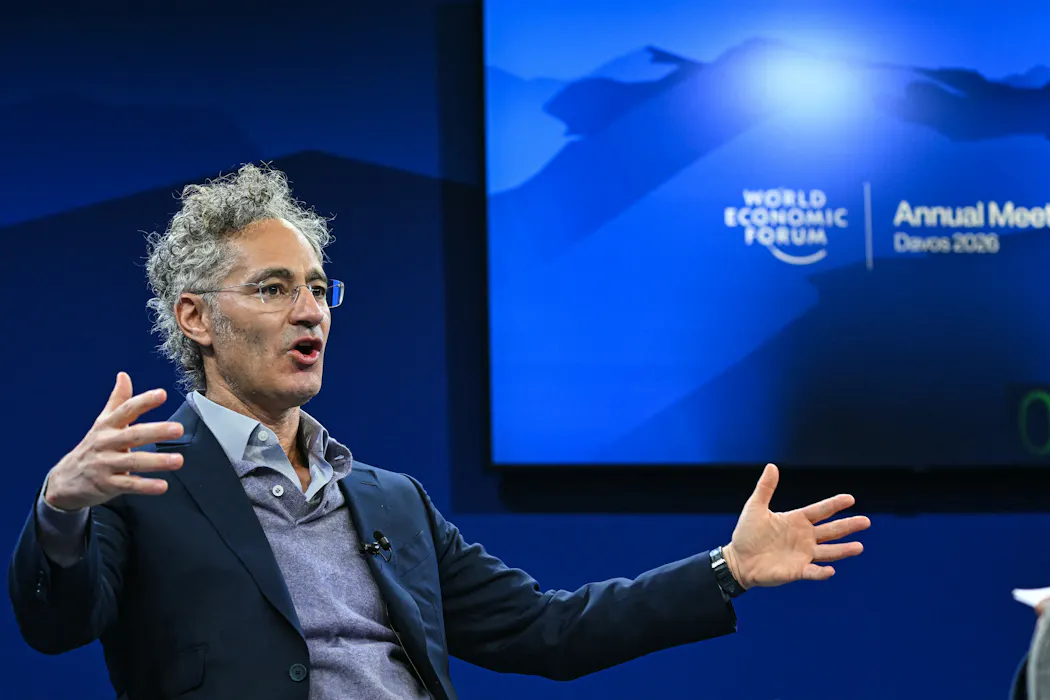
Fabrice Coffrini / Getty Images

Earlier this month, multibillion-dollar US tech company Palantir posted on X a summary of its chief executive Alex Karp’s recent book, the portentously titled The Technological Republic: Hard Power, Soft Belief, and the Future of the West.

The book and the post offer a kind of manifesto, making sweeping claims about a hierarchy of civilisations, the rejection of pluralism, Silicon Valley’s moral obligation to US military power, the necessity of AI-powered weapons, and the case for compulsory military service.

The manifesto has met widespread criticism. Some commentators have compared the rhetoric to the monologue of a comic-book villain: grand, moralising, tinged with a sense of historical destiny.

But the manifesto is more than just corporate posturing: it’s helping to construct a new geopolitical reality and normalise a worldview that concentrates power beyond democratic accountability.

From tools to worldviews

For the past two decades, large technology firms have mostly presented themselves as benevolent service providers. They build tools; governments and users decide what to do with them.

That distinction has always been convenient, but it is looking less and less tenable. For some, Karp’s manifesto offered a grim sense of confirmation of the change. As Austrian philosopher Mark Coeckelbergh put it, “reading it is like opening a food item that you suspected has gone off, but you didn’t know it was that much off”.

Palantir is not just any tech company. Its software, offering “AI-powered automation for every decision”, is embedded in military, intelligence and policing systems – not just in the United States, but in many other countries across Europe, the Middle East and Australia.

When a company in that position denounces “regressive” cultures and “hollow” pluralism, it is asserting a worldview rather than just selling technology.

As the manifesto puts it: “the ability of free and democratic societies to prevail requires something more than moral appeal. It requires hard power.” Here, “hard power” means not just military force but the technological systems that shape how force is used.

Palantir’s systems shape how threats are identified, interpreted and acted upon. So when the company advances claims about civilisational decline and the necessity of strength, it is also helping define the terms on which power is exercised.

A stakeholder letter or something older?

In one view, the manifesto is a corporate position paper or a statement of values aimed at investors, partners, the public and policymakers. But there is something older in its form.

It is reminiscent of Cicero, the Roman statesman and master of rhetoric, in its talk of decline, virtue, duty and the survival of the republic. It frames technological development not as a market activity but as a moral obligation tied to the fate of civilisation.

Like classical republican oratory, it asserts that survival depends on strength. And today, that strength is technological.

Cicero wasn’t simply expressing his own opinions when he spoke. He was asserting a right to speak on behalf of the republic. In the same way, Palantir is positioning itself as a legitimate interpreter of civilisational stakes.

The shift from argument to atmosphere

The manifesto does not argue via carefully reasoned policy claims. Instead it offers declarative statements: that some cultures are “harmful”, that pluralism has become “vacant”, that technological strength is the ultimate guarantor of civilisation. These establish a mood: urgency, decline, necessity.

The effect is to manufacture a sense of inevitability. It works via tone and framing rather than evidence, setting the background conditions under which certain policies feel necessary rather than debatable.

Once that atmosphere is in place, the range of acceptable responses shrinks. Palantir is helping to construct geopolitical realities, rather than respond to them.

Supervillain or Cicero? It’s both

Palantir’s rhetoric does bear comparison to the ranting of fictional supervillains. Both feature sweeping claims about decline and the need for decisive action.

Palantir also exempts itself from the accountability that might accompany its claims. Comic-book villains believe they see more clearly than others, but they also place themselves above constraints that apply to everyone else.

The structure of the argument feels familiar. The world is in crisis, the options are narrowing, and power must be expanded beyond normal limits.

Seen this way, the villain tone and the Cicero-like register are two expressions of the same underlying move. It is an effort to define reality at a civilisational scale, from a position that answers to no one.

An infrastructure project

This worldview did not emerge overnight. It has been developed over years through op-eds in prestige newspapers and published by major mainstream houses before being compressed into a social media thread that reached millions in hours.

When companies that build and operate core security technologies put considerable resources into developing and promoting stories about civilisation and its future, their language is not just expression. It is a kind of infrastructure for their actions in the real world.

By the time most people notice the rhetoric, the infrastructure it justifies is already in place.

But the future trajectory of this worldview is not set. The history of democratic politics is, in part, a history of people recognising when power has overreached and building the collective capacity to say so.

That work is not heroic in the comic-book sense. It doesn’t focus on a single figure or decisive moment. It starts with understanding precisely how the manufacture of inevitability works, so what is presented as necessary can be seen as a choice – before it is made for us.

The Conversation

Daniel Baldino does not work for, consult, own shares in or receive funding from any company or organisation that would benefit from this article, and has disclosed no relevant affiliations beyond their academic appointment.

  •  
❌