
Reading view

What alternatives do Gulf states have to the Strait of Hormuz?
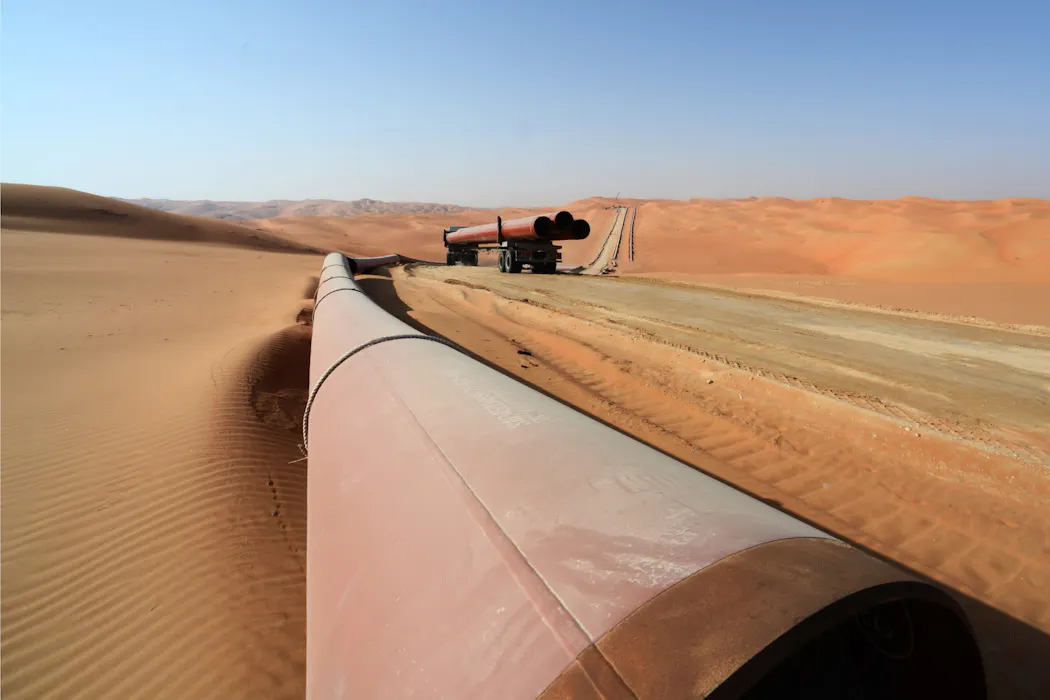
The Gulf states have built a variety of emergency pipelines over the years to bypass the Strait of Hormuz. Md. Raihan Uddin Rafi / Shutterstock

Two months into the Iran war and the Strait of Hormuz is still mostly shut. Vessel traffic is running at a fraction of pre-war levels, with the patchwork of ceasefires, blockades and re-closures since February 28 not restoring confidence on the bridge of any tanker.

Hormuz has long been understood as one of the world’s central trade chokepoints. It normally carries around 20 million barrels of crude and oil products each day, as well as roughly a fifth of global liquefied natural gas (LNG) exports. A third of the world’s helium and a similar amount of the urea that ends up as fertiliser also pass through the strait.

Plans and projects to diversify away from Hormuz have been on drawing boards for decades, and those workarounds are now being stress-tested as never before. The bypass infrastructure is doing roughly what architects had hoped, providing around 3.5 million barrels to 5.5 million barrels a day of crude capacity.

But this is still nowhere near enough.

Hormuz workarounds

The most important pipeline on the planet right now runs across Saudi Arabia. The East-West Pipeline – also known as Petroline – was built in the 1980s during the original Tanker war, when Iran and Iraq attacked merchant vessels in the Gulf as part of their wider conflict.

The pipeline’s capacity was expanded to a 7 million barrel emergency ceiling in 2019. However, the loading terminals in the city of Yanbu on Saudi Arabia’s Red Sea coast were never designed to carry this much oil this fast, and analysts tracking tanker traffic estimate that less oil is currently flowing through the pipeline than its theoretical ceiling.

From Yanbu, oil bound for Europe still has to cross Egypt via the Sumed pipeline, which has a capacity of just 2.5 million barrels per day. Although oil flows through this pipeline have surged by 150% since the start of the war, its comparatively small capacity remains a binding constraint on European supply.

Iran noticed the geoeconomic importance of Petroline and has targeted it accordingly. An Iranian drone strike on a pumping station in April knocked 700,000 barrels a day offline. Saudi Aramco, the operator, had the line back at full capacity within three days. While the repair time is reassuring, the fact of the strike is not.

The other half of the Gulf bypass story runs through the United Arab Emirates (UAE). The Abu Dhabi Crude Oil Pipeline (Adcop) goes from Habshan to Fujairah on the Gulf of Oman side of the country. With a capacity of just under 2 million barrels per day, Adcop is the only major bypass that exits the Gulf directly into the Indian Ocean.

But as with Petroline, it has been targeted during the war. Iranian drone strikes on Fujairah on March 3, 14 and 16 set storage tanks on fire and suspended loadings. While Adcop offers some diversification for the UAE, it does not solve the targeting problem.

A map showing the East-West Pipeline in Saudi Arabia and the Abu Dhabi Crude Oil Pipeline in the United Arab Emirates.
The East-West Pipeline in Saudi Arabia and the Abu Dhabi Crude Oil Pipeline in the United Arab Emirates are two crucial Hormuz workarounds. Peter Hermes Furian / Shutterstock

The situation is worse for the Gulf region’s other big oil producers. Iraq’s 3.4 million barrels per day of pre-war crude exports went almost entirely through the southern port city of Basra and the Strait of Hormuz.

There is one northern pipeline, connecting oil fields in Kirkuk to Ceyhan in Turkey. This pipeline was reopened in September 2025 after a two-and-a-half-year halt, with flows ramped up to 250,000 barrels a day in March. But this volume pales in comparison to what Iraq has lost.

Kuwait has it worse still. Pre-war crude exports ran at around 2 million barrels per day, with every barrel exiting through Hormuz. Kuwait has no pipeline alternative. Kuwait Petroleum Corporation declared force majeure in March, temporarily allowing it to suspend its obligations to meet delivery contracts.

This was extended on April 20, with the oil company saying it could not meet contractual obligations even if Hormuz reopened. Overcoming the damage that has been inflicted on Kuwait’s production base – and then ramping up production – will take months.

Qatar’s vulnerability is a different shape. Its pre-war crude exports were smaller than its Gulf neigbours, at around 0.6 million barrels per day. These exports all left Qatar via the strait. For Qatar, the story is gas. Its 77 million tonne LNG capacity at Ras Laffan is the largest in the world, supplying about 19% of global LNG trade. There is no alternative to shipping this gas through Hormuz.

Iran itself has built a Hormuz bypass: a 1,000-kilometre pipeline from Goreh at the head of the Gulf to a terminal at Jask on the Gulf of Oman. It is designed for 1 million barrels per day. But in practice, sanctions and unfinished terminal infrastructure have kept actual throughput at a fraction of design.

The US Energy Information Administration estimated that, in summer 2024, under 70,000 barrels per day were flowing through the pipeline. Loadings stopped altogether that September. According to Kpler, which provides real-time data on global shipping movements, only a single tanker – around two million barrels – has loaded at Jask in the war so far.

A call for more pipes in the Gulf, as there have been since the war began, is understandable. But it is no answer. Replicating Hormuz in pipelines would cost hundreds of billions of US dollars and a decade of construction. And at the end of it, new pipelines and terminals at Yanbu, Fujairah and wherever else would be no harder to reach with a drone than the old ones.

The Conversation

David B Roberts does not work for, consult, own shares in or receive funding from any company or organisation that would benefit from this article, and has disclosed no relevant affiliations beyond their academic appointment.


  •  

Dolls beat screens for building children’s social skills, study finds

Vach cameraman/Shutterstock

What’s the point of play? Is it simply a way to keep children occupied, or something more? For some, it’s about learning literacy and numeracy. For others, it’s how friendships form and relationships deepen. But it can be all of these at once, and more.

Most parents recognise that play matters. But there’s less agreement on what kind of play is best. Should children be guided towards activities designed to build specific skills, like sports for coordination, or construction for maths and engineering? Or should the child’s own interests lead the way, regardless of perceived educational value?

Our research focuses on a type of play often dismissed as “just for fun” – playing with dolls. Across a series of studies, we found that doll play can help children understand other people’s thoughts and feelings. This is a skill that underpins social interaction throughout life.

There is pressure on parents to create the “right” environment for development, often filled with toys that promise clear educational outcomes. STEM-focused toys (science, technology, engineering and maths), in particular, are widely seen as beneficial for learning. Doll play, on the other hand, can be viewed as having little educational benefit.

Our findings challenge that assumption.

More than make-believe

When playing with dolls, children often play out scenes between characters. These may seem simple on the surface but could present opportunities for the child to develop social and emotional skills.

As parents, it seems obvious that playmates are important for building and learning about relationships and other people, and recognising others’ emotions (empathy). But what if children can develop these skills even when playing alone?

Previous studies have found that children who engage more in pretend play tend to have stronger social understanding and empathy. Earlier studies, however, didn’t often use controlled methods to separate out the different factors linking pretend play and social understanding.

A child cuddles a doll.
Doll play can help children understand other people’s thoughts and feelings. AlesiaKan/Shutterstock

So, we set out to test this more directly. We worked with children aged four to eight, assessing their ability to understand that others can hold different beliefs and desires to their own. This is an important milestone in social development. If children recognise that their own mental states may vary from others, this should help them better understand other people and know how to interact with them.

After that initial assessment session, children were randomly assigned either a set of dolls or a tablet with open-ended creative games. They were asked to play several times a week, with parents logging how and when play occurred. We didn’t instruct children how to play because we wanted to understand their natural behaviour.


Read more: How realistic is Mattel’s new autistic Barbie?


After approximately six weeks, both sets of children came back and again completed the task about understanding others’ mental states. We found that the children who had been assigned dolls to play with, rather than tablets, showed a greater improvement in their understanding of others’ mental states during the intervening period.

The findings suggest that doll play can actively support the development of social understanding. This is consistent with prior research of ours showing that areas of the brain linked to social processing are activated during doll play, and that children use more language about thoughts and feelings when playing with dolls than when using tablets.

Why it matters beyond childhood

For parents, the message is reassuring – playing with dolls lets children practice skills that they can also use when playing with playmates, like understanding others, anticipating behaviour and responding appropriately.

These abilities matter far beyond childhood. They help us collaborate, resolve conflicts and navigate relationships. In a world that often feels increasingly divided, the capacity to see things from another person’s perspective is not just useful – it’s essential.

The Conversation

Sarah Gerson received funding for this project from Mattel Inc.

Ross E Vanderwert received funding from Mattel for this research.

Salim Hashmi received funding for this research from Mattel Inc.

  •  

Gaza: six months of ceasefire have left the territory in rubble and little vision for the future of its people

Municipal elections in the occupied West Bank and in the central Gaza city of Deir al-Balah on April 25 have been quickly framed by Fatah, the dominant faction within the Palestinian Authority (PA), as a sweeping victory.

But it’s worth taking a closer look at how the election was organised. Candidates were required to commit to the political programme of the Palestine Liberation Organisation (PLO), which which includes the recognition of Israel, the renunciation of terrorism and the pursuit of a two-state solution. It was a condition that was widely seen as effectively excluding Hamas, which does not support these policies.

Hamas – which is understood to be preparing to hold elections for its leadership, which has been decimated during the 30-month conflict in Gaza – did not field candidates. A number of other groups, including the People’s Front for the Liberation of Palestine, the Democratic Front for the Liberation of Palestine, the Palestine People’s Party, FIDA, and Palestinian National Initiative, also opted not to field candidates in the election.

It’s important, when looking at the turnout and results, to bear this in mind. In the West Bank, turnout reached around 56%, but Fatah-affiliated lists were elected unopposed in 197 councils, roughly half of all municipalities in this round.

In the Gaza Strip, voting took place only in the central city of Deir al-Balah. Here, turnout was significantly lower, at around 23%, reflecting the mass displacement, incomplete voter registries and widespread loss of life. The Fatah-backed list won six of 15 seats. A list widely seen as aligned with Hamas secured two seats, with the remainder going to non-affiliated groups.

For the Fatah-dominated Palestinian Authority, these municipal elections serve several purposes. They are presented as a way to reaffirm a political link between the West Bank and Gaza, and to signal a continued role in Gaza’s future governance. They also offer a platform promising reforms to the watching world at a moment when the PA faces pressure to demonstrate political legitimacy.


Read more: Council elections take place for some Palestinians – but continuing mass displacement makes Gaza poll farcical


While regular municipal elections have been held in the West Bank, presidential and legislative elections have not been held since 2005 and 2006. In the intervening two decades, concerns over the concentration of power under Fatah leader Mahmoud Abbas have intensified. In this context, the municipal elections represented a lower-stakes form of participation. It was a way to show electoral activity without reopening the broader question of national leadership.

Rather than a clear mandate, the results point to a constrained political landscape, shaped as much by exclusion and limited participation as by electoral competition. What these elections will change on the ground is unclear, particularly in Gaza, which remains stricken by 30 months of war.

Gaza in ruins

According to the UN, over 1.9 million people – between 80% and 90% of Gaza’s population – are displaced – six months into what is supposed to be a ceasefire. Families live in damaged homes, tents or overcrowded shelters, without reliable access to clean water, electricity, food or healthcare.

According to the World Health Organization, only 19 of Gaza’s 36 hospitals function even partially and nearly half of essential medicines have run out. Conditions in displacement sites are deteriorating. Around 81% of sites show signs of rodents or pests, affecting 1.45 million people and increasing public health risks.

A recent joint World Bank–EU–UN assessment estimates that the recovery and reconstruction of the Gaza Strip will cost more than US$70 billion (£52 billion). The restoration of housing alone accounts for US$18 billion in damage, while more than 68 million tonnes of debris will need to be removed before rebuilding can begin.

But reconstruction depends on access to materials, land and infrastructure and Israel continues to control all of these. Israeli authorities control the entry of aid into Gaza, funnel deliveries through a single crossing, impose inspection regimes that delay or halt shipments, and close crossings altogether. Aid entering Gaza fell by 37% in the three months to April 2026, as raids and other ceasefire violations continue.

Reconstruction without Palestinians

While the people of Gaza remain in these conditions, outsiders are moving ahead with plans to shape Gaza’s future. In November 2025, the UN Security Council endorsed resolution 2803, backing a US-led initiative known as the Board of Peace to oversee the territory. When it first met on February 19, the Board of Peace pledged around US$17 billion – including US$10 billion from the US and additional commitments from Gulf states such as the UAE, Qatar, Saudi Arabia and Kuwait.

Palestinians have no representatives on the Board of Peace, which is chaired by the US president Donald Trump, who also sets the agenda and calls meetings. Israel, however, does, as do Trump’s most prominent envoys, Jared Kushner and Steven Witkoff, who both have considerable business and real estate interests in the Middle East.

Palestinian civil society organisations have warned that the Board of Peace excludes Palestinians from meaningful decision-making and undermines their right to self-determination. European governments have also raised concerns about the concentration of authority in the hands of the US president and the lack of oversight.

Control over funding is also taking shape. The Gaza Reconstruction and Development (Grad) fund is structured as a World Bank Financial Intermediary Fund, with the bank acting as “limited trustee”. In practice, this means the World Bank manages donor money but has no say in how the money is spent. But World Bank president Ajay Banga also sits on the Board of Peace executive board, placing the institution inside the political structure that sets priorities.

In documents related to the Grad, the World Bank describes this moment as an opportunity to “fundamentally reshape” Gaza’s economy through private investment. The vision, as has been widely covered in the media, is to transform Gaza into a “hub” in the Imec development corridor that links India to the Middle East and beyond. The rebuilt Gaza would include a major port, high-tech industrial development, data centres and tourism resorts. Little provision has been made for the restoration of Palestinian homes, healthcare or water and power infrastructure.


Read more: Donald Trump’s vision for Gaza’s future: what a leaked plan tells us about US regional strategy


Recent discussions with the Dubai-based port operator and logistics company DP World appear to highlight Board of Peace priorities. In April 2026, representatives linked to the board explored bringing the company in to manage key parts of Gaza’s supply chains, including warehousing, tracking systems and the movement of both humanitarian and commercial goods.

The talks also included proposals for a new port in Gaza or on the Egyptian coast, as well as a free-trade zone. It’s a plan for market-led development in its most concentrated form, which envisages the reconstruction of Gaza to serve regional and global economic interests. It reflects external priorities, not the needs on the ground in Gaza.

The Conversation

Rafeef Ziadah does not work for, consult, own shares in or receive funding from any company or organisation that would benefit from this article, and has disclosed no relevant affiliations beyond their academic appointment.

  •  
❌