Reading view

To lead in global innovation, Canada must prioritize basic science

A healthy Canadian research ecosystem cannot survive on the final stages of innovation alone. (Unsplash)

Canada’s National Research Council boldly advertises itself as “advancing mission-driven science and innovation” — to strengthen national security, economic resilience and global competitiveness.

This ambition is difficult to reconcile with a national research system that has, for years, placed too little value on the basic, exploratory, investigator-led science that makes those outcomes possible.

In 2017, Canada’s Fundamental Science Review found that federal funding had shifted too far toward priority-driven and partnership-oriented research. In 2023, the Advisory Panel on the Federal Research Support System made a similar point: mission-driven research depends on the strength of the broader research ecosystem, including curiosity-driven work.

Recent federal investments in research infrastructure, including more than $552 million through the Canada Foundation for Innovation, are important. They help universities, hospitals and research institutions acquire laboratories, equipment and facilities to conduct world-class research.

However, a healthy research ecosystem also needs stable and sustained operating support for investigator-led work. This includes the early, uncertain studies that identify tomorrow’s neglected problems before they become today’s policy priorities.

A nation’s ‘scientific capital’

Health research shows why this distinction matters. We celebrate new treatment advances such as CAR T-cell therapy, which genetically engineers a patient’s immune cells to attack cancer. We welcome CRISPR-based therapies such as Casgevy, a gene-edited cell therapy for sickle cell disease and transfusion-dependent beta-thalassemia.

But these advances did not appear fully formed. They were built through years of work in molecular biology, immunology, genetics, chemistry, engineering and clinical science, much of it conducted before anyone could promise a product, a company or a clinical payoff.

That foundation is fragile when it is treated as optional. As American science adviser Vannevar Bush said back in 1945, basic research is the source of a nation’s “scientific capital.” The Organisation for Economic Co-operation and Development (OECD) continues to make this case clearly today: public support is essential for research and innovation.

A healthy Canadian research ecosystem cannot survive on the final stages of innovation alone. Of course, it needs applied research, commercialization and measurable impact. But it also requires the earlier, “high-risk” discovery work that expands the horizon of what is possible.

Special calls are not enough

Endometriosis makes the problem concrete: it affects many people in Canada, is associated with pain, infertility and reduced quality of life. Canadian research has reported an average diagnostic delay of 5.4 years.

In fields like this, upstream science is not a luxury. Before better diagnostics and treatments can exist, researchers have to ask basic questions about inflammation, pain, immune function, hormones, nerves, genetics, imaging and disease progression.

As researchers working in reproductive health, we have seen how targeted federal grant calls can elevate under-researched conditions. The National Women’s Health Research Initiative, for example, was designed to address high-priority areas of women’s health and improve care for women, girls and gender-diverse people.

This kind of targeted funding matters. It can create momentum and build networks. But it cannot carry a research system on its own. Targeted calls are often time-limited, theme-specific and shaped by priorities that are already visible enough to attract policy attention.

The case of mRNA vaccines

During the COVID-19 pandemic, mRNA vaccines looked to many people like a scientific miracle delivered at unprecedented speed. But that apparent speed was misleading. The vaccines did not emerge from nowhere.

The 2023 Nobel Prize in Physiology or Medicine recognized Katalin Karikó and Drew Weissman for discoveries that enabled effective mRNA vaccines against COVID-19. Their work helped solve a central problem: how to make mRNA useful as a medical tool without having the body immediately recognize and destroy it as a threat.

Even that breakthrough rested on a much wider scientific history, involving around 50 years of public and private research. Scientists had to understand how mRNA carries genetic instructions, how cells translate those instructions into proteins, how immune systems detect foreign RNA and how fragile mRNA could be delivered safely into cells. None of that work was a vaccine when it began. Yet without it, the vaccine could not have arrived when it was needed.

This is why short-term thinking in science policy is so risky. If research is valued only when it can explain its payoff in advance, systems will gradually favour projects that are safer, narrower and more immediately tangible. That may produce useful results in the short term, but it weakens the broader discovery pipeline over time.

Reliance on other nations

There is a strong economic case for paying attention. A 2024 study of 15 OECD countries found that public investment in research and development had positive and persistent effects on GDP and also stimulated business research and development investment.

Public support for long-term research is not separate from economic strategy. It is part of how countries build it. But the deeper issue is not only economic. It’s whether Canada wants to remain a producer of knowledge or become increasingly dependent on knowledge produced elsewhere.

A country that under-invests in basic research does not stop benefiting from science. It becomes more reliant on other systems to take the early risks, generate the foundational knowledge and shape the next generation of medical, technological and industrial advances. Canada’s Fundamental Science Review warned that continued imbalance in funding would leave the country increasingly dependent on discoveries and ideas generated abroad.

This impacts our health, climate science, energy and emerging technologies. It’s important in terms of how well Canada can respond to future crises. And it matters whether neglected areas of health and science ever receive the depth of inquiry required to produce real change.

Canada must protect upstream research

Canada should not have to choose between useful and ambitious science. These are not opposing goals. They are different points along the same continuum. Today’s basic research becomes tomorrow’s applied science. Today’s obscure mechanism becomes tomorrow’s therapy.

Today’s difficult question may become tomorrow’s platform technology. But only if someone is allowed to ask it.

Canada needs targeted programs. It needs research infrastructure. It needs commercialization possibilities that help discoveries reach patients, communities and markets. It needs sustained investment in investigator-led research.

That means protecting operating grants from erosion, funding trainees and early-career researchers, supporting high-risk work in neglected fields and evaluating scientific value by more than immediate commercial readiness.

This is not indulgence. It is foresight.

The Conversation

Shay M. Freger receives funding from the Canadian Institute of Health Research (CIHR) and Health Canada. He writes and conducts research on endometriosis, health equity, and health systems reform. The views expressed are his own.

Mathew Leonardi works for McMaster University (Department of Obstetrics and Gynecology), Hamilton Health Sciences, and SUGO - Specialized Ultrasound in Gynecology and Obstetrics. He receives funding from CanSAGE, CIHR, Hamilton Health Sciences, Health Canada, SOPHIE, MITACS, and Medical Research Future Fund.

  •  

Australia’s frighteningly unequal funding system favours private schools, argues Jane Caro. How can we fix it?

Australia’s schooling system is among the most highly segregated in the OECD. Public schools educate the majority of disadvantaged students, while there is concentrated advantage in private schools.

This situation can be attributed, in large part, to our school funding arrangements. Recent research from the Australian Education Union shows “over half of Australia’s private schools now receive more combined government funding per student from both the federal and state governments, than similar public schools”.


Review: Rich Kid, Poor Kid: The Battle for Public Education – Jane Caro (Australia Institute Press)


In her essay Rich Kid, Poor Kid, public education advocate Jane Caro provides a detailed historical excavation of Australia’s school funding policies, politics and policy ideologies over the past 65 years.

As its subtitle makes clear, her essay details the “battle” experienced by Australian public schools as they are often forced to compete with well-resourced private schools for enrolments. These private schools are free to charge uncapped school fees and receive government money.

At the same time, in states and territories other than the ACT, most public schools do not receive the minimum amount of their legislated government funding, known as the Schooling Resource Standard (SRS).

Caro contrasts this with the experiences of non-government or private schools (Catholic and independent schools), most of whom receive the full amount of their legislated government funding and more.

As the recently legislated Better and Fairer Schools Agreement – which seeks to address part of the funding inequality between sectors – comes into effect, Caro’s reflections and lamentations are timely.

Jane Caro shows how Australian public schools are forced to compete with well-resourced private schools. Wall Media

A funding system unequal by design

Caro begins by opening the “black box” of Australia’s school funding arrangements to reveal their contents.

In order to explain the current inequalities in resource distribution, Caro takes readers on a funding policy journey. Public funding for private schooling began in the late 1960s. Until this point, the federal government played virtually no role in school funding. Initially, it began its involvement through one-off grants for government and non-government schools, to support the building of science laboratories and school libraries.

This funding expanded over time with successive federal governments, in response to a few intersecting factors.

Among these was the Catholic sector’s desperate call for financial aid from the federal government to assist with rapidly increasing enrolments, and simultaneously decreasing supply of labour and resources from its religious teachers and leaders (nuns and brothers). This call for “state aid” was politically contentious.

By 1975 – under a Whitlam Labor government – recurrent federal funding for private schools was in full swing. As Caro explains, Whitlam positioned this decision as “educationally necessary”: that is, funding based on need for both public and private schools.

But this move also served dual political purposes – it helped address the “state-aid” issue and appealed to Catholic parent voters.

Caro documents what she describes as the schooling system’s “shift from an emphasis on the public good towards the private and positional”. Subsidies for private schools continued, and even expanded, but were no longer justified by needs. Rather, a right to choice came to predominate.

This was reinforced by the next federal government under Malcolm Fraser, who embedded a “basic grant model” for private schools based on entitlement and choice, rather than need. Ultimately, these decisions provided the basis for our current system: government funding for both public and private schools – a funding system that is internationally unique.

Caro moves through funding policy agendas and reforms of successive federal governments, explaining the politics, policy principles and policy levers that created and sustain deep inequalities in Australia’s school system.

Among many examples, Caro refers to the commissioning and release of the 2011 Review of Funding for Schooling, conducted by an expert panel headed by David Gonski AC. The “Gonski Review” revealed (among other things) the concentration of disadvantage in Australia’s public schools. In an attempt to address inequalities in Australia’s existing funding arrangements, it proposed a new funding model based on the concept of student need: the Schooling Resource Standard.

Here, Caro points to the infamous promise made by then Labor prime minister Julia Gillard, that “no school will lose a dollar” as a result of the review or the implementation of the new funding model. This meant the possibility of a fully needs-based approach was compromised from the outset.

Caro also explains the various concessions offered to private schools, despite them being publicly funded.

For example, private schools are free to select and exclude students, including on the grounds of gender and sexuality, and to charge uncapped school fees. Many private schools also have “charitable status”, providing a range of tax exemptions, including incentivised donations. While not explicitly stated in the essay, these factors also undermine the extent to which the Schooling Resource Standard can be understood to function as a true “needs-based” funding model in practice.

It is important to note that not all private schools are high-fee paying or elite. Indeed, there is some diversity in the sector. However, Caro confesses she sometimes “cannot help wondering whether divide and conquer was the plan all along”. Her essay reminds readers the current situation is by no means accidental. Rather, it is constructed through particular policy decisions and values that have created a class-based schooling system.

Challenging ‘business as usual’

Part of Caro’s contribution is her discrediting of arguments often used in defence of the current system. For example, governments often argue for the need to fund private schooling, to provide parents with accessible options. However, as Caro shows, private schools remain out of reach for many.

Referring to a recent study, she explains that even “after decades of publicly funding private schools”, Australia’s secondary schools are some of the most costly among developed economies of the OECD.

The result of unequal access to an unequally resourced “market” of schools, Caro shows, is the concentration of social advantage and disadvantage. Schools compete to attract the same set of privileged students, who will boost their market position for top results. At the same time, they compete to exclude students with higher needs and less potential to blitz tests.

Caro addresses other commonly evoked rationales for supporting school choice policies, too. These include: “Private school parents pay taxes, so their child is entitled to be subsidised.” And: “Public funding of private schools saves the government money.”

In response to these arguments, Caro suggests that “taxation is not a deposit account that we can draw on to ‘buy’ whatever service we choose”. (In this case, parents are buying what is “perceived as an educational advantage”.) The “glaringly obvious problem” with the tax argument, she writes, “is that when a large part of that choice involves fee-charging schools, only parents with money have choice”.

The battle for public education

Across all of these arguments, we see the tensions within Australian school funding on full display: entitlement and a right to parental choice operating at the expense of school funding based on the principle of “student need”. Underpinning Caro’s argument is a belief in

the ideal of a strong public education system funded by everyone, for the benefit of everyone, originally developed alongside the ideal of representative democracy […] for the benefit of everyone.

She opens her essay reminiscing about her own experience with New South Wales public schooling in the 1960s and 70s, which, she explains, provided her and her peers various opportunities. This included the chance to mix with a socially diverse group of students, irrespective of their socioeconomic or cultural capital. It is this version of public schooling, she argues, that has been lost.

Caro argues that “public schools are an expression of a public good: the common good.”

As professor of education Jessica Gerrard writes, there is a danger in idealising the public schools of the past, which had their fair share of exclusionary practices and prejudice. Fighting for public education requires acknowledging that it hasn’t always been inherently democratic. Public schools have also been sites of harm and exclusion for some.

The democratic potential of public schooling is connected to ongoing political struggles over whose knowledge, identities and futures are recognised and supported within public schooling – including through funding.

Where to from here?

How might we imagine and achieve a more just approach to school funding policy? Rich Kid, Poor Kid draws to a close by addressing this question, providing a list of “solutions” for a “more equal” schooling system.

Caro suggests various changes to current funding arrangements, such as reconsidering private school tax exemptions and having all schools that receive public money subject to the same standards and compliance measures. Certainly, these would go a long way toward addressing the frightening inequalities laid bare in her essay.

Caro considers what she refers to as the “political possibility” for these solutions. It is difficult to see how such solutions and more just funding policy approaches might emerge until there is a deeper reckoning with what she identifies as Australia’s unwavering political and cultural fidelity to school choice and entitlement. How this might occur must also be a core part of the discussion.

Other terms of the debate must also shift. For example, it is problematic to hold discussions about school funding in terms of the “cost” to the taxpayer, “cost” to the system, or referring to students who are the “the most costly to educate”. Narratives like this (political and otherwise) can perpetuate marginalisation and stigmatisation. They reduce student need to a bottom-line, cost-benefit analysis.

Rich Kid, Poor Kid reinforces the urgency and devastation of the school funding problem in Australia. Caro delivers the story in a way that should propel readers into action.

The Conversation

Elisa Di Gregorio does not work for, consult, own shares in or receive funding from any company or organisation that would benefit from this article, and has disclosed no relevant affiliations beyond their academic appointment.

  •  

Lake mud reveals 7,000 years of Kangaroo Island’s complex fire history

Lashmars Lagoon, Kangaroo Island. Quentin Chester

During the summer of 2019–2020, half of Australia’s third largest island was on fire. Kangaroo Island, also known as Karta Pintingga or Karti in local mainland Aboriginal languages, was one of the worst-hit places during the Black Summer fires. Two people lost their lives and almost all the remnant vegetation on the island burned.

In the wake of the fires, fears grew for unique species that live on the island, such as the green carpenter bee, a critically endangered dunnart, and the Kangaroo Island micro-trapdoor spider.

Increasingly unstable climate conditions are exacerbating fire risk across the globe. Since the Black Summer fires six years ago, we’ve seen many more megafires as far north as the Canadian Arctic. Every fire season in Australia brings more devastation as well.

In the months following the 2020 fires, we headed to Lashmars Lagoon on the Dudley Peninsula, eastern Kangaroo Island. Here, trapped within the mud, are thousands upon thousands of charcoal fragments built up over time from ancient fires. By analysing them we could reconstruct valuable long-term context for what’s happening today.

Our findings, now published in Global and Planetary Change, tell a complex 7,000-year-long story of how fire was shaped by the climate, vegetation and people.

A rare case study

To understand environmental change and how ecosystems cope with extreme events, we need perspectives longer than written observational records.

Studies of long-term fire histories from mainland Australia propose that Indigenous management reduced fuel loads, thereby reducing the occurrence and risk of bushfires.

After European colonisation, much of the Indigenous land management stopped. Since then, plant life in many parts of Australia has changed, exacerbating the risk and impact of wildfires.

But these changes also coincided with long-term fire suppression by the colonisers, landscape degradation and anthropogenic climate change. This makes it hard to untangle the exact effect of any one of these changes on fire regimes.

Kangaroo Island provides a rare chance to study the long-term fire history of an Australian environment that wasn’t managed by First Nations people in recent times. Early European colonisers in the 1800s noted Kangaroo Island’s thick scrub and lack of campfire and cultural burning smoke as evidence for lack of human habitation.

Indigenous oral histories also describe the departure of people from the island following isolation from the mainland. Archaeological work further supports the idea that the island was uninhabited for thousands of years.

Kangaroo Island is famed for its high biodiversity and unique ecosystems. There are 45 species of plants not found anywhere else. Have widespread wildfire events in the past contributed to this high biodiversity? Or are increasingly frequent fires threatening these remnant ecosystems?

This is where we come back to a seven-metre-long sediment core (a cylindrical sample) we collected after the fires in 2020.

Example of a sediment core extracted from a Kangaroo Island lagoon. Jonathan Tyler

Painting a detailed picture

We were not the first scientists to examine the mud from this site. Fifty years ago, Australian biologist Robin L. Clark established methods central to research in this field. She used fragments of charcoal and pollen grains found in the sediment of Lashmars Lagoon to paint a picture of past fire and vegetation.

We also used these techniques, combined with scientific advances in sediment dating, analysis and interpretation, to re-evaluate Clark’s hypothesis that fires became bigger after the departure of people from Kangaroo Island.

After a rigorous screening of archaeological data, we found the last reliable evidence for people living on the island was between about five and six thousand years ago. After people left, a more shrubby, denser vegetation established on the island.

Despite this, fire remained relatively rare and subdued in the landscape for a further 3,000 years under relatively wet climates. Then, fires increased over the last 2,000 years, culminating in prominent fire activity between 700 and 900 years ago.

This increase in fire activity coincided with a trend towards the climate becoming dryer, possibly due to changes in the southern westerly winds.

Lucinda Duxbury surveying the damage and the regrowth about a year after the fires, western Kangaroo Island. Farhan Farizi

Crucially, this increase in fire activity is at odds with evidence from mainland Australia. Over the same 2,000-year period, fire activity in southeastern Australia was actually lower. This suggests the importance of Indigenous stewardship in suppressing bushfires, even when contending with the impacts of a drying climate overall.

Ultimately, our study has a message of optimism. Biodiversity on Kangaroo Island appears to have weathered major changes in climate and fire regimes in the past. However, questions still remain as to whether this unique environment can continue to withstand decreasing water resources and more frequent intense fires.

One thing is certain. With a rapidly changing climate, there is an urgent need to combine Indigenous wisdom, community engagement and western scientific evidence to conserve these unique ecosystems for future generations.

The Conversation

Haidee Cadd receives funding from the Australian Research Council.

Jonathan Tyler receives funding from the Australian Research Council (ARC) and the Australian Nuclear Science and Technology Organisation (ANSTO).

Lucinda Duxbury does not work for, consult, own shares in or receive funding from any company or organisation that would benefit from this article, and has disclosed no relevant affiliations beyond their academic appointment.

  •  

The 2026 Met Gala dress code is ‘Fashion is Art’. But is it?

The first Monday in May marks the annual Met Gala: a collision of celebrities, designers and cultural icons. Established in 1948, the gala was originally a high-society event held to raise money for the Costume Institute of The Metropolitan Museum of Art.

When former editor-in-chief of Vogue Anna Wintour took over in 1995, she shifted the focus from New York’s elites to celebrities, launching it into a fashion juggernaut.

Each year brings a new theme and new dress code. The theme reflects the Costume Institute’s latest exhibition (which opens the following day). The dress code translates this theme into creative direction for gala attendees.

This year’s theme is Costume Art, and the dress code is Fashion is Art. These ideas showcase fashion as an embodied art form, and explore the historical connection between clothing, the body, the wearer and art.

So, is fashion art? And if so, at what point do clothes transform from something practical to something artistic?

Is fashion art?

Throughout his career, German fashion designer Karl Lagerfeld (1933–2019) upheld the separation of fashion and art. “Art is art, fashion is fashion”, he said.

Lagerfeld’s words were based on a distinction that is commonly understood in the art world between fine art and decorative art.

Fine art is a creative expression designed to elicit an emotional or intellectual response. Artists can work on a single piece for years to create something unique. Traditionally, this category has included paintings, sculpture and poetry.

Decorative art is aesthetically pleasing, but also functional, commercial and mass produced. Examples include home decoration and fashion.

Unlike fine artists, decorative artists or designers generally don’t have the luxury of time, and must continually produce products for market consumption. For these reasons, Lagerfeld didn’t see fashion as art.

Conversely, pop artist Andy Warhol (1928–87) declared: “fashion is more art than art is”.

Warhol’s works were defined by themes of pop culture, consumerism, capitalism and the mass media. They held a mirror to society. Fashion does this too. In addition to being emotional, intellectual and creative, it can reveal the norms and values of a society.

Warhol’s art often crossed into the fashion world through collaborations with designers such as Diane Von Furstenberg and Halston.

Italian fashion designer Elsa Schiaparelli (1890–1973) also saw the merit of fashion as art, stating “designing is not a profession but an art”.

Schiaparelli was one of the earliest designers to challenge the distinction between art and fashion. Her works are currently on display at London’s Victoria and Albert Museum, as part of a broader trend of museums and galleries showcasing haute couture as art in its own right.

Haute couture (which translates to “high dressmaking”) is exclusive, high-end fashion that is different from mass-produced ready-to-wear clothing.

One of the first major haute couture exhibits came in 2011 from the Met itself. Over three months, more than 600,000 people visited Alexander McQueen: Savage Beauty, making it one of the Met’s most visited exhibits in history.

Public appetite has only grown since then. Last year, the Louvre Couture exhibit in Paris received more than one million visitors.


Read more: How self-taught, self-made mavericks Vivienne Westwood and Rei Kawakubo redefined punk


Fashion and modern society

Haute couture may be art, but what about everyday fashion? Can that be art too?

Designer John Galliano (1960–) suggested as much when he said, “the joy of dressing is an art”.

Dressing is an active practice and is vital for participation in society – not just for the sake of modesty, but because attire speaks of identity. Clothing designates how people want to be perceived, and can be an important marker of gender, social status, political affiliation and heritage.

Haute couture artists are also becoming more accessible to the public, reflecting a societal shift that recognises – and even craves – fashion as art.

John Galliano was the lead designer at Christian Dior from 1997 to 2011, the so-called “golden age of haute couture”. He is currently partnered with fast-fashion giant Zara in a two-year collaboration deal.

Perhaps then, fashion becomes art when it transcends functionality and becomes performative, creative or inspirational.

Interpreting Met Gala fashions

So how might we approach judging fashion as art at this year’s Met Gala?

First, ask yourself if the outfit evokes emotion. Not just awe or joy – but even shock, hate or fascination. The primary purpose of art is to elicit feeling.

In 2022, Kim Kardashian sparked outrage when she wore Marilyn Monroe’s famous “Happy Birthday, Mr President” dress to the gala.

The theme that year was In America: An Anthology of Fashion. For many people, Monroe and her famous gown represented the height of American culture.

Kim’s use of the dress sparked broader conversations about historical objects, ethics and celebrity culture. Some also accused her of damaging it.

As you watch this year’s gala, it’s worth examining whether any of the outfits stimulate a thought or conversation about politics, history, technology or culture.

Designers often use colours, textiles and shapes to express something about society. These messages may be subtle, or at times quite explicit.

In 2021, American politician Alexandria Ocasio-Cortez wore a white gown with “tax the rich” written on the back, referencing the extreme wealth disparity in the United States.

Fashion reflects who we are, and the world we live in. If that isn’t art, I don’t know what is.

The Conversation

Grace Waye-Harris does not work for, consult, own shares in or receive funding from any company or organisation that would benefit from this article, and has disclosed no relevant affiliations beyond their academic appointment.

  •  

How Britain’s housing crisis contributes to its declining healthy life expectancy

I Wei Huang/Shutterstock

People in the UK are now spending fewer years in good health than they did a decade ago, according to a new analysis by the Health Foundation. The UK now sits near the bottom of a 21-country comparison, ahead only of the US.

A drop in healthy life expectancy is explained through many causes: obesity, alcohol, drugs, suicide, chronic disease, poverty and widening inequality. But one of the most powerful causes sits atop them all: housing. Where and how people live is one of the main factors explaining how health risks are created and distributed across society.

The UK Housing Review is an annual independent review of housing policy and evidence, written by housing experts and published by the Chartered Institute of Housing. Its latest edition, which we contributed to, identifies several interrelated ways that housing affects health.

A key one is affordability – housing costs shape where people can live, whether they can heat their homes, whether they can afford food and transport, whether they can move for work, whether they can leave unsafe or unsuitable housing and whether they live with chronic financial stress.

In the UK, housing costs are high by historical standards and poor housing remains widespread. The review notes that private rents are now at their highest recorded share of earnings, while millions of homes in England still contain serious health and safety hazards.

When housing is unaffordable, people are forced to make tradeoffs. For example, trading affordability for damp or overcrowded homes. They cut back on heating, food, medication, transport and social participation. They move further from public services, work and support networks. Affordability problems also force many people into cheaper, less secure, tenancies.

Poor housing quality directly shapes health. Cold, damp, mould, disrepair, poor ventilation and unsafe homes are directly linked to respiratory illness, cardiovascular risk, mental health problems and reduced wellbeing.


Read more: Cold homes increase the risk of severe mental health problems – new study


The Building Research Establishment, an independent research organisation, has estimated that poor housing costs the NHS in England £1.4 billion each year. More than half of this is attributed to cold homes, which increase the risk of respiratory illness, cardiovascular problems and poor mental health. They are especially dangerous for older people, babies and people with existing health conditions.

But the wider costs are even greater. Poor sleep, stress, disrupted schooling, insecure work, social isolation and caring strain all affect mental and physical health. They increase pressure on families and, over time, on health, education and social care systems.

Close up of someone resting their hands and hot drink on a radiator
Cold homes can cause serious and widespread health problems. Jelena Stanojkovic

Historically in the UK, social housing has provided some protection to people unable to access good quality affordable housing in the open market. But the stock of social rented housing in the UK has declined. This means that people are increasingly dependent on (often expensive) market rental, where the quality, size and location of housing depend much more directly on income.

The rise of the private rented sector this century has meant that more households are exposed, not just to higher housing costs, but also to shorter tenancies and fewer protections than social housing traditionally provided.

The Renters’ Rights Act increases security, but does not remove “no fault” evictions altogether and does little to protect tenants from economic pressures that can result in eviction. The cognitive burden of worrying about eviction, arrears, repairs or the next rent increase is a direct health risk.

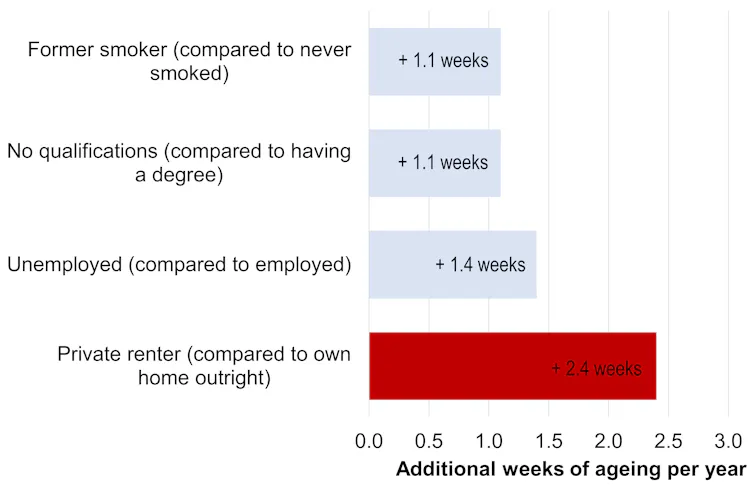
Recent evidence also suggests that insecure housing can result in measurably faster biological ageing, equivalent to the effects of more traditional health concerns like smoking.

Additional weeks of biological ageing per year from different factors

Bar chart showing additional weeks per year for private renting (2.4 weeks) compared to other social determinants of health including unemployment (1.4 weeks), having no qualifications (1.1 weeks) and being a former smoker (1.1 weeks)
Amy Clair

The number of people living in temporary accommodation has risen dramatically, reaching over 130,000 households at the beginning of 2025. This is a 156% increase compared with 2010, largely driven by the poor affordability and insecurity of the private rented sector and lack of social housing. Temporary accommodation is inadequate housing, particularly for children. Living in temporary accommodation was a contributing factor in the deaths of at least 104 children in England between 2019 and 2025, 76 of whom were under one year of age.

This is not about housing quality alone. Temporary accommodation reflects multiple risks brought together: poverty, overcrowding, poor conditions, instability, lack of space for safe infant sleep, poor access to services and wider racial and social inequality. The National Child Mortality Database identifies temporary accommodation as a contributing factor to vulnerability, ill health or death, not necessarily as the sole cause. Emerging evidence also links temporary accommodation with stillbirth and neonatal death.


Read more: Insecure renting ages you faster than owning a home, unemployment or obesity. Better housing policy can change this


Housing health inequality

ONS data shows a very large difference in healthy life expectancy between the most and least deprived areas. In 2022-24, healthy life expectancy in the most deprived areas of England was just 49.8 years for men and 48.2 years for women, compared with 69.2 and 68.5 years in the least deprived areas.

Housing contributes to this difference, determining whether people live in homes that support recovery or deepen stress, whether children grow up in stable and safe environments, and whether older people can remain warm and independent.

If the government is serious about its stated aim to “halve the gap in healthy life expectancy between the richest and poorest regions”, housing policy must become health policy.

That means investing in social housing, enforcing decent standards in the private rented sector, making homes warmer, safer and more accessible, and recognising temporary accommodation, overcrowding and insecurity as public health failures, not just housing management problems.

It also means changing the way that success is measured. Housing policy is too often judged by supply numbers, prices or tenure outcomes. These matter, but they are incomplete. A healthy housing system should also be judged by whether people can live in homes that are affordable, secure, decent, suitable and resilient to climate change.

The decline in healthy life expectancy is a warning light. It tells us that the UK is not only failing to keep people well for longer, it is failing to provide the foundations of health.

The Conversation

Emma Baker receives funding from the Economic and Social Research Council, the Australian Research Council, The National Health and Medical Research Council, and the Australian Housing and Urban Research Institute.

Amy Clair receives funding from the Australian Research Council and the Australian Housing and Urban Research Institute.

Mark Stephens receives funding from ESRC, the EU/Innovate UK and the Australian Housing and Urban Research Institute (AHURI).

  •  

Marty Supreme, Watergate, and menopausal punk-rock rage: what to stream in May

The Conversation

Along with a drop in temperatures, May brings plenty of new streaming options, whether you’re after some classic American political drama, or some local family TV you can enjoy with the kids.

We’ve also got Timothée Chalamet’s Oscar-nominated film Marty Supreme coming to Stan, as well as a new series from Richard Gadd (of Baby Reindeer fame) on HBO Max. Sit back, grab a blanket, and enjoy.

All The President’s Men

Prime Video and Apple TV

All the President’s Men, which has just turned 50, was based on the 1974 book by journalists Bob Woodward and Carl Bernstein, who investigated the Watergate scandal for the Washington Post.

A masterpiece of political cinema, All The President’s Men remains one of the finest films about investigative journalism ever made. Steeped in a fog of paranoia and distrust – an atmosphere shaped in no small part by cinematographer Gordon Willis’ matchless treatment of light and shade – it is as relevant now as it was on first release.

Redford was the driving force behind the film. Convinced that the story demanded a restrained, quasi-documentary approach, he initially envisioned a black-and-white film shot in a pared-back style, with an emphasis on process rather than star power.

Warner Bros, with whom he had a production deal, thought otherwise. Having already agreed to finance the film, the studio insisted that Redford take a leading role – and marketed the as yet-unmade project as “the most devastating detective story” of the century.

The result is an endlessly watchable and quotable (“Follow the money”) film that generates narrative and dramatic tension through the sheer difficultly of knowing anything at all.

In age beset by disinformation, brazen political deceit, strategic obfuscation and collapsing trust in public institutions, that lesson feels less historically distant than it does disturbingly prescient.

– Alexander Howard


Read more: All The President’s Men at 50: one of the finest films about investigative journalism ever made


Caper Crew

ABC iView

The ABC’s new series Caper Crew follows 12-year-old Amelia Delaney (Isabella Zhang) and her 9-year-old brother Kai (Luka Sero), who live in Woodspring, “the most boring town on Earth”. That is, apart from one incident 27 years ago when the infamous Kangaroo Gang stole the town’s priceless golden meteorite. “The Nug” was never found, despite a $100,000 reward.

When their mysterious con-artist grandmother, Queenie, appears out of the blue and starts teaching them the art of the grift, Amelia and Kai can’t help but wonder: was Queenie part of the Kangaroo Gang? Does she know where The Nug is? The siblings join forces with their friends Penelope (Caitlin Niemotko) and Ophelbert (Tevita Hu) on a mission to find the lost object.

The young cast members are very endearing. The adults don’t disappoint, either; Tina Bursill is magnetic as Queenie, while Annie Maynard and ABC-favourite Michael Theo captivate as Mayor Katinkatonk and drama teacher Jojo Encore, respectively.

For parents and carers watching with kids, Caper Crew combines a Wes Anderson-esque visual quality with a nostalgic ode to millennial classics such as Matilda and Harriet the Spy. It may charm younger viewers into taking up magic, or planning their own heists. It also reminds us just how good Australian family TV can be, with a bit of resourcing.

– Alexa Scarlata


Read more: ABC’s Caper Crew delivers heists and heart – a bright spot in a struggling kids’ TV sector


Riot Women

SBS On Demand

“And you thought The Clash were angry!” retorts Beth (Joanna Scanlan), describing her newly-formed punk band of women largely 50 years and over.

Riot Women, a hilarious five-part BBC drama series, champions strong female characters whose dilemmas authentically reflect the female experience. The band’s tracks Hot Flush, I’m Not Done Yet, and Invisible No More counter society’s assumption that menopausal women have a use-by date.

Punk is used as a metaphor for female rampage, rather than the show’s subject – and despite some dark storylines (including suicide and violence against women), the show is a raucous celebration of women on their own terms. These women find joy and energy in mid-life, emerging as formidable because they no longer give a damn.

Riot Women is written by Sally Wainwright and co-directed by Wainwright and the late Amanda Brotchie, an enormously talented Australian director.

The outstanding ensemble cast is drawn from the crème de la crème of British talent, with Joanna Scanlan as Beth, Rosalie Craig as Kitty, Lorraine Ashbourne as Jess, Tamsin Greig as Holly, and Amelia Bullmore as Yvonne.

It’s an original, emotionally resonant and high-quality drama that, like much of Wainwright’s work, doesn’t disappoint.

– Lisa French

Marty Supreme

Stan, from May 15

Marty Supreme is a frenetic tale inspired by Marty Reisman, the charismatic American table tennis champion of the 1950s.

Charged by Timothée Chalamet’s electric lead performance – alongside a stellar supporting cast (including Gwyneth Paltrow), and director Josh Safdie’s signature, anxiety-inducing aesthetic – the film captures a young man’s all-or-nothing quest for greatness.

Marty Mauser is a morally ambiguous protagonist engaged in a sociopathic, self-obsessed pursuit of glory. But Safdie invites the audience to champion his quest. In this, Marty emerges as a particularly compelling entry into Hollywood’s longstanding tradition of unlikable heroes.

How does Safdie succeed in creating a protagonist who – despite lying that his mother died during childbirth and neglecting his pregnant girlfriend – nonetheless wins the audience’s support?

Marty’s championing is undoubtedly in part due to Chalamet’s star image and onscreen charisma. And his quest for greatness depicts the triumphant tale of a figure who, against all odds, continues to pursue his dreams with obsessive belief.

While his extreme measures may be unsympathetic – and perhaps unforgivable – Marty’s fundamental desire to transcend his circumstances remains relatable. His unrelenting commitment to his dream catalyses his moral failing. But he is nonetheless a figure capable of tenderness.

While Marty Supreme dramatises the egotistical pursuit of its flawed protagonist, it ultimately explores the universal ambition to dream big – and questions what is worth sacrificing in order to achieve success.

Oscar Bloomfield


Read more: Antihero Marty Supreme is sociopathic in his pursuit of glory. Why do we want him to win?


Lizard

Mubi

Lizard (2020) is a Sundance-winning short film by British-Nigerian filmmaker and writer, Akinola Davies Jr. Currently streaming on Mubi, alongside Davies’ BAFTA-winning debut feature My Father’s Shadow (2025), it’s a magical and gritty portrait of religion, hypocrisy and violence.

Co-written with his brother, Wale Davies, Lizard is based on Davies Jr’s own childhood experiences. The thematically nuanced 18-minute narrative follows the inquisitive eight-year-old Juwon who, following some misbehaviour and removal from her Sunday school service, confronts the criminal underbelly of her Lagos church.

The fluidity between the real and surreal is central to Davies Jr’s cinematic imagination. Juwon is gifted with the ability to sense danger. Her mystic-like intuition materialises in the presence of the eponymous agama lizard: a figure who leads the young girl through her milieu.

The film masterfully blends elements of the fantastical with realist stylisation. It’s a portrayal of sociopolitical corruption and exploitation, but also extends beyond this. Through Juwon’s child-like imagination, it confronts the processes of understanding trauma and memory – with the film’s sensibilities questioning reality’s supposed superiority over fantasy.

Davies Jr is cementing himself as an exciting, distinctive voice in international cinema. I’m looking forward to watching My Father’s Shadow.

Oscar Bloomfield

Half Man

HBO Max

Richard Gadd is perhaps best known for his hugely successful series, Baby Reindeer. Part of the unsettling thrill of that Emmy-award winning series was watching a dramatisation of Gadd’s own experience of being stalked. We saw a vulnerable protagonist, played by Gadd, drawn into considerably uncomfortable situations.

Now Gadd has returned to our screens with a new series called Half Man. A similar viewing experience to Baby Reindeer is established in the opening episode, where we witness a vulnerable, isolated young man get drawn into a toxic relationship. Gadd is a master at building tension and discomfort.

Niall (Jamie Bell) is visited by his estranged step-brother Ruben (Gadd) on his wedding day. After a violent confrontation, we jump back 30 years to when they were two schoolboys. Ruben has just gotten out of youth detention and, since his mother is dating and living with Niall’s mother, he has no choice but to move in and share Niall’s room.

As boys, a young Ruben (Stuart Campbell) is prone to violent outbursts at any moment, and young Niall (Mitchell Robinson) is shy and bullied by his classmates for being perceived as gay. The early dynamics between the two boys make for incredibly unsettling viewing. But knowing how good the emotional pay-off of Baby Reindeer was, I can’t wait to see where the series goes.

– Stuart Richards

The Conversation

The authors do not work for, consult, own shares in or receive funding from any company or organisation that would benefit from this article, and have disclosed no relevant affiliations beyond their academic appointment.

  •  

Why did Indian lawmakers vote against ensuring more women in parliament?

Indian Prime Minister Narendra Modi suffered a rare defeat last week after a bill to reserve one-third of seats in the lower house of parliament for women failed to get enough support.

The bill was paired with another piece of legislation that would have set in motion the process of redrawing India’s electoral map, increasing the size of the lower house from the current 543 seats to as many as 850.

Women currently comprise about 14% of the Lok Sabha (the lower house). The Inter-Parliamentary Union, a global organisation of national parliaments, ranks India 147th in the world in terms of women’s representation.

The idea of reserving seats for women in parliament has enjoyed broad support across Indian politics, but its implementation has always met with problems.

This time, Modi’s Bharatiya Janata Party (BJP) tried to fast-track the bill while bundling it with the other bill to redraw parliamentary districts based on population – and the opposition baulked. It claimed the former was a Trojan horse to smuggle in the latter.

Why is redistricting so problematic?

That redistricting process, known as delimitation, was originally intended to ensure each citizen’s vote carried roughly equal weight. However, it has been a highly charged political issue.

Opponents claimed delimitation can lead to gerrymandering, giving advantages to BJP candidates over religious minorities. Critics also said the process could unfairly affect the distribution of parliamentary seats among states.

India has not fully redistributed Lok Sabha seats among states since 2001, partly because doing so would penalise states in southern India with lower fertility rates.

Delimitation based on current population figures would grant more seats to India’s more populous northern and central states, while reducing those in the south.

This reallocation would benefit the BJP since its political base lies in the Hindi-speaking northern-central region. For Modi, therefore, delimitation is not merely a constitutional exercise, it is a process that could help strengthen his party’s hold on power in the upcoming 2029 elections.

Why did the government introduce the bills?

The first reason is political credit. The Modi government has long tried to project itself as the driver of large, historic reforms.

And women voters have become central to Indian politics. Across the country, parties increasingly compete for their votes through welfare schemes, cash transfers, cooking gas subsidies, housing programs and other policies.

For the BJP, the push to guarantee parliamentary seats for women carried a powerful political message: the government is not merely delivering welfare to women, but offering them a direct share in political power.

The second reason was strategic. The bills were designed to test whether the opposition could remain united under pressure.

Women’s representation is a politically difficult issue to oppose. Had even a small number of opposition parties broken ranks, or abstained from the vote, the government might have cleared the constitutional threshold to pass the measures.

The third reason is that failure, too, can be politically useful.

If the bills passed, Modi’s government would gain credit for implementing two long-overdue reforms in one masterstroke. If they failed, the opposition could be blamed for blocking women’s empowerment.

In addressing the nation on television soon after the defeat, Modi did precisely that. He accused the opposition Congress party of being an “anti-reform party” that spread lies and confusion.

The opposition, however, stayed united. It called out the government for fusing a popular reform with a politically loaded institutional process that would have given the BJP an electoral advantage.

Where do things go from here?

For the past decade, the BJP’s command over India’s parliament allowed it to set the legislative agenda with confidence. It was able to push through contentious measures with its overwhelming majority and political momentum, while the opposition remained divided.

This defeat shows even a small opposition can still impose limits on a powerful prime minister.

At the same time, the opposition should not mistake this win as the last word on delimitation. It has, at most, postponed the confrontation.

Once the current census is completed early next year, delimitation will return to the political agenda, and the parliamentary arithmetic may look different by then.

Women’s representation gives the opposition an opening. It could call the BJP’s bluff now by tabling a bill for immediate implementation of the 33% quota to see if Modi will support it. The opposition parties could also voluntarily reserve a third of their own candidates for women.

Such a move would force the BJP either to follow suit or risk being exposed on the women’s representation issue ahead of the 2029 elections. It might also yield the opposition electoral dividends, strengthening its hand for the delimitation battle that will follow in the next parliament.

The Conversation

The authors do not work for, consult, own shares in or receive funding from any company or organisation that would benefit from this article, and have disclosed no relevant affiliations beyond their academic appointment.

  •  
❌