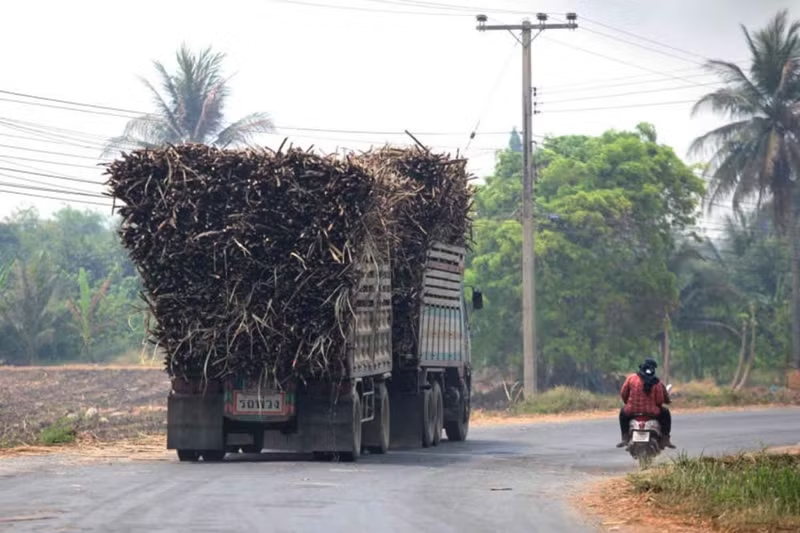
Nantapong Chiralerspong, Director-General of TPSO, said that increased sugar cane and sugar output both in Thailand and the global market, coupled with Indonesia's self-sufficiency policy, require proactive industry adaptation.
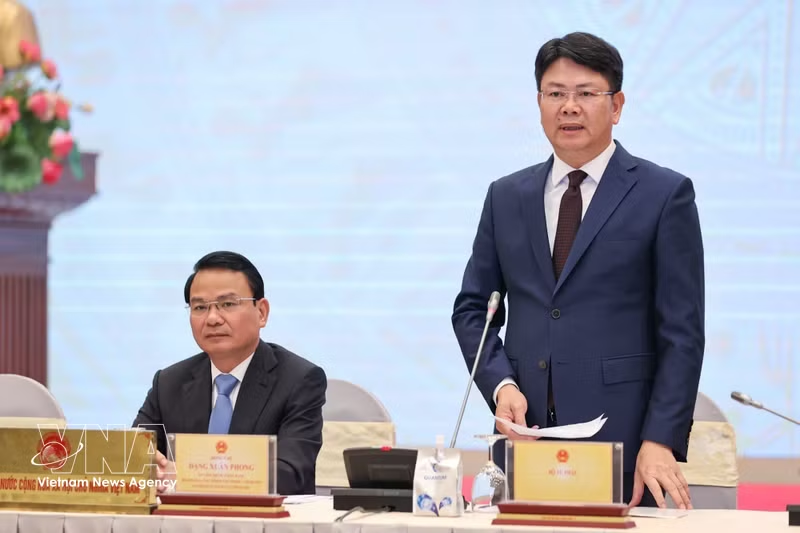
The total number of central-level administrative procedures has been reduced to 1,570, accounting for 27.31%, surpassing the target set by the Government, according to Deputy Minister of Justice Nguyen Thanh Tinh.
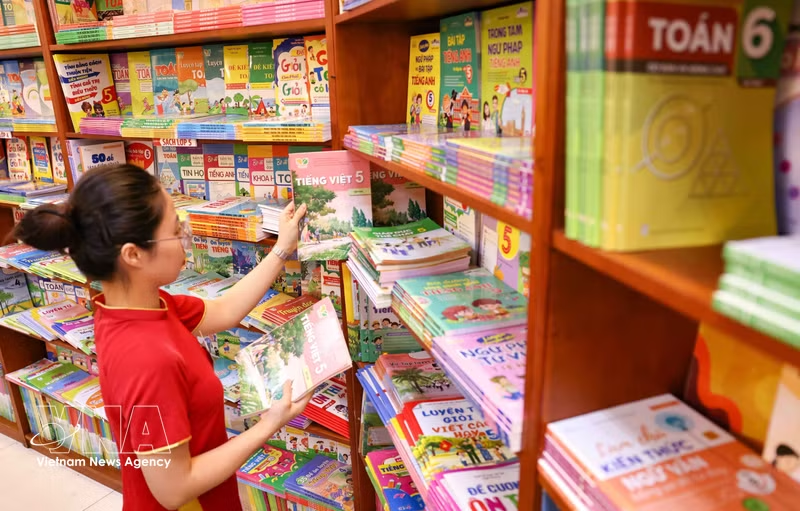
The Ministry of Education and Training has selected the “Ket noi tri thuc voi cuoc song” (Connecting Knowledge with Life) series, published by state-owned Vietnam Education Publishing House (VEPH), from among three existing sets. The education minister approved the choice on December 26, 2025, locking in enough time for preparation before the new school year.
When environmental hazards strike, the damage is usually counted in numbers: how many people died, how many homes were destroyed, how many people were displaced, and how much money it will take to rebuild.
But not all losses and damage can be measured in financial terms. Some of the most profound impacts of climate-induced disasters are emotional, cultural and social, affecting how people feel, relate to each other and think about their world.
We are scientists who research environmental hazards, climate change impacts and development practice. We wanted to find out what recovery meant for survivors of Tropical Cyclone Idai, which hit eastern Zimbabwe’s Chimanimani District for five days in 2019, turning mountains into mudslides and leaving hundreds of people dead.
We interviewed community members, including survivors and local leaders, and held discussions with government officials and aid organisations. We also spent time in affected communities, observing daily life and listening to how people spoke about the disaster and its aftermath. This allowed us to capture not just what had happened, but what it meant to those who’d lived through it.
Our research found that survivors of climate disasters didn’t only speak of losing their houses and other material goods. They also talked of grief, dislocation, loss of places of cultural significance, and a lingering sense that life would never return to what it once was.
These experiences are harder to quantify, but no less important. If recovery efforts overlook these less visible losses, they leave deep social and emotional wounds unaddressed.
Disaster recovery is not just about rebuilding material objects or infrastructure. It is about rebuilding lives.
The hidden losses
Tropical Cyclone Idai affected over 3 million people across Malawi, Mozambique and Zimbabwe. In many places, it destroyed whole communities. In eastern Zimbabwe’s Chimanimani District hundreds died, many people went missing, and thousands were displaced from their ancestral lands.
Cyclone Idai, 2019. Al Jazeera.
The cost of the economic losses and damage was more than US$2 billion. This amount does not include the non-economic losses – the damage to people’s sense of belonging, identity, relationships and emotional well-being that cannot be measured by money.
Our findings show that Cyclone Idai caused four major types of non-economic loss:
Loss of life and lasting trauma
The cyclone caused floods in the middle of the night, while people were sleeping, leaving them little chance to escape to higher ground before their houses collapsed or were washed away. Many families lost loved ones and said that grief remained a constant presence. A survivor told us:
What changed most is that we were a big family, but we lost two kids due to the cyclone. That alone has changed our lives and has affected us very much. We can hardly move forward because of these bad memories that we still have.
More than two years after the cyclone, some people said they still lived with injuries that prevented them from working or living as they once did. Mental health impacts, including anxiety, insomnia and post-traumatic stress, are widespread yet rarely addressed in formal recovery efforts.
Loss of sense of place and belonging
Displacement was one of the most significant consequences of the tropical cyclone. Families were moved to temporary camps and, later, resettled in new areas that were often very different from their original homes.
For example, people who had survived by farming and selling bananas were moved to a government housing compound (Runyararo village), where low rainfall makes it difficult to grow the fruit.
Their new area also has no tarred roads or electricity, yet people who had lived in urban and peri-urban areas were moved there. For many, this meant more than just relocation. It involved losing connection to ancestral land, familiar environments and ways of life. As one survivor described, it felt like being uprooted not just physically, but emotionally and culturally.
Breakdown of social networks
Before the cyclone, communities in Chimanimani were tightly connected through kinship, shared histories and mutual support systems. The disaster fractured these networks by separating families and neighbours. One survivor said:
We lost our younger daughter to the tropical cyclone. The older one is now living with my parents in another village, as we no longer have space … Since then, we have been helpless.
Well-intentioned aid agencies had various ways of describing the cyclone survivors – as “victims”, “directly affected people” or “beneficiaries or non-beneficiaries of disaster aid”. Our research found that using different labels for the survivors created new social tensions within communities that were already under strain.
Disruption of cultural and spiritual life
Tropical Cyclone Idai also disrupted cultural practices and belief systems. Sacred sites were destroyed, and burial rituals, which are deeply significant in local traditions, could not always be properly observed. Bodies were handled hastily due to damaged mortuaries, the absence of electricity, and acute labour shortages.
Some people were buried in pairs, which is against the Ndau culture of the area. A cultural leader said:
It was not proper to bury people who were not related, who did not share a totem, in one grave.
Breaking with established burial customs created a sense of spiritual unease and disturbed the moral and cultural order that helps people make sense of life and death.
A more human approach to disaster response
Climate change has been shown to intensify extreme weather events like Cyclone Idai, increasing both their severity and impacts. This is why disaster policies matter, including what governments and agencies do after extreme weather catastrophes.
Our research shows that disaster response must go beyond financial compensation and physical reconstruction. It must support survivors with the emotional and non-material dimensions of well-being.
Most importantly, it should involve affected communities in decision-making, ensuring that their experiences and priorities are recognised.
This is also a matter of justice. Whose losses are acknowledged? Whose voices are heard, and who gets support?
The stories from Chimanimani remind us that extreme weather and climate disasters tear apart the very fabric of life. When attention is focused mainly on what can be seen and measured, other forms of suffering remain invisible. But these “invisible” losses shape how people recover.
Emotional trauma can affect livelihoods. Loss of social networks can weaken resilience. Disconnection from place and culture can make it harder to rebuild a meaningful life.
Listening to these experiences is essential for building recovery efforts that are both effective and humane.
The authors do not work for, consult, own shares in or receive funding from any company or organisation that would benefit from this article, and have disclosed no relevant affiliations beyond their academic appointment.
Nigerians have no reliable way of scrutinising the national budget. The citizen’s portal of the Nigerian Budget Office of the Federation is often offline, and when it is online, it is highly technical and difficult for ordinary citizens to understand.
Data on the Nigerian budget sourced elsewhere online is also frequently hard to find and incomplete. As a result, the Nigerian budget is treated like a government secret and Nigerian citizens are unable to effectively scrutinise the government’s income and expenditure decisions.
My research shows that this disrupts the social contract between the citizens and the government of Nigeria and creates an opportunity for corruption.
The World Justice Project estimates that corruption has cost the Nigerian economy more than US$550 billion since 1960. And a report by the accounting firm PwC shows that corruption in Nigeria could cost up to 37% of the nation’s GDP by 2030 if it’s not dealt with immediately.
I am an economist whose research focuses on poverty and corruption reduction. In a recent paper, I show how secrecy fuels corruption in the management of Nigeria’s finances. I set out how citizen monitoring and digital engagement can enhance transparency and accountability.
I also identify some obstacles to making this a reality in Nigeria. These include technical capacity limitations, weak enforcement mechanisms, and political resistance.
To overcome these challenges, the government must invest in digital infrastructure. Fostering civic engagement and independent oversight, too, can ensure sustained accountability and effective implementation.
Budgetary secrecy and corruption in Nigeria
The Open Budget Survey is produced by the International Budget Partnership. It provides the main global assessment of budget accountability in the world and evaluates:
public participation: formal and meaningful opportunities for the public to engage in the national budget process
oversight: institutions such as the legislature, national audit office and independent bodies
transparency: comprehensive budget information, made available to the public in a timely and accessible manner.
Nigeria performed poorly in the 2023 survey. It scored 19/100 in public participation, 61/100 in oversight, and 31/100 in transparency. It ranked 92 out of 125 countries. This was below several African peers and the global average of 45.
This marks a decline from 2021. Nigeria scored higher then in public participation (26) and transparency (45), while oversight has remained unchanged.
The drop is largely due to the government’s failure to publish key fiscal reports on time. These include in-year reports and mid-year reviews.
The source of the problem
My research found that government budgetary secrecy and corruption in Nigeria have historical roots. They stem from the era of colonial taxation, when colonialists collected taxes but didn’t invest in the people’s wellbeing.
Secondly, through the budgeting of non-beneficial initiatives. Nigeria’s approved federal budget for 2025 included US$1.5 billion for health, US$2.5 billion for education and US$1.7 billion for agriculture. However, a whopping US$17 billion was allocated for the presidency.
Thirdly, through inflated figures for budgeted items. For example, the purchase of a car for ₦375 million (US$278,000).
At the federal level, the budget is prepared by the executive (president and ministries). It is coordinated by the Budget Office, approved by the National Assembly, and enacted as the “Appropriation Act”. However, limited and delayed fiscal disclosures enable budget padding, vague allocations, and weak expenditure tracking.
At the state level, budgets are prepared by governors and state ministries. They are approved by the State Houses of Assembly, focusing on state needs. However, inconsistent publication of budgets and reports at this level makes it difficult to monitor spending and creates room for misallocation.
At the local level, budgets are prepared by local government officials. However, they are heavily influenced by state governments and approved by local councils. Here, a lack of financial autonomy and state control over funds leads to diversion, ghost projects, and minimal accountability to citizens.
The solution
The Nigerian government says it also has an Open Treasury Portal that provides transparency in its budgeting system. My research shows that this platform also suffers from technical glitches, incomplete data, and low enforcement.
BudgIT, a Nigerian civic technology organisation, uses data visualisation and storytelling to try to make the government budget more accessible to citizens, but its impact is also limited by insufficient data availability.
Advances in information technology make it possible for Nigeria to build a real-time online government budget system that the public can access and monitor. This would cover financial statements and reports across federal, state and local governments. Nigerians could also use a system like this to vote on projects the government should focus on.
South Korea has a similar model. Known as the Digital Budget and Accounting System (dBrain), it is a fully integrated system for budget planning, execution and monitoring of government finances across agencies in real time.
Another country, Georgia, has an e-budget transparency system. It provides real-time budget execution data and is integrated with the goverment’s e-procurement and treasury systems.
The US also has the USAspending.gov service, which tracks federal spending in real time and provides publicly accessible and searchable data on what the federal government spends.
Importantly, real-time online budget monitoring enables quick detection of corruption, but its effectiveness depends on clear and consistently enforced penalties.
What needs to be done
An online government budget system which the public could monitor would improve transparency and accountability in Nigeria. Technologies such as Enterprise Resource Planning systems and Integrated Financial Management Information systems enable real-time budget tracking and integrated financial management. Blockchain can further strengthen transparency through secure records. Also, cloud computing can improve accessibility and data security.
Data analytics and AI can enhance forecasting, automate monitoring, and improve decision-making. This would make budgeting more efficient, transparent and responsive.
The Nigeria Tax Administration Act has introduced a digital tax system requiring Nigerian taxpayers to keep accurate transaction records.
The Nigerian government aims to use this to improve efficiency, accuracy and transparency in its tax system. The government should implement a similar system for all its own financial transactions.
Tolu Olarewaju does not work for, consult, own shares in or receive funding from any company or organisation that would benefit from this article, and has disclosed no relevant affiliations beyond their academic appointment.
Across Africa and beyond, education systems are shifting to curricula designed to build critical thinking and problem-solving skills.
Competency-based curricula put learners at the centre. They are meant to prepare students for a rapidly changing world, where success depends on the ability to adapt, think critically and solve complex problems.
Unlike traditional curricula, which often emphasise covering content and memorising facts, competency-based curricula focus on how students apply what they learn in real-world situations. For example, instead of simply recalling scientific definitions, students might be asked to use a concept to explain how diseases spread.
Much of the discussion around this shift in education has focused on familiar challenges, including teacher preparedness, availability of learning materials, and how faithfully the curriculum is implemented.
While these factors are important, they do not fully explain why reforms often fall short of their intended goals, particularly in improving how students learn and develop competencies.
In a recent study I co-authored, published in Discover Education, we reviewed evidence from different countries, including Ghana, Kenya and Vietnam, about what is undermining learner-centred education. We found that the main constraint to reforms in teaching is assessment systems. Teaching and testing systems are mismatched. While curricula promote skills like critical thinking and problem-solving, national exams want learners to memorise facts and follow routine procedures. So that’s what teachers concentrate on.
The misalignment is holding students back from success: being able to apply what they learn in real-world situations. This ability is essential for further education, employment and everyday decision-making.
Exams shape what counts
In our study, we set out to understand why learner-centred reforms, which are central to competency-based education, often fail to produce meaningful changes in classroom practice. We reviewed research and policy evidence from multiple countries across Africa, Asia and beyond, focusing on how national assessment systems interact with curriculum reforms.
We found a pattern: high-stakes exams do more than assess learning; they shape what teachers teach and what students focus on.
Our analysis shows that this creates a “double bind” for teachers. They are expected to promote critical thinking and problem-solving, while also preparing students for exams that reward recall and procedural accuracy. In practice, this often leads to surface-level reforms. New methods are introduced but teaching remains focused on memorisation.
In many African countries, examinations such as the West African Senior School Certificate Examination and Kenya’s National Secondary School Exams exert strong pressure on teachers.
Assessment should focus less on what students can recall and more on what they can do with what they know. This could include tasks that require analysis, problem-solving and application in real-world contexts.
It also means moving beyond a single high-stakes test. Combining national examinations with school-based assessments (such as projects or portfolios) can provide a more complete picture of learning.
The challenge is to do this in ways that remain fair, reliable and scalable across entire education systems.
A practical way forward
In our study, we propose a practical way to address this misalignment. We call it the LEARN model (Learner-centred assessment design; Evidence of competence; Adaptive to context; Reflective and feedback oriented; Nationally relevant and scalable). It offers a system-level framework for policymakers and education systems to redesign assessment so that it supports curriculum reforms.
designing assessments that reflect how students learn, using tasks that require applying knowledge rather than simple recall
focusing on evidence of competence rather than recall, emphasising what students can do with what they know
allowing flexibility to adapt to different classroom and national contexts
integrating feedback into assessment so that it supports learning, instead of just measuring it
ensuring that systems remain nationally relevant while still being practical to implement at scale.
The model shifts the focus from standardising test formats to aligning what is assessed with what matters.
Our model shows it is possible to balance two goals that are often seen as competing: maintaining national standards while supporting meaningful learning.
Frank Quansah does not work for, consult, own shares in or receive funding from any company or organisation that would benefit from this article, and has disclosed no relevant affiliations beyond their academic appointment.
Robert Kyagulanyi Ssentamu, popularly known as Bobi Wine, is a Ugandan music star and political leader currently in exile. Framing his movement as a “people power” struggle by young Ugandans for democratic transition, he is a vocal critic of the regime.
After a disputed election in January won by long time ruler Yoweri Museveni, his home was besieged by soldiers, and he managed to escape with the help of his supporters. He fled to the US.
Before politics, Bobi Wine was known as a musician. He is one of east Africa’s major artists, having built a huge fan base with his socially conscious reggae and dancehall songs.
During his recenttour of Harvard University, where he met students and members of the Ugandan diaspora, I had the opportunity to talk with him. As a scholar of African literature, I was keen to know about the stories and ideas that sustain his conviction.
Listening to him was a reminder that political imagination is often rooted in artistic and intellectual traditions. He continues to draw on some of these traditions as he navigates the demands of public life.
Tinashe Mushakavanhu: You come from Kampala, a city that was once a gathering place for African writers and intellectuals. Which writers – Ugandan, African, or beyond – have most influenced your thinking?
Bobi Wine: (Nigerian novelist) Chinua Achebe’s Things Fall Apart. It was the first book I ever read cover to cover, and it made me fall in love with African writers. I was also inspired by writers like (Kenyan author and academic) Ngũgĩ wa Thiong’o, and (Ugandan surgeon and author) Tumusiime Rushedge.
Of course, I must add that we do not have that same space anymore, because many of our writers face repercussions. Recently, a great writer called Joe Nam was gunned down in his house after he published a book called The Day Museveni Goes: Reflections, Questions, Fears, Hope. We strongly believe it was because of the book.
So it is tough. I mean, you cannot find these works anywhere, but the revolutionary and stubborn spirit keeps leading us to where we want to go, and keeps us giving all we have, even when we might otherwise have given up. It keeps us speaking even when it is dangerous.
And also, online has helped a great deal, people can now get books from the internet. Writers have been constantly targeted and killed, and this goes back to the days of Idi Amin, when writers were brazenly persecuted and killed. I was, and will continue to be, influenced by great writers and great books.
Tinashe Mushakavanhu: You studied theatre; who are your favourite playwrights?
Bobi Wine: My favourite playwrights include (Nigeria’s) Wole Soyinka and all my teachers at Makerere.
Tinashe Mushakavanhu: As a graduate of Makerere University in Uganda, home to the historic 1962 Conference of African Writers of English Expression, how do you see yourself in relation to that literary legacy? Are there Ugandan writers whose work you feel particularly connected to today?
Bobi Wine: Today, it is not only about writers and literature; it has largely broadened. It is about poets, comics, visual artists, singers, and especially rappers, who are the philosophers of the people.
I always wanted to be a writer myself, but studying our people taught me something: they don’t read as much as before – they listen, they dance, they gather around sound. So I meet them where they are, in the studio, on the stage, on the dance floor, and that’s where I deliver my message.
Tinashe Mushakavanhu: Is there a book or books you find yourself returning to, one that continues to offer new meaning at different moments in your life; perhaps one that is always in your carry-on bag or on your bedside table?
Bobi Wine: Betrayed by My Leader, written by John Kazoora, one of (Ugandan president Yoweri) Museveni’s former comrades, who also died under suspicious circumstances. He writes about the hope and disappointment of the armed struggle that brought Museveni to power. He was a grounded man; he was a revolutionary. It is this book that touches me most deeply. It shows me the pain of trust, but also reminds me of what can happen.
Tinashe Mushakavanhu: As both a political leader and a musician, how do you see the relationship between music, literature and political expression in your work?
Bobi Wine: Music and literature are not separate, they move together. Historically, they go back to the days of slavery, the days of colonialism, the days of the armed resistance against dictatorship, music has always carried the message.
It is art, it is music, it is the recital of powerful ideas and spoken word that carries memory, protest and truth. It is the most effective way of carrying messages from one generation to another, from one group to another, from one region to another. So you can’t separate them.
No wonder art is now also being used against the people, to the extent that artists are bought and paid for. They’re compromised to change their values. I am a musician, and my music is banned in Uganda. Why? Because of the effectiveness of music.
Tinashe Mushakavanhu: Finally, if you were to create a short playlist to accompany a reading list – songs that speak to the same themes as the books that inspire you – what would be on it?
Tinashe Mushakavanhu does not work for, consult, own shares in or receive funding from any company or organisation that would benefit from this article, and has disclosed no relevant affiliations beyond their academic appointment.
Participants agreed the crisis, though expected to last up to 18 months, offers a key opportunity for Malaysia and ASEAN to reshape their economic models through innovation, stronger public-private partnerships, and data-driven governance.
What kind of education best helps students learn math?
In the province of Ontario, the most recent provincial standardized results (2024–25) show modest improvement in elementary mathematics achievement, but overall performance remains uneven, particularly in the junior grades.
Provincially, 64 per cent of Grade 3 students met the provincial standard, up from 61 per cent the previous year. In contrast, only 51 per cent of Grade 6 students met the standard, indicating that about half of students are not yet achieving expected levels by the end of the junior division.
Student attitudes toward mathematics also decline with age: while 67 per cent of Grade 3 students reported liking mathematics, this dropped to 48 per cent in Grade 6.
These results suggest gradual recovery following COVID-19 pandemic disruptions, but they also point to the necessity for more work to be done for both teachers and students to develop a deeper understanding of the 2020 math curriculum. This curriculum incorporated new priorities like social–emotional learning, coding, mathematical modelling and financial literacy.
In our research with a “Sister School Network” project, generalist elementary teachers from a Windsor, Ont. public school and mathematics specialist teachers from a Chongqing, China primary school participated in monthly online knowledge-sharing meetings.
At the meetings, teachers shared and compared curriculum. They offered demonstrations on topics such as fractions, multiplication and estimation, and discussed student learning and parent engagement.
From 2016 to 2019, Xu and I co-ordinated these monthly exchanges and organized visits of Canadian teachers to Chongqing as well as Chinese teachers’ visits to Windsor.
Chinese mathematics specialist teachers deeply appreciated the strengths of Ontario’s generalist model — particularly the comprehensive learning support provided to students with diverse needs and the high level of professional autonomy granted to teachers.
One Chinese participant with more than 20 years of mathematics teaching experience reflected:
“I wish we could have a special education support system like in Canada.”
Such perspectives highlight a key strength of Ontario’s elementary generalist system — one that educators in the province can take pride in. In an interview I did with mathematics education researcher Christine Suurtamm, whose research has engaged international perspectives on mathematics education and Canadian teachers’ practice, Suurtamm noted:
In my study, a Grade 5 Canadian teacher also appreciated the opportunity to co-plan and co-teach with a Chinese mathematics specialist teacher. In interviews, the teacher emphasized a deep appreciation for this collaborative approach and expressed the hope that Canadian schools could provide more structured opportunities for such professional collaboration.
In my interview with Suurtamm, she also noted it would be worthwhile if Ontario teachers had more time to develop their math lessons in collaboration with other teachers.
In 2023, Ontario announced funds to double the number of school mathematics coaches. Research about how and where the coaching model has been implemented, how teachers are relying on it and its real effects in the classroom would help gain insight into the efficacy of this approach.
Challenges with Ontario math education
My research also suggested ways Ontario mathematics education might learn from Chinese mathematics learning.
Two key challenges emerge in Ontario mathematics teaching. First, teacher collaboration is limited. Unlike Chinese mathematics specialists who routinely engage in co-planning, lesson observation and collective reflection, Canadian generalist teachers have few structured opportunities for sustained collaboration, despite a clear desire for it.
Second, the consolidation of mathematical learning seen in Ontario is relatively weak. One Chinese math specialist teacher described teaching mathematics as a dynamic balance between Fang (放) — encouraging open exploration and the use of multiple strategies — and Shou (收) — a structured consolidation phase. In this phase, key ideas are clarified, connections are synthesized and methods are formalized.
Ontario educators and policymakers may consider these insights in ways that are responsive to local situations.
Curriculum and approaches evolve
Overall, my collaborative research views improving mathematics teaching and curricula as an ongoing and progressive process.
As Suurtamm notes, curriculum changes should be approached as an evolution rather than a revolution. Changes build thoughtfully on existing foundations rather than seeking to replace them wholesale.
Before pursuing new directions, it is important to reflect on and recognize the strengths that already characterize Ontario’s mathematics education system.
Chenkai Chi receives funding from SSHRC Doctoral Fellowship, Ontario Graduate Scholarship and Mitacs Globalink Fellowship.
For decades, psychology and neuroscience have suggested that if humans and animals naturally try to make as little effort as possible, it is because putting in the effort is not enjoyable.
Another possible interpretation: is that it’s not the actual effort that individuals avoid, it’s the effort wasted – effort that leads you nowhere or whose benefits do not justify putting in the effort. This vision is explored in a recent article I co-wrote with Roy Baumeister at Harvard University, Guido Gendolla at the University of Geneva, and Michel Audiffren from the University of Poitiers and published in 2026 in Neuroscience & Biobehavioral Reviews.
Let me explain:
How did we come to pinpoint that it’s effort-wasting that people avoid rather than actual effort?
To support our thesis, we conducted a critical, two-pronged synthesis of the scientific literature. First looking at child development. We thought that, if the effort was intrinsically unpleasant, effort rejection should be observed very early in development.
Infants and young children do not show any spontaneous aversion to effort: they engage in it freely, associate pleasure with satisfaction, and only learn how to spare their efforts gradually. The example of 10-month-olds is particularly striking: after watching an adult persevere in a difficult task, they themselves redouble their efforts to solve a problem.
Later on, at around 6 years old, children smile more after achieving something difficult than when something is easy – as if the acutal resistance involved added value to their success. If effort were intrinsically aversive, none of this would be possible.
Secondly, we focused on studies of the “least effort principle” in animals and adults. The preference for the least costly path in terms of effort emerges only when the rewards are strictly equivalent – and disappears as soon as the benefits justify the investment.
Better still, several studies show that people prefer to actively engage in a task rather than remain passive, and that busy people are happier than idle people, even when they are forced to be active.
Why is this so important?
This shift in perspective is transforming our understanding of human motivation. It makes it possible to solve what some call the “paradox of effort”: if there is indeed a biological law of “least effort”, then how can we explain why millions of people voluntarily engage in demanding activities such as extreme sports, learning an instrument, lengthy studies – and find them enjoyable?
If effort is perceived as a neutral cost (i.e. neither positively nor negatively balanced), comparable to spending money, then it becomes logical that people agree to put in the effort when it pays off.
This approach reinstates human beings as agents capable of evaluating and making decisions, rather than as an organism perpetually battling against a biological repulsion to action. It also makes it possible to better distinguish between ordinary situations of disengagement – when faced with something deemed unfavourable – and pathological cases, where a real aversion to effort may arise.
In the second case, such resistance to effort is based on well-identified neurobiological mechanisms, notably a reduced activity of the dopaminergic system.
Dopamine plays a central role in motivation in this respect: it strengthens the sense of reward and stimulates the pursuit of goals. When dopamine is lacking, effort becomes truly unpleasant and the desire to engage withers away.
What should be the next steps for this research?
Several questions remain open.
It is still unclear in what conditions some people develop a real aversion to effort and which neurobiological mechanisms are involved. Dopamine function is often cited, but research has mainly focused on situations involving external rewards. However, few studies examine the intrinsic motivations behind actually seeking effort for the sake of it.
One practical question still stands: what if, rather than seeking to make tasks less burdensome in schools, at work, and in care sectors – we primarily sought to make them more justified and useful in the eyes of those who are required to do them? This could make all the difference.
The Research Brief is a short, three-minute take on interesting academic work with context and commentary from the academics themselves.
A weekly e-mail in English featuring expertise from scholars and researchers. It provides an introduction to the diversity of research coming out of the continent and considers some of the key issues facing European countries. Get the newsletter!
Nathalie André ne travaille pas, ne conseille pas, ne possède pas de parts, ne reçoit pas de fonds d'une organisation qui pourrait tirer profit de cet article, et n'a déclaré aucune autre affiliation que son organisme de recherche.
When delegates gathered for COP30 in Belém, Brazil in November 2025, they scrutinized various sectors of the global economy for their contributions to rising greenhouse gases. Agriculture, aviation, steel, cement — all were on the table. One topic not discussed was war.
Recently published research calculated that the first 15 months of Israel’s war in Gaza generated more than 33 million tonnes of CO₂ equivalent, comparable to the combined 2023 annual emissions of Costa Rica and Slovenia.
In February 2026, Israel and the United States launched a war against Iran, joining a long list of other conflicts where emissions go uncounted in global inventories.
These are massive emissions, and they are generated with no formal mechanism to record, report or attribute them, and no accountability for the climate costs that affect people in conflict zones and far beyond.
A recent article by Neta Crawford, a researcher with the Cost of War project at Brown University, highlights how armed forces, militarization and war fuel climate change. She argues that military emissions and conflict-related emissions remain undercounted, even though they undermine efforts to mitigate climate change.
The military emissions gap
Estimates suggest militaries and their supply chains account for approximately 5.5 per cent of global greenhouse gas emissions, which is enough to make them the world’s fourth largest emitter if counted as a country. And that figure only covers peacetime.
This is what researchers call the military emissions gap: the difference in emissions between what governments report and what their armed forces actually emit.
The problem starts with the rules. Under the United Nations Framework Convention on Climate Change (UNFCCC), countries have been exempt from fully reporting military emissions since the Kyoto Protocol negotiations in the 1990s. The United States successfully lobbied for the exclusion on national security grounds.
The top three military spenders — the U.S., China and Russia — either submit no data or incomplete, non-disaggregated figures. This is a structural blind spot that excludes one of the most carbon-intensive sectors from meaningful accountability.
What wars cost the climate
Crawford’s study on Gaza provides a comprehensive account of the war’s full carbon cycle. It found that direct combat emissions — jets, rockets, artillery, military vehicles — account for just 1.3 million of the 33.2 million tonnes of CO₂ equivalent.
Russia’s attacks on electrical infrastructure have further released sulphur hexafluoride, a greenhouse gas 24,000 times more potent than CO₂, from high-voltage switching gear. And the rerouting of civilian aircraft around Ukrainian and Russian airspace has added an estimated 20 million extra tonnes of CO₂ equivalent compared to pre-invasion flight paths.
In Iran, it is estimated that the U.S.-Israel war has unleashed over five million tonnes of CO₂ equivalent — largely from infrastructure destruction and energy-related impacts.
In July 2025, the International Court of Justice (ICJ) delivered an advisory opinion establishing that states have binding obligations to assess, report and mitigate harms to the climate system. In a separate declaration, ICJ judge Sarah Cleveland stated that those obligations extend to harms resulting from armed conflicts and other military activities.
The UN General Assembly has called for Russia to compensate Ukraine for all damages resulting from its invasion. When wars of aggression are launched, the emissions generated in fighting them, surviving them and rebuilding belong on the aggressor’s carbon ledger. When Russia invaded Ukraine, it generated a climate debt on behalf of the entire planet. The same can be said of other aggressors.
The Intergovernmental Panel on Climate Change (IPCC) is the UN body responsible for assessing the science related to climate change. The IPCC is currently in its seventh assessment cycle, with reports expected in late 2029.
This assessment cycle must include a dedicated report for conflict emissions covering infrastructure destruction, fighting and post-conflict reconstruction. The UNFCCC must make reporting military emissions mandatory and develop a framework for attributing conflict emissions under its Enhanced Transparency Framework.
Civil society and academia have already done the hard work of showing it can be done. Organizations like the Conflict and Environment Observatory have built methodologies from scratch, using open-source data. The science exists. What’s lacking is the political will to enshrine it in global climate governance.
Every degree of warming we are trying to avoid is undermined by wars. Accounting for conflict emissions is a vital way to make climate science whole.
This article was co-authored by researchers who are part of the Accelerating Community Energy Transformation initiative: Curran Crawford, Basma Majerbi, Madeleine McPherson (University of Victoria) and Samaneh Shahgaldi (Université du Québec à Trois-Rivières).
Tamara Krawchenko does not work for, consult, own shares in or receive funding from any company or organisation that would benefit from this article, and has disclosed no relevant affiliations beyond their academic appointment.
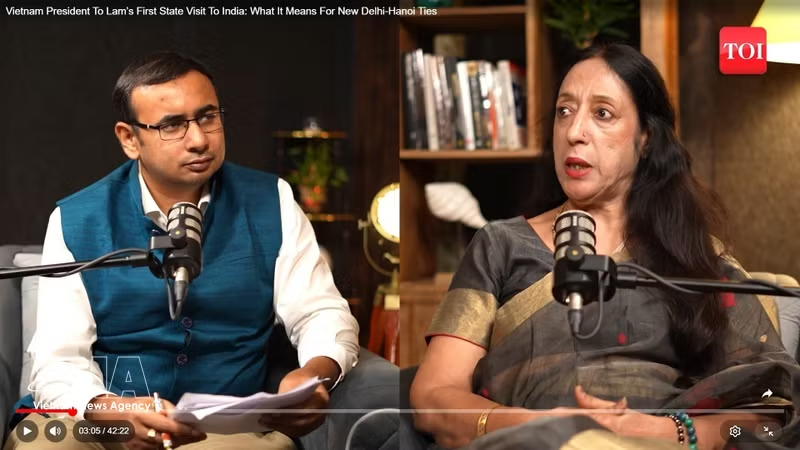
With strong political trust, converging strategic interests and broad cooperation potential, the visit by Party General Secretary and President To Lam is expected to inject fresh momentum into Vietnam–India relations, both bilaterally and within the evolving Indo-Pacific regional architecture.

 Login
Login