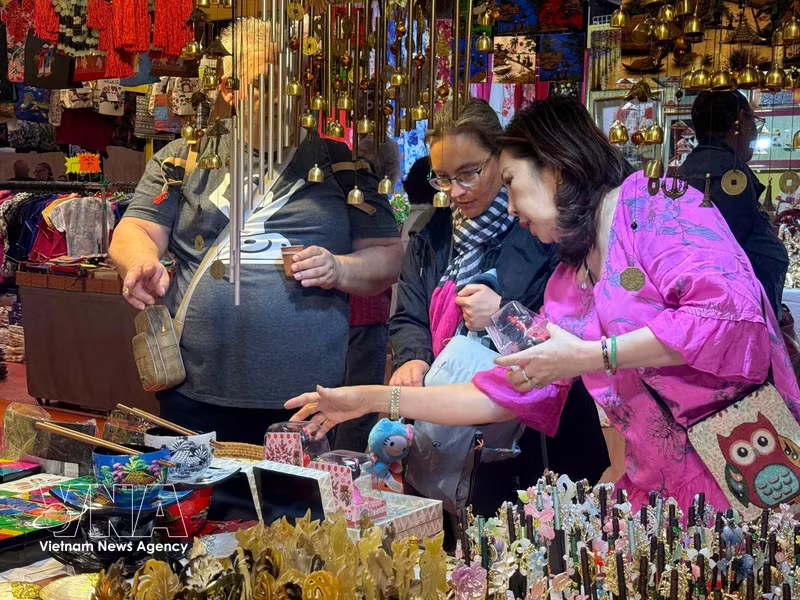
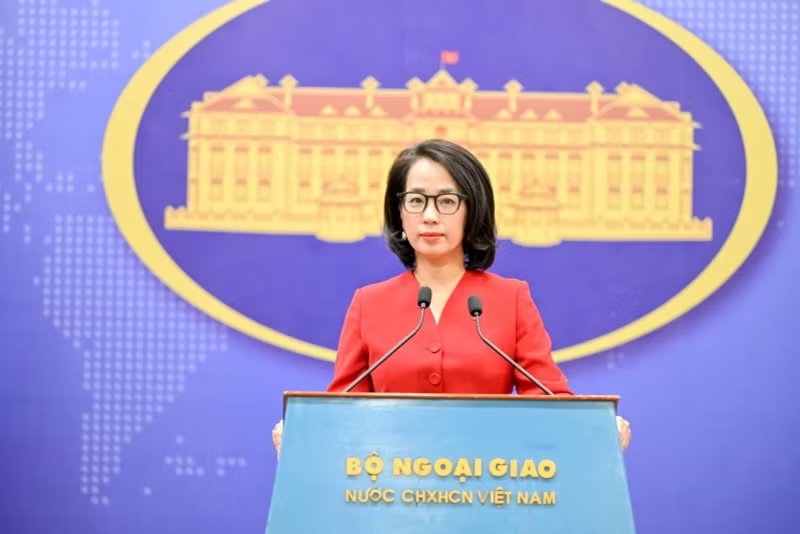
Amid deepening international integration, the presence of Vietnamese enterprises at the annual Foire de Paris continues to affirm the appeal of Vietnamese goods and culture in the French market. The event also provides an opportunity for Vietnamese businesses to directly engage with French and European consumers, thereby strengthening their foothold in this promising market.
The UK has raised its terror threat level from “substantial” to “severe”, meaning an attack within the next six months is considered highly likely. The change means the threat level is at severe for the first time in four years. It came with a warning from the Home Office of an increased threat from individuals and small groups based in the UK.
Counter-terrorism in the UK centres on a strategy known as Contest – a key part of this is the Prevent programme. The primary objective of Prevent, as the name suggests, is to stop people becoming involved in terrorism or from supporting extremist ideologies.
As such, it is designed to deliver tailored early-intervention aimed at addressing risks of radicalisation, extremism and terrorism.
In my experience as a researcher in counter-terrorism studies, I have engaged extensively with Prevent practitioners. I have gained an insight into their work, which is carried out with commitment and dedication despite constraints in funding and resources.
A Prevent referral does not imply that someone has committed, or is suspected of committing, a criminal offence. Rather, it indicates that a professional with a statutory “Prevent duty” has raised concerns about someone’s behaviour, expressions or vulnerabilities. These professionals include teachers, healthcare workers and or social workers.
Recent data illustrates the scale of the programme: between April 2024 and March 2025, 8,778 people were referred to Prevent. This is the highest figure recorded since data collection began in 2015.
Notably, a significant proportion of these referrals involve young people, with 36% (3,192 cases) concerning children aged 11 to 15. A further 1,178 cases involved those aged 16 and 17.
The criteria for referral are broad, and they can include observable changes in behaviour, expressing extremist views, or signs of vulnerability that could make someone more susceptible to being radicalised.
Referrals are assessed by a panel that often include representatives from education, social services and law enforcement. In many cases, referrals do not progress beyond this initial stage. Instead, they may be signposted to other teams, such as social services, for more support.
But where there are still concerns, individuals may be offered support through the Channel programme. This is Prevent’s primary de-radicalisation mechanism. Channel is voluntary and confidential, and referrals can come from anyone and from any context. They are often issued by the police and education sector.
The support is tailored to the specific needs in each case and may include mentoring and mental health support. Participation is voluntary, and individuals can refuse to be involved or stop participating at any point.
Critics argue that it can result in referrals based on ambiguous or misinterpreted behaviour. As such it has the potential to reinforce polarisation, particularly in relation to specific groups such as Muslims. This can clearly leave people feeling stigmatised, under surveillance or unfairly judged, particularly if they believe the referral was based on cultural, religious or political misunderstandings.
The scheme also has significant structural limitations as it functions as a time-limited intervention rather than a system of ongoing monitoring. Once a case is closed, the person is not subject to continuous oversight. This means that a previous referral does not eliminate the possibility of future risk – it simply means that the threshold for intervention was not met at that time.
It is important to remember that positive stories rarely get widespread attention. Every year, thousands of people in the UK receive early support and successfully disengage from radical and extremist ideologies.
Prevent operates in a difficult space between safeguarding and security, where risk is assessed before an offence occurs. While high-profile cases can amplify perceptions of failure, they do not reflect the full picture. Most referrals do not lead to further action, and many result in early, voluntary support that helps people disengage from harmful pathways.
At the same time, concerns around ambiguity and stigma remain valid. In short, rather than seeing Prevent as a measure of guilt, it’s important to recognise its limitations and its role as an early intervention tool.
Elisa Orofino does not work for, consult, own shares in or receive funding from any company or organisation that would benefit from this article, and has disclosed no relevant affiliations beyond their academic appointment.
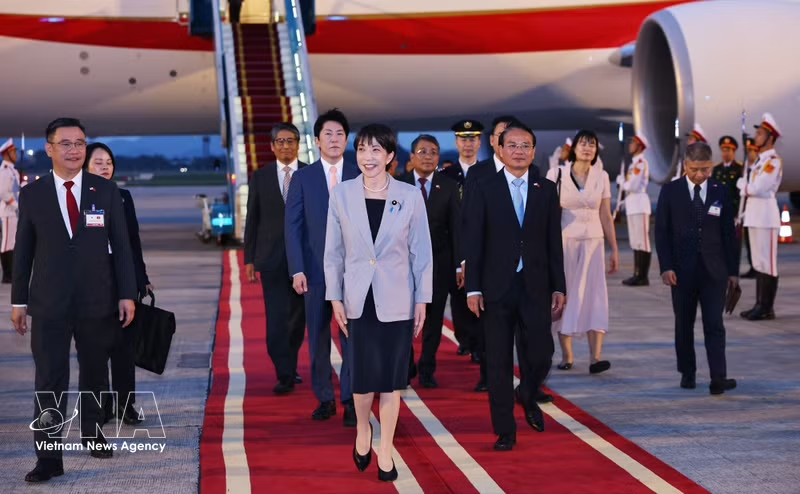
Japanese Prime Minister Takaichi Sanae arrived in Hanoi on the evening of May 1, starting her official visit to Vietnam from May 1–3 at the invitation of Prime Minister Le Minh Hung.
As King Charles concludes his transatlantic travels with a visit to Bermuda, a British Overseas Territory, he can take pride in a job well done. His four-day state visit to the US – which concluded with a wreath-laying at Arlington National Cemetery and a block party in Virginia – appears to have been a success.
Amid a period of heightened tension between President Donald Trump and Prime Minister Keir Starmer, the king’s carefully calibrated speech to a joint session of Congress has secured praise on both sides of the Atlantic (and on both sides of the Congressional aisle).
It was a remarkable performance: careful, diplomatic, occasionally pointed and at times both charming and witty. Perhaps we should not be that surprised. The king is a highly experienced diplomat, and while this was his first address to Congress, it was his 20th visit to Washington – as he himself noted.
But what does the undoubtedly warm American response to the king’s visit mean for the future of the US-UK “special relationship”?
On its own, no act of royal diplomacy, however well executed, can deliver an instant reset in US-UK relations. Nor can it force an American president of any stripe – let alone the current incumbent – to change tack or alter approach.
On this, history offers a salutary lesson. For all the positive impact of King George VI’s June 1939 visit to the US, when war broke out just a few months later, it did not lead to instant American intervention.
The queen’s visit in 1957 was similarly well received. But the work of rebuilding transatlantic trust – so damaged by the Suez crisis – remained ongoing in the months that followed.
This latest state visit will similarly offer no quick fix. But like its predecessors, it might shift the dial on the current US-UK dialogue – and perhaps help to temper the tone, at least for a while.
For the UK, there has already been one immediate win: Trump has decided to remove whisky tariffs in honour of the king’s visit. This will be very much welcomed by the Scottish whisky industry.
The potential long-term impact of the king’s visit is harder to ascertain. Not least because this will be determined by variables well beyond either his or Starmer’s control: contemporary geopolitics, especially as affected by the wars in Iran and Ukraine. Despite this week’s mutual exchange of praise and platitudes, the distance between London and Washington on these matters remains substantive.
Worlds apart
There was a brief glimpse of these differences in two of the speeches: the king’s to Congress and, on the same day, the president’s at the White House.
The king’s speech lingered on the shared ties of history and, especially, on democratic values and ideals. It included references to the importance of compassion and interfaith dialogue, and celebrated the strength of what the king called “our vibrant, diverse and free societies”.
President Trump’s speech at the White House a few hours earlier similarly featured references to the transatlantic connections born of history. But elsewhere, his tone and intent seemed rather different.
Trump celebrated “the blood and noble spirit of the British” – qualities which had provided American revolutionaries with a “majestic inheritance”. At one point, he even declared that the patriots of the American Revolution had been animated by the “Anglo-Saxon courage” in their veins. This is a claim on American history that one commentator has suggested “walks up to the edge of white nationalism”.
There are indeed echoes here of an early 20th-century diplomatic discourse known as Anglo-Saxonism. Once popular and pervasive among transatlantic writers and diplomats (including those of a nativist bent), it largely fell out of favour in the years between the world wars – its racial assumptions increasingly untenable.
As long ago as December 1918, President Woodrow Wilson explicitly told an audience of British dignitaries – including King Charles’s great-grandfather, George V – that they must not “think of us as Anglo-Saxons, for that term can no longer be rightly applied to the people of the United States”.
Wilson was the first serving US president to visit Britain, and, like Trump, had a British mother (Trump’s was from Tong on the Isle of Lewis, Scotland). Wil point – made in advance of the Paris Peace Conference – was that the US was a melting pot, not a monoculture.
King Charles’s speech hailed the importance of alliances (Nato), of multilateral institutions (the UN), and of the rule of law. These, he argued, are what has delivered eight decades of transatlantic peace and prosperity.
From the president, meanwhile, came a celebration of Anglo-American blood brotherhood. It was at times reminiscent of thinking (and language) which his predecessor Wilson – no “woke” radical – had called into question well over a century ago.
These two visions of the US-UK relationship, distinct in their underlying assumptions, reflect a broader geopolitical shift – one which has increasingly strained the transatlantic relationship in recent months.
The king’s vision, indicative of widespread sentiment in Europe, represents an affirmation of the post-1945 world order. The other, with its echoes of the early 20th century, is disruptive. Between them lies a chasm of significant proportions, and bridging it will be the task of today’s transatlantic diplomats.
Sam Edwards has previously received funding from the ESRC and the US-UK Fulbright Commission. Sam is a Governor of The American Library (Norwich) and a Trustee of Sulgrave Manor (Northamptonshire).
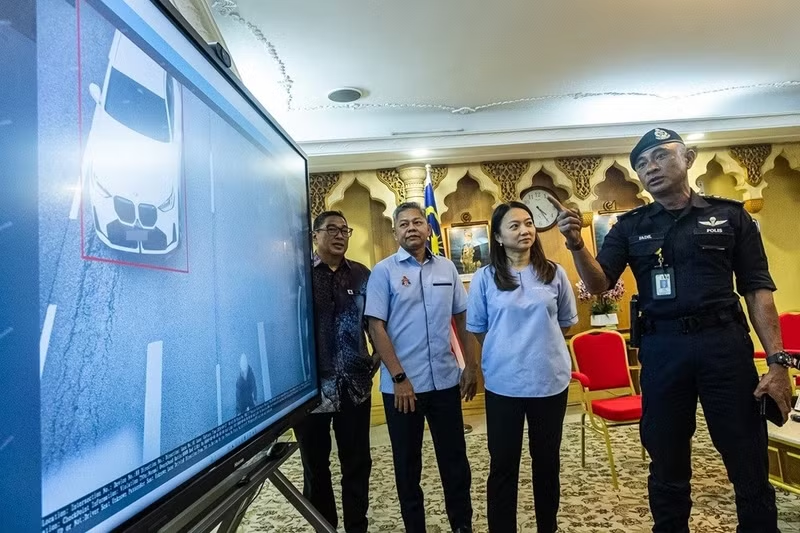
Authorities in Kuala Lumpur have upgraded all 10,000 surveillance cameras across the capital with high-resolution facial recognition technology to enhance security and improve urban management.
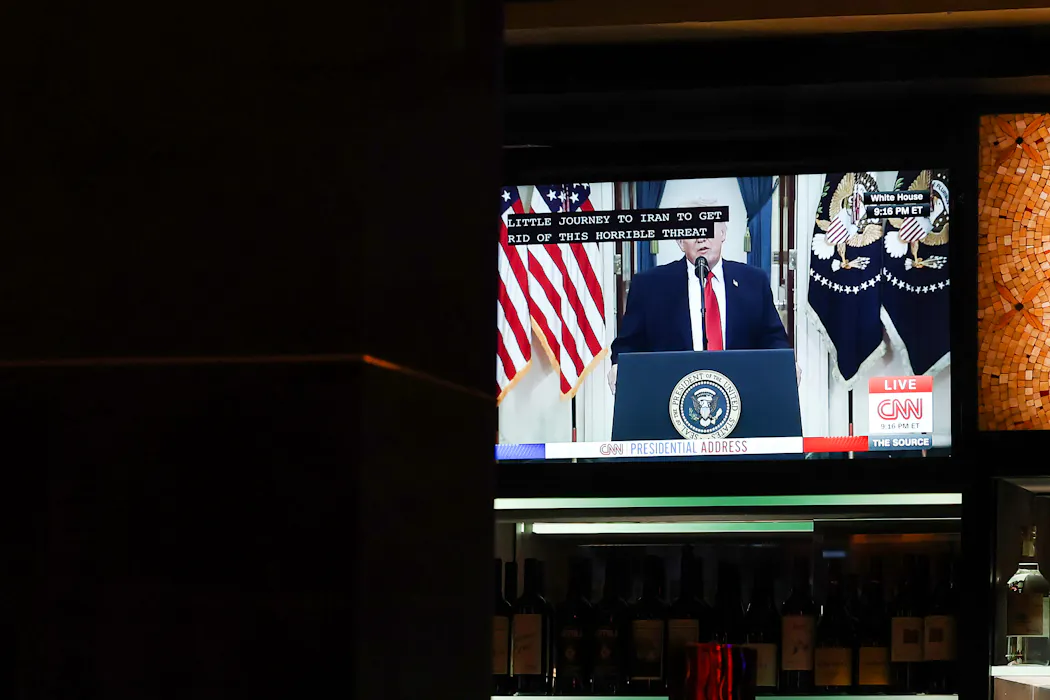
A TV displays U.S. President Donald Trump's prime-time address on the war in Iran inside a Cheesecake Factory on April 1, 2026, in Washington, D.C. Anna Moneymaker/Getty Images
May 1, 2026, marks the 60th day of Operation Epic Fury in Iran – a symbolically significant date designating when a president who has mounted unilateral military operations must receive Congressional approval or wind it down.
However, the complex history of the War Powers Resolution clock demonstrates it is a toothless milestone.
The Trump administration signaled on April 30, 2026, that it would ignore that deadline, set by the War Powers Resolution. Secretary of Defense Pete Hegseth testified before the Senate Armed Services Committee that “we are in a cease-fire right now, which my understanding is that the 60-day clock pauses or stops in a cease-fire. That’s our understanding, so you know.”
Sen. Tim Kaine of Virginia, a Democrat, responded that the 60-day threshold poses a “legal question” and “constitutional concerns.”
This is not the first time presidents and members of Congress have sparred on the meaning of the War Powers Resolution. What happens next will play out through regular politics, because the conflict is not a matter of simple legal interpretation.
A crucial section of the resolution reasserts legislators’ role, and makes clear that the constitutional power of the president to make war is subject to, or exercised with, the following conditions: a Congressional declaration of war; specific statutory authorization; or a national emergency created by attack upon the United States, its territories or possessions or its armed forces.
For new military campaigns that do not meet these criteria, the resolution included a 60-day clock that begins when a president reports the action to congressional leadership within 48 hours of the action beginning.
After 60 to 90 days, the resolution originally said this type of unilateral military action would be terminated automatically unless both chambers of Congress approved some form of legislative authorization.
Congress could also choose to terminate an unauthorized military operation any time before the 60 days with a concurrent resolution, which doesn’t require a president’s signature – essentially, a “legislative veto.”
And to make sure the president couldn’t stretch the definition of congressional approval, the resolution said neither existing treaties nor new budget appropriations could substitute for legislative authorization of a military action.
Since 1973, actions by all three branches across a variety of political and policy landscapes have undermined its intents and procedures.
Now, if members want to stop a presidential military campaign already in progress, they must act affirmatively and pass a disapproval resolution, which a president could veto like any other bill. Congress has sent only one such disapproval – to President Donald Trump in his first term – which he vetoed. Congress did not have the two-thirds required in the Constitution to override.
Both chambers of Congress now have to vote twice, once to disapprove a military action and then again to overcome a likely veto, to stop something it never approved in the first place.
House Majority Leader Mike Johnson explains on March 4, 2026, why his party rejects a Democratic-led measure to assert Congress’ war powers and stop the Iran military action.
The 60-day mark for the current Iran operation has therefore loomed as more of a politically charged symbol of this longstanding imbalance on war powers than a real deadline for action by either branch.
Although most presidents from Richard Nixon onward have claimed that the War Powers Resolution is an unconstitutional check on their institutional powers, they usually filed the required reports on new military actions 48 hours after they began.
While the current Iran conflict is different in many ways, presidential unilateralism, inconclusive chamber actions and even member lawsuits all echo controversies over U.S. military action in Kosovo in 1999 and Libya in 2011.
After detailing the rationale for military action, Trump added “Although the United States desires a quick and enduring peace, it is not possible at this time to know the full scope and duration of military operations that may be necessary.”
He concluded the memo with his interpretation of constitutional power to act unilaterally.
“I directed this military action consistent with my
responsibility to protect Americans and United States interests both at home and abroad and in furtherance of United States national security and foreign policy interests,” the president wrote. He acted, he said, “pursuant to my constitutional authority as Commander in Chief and Chief Executive to conduct United States foreign relations.” He said he made the report “consistent with the War Powers Resolution. I appreciate the support of the Congress in these actions.”
Similarly, on March 26, 1999, President Bill Clinton sent a War Powers Resolution letter explaining his decision two days earlier to take part in a NATO-led operation against the Federal Republic of Yugoslavia, known as FRY.
Clinton wrote to Congress using mostly the same words and phrases Trump did in his 2026 letter. Clinton also said that he took the action “in response to the FRY government’s continued campaign of violence and repression against the ethnic Albanian population of Kosovo.”
President Bill Clinton after his television address to the nation on the NATO bombing of Serbian forces in Kosovo, March 24, 1999.Pool/Getty Images
Clinton explained his authority in virtually the same language as Trump and, like Trump, said it was hard to predict how long the operations would continue.
The House and Senate repeatedly failed to either approve or disapprove of Clinton’s actions through a series of votes across March and April 1999. But lawmakers did send him supplemental appropriations for the operations in May.
NATO suspended the operation after 78 days. Almost a year later, a federal appellate court upheld a district court’s decision rejecting a lawsuit led by Rep. Tom Campbell, a California Republican, alleging Clinton violated the War Powers Resolution. Rather than deciding on the merits, the decision rejected the lawmakers’ claims of injury as not reviewable by the court.
Obama did it, too
In a very different context, a similar rhythm played out during President Barack Obama’s presidency.
Within the current dynamics of the War Powers Resolution, until Congress musters bipartisan supermajorities to connect its own institutional ambition with constitutional power, presidents from either party will decide alone if, and when, the country goes to war. Instead of Congress, presidents may heed public opinion and economic indicators, especially in election years.
Jasmine Farrier is affiliated with the American Political Science Association.
SINGAPORE: A man has found himself in an unexpected dispute after his ex-fiancée insisted he reimburse her S$15,000 in cash for the CPF downpayment she lost when their BTO application was cancelled.
Hoping to find some guidance, he posted on the r/asksg subreddit on Tuesday (Apr 28).
In his post, he explained that he had been in a relationship with his ex-fiancée for five years before they called off their wedding plans. He also noted that he had already returned her share of the wedding banquet and vendor expenses.
Matters, however, became complicated when his ex-fiancée said she expected him to refund her for the BTO downpayment as well.
“When it comes to the forfeit for the BTO, she felt that I am responsible to pay her back in cash. Approximately S$15k from the loss from CPF. Do you think I should be paying her back the money?” he asked others.
The man said they both paid “50/50 for the BTO deposit.”
“Legally, I am not obliged to pay her anything, but she and her family are determined to have the money back and have been pursuing me constantly on this issue. This led to a number of harassment messages from them. Is it a must to pay her back? I just don’t find it justifiable to pay her back entirely. I have borne a substantial amount of money with the loss of the wedding and now another round for the CPF money,” he continued. “I have already paid her back the banquet/vendor cost even before I was able to get a refund from the shops, and now they are coming for more.”
The man also clarified that neither party had been unfaithful during the relationship. The decision to call off the wedding, he said, was his, after he concluded that an unresolved “internal problem” between them would eventually lead to divorce.
“I initiated the cancellation…It was a last-minute decision to back off,” he said. “I woke up from it.”
“She’s just using this to her advantage.”
The post quickly gained traction on the forum, with many Singaporeans jumping in to share their thoughts on the issue.
One individual wrote that the post author should not give in to the demand because it “was a mutual loss,” adding, “Just ignore them and block if necessary.”
Another user said, “Pay her back in cash? At the end of the day, it was a 50/50 CPF payment. If you have to pay her back in cash for her share, why not also claim it back from her in cash as well? Lastly, it’s CPF, not cash. There is no such thing as converting CPF payments to cash. She’s just using this to her advantage.”
A third commented, “If you really don’t have money, then no point, bro. You already did good by paying her share for the wedding banquet. I don’t think you need to pay for her CPF too.”
Several others, however, disagreed and said that he should at least compensate her in some way since he “initiated” the cancellation.
“You’re the cause of the breakup,” one user argued. “You ‘foresaw’ an issue and initiated it. Instead of resolving the issue, you decided on the breakup. You’re the reason for the monetary loss.”
Another added, “My 2 cents would be, although you are very gentlemanly and gave back the wedding expenses that she forked out already, CPF-wise it does sound slightly unfair to her because of how last-minute your cancellation of BTO comes in.”
“Paying back the entire S$15k can be too much of a burden and might even place you in debt. Maybe offer to pay back 50%? Generally, anywhere from 30 to 70%, whichever you feel comfortable enough with.”
In other news, a Singaporean took to Reddit to open up about how being laid off has deeply affected the way they see themselves.
In their post, they shared that they have been carrying a persistent sense of being “useless,” describing it as a feeling that refuses to go away, no matter how hard they try to stay occupied or push forward.
People in the UK are now spending fewer years in good health than they did a decade ago, according to a new analysis by the Health Foundation. The UK now sits near the bottom of a 21-country comparison, ahead only of the US.
A drop in healthy life expectancy is explained through many causes: obesity, alcohol, drugs, suicide, chronic disease, poverty and widening inequality. But one of the most powerful causes sits atop them all: housing. Where and how people live is one of the main factors explaining how health risks are created and distributed across society.
The UK Housing Review is an annual independent review of housing policy and evidence, written by housing experts and published by the Chartered Institute of Housing. Its latest edition, which we contributed to, identifies several interrelated ways that housing affects health.
A key one is affordability – housing costs shape where people can live, whether they can heat their homes, whether they can afford food and transport, whether they can move for work, whether they can leave unsafe or unsuitable housing and whether they live with chronic financial stress.
In the UK, housing costs are high by historical standards and poor housing remains widespread. The review notes that private rents are now at their highest recorded share of earnings, while millions of homes in England still contain serious health and safety hazards.
When housing is unaffordable, people are forced to make tradeoffs. For example, trading affordability for damp or overcrowded homes. They cut back on heating, food, medication, transport and social participation. They move further from public services, work and support networks. Affordability problems also force many people into cheaper, less secure, tenancies.
The Building Research Establishment, an independent research organisation, has estimated that poor housing costs the NHS in England £1.4 billion each year. More than half of this is attributed to cold homes, which increase the risk of respiratory illness, cardiovascular problems and poor mental health. They are especially dangerous for older people, babies and people with existing health conditions.
But the wider costs are even greater. Poor sleep, stress, disrupted schooling, insecure work, social isolation and caring strain all affect mental and physical health. They increase pressure on families and, over time, on health, education and social care systems.
Cold homes can cause serious and widespread health problems.Jelena Stanojkovic
Historically in the UK, social housing has provided some protection to people unable to access good quality affordable housing in the open market. But the stock of social rented housing in the UK has declined. This means that people are increasingly dependent on (often expensive) market rental, where the quality, size and location of housing depend much more directly on income.
The rise of the private rented sector this century has meant that more households are exposed, not just to higher housing costs, but also to shorter tenancies and fewer protections than social housing traditionally provided.
The Renters’ Rights Act increases security, but does not remove “no fault” evictions altogether and does little to protect tenants from economic pressures that can result in eviction. The cognitive burden of worrying about eviction, arrears, repairs or the next rent increase is a direct health risk.
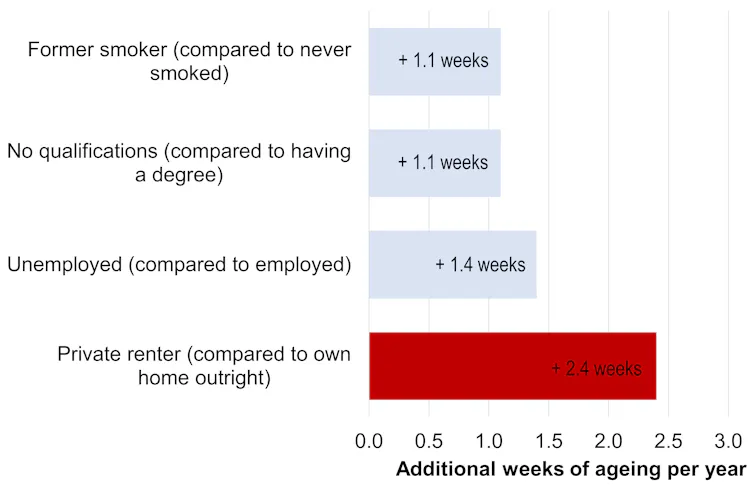
Recent evidence also suggests that insecure housing can result in measurably faster biological ageing, equivalent to the effects of more traditional health concerns like smoking.
Additional weeks of biological ageing per year from different factors
Amy Clair
The number of people living in temporary accommodation has risen dramatically, reaching over 130,000 households at the beginning of 2025. This is a 156% increase compared with 2010, largely driven by the poor affordability and insecurity of the private rented sector and lack of social housing. Temporary accommodation is inadequate housing, particularly for children. Living in temporary accommodation was a contributing factor in the deaths of at least 104 children in England between 2019 and 2025, 76 of whom were under one year of age.
This is not about housing quality alone. Temporary accommodation reflects multiple risks brought together: poverty, overcrowding, poor conditions, instability, lack of space for safe infant sleep, poor access to services and wider racial and social inequality. The National Child Mortality Database identifies temporary accommodation as a contributing factor to vulnerability, ill health or death, not necessarily as the sole cause. Emerging evidence also links temporary accommodation with stillbirth and neonatal death.
ONS data shows a very large difference in healthy life expectancy between the most and least deprived areas. In 2022-24, healthy life expectancy in the most deprived areas of England was just 49.8 years for men and 48.2 years for women, compared with 69.2 and 68.5 years in the least deprived areas.
Housing contributes to this difference, determining whether people live in homes that support recovery or deepen stress, whether children grow up in stable and safe environments, and whether older people can remain warm and independent.
If the government is serious about its stated aim to “halve the gap in healthy life expectancy between the richest and poorest regions”, housing policy must become health policy.
That means investing in social housing, enforcing decent standards in the private rented sector, making homes warmer, safer and more accessible, and recognising temporary accommodation, overcrowding and insecurity as public health failures, not just housing management problems.
It also means changing the way that success is measured. Housing policy is too often judged by supply numbers, prices or tenure outcomes. These matter, but they are incomplete. A healthy housing system should also be judged by whether people can live in homes that are affordable, secure, decent, suitable and resilient to climate change.
The decline in healthy life expectancy is a warning light. It tells us that the UK is not only failing to keep people well for longer, it is failing to provide the foundations of health.
Emma Baker receives funding from the Economic and Social Research Council, the Australian Research Council, The National Health and Medical Research Council, and the Australian Housing and Urban Research Institute.
Amy Clair receives funding from the Australian Research Council and the Australian Housing and Urban Research Institute.
Mark Stephens receives funding from ESRC, the EU/Innovate UK and the Australian Housing and Urban Research Institute (AHURI).
Three Reading Women in a Summer Landscape by Johan Krouthén (1908).WikiCommons
We asked ten literary experts to recommend the climate poem that has spoken to them most powerfully. Their answers span over 200 years and a range of emotions from sorrow, to anger, fear and hope.
This article is part of Climate Storytelling, a series exploring how arts and science can join forces to spark understanding, hope and action.
1. Death of a Field by Paula Meehan (2005)
Published in the wake of the 2008 financial crisis, Paula Meehan’s Death of a Field critiqued the environmental impact of the Celtic Tiger economy in Ireland.
The poem anticipates the destruction of the titular field by property developers with little regard for native ecologies: “The end of the field as we know it is the start of the estate.”
Death of a Field read by Paula Meehan.
The global effects of the climate crisis are seen from a uniquely local perspective as the displacement of Irish wildlife mirrors the effect of colonial violence. “Some architect’s screen” is simply the latest iteration of imperial technologies that seek to plunder Irish landscapes. The poem gains further strength by refusing to replicate a hierarchical relationship to nature by preserving its many mysteries:
Who can know the yearning of yarrow
Or the plight of the scarlet pimpernel
Whose true colour is orange?
Jack Reid is a PhD Candidate in Irish literature
2. Darkness by Lord Byron (1816)
Darkness imagines the fallout of a volcanic eruption that has destroyed the Earth. The “dream” that the poem mentions was inspired by genuine weather conditions during the “year without a summer” in 1816, caused by the eruption of Mount Tambora in Indonesia the previous year.
Darkness by Lord Byron.
Sulphur in the atmosphere caused darkness and low temperatures across Europe. In Lake Geneva, Lord Byron experienced the infamous “haunted summer” of darkness.
Byron’s depiction of climate catastrophe is bleak, with words like “crackling”, “blazing” and “consum’d” bearing resemblance to contemporary reports of wildfires caused by climate change. After a famine, all elements of Byron’s Earth, from the clouds to the tide, eventually cease to exist: “Seasonless, herbless, treeless, manless, lifeless– / A lump of death – a chaos of hard clay.” Read as a portent of the Anthropocene, Byron’s poem urges readers to seriously consider the future of mankind.
Katie MacLean is a PhD candidate in English Literature
3. Mont Blanc by Percy Bysshe Shelley (1817)
Byron’s close friend Percy Bysshe Shelley was also inspired by the “year without a summer”. He witnessed temperatures drop, volcanic ash hanging heavy in the air and crops failing. While his wife Mary used the gloomy climatic event to inform her novel Frankenstein (1818), Shelley channelled them into his poem Mont Blanc.
A reading of Mont Blanc.
In his ode, Shelley describes a timeless “wall impregnable of beaming ice”. By drawing on his scientific reading, he then explains his fears regarding global cooling and the possibility of vast glaciers eventually covering the alpine valleys.
He imagines “the dwelling-place / Of insects, beasts, and birds” being obliterated and mankind forced to flee. While Shelley saw this process as “destin’d” and inevitable, it is clear that Mont Blanc is a poem with catastrophic climate change at its heart. In 2026, it is difficult to read in any other way.
Amy Wilcockson is a research fellow in Romantic literature
4. Characteristics of Life by Camille T. Dungy (2012)
There’s something gloriously elastic about invertebrates: the spinelessness of a worm, the pulsing of the jellyfish, the curling of an octopus. Spiders, snails and bees, too, with their exoskeletons on display, invite us to see things “inside-out”.
These are the thoughts I have when I read Characteristics of Life by Camille T. Dungy, which opens with a snippet from a BBC news report claiming that “a fifth of animals without backbones could be at risk of extinction”. What would a world be without the “underneathedness” of the snail beneath its shell beneath the terracotta pot in the garden? Or “the impossible hope of the firefly” whose adult lives span only a handful of human weeks?
Camille T. Dungy speaks about nature and poetry.
Dungy speaks from a “time before spinelessness was frowned upon”, and from a world where to dismiss a being as “mindless” (jellyfish have no brains) or even “wordless” would be “missing the point” entirely. As I think of these creatures that dwell beyond our usual line of vision – flying, crawling, tunnelling and swimming – I find my perspective on our beautiful world turning and shifting.
Janine Bradbury is a poet and a senior lecturer in contemporary writing and culture
The speaker’s request of passing her “last years with less anxiety” appears to be denied by a god who first responds by changing her into “a tiny spider / launching into the unknown / on a thread of gossamer” and who, when she begs to “be a bigger / fiercer creature”, turns her into “a polar bear / leaping between / melting ice floes”.
A reading of Prayer at Seventy by Vicki Feaver followed by an explanation by the poet.
Both images present creatures who are in precarious positions, their futures uncertain, reflecting the state of a person contemplating the unknowns of old age and death. But the poem moves beyond the personal. The reference to the melting ice floes is not solely metaphorical: it reminds us that the planet itself is in danger and every living thing is therefore vulnerable – and will be increasingly so.
Walrus, from Jessica Traynor’s 2022 collection Pit Lullabies expresses the quiet anxiety a mother has for her child in the world of climate breakdown.
While stripping wallpaper from the box room of her house, the poet discovers a mural of the Walrus and the Carpenter from Alice’s Adventures in Wonderland. Traynor takes part of Lewis Carroll’s poem about the Walrus and the Carpenter walking along the beach, eating the vulnerable oysters, and weaves it into her own poem.
Jessica Traynor reading poems from her collection Pit Lullabies.
Carroll’s absurd verse includes what, at that time no doubt, seemed like an impossible image of a “boiling hot” sea. In the 21st century, this is no longer an absurdity, as Traynor knows. She makes a connection with Carroll’s poem, imploring her child:
Sleep as the sun rises and ice melts
and for want of the freeze a walrus
pushes further up a cliff-face.
It’s a complex poem that reimagines a key work of children’s literature, connecting it with the reality of the changing world. All the while the mother keeps her fears at bay for the sake of her child, “brows[ing] washing machines” with a “ball of tears” in her throat.
Ellen Howley is an assistant professor of English
7. Ocean Forest, co-created by the We Are the Possible programme
Ocean Forest is woven out of words, research, ideas and stories shared by scientists, educators, health professionals, youth leaders, writers and artists. They took part in creative writing workshops to co-create the anthology Planet Forest – 12 Poems for 12 Days for the UN Climate Conference in Brazil in 2025.
In the shallows, alert to change,
the minuscule, overlooked creatures
weave between seagrass, and weed –
live their shortened lives.
When ships pass overhead, when sands shift,
fish navigate swell, migrate beyond
where coral’s been bleached, through schools
of silenced whales and barely rooted mangroves
struggling to thrive in darkening water.
Deeper down,
pressure builds, species exist, unaware,
undisturbed. As heat and waves rise there’s hope
the unfound, the unnamed, the unpolluted
in the remotest ocean forests will survive.
Through uniting disciplines and voices the poem takes unexpected shifts. It demonstrates that climate change affects and erodes the habitats that lie beneath the surface and that urgent action is needed to protect disappearing species.
Yet, there is also a glimmer of hope – that in the deepest, darkest parts of the ocean, where temperatures are near freezing and there are bone-crushing pressures, maybe there are creatures that will survive human interference and pollution.
Sally Flint is a lecturer in creative writing and programme lead on the We Are the Possible programme
8. Di Baladna (Our Land) by Emi Mahmoud (2021)
Emtithal “Emi” Mahmoud is a Sudanese poet and activist, who has won multiple awards for her slam poetry performances. Mahmoud performed Di Baladna at the United Nations Climate Change Conference in 2021.
Poetry – especially spoken word – helps people connect emotionally with the human side of climate-driven displacement, a topic that’s often explained only through technical language. The language of emissions targets, temperature thresholds, or policy frameworks can distance people emotionally from its consequences. Yet poetry can cut through this abstraction.
Di Baladna (Our Land) read by Emi Mahmoud.
Mahmoud’s performance gave voice to those forced from their homes by environmental collapse, reminding listeners that climate change is not only an environmental crisis but a deeply human one, with profound effects on individuals, families and communities.
By merging vivid natural imagery with the rhythms of displacement and lived testimony, the poem urges listeners to replace passive awareness with empathy. Mahmoud implores us to feel the loss, fear and resilience of displaced communities, looking beyond news headlines and images of victimisation. Engaging with such work helps transform climate refugees from statistics into people.
Clodagh Philippa Guerin is a PhD candidate in refugee world literature
9. Flowers by Jay Bernard (2019)
At first glance, Jay Bernard’s Flowers is circular poem (one that begins and ends in the same place) but you soon realise that the circle isn’t going to complete. It opens:
Will anybody speak of this
the way the flowers do,
the way the common speaks
of the fearless dying leaves?
And closes:
Will anybody speak of this
the fire we beheld
the garlands at the gate
the way the flowers do?
And the answer seems to be, no: no one will speak of these things – the “coming cold” and the “quiet” it will bring – only the things themselves as they die. With the songs Where Have All the Flowers Gone? by Pete Seeger and Blowin’ in the Wind by Bob Dylan in its DNA, Flowers has the eternal power of a folk-lyric – prophetic and unignorable.
Kate McLoughlin is a professor of English literature
10. Place by W.S. Merwin (1987)
Climate change poetry – should it be a thing? How do poets avoid the oracular pomp it threatens? Browsing my small library I’m shocked anew to realise most poets lived and died blissfully innocent of our condition.
OK, what about the late John Burnside’s lyric Weather Report (“this is the weather, today / and the weather to come”). It poignantly extrapolates from a sodden summer to his sons’ futures: “a life they never bargained for / and cannot alter”. Heartbreaking. Or the odd dread of spring in Fiona Benson’s Almond Blossom, a season characterised as Earth’s, “slow incline … inch by ruined inch”. Ditto.
W.S. Merwin reads Place.
But then I reach back to the great American poet W.S. Merwin’s short prayer Place to find that grace-note of hope which surely needs to thread through all poems, whether they speak of climate change, mortality or love: “On the last day of the world / I would want to plant a tree.” Me too.
Steve Waters is a playwright and professor of scriptwriting at the University of East Anglia
This article features references to books that have been included for editorial reasons, and may contain links to bookshop.org. If you click on one of the links and go on to buy something, The Conversation UK may earn a commission.
Amy Wilcockson receives funding from Modern Humanities Research Association as Research Fellow for the Percy Bysshe Shelley Letters project.
Steve Waters receives funding from AHRC
Clodagh Philippa Guerin, Ellen Howley, Jack Reid, Janine Bradbury, Julie Meril Gardner, Kate McLoughlin, Katie MacLean, and Sally Flint do not work for, consult, own shares in or receive funding from any company or organisation that would benefit from this article, and have disclosed no relevant affiliations beyond their academic appointment.
In recent years, Vietnam has made substantial efforts to protect intellectual property, including improving its legal framework, raising public awareness, and strengthening international cooperation with the World Intellectual Property Organisation (WIPO), the US, and many other countries.
Vietnam is pursuing a “one centre – two destinations” model. Ho Chi Minh City is envisioned as a comprehensive financial hub linked with a free trade zone, while Da Nang will focus on innovation, fintech, digital assets and serve as a testing ground for new financial models. This complementary structure allows Vietnam to develop a tailored approach rather than replicate existing financial centres.
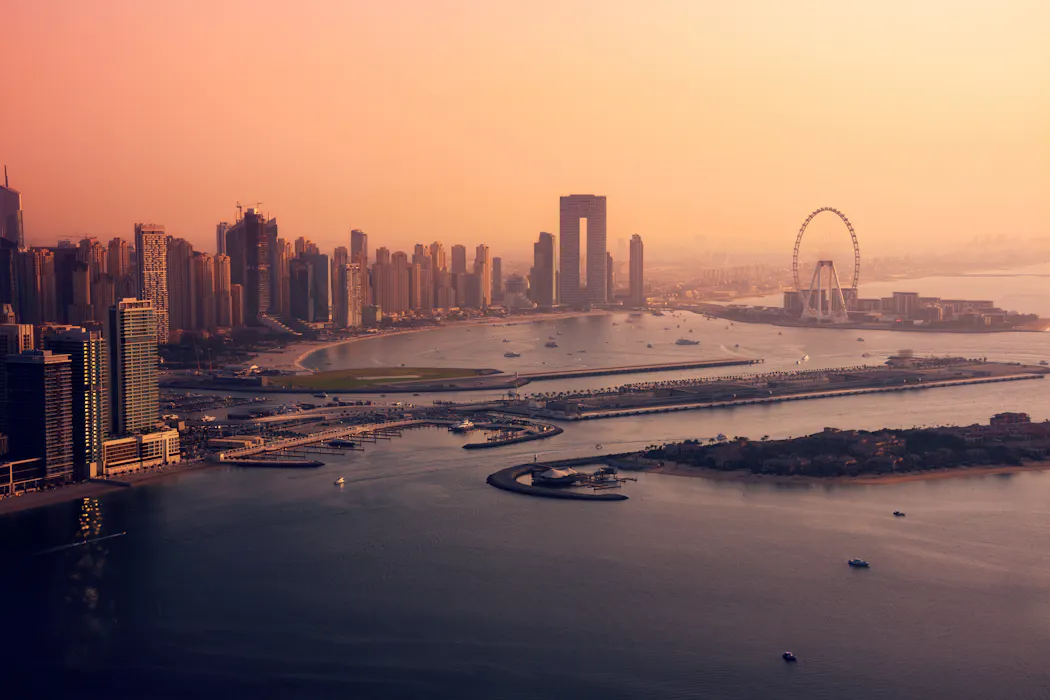
Dubai's port and airport plus some residential buildings and hotels were struck by Iranian missiles and drones.Maria_Usp / Shutterstock
The United Arab Emirates (UAE) announced on April 28 that it will leave the global oil producers’ cartel Opec. Its decision is the latest sign that the war in the Middle East has not only deepened animosities between Iran and its Gulf neighbours, but among the Gulf states too.
Founded in 1960, Opec is a rare success story among multilateral organisations in the region. Its policies paved the way for Gulf oil producers to have enough funds to buy back or renationalise their oil resources, and finance the spectacular development of their states.
The organisation has survived all major revolutions and wars in the region thus far – though Qatar left in 2019 when it was blockaded by its Gulf neighbours.
Saudi Arabia, the largest oil producer in Opec, holds substantial leverage within the group. This has led to tension with the UAE, which has for some time pushed for higher production quotas for itself, given its spare capacity. These efforts have been to no avail.
However, its decision to leave Opec is about more than merely frustration with the organisation.
Though it was very close to Saudi Arabia in the mid-2010s, the UAE has in recent years drifted apart from its larger neighbour. This has been driven by a number of regional issues including the countries’ diverging strategies in wars in Yemen and Sudan, and their respective relations with Israel.
The two countries have also recently become serious economic competitors. And although both states have been hit hard by Iran in the current war, the conflict seems to have accelerated their rivalry.
Iran responded to US-Israeli attacks in February by launching strikes on countries around the Gulf and blockading the Strait of Hormuz.Peter Hermes Furian / Shutterstock
Saudi Arabia is the largest and richest country in the Gulf. But many of its transformative economic projects require political stability and a high oil price to succeed. The war has exposed the limits of its policy of tentative outreach to Iran, and of its partnership with a US that is so closely allied with Israel. So, the Saudis have strengthened defence ties with nuclear-armed Pakistan.
These deepening ties have been met with dismay in the UAE, which has close ties to India. The Emiratis have been critical of Pakistan during the war, calling on Islamabad to condemn the Iranians more forcefully – something that is not possible due to Pakistan’s role as a mediator in peace negotiations.
At least partly in frustration at its response to the war, the UAE recently demanded that Pakistan repay a US$3.5 billion (£2.6 billion) loan. Saudi Arabia immediately came to the rescue by providing Pakistan with financial support.
The UAE’s announcement to leave Opec coincided with a meeting of the Gulf Cooperation Council in the Saudi Arabian capital Riyadh, where members sought to find common ground on the Iran war. This was a major affront to the Saudis.
Other Gulf frictions
The war has sparked other frictions in the Gulf, including reviving old tensions between the UAE and Iran over three islands – Abu Musa, Greater Tunb and Lesser Tunb – that Iran occupied at the time of Emirati independence from Britain in 1971. These islands strengthen Iran’s strategic position along Gulf shipping lanes.
The UAE has long claimed sovereignty over the islands, while Iran claims they were always part of its territory. Iran’s control of the three islands is thought to be part of a secret deal between Britain and the Shah of Iran around 1970, whereby the shah would renounce a claim Iran maintained to Bahrain in return for the islands.
This and other historic border disputes in the region, including between the UAE, Saudi Arabia and Oman, remain some of the most sensitive topics in modern Gulf history. For a forthcoming book on the rise of the Gulf states, I have tried to access relevant UK Foreign Office documents, but have had numerous freedom-of-information requests denied on closed material dating back to the 1960s and earlier.
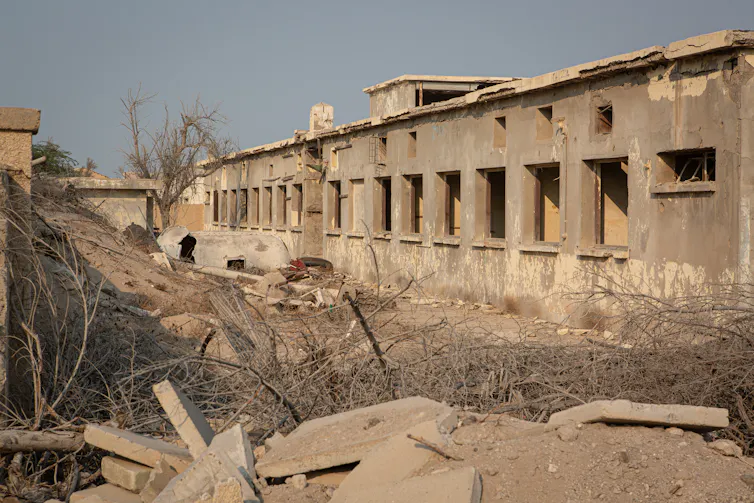
Failaka Island off Kuwait’s coast remains partially abandoned due to the heavy damage that was inflicted during the 1990 Iraqi invasion.Sebastian Castelier / Shutterstock
The northern Gulf state of Kuwait has also been hit hard during the conflict. Here, many attacks seem to have come from Shia militias based in Iraq. These attacks have revived traumatic memories of Iran-linked political violence in the 1980s, and Iraq’s invasion in 1990.
States that cannot bypass the closed Strait of Hormuz – such as Bahrain, Kuwait and Qatar – have experienced the most economic damage from the war. To balance its budget, Bahrain is already dependent on aid by wealthier Gulf states. The UAE, Saudi Arabia and Oman, on the other hand, have the geographical means to bypass Hormuz.
Oman, which controls one side of the strait, may well benefit in the long run. This could either be through a new arrangement with Iran to charge vessels a toll, or because its ports on the Arabian Sea will increase in significance – perhaps even resurrecting some of Oman’s former glory, when it was a major regional power. This is not something neighbouring UAE and Saudi Arabia would like to see.
The reckless US-Israeli attack on Iran has thus opened up old faultlines, and could create new ones between states around the Gulf. It is also undermining the few avenues of regional cooperation that remain. This makes a fragmented and dangerous region even more so.
Toby Matthiesen does not work for, consult, own shares in or receive funding from any company or organisation that would benefit from this article, and has disclosed no relevant affiliations beyond their academic appointment.

 Login
Login