Reading view

Woman, three children murdered in Multan; scene staged as suicide: officials

LAHORE: A woman and her three children were murdered in their house in Multan, police said on Tuesday, adding that the crime scene was staged as a suicide.

City Police Officer (CPO) Multan Sadiq Ali Dogar confirmed to the media that the woman and her children were murdered, and it was staged as a suicide.

“Certainly, this is not a suicide; this leans more towards murder,” he said. “It was a staged suicide.”

The CPO added that evidence was still being collected and that all aspects of the case are under investigation.

Initially, Rescue 1122 and police received a call on their helplines reporting that a woman had allegedly hanged herself along with her children in an informal settlement near Mumtazabad Phatak in Multan.

However, investigators expressed doubts about the nature of the deaths.

A senior police officer, on condition of anonymity, told Dawn that initial findings suggested that the case appeared to be a suspected homicide staged as suicide.

He added that evidence collected from the scene indicated that the victims might have been strangled with a rope before being hanged to mislead investigators.

“The condition of the bodies and the crime scene do not support a straightforward suicide. It seems the children were killed first and then hanged from a ceiling fan, while the scene was arranged to create an impression of suicide,” the officer said.

Police further added that there were no clear signs indicating that the woman had taken her own life.

The situation was complicated by the fact that the bodies had been taken down before police and Rescue 1122 reached the scene, raising concerns of possible evidence tampering.

The officer said that an initial investigation revealed that a domestic dispute had taken place earlier in the day, and the woman had reportedly informed her parents about it. The incident occurred before they could arrive.

They added that post-mortem examinations would determine the exact cause and time of death.

Police said the victims were identified as children aged six, four and three, and that the woman was also pregnant.

Meanwhile, police took the deceased’s husband and his brother into custody for investigation.

On Saturday, a woman, her two minor sons and a man were found dead, while the woman’s two daughters were injured under mysterious circumstances in a flat at Safanwala Chowk in Mozang.

According to police and Edhi, Ayesha, 42, her 10-year-old son Muneeb and 14-year-old son Safeer were found shot dead, while her two daughters, 11-year-old Manahil and 19-year-old Samra, were injured in the flat. A property dealer, Shahid Jatt, was also found shot dead in the flat.

Police shifted the injured girls to the Mayo Hospital for treatment and bodies to the morgue for an autopsy. A case was registered on the complaint of their heirs.


  •  

YouTuber held for ‘recruiting individuals for al-Qaeda’

LAHORE: The Counter Terrorism Department has arrested a YouTuber for recruiting individuals for a banned outfit and registered a case against him under the Anti-Terrorism Act, 1997.

The FIR identified the suspect as Muhammad Saad bin Riaz, associated with YouTube channel named Eon News. A case has been registered against him on behalf of the state under Section 11F(2), pertaining to membership and support of a proscribed organisation and Section 11W, which relates to the dissemination of material linked to banned groups.

According to FIR, the arrest was made on April 27 during a search operation near GPO Chowk on Mall Road.

“After getting information from a source that a suspected al-Qaeda member was present at a mosque, Hanfia Ghusia Mughal Saraiy, opposite to Lytton Road, he was caught recruiting individuals and distributing prohibited material.”

During the raid, officials claimed to have recovered five copies of a book about Osama bin Laden from his custody along with an al-Qaeda membership card.

Meanwhile, the CTD claimed to have arrested 21 suspected members of banned organisations within this week and foiled planned terrorist activities in different districts.

According to a CTD spokesperson, the department conducted 214 intelligence-based operations (IBOs) across the province and questioned 215 suspects, leading to the arrest of 21 individuals.

Among those was a suspected member of Fitna-ul-Khawarij identified as Peer Shams arrested from Lahore and an alleged Balochistan Liberation Army (BLA) operative Abdul Lateef apprehended from Toba Tek Singh.

The spokesperson said the suspects were arrested during IBOs in various districts including Lahore, Sheikhupura, Gujranwala, Faisalabad, Jhang, Khanewal, Mianwali, Toba Tek Singh, Multan, Gujrat, Pakpattan and Bahawalpur.

Published in Dawn, May 3rd, 2026

  •  

‘Domestic pressures in US, Iran may stall peace deal’

• Speakers at discussion on Islamabad talks warn oil prices may go beyond $120 per barrel if war resumes
• Tehran proposal on Hormuz reopening gains traction, ex-envoy claims
• Conflict described as ‘non-contact war’ with global economic impact
• Pakistan’s role for world peace praised at UK-based forum

LAHORE: Intense dom­estic political pressures in Washington and Tehran could stall a final peace deal, speakers at a panel discussion warned on Wednesday, stressing that failure to reach an agreement might trigger a regional conflict and push global crude oil prices beyond $120 per barrel.

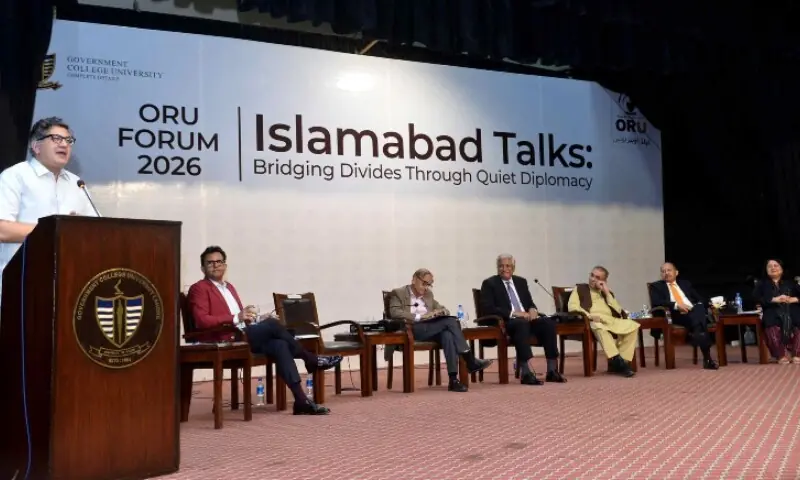
The discussion, titled ‘Islamabad Talks: Bridging Divides Through Quiet Diplo­m­a­­cy’, was hosted by the Old Ravians Union (ORU) at Government College University (GCU).

Speaking on the occasion, former ambassador Mansoor Ahmed Khan said growing global polarisation had weakened the credibility of traditional mediators such as the European Union and Nato.

In this context, he noted, Pakistan’s civil and military leadership had stepped in to facilitate engagement among key international stakeholders.

He revealed that a proposal by Tehran to separate the reopening of the Strait of Hormuz from long-term nuclear negotiations was gaining traction and was being actively debated by the US National Security Council.

Khan said the conflict had reshaped regional dynamics, leaving Israel politically isolated while positioning Iran as a resilient actor. He added that a new regional security framework involving Pakistan, Saudi Arabia, Turkiye, Egypt, Indonesia and China could emerge, though he cautioned that Pakistan’s peace efforts faced opposition and disinformation campaigns from India.

Senior journalist Mujeebur Rehman Shami said Pakistan had acted proactively rather than waiting for external engagement. He warned that a US-led blockade had pushed Iran’s oil storage capacity to its limits, and any forced closure of oil wells could have long-term consequences, creating a strategic deadlock between Tehran’s leverage over the Strait of Hormuz and Washington’s economic pressure.

Retired Gen Muhammad Saeed pointed out that while talks in Vietnam and Afghanistan took years to initiate, Pakistan facilitated direct US-Iran engagement shortly after the April 8 proposal.

He noted that the US administration faced domestic political constraints in escalating military action, while Iran could not sustain the economic burden of a prolonged conflict. With both sides stepping back from aggressive media rhetoric, he predicted a high probability of secondary, fast-tracked talks returning to Islamabad.

He also observed that neither the IAEA nor US intelligence had officially confirmed that Iran was pursuing a nuclear weapon, suggesting alternative motivations behind the US-Israel war on Iran.

Political scientist Dr Hasan Askari Rizvi attributed Pakistan’s diplomatic role to its balanced and non-partisan approach, as well as the credibility gained following the May 2025 conflict with India. He said Islamabad’s stance — condemning attacks on Iran while also criticising Iranian strikes on Gulf states — had helped build trust with both Washington and Tehran.

He outlined critical hurdles to a final agreement, including domestic political pressures in both countries, ensuring free navigation through the Strait of Hormuz, resolving the nuclear dispute, lifting sanctions, unfreezing Iranian assets and addressing Tehran’s demands for war-related compensation.

Terming the hostilities a modern “non-contact war”, Dr Rizvi said economic interdependence meant regional conflicts now had global repercussions. He emphasised the need for universities and research institutions to play a greater role in national security in an era of technology-driven warfare.

Dr Asma Faiz said managing the US-Iran rivalry while maintaining strategic autonomy had enhanced Pakistan’s credibility as a regional mediator.

Pakistan’s role praised

Separately, Pakistan’s efforts to promote dialogue and prevent escalation were acknowledged at the UK-based Defence and Security Forum in London, where a federal minister addressed the forum for the first time.

Minister for Board of Investment Qaiser Ahmed Sheikh highlighted Pakistan’s growing role at the intersection of defence and economic diplomacy, describing the country as a strategic gateway linking East and West.

The event, held at a venue in Pall Mall, brought together diplomats, parliamentarians, defence experts and business leaders.

With input from Amin Ahmed in Islamabad

Published in Dawn, April 30th, 2026

  •  
❌