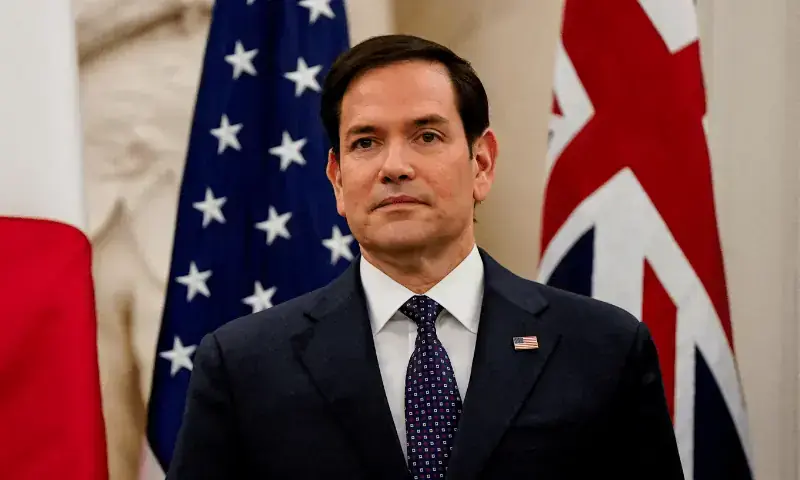
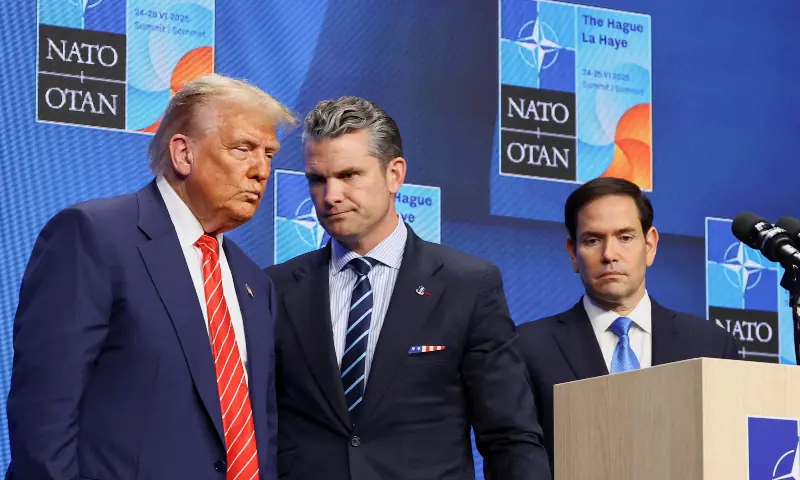
US Secretary of State Marco Rubio will visit Rome and the Vatican this week, an Italian government source said on Sunday, just weeks after a clash between Donald Trump and Pope Leo.
Rubio, who is a Catholic, is expected to meet Vatican Secretary of State Pietro Parolin and Italian Foreign Minister Antonio Tajani, the source told AFP.
Italian media reported that he would also meet Defence Minister Guido Crosetto during the Thursday-Friday visit.
The meetings come several weeks after US President Trump’s extraordinary criticism of Pope Leo XIV over the Catholic leader’s anti-war rhetoric.
Trump also dismissed Italian Prime Minister Giorgia Meloni — one of his closest European allies — as lacking courage after she defended the US pontiff.
Italian media on Sunday presented Rubio’s visit as a meeting to “thaw” relations.
Since taking over as leader of the world’s 1.4 billion Catholics on May 8, 2025, following the death of Pope Francis, Leo has criticised the Trump administration’s crackdown on immigration.
But it was his increasing anti-war rhetoric, particularly following the US-Israeli attack on Iran, that triggered Trump’s ire.
Leo, on April 7, declared Trump’s threat to destroy Iran “unacceptable” and urged Americans to demand that US lawmakers “work for peace”.
The US president subsequently slammed the pontiff in a social media post as “WEAK on Crime, and terrible for Foreign Policy”.
Trump also said he was “not a big fan of Pope Leo” and that he does not “want a pope who thinks it’s OK for Iran to have a nuclear weapon”.
Meloni condemned as “unacceptable” Trump’s criticism — prompting the president to turn his fire on her.
“I’m shocked at her. I thought she had courage, but I was wrong,” the US president said in an interview with Italian daily Corriere della Sera.
He also accused Meloni — a far-right leader who has sought to act as a bridge between diverging US and European views — of failing to help the United States with Nato.
Trump has threatened to pull US troops from Italy, saying Rome “has not been of any help to us” in the Iran war. He has made a similar threat towards Spain, while the Pentagon has announced it is withdrawing 5,000 US troops from Germany.
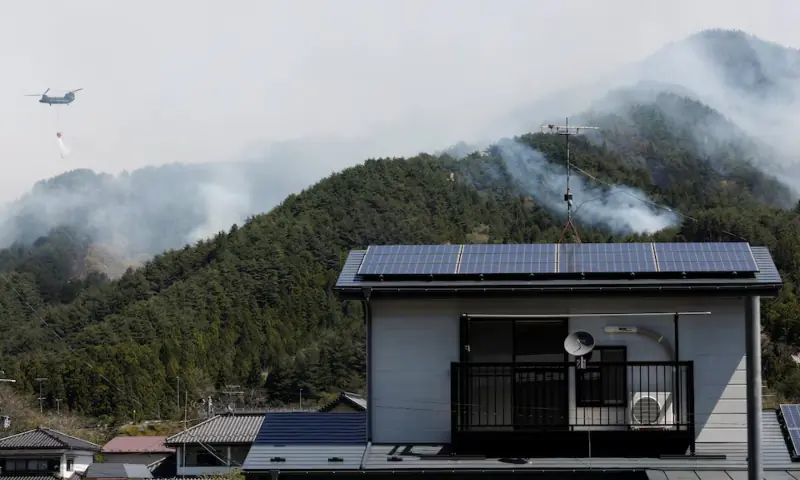
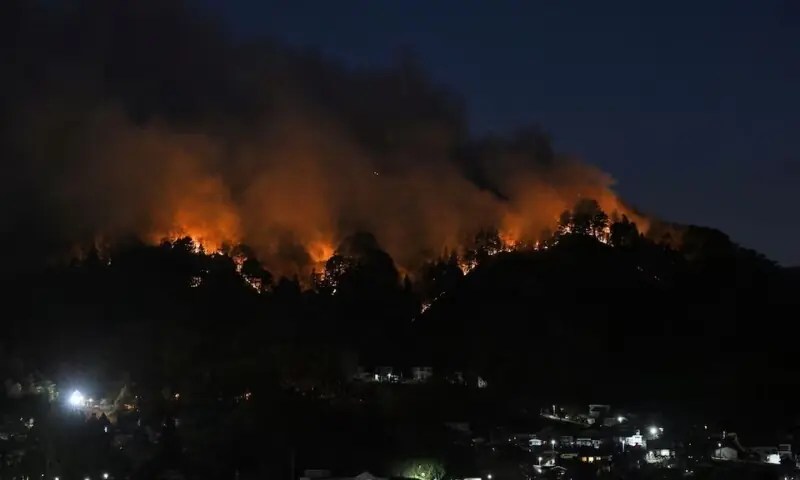
Wildfires that scorched forests in northern Japan, reportedly the second biggest in over 30 years, have been brought under control after 11 days, officials have said.
Hundreds of firefighters and more than 1,000 military personnel had battled the blazes since late April, as they burned around 1,600 hectares (4,000 acres) across the mountainous Iwate region.
The affected area is almost five times the size of New York City’s Central Park.
At least eight buildings were damaged, and two people suffered minor injuries, according to the Fire and Disaster Management Agency. Thousands of people were evacuated as fires picked up.
Otsuchi town mayor Kozo Hirano told reporters on Saturday that he had been “informed that… the fire had been brought under control” after visiting the area with fire officials.
He credited aerial and ground firefighting operations, as well as heavy rainfall, for containing the flames.
But Hirano said authorities would remain vigilant as there was a possibility that smouldering embers would remain.
Kyodo News described the blaze as Japan’s second-largest wildfire in over 30 years.
Increasingly dry winters have raised the risk of wildfires. Last year, Iwate suffered a separate wildfire that burned 2,600 hectares, the largest in Japan since 1975, when 2,700 hectares were scorched by fire in Kushiro, on the northern island of Hokkaido.
Scientists have long warned that climate change caused by mankind’s burning of fossil fuels will make periods of drought more intense and longer-lasting, creating the ideal conditions for wildfires.
Austrian police have arrested a man suspected of lacing jars of baby food with rat poison in what authorities presumed was an extortion scheme.
Police, cited by the APA news agency, said the suspect, aged 39, was apprehended in the state of Burgenland, south of Vienna. They did not name him nor say where exactly he was arrested.
He was charged with deliberately causing a public danger and attempted grievous bodily harm.
The arrest comes two weeks after Austrian authorities detected rat poison in baby food jars sold in some supermarkets. The jars were made by the German-based company HiPP, and German police became involved in the case.
Five tampered jars were recovered before they were consumed in the following days in Austria, the Czech Republic and Slovakia.
Police said they believed the crime was carried out to extort the company, which put out a product recall in Austria.
One of the adulterated jars was bought in a Spar supermarket in Burgenland state, in the city of Eisenstadt. It was found to contain 15 microgrammes of rat poison.
Another jar sold in the same supermarket was suspected to have also been laced with poison, but it has not yet been recovered.
Two activists who participated in a Gaza-bound aid flotilla were brought to Israel for questioning, the foreign ministry said on Saturday, after the vessels were intercepted by Israeli forces this week.
Saif Abu Keshek, from Spain, and Thiago Avila, a Brazilian, were in Israel and would “be transferred for questioning by law enforcement authorities”, the ministry said on X, adding that the two activists were affiliated with an organisation sanctioned by the US Treasury.
The ministry said the activists were affiliated with the Popular Conference for Palestinians Abroad (PCPA), a group Washington has accused of “clandestinely acting on behalf of Hamas”.
In January, the US Treasury imposed sanctions on the group, which it said was involved in organising Gaza-bound civilian flotillas that aimed to break Israel’s sea blockade on the Palestinian territory.
Israel’s foreign ministry said Abu Keshek was a leading member of PCPA and Avila, also linked to the organisation, was “suspected of illegal activity”.
“Both will receive a consular visit from the representatives of their respective countries in Israel,” the ministry said.
Spain condemned the “illegal detention” of its citizen. Abu Keshek “must be released immediately so that he can return to Spain”, Spanish Foreign Minister Jose Manuel Albares told Rac1 radio.
“We are facing an illegal detention in international waters, outside any jurisdiction of the Israeli authorities,” Albares said.
Avila was among the organisers of a flotilla that had tried to bring aid to Gaza last year despite the naval blockade. That effort was also intercepted by Israeli forces.
The current flotilla comprised more than 50 vessels and had set sail from ports in France, Spain and Italy with the aim of breaking the blockade of Gaza and bringing humanitarian aid to the Palestinian territory.
Israel controls all entry points to Gaza.
Throughout the conflict, there have been shortages of critical supplies in Gaza, with Israel at times cutting off the entry of aid entirely. The Gaza Strip has been under Israeli blockade since 2007.
Israel’s foreign ministry earlier claimed around 175 activists had been taken off more than 20 vessels on Thursday by the country’s military. Flotilla organisers said 211 activists had been kidnapped.
Organisers said the Israeli operation had taken place over 1,000 kilometres from the Gaza Strip. Israeli forces halted the boats overnight Wednesday to Thursday, with organisers, the Global Sumud Flotilla, saying their equipment had been smashed and that the intervention had left them facing a “calculated death trap at sea”.
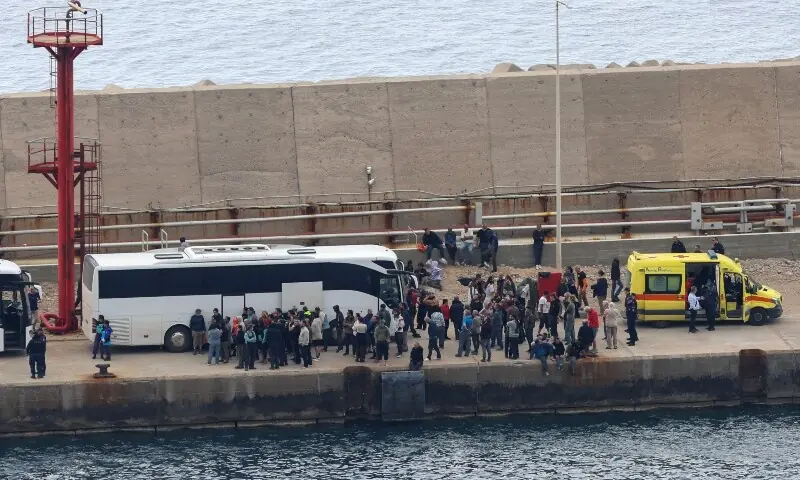
Dozens of intercepted activists disembarked on Friday on the Greek island of Crete, according to an AFP journalist.
Former senator Mushtaq Ahmad was also among those detained. On Friday, Deputy Prime Minister and Foreign Minister Ishaq Dar said on X that Ahmad had been released.
“I reiterate my strongest possible condemnation of the illegal detention of humanitarian workers aboard the flotilla as well as obstruction of humanitarian aid destined for the besieged people of Gaza,” he said.
The United States has backed Israeli authorities, calling the flotilla a “stunt”.
In the summer and autumn of 2025, a first voyage by the Global Sumud Flotilla across the Mediterranean towards Gaza drew worldwide attention. The boats in that flotilla were intercepted by Israel off the coasts of Egypt and the Gaza Strip in early October.
Crew members, including Swedish activist Greta Thunberg, were arrested and then expelled by Israel.
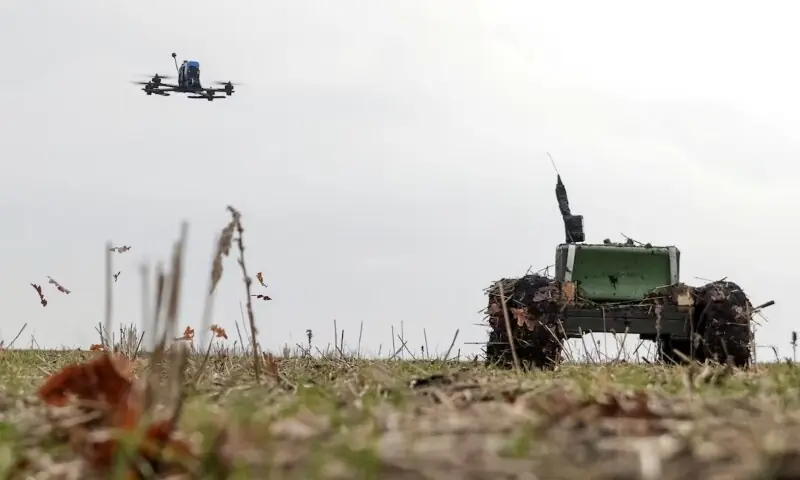
Hezbollah’s cheap fibre-optic drones are creating new challenges for Israeli troops in southern Lebanon, forcing the military to adapt its tactics against an increasingly lethal threat.
The Israeli military — considered one of the most advanced in the world — has confirmed two soldiers and one civilian contractor killed in explosive drone attacks in under a week, with several others wounded despite a ceasefire in place since mid-April.
The devices are small, cheap and readily available, like “children’s toys”, explained Orna Mizrahi, a senior researcher at Israel’s Institute for National Security Studies (INSS).
The military “does not have nowadays any response for that, because they didn’t prepare themselves for such low-tech explosives”, she told AFP.
Israel has been fighting Hezbollah since early March, invading the neighbouring country’s south to confront the group.
Since then, violence has continued, with both sides accusing each other of breaching the ceasefire. Israel has continued its airstrikes since the ceasefire came into effect.
Unlike conventional drones guided by GPS or radio, which can therefore be jammed, Hezbollah is using devices linked to their launch site by a thin fibre-optic cable that can stretch for dozens of kilometres.
Operators pilot the drones in first-person view (FPV) using screens or virtual reality goggles that require limited training.
“Since the drone does not transmit the image via radio broadcast and does not receive guidance commands via radio receiver, it cannot be detected by electronic intelligence means or blocked through electronic warfare,” said Arie Aviram, an expert who has written on the subject for the INSS.
The drones’ speed and precision mean they can cause considerable damage to Israeli targets, and their lack of electronic traces leaves troops reliant on radar or visual detection, which often comes too late.
Asymmetrical warfare
Hezbollah’s use of these drones is characteristic of asymmetrical warfare, explained INSS researcher Mizrahi.
In recent days, Hezbollah has relied more on these drones, a notable shift from the barrages of rockets it unleashed in the weeks after the war broke out.
Experts say the cost of assembling the fibre-optic drones can range from just a few hundred dollars to around $4,000, depending on the quality and type of components, which can be bought on online platforms such as AliExpress.
On Friday, the group’s media chief Youssef al Zein confirmed the group was using the drones and said they were being manufactured in Lebanon.
“We are aware of the enemy’s superiority, but at the same time we are exploiting its weak points,” he said.
For Israel, shooting down cheap drones using sophisticated air defences and fighter jets is unsustainable and costly.
Aviram said that lasers, like those used by Israel’s Iron Beam air defence system, could be a suitable solution “provided they were widely deployed”, which is not the case.
Indicating the challenge posed by these devices, the Israeli defence ministry put out a public call on April 11 for “proposals to identify additional capabilities to address the threat of fibre-optic-controlled FPV drones”.
Nets and barriers
A video shared on social media by prominent Israeli journalist Amit Segal on Wednesday appeared to show military vehicles draped in netting to protect against drones. AFP was unable to verify the footage.
A senior military official told journalists on Tuesday that “so far, we’re using force protection technologies and other protections that we learned from other places, from our own experience with nets, with barriers”.
“But it’s a threat that we’re still adapting to, there’s nothing that is foolproof,” the official added, noting that the military was “learning” from the war in Ukraine, where fibre-optic drones are now common.
Israeli news website Mako reported in 2024 that Ukraine — which has become a world-leading drone expert since Russia’s invasion — offered its expertise to Israel several years ago but was rebuffed.
“There was no concrete response,” Ukraine’s former defence minister Oleksii Reznikov told Mako at the time.
Asked by AFP about the challenges posed by fibre-optic explosive drones, the Israeli military said troops had in recent weeks “conducted an in-depth analysis of how this threat operates and how Hezbollah employs it”.
“The IDF is monitoring the drone threat and developing operational methods to address it,” it said, adding that troops on the ground were “continuously working to improve and adapt their systems in order to deal with the evolving threat”.
Nato said on Saturday it was working with the United States to understand Washington’s decision to withdraw 5,000 troops from Germany as a rift in transatlantic ties deepens over the Middle East war.
The Pentagon’s announcement of the troop withdrawal follows a spat between US President Donald Trump and German Chancellor Friedrich Merz, who said on Monday that Iran was “humiliating” Washington at the negotiating table.
Trump fired back by saying that Merz “doesn’t know what he’s talking about”.
It also came as Trump announced that tariffs on cars and trucks from the European Union will increase to 25 per cent next week over accusations that the bloc did not comply with a trade deal signed last summer.
Pentagon spokesman Sean Parnell said on Friday the withdrawal of around 5,000 troops from Germany was expected “to be completed over the next six to twelve months”.
“This decision follows a thorough review of the Department’s force posture in Europe and is in recognition of theater requirements and conditions on the ground,” Parnell said in a statement.
There were 36,436 active-duty US troops in Nato ally Germany as of December 31, 2025, compared to 12,662 in Italy and 3,814 in Spain.
German Defence Minister Boris Pistorius said on Saturday the US troop withdrawal “from Europe and also from Germany was to be expected”.
Nato said it was “working with the US to understand the details of their decision on force posture in Germany”.
“This adjustment underscores the need for Europe to continue to invest more in defence and take on a greater share of the responsibility for our shared security,” Nato spokeswoman Allison Hart wrote on X.
‘Why shouldn’t I?’
Trump has made a number of threats to slash US troop numbers in Germany and other European allies during both his terms in office, saying he wants Europe to take on greater responsibility for its defence rather than depending on Washington.
He now appears determined to punish allies who have failed to back the Middle East war or contribute to a peacekeeping force in the crucial Strait of Hormuz waterway, which Tehran’s forces have effectively closed.
Trump also accused German automakers such as Mercedes-Benz and BMW of ripping off Americans, saying on Friday that Germany and “other European nations have not adhered to our trade deal”.
Germany would likely be hit hard by a sharp vehicle tariff because it is responsible for a significant portion of EU auto exports.
Such tariffs would impose “enormous costs on the Germany and European automobile industry,” the head of Germany’s VDA lobby group for the sector, Hildegard Mueller, said in a statement sent to AFP.
She called for an “urgent” de-escalation and speedy negotiations on the issue.
Trump said on Thursday he might pull US troops from Italy and Spain due to their opposition to the war.
“Italy has not been of any help to us and Spain has been horrible, absolutely horrible,” he told reporters in the Oval Office.
“Yeah, probably, I probably will. Why shouldn’t I?” Trump said.
German Foreign Minister Johann Wadephul said on Thursday during a visit to Morocco that Germany was “prepared” for a reduction in US troops and was “discussing it closely and in a spirit of trust in all Nato bodies”.
However, Wadephul said large American bases in Germany are “not up for discussion at all” and cited the example of Ramstein Air Base, which he said has “an irreplaceable function for the United States and for us alike”.
Ukraine support
The EU said on Thursday the deployment of US troops in Europe was in Washington’s interest, and that the US was “a vital partner in contributing to Europe’s security and defence”.
Trump, however, took aim at Merz again, telling him to focus on ending the Ukraine war instead of “interfering” on Iran.
European powers have been on alert since Russia invaded Ukraine in 2022. A spate of drone incursions in the past year, as well as US promises to move away from defending the continent, have pushed the issue to the top of the agenda.
Merz has made national security a priority, announcing unprecedented investments in an army that has been underfunded and under-equipped for decades. He has also reaffirmed support for Ukraine.
India raised on Friday the prices of commercial liquefied petroleum gas (LPG) and jet fuel for international airlines, according to a state-run energy firm, as supply pressures from the Middle East war mount.
The South Asian nation is heavily dependent on imported energy, including for roughly 60 per cent of its LPG, the fuel used for cooking by a vast section of its population, the largest in the world.
As imports have been disrupted since the Middle East war began in late February, New Delhi has moved to ensure households and essential sectors remain adequately supplied, leaving many restaurants, manufacturers and power plants in the lurch.
The government has maintained that India faces no overall fuel shortage.
“Prices of bulk and commercial LPG cylinders have been revised,” the state-run Indian Oil Corporation Limited (IOCL), the country’s leading energy marketing company, said.
IOCL’s price chart shows an increase of 993 rupees ($10.50) in the price of a 19 kilogramme LPG cylinder meant for commercial use.
That amounts to a nearly 48pc rise in the capital New Delhi. Local levies mean rates vary across cities.
The sharp hike will hit restaurants particularly hard, with many already scaling back operations during the Middle East war.
The oil company said that the price of jet fuel for international airline operations has also “been adjusted upward”.
Aviation turbine fuel (ATF) has gone up by around 5pc in Delhi, according to IOCL’s catalogue.
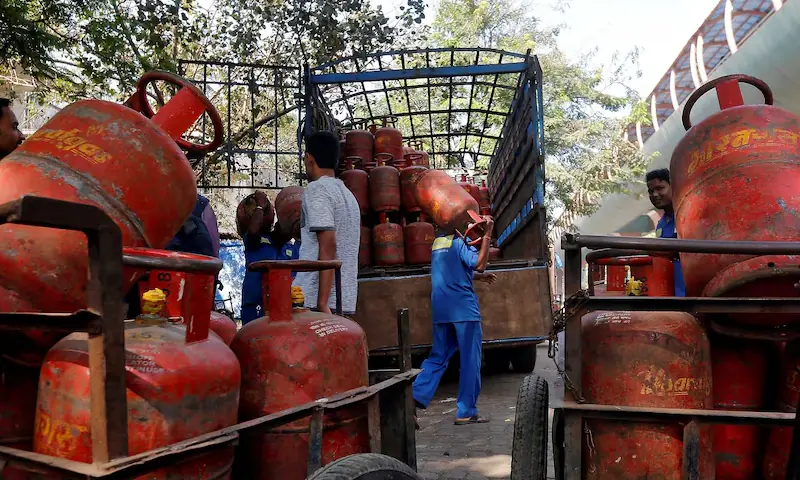
Across much of India, an energy crunch caused by the Iran war has prompted long queues for cooking gas cylinders. That’s not a problem for Gauri Devi.
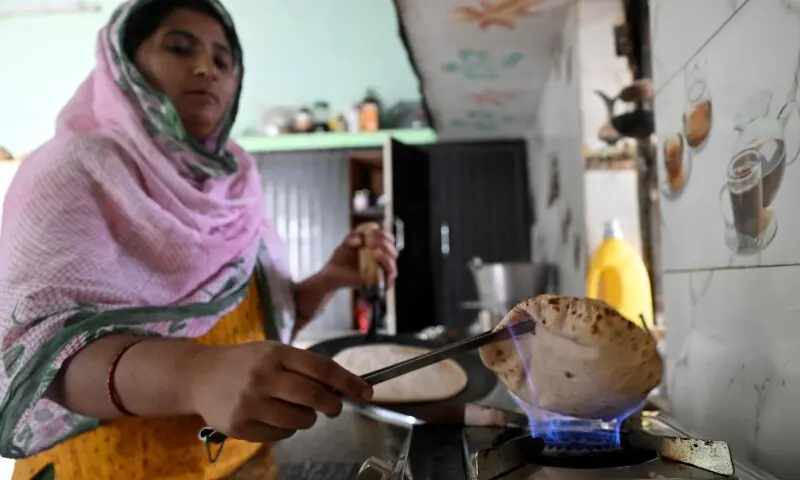
On a stove with blue flames, she flips a chapati flatbread, burning biogas produced from cow dung — an alternative fuel helping ease pressure on supplies.
This photograph taken on April 24, 2026 shows villager Gauri Devi cooking using biogas at her residence in Uttar Pradesh’s Bulandshahr district. —AFP
“It cooks everything,” the 25-year-old said in her courtyard kitchen in Nekpur, a village in Uttar Pradesh, about 90 kilometres (55 miles) from New Delhi.
“If the pressure goes down, we let it rest for half an hour and it works again.” India consumes more than 30 million tonnes of liquefied petroleum gas (LPG) annually, importing over half its needs.
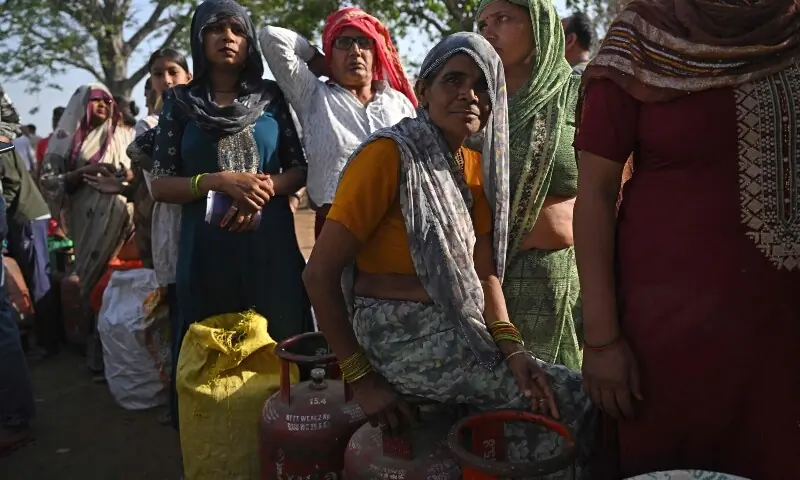
The government insists there is no shortage of cooking gas, but supply delays, panic buying and black marketeers have created long queues for cylinders.
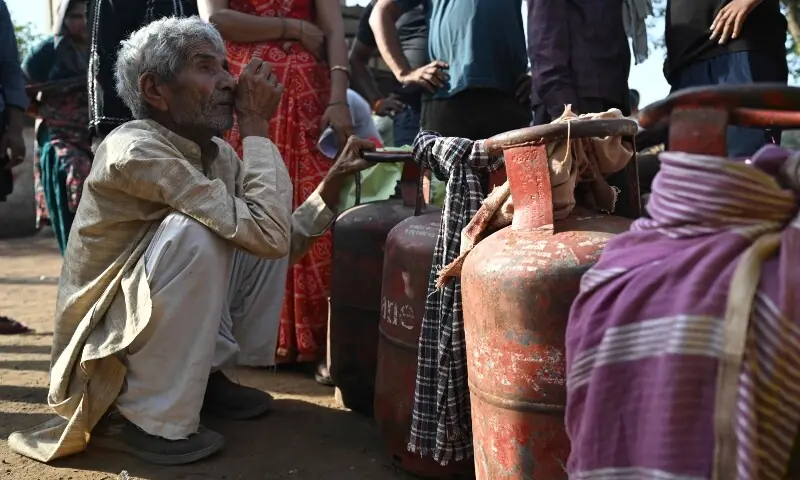
This photograph taken on April 24, 2026 shows people waiting with empty LPG (liquefied petroleum gas) cylinders for refilling, in a village on the outskirts of Uttar Pradesh’s Jewar district. —AFP
However, since the 1980s, India has also promoted biogas as a low-cost rural energy source, subsidising more than five million “digester” units that convert farm waste into methane for cooking, and nitrogen-rich slurry for fertiliser.
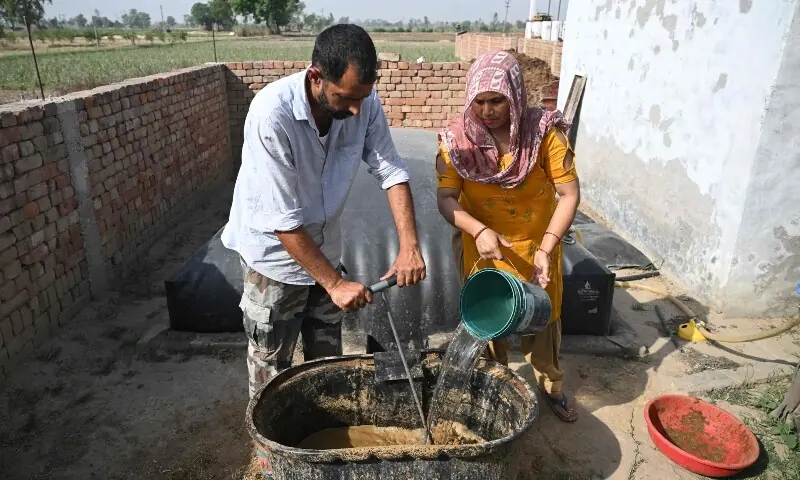
For Gauri, it requires mixing a couple of buckets of dung with water, then pouring the mixture into a car-sized underground tank topped with a storage balloon.
This photograph taken on April 24, 2026 shows residents pouring cow dung into their biogas plant at a village in Uttar Pradesh’s Bulandshahr district. —AFP
It provides a piped methane supply so regular that she only uses an LPG cylinder for emergencies or large gatherings.
The biogas works for everything — “vegetables, tea, lentils”, she said.
‘Black gold’
The residual slurry is later spread on fields as fertiliser. It has better nitrogen availability for plants compared with raw dung, farmers say.
“The manure is so good,” said farmer Pramod Singh, who installed a larger unit in 2025, enough for six people, fuelled by 30-45 kilogrammes of dung daily from four cows.
And he said the slurry fertiliser is particularly valuable at a time when global supplies of artificial fertilisers have been hit by trade disruptions due to the war.
“The real benefit is not just the gas — that is like a bonus,” local farmer leader Pritam Singh said.
“The slurry is ‘black gold’.”
More than 45 per cent of India’s 1.4bn people rely on farming, and the country has one of the largest cattle populations.
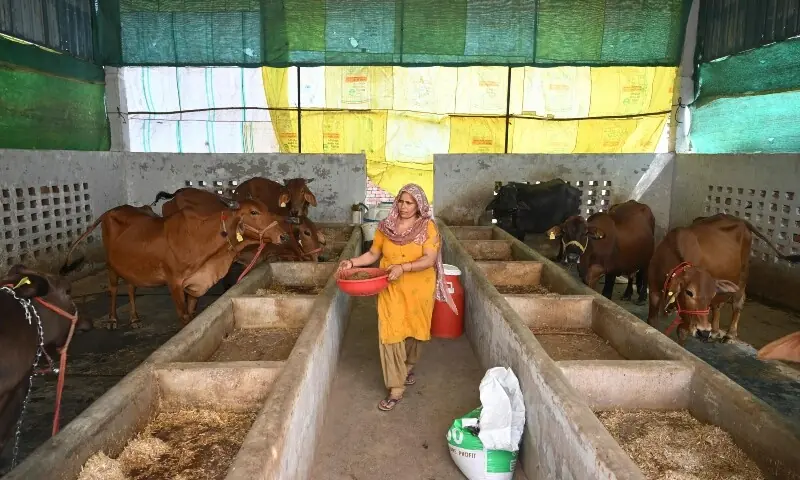
This photograph taken on April 24, 2026 shows a villager collecting cow dung from her cattle stable near her residence in Uttar Pradesh’s Bulandshahr district. —AFP
India — the world’s most populous nation and third-largest fossil fuel polluter — has pushed large-scale biogas production to achieve a goal of carbon neutrality by 2070.
The government last year required that biogas account for at least one percent of liquid gas fuelling both vehicles and for domestic use— rising to five per cent by 2028.
Dozens of multi-million dollar production plants are now in the pipeline.
But small-scale rural producers are also being rolled out – units cost around INR25,000-30,000 ($265-$318), often heavily subsidised by the government.
In a Hindu-majority nation where cows are revered and dung and urine are used in everything from floor plastering and fuel to ritual practices, it is easy to win supporters, said Pritam Singh.
He installed his first plant in 2007 and has helped put in 15 more in his village in the past year alone.
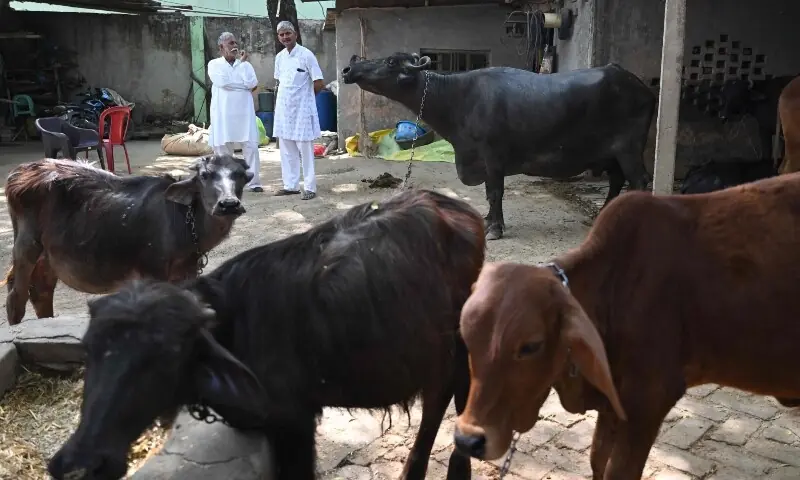
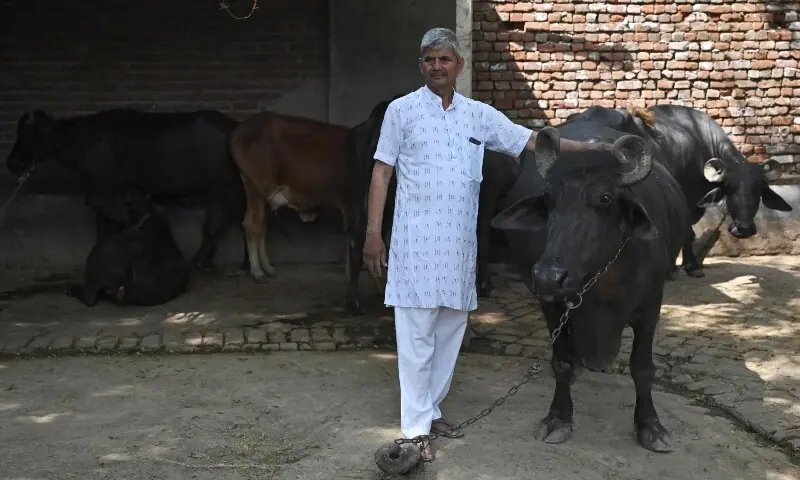
This photograph taken on April 24, 2026 shows Pritam Singh (R), a local farmer leader standing alongside his cattle, at a village in Uttar Pradesh’s Bulandshahr district. —AFP
He said interest had shot up after the LPG shortages.
“People who earlier were not interested now ask how to get it,” he said.
“Once they see food being cooked and crops benefiting, they are convinced.”
‘Mini factories’
But biogas is still a small fraction of household cooking fuel, with LPG considered more convenient because companies manage the supply chain.
“Biogas plants are not just equipment; they are mini factories,” said A.R.Shukla, president of the Indian Biogas Association.
“They need organised installation, regular operation and maintenance,” he added.
This photograph taken on April 24, 2026 shows a villager carrying cow dung from her cattle stable to a biogas plant at her residence in Uttar Pradesh’s Bulandshahr district. —AFP
“So, unless installation and upkeep are handled through community-based or cooperative enterprises, households will continue to treat biogas as secondary fuel.” And even with government support, there are barriers to uptake, including cost and space.
“We work on other people’s farms the whole day. We don’t have land for it,” said labourer Ramesh Kumar Singh, standing in a line of around 100 queueing for LPG cylinders in the nearby village of Madalpur.
This photograph taken on April 24, 2026 shows people waiting with empty LPG (liquefied petroleum gas) cylinders for refilling, in a village on the outskirts of Uttar Pradesh’s Jewar district. —AFP
“I am standing in scorching heat, hungry and thirsty,” said Mahendri, 77, who had failed to secure a cylinder for three days in a row.
Japanese police arrested a man for allegedly incinerating his dead wife at the zoo where he worked, officials and local media said Friday, following the discovery of human remains.
Police arrested Tatsuya Suzuki on Thursday evening on suspicion that he “transported the victim’s body to a tourist facility” in the northern island of Hokkaido and “destroyed it through incineration there,” a local police official told AFP.
The victim, 33-year-old Yui Suzuki, was identified by local media as his wife. Police have not said how she died.
While held in voluntary police questioning, Suzuki said he used his zoo’s incinerator —meant to dispose of waste and dead animals —to burn the woman’s body “for a few hours,” local media reported.
His confession sent police scouring the incinerator for her remains, whose partial discovery paved the way for Suzuki’s arrest, local media said.
While alive, the wife once told her relatives that her husband was threatening to “burn you until no trace of you will be left”, public broadcaster NHK said, citing investigative sources.
The gruesome case forced the Asahiyama Zoo, a popular tourist attraction closed since early last month as part of regular maintenance ahead of the summer season, to delay its reopening scheduled for Wednesday.
On Friday, the zoo resumed business, with officials bowing to visitors and apologising for the trouble caused.
“The zoo is in an extremely difficult situation at the moment,” Hirosuke Imazu, mayor of Asahikawa City, which operates the facility, said, according to NHK.
“But we would like to turn your support into our energy, and convey the beautiful lives of our animals,” he said.
New York City Mayor Zohran Mamdani called for King Charles to “return” the prized Koh-i-Noor diamond, which the British Empire took from the Indian subcontinent in the 1800s, on the third day of the monarch’s state visit on Wednesday.
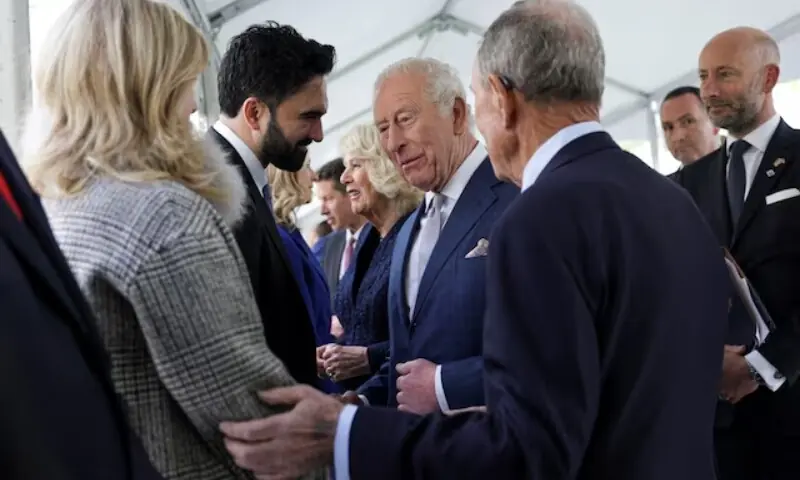
Before greeting Charles and Queen Camilla at a 9/11 memorial event, Mamdani was asked what he would discuss with the king if he had the chance.
“If I was to speak to the king, separately from that, I would probably encourage him to return the Koh-i-Noor diamond,” the leftist mayor said, adding that his focus would be honoring those killed in the terror attacks.
It’s unclear whether Mamdani followed through and brought up the contentious subject with Charles when the two met.
The monarch was seen laughing with Mamdani and having a brief conversation after they shook hands.
Housed in the Tower of London, the massive 106 carat stone is the star of Britain’s crown jewels, adorning the Crown of Queen Elizabeth the Queen Mother.
The ownership of the jewel has been contested over the centuries, passing through the hands of Mughal emperors, Iranian shahs and Sikh maharajas before the Kingdom of Punjab gave it to Queen Victoria in 1849 as part of a peace treaty.
India has repeatedly and unsuccessfully sought the return of the priceless jewel.
While there is little doubt it was mined in India, its history thereafter is a mixture of myth and fact, with several countries including Afghanistan, Iran and Pakistan also laying claim to the gem.
A politician from the anti-immigration Reform UK party was quick to slam the comments as an “insult to our King.” “This beautiful diamond is currently on display in the Tower of London,” the party’s home affairs spokesman Zia Yusuf said in an X post. “That is where it will stay”.
White supremacist killer Brenton Tarrant lost on Thursday an appeal seeking to overturn his conviction and sentence for shooting dead 51 people at two New Zealand mosques in 2019, court documents showed.
The 35-year-old admitted to carrying out New Zealand’s deadliest modern day mass shooting before being sentenced to life in prison in August 2020.
He appealed to the Court of Appeal in February, saying “torturous and inhumane” detention conditions during his trial made him incapable of making rational decisions when he pleaded guilty.
“I did not have the mind frame or mental health required to be making informed decisions at that time,” Tarrant said at the time.
The panel of three judges said the court “does not accept Mr Tarrant’s evidence about his mental state.”
“There were inconsistencies in Mr Tarrant’s own evidence, and his evidence is at odds with the detailed observations of prison authorities and the assessments of mental health professionals at the time of him entering his pleas.”
The judges found Tarrant’s guilty pleas were voluntary and “he was not coerced or pressured in any way to plead guilty”.
“The evidence overwhelmingly demonstrates that he was not suffering any significant psychological impacts as a result of his prison conditions at the time he pleaded guilty,” the court said.
The court said Tarrant’s “proposed conviction appeal is utterly devoid of merit”.
“The facts concerning Mr Tarrant’s offending are beyond dispute. He has not identified any arguable defence, or indeed any defence known to the law.”
‘Huge relief’
Tarrant’s penalty of life imprisonment without parole was the stiffest in New Zealand history.
Armed with an arsenal of semi-automatic weapons, Tarrant attacked worshippers at two mosques in Christchurch on March 15, 2019.
He published an online manifesto before the attacks and then livestreamed the killings for 17 minutes.
His victims were all Muslim and included children, women and the elderly.
The court’s decision was complicated one week after Tarrant’s February hearing when he sought to abandon his appeal entirely.
The judges said the court received a notice of abandonment of appeal signed by Tarrant using a “self-styled moniker” but the document was thrown out because it was not dated or witnessed.
Tarrant filed a second notice later that week, again using a pseudonym, which was dated and witnessed.
He said he “no longer wishes to have a lawyer” and the appeal should not continue as “it would likely lead to a miscarriage of justice”.
Lawyers acting for the survivors and families of victims told national broadcaster RNZ the decision had been a “huge relief”.
“The law has now done its job,” they said.
“The families, and frankly all of us, will be spared the trauma of reliving the 15th of March all over again in a trial.
“It is a huge relief that the difficult and often unsupported journey families are on will not now be added to by the great burden of a new trial. It would have been unimaginably traumatic. “
WASHINGTON: US Defence Secretary Pete Hegseth repeatedly clashed with Democratic lawmakers over the Iran conflict on Wednesday, in his first testimony to Congress since President Donald Trump launched the war more than two months ago.
Appearing before the House Armed Services Committee, Hegseth quickly struck a combative tone, saying in his opening remarks that the main challenge at this point is the “defeatist words of Democrats and some Republicans.”
Representative Adam Smith — the committee’s top Democrat — took aim at the regional fallout from the war and its toll on both US troops as well as civilians, saying he wanted answers on where the conflict is going and “the plan to achieve our objectives.”
He later asked Hegseth how the “lethal, kinetic action” of the war could be turned into an improvement when it comes to Iran’s nuclear program, which Washington is seeking to eliminate. Hegseth responded by taking aim at the “very bad” nuclear agreement that Trump scrapped during his first term in office.
John Garamendi, another Democrat, accused Hegseth of “lying to the American public about this war from day one” describing what is happening in the Middle East as a “geopolitical calamity, a strategic blunder, resulting in worldwide economic crisis.”
“During the 60 days of Trump’s Iran war, critical munitions have been expended at an alarming rate, depleting magazine levels below what is thought necessary to hold China at bay,” said Garamendi, also describing the conflict as a “quagmire.”
Hegseth pushed back, asking Garamendi “who are you cheering for here?” and saying that calling the war a quagmire was “handing propaganda to our enemies.”
Democratic Representative Seth Moulton asked Hegseth if he advised Trump to attack Iran — a question Hegseth declined to answer, though he later said he thought doing so was “a good idea.”
Asked by Moulton if he had considered the risk of Iran closing the vital Strait of Hormuz if it was attacked, Hegseth said the Pentagon “looked at all aspects of this risk.”
Hegseth was also pressed on the cost of the conflict, which he said was estimated at less than $25 billion so far.
The Pentagon chief then asked the committee: “What is it worth to ensure that Iran never gets a nuclear weapon?”

 Login
Login