When most people imagine scientists discovering new species, they probably still picture an expedition into the unknown.
A naturalist travels somewhere remote, perhaps on a wooden ship, and traipses through the jungle to encounter an animal or plant never before described by science. The intrepid explorer brings back specimens or observations to a museum, where they can be compared, named and described.
There is some truth to this stereotype. Between 1854 and 1862, scientist Alfred Russel Wallace travelled through the Malay Archipelago, discovering animals and insects unknown to Western science. This led him to the theory of evolution by natural selection, contemporaneously with Charles Darwin.
Antarctica had its own era of discovery. In 1840, scientists on a French expedition encountered what we now know as Adélie penguins. Imagine seeing penguins for the first time: strange black-and-white birds waddling over the ice, sliding on their bellies, leaping from freezing seas.
Of course, “discovery” is a loaded word. Many animals and plants described by Western science were already known to Indigenous peoples and local communities. What changed was their entry into the formal scientific naming system – the global process by which species are compared, classified and recognised.
Today, scientists are still finding new life in remote places and hidden inside the DNA of animals we thought we already knew.
We still explore unknown worlds
Scientists still discover species this way: by probing Earth’s nooks and crannies and travelling to remote places to study what lives there.
Last year, I was onboard the scientific vessel R/V Falkor (too) in Antarctica’s Weddell Sea, where one scientific team was searching for seafloor methane seeps.
These are not just geological curiosities. Methane seeps create unusual habitats that harbour strange communities of life fuelled not by sunlight, but by chemicals rising from below. Scientists have already found new microbial diversity at Antarctica’s first known active methane seep.
Not all hard-to-reach worlds are underwater. In Papua New Guinea’s Southern Fold Mountains, camera traps captured a shy, ground-dwelling bird slipping through rugged limestone forest. Scientists described it as a new species in 2025, the hooded jewel-babbler.
But there is another kind of discovery happening too.
White microbial mats underwater are telltale signs of seeping methane.Andrew Thurber, CC BY-ND
Hidden species in familiar animals
Some species are not hidden because they live at the bottom of the sea or deep in a mountain forest. They are hiding in plain sight.
Gentoo penguins are a good example. With their bright orange bills and comic waddle, they are familiar to anyone who has visited Antarctica. To most observers, they are simply “gentoos”.
But our new research shows gentoo penguins are not one widespread species, but four. Our 2020 study first showed major genetic and physical differences between gentoo penguins from different islands.
Now, using whole genomes – the complete set of genetic instructions inside an animal – and ecological modelling, we found these penguins are not just separated by distance, but have adapted to different Southern Ocean worlds.
Discoveries like this are often called “hidden” species. They look very similar to their relatives, but if we study their DNA, body measurements, behaviour and ecology, it’s clear they are separate species.
Species discovery has always depended on the tools available. Early naturalists relied on what they could collect: feathers, skins, eggs and bones. These museum collections are like time machines and remain incredibly important.
Today, whole genomes tell us if animals have different coding. Ecological models show whether animals live in different environmental conditions. Mathematical approaches test whether groups are evolving independently.
In other words, we are learning to see biodiversity in higher resolution.
This sharper view is changing how we understand familiar animals. For a long time, giraffes were considered one species, but genetics suggests they are four. My own work on forest birds in Madagascar found a new species of Newtonia bird.
The Tapanuli orangutan is a powerful example. This Indonesian great ape from Sumatra was described as a new species in 2017, based on genomic, anatomical and behavioural evidence. It was extraordinary to recognise a new great ape in the 21st century, and sobering to realise fewer than 800 may remain.
Again and again, the message is the same. The natural world is more complex than we know. And sometimes, by the time we recognise that complexity, a species may already be in deep trouble.
The Tapanuli orangutan is a species of orangutan restricted to South Tapanuli in the island of Sumatra in Indonesia. It is one of three known living species of orangutan.Prayugo Utomo/Creative Commons, CC BY
Why names matter
Taxonomy – the science of naming and classifying life – can sound like an old-fashioned labelling exercise. But it’s how we map life on Earth.
Conservation laws, threatened species lists and monitoring programs usually work at the species level. If several species are mistakenly treated as one, a declining species can be hidden inside a larger group that looks secure.
As we stand at the precipice of Earth’s sixth mass extinction, this has never been more important.
Recognising hidden biodiversity does not solve conservation problems by itself. But it helps us ask better questions. Which species are increasing? Which are declining? Which have not been counted for decades?
These questions are urgent, because we are racing to understand biodiversity while climate change and habitat loss reshape life on Earth.
Even now, in an age of satellites and genome sequencing, Earth still has secrets. Not only in the most remote places, but in the first animals we learn to recognise as children: penguins, giraffes, orangutans.
The closer we look, the more life reveals itself. Our task now is to keep looking and protect the richness that was there all along.
Jane Younger receives funding from the Australian Research Council, National Geographic Society, Rolex, WIRES, the Marine Megafauna Research Fund, and Lindblad-National Geographic. She is affiliated with the University of Tasmania and Senior Editor of Ecology & Evolution.
Taylor Swift has filed a trademark application covering her voice and stage image. It includes a photo of her performing in her distinctive bejewelled Eras Tour bodysuit and two voice recordings: “Hey, it’s Taylor” and “Hey, it’s Taylor Swift.”
It’s the latest example of the singer using her status and power to challenge industry norms and assert the rights of artists.
In 2014, Swift removed her entire catalogue from Spotify in protest at the low level of artist remuneration generated by the platform (later relenting in 2017). In 2019, she began rerecording her previous albums in protest at the acquisition of her back catalogue by alleged industry foe Scooter Braun’s Ithaca Holdings, giving her back control over masters of her songs. The new “Taylor’s Versions” outperformed the original versions on streaming services.
Although the actor Matthew McConaughey beat Swift to the punch by successfully trademarking some of his famous spoken lines of movie dialogue earlier this year, she appears to be the first music artist of note to take the step. The move raises some interesting issues in terms of copyright law and the rights of music artists.
‘Passing off’ and deepfaking
In music, both sound recordings and the songs which they embody are protected by copyright law. Much of the income generated by the music industry is based on the commercial exclusivity to exploit these forms of intellectual property (IP), which that law ensures.
All of Swift’s vocals are protected from copying in terms of being sampled without permission. But the question of whether or not a vocal being performed (or manufactured in the case of AI) to sound like Swift is a copyright infringement is less clear.
In 1988, Bette Midler successfully sued Ford Motor Company for using an impersonator to perform her songs in TV adverts. This case suggests that deliberately copying a singer’s voice, style and tone can amount to passing off. In UK law, passing off is a common law tort involving misrepresentation that causes reputational or financial damage. In the US, similar protection is provided under the Lanham Act, which also guards against misleading imitation.
This article is part of our State of the Arts series. These articles tackle the challenges of the arts and heritage industry – and celebrate the wins, too.
Swift has also experienced the darker side of deepfakes, including fake pornographic images and AI-generated photos showing her wearing a “Swifties for Trump” T-shirt ahead of the last US presidential election.
While further legislation is being developed in the US to address AI-generated impersonation more broadly, Swift’s move to trademark both her voice and visual likeness suggests a desire to retain stronger legal control over her identity. This may give her a basis for pursuing civil action under common law or intellectual property rights when objectionable AI-generated content appears. Given her significant wealth and influence, such legal routes may also allow for faster enforcement than relying solely on the criminal justice system.
The trademarks registered both by McConaughey and Swift arguably only offer protection for exactly what has been registered on the basis of the scope of a trademark being “what you see is what you get”.
However, the fact that many platforms require proof of IP registration before taking down potentially infringing content suggests that having these trademarks in place will act as a powerful deterrent against future fakes at the very least.
Training data
A more complex issue for Swift and artists in general is the use of their existing works as data by AIs to create new works. For example, I could prompt an AI to write a song for me in the style of Fearless-era Swift but performed by a voice that is a cross between Norah Jones and Diana Krall. It would be very hard to prove that any particular piece of IP had been infringed, as the AI would be synthesising dozens of songs and performances to achieve its creation.
However, new content would have been created via the mining of existing IP; a songwriter’s moral right of integrity protects against adaptation of their works without permission, and musicians and songwriters have become increasingly concerned that they are not being recompensed sufficiently, or indeed even consulted about AI using their work.
In the UK, the Musicians Union has launched an initiative demanding consent and remuneration for AI training and AI-generated music. The UK government has pulled back from its previous line of allowing an exemption for AI training on copyrighted works in favour of more creator control after strong opposition to this stance from the creative industries.
The UK Performing Rights Society, which collects royalties from around the globe for its songwriter and composer members (and their publishing companies) when their work is performed live, broadcast or streamed, has declared that it will not register AI-generated works. However, it will register works which it classes as AI-assisted. This leads to the question of how much human input needs to be evidenced for a piece of music to be copyright-able.
In UK copyright law, the Copyright, Design and Patents Act allows for recordings “generated by computer” but a song or composition needs to display originality to acquire the law’s protection – a product of skill, judgement and labour which should arguably involve significant human involvement, but how much?
There have been some positive developments for artists’ earnings, with certain AI companies recently reaching settlements with major music rights holders over the use of training data in music generation. However, artists such as Swift may still need stronger protection to prevent the unauthorised use, imitation and commercial exploitation of their distinctive vocal styles.
The current regulatory grey areas around AI’s use of IP have been likened to the wild west. With her trademarking initiative, Swift has donned her Stetson, pinned on her five-point star badge and declared herself the new sheriff in town.
Justin Morey does not work for, consult, own shares in or receive funding from any company or organisation that would benefit from this article, and has disclosed no relevant affiliations beyond their academic appointment.
When the University of Queensland Press cancelled the publication of Wiradjuri poet Jazz Money’s book Bila: A River Cycle because of a blog post by its illustrator, 60 UQP contributors signed a letter of protest. Some declared they would no longer publish with UQP. Fourteen staff members issued a statement decrying “the precedent the University of Queensland has set”.
Had HarperCollins, a publisher owned and controlled by the Murdoch family, nixed
an Indigenous children’s book, the decision would perhaps not have been experienced as such a betrayal. UQP, however, boasts on its website of “publishing literary works, poetry and Aboriginal Torres Strait Islander stories”: scarcely an orientation one usually associates with politicised book pulping.
The Bila episode follows a recent pattern in which supposedly progressive institutions and organisations respond to any connection to the Gaza genocide as aggressively as their right-wing counterparts, or even more so.
Conservative politicians and the right-wing press systematically demonise the Palestinian cause and its supporters. According to a study by Ette media, the Australian published, between October 7 2023 and April 9 2026, an astonishing 412 articles wholly or in part about Palestinian writer Randah Abdel-Fattah. Yet some of the most punitive campaigns have played out not in the corporate sector but at the ABC and within the university sector.
In How to Sell a Genocide: The Media’s Complicity in the Destruction of Gaza, Adam Johnson explores a similar phenomenon in the United States. His book does not focus, he says, on “the conservative or MAGA media’s dehumanization of Palestinians”. This is partly because right-wing outlets such as Fox News, the Wall Street Journal and The Daily Wire don’t disguise their anti-Palestinian stance, but also because the timing of the war in Gaza made the reporting and commentary by supposed progressives particularly important.
“There was,” Johnson reminds us, “a Democratic president in office when the
genocide began in earnest, and support from Democrats in Congress and in the think-tank and media world was dispositive in continuing said genocide.”
His critique of what he calls the “Center-Left media” is based on careful
documentation of some 12,000 articles and 5,000 television clips. He brings, as they say, the receipts.
For instance, Johnson notes that CNN – a pillar of US liberalism – mentioned the child deaths in the first 100 days of the Ukraine war far more (4,223 times) than child deaths in the corresponding period in Gaza (3,632 times). On MSNBC, child victims of the Ukraine war featured 1,775 times, compared with 1,522 times for Gaza.
The systematic obliteration of civilian infrastructure in Gaza meant that, even in the initial period Johnson studied, 80% of the population was displaced. In Ukraine, the equivalent figure was only 33%. Yet Johnson finds the US television networks referred to refugees, displaced people and similar terms eight times more often for Ukrainians than for Palestinians (1,663 versus 211).
Yet most liberal news outlets still do not use the word “genocide” in relation to Gaza.
Johnson shows how such lexical scruples do not apply elsewhere. “Even though the destruction of Gaza, by all objective metrics, has been magnitudes more brutal and deadly than that of Russia’s invasion and occupation of Ukraine,” he observes, “the totalising moral labels of ‘war crime’ and ‘genocide’ were used on CNN and MSNBC 17.2 times more often in the context of Russia’s invasion of Ukraine than Israel’s action in Gaza.”
His review of the first 30 days of the two conflicts found that, on CNN and MSNBC, Ukrainians were described on air as victims of genocide or war crimes 1,790 times: 1,515 for war crimes and 275 for genocide. When the victims were Palestinian, the terms were used 104 times: 92 for war crimes and 12 for genocide.
“Ostensibly non-opinionated reporters and ‘analysts’ on both MSNBC and CNN,” writes Johnson, “often asserted, as a matter of fact, that Russia was committing war crimes against Ukrainians, without this being seen as violating their neutrality.”
Higher standards
Israel’s defenders insist the country should not be held to a higher standard than other nations. Johnson’s research shows the opposite is true: judgements regularly made in other contexts become controversial only when applied to Israel.
Channel 4 quickly debunked the audio as a clumsy fake; the investigative group Forensic Architecture determined that most of Israel’s claims about the hospital attack were demonstrably false.
In the months that followed, the IDF engaged in what UN experts later described as “medicide”: namely, the targeted destruction of Gaza’s healthcare system and the killing of more than 1,500 healthcare workers. In one particularly ghastly incident, the IDF fired on five clearly marked ambulances and a fire truck after they came to the aid of Palestinians wounded in an earlier attack.
A subsequent investigation by Forensic Architecture and Earshot alleged the soldiers fired more than 900 bullets at the convoy, before shooting the survivors at close range. The IDF then deployed bulldozers to crush and cover the vehicles, and bury the dead in an unmarked mass grave.
That was one year and five months after Israeli president Isaac Herzog rejected allegations of Israeli responsibility for the Al-Ahli hospital attack as a “blood libel”.
The pushback by the Israelis led to US news outlets formulating new policies. CNN and the New York Times began instructing employees that attacks could only be attributed to Israel after confirmation from the IDF and GPS coordinate location. Johnson quotes a source at CNN:
Whether it’s in the newsroom or in the field, we couldn’t credit anything to Israel unless we were held to this impossibly high bar of having to call it an “explosion”, until we geolocated the site of the explosion, sent the coordinates to the Israelis and asked them for comment.
Asked about whether the policy was applied in other conflicts, such as the Ukraine
war, Johnson’s source answers: “Never, never, never, never, never.”
Previously, the World Health Organization, Human Rights Watch and the US State
Department had all used data from the Gaza Health Ministry because of its proven reliability. After the Al-Ahli hospital attack, US news outlets began appending the description “Hamas-controlled” or “Hamas-run” to descriptions of the health ministry. Johnson says:
in our 100-day survey period, CNN used the “Hamas-run” label and related terms 277 times and MSNBC used it 146 times, despite neither using it once between October 7, 2023 and October 17, 2023.
The practice spread, including to Australia. By October 28 2023, the Sydney Morning
Herald was also attributing casualty figures to the “Hamas-controlled Health Ministry”.
While no one has yet studied the liberal media in Australia with the rigour applied by Johnson in the US, the available evidence suggests it followed the patterns he describes. As I noted in a piece for Deep Cut News, the Age published a bold editorial declaring:
There is a genocide happening today […] Our government should urgently, repeatedly and loudly call for international intervention, and lead in imposing sanctions. We should send bountiful aid to the victims, and halt economic and diplomatic relations […] unless and until the savagery is stopped. All of us, as Australians, should shun travel […] for tourism or business.
And our government should, as it did with the Syrian refugee crisis a few years ago, rapidly engineer an intake of […] refugees.
That wasn’t about Gaza. It appeared in 2017, in relation to the persecution of the
Rohingya people in Mynamar.
Some commentators point to the absence of a final judgement by the International Court of Justice in relation to Gaza. But in 2017 the International Court of Justice had not ruled that the killings of the Rohingya were genocidal. It still hasn’t. The glacial pace at which the court moves means genocide allegations brought by Gambia against Myanmar remain unresolved.
Nevertheless, in 2017, the Age saw no problem with using the word “genocide” after studying reports from Medecins Sans Frontieres about “a deliberate, systematic campaign causing death and human suffering”.
Today, Medecins Sans Frontiers describes Israel’s operations in Gaza as genocidal. The Age does not. It has not published an editorial akin to that it issued in respect of Mynamar; it has not called for the government to impose sanctions, nor urged Australians to boycott Israel.
An acquiescent press
How to explain the special treatment of Israel by the liberal press?
The Gaza war focused attention on lobbyists and their influence on politics and the media. In the US, the American Israel Public Affairs Committee devoted the staggering sum of US$100 million in 2024 to unseating candidates it deemed insufficiently supportive of Israel.
In his book Dateline Jerusalem, veteran journalist John Lyons describes a similar process in Australia. Well before the Gaza war, he witnessed the brutal discrimination dished out by Israeli soldiers to 12-year-old Palestinians in the West Bank, but recognised that, if he reported it, “I would be the target of a backlash which would be tough, nasty and prolonged”.
So it proved. His 2014 story Stone Cold Justice won a Walkley, but he was “attacked professionally, personally and relentlessly by the pro-Israel lobby and its supporters”.
Famously, Edward Herman and Noam Chomsky list “flak” from corporate lobbyists as one of the filters that produces an acquiescent press. Dissenting journalists face a barrage of time-consuming complaints so exhausting it induces preemptive self-censorship. Flak from pro-Israel groups aims, as Lyons puts it, “to make journalists decide that, even if they have a legitimate story that may criticise Israel, it’s simply not worth running it as it will cause ‘more trouble than it’s worth’”.
Along with the stick comes various carrots. In Australia, pro-Israel groups regularly provide journalists, editors and other media workers (as well as politicians) with all-expenses-paid “study trips” to the Middle East. Recipients of this largesse include a roll call of conservative media talent, but also include prominent journalists from the liberal press.
To contextualise that record, consider the response when hundreds of media workers
(including me) signed an open letter on the Gaza conflict in 2023, calling on outlets to, among other issues, reject “both sideism”, centre the human casualties, show equal scepticism to IDF and Hamas reports, report credible allegations of “war crimes, genocide, ethnic cleansing and apartheid”, and cover the anti-war movement.
In reply, Nine issued a memo written by Tory Maguire, then executive editor of the Sydney Morning Herald and the Age, and signed by then Age editor Patrick Elligett, SMH editor Bevan Shields and national editor David King. The memo cautioned journalists that “personal agendas” should not influence reporting.
The principle, Maguire wrote, meant that “any newsroom staff who signed this latest industry letter will be unable to participate in any reporting or production relating to the war”.
Guardian staff received a similar message from the editors of its Australian, US and UK organisations: Lenore Taylor, Betsy Reed and Kath Viner. The memo explained that staff “should not sign public petitions or open letters about matters that have, or could be perceived to have, a bearing on [the publication’s] ability to report the news in a fair and fact-based way”.
Maguire, Shields and King had previously travelled to Israel on “study trips”; so had Taylor. A petition calling for fair cover for Palestinians created a perception of “bias” – but accepting free travel and accommodation from Israel or pro-Israel groups did not.
Double standards
Such double standards foster allegations of a media “captured” by pro-Israel lobbyists, a claim that can degenerate into antisemitic conspiracism. Johnson’s book rests on a much better analysis, one that centres US rather than Israeli power.
Three decades ago, secretary of state Alexander Haig provided a simple explanation of why Tel Aviv mattered so much to Washington. “Israel,” he said, “is the largest American aircraft carrier in the world that cannot be sunk, does not carry even one American solider, and is located in a critical region for American national security.”
Since the 1970s, the US has looked to Israel to protect American interests in the oil-rich Middle East. To equip Israel for that function, the US provides more cumulative foreign aid to Israel than any other nation: since 1948, more than US$300 billion (adjusted for inflation) in total.
Most US support, particularly in recent years, pertains to defence. The majority of Israel’s air force and all of its combat aircraft are made in the US. The analyst William D. Hartung estimates that, since the Hamas attack on October 7 2023, the US government has provided Israel with US$21.7 billion of military aid.
If we recognise America’s strategic reliance on Israel, we are better positioned to
understand the liberal response to Gaza, which also needs to be seen in the context of Trumpism. During the first Trump administration, many progressive institutions ostentatiously signalled their opposition to a presidency they considered illegitimate and anomalous.
Johnson notes that, when the killing of George Floyd in 2020 spurred a revival of the Black Lives Matter movement, “media outlets, cultural nonprofits, and colleges issued lofty – if vague – statements of support for racial justice”. These were low-stakes anti-Trump gestures that aligned mainstream liberals with what they saw as the imminent restoration of progressive normality.
Support for Ukraine was equally easy. Unlike Palestinians, Ukrainians were, after all, understood by the Western media as civilised. In the London Telegraph, pundit Daniel Hannon spelled out why Ukrainian suffering resonated in the West: “They seem so like us. That is what makes it so shocking.” In 2022, CBS News foreign correspondent Charlie D’Agata explained (in remarks for which he subsequently apologised) that Ukraine was not “a place, with all due respect, like Iraq or Afghanistan, that has seen conflict raging for decades”; it was “relatively civilized, relatively European”.
Adam Johnson, author of How to Sell a Genocide.Pluto Press
Johnson shows that, in the period he surveyed, the New York Times, the Associated Press, the Washington Post, CNN, Politico, USA Today and Axios collectively used the term “savage” 16 times for the killing of Israelis, but never for the killing of Palestinians.
Likewise, “slaughter” appeared 120 times in relation to the killing of Israelis, but only once for Palestinians. “Massacre” was used 344 times in relation to Palestinians killing Israelis, but never for Israelis killing Palestinians. “Barbaric” was used 14 times to describe the killing of Israelis, but zero times in relation to the deaths of Palestinians.
The cable coverage displayed a similar pattern. Johnson records that on MSNBC, presenters and guests used “massacre” 177 times, “barbaric” 46 times, “savage” 23 times and “slaughter” 102 times in relation to Israeli deaths. They never called the killing of Palestinians “barbaric” or “savage”. In relation to Palestinians, they only used “massacre” eight times and “slaughter” four times.
References to “savagery” and “barbarism” echo the logic of settler colonialism, identifying the uncivilised natives as a problem to be solved.
The sphere of deviancy
By denouncing Putin’s invasion, liberal politicians and institutions were opposing a traditional US adversary. They were siding with the incoming Biden administration and most Western nations. And they were distancing themselves from an increasingly unpopular Trump, widely seen as sympathetic to Russia.
After October 7 2023, the calculus changed. Unlike a stance on Ukraine, opposition to Israel’s war was not cost-free. Hostility to the longstanding foreign policy consensus required a modicum of courage. In the terms established by Daniel Hallin’s famous study of the US media and Vietnam, The “Uncensored War” (1986), those who opposed Israel’s war stepped outside the “sphere of consensus” and the “sphere of legitimate controversy” to inhabit the “sphere of deviancy”.
This is a space occupied, in Hallin’s words, by “those political actors and views which journalists and the political mainstream of the society reject as unworthy of being heard”.
Not surprisingly, as Johnson explains, institutions that had previously backed Black Lives Matter, the people of Ukraine and other popular causes “found both their tongues and hands tied on the subject of social justice as the death toll in Gaza skyrocketed”.
In 2022, Harvard president Lawrence Bacow proclaimed his institution’s solidarity with Ukraine with a rousing speech. “Now is the time for all voices to be raised,” he declared:
The deplorable actions of Vladimir Putin put at risk the lives of millions of people and undermine the concept of sovereignty. Institutions devoted to the perpetuation of democratic ideals and to the articulation of human rights have a responsibility to condemn such wanton aggression […]
Today the Ukrainian flag flies over Harvard Yard. Harvard University stands with the people of Ukraine.
By 2024, Harvard had changed its mind. The time for raising voices had,
apparently, come to an end. In the face of student protests, Harvard announced it would “no longer take positions on matters outside of the university”.
Then, as the Gaza crisis intensified, they suddenly explained they couldn’t take stands on political issues.
Third partying
The media, however, had to say something. In 2016, progressive outlets in the US had portrayed Trump as something akin to a fascist. In 2020, they had campaigned, more-or-less openly, for the Democrats. Even sober publications such as the New York Times made clear their preference for Joe Biden: a sensible centrist who would restore decency and democracy. Not surprisingly, in 2023, the Gaza genocide – and Biden’s complicity with the killing – created a tremendous ideological crisis for the liberal media.
Johnson notes that Biden could have stopped the war at any time, citing multiple Israeli sources to that effect. In November 2023, for instance, retired Israeli major general Yitzhak Brick acknowledged that the Gaza operation depended utterly on the US:
All of our missiles, the ammunition, the precision-guided bombs, all the airplanes and bombs, it’s all from the US. The minute they turn off the tap, you can’t keep fighting. You have no capability […] Everyone understands that we can’t fight this war without the United States. Period.
Michael Herzog, the former Israeli ambassador to the US, explained:
God did the State of Israel a favor that Biden was the president during this period, because it could have been much worse. We fought for over a year, and the administration never came to us and said, ‘ceasefire now’. It never did. And that’s not to be taken for granted.
Biden’s agency was rarely acknowledged by the mainstream media. Johnson
describes the emergence of several distinctive styles of reporting that allowed “the average media consumer – and media worker – to cope with the undeniable and untenable war crimes being carried out by their leaders before their eyes”. A common trope involved what he dubs “Third Partying”. This entailed journalists framing the US “as a neutral party – even a humanitarian force – always looking (but, mysteriously, always failing) to end the conflict”.
Liberals depicted Biden as helpless. As the New York Times put it, the most powerful man in the world was supposedly constrained by the “limits of US influence in the Mideast”. They wrote stories about what Johnson calls “Fuming/Deeply Concerned Biden”, in which the president featured as “secretly upset, outraged, having stern words for Netanyahu, or privately sad or anguished about civilian casualties”.
We might think about these tropes in relation to journalism professor Jay Rosen’s work on the professional socialisation of political journalists into what he describes as the “savvy style”. Rosen explains:
In politics, our journalists believe, it is better to be savvy than it is to be honest or correct on the facts. It’s better to be savvy than it is to be just, good, fair, decent, strictly lawful, civilized, sincere, thoughtful or humane. Savviness is what journalists admire in others. Savvy is what they themselves dearly wish to be. (And to be unsavvy is far worse than being wrong.)
Savviness is that quality of being shrewd, practical, hyper-informed, perceptive, ironic, “with it”, and unsentimental in all things political. And what is the truest mark of savviness? Winning, of course! Or knowing who the winners are.
In relation to Gaza, savvy commentators recognised (though not necessary openly) the US reliance on Israel to maintain hegemony in the Middle East. Savviness meant understanding the political consequences of that relationship: namely, that US politicians would back Israel under almost every circumstance.
Though the Australian situation is different, certain parallels can be identified.
The Albanese government came to power in 2022 with considerable support from a liberal media impressed by Labor’s aura of competence, particularly in contrast to the shambolic Morrison administration.
As a backbencher, Anthony Albanese had spoken at rallies to denounce the IDF for meeting “children throwing rocks with helicopters, with tanks and with missiles”. But as prime minister, he and his foreign minister Penny Wong sought, above all else, to strengthen the US alliance as a counter to an increasingly confident China. In relation to Gaza, Australia determinedly followed the US lead.
The tropes identified by Johnson appeared, in slightly modified form, in the
Australian liberal press. For instance, after Greens leader Adam Bandt’s defeat in the seat of Melbourne during the federal election in May 2025, Nine’s David Crowe explained that Bandt had lost in part because he had:
seized on the war in Gaza to accuse Albanese of knowingly aiding Israel in a genocide. There was no such support for genocide; the Australian government wants a ceasefire and a two-state solution. Most importantly, most Australians knew their government did not have the power to stop the war. The Greens leader was eyeless in Gaza, blind to the danger for him and his party.
Crowe was right to say that an Australian prime minister lacked the power of a US president to stop the war. But Bandt had never suggested otherwise. Instead, the Greens – like many others – had insisted that abstract calls for a ceasefire and a two-state solution (an outcome that Israeli Prime Minister Benjamin Netanyahu has repeatedly vowed to oppose) meant nothing unless accompanied by what Bandt called pressure from “real, concrete steps”, such as an end to military trade, the imposition of sanctions and the expulsion of the Israeli ambassador.
Symptomatically, in his condemnation of Bandt, Crowe does not reject his description of the war as genocidal. Instead, he presents Bandt’s response as an electoral misfire by the Greens. “Young voters may be drawn to its exaggerated rhetoric and confected conflict,” he concludes, “but voters trend to drop the party as they age.”
We might again recall Jay Rosen. “Prohibited from joining in political struggles,” he writes,
dedicated to observing what is, regardless of whether it ought to be, the savvy believe that these disciplines afford them a special view of the arena, cured of excess sentiment, useless passion, ideological certitude and other defects of vision that players in the system routinely exhibit. The savvy don’t say: I have a better argument than you. They say: I am closer to reality than you.
Throughout the liberal media in Australia, the question of Gaza often manifested as a tension between employees and management. In November 2023, for instance, the Australian Financial Review reported on a meeting by the staff of Schwartz Media, publisher of the Saturday Paper, at which editor-in-chief Erik Jensen addressed concerns about the paper’s response to the Gaza crisis.
As far back as 2021, Alex McKinnon, the one-time morning editor of the Saturday
Paper, identified what he called “an unofficial but widely known editorial policy of avoiding coverage of Israel and Palestine, especially any coverage that could be perceived as being critical of the Israeli government’s ongoing human rights abuses of Palestinians”. Many staff members, said McKinnon, “expressed discomfort with it, but all seemed resigned to it”.
In response to McKinnon, Jensen rejected claims of a pro-Israel bias. He said the same in the 2023 staff meeting. Yet, as the staff reportedly argued, the Saturday Paper had previously distinguished itself with overt stances on other progressive causes, such as refugee rights and climate; it campaigned, through the dogged reporting of Rick Morton, for justice over the Robodebt scandal.
On May 21 2022, the Saturday Paper called for the defeat of Scott Morrison in the federal election, saying Morrison “will be remembered, if he is remembered at all, as the country’s great torturer”. On April 8 2023, the paper attacked Peter Dutton’s stance on the Indigenous Voice to Parliament, saying his “cynicism is boundless” and calling him an “ugly person who makes true the old joke about politics and show business”. The editorial accused him of dividing the country with his “ghoul politics”.
Elections and Indigenous reconciliation are important issues. But so is genocide. Had the Saturday Paper applied the same editorial focus to Gaza, it might have published something like this:
How will history regard the government of Albanese, Chalmers, Marles and Wong? It
will record that after two and half years of genocide by Israel, Australia’s leadership invited Israel’s president for a state visit. Australia refused to condemn the raft of war crimes committed by Israel and supported by the United States, first in Gaza and then in Iran and southern Lebanon. […]
Australia has said nothing while Israel has continued to assassinate journalists, medics, aid workers, diplomats, foreign and spiritual leaders across the Middle East. Worse, it has done nothing even to dissuade Israel – no sanctions, no calls for justice or statements of support for the ICC arrest warrants, not even stopping our arms trade to Israel.
This passage was written by Nick Feik, the former editor of Schwartz Media’s magazine the Monthly, but it didn’t run in the Monthly or in the Saturday Paper. It appeared on Feik’s personal Substack.
Alternative platforms
That’s symptomatic of a growing trend in which writers horrified at the genocide are, either by choice or necessity, publishing on alternative platforms rather than the established liberal outlets. Robert Manne has long been acknowledged one of the most important public intellectuals in Australia. Remarkably, if you want to read his thoughtful comments on Gaza, Bondi and antisemitism, you must turn, not to any of the mainstream papers, but to his Substack.
Rick Morton, who spearheaded the Saturday Paper’s coverage of Robodebt, posted his thoughts on Gaza and the Bondi massacre on Ghost, a Substack alternative, in January 2026. He quit his job at the Saturday Paper shortly afterwards.
Alex McKinnon established a Substack to report “what others won’t about Australia’s silence on Palestine”; he later launched Deep Cut News with Antoun Issa, who resigned from the Guardian in 2024 “due to objections over the outlet’s coverage of the Gaza genocide”.
Antoinette Lattouf – who won a high-profile legal case against the ABC after it sacked her for sharing a post from Human Rights Watch about Gaza – now works with Jan Fran making podcasts and YouTube shows for their own Ette Media.
Scott Mitchell and Osman Faruqi, who both worked for Schwartz’s 7am podcast (as well as various other outlets), collaborate on the news platform Lamestream.
The proliferation of new outlets and the rejuvenation of older ones, such as Overland, has led to important interventions. The Klaxon, a project of investigative journalist Anthony Klan, doggedly pursued the ties between John Roth, the husband of antisemitism envoy Jillian Segal, and the far-right Advance project. Deep Cut News published the letter in which a pro-Israel academic group lobbied to exclude Abdel-Fattah from the Bendigo Writers Festival. Lamestream broke the story about UQP’s cancellation of Jazz Money’s book.
Yet good journalism does not, in itself, guarantee the survival of the outlets who
conduct it. The mass street movement in support of Gaza created a new audience for
alternative publications. But with the establishment of a ceasefire (though not a genuine peace) the protests have declined, creating a difficult environment for media projects challenging the liberal consensus.
Legal ramifications
In the US context, Johnson doubts that the progressive outlets that supported the genocide will pay much of a short-term price. On the contrary, he identifies a process of rationalisation and justification already underway. Insofar as liberals apportion blame, they attribute it to Netanyahu and what they see as an unfortunate overreaction by the IDF to the barbarities of Hamas. He concludes:
Mostly, I think the genocide in Gaza will be put into a memory hole, forgotten, dismissed as a lefty ‘obsession’, or hung up, the disproportionate focus of which, it will be heavily implied, is evidence of latent antisemitism. And that will be that.
Nevertheless, the consequences of so much killing cannot be evaded entirely. The precedent set by the genocide will reverberate for generations, in the media and elsewhere. As Johnson notes,
we will likely see versions of Gaza play out in the coming decades across various peripheries […] And the model of deflection, dehumanization, and liberal excuse-making perfected during the Gaza genocide will be the template – the weapons, technological and rhetorical, having been sharpened over late 2023 into 2025.
The Gazafication of south Lebanon provides one immediate and obvious example, but there are others. The indifference to legal norms shown by Donald Trump when he greenlit the US and Israeli war on Iran reflected the experience of Gaza, where nothing said by the International Court or the United Nations or similar bodies made any difference at all.
It is not just the existing international legal system that is in jeopardy now. At risk is the survival of any rules at all – and with them any constraints on the exercise of state power.
critique of the fourth estate, the so-called pillar of democracy, not only becomes more pertinent. It resonates as a broader analysis of the decay of democratic institutions in the West.
How to Sell a Genocide is part of that critique. But much more remains to be done.
Jeff Sparrow has signed statements of solidarity with Palestine and participated in campus campaigns against the genocide in Gaza.
Cities around the world are planting more trees to cope with rising urban heat. But our research shows trees alone are often not enough. In some cases, the wrong kind of greening can even make streets feel less comfortable on a hot day.
We compared field measurements from Melbourne, Munich and Hong Kong to test how different kinds of urban planting changed the heat people experience outdoors.
The results showed layered vegetation – where trees are combined with shrubs and ground cover – often cooled cities more effectively than trees alone. We also found local climate and street design strongly shaped whether greening worked well.
These findings matter because urban greening is no longer just about aesthetics. As cities spend billions adapting to extreme heat, planting design may matter as much as planting quantity.
Cities are getting hotter
Cities trap heat. Roads, buildings and asphalt absorb solar energy during the day and slowly release it back into the air, especially at night.
This “urban heat island” effect, combined with climate change, is making heatwaves more intense and more dangerous in our cities.
Trees are one of the most popular responses because they provide shade and reduce the amount of heat absorbed by surrounding surfaces. But outdoor comfort depends on more than air temperature alone.
People experience heat through sunlight, reflected heat, humidity and airflow. A shaded street can still feel uncomfortable if humidity is high or if wind cannot move through the space.
That is why a “one-size fits all” greening strategy can fail. A planting design that works well in Melbourne may behave very differently in Hong Kong or Munich.
What we found
To better understand how urban vegetation affects heat stress, we did field measurements in three cities with different climates: temperate Melbourne, cooler Munich and humid subtropical Hong Kong.
Rather than relying only on computer models, we measured real conditions in streets and green spaces during summer.
We compared open urban spaces (with no plantings), sites with trees only, and layered planting (which means trees, shrubs and ground cover together).
Importantly, we did not just measure air temperature. We also measured “mean radiant temperature”, which captures the heat radiating from roads, walls and other surfaces onto the human body.
In Melbourne, street trees reduced radiant heat absorbed by pedestrians by more than 18°C, compared with open streets. Even where air temperatures changed only slightly, shaded streets felt substantially cooler.
Munich showed the strongest benefits from layered planting. There, streets and green spaces containing trees, shrubs and ground cover reduced afternoon heat stress by almost 8°C compared with more open spaces.
Hong Kong also benefited from vegetation, especially through shade created by overlapping tree canopies. But the results there were more mixed because the humid climate changed how cooling worked (more on that later).
Across all three cities, one finding stood out: vegetation structure matters.
Combining trees with shrubs and ground cover often performed better than trees alone, but the benefits depended on how the planting interacted with the local environment.
Why some greening can fail
The study showed that more vegetation is not automatically better.
In Hong Kong, dense vegetation sometimes increased humidity enough to reduce some of the cooling benefit. Plants release water vapour into the air through transpiration, which can help to cool dry climates. But in already humid cities, extra moisture can make outdoor spaces feel sticky and uncomfortable because sweat evaporates less efficiently.
In some Munich streets, dense vegetation reduced airflow through narrow urban corridors, trapping warm air and slowing the movement of vehicle pollution away from pedestrians.
These findings highlight why cities cannot rely on generic canopy targets copied from elsewhere. Climate, street width and airflow all shape whether vegetation improves comfort or creates unintended side effects.
Designing cooler cities
The solution is not to stop planting trees. It is to design urban greening more carefully.
Cities need planting strategies tailored to local conditions rather than universal greening formulas. In parks and open green spaces, layered vegetation can provide strong cooling while also supporting biodiversity. In dense streets, planners may need to balance shade with ventilation.
The findings also suggest cities should move beyond measuring success through tree numbers alone. The arrangement, density and type of vegetation matter just as much as canopy cover.
Designing for local conditions
Our research shows urban vegetation can reduce heat stress, but the benefits depend on how and where cities plant it.
Melbourne demonstrated the strong cooling effect of street trees on radiant heat, Munich showed the added value of layered vegetation, and Hong Kong revealed how dense planting can sometimes backfire in humid conditions.
Cities need climate-smart green spaces designed for local conditions, airflow and human comfort to remain liveable as temperatures rise.
Mohammad A Rahman receives funding from the German Research Foundation (DFG), TREE Fund, Humboldt Foundation, Bavarian State Ministry of the Environment and Consumer Protection, German Academic Exchange Service (DAAD), Sustainable Consumption Institute (SCI), University of Manchester and the European Union.
When players arrive in the US this year for their World Cup pre-tournament media shoot, they will each step into a scanning chamber to capture their precise body-part dimensions and create 3D, AI avatars. Why? Because even when you’re the biggest sport in the world, you can’t afford to stand still.
This year’s Fifa World Cup will feature more teams (48), more matches (104) and more cameras than ever. Describing the scale of the tournament, Fifa boss Gianni Infantino told fans to expect the equivalent of “104 Super Bowls”.
Infantino wants to “break” America, where soccer has never reached the same levels of mainstream popularity as it has in the rest of the world. The last time the World Cup was held there was 1994. Singer Diana Ross missed a penalty in the opening ceremony and Italian player Roberto Baggio missed one in the final. England missed out altogether. Memorable, but it didn’t capture American hearts.
This summer 5 million paying customers will buy eye-wateringly expensive tickets to watch games play out in stadia across three different host countries – Canada, the US and Mexico. And it’s predicted up to 6 billion will engage with the competition around the world; on screens, phones, tablets, in bars, bookmakers and fan zones.
Sport exists in the same ultra-competitive attention economy as other forms of entertainment. If Fifa want to get inside the minds and mobile phones of audiences, then they’ll need to think visually in a broadcast sense, but also vertically, in terms of creating content which will cut through online.
At the recent Winter Olympics held in Milano-Cortina, Italy, the drone cameras caught eyes and stole the show. Drones worked well buzzing after skiers down a fixed-track mountain course or chasing skaters around an ice rink but they won’t work in football stadiums where the unpredictability of the action means a drone could get hit by the ball.
How drones transformed the way the Winter Olympics were filmed.
However, this World Cup will have cable-suspended, gyro-stabilised spider cameras swooping above the action. Expect to see them used more on the live action than in previous World Cups, perhaps even during penalty shootouts.
At every game there will be 45-50 cameras focused on the action including pole cams, cable cams, 360 cams and one new camera taking you closer to the action than ever before. “Referee view” will allow audiences to see what the referee sees. Cameras mounted on the referee, trialled at the Fifa Club World Cup last year, will show us what the ref can – and can’t – see. These points of view are not new to sports broadcasting (they are common in rugby) but the issue in the past has been the stability of the vision. For this competition, broadcasters will use AI stabilisation software to improve the smoothness of the shots.
The AI World Cup
AI-enabled 3D avatars will also assist VAR decisions by ensuring precision around player ID and tracking. This will drive semi-automated offside technology, so you’ll get greater quality images and faster, fairer decisions.
At the 2022 World Cup in Doha, Qatar, there was access all areas for a Netflix documentary called Captains, broadcast after the tournament. Ever since the Formula 1 Drive to Survive fly-on-the-wall format took us inside F1’s previously sacred inner sanctums, fans want to see everything on and off the pitch. But this year if you want to go behind the scenes, you’ll have to go online.
Trialled at the Women’s World Cup in 2023, the agreement will give TikTok ability to live-stream parts of matches, access to behind-the-scenes content and specially curated clips. Meanwhile YouTube’s deal permits broadcast partners to post highlights on the platform, live-stream some games in their entirety and give YouTube “first party” presence with archive matches from previous tournaments playing across the platform.
‘Referee view’ footage from an MLS All-Stars v Arsenal match in 2024.
American sports coverage is all about entertainment and this World Cup even the statistics will be given a glow up. Get ready for something called “data-tainment”, providing fans with what Fifa describes as “unparalleled insight and enjoyment”. Expect a seamless integration of advanced analytics with real-time graphics, all based on official optical tracking data.
What’s the end goal? It seems Fifa want those at the stadium to enjoy the benefits of watching from their sofa (replays, stats, analysis) and those viewing from home to feel the more visceral, immersive aspects of being there at the stadium (cinematic lenses, wearable cameras, enhanced audio). At the stadium spectators will be able to see key decisions play out on the big screen, with real-time stats delivered to their phones. Stadium connectivity, an issue in the past, will be amped up to ensure everyone stays connected.
It’s a delicate balance. Despite the innovations announced, Fifa knows the enduring appeal of watching football is its simplicity. Traditional audiences do not want gimmicks disrupting their beautiful game. Fifa has a tightrope to walk because the American audience it so dearly craves like their sport packaged in a certain way. The rest of the world – well, they seem happy with football the way it is.
World Cups of the future will be a more immersive experience. Audiences at home wearing VR headsets as real-time player tracking graphics appear live in their lounge. But the reality remains that live football match coverage hasn’t changed that much in decades. What you get to watch won’t change much, but where you watch it will, traditional broadcasters no longer the only show in town. And it’ll be what happens in the stoppages and the moments around the game which is set for revolution. A revolution that will be televised – and streamed, downloaded and clipped to watch on catch up later.
Joe Towns does not work for, consult, own shares in or receive funding from any company or organisation that would benefit from this article, and has disclosed no relevant affiliations beyond their academic appointment.
Four percent of Americans – roughly 12 million people – believe that “lizard people” secretly control the Earth. At least, that was the finding of an infamous 2013 public opinion survey.
Do so many people really believe such outlandish claims? Or do results like these partly reflect people giving silly answers or deliberately skewing surveys for fun?
US psychiatrist Alexander Scott believes the latter plays a significant role.
Using the survey as an example, he coined the term “the Lizardman constant” to describe the idea that a certain amount of noise and trolling will always exist in surveys about unusual beliefs.
As Scott warned: “Any possible source of noise – jokesters, cognitive biases, or deliberate misbehaviour – can easily overwhelm the signal.”
As researchers who study uncommon beliefs such as conspiracy theories, we wanted to investigate how this kind of cheeky trolling can muddy the waters.
We did this in two ways. First, we directly asked people a yes/no question at the end of the survey:
“Did you respond insincerely at any earlier point in this survey? In other words, did you give any responses that were actually just joking, trolling, or otherwise not indicating what you really think?”
Second, we included in the survey a “conspiracy theory” so ridiculous we could assume most, if not all, people who said they believed it were taking the mickey.
We asked them if they believed:
The Canadian Armed Forces have been secretly developing an elite army of genetically engineered, super intelligent, giant raccoons to invade nearby countries.
In our representative online sample of 810 New Zealanders, 8.3% of respondents confessed to being insincere in the survey.
Another 7.2% said they thought the Canadian raccoon army theory was probably or definitely true. That proportion – similar to findings from Australia – would equate to more than 300,000 adult New Zealanders.
To complicate things slightly, there was some overlap between those admitting to insincere answers and those claiming to believe the raccoon conspiracy. Combined, 13.3% of respondents fell into one or both groups – roughly one in eight people not appearing to take the survey seriously.
Importantly, these respondents were also much more likely to endorse other conspiracy theories, inflating estimates of how widespread those beliefs really are.
For instance, 6.5% of the full sample endorsed the claim that governments around the world are covering up the fact that 5G mobile networks spread coronavirus.
But once we removed the insincere responders, that figure dropped by more than half to 2.7%.
Across 13 different conspiracy theories, the estimated proportion of believers fell substantially once those respondents were excluded.
Another interesting insight from our study was that people endorsing contradictory conspiracy theories were much more likely to show signs of responding insincerely.
Previous studies have found some people appear to believe conspiracy theories that directly contradict each other. In our survey, for example, some participants agreed both that COVID-19 is a myth and that governments are covering up the fact that 5G networks spread the virus.
But nearly three-quarters of those respondents also showed signs of joking or dishonest answers.
This suggests genuinely believing contradictory conspiracy theories may be less common than previously thought.
Not every conspiracy believer is joking
Our findings add further weight to the idea that surveys may overestimate how many people truly believe some conspiracy theories – thanks, in part, to trolls.
But does that mean all conspiracy theory research is bunk?
Fortunately not. Most research in this area is not focused on counting conspiracy believers, but on understanding why people hold these beliefs and what effects they can have.
We tested several well-established findings from earlier conspiracy theory research to see whether they still held up once insincere respondents were removed from the data.
For example, previous studies have found that people who endorse conspiracy theories are more likely to see the world as a dangerous and threatening place.
We found the same pattern. In fact, removing insincere respondents made little difference to the broader relationships identified in earlier research.
Nevertheless, we recommend that future surveys include ways to gauge whether respondents are answering sincerely and account for this in the analysis. At the very least, researchers should acknowledge that trolls and joking responses can distort their results.
While our research suggests some people are taking the mickey in surveys, it also shows a significant minority genuinely appear to believe some of these claims.
In some cases – such as believing authorities are covering up the fact that the Earth is flat – this may be relatively harmless. But other conspiracy beliefs can lead to real-world harm.
Good-quality research is essential for understanding how sincere believers end up down these rabbit holes, and how those beliefs influence real-world behaviour.
Research into why people embrace conspiracy theories – and the real-world consequences of those beliefs – remains important.
But when surveys suggest millions may believe in lizard overlords or genetically engineered raccoon armies, it is also worth remembering the “Lizardman constant”: some respondents may simply be having us on.
The authors acknowledge the contributions of Rob Ross, Mathew Ling and Stephen Hill to this article.
John Kerr is supported by a Royal Society Te Apārangi Mana Tūānuku Research Leader Fellowship.
This research was supported by the Marsden Fund Council from Government funding, managed by Royal Society Te Apārangi.
Mathew Marques does not work for, consult, own shares in or receive funding from any company or organisation that would benefit from this article, and has disclosed no relevant affiliations beyond their academic appointment.
A huge change is coming to the world’s booming artificial intelligence (AI) sector.
Starting with Elon Musk’s SpaceX, with OpenAI and Anthropic preparing to follow, all three private companies are set to sell shares of their stock to the general public for the first time. These are what’s known as initial public offerings (IPOs).
SpaceX – the first of them to launch this Friday, June 12 – expects to raise $US75 billion from selling just 4% of the company’s shares.
Musk is already the world’s richest man, worth around US$800 billion. He owns around 42% of SpaceX now, plus options to buy more shares at a fraction of the US$135 a share price ordinary investors are being asked to pay. Given his existing wealth, after this Friday’s listing Musk looks likely to become the world’s first trillionaire.
Together, these three companies are valued at almost $US4 trillion and are expected to raise a record-breaking $US200 billion, despite well-founded concerns that big AI stocks are now hugely overvalued.
While most of the news coverage has focused on the money involved, there’s actually another side to these sales that could be a big deal in the longer run.
At a time when everyone from the Pope to people from all walks of lifeworldwide are concerned about AI’s growing role in our lives, these stock exchange listings have the potential to finally bring some extra transparency to the inner workings of the AI giants.
Why SpaceX, OpenAI and Anthropic matter to you
Once these companies list, hundreds of millions of investors around the world will be exposed to these companies. That could be directly, if you buy these stocks, or else through index funds, which hold shares on behalf of investors – including big retirement and superannuation funds.
Even for those who don’t consider themselves investors, these three share offerings could easily affect your savings too.
Here’s what we know about these IPOs so far.
SpaceX’s most recent June 3 filing amendment with the United States Securities and Exchange Commission added a notable new line. It said SpaceX “may issue a significant amount of equity in connection with future transactions”.
US business outlet Fortune is reading this as a signal for a possible future Tesla merger, bringing another of Musk’s companies into the fold. That could be the biggest merger in history.
Once publicly listed, the AI labs of SpaceX – xAI – as well as Anthropic and Open AI would be subject to public market scrutiny for the first time.
This would push these companies to disclose more AI risks than they have had to as private companies – or risk being sued for misleading investors.
US securities laws are among the most enforceable in the world. Under US law, investors can sue a company for securities fraud if it fails to disclose a risk that later materialises.
One regulation commonly used in securities fraud lawsuits is Rule 10b-5 under the Securities Exchange Act of 1934.
This has been successfully used in the past many times. For example, Bank of America paid US$2.43 billion settle a lawsuit related to its purchase of investment bank Merrill Lynch in 2008. Countrywide Financial paid US$600 million for failing to disclose the mounting risks of its subprime mortgage business.
Only last month, the International Monetary Fund warned “financial stability risks mount as artificial intelligence fuels cyberattacks”, pointing out:
Anthropic’s recent controlled release of its Claude Mythos Preview, an advanced AI model with exceptional cyber capabilities, underscored how quickly risks are increasing […] This foreshadows how fast‑moving, AI‑driven cyber risks could destabilize the financial system if not managed carefully.
There are good reasons to be concerned about the increasing dominance of tech companies and what happens to economies around the world if the AI share bubble bursts.
Having more of the biggest AI companies forced into greater disclosure would offer one silver lining amid those AI fears.
AI and chip stocks have been surging in 2026. What happens if the AI bubble bursts?
What difference could public disclosure make?
Just as an example, let’s suppose Anthropic accidentally leaked its Claude Mythos source code (like a leak that actually happened earlier this year). Then let’s say North Korean hackers used that code to hack into US government systems.
If that happened when Anthropic was a public company, its share price would very likely fall in response.
Investors could then sue Anthropic for failing to disclose the risk of code leak, which later caused the share price to fall.
This mechanism has its limitations: it only works if AI harms are eventually reflected in stock prices of Anthropic.
In other words, the mechanism only protects the general public from AI risks indirectly – though protecting Anthropic’s investors first.
The market is meant to incorporate all public information to arrive at the fair price of a public company.
In doing so, market listings should make it easier for investors to police AI safety. After all, it’s in investors’ interests to not drive humanity to the verge of collapse.
But is the market delivering on this function so far with AI?
So far, you’d have to say it’s not. For instance, the world’s second-largest stock exchange, the New York-based Nasdaq, controversially changed its own rules for SpaceX to join its Nasdaq 100 index after just 15 trading days, not the usual three months.
But perhaps there is still hope that investors’ own desire to survive AI will make them push companies to manage AI’s risks more responsibly.
Will it be enough? Probably not on its own. The risks most people worry about with AI – diffuse, slow-moving, hard to pin to a single quarter – may never register clearly in an earnings report.
But more disclosure is better than less. And more disclosure is exactly what these listings will finally force.
Marta Khomyn does not work for, consult, own shares in or receive funding from any company or organisation that would benefit from this article, and has disclosed no relevant affiliations beyond their academic appointment.
The colonisation of Brazil, which began in the 16th century with the arrival of the Portuguese, caused profound transformations in the lives of Indigenous peoples. This included the spread of disease, loss of territory and violence.
Today, a comparable process is underway, one we are calling “Indigenous digital colonisation.”
Higor Leite, one of the co-authors of this piece, spent a week in these communities in the state of Pará in the north of Brazil. He observed the residents going about their lives and spoke with them about the impact of the internet on their communities. The experience was both productive and deeply unsettling.
Connecting the disconnected
As a research team, we have long argued that inclusion is necessary for people experiencing vulnerability, especially when it comes to accessing resources widely available to the rest of society.
Residents reported meaningful improvements in communication with family members in urban areas and other tribes. Access to essential services has also expanded. In emergencies, the communities can now quickly contact the health system, receive initial guidance, and arrange aerial evacuation when necessary.
In this respect, technology functions as more than a facilitator. It can, in certain cases, save lives.
Beyond health care, internet access opens new pathways to information. Indigenous communities members can now follow and participate in debates far beyond their tribes.
During our visits, we noticed that Starlink antennas paired with solar panels had become part of the local landscapes. What was once a single, communally shared connection is giving way to individualised access, with residents managing their own devices and accounts.
A return to a disconnected Amazon is neither realistic nor, at this point, desirable. At first glance, this represents significant advancement with real potential for inclusion and social transformation.
Our conviction that inclusion is a positive process was directly challenged by what was witnessed in the communities.
To be clear: we continue to believe that digital inclusion is fundamental for supporting people experiencing vulnerability. But this fieldwork made clear that the effects are not uniformly positive. Alongside the gains, technology brings a set of less visible, and often unintended, consequences.
Intensive use of mobile devices is already widely associated with hyperstimulation, increased screen exposure, and behavioural changes, particularly among young people. If these effects are a significant challenge in urban areas, the impacts are likely to be more acute in communities experiencing vulnerability, such as Indigenous populations who have had no gradual acclimation.
As Higor walked around the communities, he witnessed children and adolescents deeply absorbed in their phones. Many times, his presence went entirely unnoticed.
Groups of people gathered together under trees, but remained isolated from one another, focused on online games, with little or no direct interaction.
The impact was intensified at night, when the absence of natural light made the glow of screens all the more visible.
A major health event also occurred in one community during Higor’s stay, which allowed for access to chiefs, teachers and leaders from neighbouring communities. They described similar scenes in their communities, where cell phone use had become compulsive, in some cases comparable to alcoholism or substance dependence.
There were reports of residents inverting their sleep cycles, trading daytime activities for night to maximise their time online. Many had withdrawn from traditional practices, such as hunting, fishing and cultural gatherings.
When device use was interrupted, particularly among children and adolescents, many showed signs of withdrawal: heightened aggression, anxiety, verbal abuse and disrupted sleep. In the most serious cases, leaders described instances of suicide ideation or attempts.
This is what we have come to call “Indigenous digital colonisation”. While promoting inclusion, access to technology has also simultaneously caused dependency and put strains on elements of cultural identity that hold communities together.
The parallel to historical colonisation, however, runs deeper than just the metaphor.
Hidden risks of Indigenous digital Colonisation
Beyond the intensive screen time, other risks arise from exposure to the broader digital environment.
A recurring pattern involves scams via WhatsApp and Instagram. Indigenous people are being targeted through extortion, pressured into financial transfers under threat of having intimate images exposed.
There were also accounts of recruitment attempts targeting women in particular, with promises of a better life in urban areas.
These episodes point to something beyond the direct risks of connectivity. There is a significant asymmetry in preparedness between these communities and the digital environment they are now navigating.
Distinguishing legitimate content from fraud is a challenge even for people long familiar with the internet. For communities at an early stage of technological adaptation, with social vulnerabilities, communication barriers, and limited digital literacy, exposure to harm is amplified even further.
A connected Indigenous future
Our research is in its early stages, and we expect further layers of complexity to emerge as our analysis continues.
Our central premise remains: the digital inclusion of Indigenous people must be preserved and strengthened, given its potential to expand access to rights, services and opportunities.
But more work is required. The effects of Indigenous digital colonisation must be understood and mitigated to ensure technological inclusion translates into genuine improvements in wellbeing, rather than new and insidious experiences of vulnerability.
Our research agenda is moving toward applied solutions in four areas:
developing structured protocols for internet access in communities
producing educational materials on digital safety and privacy
raising awareness of risks associated with excessive screen time
and building digital literacy within Indigenous communities.
The challenge is no longer simply whether to connect. How access is shaped, mediated, and supported will matter as much as the connection itself.
These communities deserve better than the version of connectivity that has, so far, largely been delivered to them.
Higor Leite receives funding from the Transformative Consumer Research (TCR) Committee, the Association for Consumer Research (ACR), and the American Marketing Association (AMA).
Alison M Joubert receives funding from the Transformative Consumer Research (TCR) Committee, the Association for Consumer Research (ACR), and the American Marketing Association (AMA).
Amelie Burgess não presta consultoria, trabalha, possui ações ou recebe financiamento de qualquer empresa ou organização que poderia se beneficiar com a publicação deste artigo e não revelou nenhum vínculo relevante além de seu cargo acadêmico.
When basketball was invented by medical doctor James Naismith in 1891 – to keep American football players active during winter – all baskets were worth two points, regardless of where they were shot from.
Games were dominated by tall players who usually shot from close to the basket.
It was often very crowded near the basket and there were fewer opportunities for smaller players.
This all changed when the 3-point line was introduced.
History of the 3-point line
The 3-point line was temporarilytrialled in a few college games and minor professional leagues from the 1940s to the early 1960s, but was seen as more of a gimmick.
Sports can change dramatically in the blink of an eye. Sometimes, these moments create immediate shockwaves. Other times, it’s not until much later that their impact become obvious. This is part of a rolling series that explores key (and sometimes long forgotten) moments in sports history.
The ABA wanted to make basketball more interesting and exciting. It viewed the 3-pointer as the equivalent to a home run in baseball and believed it would “give smaller player a chance to score and open up the defence to make the game more enjoyable to fans”.
The ABA merged with the NBA in 1976 but the NBA did not immediately introduce the 3-pointer because many traditional coaches and players were against it.
It was finally introduced for the 1979–80 season, with Chris Ford from the Boston Celtics shooting the first one.
The International Basketball Association (1984) and other national leagues followed this move during the next decade.
It changed basketball, slowly
The 3-point line did not make a big difference straight away.
Players still preferred to shoot from closer to the basket because there was a higher chance of success. Teams did not practise 3-pointers and generally only used them when trying to win a game in the final few seconds.
The San Diego Clippers scored the most 3-pointers for the 1979–80 season, with 177 (2.2 per game). Brian Taylor from the Clippers had the most individual 3-pointers (90).
Times have changed.
During the 2024–25 season the Celtics scored the most 3-pointers: 1,475 (17.8 per game) and every team in the NBA scored more than 900. Some 139 players made 100 or more.
From 1994 to 1997 the NBA moved the 3-point line closer to the basket (from 7.24 metres to 6.71m) to encourage more scoring in games.
While it did not improve the trend of lower scores and the line was moved back, teams did start to shoot more threes.
The Steph Curry phenomenon
In the 2010s, the rise of the Golden State Warriors sparked a 3-point revolution.
Led by two-time MVP StephCurry, the Warriors’ heavy reliance on the 3-pointer helped them make the NBA Finals five years in a row, winning three championships.
Curry, who is more than 10cm shorter than the average NBA player, is credited with changing the game by regularly shooting “deep threes” from way behind the 3-point line. This allowed him more time to shoot over taller players.
It also changed how other teams defend because they have to cover more space to defend him. Consequentially, his teammates enjoy increased scoring opportunities.
WNBA All-Star Caitlin Clark has also been influential increasing the popularity of 3-pointers.
The role of analytics
Statistics-focused executives such as Daryl Morey also played a key role in the increasing popularity of 3-pointers.
They realised teams could score more points by shooting 3-pointers, even if they shot a slightly lower percentage.
For example, if a team takes ten 3-point shots and make 40% (four) of them, they will score 12 points (4x3 = 12). This is more than they will score if they take ten 2-point shots and make 50% (five) of them (5x2 = 10).
Under Morey’s leadership, the Houston Rockets became the first NBA team to attempt more 3-pointers than 2-pointers in a season. They did this from 2017 to 2020, when they won three consecutive division titles.
A statistical analysis across ten seasons from 2009–10 to 2018–19 also showed teams that took more 3-point shots had a higher probability of winning.
This rise in 3-pointers has come almost exclusively at the expense of mid-range shots.
The percentage of total shots from mid-range has plummeted from 31% in 2010–11 to just 13% a decade later, while shots in the paint (close to the basket) have remained relatively steady.
The 3-point line has improved the game by adding variety in offence, spreading players out and allowing players of different sizes and skills to be successful.
However, fans, players and commentators are starting to wonder whether there are now too many 3-pointers being shot.
Too much of a good thing?
The increased emphasis on 3-pointers in the NBA has coincided with a decline in viewership. Although these may not be related, it has sparked concerns.
NBA Commissioner Adam Silver noted that while game attendance remained strong and fans enjoy the skill on display, he acknowledged some teams’ attacking plays can appear “cookie cutter” as teams mimic each other’s 3-point-heavy tactics.
Silver says the league is open to exploring tweaks if they improve the balance between inside and outside play.
There are no plans to change yet, as any rule change will trigger flow-on effects for offence and defence that may not improve the game.
The authors do not work for, consult, own shares in or receive funding from any company or organisation that would benefit from this article, and have disclosed no relevant affiliations beyond their academic appointment.
In recent weeks, the back-to-back state visits to Beijing by Russian President Vladimir Putin and US President Donald Trump have put China in the global spotlight.
Chinese analysts, meanwhile, noted that over the past six months, numerous other world leaders have visited Beijing, including those from France, Britain, Canada, South Korea and Germany. Crucially, some leaders returned after long gaps. It was the first visit in eight years by a UK prime minister, for example. And the first visit in nine years for a Canadian, South Korean and American leader.
With all these visits happening one after another, Chinese media described the
Chinese capital as an international “living room” that provides stability in a turbulent world. Another headline read, “The world is entering ”Beijing time“.
Beyond the optics
While this has undeniably been a big moment on the global stage for Beijing, these interpretations miss three important points.
First, it is unclear whether world leaders are visiting China because of proactive Chinese diplomacy or as a way of gaining leverage in dealings with the Trump administration.
For example, when Canadian Prime Minister Mark Carney visited Beijing in January, it was widely interpreted as a response to Canada’s structural dependence on the US and the volatility of the second Trump administration. Some media said he was playing the "China card” to negotiate better terms with the US.
Second, Beijing sets a high “entry price” for visits to its “living room”. Occasionally, these summits have been linked to major policy shifts by visiting dignitaries.
When Trump visited Beijing, for instance, he backtracked on earlier calls to block Chinese nationals from buying farmland in the US and to impose limits on the number of Chinese students at US universities. Chinese media highlighted the negative reactions these concessions got from Trump’s MAGA base and other Republicans in the US.
Similarly, Carney’s visit to China resulted in a trade deal reducing tariffs on made-in-China electric vehicles to 6.1% for the first 49,000 cars annually. In late 2024, Canada had imposed a 100% tariff on Chinese EVs. Months later, during the 2025 election, Carney called China the biggest threat “from a geopolitical sense”.
Carney’s concession on electric cars drew criticism back home. Politicians warned it would invite a “flood of cheap made-in-China electric vehicles”, without guarantees of investment in Canada’s economy.
Finally, these visits by foreign leaders have clearly not changed China’s core foreign policy positions.
The appeals of European leaders did not, for example, change Beijing’s material support for Russia’s war in Ukraine. Nor did they reduce China’s large trade surplus with the European Union.
Similarly, Beijing did not agree to assist the Trump administration on Iran, despite Trump’s praise for Xi’s leadership and his decision to pause a weapons sale to Taiwan.
And even Putin failed to resolve disagreements over the Power of Siberia 2 pipeline, a project long sought by Putin. If built, the pipeline could carry 50 billion cubic metres of Russian natural gas annually to China, or about 12% of China’s gas use in 2025.
Visibility without influence?
The recent influx of international leaders to China may instead be a reflection of growing uncertainty in the global order.
The dramatic shifts in US foreign policy under the Trump administration have prompted a great deal of concern among Washington’s traditional allies. It’s also provided an opportunity for China to project itself as a stable partner after years of pursuing its more aggressive, wolf-warrior diplomacy.
But these visits do not prove China’s diplomatic efforts have become more effective. Domestic economic pressures and competing international priorities still limit what Beijing can realistically deliver.
For example, to prevent factory closures and meet growth targets, Beijing channels massive state subsidies into certain manufacturing sectors. This creates surplus output that is exported globally – including to the EU – at artificially low prices. China can’t afford to rein these exports in.
At the same time, China has continued to support Russia and Iran in challenging the US and Europe’s security, despite the importance of these Western markets to China’s economic development.
As a result, high-profile meetings in Beijing produce ceremony and pomp, but deliver limited concrete outcomes.
These recent visits by Trump, Putin and other world leaders have certainly made China appear more central to global diplomacy. But this visibility does not necessarily translate into effective global leadership.
Czeslaw Tubilewicz does not work for, consult, own shares in or receive funding from any company or organisation that would benefit from this article, and has disclosed no relevant affiliations beyond their academic appointment.
Pope Leo XIV has just declared artificial intelligence one of the defining moral challenges of our time, in his first encyclical: a formal letter intended to guide moral, social and theological thought. Titled Magnifica Humanitas (Magnificent Humanity), it argues technology must serve humanity, rather than concentrate power or weaken human dignity.
He presented it at the Vatican alongside AI developer Christopher Olah, cofounder of Anthropic, who acknowledged that companies like his need moral guidance to guard against “incentives and constraints that can sometimes conflict with doing the right thing”, the New York Times reported.
“Technology is not simply a tool,” read the roughly 42,300-word open letter. “When it becomes the standard by which everything is judged, it begins to dictate what matters and what can be discarded, reducing creation to an object of exploitation and human beings to mere cogs in a system driven toward ever greater efficiency.”
It warns that AI is never truly neutral, but “takes on the characteristics of those who devise, finance, regulate and use it”. And it calls for ethical oversight, social justice, protection of workers, responsible governance and peace.
Automated warfare
The encyclical criticises the use of AI in warfare, calling for imposing the “most rigorous ethical constraints” on weapons developed using AI.
As governments invest heavily in autonomous military technologies and AI-assisted defence systems, the “growing ease” of deploying them makes war more likely and “less subject to human control”, it warns. This “violates the principle that armed force should be used only as a last resort in cases of legitimate self-defense”.
The letter also criticises the growing concentration of technological power, and systems that reduce people to data or economic functions. It promotes what it calls a “civilisation of love”, centred on human dignity, solidarity, truth, compassion and the common good.
Pope Leo’s response to the the AI revolution deliberately references his predecessor Pope Leo XIII’s response to the problems of the Industrial Revolution, Rerum Novarum (“Of New Things”), in 1891. Though Magnifica Humanitas was released on May 25 2026, it is symbolically dated May 15, the date of Rerum Novarum.
Industrial Revolution to AI Revolution
An encyclical is not an ordinary papal statement. Traditionally addressed to bishops and the wider Catholic world, it is one of the Catholic church’s most authoritative teaching documents.
The pope no longer has the direct political power the papacy held in the 19th century. But papal teaching still carries moral weight across a global Catholic network of schools, universities, charities, hospitals and community organisations.
The Vatican cannot regulate AI. It cannot write safety standards, police data centres, or force companies to disclose how their systems work. But it can help shape the moral terms of the debate. For more than a century, Catholic social teaching has influenced public arguments about work, inequality, poverty, human dignity and the ethical limits of economic power.
Although popes issued encyclicals long before the modern era, Rerum Novarum made social encyclicals globally influential.
It confronted exploitative labour conditions, widening inequality, and conflict between workers and employers. Pope Leo XIII defended workers’ rights and argued that wealth carried social responsibilities. He criticised both unrestricted capitalism and revolutionary socialism.
The document influenced debates about labour rights and economic justice well beyond the church. In Australia in 1907, Justice H.B. Higgins drew on Rerum Novarum when establishing principles for a fair living wage.
Pope Leo XIV’s encyclical attempts to do for the AI age what Rerum Novarum did for the industrial age: provide a moral framework for a technological transformation reshaping work, power and human relationships.
Human dignity in the age of algorithms
Pope Leo XIV argues human rights are not granted by governments or corporations: they arise from the intrinsic dignity of every person. Technologies should serve humanity rather than reduce people to data, economic units or optimisation problems.
He builds on Pope Francis’ critique of “the tendency to let the logic of efficiency, control and profit alone shape personal, social and economic decisions”, in his 2015 encyclical. It, too, warned of the risks of technology.
Pope Leo XIV argues moral responsibility can’t be transferred to automated systems, regardless of how sophisticated they become. He also rejects transhumanist ideas that human limitations should be technologically overcome, arguing vulnerability, dependence and imperfection are essential to being human. Relationships, care, solidarity and compassion are not weaknesses. “Humanity flourishes not despite limitations, but often through them.”
Running throughout the encyclical is a contrast between a “culture of power” and a “civilization of love”. One treats technology primarily as a tool for domination and control. The other places human dignity, justice and care at the centre of social life.
Why this matters
The significance of Magnifica Humanitas lies in its ability to shape public conversation and moral imagination. Moral frameworks matter. They influence what societies fear, what they tolerate, what they defend – and what they refuse to sacrifice.
Governments are investing in AI capability while still developing frameworks for transparency, accountability and safe deployment. Businesses are adopting AI tools at speed. Schools and universities are rethinking assessment, authorship and learning. Workers are being asked to adapt to systems they did not design and often cannot challenge. And citizens are increasingly governed, assessed and targeted by automated systems they may never see.
Pope Leo XIV’s intervention reminds us the central question is not whether AI will be powerful: it already is. The question is whether that power will be made answerable to human dignity.
The future of AI will not just be decided in laboratories, boardrooms or parliaments. It will also be decided by the moral limits societies are willing to set. Pope Leo XIV’s encyclical is an attempt to draw those limits.
The authors do not work for, consult, own shares in or receive funding from any company or organisation that would benefit from this article, and have disclosed no relevant affiliations beyond their academic appointment.
The fresh air, picturesque vistas and pristine bush of the Blue Mountains west of Sydney draw millions of visitors a year.
Unfortunately, the Blue Mountains are also the site of a controversial investigation into water contamination with “forever chemicals”, also called PFAS.
Our recent study investigated long-term PFAS contamination from two incidents, both involving petrol tanker crashes and fires. Both accidents occurred in drinking water catchments, and our study found contamination was present but undetected for 24 and 33 years, respectively. We have searched the international literature and could not find similar examples.
PFAS (Perfluoroalkyl and polyfluoroalkyl substances) are a broad category of thousands of synthetic chemicals used in numerous consumer and industry products. Exposure to PFAS is associated with a greater risk of several illnesses.
Our research shows how vulnerable drinking water supplies are to long-term PFAS contamination. It also shows how contamination can remain hidden due to an absence of PFAS monitoring.
Two historical accidents
The 1992 petrol tanker accident in the Blue Mountains at Medlow Bath caused PFAS contamination of the local drinking water supply. And 32 years later it forced the closure of two storage reservoirs.
Despite limited data, we identified the source of contamination as a type of foaming material used globally by firefighters to help extinguish burning fuel fires. This foaming substance was mixed with water using perfluorooctane sulfonate, a type of PFAS.
Firefighters used this substance to form a foam “blanket” and coat burning materials and extinguish liquid fires. The PFAS foams were used for decades before their harmful human health and environmental impacts were understood.
Nine years after the first petrol tanker accident, another fuel tanker crash and fire linked to PFAS contamination occurred in 2000, near Ourimbah on the NSW Central Coast. The fuel tanker was carrying 40,000 litres of fuel, and the crash and fire were triggered by a collision with a car. This resulted in the tragic death of two people.
Similar to the Medlow Bath accident, news footage showed water and foam were used to control the blaze. It also showed a foamy runoff draining from the accident.
Why are PFAS a problem?
PFAS, often called “forever chemicals”, are a broad category of thousands of synthetic chemicals. They are used in numerous products, such as non-stick cookware, stain-resistant fabrics, takeaway food packaging and even cosmetics.
PFAS molecules don’t easily break down, and readily accumulate in tissue of wildlife across the globe. Exposure to small amounts of PFAS sees the chemicals build up in the vital organs of animals and people. Analysis of human autopsy tissue revealed accumulation of PFAS in the brain, lungs, liver, kidney and bones.
In 2025, an Australian Bureau of Statistics report revealed nearly all Australians have PFAS chemicals accumulating in our bodies.
Should we be worried?
Exposure to PFAS is associated with a greater risk of several illnesses. These include decreased fertility, higher blood pressure, increased risk of cancer (particularly prostate, kidney and testicular cancers), liver disease, higher cholesterol and obesity.
One of the humans are likely to consume PFAS is through eating foods containing PFAS and in drinking water.
The Upper Blue Mountains water supply serves about 40,000 people, and operated by Sydney Water Corporation. It reported that one of the most hazardous forms of PFAS, PFOS, reached 16.4 nanograms per litre in the local drinking water on June 25 2024. This is double the safe amount, according to the recently revised Australian drinking water guidelines.
Discovery of PFAS triggered the closure of two drinking water reservoirs downstream of the Medlow Bath petrol tanker crash and fire. Although a lack of testing data creates uncertainty, it is likely PFAS contamination was undetected in the Blue Mountains drinking water supply for more than 30 years.
What our study showed
Our study showed contaminated creek water contained 2,000–2,400ng/L of PFOS in October 2025. This is 250–300 times the maximum safe concentration (less than 8ng/L) recommended by the Australian Drinking Water Guidelines.
The Blue Mountains contamination plume extended downstream into Greaves Creek, in the upper Blue Mountains. This creek is part of the UNESCO Blue Mountains World Heritage Area, where PFOS levels exceeded aquatic ecosystem guidelines by 100 times. The safe level of PFOS concentration for protection of freshwater species is 0.23ng/L.
As far as we know, the PFAS contamination identified in this study has not received any remediation to remove contaminated soil or water. Most PFAS contamination across Australia has occurred at sites where PFAS foam was used in repeated fire fighting training activities. Our work shows even single incidents involving PFAS can have long-lasting environmental impacts.
Ian A. Wright has received research funding from industry, local, NSW and Commonwealth Government. He has previously worked for the water industry (Sydney Water) as a scientist and catchment officer.
Amy-Marie Gilpin receives funding from the research and development corporation Hort Innovation.
Katherine Warwick receives funding from the water industry (Sydney Water), WIRES, local and state government bodies.

 Login
Login


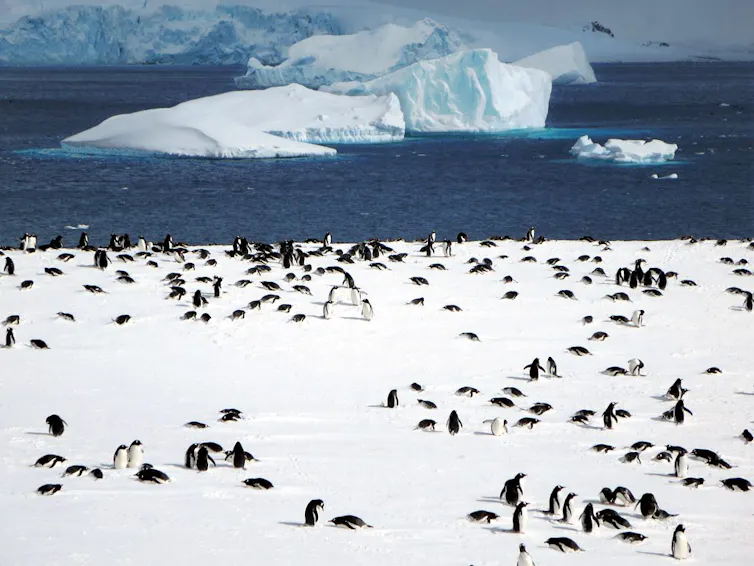








.png)
.jpg)