Reading view

After an opaque summit, China and the US want to work together again. That might not be good news for the world

Back in 2005, US economist Fred Bergsten coined the term “Group of 2” or “G2”, proposing a stronger partnership between what are now the world’s two largest economies – the United States and China.

In the aftermath of the global financial crisis a few years later, economic cooperation between these two countries briefly seemed to attest to the success of efforts at integrating China into a liberal rules-based order.

To be sure, the ostensible G2 was not meant to replace the larger, formalised G20 group of major economies, so much as strengthen it. Underpinning the broader G20’s response to the global financial crisis, the US enacted an initial US$787 billion fiscal stimulus, while China provided its own US$586 billion stimulus. This helped avert a much larger global economic catastrophe.

This week’s summit between US President Donald Trump and Chinese President Xi Jinping heralds a different sort of G2. On Friday, Trump claimed the countries had struck some “fantastic trade deals”. But anyone hoping for details of such deals – on tariffs, rare earths or Iran – was left disappointed on Friday afternoon.

Whatever may have transpired, US–China cooperation no longer automatically implies positive spillover effects for the rest of the world. Instead, in 2026, the G2 appears, at best, to be a private bargain between two great powers, imposing hidden costs on those outside, looking in.

The Trump administration has ushered in a noticeable shift in how the US views its economic interests: no longer premised on shared liberal values, but on spheres of influence among great powers. The key question, therefore, is not whether the US and China can cooperate. It is what kind of order their cooperation will produce.


Read more: Trump-Xi summit: 3 ways the US and China can compete without going to war


West and East

An older economic contrast is useful here.

In the wake of the second world war, the Western bloc (led across the US, the United Kingdom, and Western European states) was united by a shared commitment to a Keynesian global order (under the Bretton Woods system) that sought freer trade in goods while preserving national economic autonomy.

In contrast, the Eastern bloc (led by the Soviet Union) organised trade through what was called the Council for Mutual Economic Assistance (Comecon), trading many goods between countries through planned barter arrangements, instead of for cash.

The irony for the present day is that the Trump–Xi agenda looks more like the old Eastern bloc’s approach.

In this light, the clearest sign that a G2 may be working outside the G20 or larger rules-based order is not that Washington and Beijing are talking. It is the range of issues that may be managed, tying together such concerns as tariff relief, airplane orders, rare-earths access, chip restrictions, Taiwan and Iran.

In each of these cases, it’s reasonable the two countries would want to coordinate their policies. But together, they point to a new global order where two superpowers increasingly call the shots in their own interests.

Chips and rare earths

Rare earths and advanced chips are the clearest example. Beijing wants access to the advanced semiconductors necessary to dominate the artificial intelligence race.

Washington wants rare earths and critical minerals whose importance has become more acute as the conflict with Iran has strained US stocks of missiles, drones, air-defence systems and other high-end military technologies.

If these are traded against one another, the summit is not about economic liberalisation. It is about whether strategic technologies remain national-security constraints or become bargaining chips in a bilateral deal.

An entourage of executives

The business delegations that have accompanied Trump on this trip point in the same direction.

The presence of executives such as Nvidia’s Jensen Huang, Apple’s Tim Cook, Tesla and SpaceX’s Elon Musk (not to mention others from Qualcomm, Citigroup and Boeing) gave the summit the appearance of a commercial negotiation.

Reported agreements on aircraft orders, agricultural purchases, investment forums and corporate access may all be presented as signs of economic normalisation.

But the question is not only whether US firms gain market access. It is whether commercial wins help stabilise a great-power bargain whose geopolitical costs are borne elsewhere.

Any deal the countries eventually reach on tariffs will likely have the biggest market impacts. But the deal itself could matter less than the optics, allowing Trump to claim a business victory.

This might calm markets in the short term, but it highlights the potential for a retreat from rules-based multilateral liberalisation in the longer term.

A warning on Taiwan, near silence on Iran

The question of Taiwan loomed large over this week’s summit. On Thursday, Xi gave an unusually direct warning to Trump, saying if the issue was not handled properly, the two countries could see “clashes and even conflicts”.

In a larger sense, the danger is not necessarily a formal US concession on Taiwan. It is that Taiwan and other regional actors bear the external costs of a private bargain.

If Taiwan becomes one variable in a wider negotiation, the costs of US–China cooperation may fall on those not in the room.

Iran and oil broaden the same logic. If Trump has pressed Xi to use China’s influence over Tehran, he is not simply asking for diplomatic help. He is treating Beijing as a co-hegemon in a great-power bargain based on order for some – the US and China – and exclusion for others.

This kind of G2 can undermine the global public good. It will also test whether middle powers like Australia, Canada and European countries can keep their seat at the table where decisions are made or, as Canadian Prime Minister Mark Carney put it, risk being “on the menu”.

The Conversation

Wesley Widmaier receives funding from the Australian Research Council.
  •  

Trump’s call to expand Abraham accords is destined to fail

As negotiations to end the Iran war continued on May 25, Donald Trump made a series of phone calls in which he pressed key leaders from the Middle East to join the Abraham accords. Announced in 2020, these accords established diplomatic relations between Israel and several Arab states, beginning with the United Arab Emirates (UAE) and Bahrain.

The US president reiterated his proposal in a social media post later that day: “After all the work done by the United States to try and pull this very complex puzzle together, it should be mandatory that all of these countries, at a minimum, simultaneously, sign the Abraham accords.”

Trump’s post suggested that Iran could also join the accords. This really would be something, given that one motivation for signing the accords was to push back against Iranian influence in the region. Sadly for Trump, this is wishful thinking at best.

Few Middle Eastern leaders can agree to Trump’s proposal. In comments published by Politico on May 26, one unnamed former US diplomat described Trump’s comments as a “poison pill”. They added he had created new “conditions for peace that neither Iran nor the states in question will accept”.

In advocating this approach, Trump misreads the vitriol held by many across the Middle East – and beyond – about Israel’s actions in Gaza and Lebanon. The official death toll in Gaza, where Israel has fought a military campaign since 2023, stands at over 70,000 people. A further 170,000 people have been injured amid what many are calling a “genocide”.

In southern Lebanon, Israel has used ground troops and a relentless campaign of air attacks since the beginning of the Iran war in what appears to be an attempt to secure a “buffer zone” against attacks from Hezbollah. More than 3,200 people there have been killed so far, with a further 7,500 injured and millions forced from their homes. This is despite the signing of a ceasefire between Israel and the Lebanese government in April.

Opposing Trump’s proposal

The destruction of Gaza angered Bahrain and the UAE, with Manama recalling its ambassador to Israel shortly after the start of the war. But neither country withdrew from the Abraham accords. Instead, trade and security collaboration continued with both taking the stance that working more closely with Israel would be in the best interests of their states.

Yet Bahrain and the UAE are outliers in the Middle East. Other countries are far less willing, or able, to normalise with Israel. When US officials visited Saudi Arabia in 2024, four years after the signing of the accords, Crown Prince Mohammad bin Salman is said to have told them he feared being killed if he normalised relations with Israel.

Though many have argued the Saudi Kingdom was close to normalising relations with Israel before the war in Gaza, this has been largely rejected by Saudi officials. And since the outbreak of the Gaza war, bin Salman and other Saudi officials have repeatedly stressed that normalisation of diplomatic relations with Israel will not happen without irrevocable steps being taken towards Palestinian statehood.

Meanwhile, tensions between Israel and Turkey have been brewing for some time. In February, the former Israeli prime minister, Naftali Bennett, declared that Turkey was “the next Iran”. More recently, on May 20, Israel’s minister of culture and sports, Miki Zohar, declared that Turkey should be treated as “an enemy state”.

And in Qatar, state officials remain furious with Israel for launching strikes on Doha in 2025 in an attempt to kill key Hamas figures who were based there. Qatar said it had been hosting Hamas figures as part of broader mediation efforts requested by the US and Israel.

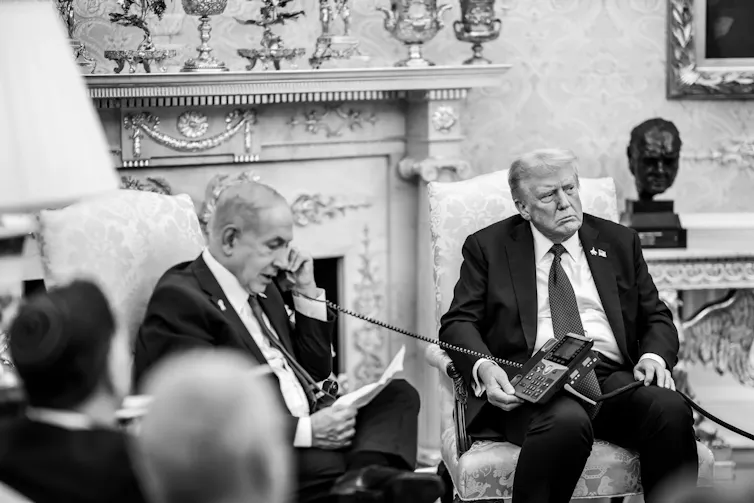
The strikes led to a now infamous photo released by the White House of Trump overseeing the Israeli prime minister, Benjamin Netanyahu, while he called Qatari prime minister Sheikh Mohammed bin Abdulrahman Al Thani to apologise.

Benjamin Netanyahu calls Sheikh Mohammed bin Abdul Rahman Al Thani from the White House with Donald Trump watching on.
Benjamin Netanyahu calls Qatar’s prime minister, Sheikh Mohammed bin Abdul Rahman Al Thani, from the White House in September 2025. White House, CC BY-NC

The idea of Iran becoming a signatory of the Abraham accords in the immediate aftermath of a devastating war is also fanciful. Tensions between Israel and Iran can be traced back to 1979, when a revolution toppled the Iranian monarchy and led to the establishment of an Islamic republic.

Iran’s new leadership immediately provided support to the Palestinian cause and, in later years, to Hezbollah and other militias across the Middle East. In response, Israel has carried out military strikes on targets across Iran, assassinated key nuclear scientists and more. To suggest disregarding almost half a century of history with little to no efforts at reconciliation is farcical.

Why, then, has Trump suggested such a move? Perhaps it speaks to a need to assuage domestic constituencies within the US, or those in Israel, pushing for wider normalisation between Tel Aviv and the Arab and Muslim worlds.

A second reading is that it is an attempt to prevent diplomatic progress on resolving tensions with Iran by putting an insurmountable obstacle in the way in the form of the demand for normalisation with Israel, perhaps reflecting the plurality of positions on the war found in Washington.

A third view is that this is a move aimed at diminishing the scale of destruction and human suffering that has been wrought on Gaza, the West Bank and Lebanon, in the hope that a form of transactional politics – driven by trade and security – will prove sufficient. But, as Trump will find out, this is a longshot.

The Conversation

Simon Mabon receives funding from Carnegie Corporation of New York and the Henry Luce Foundation.

  •  

Trump-Xi summit: 3 ways the US and China can compete without going to war

US President Donald Trump’s visit to Beijing this week may ease tensions at the margins of the US–China rivalry. But it will not change a central fact: neither side can escape the rivalry, and neither side can decisively win it.

The biggest challenge for Trump and Chinese leader Xi Jinping is whether they can compete without turning the world’s most consequential bilateral relationship into its most dangerous one. A war is not inevitable.

If Washington and Beijing want to keep their competition peaceful, they must try to accomplish a few basic things:

  • preserve military deterrence without turning it into provocation

  • channel their rivalry into institutions and public goods, such as infrastructure development, rather than a military confrontation

  • keep ideology from hardening every disagreement into a zero-sum struggle.

So, how can this be done?

1. Establish mutual restraint

Both countries will continue to build military capabilities and balance against each other. The danger comes when each side convinces itself that its actions are intended to deter hostilities, while the other interprets them as a provocation.

Nowhere is that danger greater than the impasse over Taiwan. For Beijing, Taiwan is a core sovereignty issue and a test of national resolve. For Washington, it is tied to US credibility as a security guarantor in the Indo-Pacific, regional stability, and its ability to deter coercive unification.

Both sides claim to be defending the status quo. Both believe the other is eroding it. And both are acting in ways that may be making the situation less stable.

The answer is not a unilateral concession by one side or the other. Rather, both sides need to establish mutual restraint, backed by clearer political reassurance.

For instance, China could reduce the scale and frequency of coercive military actions around Taiwan, such as military aircraft sorties, naval patrols and drone operations near the island. And the US could avoid steps that blur the line between support for Taiwan and support for formal independence.

Trust may be absent. But trust is not a precondition for stability. Clarity and restraint are.

This requires a serious framework for deterrence management, including:

  • sustained efforts to clarify red lines

  • reducing misperceptions about each other’s intentions and resolve

  • preventing competitive signalling from spiralling into a confrontation.

During the Cold War, Washington and Moscow eventually learned that an arms race without guardrails was too dangerous to sustain. Washington and Beijing have not yet reached that level of strategic maturity. They need to.


Read more: Trump-Xi summit will be no ‘Nixon in China’ moment – that they are talking is enough for now


2. Compete in safer arenas

Rivalries can be channelled into forms that are less dangerous than military conflict, and can sometimes even be productive.

That is already happening. The United States and China are competing through global institutions and alignments, from the Quad and AUKUS (on the US side) to the BRICS and the Shanghai Cooperation Organisation (on China’s side).

Both are trying to shape the rules, memberships and agendas of the regional and global orders in ways that advance their own influence and constrain the other’s.

On the surface, this can look like just another front in a new cold war. But institutional competition can be one of the safer forms of rivalry.

Competition can force institutions to adapt rather than stagnate. It can encourage new forms of regional cooperation. It can also push rival powers to provide public goods – such as infrastructure, development financing, technological investments and climate initiatives – in order to win support from others.

In infrastructure financing, for instance, China has used the Belt and Road Initiative and the Asian Infrastructure Investment Bank to expand its reach globally. The US and its partners have responded with initiatives of their own.

The competition between the two has been beneficial – and it has expanded the options available to developing countries.

This is also why a rush toward broad economic decoupling would be such a mistake. Some restrictions in sensitive sectors may be unavoidable. But a sweeping effort to sever economic ties would remove one of the few remaining guardrails in the relationship.

As long as the United States and China remain economically intertwined, both sides are incentivised to maintain stability and avoid conflict.

3. Lower the temperature

The US and China are not simply clashing over interests. They also have very different political and historical narratives.

US policymakers often cast the rivalry as a defence of the liberal order against authoritarian revisionism. Chinese leaders often see it as a struggle against containment, humiliation and foreign interference.

These are not just different rhetorical narratives. They shape what each side sees as threatening, acceptable or beyond compromise. They also help explain why the relationship has become so emotionally and politically charged.

Ideological competition is safest when it remains indirect. Neither Washington nor Beijing is likely to convert the other to its way of thinking. And neither is likely to persuade the wider world through their lectures on ideology.

The sounder strategy is to compete by example.

For the United States, it means showing that democratic governance can still deliver competence, cohesion and long-term economic vitality. For China, it means showing that its model can bring growth, social stability and international cooperation.

Both sides also need to recognise that ideological overreach is dangerous. The more Washington frames competition as a global struggle between democracy and autocracy, the more it encourages Beijing to see compromise as capitulation.

And the more Beijing wraps its foreign policy in narratives of anti-hegemony, the more likely Washington is to see its own restraint as weakness.

Engagement still matters for the same reason. If the United States and China stop talking, this ideological competition will harden and become more dangerous.

The greatest danger in the US–China competition is that both sides will come to see restraint as weakness, compromise as surrender and coexistence as impossible. Once that happens, catastrophe becomes far more likely.

The most realistic goal is not friendship, or even reconciliation. It is something harder and more modest: competition without war.

The Conversation

Kai He receives funding from the Australian Research Council and the Toda Peace Institute, an independent institute in Japan promoting policy-oriented peace research. He serves as a non-resident senior research fellow at the Toda Peace Institute.

Huiyun Feng receives funding from Australia Research Council.

  •  
❌