Reading view

Pope Leo warns of AI’s risks to humanity in his first encyclical

Pope Leo XIV has just declared artificial intelligence one of the defining moral challenges of our time, in his first encyclical: a formal letter intended to guide moral, social and theological thought. Titled Magnifica Humanitas (Magnificent Humanity), it argues technology must serve humanity, rather than concentrate power or weaken human dignity.

He presented it at the Vatican alongside AI developer Christopher Olah, cofounder of Anthropic, who acknowledged that companies like his need moral guidance to guard against “incentives and constraints that can sometimes conflict with doing the right thing”, the New York Times reported.

“Technology is not simply a tool,” read the roughly 42,300-word open letter. “When it becomes the standard by which everything is judged, it begins to dictate what matters and what can be discarded, reducing creation to an object of exploitation and human beings to mere cogs in a system driven toward ever greater efficiency.”

It warns that AI is never truly neutral, but “takes on the characteristics of those who devise, finance, regulate and use it”. And it calls for ethical oversight, social justice, protection of workers, responsible governance and peace.

Automated warfare

The encyclical criticises the use of AI in warfare, calling for imposing the “most rigorous ethical constraints” on weapons developed using AI.

As governments invest heavily in autonomous military technologies and AI-assisted defence systems, the “growing ease” of deploying them makes war more likely and “less subject to human control”, it warns. This “violates the principle that armed force should be used only as a last resort in cases of legitimate self-defense”.

The letter also criticises the growing concentration of technological power, and systems that reduce people to data or economic functions. It promotes what it calls a “civilisation of love”, centred on human dignity, solidarity, truth, compassion and the common good.

Pope Leo’s response to the the AI revolution deliberately references his predecessor Pope Leo XIII’s response to the problems of the Industrial Revolution, Rerum Novarum (“Of New Things”), in 1891. Though Magnifica Humanitas was released on May 25 2026, it is symbolically dated May 15, the date of Rerum Novarum.

Industrial Revolution to AI Revolution

An encyclical is not an ordinary papal statement. Traditionally addressed to bishops and the wider Catholic world, it is one of the Catholic church’s most authoritative teaching documents.

The pope no longer has the direct political power the papacy held in the 19th century. But papal teaching still carries moral weight across a global Catholic network of schools, universities, charities, hospitals and community organisations.

The Vatican cannot regulate AI. It cannot write safety standards, police data centres, or force companies to disclose how their systems work. But it can help shape the moral terms of the debate. For more than a century, Catholic social teaching has influenced public arguments about work, inequality, poverty, human dignity and the ethical limits of economic power.

Although popes issued encyclicals long before the modern era, Rerum Novarum made social encyclicals globally influential.

It confronted exploitative labour conditions, widening inequality, and conflict between workers and employers. Pope Leo XIII defended workers’ rights and argued that wealth carried social responsibilities. He criticised both unrestricted capitalism and revolutionary socialism.

The document influenced debates about labour rights and economic justice well beyond the church. In Australia in 1907, Justice H.B. Higgins drew on Rerum Novarum when establishing principles for a fair living wage.

Pope Leo XIV’s encyclical attempts to do for the AI age what Rerum Novarum did for the industrial age: provide a moral framework for a technological transformation reshaping work, power and human relationships.

Human dignity in the age of algorithms

Pope Leo XIV argues human rights are not granted by governments or corporations: they arise from the intrinsic dignity of every person. Technologies should serve humanity rather than reduce people to data, economic units or optimisation problems.

He builds on Pope Francis’ critique of “the tendency to let the logic of efficiency, control and profit alone shape personal, social and economic decisions”, in his 2015 encyclical. It, too, warned of the risks of technology.

Pope Leo XIV argues moral responsibility can’t be transferred to automated systems, regardless of how sophisticated they become. He also rejects transhumanist ideas that human limitations should be technologically overcome, arguing vulnerability, dependence and imperfection are essential to being human. Relationships, care, solidarity and compassion are not weaknesses. “Humanity flourishes not despite limitations, but often through them.”

Running throughout the encyclical is a contrast between a “culture of power” and a “civilization of love”. One treats technology primarily as a tool for domination and control. The other places human dignity, justice and care at the centre of social life.

Why this matters

The significance of Magnifica Humanitas lies in its ability to shape public conversation and moral imagination. Moral frameworks matter. They influence what societies fear, what they tolerate, what they defend – and what they refuse to sacrifice.

Governments are investing in AI capability while still developing frameworks for transparency, accountability and safe deployment. Businesses are adopting AI tools at speed. Schools and universities are rethinking assessment, authorship and learning. Workers are being asked to adapt to systems they did not design and often cannot challenge. And citizens are increasingly governed, assessed and targeted by automated systems they may never see.

Pope Leo XIV’s intervention reminds us the central question is not whether AI will be powerful: it already is. The question is whether that power will be made answerable to human dignity.

The future of AI will not just be decided in laboratories, boardrooms or parliaments. It will also be decided by the moral limits societies are willing to set. Pope Leo XIV’s encyclical is an attempt to draw those limits.

The Conversation

The authors do not work for, consult, own shares in or receive funding from any company or organisation that would benefit from this article, and have disclosed no relevant affiliations beyond their academic appointment.

  •  

Trees and greenery can cool cities by as much as 18°C – but only if they’re the right type

You Le/Unsplash

Cities around the world are planting more trees to cope with rising urban heat. But our research shows trees alone are often not enough. In some cases, the wrong kind of greening can even make streets feel less comfortable on a hot day.

We compared field measurements from Melbourne, Munich and Hong Kong to test how different kinds of urban planting changed the heat people experience outdoors.

The results showed layered vegetation – where trees are combined with shrubs and ground cover – often cooled cities more effectively than trees alone. We also found local climate and street design strongly shaped whether greening worked well.

These findings matter because urban greening is no longer just about aesthetics. As cities spend billions adapting to extreme heat, planting design may matter as much as planting quantity.

Cities are getting hotter

Cities trap heat. Roads, buildings and asphalt absorb solar energy during the day and slowly release it back into the air, especially at night.

This “urban heat island” effect, combined with climate change, is making heatwaves more intense and more dangerous in our cities.

Trees are one of the most popular responses because they provide shade and reduce the amount of heat absorbed by surrounding surfaces. But outdoor comfort depends on more than air temperature alone.

People experience heat through sunlight, reflected heat, humidity and airflow. A shaded street can still feel uncomfortable if humidity is high or if wind cannot move through the space.

That is why a “one-size fits all” greening strategy can fail. A planting design that works well in Melbourne may behave very differently in Hong Kong or Munich.

What we found

To better understand how urban vegetation affects heat stress, we did field measurements in three cities with different climates: temperate Melbourne, cooler Munich and humid subtropical Hong Kong.

Rather than relying only on computer models, we measured real conditions in streets and green spaces during summer.

We compared open urban spaces (with no plantings), sites with trees only, and layered planting (which means trees, shrubs and ground cover together).

Importantly, we did not just measure air temperature. We also measured “mean radiant temperature”, which captures the heat radiating from roads, walls and other surfaces onto the human body.

In Melbourne, street trees reduced radiant heat absorbed by pedestrians by more than 18°C, compared with open streets. Even where air temperatures changed only slightly, shaded streets felt substantially cooler.

Munich showed the strongest benefits from layered planting. There, streets and green spaces containing trees, shrubs and ground cover reduced afternoon heat stress by almost 8°C compared with more open spaces.

Hong Kong also benefited from vegetation, especially through shade created by overlapping tree canopies. But the results there were more mixed because the humid climate changed how cooling worked (more on that later).

Across all three cities, one finding stood out: vegetation structure matters.

Combining trees with shrubs and ground cover often performed better than trees alone, but the benefits depended on how the planting interacted with the local environment.

Why some greening can fail

The study showed that more vegetation is not automatically better.

In Hong Kong, dense vegetation sometimes increased humidity enough to reduce some of the cooling benefit. Plants release water vapour into the air through transpiration, which can help to cool dry climates. But in already humid cities, extra moisture can make outdoor spaces feel sticky and uncomfortable because sweat evaporates less efficiently.

In some Munich streets, dense vegetation reduced airflow through narrow urban corridors, trapping warm air and slowing the movement of vehicle pollution away from pedestrians.

These findings highlight why cities cannot rely on generic canopy targets copied from elsewhere. Climate, street width and airflow all shape whether vegetation improves comfort or creates unintended side effects.

Designing cooler cities

The solution is not to stop planting trees. It is to design urban greening more carefully.

Cities need planting strategies tailored to local conditions rather than universal greening formulas. In parks and open green spaces, layered vegetation can provide strong cooling while also supporting biodiversity. In dense streets, planners may need to balance shade with ventilation.

The findings also suggest cities should move beyond measuring success through tree numbers alone. The arrangement, density and type of vegetation matter just as much as canopy cover.

Designing for local conditions

Our research shows urban vegetation can reduce heat stress, but the benefits depend on how and where cities plant it.

Melbourne demonstrated the strong cooling effect of street trees on radiant heat, Munich showed the added value of layered vegetation, and Hong Kong revealed how dense planting can sometimes backfire in humid conditions.

Cities need climate-smart green spaces designed for local conditions, airflow and human comfort to remain liveable as temperatures rise.

The Conversation

Mohammad A Rahman receives funding from the German Research Foundation (DFG), TREE Fund, Humboldt Foundation, Bavarian State Ministry of the Environment and Consumer Protection, German Academic Exchange Service (DAAD), Sustainable Consumption Institute (SCI), University of Manchester and the European Union.

  •  

Israeli forces capture Lebanon’s Beaufort Castle, a Crusade-era site once held by the Knights Templar

Getty Images/Monik-a

A 12th-century castle built during the Crusades in Lebanon has been seized by Israeli forces in what’s been described as the deepest incursion into Lebanon for more than 25 years.

The historic site, known as Beaufort Castle or Qalʿat al-Shaqīf, sits atop a striking rocky outcrop in a commanding position on the edge of the Litani gorge, boasting spectacular views across southern Lebanon. It has historically been a very strategic site, especially during the Crusades.

What were the Crusades?

The Crusades is the name given to a series of military expeditions, beginning in the late 11th century, of Latin Christians from across Europe to a range of destinations, most famously the Holy Land.

The Crusades were armed pilgrimages, representing a fusion of ideas about warfare and spirituality.

Crusades would be called for by a pope, who would promise participants spiritual rewards if they took the Crusade vow and undertook these campaigns.

The aims and goals of Crusades changed over time as the geopolitical landscape changed. The First Crusade – called in 1095 CE – had a broad goal of “liberating” the holy sites of Jerusalem from the Seljuk Turks, a Sunni Muslim group in power in Asia Minor at the time.

The Crusaders also wanted to render military aid to Eastern Christians in the region.

But what distinguishes the Crusades from other military campaigns was that this was seen as a spiritually meritorious form of warfare.

The First Crusade established the Crusader States, with what came to be known as the Kingdom of Jerusalem at its heart.

Who built Beaufort Castle and why?

This site’s time as a Crusader castle began in 1139 CE with the Franks – the label used at the time to denote western European settlers in the east.

When the Franks arrived at the site, it was probably already being used in some significant way because of its strategic position.

The king of Jerusalem at this time was Fulk, who was a Frank (the Kingdom of Jerusalem had already existed for 40 years before he captured the Beaufort Castle site).

He began construction of Beaufort Castle (Old French for “beautiful fortress”) in about 1139 CE. Ultimately, it became a large castle over two levels, roughly triangular in shape. As is often the case for buildings from this era, it has had parts added on and destroyed over time.

What we are left with is a mix of Frankish building work and augmentations from various Muslim rulers over the centuries.

Latin Christians saw it as part of a network of fortified castles they hoped would help shore up Frankish settlement in the area.

Enter Saladin

The next key character in the history of Beaufort Castle is Saladin. He is among the most famous figures in Crusades history, in the region and in Islamic history more broadly.

King (Saladin from Egypt), from 'Court Game of Geography'
Saladin was a key figure in military Muslim efforts against the Latin Christians. The Metropolitan Museum of Art

He was of Kurdish origin, and by the time Beaufort Castle was controlled by Latin Christians, he was sultan of Egypt and Syria.

By all accounts, Saladin appears to have been a charismatic, canny leader and military practitioner. He was a key figure in Muslim military efforts against the Latin Christians.

Saladin captured Beaufort Castle in 1190 CE. This was part of a longer story of success for Saladin in what has been called the “counter-Crusade”. A few years earlier, he had won some significant victories, including at the famous Battle of Hattin (depicted in Ridley Scott’s 2005 film, Kingdom of Heaven).

Saladin also captured the city of Jerusalem in 1187, which was an enormous loss for the Crusaders.

So the Beaufort capture was part of the bigger picture of Saladin’s spectacular journey of conquest in this region around this time. He died not long after in 1193 CE, and the castle remained in Muslim hands until 1240 CE.

After that, the castle went back to Latin Christian ownership as part of a treaty with Theobald I of Navarre in the Barons’ Crusade. Ultimately, the castle passed to the Knights Templar in 1260 CE.

Who were the Knights Templar?

The Knights Templar was a military religious order made up of hybrid warrior-monks, founded in 1118 in the Kingdom of Jerusalem. Their initial remit was to defend Christian pilgrims visiting holy sites, but their role changed over time.

They lived according to a religious rule, known as the Templar Rule, and they took vows of chastity, poverty and obedience to live in communities according to their vows.

A medieval king consults with the Templars.
A medieval king consults with the Templars. Unknown author - Chronique d’Outremer, vers 1280. Manuscrit Français 770, fol. 313, Gallica/BNF/Wikimedia Commons

What was unusual about these monks was they were also highly trained warriors, especially skilled as mounted knights, as both heavy and light cavalry.

The kings of Jerusalem soon came to rely on them for military advice and as a highly trained standing army.

They were viewed as having the power to fight on both a spiritual and earthly battlefield, a kind of holy super soldiers. According to their patron, Bernard of Clairvaux, the Templar’s

soul is protected by the armour of faith just as his body is protected by armour of steel.

Kings and nobles increasingly began to donate land and riches to the Templars. They eventually became an international organisation with significant wealth across Europe and the Eastern Mediterranean (although they would eventually be tried for heresy).

The Knights Templar held Beaufort Castle for only eight years, before the site was returned to Muslim rule for centuries. In modern history, it has been controlled by Lebanon – until its capture by Israeli forces this week.

This is a region with an incredibly nuanced and complex history, and it remains that way today.

The Conversation

Beth Spacey received funding from the Arts and Humanities Research Council (UK) for her PhD research on medieval history.

  •  

370 billion crickets are farmed for food every year. Scientists have discovered they may feel pain

House Cricket (_Acheta domesticus_). mani_raab/iNaturalist, CC BY-NC

You’re cooking dinner, distracted, and your hand brushes a hot pan. Nerve signals race to your spinal cord and back to yank your arm away in a fraction of a second, with no thought required.

Then comes the pain. A sharp, spreading sting gives way to a pulsing ache, and you cradle your hand and run it under cold water until it subsides. That felt experience is distinct from the reflex that preceded it. While the reflex moved your body out of danger, pain drives you to protect the wound, recover, and learn to avoid similar mistakes in the future.

We readily accept that other people feel pain by reading cues in their behaviour, like the inspection and nursing of an injury. We extend this to some animals too – a dog licking its paw or a cat favouring a limb rightly stir our sympathies. But what happens when we turn that lens on animals far less like us?

In our new study, published in Proceedings of the Royal Society B, we searched for behavioural signs of pain in house crickets, one of the most widely farmed insects. After applying heat to an antenna, we found that crickets didn’t just reflexively flinch and recover. They nursed the harm, returning again and again to groom the affected site, much as we rub a burned hand.

The frontiers of feeling

French philosopher René Descartes considered animals unfeeling biological machines, and for centuries the circle of moral concern barely extended beyond our own species.

But the boundaries have steadily crept outward. Recognition that mammals experience pain came first, followed by birds. Fish too, once assumed to lack the necessary brain structures, are now widely accepted as capable of pain-like states.

The leap into invertebrates has been greater and more contentious. Their nervous systems bear little resemblance to our own, so arguments from brain anatomy alone don’t carry us far. Instead, we look to behaviour. Does the animal respond to harm in ways that go beyond reflex, ways that are flexible, persistent, and sensitive to context?

Over the past decade, testable indicators for pain in non-humans have been developed and are increasingly accepted. These include learning from unpleasant events, trading off harms against rewards, and actively protecting the site of injury. Evidence meeting these criteria helped crabs and lobsters gain legal recognition as sentient under United Kingdom law in 2022.

Among insects, the evidence has been accumulating fast. Yet most of this evidence comes from bees. Bumblebees weigh the risk of harm against the richness of a food reward, and groom the site of an injury. Honeybees learn to associate particular smells with harmful stimuli and avoid them.

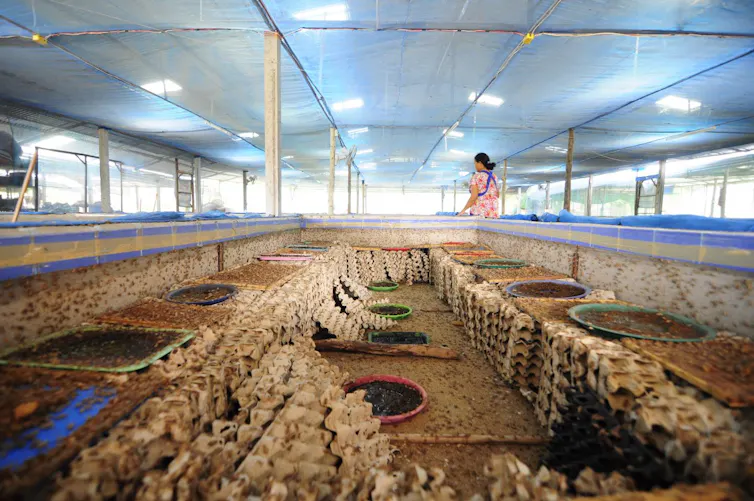
Far less attention has been paid to Orthoptera, the group that includes grasshoppers, locusts and crickets. That gap matters, because the house cricket (Acheta domesticus) is the world’s most widely farmed insect, with more than 370 billion reared annually.

A large warehouse, divided into separate pens, each filled with thousands of crickets.
A cricket farm in Thailand. Afton Halloran

Do crickets feel pain?

We tested 40 male and 40 female crickets, each experiencing three conditions in random order: a hot probe to a single antenna (65°C, to activate damage receptors but not cause lasting injury), the same probe unheated, or no contact at all.

We filmed their behaviour for ten minutes. Observers scoring the footage did not know which treatment any animal had received.

The results were clear. After the hot probe, crickets were more than twice as likely to groom the affected antenna compared to controls, and spent roughly four times longer doing so.

Could this simply reflect general disturbance rather than targeted care? Unlikely: grooming was directed specifically at the heated side, not spread evenly across both antennae as it was after gentle touch or no contact.

And the behaviour wasn’t a brief, reflexive reaction. It was elevated from the outset and tapered gradually over minutes, much like rubbing a burned hand as the felt sting slowly fades.

Small minds, big feelings

Subjective experience cannot be directly observed in any animal, not even humans.

But we have shown crickets respond to harm in a way that satisfies a key criterion many scientists and philosophers use to infer pain: flexible, directed self-protection. Combined with the knowledge that crickets possess damage receptors, can learn to avoid harms, and respond less to injury under morphine, the weight of evidence for an inner life is growing.

The practical stakes are real. Hundreds of billions of farmed insects are slaughtered each year by freezing, boiling and baking. Pesticides kill trillions more, optimised for lethality with no consideration of potential suffering.

If we take a precautionary approach, credible evidence of suffering should motivate proportionate protections well before we are certain.

Insects have been around for more than 400 million years and are far more behaviourally and cognitively sophisticated than once assumed. The question, then, may not be whether some insects feel, but why we ever assumed they couldn’t.

The Conversation

Thomas White receives funding from The Australian Research Council, the Arthropoda Foundation, and The Australia and Pacific Science Foundation. He is a scientific advisor for the registered charity Invertebrates Australia.

Kate Lynch receives funding from the Australian Research Council, the Arthropoda Foundation, and the Australia & Pacific Science Foundatio. She has previously received funding fromand the John Templeton Foundation.

  •  

Three ways to avoid being fooled by AI slop

Marten Newhall/Unsplash

Global society makes billions of images and uploads hundreds of thousands of hours of video on the internet every day.

The problem is, some of this content is misleading or downright wrong. And when it’s in visual form, it can be particularly convincing.

Take the Met Gala that happened earlier this month in New York. While photographers snapped photos of Rhianna, Beyoncé and Nicole Kidman as they strutted their stuff, others saw “photos” of celebrities, such as Rosalía, Lady Gaga and Jacob Elordi, who were actually elsewhere (the images in the below Instagram carousel are AI generated).

While this type of AI slop might seem harmless and can be easily verified, other “media fakery” is becoming far more problematic and demands more robust techniques to verify.

Traditional verification techniques are falling short as AI becomes increasingly convincing and the line between authentic and synthetic blurs. This is true across all content, from still images to moving ones and audio deepfakes.

The volume of content and the speed at which it travels doesn’t help. It also doesn’t help that fact-checking can take hours or days while fakes can be created in seconds.

First, equip yourself

Guides on detecting AI-generated content suggest multiple strategies and acknowledge there are no perfect solutions. But there are helpful things you can do.

Familiarise yourself with examples of fakes and study how they were fact-checked. This helps you understand what is possible and learn how fact-checkers sort real from fake.

Look deeply. Zoom in. Pause the content or watch it frame-by-frame. Inspect the small details. Look out for inconsistencies, textures that are flat when they shouldn’t be, or patterns that are too perfect or are inexplicably off. Does the location shown match with where the scene is purported to be? Do shadows fall naturally and do lines follow the rules of perspective?

Look widely. Are you familiar with the source? What else does it publish and how long has it been around? What do other trusted sources say? How does this depiction compare to others that are available? Or if there aren’t others available, should that give you pause?

Then, apply your learnings

Let’s take an example and work through it together.

This Facebook reel, posted by an account called “Real Talk Hub”, purports to show migrants being stopped and returned by Australian police at an airport.

Before getting too granular, let’s take stock of the opening image.

The video uses scale to show what appears to be a long stream of passengers. Some are moving toward and some are moving away from a plane. It is difficult to identify specifics in the video. The superimposed text blocks almost all of the horizon line. Shallow depth of field makes aspects in the distance blurry and hard to discern.

Many of the passengers have darker skin and are visually coded as “other”. They interact with a light-skinned police officer who takes notes on a clipboard.

The vertical video is framed carefully to not reveal identifiers like the name of the airline that seems to start with the letter “P”. This makes it difficult to search the airline’s name and whether credible sources corroborate the story that’s told.

Even though the people and scenes look realistic at first glance, the video’s integrity unravels when we slow down and look closer. People in the passenger line morph and transform.

The officer is able to single-handedly remove the paper from the clipboard and it appears to inexplicably leave white strips behind. The police vests look different to images you can find in verified media photos of the Australian Federal Police.

Taken together, all these clues suggest the video is AI-generated.

The paper on the clipboard moves in an unrealistic way, and the police vest is not accurate. Real Talk Hub/Facebook

Think like a fact-checker

Many AI-generated videos can trick you and create a very compelling narrative. So, fact-checkers have developed triangulated methodologies that examine elements beyond just what you see in the video.

One way to do this is to systematically check contextual factors – the other things surrounding the content. Our team’s research has found professional fact-checkers usually pay attention to the type of social media accounts or websites distributing suspicious media.

For this AAP verification on a video about banning dogs on the beach, it was crucial to inspect the user’s activity and posting patterns.

In addition to visual anomalies, the fact-checkers also found an invisible watermark that helped them determine the content was AI-generated.

Other things to check are how long a social media account has been operating, how often the social media account posts, and whether the account is transparent about its use of AI.

These aren’t fool-proof indicators of authenticity, though. The migrant example above comes from an account that is about five years old. It also comes from a “verified” account, which might make it feel more credible. But both Facebook and X now let users pay for this verification.

Overall, when it comes to suspect images or video, don’t just look deeply. Also look widely.

AI-generated content can increasingly fool our eyes, so you also have to look beyond what’s in the video. Taking a mixed-methods approach that considers visual and contextual clues can help. By training your ability to think like a fact-checker, you can stay safer online.


Read more: We teach young people to write. In the age of AI, we must teach them how to see


The Conversation

Silvia Montaña-Niño is also associate investigator of the ARC Centre of Excellence for Automated Decision-Making & Society and the Fact Check Research Team at this centre.

T.J. Thomson receives funding from the Australian Research Council. He is an affiliate with the ARC Centre of Excellence for Automated Decision Making & Society.

  •  

We found hundreds of huge ancient mass graves hidden in the Sahara desert

We have been on a years-long campaign of satellite remote sensing of the vast desert landscapes in Eastern Sudan.

This involved using satellite aerial imagery to systematically and painstakingly search for archaeological features in Atbai Desert of Eastern Sudan, a small part of the much larger Sahara.

Our team – which includes archaeologists from Macquarie University, France’s HiSoMA research unit, and the Polish Academy of Sciences – wanted to tell the story of this desert region between the Nile and the Red Sea, without having to excavate.

One mysterious archaeological feature stood out. We kept finding large, circular mass graves filled with the bones of people and animals, often carefully arranged around a key person at the centre.

Likely built around the fourth and third millennia BCE, all these “enclosure burial” monuments have a large round enclosure wall, some up to 80 metres in diameter, with humans and their cattle, sheep and goats buried inside.

Our new research, published in the journal African Archaeological Review, reveals how we found 260 previously unknown enclosure burials east of the Nile River, across almost 1,000km of desert.

Who built them?

Already known from a few excavated examples in the Egyptian and Sudanese deserts, these large circular burial monuments have long puzzled scholars.

What seemed once isolated examples emerge now as a consistent pattern. It is suggestive of a common nomadic culture stretching across a vast stretch of desert.

Most are within the borders of modern Sudan on the slopes of the Red Sea Hills. Unfortunately, satellite imagery alone cannot communicate the whole story of these enclosure burial builders.

The carbon dates and pottery from the few excavated monuments tell us these people lived roughly 4000–3000 BCE, just before Egyptians formed a territorial kingdom we know of as Pharaonic Egypt.

But these “enclosure burial” nomads had little to do with urbane and farming Egyptians.

Living in the desert and raising herds, these were Saharan desert nomads through and through.

A new elite?

Some enclosures show “secondary” burials arranged around a “primary” burial of a person at the centre – perhaps a chief or other important member of the community.

For archaeologists, this is important data for discerning class and hierarchy in prehistoric societies.

The question of when Saharan nomads became less egalitarian has plagued archaeologists for decades, but most agree it was around this time of the fourth millennium BCE that a distinctive “elite” class emerged.

This is still a far cry from the sort of huge divisions between ruler and ruled as seen in societies such as Egypt, with its pharaohs and farmers. However, it ushers in the first traces of inequality.

Animals held in high esteem

Cattle seem very important to these prehistoric nomads (a theory also supported by ancient local rock art in the area).

Burying themselves alongside their herd, these nomads show they held their animals in esteem.

Thousands of years later, local nomads chose to reuse these now “ancient” enclosures for their burial plots – sometimes almost 4,000 years after they were first built.

In other words, the prehistoric nomads created cemetery spaces that lasted for millennia.

What happened to these people?

No one can say for sure.

The few dates we have for these monuments cluster between 4000–3000 BCE, nearing the end of a period when the once-greener Sahara was drying, a phase scientists call the “African Humid Period”.

From north to south, the summer monsoon gradually retreated, reducing rainfall and shrinking pastures. This led nomads to abandon thirsty cattle, increase the mobility of their herds, migrate to the south or flee to the Nile.

The monuments are overwhelmingly located near what were then favourable watering spots; near rocky pools in valley floors, lakebeds and ephemeral rivers.

This tells us that when the monuments were being built, the desert was already quite challenging and dry.

At some point, as grass and bush made way for sand and rocks, keeping their prized cattle became unsustainable.

Having large herds of cattle in this desert, at this period, may have been a way of showing off an expensive and rare possession – a prehistoric nomad’s equivalent to having a Ferrari. This may help explain why cattle were frequently buried alongside their owners in enclosure burial monuments.

A bigger story

These enclosure burials are only one part of the greater story of human adaptation to climate change across North Africa.

From the Central Sahara, to Kenya and Arabia, keeping cattle, goats and sheep transformed societies. It changed the food they ate, the way they moved around, and community hierarchies.

It’s no coincidence communities changed how they buried their dead at the same time as they adopted herding lifestyles.

These burial enclosures tell us even scattered nomads were extremely well-organised people, and expert adapters.

Our discovery reshapes the story of the Sahara deserts and the prehistory of the Nile.

They provide a prologue for the monumentalism of the kingdoms of Egypt and Nubia, and an image of this region as more than pharaohs, pyramids and temples.

Sadly, many of these enclosure monuments are currently being destroyed or vandalised as a result of unregulated mining in the region. These unique burials have survived for millennia, but can disappear in less than a week.

Maria Gatto (Polish Academy of Sciences) was an author on our paper. We also want to acknowledge Alexander Carter, Tung Cheung, Kahn Emerson, Jessica Larkin, Stuart Hamilton and Ethan Simpson from Macquarie University for their contribution. We are also grateful to the National Corporation of Antiquities and Museums (Sudan).

The Conversation

Julien Cooper receives funding from the Australian Research Council, (Future Fellowship, FT230100067).

Maël Crépy receives funding from the CNRS (HiSoMA) and the Ifao (NOMADES research program).

Marie Bourgeois receives funding from Ifao (NOMADES research program).

  •  

How to encourage a child to try new, scary things (without traumatising them in the process)

Justin Paget/ Getty Images

If your child has ever dug their heels in on the morning of the school athletics or cross country day, or refused to speak in front of the class, you’re not alone.

For some children, these kinds of events bring a heavy, anxious feeling: what if I’m the slowest, what if everyone’s watching, what if I get it wrong?

For parents, it can be hard to know what to do. Push too hard and the morning becomes a meltdown. Let them off and you worry you’ve taught them to opt out.

Is it ever okay to follow their lead? And how do you give them the best chance of having a go next time?

Why (gently) facing fears matters

When we avoid something we’re afraid of, we feel instant relief. That relief is powerful, and it teaches the brain that avoiding worked. Over time, the fear grows and the impulse to avoid gets stronger. This is true for all of us, not just children.

So, in general, it helps for children to face fears sooner rather than later, before avoidance settles in.

But that doesn’t mean forcing a child through a panic. Pushing too hard can confirm to them the situation really is dangerous.

It’s worth helping your child face the fear before avoidance takes hold. What that looks like depends on what’s driving it.

Start by understanding what’s going on

If you can see a tricky day coming, talk to your child about how they are feeling ahead of time. Ask gentle questions to work out what the resistance is actually about.

Did something happen last time? Is something going on with friends? Is your child worried about failing, being judged, or being laughed at?

You might say:

I noticed you got really quiet when Dad mentioned athletics day. Is something about it worrying you?

Children won’t always have the words straight away, so give them time. It can help to have these conversations side-by-side rather than face-to-face: at bedtime, walking or driving together. Without eye contact, children find it easier to think and talk about hard things.

Try not to jump in to say “you’ll be fine” or “there’s nothing to worry about”. This can come across as dismissing the feeling, and your child may stop talking. Just listening can help children open up.

Validate the feeling

Once you have a sense of what’s going on, let your child know the feeling makes sense before moving to suggesting what to do. Children find it easier to think about solutions once they feel heard. You might say:

I can see this feels really big right now. It makes sense you’re worried.

Pause and stay silent for a moment. They may start crying, which is often part of processing fears.

This is often when we are tempted to rescue or reassure them. Instead, try to just remain a supportive presence. You can offer a hug and say, “This sounds really hard”.

Then work out a plan together

At this point, help your child think about what taking part might look like in a way that feels safe and manageable for them. You might say:

I wonder what might make it easier to go? What’s one small part of it you think you could manage?

Options might be walking the cross country instead of running it, reading the speech to one trusted teacher before presenting to the class, or going along and just observing to start with.

For some events, it’s worth having a quiet word with the teacher too, so the plan works at school as well as at home. The goal isn’t a perfect performance, it’s helping your child take part in a way they can manage.

Try not to rush or pressure them. If they say “I don’t know” acknowledge it can be hard to think when you are feeling worried. Sometimes it helps to take a brief break and come back to explore options later.

On the day

You can calmly remind them of what has been discussed. It can help to state what you would like to happen and then provide opportunity for the child to express how they are feeling:

It’s time to go. I know this is not easy and a part of you really doesn’t want to do this.

If they become upset, stay close and let the feelings be there. You don’t need to fix it or hurry them through it. A hand on their back or a quiet “I’m here” is often enough.

Children often need to feel their fear before they can move through it. This is where courage grows. Courage isn’t the absence of fear, it’s being able to move forward even when fear is present.

When children see they can carry their worries and still take part, they begin to develop confidence in their ability to cope with challenges.

Is it ever okay to follow their lead?

Sometimes, yes, if your child is really distressed, a brief step back will help them regain a sense of control.

A one-off opt-out isn’t a problem, and children are allowed to dislike things.

The warning sign is a pattern: when avoidance is creeping in more often, or your child is missing out on things they actually want to do.

If there’s a history of bullying, a bad past experience, or their fear and anxiety is starting to limit daily life, it’s worth seeing your GP for a referral to a psychologist who works with children.

How to approach ‘achievement’ and ‘participation’ in general

Most of what helps a child “have a go” is built in to the everyday conversations at home, not on the morning of the event. It’s about gently setting expectations: that we don’t always have to win, be the best, or get it right, and that’s okay.

A few themes are worth weaving in often.

The first is everyone has different brains and bodies so some things will come more or less easily to each of us. Difference is normal, and worth admiring rather than ranking. You might say:

I loved learning from my colleague Penny at work today. She knows so much about how water works in the environment.

The second is that skill is built, not bestowed. Children often think of sport, music or performance as fixed talents you either have or you don’t. But ability develops with practice. A child who plays sport every day will find running at athletics day easier, because they’ve put in the time, not because they were born for it.

The third is to help children notice progress against their own past self, rather than the ranking.

Last week you could swim 20 metres, and now you are swimming almost 30!

And the fourth, persisting at something hard is the real achievement. It’s easy to do what you’re already good at. Sticking with the thing that doesn’t come easily is harder, and worth naming when you see it.

I can see how frustrated you are with your reading. Keeping going – when it’s this hard is the bit I’m most proud of.

The goal isn’t a fearless child

The goal is a child who learns, over time and in small steps, that they can do hard things, and that being different from the child next to them is okay and a normal part of life.

The Conversation

Elizabeth Westrupp receives funding from the National Health and Medical Research Council. She is Editor-in-Chief of the journal Mental Health & Prevention, affiliated with the Parenting and Family Research Alliance, and is a registered clinical psychologist.

Christiane Kehoe is co-author on the Tuning in to Kids suite of programs and receives royalties from the sale of the facilitator manuals used by clinicians who deliver the parenting groups. She is affiliated with the Parenting and Family Research Alliance and Deputy Editor of the journal Mental Health & Prevention.

Rebecca Knapp does not work for, consult, own shares in or receive funding from any company or organisation that would benefit from this article, and has disclosed no relevant affiliations beyond their academic appointment.

  •  

Stardust trapped in Antarctic ice reveals tens of thousands of years of Solar System’s past

Alfred-Wegener-Institute/Esther Horvath

When you think of outer space, you’re likely picturing stars, planets and moons. But much of space is filled with clouds of gas, plasma and stardust – known as interstellar clouds.

In the local parts of our galaxy alone there’s a complex of roughly 15 individual interstellar clouds. The Solar System is currently traversing one of them, aptly named the Local Interstellar Cloud. The origin and history of these clouds are believed to be tightly connected to the birth and death of stars. But we can see their imprints right here on Earth, in a place you might not expect – Antarctic ice.

My colleagues and I have been studying stardust trapped in old Antarctic snow and ice to trace the history of our solar neighbourhood, including the Solar System itself.

In a new study published in Physical Review Letters, we found a subtle clue that reveals our Solar System’s movement through the local interstellar environment over the past 80,000 years.

Looking down to see the sky

Astronomy usually looks outward. Telescopes collect light from distant stars and galaxies, allowing us to observe events across vast stretches of space and time. From these observations, we infer how stars live and die, how elements are formed, and how the universe evolves.

Our approach turns that idea on its head.

Instead of observing the light coming to us, we study the debris of exploding stars right here on Earth. As cosmic furnaces, stars forge many elements in their cores, from carbon and oxygen to calcium and iron. This includes rare isotopes (variants of chemical elements) such as iron-60.

When massive stars explode into supernovae at the end of their life, these elements are ejected into space and become interstellar dust.

Tiny grains of this dust then drift through the galaxy and occasionally find their way to Earth’s surface. Radioactive iron-60, a fingerprint of stellar explosions, is embedded within these grains. By searching for these atoms in geological archives on Earth, we can probe astrophysical events like supernovae long after their light has faded.

This is why Antarctica is so valuable. Its snow accumulates slowly and remains largely undisturbed, forming a layered record that stretches back tens of thousands of years. Each layer captures a snapshot of the material that was present in our cosmic neighbourhood at the time.

Finding stardust in Antarctic ice

When we studied 500kg of recent snow in Antarctica, we unexpectedly found this rare radioactive isotope. Where did it come from? There was no recent near-Earth supernova.

But our solar neighbourhood is filled with 15 clouds, with the Solar System currently traversing at least one of them. Is the stardust waiting in the clouds to be picked up by Earth? If yes, then the amount of stardust Earth collects should be related to their structure: the denser the clouds, the more iron-60 they contain. This was our educated guess in 2019.

Soon, other explanations were brought forward. Millions of years ago Earth received large showers of iron-60 from massive supernovae. Is the iron-60 in Antarctic snow the last remnant or an echo of this signal? A rain that became a drizzle?

To find out, we analysed a 300kg section of Antarctic ice, dating from 40,000 to 80,000 years ago. The process is painstaking. The ice needs to be melted and chemically treated to isolate tiny amounts of iron, including the iron-60 from the stardust.

Then, using the sensitive atom counting technique of accelerator mass spectrometry at the Heavy-Ion Accelerator Facility at Australian National University, we counted individual atoms of iron-60.

The expectation was straightforward: based on previous measurements from surface snow of Antarctica and several thousand-year-old ocean sediments, we anticipated a certain steady level of iron-60 deposition.

Instead, we found less. Not zero, but noticeably lower than expected.

This result suggests that less interstellar dust was reaching Earth during that period. This is a remarkable change on a comparatively short astrophysical timescale and does not fit the long timescales of the iron-60 deposits that landed here millions of years ago. Instead, we needed to look for a smaller, more local source for the isotope.

The Orion Molecular Cloud Complex is a type of interstellar cloud. NASA/JPL-Caltech

A fitting story

Naturally, astronomers are also quite interested in the clouds around the Solar System. Last year, a study reconstructing the history of the clouds arrived at the conclusion that they most likely originated in a stellar explosion. Furthermore, they found the Solar System has been traversing the Local Interstellar Cloud from sometime between 40,000 and 124,000 years ago.

If that’s correct, we would expect that the amount of iron-60 collected on Earth should have changed sometime in the same time period – between 40,000 and 124,000 years ago.

This is exactly what our results showed in Antarctica.

The story doesn’t fit perfectly, though. If these clouds did originate directly from an exploding star, we would expect way more iron-60 than we actually see in Antarctic ice.

Nevertheless, these clouds are imprinted in Earth’s geological record. If we look deeper and analyse even older ice, we might soon unravel the mystery of these local interstellar clouds, revealing their full history and uncertain origins.

The Conversation

Dominik Koll receives funding from the Australian Institute of Nuclear Science and Engineering (AINSE).

  •  

Can you really drain your lymphatic system, and should you?

Iuliia Burmistrova/Getty

Did you know your body has an inbuilt sewerage system?

It’s called the lymphatic system, and is a crucial part of how your body fights infection and disease.

Lately the lymphatic system is causing a stir online, with some social media personalities promoting “lymphatic drainage” for beauty and skin health.

So what is lymphatic drainage? And is it backed by science?

What does the lymphatic system do?

The lymphatic system is a network of tiny vessels that, like your blood vessels, branch out to most tissues in the human body.

These vessels carry lymph, a colourless fluid that contains specialised white blood cells known as lymphocytes. Lymphocytes help the body fight infection.

Unlike blood, which circulates around your body in a loop, lymph moves in one direction. It starts off as extra fluid in the tissues in your body, which is then picked up by lymphatic capillaries. From there it travels through to larger lymph vessels and nodes, before draining back into the bloodstream.

The lymphatic system has three main jobs:

  • draining excess fluid, mainly to prevent swelling
  • supporting immunity, by helping the immune system detect and respond to unwanted substances such as bacteria, viruses, parasites and cancer cells
  • absorbing fats, mainly from food, to transport them back into the body.

When something’s wrong

If the lymphatic system is not working properly, the affected body part can start to swell. This swelling is known as lymphoedema, and most commonly affects the arms or legs.

There are two main types of lymphoedema.

Primary lymphoedema occurs when the lymphatic system does not develop properly. This may be due to a genetic condition which impacts the number of lymphatic vessels you have, or their ability to pump fluid. Primary lymphoedema may be present from birth, or may develop during puberty or in adulthood.

Secondary lymphoedema occurs when the lymphatic system is damaged in some way. A common cause of secondary lymphoedema is cancer. This is because cancer treatment may involve surgically removing lymph nodes or unintentionally damaging them with radiation therapy.

Lymphoedema is a sign your lymph fluid isn’t draining properly. To keep things moving, your body pushes lymph into the tiny lymphatic capillaries near your skin. It’s similar to a traffic jam, where cars need to leave the highway to drive on backroads. However, these backroads soon become congested because they aren’t designed to handle that much traffic.

A special type of imaging known as indocyanine green lymphography can test whether your lymphatic system is congested. If your limbs show signs of persistent swelling, your GP will first assess the swelling to rule out other common causes. If they suspect lymphoedema is the cause, they can refer you to a lymphoedema specialist who may request indocyanine green lymphography to help with diagnosis and/or treatment.

People with lymphoedema may also be more vulnerable to infections because their lymphatic system isn’t working as it should. A common and potentially serious one is cellulitis, a bacterial skin infection which can leave you with red, swollen skin.


Read more: What are lymph nodes? And can a massage really improve lymphatic drainage?


What is ‘lymphatic drainage’?

The main treatment for lymphoedema is compression. This involves using medical stockings or bandaging to apply pressure to the swollen body part. This helps move excess fluid from the affected area while also softening any hard, swollen tissue.

Exercise and skincare may also help treat lymphoedema. When your muscles contract during exercise, they act like a pump and help move fluids – such as lymph – around the body. Daily skincare, which may involve washing with a pH-neutral soap and applying moisturiser, is important for keeping the skin clean and well-moisturised. It also helps prevent cracks and infections, which might make lymphoedema worse.

Some people with lymphoedema may benefit from manual lymphatic drainage. This usually involves a trained lymphoedema practitioner using specialised massage techniques that help move fluid out of congested areas. This ensures your body drains lymph fluid if, for some reason, it can’t do so properly by itself.

However, there’s little evidence that manual lymphatic drainage alone treats lymphoedema in any significant or lasting way. This is also the case with claims – mainly circulated on social media – that manual lymphatic drainage can make your skin healthier and more beautiful. The research here is even more limited, and any potential benefits are likely to be small or short-lived.

The bottom line

If your lymphatic system is healthy and you don’t have any swelling, you probably don’t need “lymphatic drainage”. To keep your lymphatic system working well, it’s best to have a balanced diet, stay hydrated and exercise regularly.

If you do notice any swelling or have concerns about your lymphatic system, speak to your GP. If you are having treatment for cancer, you should consult an accredited lymphoedema practitioner. If they recommend trying manual lymphatic drainage, it should be done by a trained lymphoedema therapist. And you should receive it alongside other evidence-based treatments such as compression, exercise and skin care.

The Conversation

Belinda Thompson receives funding from Essity and Haddenham Healthcare.

Louise Koelmeyer receives funding from Essity and Haddenham Healthcare.

  •  

Love, quest, adventure: the storytelling behind Xi Jinping’s speeches and China’s grand strategy

For many in the West, China still feels hard to fully understand. Public debate and media coverage too often focus on the “China threat”. Critics highlight the flaws of China’s political system and limits on freedom, yet China has still managed to rise as a major power that can now compete with the United States.

One reason for this gap in understanding is that the media often interprets China through a Western-centric perspective.

US President Donald Trump’s summit with Chinese leader Xi Jinping this week, for instance, will be analysed in the West very differently from the way it will be seen in China. Xi’s language will be parsed and scrutinised for couched messages, veiled threats and hidden meanings.

But analysts may be missing some of the tools China uses to explain and justify its actions.

My co-authored new research offers a new way to look at China’s grand strategy: by analysing the way the government uses storytelling. My research partners and I are part of a growing group of scholars looking at how geopolitics is becoming a contest of narratives – how states tell stories about themselves and each other.

To do this, we studied four major speeches by Xi from 2021–23. We read them as stories and dissected the narratives – as well as the characters and language – to better understand the meaning behind the words.

Why narrative in politics matters

The use of political narratives by leaders is not new.

In ancient Athens and Rome, politicians relied on strong public rhetoric to persuade people. Aristotle described three key elements of persuasion in rhetoric: logic (logos), emotional appeal (pathos), and the speaker’s credibility (ethos).

Modern theorists like Kenneth Burke argue rhetoric creates a sense of shared purpose between leaders and the public, but it can also create division between groups.

And communications scholar Michael Kent identifies 20 master “plots” that have been used by storytellers for thousands of years to craft effective narratives. These include: quest, adventure, pursuit, transformation, revenge, sacrifice, discovery and of course love.

My research partners and I used these plot devices to analyse Xi’s speeches to see how he communicates – and tells stories – about China’s strategies.

The plot devices in Xi’s speeches

We found several master plots that consistently shape China’s official stories:

Adventure

In the Chinese Communist Party’s 100th anniversary speech in 2021, Xi said:

To save the nation from peril, the Chinese people put up a courageous fight. As noble-minded patriots sought to pull the nation together.

This storyline frames China as a nation on a long journey towards strength and prosperity, marked by setbacks and breakthroughs. This is seen as a type of political adventure. This narrative also appeals to shared memories in China of hardship and endurance.

Xi Jinping’s speech to mark the 100th anniversary of Chinese Communist Party’s founding.

Quest

Xi’s speeches also described a quest – the nation’s striving towards a difficult goal, under the leadership of the Chinese Communist Party (CCP).

In Xi’s 20th Party Congress report in 2022, he said:

There has never been an instruction manual or ready-made solution for the Chinese people and the Chinese nation to turn to […] as they moved on toward the bright future of rejuvenation.

The message is intended to inspire unity, patriotism and pride among Chinese listeners.

Transformation

In his 14th National People’s Congress speech in 2023, Xi said:

The Chinese nation has achieved the great transformation from standing up and growing prosperous to becoming strong, and China’s national rejuvenation has become a historical inevitability.

Transformation stories describe not just change, but growth and renewal. This narrative presents China’s rise as a natural evolution built on decades of reform and sacrifice.

Xi Jinping’s speech at the 14th National People’s Congress.

Rivalry

Rivalry stories tend to feature internal and external threats.

In two of the speeches we studied, Xi refers to efforts by foreign powers to “blackmail, contain, blockade, and exert maximum pressure on China,” and recalls a past when foreign bullying caused “great suffering”.

In the CCP’s 100th anniversary speech, Xi also said:

Anyone who would attempt to do so will find themselves on a collision course with a great wall of steel forged by over 1.4 billion Chinese people.

These storylines reinforce the idea that China must remain vigilant and united against outside pressure.

Love

Xi doesn’t refer to a romantic-type of love story in his speeches; rather, he speaks of the dedication and loyalty of the Communist Party’s supporters.

In the 100th anniversary speech, for instance, Xi said:

And I would like to express my heartfelt gratitude to people and friends from around the world who have shown friendship to the Chinese people and understanding and support for China’s endeavours in revolution, development and reform.

How audiences see these messages

The impact of this messaging is strong at home. It’s often reinforced through state media, cultural products and patriotic education to reach as wide an audience as possible.

The frequent contrast between past suffering and present strength encourages the public to see China as a peaceful but firm global actor.

For a foreign audience, this storytelling can help other countries interpret China’s actions and anticipate its responses.

For example, China’s narratives about past humiliation and the need to defend its sovereignty help explain its strong stance on Taiwan – and the Communist Party’s legitimacy on this issue in the eyes of the people.

But this does not mean a military conflict is inevitable. Any future military action over Taiwan would depend on a multitude of factors, including careful calculations of risk, China’s economic interdependence with the world, and the potentially catastrophic consequences for the region and its people.

This cannot be easily conveyed in storytelling, which is why we can’t rely on this device alone to explain China’s actions. But it does give us a window into leadership’s thinking – and in a political system like China’s, this is vital.


The author would like to acknowledge her co-researchers on the project: Mitchell Hobbs of the University of Sydney (project lead), and Zhao Alexandre Huang and Lucile Desmoulins of Gustave Eiffel University, France.

The Conversation

This piece is based on the author's contribution to a research project funded by the Australia-France Social Science Collaborative Research Program from the Academy of Social Sciences in Australia.

  •  

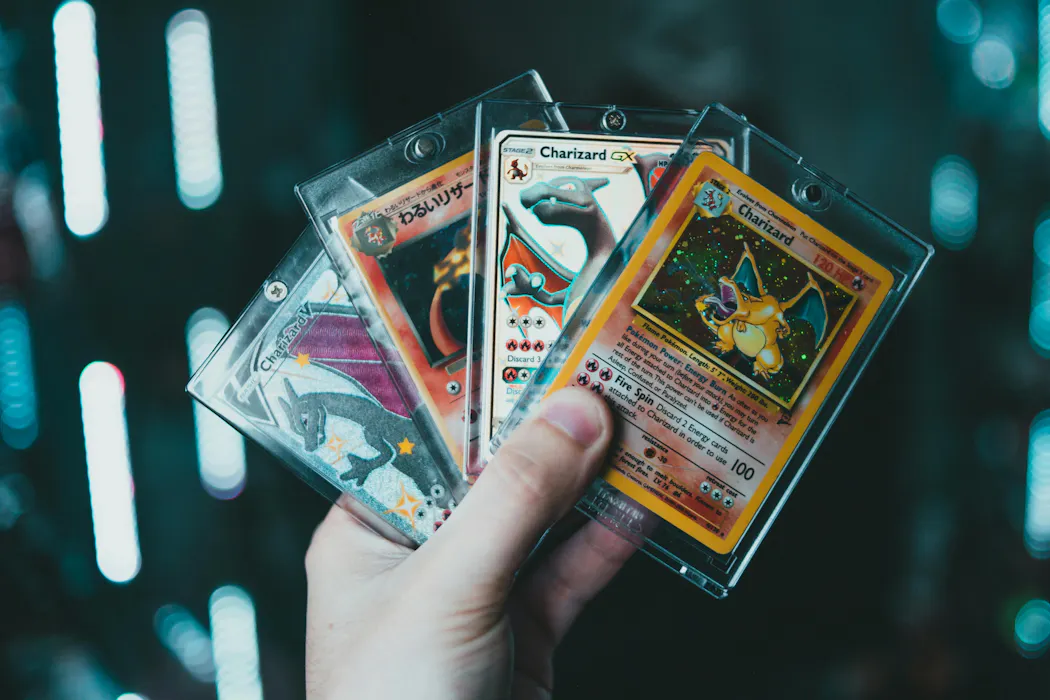
Why are people obsessed with (and stealing) Pokemon cards again?

Pexels/Erik Mclean, CC BY

In 1973, Japanese food company Calbee started attaching free collectable baseball player cards to its potato chip packets (and continues to do so today). It was mimicking a trend that had already taken off in tobacco markets in Japan and overseas. Baseball, Japan’s national sport, was an obvious choice for Calbee to attract consumers.

Some four years later, rival company Lotte joined the trend, launching a chocolate wafer snack with Bikkuriman “surprise man” stickers. These stickers quickly caught on – and eventually spawned an entire fantasy world that made its way to anime and manga.

Both Calbee and Lotte helped set a template for how children’s collectables could become objects of desire, competition and, later, nostalgia. Bikkuriman is still sold today, with rare 1980s Super Zeus stickers going for thousands of dollars to adult collectors.

It was against this backdrop that Satoshi Tajiri (born 1965) grew up. He would have been about 12 when the first Bikkuriman card was released. Satoshi himself would end up creating one of the most popular collectable card games in the world: Pokémon.

These cards are now so highly coveted they are driving international crime, getting banned from schools, and locked behind glass cabinets in stores.

Creating the cultural conditions for a hit

Satoshi drew on a childhood memory when he created Pokémon (short for “Pocket Monsters”): catching insects and trading them with friends.

He imagined a Nintendo Game Boy game where players could collect and exchange monsters. After seven years in development, Pocket Monsters Red and Green launched in February 1996. This was followed by a trading card game in October.

In 1997, the anime began airing on Japanese television, with a protagonist also named Satoshi (the name still used in Japan today). Pikachu – originally just one of 151 monsters – became the face of the franchise.

Like Bikkuriman, Pocket Monster spread rapidly across games, TV and print media. But unlike Bikkuriman, it also aimed to cross borders.

The English-language version of the game was released in 1998, with its name changed to Pokémon. “Pocket Monsters” may have sounded awkward, or even suggestive, to English speakers. Although it remains the official name in Japan, most Japanese fans also use the portmanteau, Pokémon.

Character names were also adapted and anglicised for overseas audiences.

For instance, Satoshi became Ash. Nyarth, a bipedal cat thought to be inspired by the Japanese lucky charm maneki-neko, became Meowth, to match the English-language cat sound. (Pikachu, drawing on the Japanese onomatopoeia of “pika” and “chu”, was retained.)

Soon enough, the character names, types and Pokédex numbers became shared internationally, allowing players the world over to connect through a shared Pokémon language. In 2004, the first World Championship for the Pokémon Trading Card Game was held in the United States.

Squirtle in your neighbourhood

It’s difficult for any single commodity to maintain popularity over decades. During the early 2010s, Nintendo suffered significantly, even falling into deficit, and the Pokémon franchise faced competition from rivals such as Yu-Gi-Oh! and Yo-Kai Watch.

The old-school model of marketing through traditional media was no longer enough for global dominance. To survive, Pokémon would need to adopt the logic of new media platforms – and catch the eye of the online generation. Then came Pokémon GO.

The 2016 smartphone app was developed by American software company Niantic, in collaboration with Nintendo and The Pokémon Company.

Through augmented reality, parks, shopping streets and neighbourhoods gained new meaning as potential locations for your next Pokémon catch. One grandfather in Taiwan made the news for using 64 smartphones at once.

Some players even travelled internationally to capture region-exclusive Pokémon, such as Kangaskhan in Australia, which was clearly modelled on a kangaroo.

Downloaded more than 500 million times, the enormous success of Pokémon GO played a key role in re-energising the global Pokémon fandom. Many players sought out the cards they had collected as children.

Interest was further amplified by the release of Pokémon TCG Pocket. Released in 2024, this app digitised the old-school Japanese tabletop to make it accesible for all.

Chasing profits and childhood memories

Then there was another, less predictable factor that drove the popularity of Pokémon cards: COVID lockdowns. With more time at home, people dug out old binders and rediscovered their childhood cards – many of which had high value – and began trading to make money.

This has led to a renewed interest in rare cards such as the Pikachu Illustrator, which was distributed in 1998 to the winners of an illustration contest. The card features artwork by Atsuko Nishida, Pikachu’s original designer. With only 39 copies known to exist, collectors call it the “holy grail” of Pokémon cards.

Earlier this year, influencer Logan Paul sold his Pikachu Illustrator for US$16.492 million, setting a record for the most expensive trading card ever sold.

This potential for profit has led to a surge in Pokémon card-related crime, as the cards are easy to carry, hide and move internationally. We’ve seen a wave of burglaries targeting hobby shops all over the world, including in Australia, the US and Japan.

Many fans may now find themselves unable to purchase cards due to the economic bubble. Still, it seems demand is high; roughly 10.2 billion cards were printed from 2024 to 2025.

Pokémon cards are a rare kind of tangible object. They connect the digital to the physical – the past to the present – and Japan to the world. They aren’t just collectables; they are a cultural currency, which, unfortunately, can be stolen.

The Conversation

Tets Kimura does not work for, consult, own shares in or receive funding from any company or organisation that would benefit from this article, and has disclosed no relevant affiliations beyond their academic appointment.

  •  

Game changers: how a stroke of paint transformed basketball, and the athletes who play it

When basketball was invented by medical doctor James Naismith in 1891 – to keep American football players active during winter – all baskets were worth two points, regardless of where they were shot from.

Games were dominated by tall players who usually shot from close to the basket.

It was often very crowded near the basket and there were fewer opportunities for smaller players.

This all changed when the 3-point line was introduced.

History of the 3-point line

The 3-point line was temporarily trialled in a few college games and minor professional leagues from the 1940s to the early 1960s, but was seen as more of a gimmick.

It gained more popularity after it was introduced in the American Basketball Association (ABA) (a competitor league to the NBA) during the 1967–68 season.


Sports can change dramatically in the blink of an eye. Sometimes, these moments create immediate shockwaves. Other times, it’s not until much later that their impact become obvious. This is part of a rolling series that explores key (and sometimes long forgotten) moments in sports history.


Read more: Game changers: how a rainy week led a frustrated Don Bradman to reinvent cricket


The ABA wanted to make basketball more interesting and exciting. It viewed the 3-pointer as the equivalent to a home run in baseball and believed it would “give smaller player a chance to score and open up the defence to make the game more enjoyable to fans”.

The ABA merged with the NBA in 1976 but the NBA did not immediately introduce the 3-pointer because many traditional coaches and players were against it.

It was finally introduced for the 1979–80 season, with Chris Ford from the Boston Celtics shooting the first one.

The International Basketball Association (1984) and other national leagues followed this move during the next decade.

It changed basketball, slowly

The 3-point line did not make a big difference straight away.

Players still preferred to shoot from closer to the basket because there was a higher chance of success. Teams did not practise 3-pointers and generally only used them when trying to win a game in the final few seconds.

The San Diego Clippers scored the most 3-pointers for the 1979–80 season, with 177 (2.2 per game). Brian Taylor from the Clippers had the most individual 3-pointers (90).

Times have changed.

During the 2024–25 season the Celtics scored the most 3-pointers: 1,475 (17.8 per game) and every team in the NBA scored more than 900. Some 139 players made 100 or more.

League 3 point trend. NBA

How 3-pointers became more popular

A few key events contributed to 3-pointers becoming more popular.

The inclusion of a 3-point contest at the NBA All-Star weekend in 1986 made the shot more respected. It helped that the first three were won by popular Celtics All-Star Larry Bird.

From 1994 to 1997 the NBA moved the 3-point line closer to the basket (from 7.24 metres to 6.71m) to encourage more scoring in games.

While it did not improve the trend of lower scores and the line was moved back, teams did start to shoot more threes.

The Steph Curry phenomenon

In the 2010s, the rise of the Golden State Warriors sparked a 3-point revolution.

Led by two-time MVP Steph Curry, the Warriors’ heavy reliance on the 3-pointer helped them make the NBA Finals five years in a row, winning three championships.

Curry, who is more than 10cm shorter than the average NBA player, is credited with changing the game by regularly shooting “deep threes” from way behind the 3-point line. This allowed him more time to shoot over taller players.

It also changed how other teams defend because they have to cover more space to defend him. Consequentially, his teammates enjoy increased scoring opportunities.

Curry is the most successful 3-point shooter in NBA history. Kids now want to “be like Steph”.

WNBA All-Star Caitlin Clark has also been influential increasing the popularity of 3-pointers.

The role of analytics

Statistics-focused executives such as Daryl Morey also played a key role in the increasing popularity of 3-pointers.

They realised teams could score more points by shooting 3-pointers, even if they shot a slightly lower percentage.

For example, if a team takes ten 3-point shots and make 40% (four) of them, they will score 12 points (4x3 = 12). This is more than they will score if they take ten 2-point shots and make 50% (five) of them (5x2 = 10).

Under Morey’s leadership, the Houston Rockets became the first NBA team to attempt more 3-pointers than 2-pointers in a season. They did this from 2017 to 2020, when they won three consecutive division titles.

A statistical analysis across ten seasons from 2009–10 to 2018–19 also showed teams that took more 3-point shots had a higher probability of winning.

This rise in 3-pointers has come almost exclusively at the expense of mid-range shots.

Mid-range shots are shot from outside the paint but inside the 3-point line (roughly 3–7m from the basket).

The percentage of total shots from mid-range has plummeted from 31% in 2010–11 to just 13% a decade later, while shots in the paint (close to the basket) have remained relatively steady.

League wide % of all field goal attempts. NBA

The 3-point line has improved the game by adding variety in offence, spreading players out and allowing players of different sizes and skills to be successful.

However, fans, players and commentators are starting to wonder whether there are now too many 3-pointers being shot.

Too much of a good thing?

The increased emphasis on 3-pointers in the NBA has coincided with a decline in viewership. Although these may not be related, it has sparked concerns.

NBA Commissioner Adam Silver noted that while game attendance remained strong and fans enjoy the skill on display, he acknowledged some teams’ attacking plays can appear “cookie cutter” as teams mimic each other’s 3-point-heavy tactics.

NBA legend Shaquille O’Neal also stated the 3-point craze made games feel predictable, where “every team is running the same plays”.

Time for a change?

Suggestions from former players, coaches, commentators and spectators include moving the line further back, reducing the space available for shooting 3-pointers from the corner of the court, increasing overall court dimensions, adding a 4-point line or even capping teams’ 3-pointer attempts.

Silver says the league is open to exploring tweaks if they improve the balance between inside and outside play.

There are no plans to change yet, as any rule change will trigger flow-on effects for offence and defence that may not improve the game.

The Conversation

The authors do not work for, consult, own shares in or receive funding from any company or organisation that would benefit from this article, and have disclosed no relevant affiliations beyond their academic appointment.

  •  
❌