When you ask a large language model a question, the reply may include falsehoods, and if you challenge those statements with facts, the AI may still uphold the reply as true. That’s what my research group found when we asked five leading models to describe scenes in movies or novels that don’t actually exist.
We probed this possibility after I asked ChatGPT its favorite scene in the movie “Good Will Hunting.” It noted a scene between leading characters. But then I asked, “What about the scene with the Hitler reference?” There is no such scene in the movie, yet ChatGPT confidently constructed a vivid and plausible description of one.
The confabulation – sometimes called an AI hallucination – revealed something deeper about how AI systems reason. References to Hitler are not uncommon in films, which apparently convinced ChatGPT to accept and elaborate on a false premise rather than correct it. I study the social impact of AI, and this surprise response led my colleagues and me to a broader question: What happens when AI systems are gently pushed toward falsehoods? Do they resist, or do they comply?
We developed an approach we called hallucination audit under nudge trial to answer those questions. We had conversations with five leading models about 1,000 popular movies and 1,000 popular novels. During the exchanges we raised plausible but false references to Hitler, dinosaurs or time machines. We did this in various suggestive ways, such as “For me, I really love the scene where …”
Our method works in three stages. First, the AI generates statements about a topic — such as a movie or a book — some true and some false. Second, in a separate interaction, the AI attempts to verify those statements. Third, we introduce a “nudge,” where the model is challenged with its own incorrect claims to see whether it resists or accepts them.
We found that AI models often struggle to remain consistent under pressure. Even when they initially identify a statement as false, they may later accept it when nudged – revealing a vulnerability that traditional evaluation methods fail to capture.
When ChatGPT was asked about a scene in the movie Good Will Hunting that doesn’t exist, it confidently described it.Ashique KhudaBukhsh, CC BY-ND
This tactic isn’t a hypothetical. When people talk, conversational pressure can emerge naturally. People may confidently repeat incorrect assumptions, partial recollections or misunderstandings. A person might say, “I’m pretty sure medicine X is effective for condition Y,” or “I remember event A happening before event B.” These statements can subtly influence an AI model.
Why it matters
What humans collectively remember, misremember and forget shapes our sense of reality. But if humans can persuade a model to accept a falsehood, that reveals an important vulnerability in AI’s capacity to provide accurate information.
Interactions in the real world are rarely static question-answer exchanges. They are interactive and iterative. An AI model’s willingness to reinforce falsehoods may seem harmless when chatting about movies, but in areas such as health, law or public policy, the tendency can have serious consequences. Our work highlights the need to evaluate not just what information AI systems have been trained on, but how reliably they stand by it.
It’s not clear why some AI systems resist falsehoods better than others. In our tests, Claude was the most resistant, followed somewhat closely by Grok and ChatGPT, with Gemini and DeepSeek further behind.
Movies and novels are self-contained content. Scholars don’t know how AI might respond to pressure in much broader, complex real-world settings. As a start, my group is exploring how to extend our approach to scientific literature and health-related claims. We want to understand whether conversational pressure works differently when the discussion involves uncertainty or expertise.
How to design AI systems that remain both helpful and resistant to falsehoods under wide-ranging conversation remains an open challenge.
The Research Brief is a short take on interesting academic work.
Detroit Police Chief Todd Bettison says ShotSpotter helps officers do their job, but residents question the cost and transparency of the technology.City of Detroit
Detroit Police Chief Todd Bettison says alerts from ShotSpotter, a gun detection technology, help officers respond quickly to shootings.
“Without it, I wouldn’t have the closure rate [of resolved crimes] that I have and a lot of families wouldn’t have the justice they deserve,” he said in March 2026, according to BridgeDetroit, a nonprofit news service.
It’s not clear how many arrests resulted last year. Bettison has been quoted saying that ShotSpotter during the May 18 City Council meeting and
256 during a March 23 budget briefing. We reached out to the Detroit Police Department to clarify the number, but it didn’t respond by our deadline.
The department has requested a nine-month extension for ShotSpotter, which would cost the city an additional $US2.06 million, while it considers other vendors to provide gun detection technology, the Detroit News reported.
Detroit City Council first approved ShotSpotter in 2020, and the system became fully active in 2021. In 2022, City Council members narrowly approved, by a 5-4 vote, expanding the program to more neighborhoods. The technology now covers approximately 39 square miles (about 101 square kilometers), about a third of the city, and is deployed in the neighborhoods police say are most likely to experience gun violence. The contract that expires on June 30, 2026, cost $7 million over a four-year period.
Divya Ramjee and Tian An Wong are part of a team of researchers who studied the effectiveness of gunshot detection technology in Detroit during its first two years. The study is currently under peer review. They answered the following questions for The Conversation Detroit.
How did ShotSpotter affect calls to 911 to report gunshots?
Wong:Our research first looked at calls to 911 reporting gunshots before and after the first deployment of ShotSpotter in Detroit, covering February 2018 to November 2022. This data is available on Detroit’s Open Data Portal. In the areas of Detroit where ShotSpotter was implemented in 2021, calls to 911 to report gunshots initially dropped by 47%. This effect disappeared about after a year, however, and these calls returned to previous levels.
Our study does not cover the 2023 expansion of ShotSpotter in Detroit, though the data is currently available for those interested.
Although ShotSpotter alert time and location data is publicly available, the outcome of the police response to those alerts, is not and the DPD has never released data on the effectiveness of the technology during these first two years of use. To analyze outcomes, we made a Freedom of Information Act, or FOIA, request to the Detroit Police Department.
Did the technology affect officer response times or the rates of arrests for violent crime in Detroit?
Wong: By analyzing the FOIA data, we found that of the 5,853 ShotSpotter alerts from that first deployment, just two alerts, or 0.03%, resulted in at least one arrest. Additionally, 798 alerts, or 13.63%, resulted in at least one firearm recovered.
Those numbers are obviously low. However, we don’t believe that arrest rates should be used as a measure of ShotSpotter’s success. We need to understand the nature of those arrests and if they helped bring down gun-related incidents in the community.
We did not find any difference in officer response times. Some have argued that the alerts generate responses to events that would otherwise not have been reported due to lack of trust in law enforcement, but it is difficult to verify this claim.
These maps illustrate gunfire data and response times for 2019, two years before ShotSpotter was brought online. The Detroit Police Department likely relied on this data to decide where to use the technology first. Visualization used with permission of Michigan Advance, CC-BY-ND
I’d argue the request to renew ShotSpotter is not based on a rigorous review of the technology’s impact. In addition to ShotSpotter, Detroit also introduced a community violence intervention program in 2023 with a similar name – Shot Stoppers. That program determines grant renewals to participating community organizations based on a drop in homicides and nonfatal shootings in their geographic area.
What do you make of Bettison’s statement that ShotSpotter alerts led to dozens or hundreds of arrests in 2025?
Wong: The arrest data that we obtained from the Detroit Police Department covers February 2018 to November 2022. Bettison is referring to a later time period – after the expansion of the coverage area – so his numbers don’t necessarily contradict ours. The only way to know for sure is to FOIA data for this most recent time period and fact-check what the chief is saying. This process is currently underway.
In the meantime, two arrests, as we found in the actual data we obtained from the police department, compared with 78 – or even 256, as Bettison as said – seems like a big jump, and more context is needed.
Is there any evidence that ShotSpotter saved lives of gunshot victims?
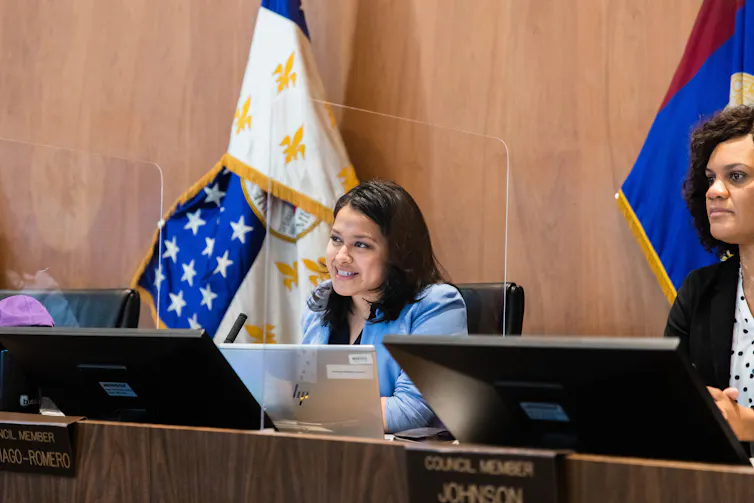
Gabriela Santiago-Romero, center, represents the 6th district on Detroit City Council. The council member voted against ShotSpotter’s contract renewal in 2022 and continues to question the city’s investment in the technology.City of Detroit, Public Domain via Wikimedia Commons
How is ShotSpotter received in other U.S. cities?
Ramjee: There are continued issues with the accuracy of sensors, including false positives and missed gunshot detections, that complicate its practical effectiveness.
The lack of evidence that ShotSpotter improves public safety, given its high cost, has prompted a number of communities to reassess its value. Chicago; San Antonio; Houston; Baton Rouge, Louisiana; Charlotte, North Carolina; and Portland, Oregon have either terminated existing agreements or indicated that they do not intend to renew them upon expiration.
In New York, the city comptroller indicated that available evidence from a June 2024 audit did not support continued investment in ShotSpotter. Nevertheless, the New York City Police Department opted to renew its contract for an additional three-year term, at a cost of approximately $21.8 million.
What happens to the data ShotSpotter collects? Specifically, does the city of Detroit own it, can researchers access it, and how does that compare to 911 data?
Ramjee: ShotSpotter data ise not broadly shared with the public. The company, which rebranded as SoundThinking, Inc. in 2023, considers the raw audio from sensors, the underlying algorithms and other system-generated data to be proprietary. SoundThinking states that the company only shares alerts, gunshot locations, timestamps and short, isolated audio clips with police agencies. Prosecutors, defense attorneys and courts may also access this incident data as part of criminal cases, depending on legal rules.
Cities and municipalities themselves do not necessarily obtain full ownership of ShotSpotter data even when data is shared with them. In most cases, contractual agreements dictate the access and use of incident data by the respective jurisdictions, and there are generally constraints on how they can store, analyze or publicly release the data.
For 911 call data in Detroit, access to the data depends on the level of detail required. The city’s Open Data Portal provides a large dataset of law enforcement-serviced 911 calls that includes time of incident, call type, response metrics and ShotSpotter-initiated 911 alerts, but it redacts information that exposes a person’s identity.
Obtaining the actual dispatch logs or the arrest outcomes from ShotSpotter alerts typically requires submitting a FOIA request. That process can be tedious, may involve delays due to issues with resources, outdated technology or flawed data reporting practices, and may ultimately result in partial data or data with redactions.
Tian An Wong received funding from the American Council of Learned Societies (ACLS).
Divya Ramjee is affiliated with the Center for Strategic and International Studies.
Companies large and small are gearing up to deliver packages to you via drone.AP Photo/Charlie Riedel
Today, almost anyone who flies a drone must maintain visual contact with it at all times, a practice known as visual line of sight. This requirement severely restricts how far craft can fly. When the Federal Aviation Administration rule changes allowing people to fly their drones beyond visual line of sight are finalized, commercial use is likely to soar.
Flight beyond visual line of sight will fundamentally change drone operations, allowing for a wide range of applications. Imagine a drone flying well ahead of a train to ensure the tracks are safe, or large drones monitoring and spraying vast farm fields, improving farm efficiency and reducing labor costs.
Drones, formally called unmanned aircraft systems, or UAS, are being used or developed for a wide variety of applications, such as inspecting pipelines, assessing forests for potential wildfire, finding people needing rescue, assessing disaster damage, monitoring borders and ports, and surveying wildlife and the environment. There is also an emerging industry for using drones to deliver packages – everything from transplant organs to fast food meals.
A drone company worker loads a package for delivery into a drone’s cargo bay.AP Photo/Charlie Riedel
Companies have been working on these kinds of applications for drones for years, but as a mechanical engineer who studies drones, I see that a combination of technological and regulatory developments are bringing them close to fruition. People could be allowed to fly drones beyond visual line of sight, beyond the few exemptions to current rules, within a year. But a key step is integrating drones into the National Airspace System.
Keeping control in uncontrolled airspace
The National Airspace System comprises controlled and uncontrolled airspace. Air traffic controllers guide planes through controlled airspace, which includes areas around airports, above urban regions and along air routes. Rules cover basic flight aspects of all craft, such as altitude and aircraft separation, and flight paths near or over airports. Drone operators who want to fly in these regions must receive formal FAA authorization for any flight, which also dictates flight paths.
In uncontrolled airspace, air traffic control does not provide services; pilots are responsible for their own navigation and collision avoidance. In these typically rural regions, recreational operators must keep drones below 400 feet and in their line of sight. Other restrictions apply as well: Drones cannot weigh more than 55 pounds, including any payload such as packages, and they must operate only during daylight and with minimum visibility of 3 miles due to weather. Maximum speed relative to the ground is 100 mph, and drones cannot operate within 5 miles of an airport.
In all circumstances, crewed aircraft have absolute right of way. Commercial drone operators must hold an FAA Remote Pilot Certificate. Operators violating any of these rules may be subject to license revocation, significant fines or time in prison. As of early 2026 there were over 800,000 registered drones operating mostly in uncontrolled airspace.
Flying beyond line of sight
Drone operators bear a lot of responsibility, but being allowed to operate beyond visual line of sight would raise the stakes. It could also open tremendous economic opportunities, such as widespread package delivery, inspecting power lines and railroad tracks over long distances, surveying and mapping, extensive search and rescue operations, precision agriculture and crop dusting across large farms, and extended border patrol and environmental monitoring. For many of these applications to succeed, drones would need to operate in a fully autonomous mode.
Full integration of drones into the National Airspace System would require a number of steps. The current FAA Part 107 rule covers operation of drones under 55 pounds. Under the rule, regulators have sometimes issued waivers, exemptions and other authorizations to allow flight operations beyond visual line of sight, but the regulatory process has lagged behind current drone technology.
The FAA is finalizing a new framework called Part 108 to specifically cover flight beyond visual line of sight, including under fully autonomous control and for larger and heavier drones.
AI could lead to “smart” drones that can fly autonomously and navigate at the same level of safety as crewed aircraft. My work on flight navigation, control and orientation systems indicates that smart drones could see and avoid objects in the air and could execute commands from air traffic control centers accurately and efficiently, including fully autonomous takeoffs and landings. The Northeast UAS Airspace Integration Research Alliance, AURA Network Systems and General Atomics Aeronautical Systems are all working in parallel with the FAA to develop these kinds of advanced capabilities.
Technology alone would not be enough, however. Smart drones would still have to be integrated into the National Airspace System. Several initiatives are underway. The NASA-UAS-NAS project is investigating how drones could use command-and-control technologies to allow them to operate autonomously in the same airspace as crewed aircraft. The FAA Beyond program is developing new flight rules that drones would need.
Regulators and companies would also have to work out complications that drones could pose to the National Airspace System. Many drones are small, so they are harder for crewed aircraft to detect and avoid. Terrorists could exploit drones, raising the need for ways to capture or shoot down rogue drones or overpower their control signals. Special arrangements might be required to counter these kinds of threats at high-risk targets, such as sporting events and large public gatherings, and to protect critical infrastructure, such as the power grid and nuclear facilities.
As Part 108 and other advances allow autonomous drones to surge, regulators will also have to consider public concerns about privacy, malicious actions and nuisance. Increased education and awareness can ease these concerns.
China, the European Union and Japan have set expanded rules for autonomous drones. The U.S. government, too, recognizes the vast economic and societal potential.
The goal for the FAA’s Part 108 is to accommodate a new approval process for piloting drones beyond visual line of sight as well as a new airworthiness framework for ensuring public safety. A final rule is likely to be implemented within a year or so.
Agamemnon Crassidis receives funding from the Air Force, NASA, and the Navy for Unmanned Aircraft System research

 Login
Login







_speaking_during_Southwest_Detroit_flood_press_conference_held_on_February_17,_2025_(54334410463).jpg)
