Reading view

How natural selection helps design antennas, cancer treatments and adhesives

Natural selection can efficiently explore a range of options, some obvious and some less so. Justin Paget, DigitalVision via Getty Images

NASA had a big – and little – problem. For a small satellite, the agency needed a tiny antenna, with very specific communication capabilities and very strict limits on size and weight. The agency gave the problem to a design team adept at simulating the way natural selection engineers solutions.

Design using natural selection is based on a simple but powerful idea with broad applications across the world: When variation in replicable traits exists, and some variants succeed more than do others, those variants will tend to spread to larger and larger percentages of future populations. For instance, early gazelles that happened to be faster were harder for predators to catch, so they were – generation after generation – more likely than slower gazelles to live, reproduce and pass on their capabilities for higher speed.

A small metal base supports a metal wire that has many complicated bends in it.
The X-band antenna for a group of satellites was designed by a computer program using the principles of natural selection to refine an idea. NASA via Wikimedia Commons

The NASA team adapted that idea to work inside a computer. They first created two very rough “parent” programs for designing the antenna. They then bred them together, creating digital “offspring” that shared varying halves of each parent, mimicking sexual recombination. To mimic mutation, some coding elements were randomly switched from 0s to 1s, and vice versa. The better-performing offspring programs were kept to become the parents of the next generation, while the rest were discarded.

Repeated over many cycles, this process quickly refined the programs that produced antenna designs until a design outperformed a human-designed version – with stronger signal, greater range and lower energy use – and took less time to develop. It was built, was launched into space in 2006, and performed admirably for the planned 90-day duration of the mission.

To me, as a professor of both law and biology, that success points to a broader truth: When people harness the logic of natural selection, they can often find efficient and effective ways to solve complex problems. As I explore in my book, “Force of Nature: Understanding Evolution’s Deepest Logic – And Putting It to Use,” natural selection is the most relentless efficiency-seeking force in the history of life.

Deepening understanding

Ignoring the power of natural selection can mean missing opportunities – or making things worse.

For example, consider fishing: As global demand for fish has grown, industrial fishing has become highly efficient at removing all the individuals above a certain size. Anything small enough to fit through the holes in a net survives; anything larger dies. At first that might seem sensible: Take the big fish and leave the small ones to grow.

But that strategy shifts the factors that work to change the population for generations to come.

Fish that mature at smaller sizes are more likely than larger ones to escape the nets and reproduce. Over time, the trait of maturing smaller spreads. The result is a population composed primarily of smaller adults. For instance, a 2025 study found that heavily fished Baltic Cod became 48% shorter in length from 1996 to 2019.

The consequences compound. Smaller adult females produce far fewer eggs. In Atlantic Cod, for instance, a female that is one-half as large as a 66-pound female doesn’t lay 50% of the number of eggs; she lays about 4% as many – and her eggs are smaller, reducing the energy available to boost the chances of survival.

By ignoring how selection pressures work, the fishing industry has ended up breeding its future generations primarily from smaller fish with less reproductive ability. That has shrunk not only the average size of adults but also their overall numbers – and contributed to a global overfishing crisis.

A fish swims through water.
Photographed in an aquarium, an Atlantic cod. Auscape/Universal Images Group via Getty Images

Treating cancer

Across many fields, tuning into the evolutionary results of selection offers powerful – and often underused – insight.

Medical scientists increasingly understand the dynamic by which over-using antibiotics has helped to foster the rise of bacteria resistant to antibiotics. Killing off the bacteria that are easiest to kill reduces competition for the more resistant ones.

That insight has inspired a new approach to treating some cancers, called adaptive therapy.

Tumors tend to consist of cells that vary in their resistance to cancer treatments.

Traditional approaches assume that eradication of all cancer cells should be the goal. But efforts to eradicate often backfire and kill the patient too, because treatment-resistant cells survive, have newly lessened competition, and consequently thrive and expand.

By contrast, adaptive therapy aims to keep the most dangerous cancer cells in check by preserving some of the treatment-susceptible cancer cells to compete with them. When a tumor starts to grow, doctors increase the treatment dosages. When a tumor starts to shrink, doctors dose less.

For some patients, this approach can help manage cancer over significantly longer periods, even if – and in fact precisely because – this treatment does not seek to entirely eliminate the cancer.

A high-speed train in a station.
The nose of a Japanese high-speed train resembles a kingfisher’s beak. Artur Widak/NurPhoto via Getty Images

A world of opportunities

Other engineers are finding even more sources of untapped inspiration in the solutions natural selection has already designed.

A brightly colored bird with a specially shaped beak.
A kingfisher’s beak allows it to dive into water for its prey. James Manning/PA Images via Getty Images

The nose of a Japanese bullet train, for example, was redesigned based on the beak of a kingfisher, a bird natural selection enabled to dive into water with minimal splash. The result was a quieter, faster and more energy-efficient train.

The remarkably strong and tough scales of the Brazilian pirarucu, a fish that evolved among the voracious piranha, inspired new approaches to improving body-armor.

A gecko’s ability to walk upside down on glass, with toe-filament nano-features harnessing the attractive power of subatomic particles, inspired a new class of adhesives.

Beyond physical attributes

Natural selection doesn’t only operate on anatomical or physical traits. It also works on behavioral traits.

In psychology, natural selection perspectives are showing how human brains – which have been shaped by natural selection to process information in ways that influence behaviors – incorporate some forms of information more easily than identical information conveyed in a different way. For instance, people are far better at calculating the conditional probabilities of various risks when those are expressed in natural frequencies, such as “3 out of 10,” than when expressed in the modern language of statistics, such as “0.3” or “30%.” That’s because for 99% of human history, information arrived into brains mainly as whole integers – as people, things and events.

In law, this perspective is illuminating such insights as the origins of the sense of fairness in primate relatives. There is evidence that natural selection has favored the propensity of a person to notice when they are being treated inequitably, to remember who is behind it and to respond negatively both in the present and in the future.

In economics, people tend to value an item they have just acquired far above the maximum price they would have paid to acquire it. There is evidence that this tendency, known as the endowment effect, was favored by natural selection when bargains were risky in a pre-modern world, a time when giving over one item, in trade for another, might risk getting nothing at all from an untrustworthy trading partner.

But that behavioral leaning makes less sense in the context of modern economic innovations like legal rights, banks and laws, and with mechanisms to enforce bargains, such as police and litigation. This is therefore part of a larger research stream that centers on the ways that some modern problems stem from a mismatch between our evolved brains and our modern human environments, which have changed dramatically in an eye-blink of evolutionary time.

What all this means is that the logic of natural selection has enormous practical value: It can help us identify problems, inspire new solutions, and recognize when our own actions are silently undermining our goals.

The Conversation

Owen D. Jones has received funding from The MacArthur Foundation, the National Science Foundation, and the Glenn M. Weaver Foundation.

  •  

How a proposed green card application policy change would disrupt lives by assuming legal immigrants are evading the law

A draft policy from the Trump administration would make this card much harder to get. Stefano Spicca/Getty Images

More than half a million people rely every year on the ability to apply from within the United States for a green card, the government-issued ID that allows an immigrant to legally live and work in the country long term.

But in May 2026 the federal government issued a policy memorandum – essentially, a draft change to current policy – that could upend this process and deny immigrants the ability to apply for a green card while in the U.S. Instead, they would have to return to their home country to do it.

To see why this matters, picture a British woman, let’s call her Lucy, who comes to the U.S. on a student visa to earn her Ph.D. at Ohio State University. During her studies, she falls in love with Mike, an American engineer, and they marry. Under long-standing practice, Lucy could apply for her green card right in Ohio without uprooting her life.

The new policy memorandum, however, could force families like hers to make wrenching choices, sending one member of a couple out of the country with no guarantee they would be allowed back in.

As law professors who study the legal procedures relating to citizenship and immigration, we see this shift as a significant departure from how the system has worked for decades.

Congress built what’s called “adjustment of status” – the shift from one immigration status to another – into the immigration legal framework as a pathway to permanent residency. A policy memo cannot cut off that avenue.

Instead, what is being proposed by the Trump administration would require congressional action or agency rule-making that follows the proper procedural steps. The hundreds of thousands of people every year who have been clearing the legal requirements of adjustment of status cannot have their rights cut off arbitrarily.

Separation, disruption

Approximately 54%, or 608,260, of the 1.17 million new lawful permanent residents in fiscal year 2023 received a green card from within the United States.

But now, the draft policy emphasizes that those who entered the United States as nonimmigrants – such as people on student visas, who stated that they would be leaving the country once their education was finished – “are generally expected to pursue an immigrant visa and admission from outside the United States if they wish to reside permanently in this country.”

Silhouette of hand of passenger while using mobile phone during waiting in airport terminal.
Under proposed rules, a person in the U.S. who wants to apply for a green card would have to leave the country to do so. Chalabala/Getty Images

Applying from within the United States, as Lucy sought to do in the hypothetical example above, would be seen by officials as a negative element – a strike against granting the green card – that would need to be balanced out by what officials deem extraordinary counterevidence, such as sufficient family ties, hardship or length of residence in the United States, for the applicant to succeed.

The memo deems application from within the U.S. a red flag, calling such an application an “attempt to avoid the ordinary consular immigrant visa process,” implying that the immigrant hid their intention to immigrate when they obtained the nonimmigrant visa.

If the memo becomes implemented as official policy, individuals like Lucy would be expected to return to their country – in her case, the U.K. – to apply for a green card.

This could take a substantial amount of time. She would thus need to interrupt her studies, which her university may or may not allow for her to complete the degree. Her husband, Mike, would get the choice of being geographically separated from his spouse indefinitely or disrupting his own career in Ohio, with his employer potentially not letting him return to the job. The family would face even more disruption if Lucy and Mike had children.

Unsupported implications

Even if the process to get a green card goes smoothly, it can easily take over a year from applying to receiving the status symbolized by the card.

Spending over a year in the home country while waiting for the application to be resolved is a massive disruption for any individual or family. The policy memorandum justifies this by stating that seeking a green card from inside the United States is founded on applicants’ desire to evade the normal immigrant visa process, “usually accompanied by their violation of our immigration laws.”

In other words, the U.S. Citizenship and Immigration Services believes that certain people applying for green cards from inside the country – the ones who came here saying their time in the U.S. was limited – are trying to cheat the system.

The agency, however, provides no support in the policy memorandum for its claim that most individuals who seek a shift from a temporary status to a permanent one have done anything illegal.

To the contrary, the document acknowledges that such an adjustment of status already can be used only by individuals who have been either inspected and admitted or inspected and paroled, both lawful processes. And it gives no evidence for the accusation that most such individuals have done anything illegal since.

The memo also implies that all applicants for green cards who were previous holders of nonimmigrant visas – such as students and tourists, but also performing artists, athletes coming to compete, diplomats and their staff – should expect greater scrutiny in the future. It treats the move from nonimmigrant to immigrant status as highly unusual. That’s despite the fact that over half a million people a year have routinely benefited from such transitions.

A substantial number of those applicants would now be treated with greater suspicion about their original intentions. They would likely also need to take on tremendous burdens, including spending months or even years separated from a spouse or children while waiting abroad; interrupting or abandoning a degree, a job, or a career; and gambling on whether they’ll be allowed back into the U.S. at all, since consular processing abroad carries the risk of a denial with no easy appeal.

The top of a press release from the U.S. Citizenship and Immigration Services.
The press release from the U.S. Citizenship and Immigration Services announcing the change in policy regarding green cards. U.S. Citizenship and Immigration Services

Legal change or intimidation?

The largest group already in the U.S. that may avoid having to leave the country to apply for green cards is those who came to the U.S. on temporary work visas. But even they will likely face a tougher process to get a green card, and they may also face longer processing times than in the past.

Many questions have been raised about the legality of this new policy, including if it were to end up changing how pending applications are treated. Some analysts say that Congress did not intend to make the shift to immigrant status “extraordinary” and rare, as the memo claims.

Commentators – including ones who used to work at the Department of Homeland Security – have stated that, as with other announcements during the second Trump administration, the real goal may be to discourage immigration rather than effecting direct policy changes.

One immigration attorney wrote, “These policies send a clear anti-immigrant message intended to intimidate and drive undocumented immigrants to self-deport.” Another immigration lawyer called the memo legally “bonkers” and its text an “incoherent word salad.”

A number of immigration law firms are encouraging people to continue applying for adjustment of status as they had been. They are also cautioning applicants to “ensure, however, that their social media activity does not include any actions or statements that could be deemed problematic by the U.S. government.”

If the administration’s goal was to put immigrants on pins and needles, that has likely already been accomplished.

The Conversation

The authors do not work for, consult, own shares in or receive funding from any company or organization that would benefit from this article, and have disclosed no relevant affiliations beyond their academic appointment.

  •  

When you don’t have the facts, argue the law: How Trump’s EPA is limiting its own ability to protect public health far into the future

The Trump administration is trying to tie the hands of future administrations when it comes to regulating pollution, including greenhouse gas emissions. Chris Sattlberger/Tetra Images via Getty Images

As the Trump administration moves to weaken America’s air pollution rules, it is deploying new legal interpretations that are intended to tie the hands of future administrations for years to come.

In practice, the changes limit the Environmental Protection Agency’s authority under the Clean Air Act. The result allows EPA officials to ignore science, data and the adverse effects their decisions will have on public health and the environment.

But the new interpretations are also designed to apply not just to the rule in which they are first set forth but into the future.

If affirmed by the U.S. Supreme Court in inevitable legal challenges, these interpretations could make it harder for future administrations to restore the public health protections that the Trump administration eliminates. They could also make it difficult to update rules to respond to new information about health risks.

Typically, moves to weaken pollution regulations through novel legal interpretations would have a good chance of being overturned in court. But the EPA’s new interpretations are strategically designed to appeal to the current U.S. Supreme Court’s view of federal agencies’ authority, especially in light of the court’s 2024 ruling in Loper Bright v. Raimondo. In that case, the court overturned what’s known as the Chevron doctrine. A 1984 Supreme Court ruling had established that courts should defer to executive agencies’ legal interpretations of their governing statutes when the text of the law was ambiguous or left gaps. That deference no longer applies.

As a former EPA appointee who helped write and review dozens of regulations under the Clean Air Act during the Obama and Biden administrations, I find these efforts to prevent the EPA from doing its job of protecting public health and the environment to be alarming. Here are two examples of how the new interpretations are playing out.

Blocking future climate regulations

In February 2026, the EPA rescinded its 2009 endangerment finding, a determination under the Clean Air Act that carbon dioxide and five other greenhouse gases “may reasonably be anticipated to endanger public health or welfare” because they contribute to climate change.

The endangerment finding was the scientific and legal basis for EPA rules requiring automakers, power plants and oil and gas operations to cut their greenhouse gas emissions. Erasing it would make it easier for the Trump administration to eliminate greenhouse gas regulations.

Rather than try to challenge the science of climate change, which would be difficult given the growing mountain of evidence, the Trump EPA relied on legal arguments that were intended to dispense forever with the EPA’s ability to regulate greenhouse gas pollutants under the Clean Air Act.

Two men walk toward a podium. One of them, Zeldin, is grinning. The promotional sign reads 'Largest Deregulation in History
President Donald Trump and U.S. Environmental Protection Agency Administrator Lee Zeldin arrive for a White House event to announce a rollback of the 2009 Endangerment Finding on Feb. 12, 2026. Anna Moneymaker/Getty Images

Among the administration’s numerous arguments, two stand out:

First, the Trump EPA says the Clean Air Act should be read to limit the EPA’s authority to regulate air pollution only if its harm to the public is “through local or regional exposure.”

That would mean contributions from U.S. sources to global air pollution, no matter how demonstrable or how much they endanger Americans, are not covered by the Clean Air Act.

Second, the Trump EPA says that reducing greenhouse gas emissions from motor vehicles and engines would be “futile.” It points to global climate modeling that suggest these reductions would not meaningfully reduce the harm to public health and welfare.

What that argument fails to mention is that actions by people around the world to reduce emissions across different sectors add up. Motor vehicle emissions are the No. 1 contributor of U.S. emissions. If this sector is too small to regulate, then nothing is big enough.

Each of these interpretations is contrary to positions that the EPA took in the original endangerment finding, which the D.C. Circuit Court of Appeals upheld in 2012.

Allowing more toxic air pollutants

A second example involves the EPA’s proposal on March 17, 2026, to weaken pollution restrictions on businesses that sterilize medical equipment using ethylene oxide, a known carcinogen.

In that proposal, the EPA is also changing a legal interpretation in a way that would constrain the agency’s ability to protect human health into the future, this time from emissions of toxic air pollutants.

The Clean Air Act, under Section 112, establishes a methodical program for the EPA to regulate industries that emit significant quantities of air pollutants that can cause cancer, birth defects, genetic mutations or neurological harm, or harm reproductive health.

The EPA reviews how facilities control their emissions and sets standards that require all facilities to meet what the best-controlled sources are doing. But Section 112 has an important provision called “residual risk” review: Eight years after the EPA sets the first technology-based standards, it must determine whether the public health risk posed by emissions from the facilities after controls are added is acceptable.

In 2024, the EPA updated its hazardous air pollution rule for facilities that use ethylene oxide to sterilize medical equipment sensitive to steam heat, such as devices containing plastic, rubber or electronic components. Because recent research showed that ethylene oxide posed a much higher risk of cancer than previously thought, the EPA also updated its 2006 residual risk finding and required additional safeguards.

The Trump EPA is now arguing that the agency can assess residual risk only once, even if more recent information shows that the health risk is unacceptably high.

By constraining its own authority, the EPA is withholding standards that would protect thousands of people from a higher risk of cancer. It is also creating a legal precedent that will justify weakening other standards. Those include standards for chemical manufacturing facilities that the Biden EPA updated in 2024 through residual risk review.

That precedent would also prohibit the EPA in the future from taking into account new information about the health effects of any regulated hazardous air pollutant from any type of industry the EPA regulates under Section 112 of the Clean Air Act, including petroleum refineries, chemical manufacturing and paper mills.

Arguing the law

These rules are just two examples of the administration’s “if you don’t have the facts, argue the law” approach.

If the administration’s strategy works, the American public may be living, and dying, with the consequences of these industry-friendly regulations for years to come.

The Conversation

Janet McCabe is a volunteer with the Environmental Protection Network and has held several appointed positions at the United States Environmental Protection Agency. Consistent with the Indiana University Statement of Policy on Institutional Neutrality, the comments contained in this communication are solely my views and are not intended to be construed, and shall not be construed, as the views of Indiana University or comments made on behalf of or by Indiana University.

  •  

The US Constitution and laws do not protect oil companies from being sued over the harm they cause to the climate

Across the U.S., people are calling for companies to pay for the damage they have done to the environment. Alex Kent/AFP via Getty Images

In recent years, at least two dozen local and state governments have sued petroleum companies to recover the billions in costs they have incurred responding to and rebuilding after flooding, storms and wildfires – all of which have been worsened by changes to the climate resulting from burning fossil fuels.

Most of these lawsuits, often filed in state courts, make a simple claim: Fossil fuel companies knew for decades that their products were harmful but concealed that fact to protect their profits. The lawsuits ask judges to order companies that have profited from the extraction and sale of fossil fuels to pay for the costs their products have imposed on the taxpaying public.

Recently, the U.S. Supreme Court agreed to hear one of these cases, Suncor Energy v. Boulder County, in the term beginning in October 2026. In their appeal to the Supreme Court, the oil companies are asking the nation’s highest court to block state courts from even considering holding the companies liable for climate-related damages.

The effort to block liability is part of a decades-long strategy by the conservative legal movement to limit victims’ ability to seek reimbursement for damage caused by corporate irresponsibility. In fact, this type of orchestrated campaign to abuse corporate power goes back well over a century in U.S. environmental legal history.

As professors with decades of experience analyzing environmental law, we believe this effort misreads the U.S. Constitution, misunderstands judicial precedent and misrepresents the role of courts in a federal system.

An aerial view of a neighborhood with muddy water filling streets and yards.
In a lawsuit, Boulder County, Colo., claims petroleum companies’ actions contributed to the climate change that exacerbated heavy rains and flooding. The lawsuit also alleges that the companies knew their products were dangerous to the environment, and sold them anyway. Matt Jonas/Digital First Media/Boulder Daily Camera via Getty Images

Foreign relations and national security justifications

One type of argument companies are using to try to limit their liability involves the federal government’s authority to conduct foreign affairs and protect national security. Federal courts have long applied a “customary policy of deference to the President” in matters of foreign affairs because the Constitution gives the president powers to enter treaties, appoint ambassadors, and the like.

Some prominent conservative legal scholars have tried to extend this concept by claiming that allowing lawsuits seeking compensation for climate-related damages to proceed would penalize multinational corporations doing business in the United States. They say such cases would interfere with the federal government’s ability to conduct the nation’s foreign affairs.

The Office of the Solicitor General – the government’s top litigation attorney – is making that argument to the Supreme Court in the Suncor case. It claims that by lodging authority over the nation’s foreign affairs in the federal government, the Constitution limits local governments’ ability to sue multinational corporations. Some legal academics support this claim by relying on a 2015 Supreme Court decision that states the nation must “speak with one voice” on foreign affairs.

But that case concerned the president’s narrow power to formally recognize foreign governments, which differs from corporate liability in state court for harms occurring in the U.S. As scholars at the Transnational Litigation Blog have noted, elimination of state law based on the federal government’s power to determine the nation’s foreign affairs is a “controversial and mostly moribund” doctrine. Applying it to suits in which defendants caused harm within the state is a stretch.

More troubling, the argument could prevent any lawsuit against energy, asbestos, pharmaceutical, or other multinational corporations. Unsurprisingly, both the Colorado and Hawaii Supreme Courts have rejected this reasoning. The Colorado court stated that Boulder’s suit involves areas of traditional state responsibility. It denied that Boulder was “seeking to implement foreign policy” or that its claims “intrude(d) on any power over foreign policy … reserved to the federal government.”

The Trump administration and its energy company allies have also tried to invoke national security as a a reason to dismiss these suits. The administration and the companies claim that forcing oil companies to defend these suits would reduce production of needed energy supplies. But that claim is completely unsubstantiated.

A fire truck drives by a burned-out home.
Wildfires like the one in Fourmile Canyon, Colo., in 2010, have been made more likely and worse by greenhouse gas emissions, which increase air temperatures and dry out vegetation. AP Photo/Jae C. Hong

Clean Air Act preemption

The oil companies also argue that the federal Clean Air Act preempts local claims in state courts like those made by Boulder County.

Many local claims are based on longstanding doctrines that allow court-ordered remedies for infringements like “nuisance,” which involve interfering with the public’s interest in health, safety, and welfare or enjoyment of private property.

In 2011, the Supreme Court found that the Clean Air Act blocks federal claims that air pollution is a nuisance. But it left open whether the act would also prevent similar state law cases. Numerous other Supreme Court decisions have declared that courts should presume that federal laws do not block claims in areas of traditional state authority. Since the nation’s founding, state courts have had jurisdiction over cases, like Suncor, that deal with liability for damage caused by a defendant’s wrongdoing.

In fact, the Clean Air Act includes a provision that explicitly preserves rights and remedies created and administered by state courts. Rather than seeking to regulate pollution, lawsuits like Suncor claim that the oil industry knew for decades that its product was dangerous but concealed that fact to protect its profits. The Clean Air Act does not regulate corporate fraud or deception, and no federal statute has ever preempted state law deception claims.

Even if the Supreme Court were to find that liability for fraudulent marketing is functionally equivalent to regulating emissions, that should not block state-level lawsuits. In 1984, the Supreme Court found that even the Atomic Energy Act – which comprehensively regulates management of nuclear materials and facilities, a matter of recognized federal concern – did not prevent state lawsuits to recover damages caused by a company with a federal license to operate a nuclear plant. The court stated it was “inconceivable that Congress intended to leave victims” without a remedy.

The same logic applies in these climate-damage cases. The Clean Air Act provides no compensation to communities that bear wildfire, flood, and infrastructure costs due to climate change. Preventing local governments from suing would leave local governments and the constituents they represent with no way to seek compensation for harms they have suffered. As the Supreme Court said in 2005, “If Congress had wanted to deprive injured parties of a long available form of compensation, it surely would have expressed that intent more clearly.” It did not do so in the Clean Air Act.

More generally, federal environmental laws protect wide-ranging public interests by regulating future behavior. State court damage claims seek to compensate specific victims for past harms. In building the modern environmental regulatory framework, Congress undeniably assumed that longstanding state laws that impose civil liability for irresponsible behavior would continue to be available to compensate those harmed by such actions.

People stand on a road that has been eroded by water, which still runs nearby.
Climate-related natural disasters have caused billions of dollars in damage in the U.S. alone. Marc Piscotty/Getty Images

A back-up plan

The energy industry and its political allies are already planning for the possibility that the Supreme Court will reject their pleas for immunity. U.S. Rep. Harriet Hageman, a Wyoming Republican, and Sen. Ted Cruz, a Republican from Texas, have introduced legislation that would block any lawsuits in state or federal courts based on state laws requiring energy businesses to pay for climate-related damage.

The bills are in the early stages in Congress. However, they are also based on the flawed idea that the federal government’s power over national security and foreign affairs bars the rights of local communities and individuals to seek redress for harms they have experienced.

Conservative legal scholars and practitioners have long sought to shield irresponsible corporations from answering for the harms they cause.

We believe people and communities who have suffered harm from companies deserve their day in court. Claiming that the Constitution requires local taxpayers to endure these harms without a chance to prove their case is not a defense of national security. It is a defense of corporate impunity.

The Conversation

The authors do not work for, consult, own shares in or receive funding from any company or organization that would benefit from this article, and have disclosed no relevant affiliations beyond their academic appointment.

  •  

What to do if someone you know in Philadelphia or elsewhere is detained by ICE

A handout photo provided by U.S. Immigration and Customs Enforcement of a worksite enforcement operation at a car wash in Philadelphia on Jan. 28, 2025. U.S. Immigration and Customs Enforcement via Getty Images

If someone you know is detained by U.S. Immigration and Customs Enforcement, it can be incredibly challenging to find and communicate with them.

For example, it can take several days just to confirm where they are. Even after locating a loved one, it is possible to lose track of them again, as ICE regularly moves people between facilities without notice.

I’m a law professor at Temple University in Philadelphia, where I work with immigrant rights organizations on issues of ICE arrest and detention.

Here’s what we know about how and where ICE is holding people as of May 2026.

A confusing web of detention facilities

When a person is arrested by ICE, the lack of a centralized immigration detention system makes it hard to figure out where they are.

For ICE detention, the federal government can contract with counties for county jail space or to execute service agreements with private prison companies. ICE also contracts with the Federal Bureau of Prisons to hold immigrants in their facilities.

Pennsylvania is no exception to this patchwork system. Four county jails – in Pike, Clinton, Cambria and Franklin counties – have contracts with the federal government to detain immigrants for ICE. Pike County, for example, received US$16 million from ICE in 2024 and 2025 for use of its jail.

Further, ICE contracts with Centre County so the county can serve as a pass-through for payment to the private prison company, the Geo Group, which runs the Moshannon Valley Processing Center. Moshannon is the largest detention center in the Northeast with 1,876 beds. This pass-through system allows the federal government to avoid the burdensome Federal Acquisition System for contractors. That purchasing system is governed by uniform policies that apply to all federal agencies that enter into contracts for services to ensure that business is conducted with integrity, fairness and transparency.

ICE pays millions of dollars each month to operate the Moshannon Valley facility.

Most recently, ICE set up contracts with two Bureau of Prison facilities in Pennsylvania to hold immigrants: the federal detention center in Philadelphia and the federal prison FCI Lewisburg.

Over 2,000 immigrants in detention in PA

After a person has been arrested by ICE, major federal policy changes that are intended to keep people locked up or have them deported make it difficult to get that person released.

For example, ICE has issued new guidance that expands who is subject to mandatory detention without access to a bond hearing to include anyone who entered the U.S. without a visa. This policy is currently being legally challenged by the ACLU along with other groups.

Additionally, ICE releases many fewer people. Under federal law, ICE has the discretion to release most people, unless they fall into a specialized category of “criminal aliens.” Previously, people were released on parole or on their own recognizance, sometimes with an order of supervision or bond.

As a result, immigration detention has reached unprecedented levels. Over 70,000 people were held in immigration detention in January 2026. As of April 2, 2026, over 2,000 people were held in immigration detention in Pennsylvania.

Crowd of people with one holding a sign that reads 'Sergio is one of us' and another holding a sign that reads 'We stand with Sergio'
Residents of Danville, Pa., hold a candlelight vigil for local business owner Sergio Chavez Jimenez after he was arrested by ICE on Dec. 27, 2025, and detained at the Clinton County Correctional Facility. Paul Weaver/SOPA Images/LightRocket via Getty Images

Isolated from family and legal advice

Once arrested, ICE detainees have a hard time contacting the outside world.

Upon arrival at a facility, they are stripped of their belongings, including their cellphone. They must pay for telephone calls to their family or get others to pay by putting money in their commissary account.

Further, ICE detention facilities are often outside of major urban areas and far from legal services and community support. Moshannon, for example, is over 100 miles from any nonprofit immigration attorneys who provide representation to people in immigration removal proceedings.

Previously, the federal government funded a Legal Orientation Program where nongovernmental legal services offered information, referrals and representation to those in detention. In 2025, the Department of Justice ended the program, justifying its termination based on the executive order entitled “Protecting the American People Against Invasion.” Section 19 of that executive order relates to reviewing, pausing or terminating contracts, grants or other agreements with nongovernmental organizations that support or provide services “to removable or illegal aliens.”

Out-of-state transfers are common

ICE’s movement of people without notice across different facilities is a long-standing practice. However, a recent UCLA study found that out-of-state transfers of noncriminal Latino detainees jumped from 18% to 55% after President Donald Trump’s reelection in 2024.

Transfers are mostly about ICE’s own efficiency in maximizing the filling of bed space. Some advocacy organizations have alleged that transfers are conducted for retaliatory reasons against people who make requests or complain. Transfers are not only disorienting for the person involved but also impede communication with family and access to counsel.

How to find someone in ICE detention

Several online guides provide information about how to locate someone after an ICE arrest and how to prepare one’s family in case of future arrest.

Here are some key tips.

1. Use the ICE online detainee locator.

The locator requires either a person’s country of birth and alien registration number – called an “A number” – or their full name and date of birth. A person might have an A number if they have a past or present case with the government, including having applied for a green card or asylum. It can take 48 hours for ICE to enter information about the person into its database so it can be picked up by the online locator. The name must be an exact match with what was entered into the system.

Webpage of U.S. Immigration and Customs Enforcement
This online search tool can help locate an adult detainee in ICE or Customs and Border Protection custody. U.S. Immigration and Customs Enforcement

2. Contact the ICE field office.

The Philadelphia field office covers Delaware, Pennsylvania and West Virginia. If you are a noncitizen, you might want a U.S. citizen to do this for you out of an abundance of caution, because ICE records information about the person calling. Call 215-656-7164 or email Philadelphia.Outreach@ice.dhs.gov.

3. Contact the consulate.

In many instances, ICE is supposed to notify the consulate of the arrested person’s home country within 72 hours.

4. Reach out to community groups, attorneys and elected officials.

In Philadelphia, community groups such as Asian Americans United, Juntos and New Sanctuary Movement, or the statewide Pennsylvania Immigration Coalition, might be able to help you. An attorney might also be able to help you. Here is a list of nonprofit legal service providers in Pennsylvania.

Further, you can ask for help from your federal elected officials, such as your congressional representative or Sens. John Fetterman or Dave McCormick. If you have a more direct relationship with a local elected official, such as your city council member, it cannot hurt to see whether they can also help you.

How to prepare in advance

If you know someone who is at risk of arrest by ICE, you can help them prepare in advance. Tell them to:

1. Keep copies of their documents in a secure space.

This includes their A number as well as immigration documents, passport, birth certificate, marriage certificate, tax returns and any employment and medical records. If they have children, make sure to include their passports, birth certificates and medical records.

2. Memorize important phone numbers.

They should know the numbers of family members and their attorney in case their cellphone is taken from them.

3. Have an emergency plan.

A family preparedness plan includes designating a caregiver for children in case a parent or guardian is arrested. They should also consider filling out documents that may help a family member or friend to care for their children if they are unavailable because of detention or deportation. These include forms that provide temporary guardianship or custody of minor children, consent for medical care of minor children and information for the Philadelphia School District.

Philadelphia Legal Assistance provides free downloadable packets in English and in Spanish to build a family preparedness plan.

Read more of our stories about Philadelphia and Pennsylvania, or sign up for our Philadelphia newsletter on Substack.

The Conversation

Jennifer J. Lee does not work for, consult, own shares in or receive funding from any company or organization that would benefit from this article, and has disclosed no relevant affiliations beyond their academic appointment.

  •  

What Jefferson and Madison would have thought about ‘rededicating’ the US to God

Many of the thousands of letters between the two founders attest to their deep commitment to religious freedom. AlexanderZam/iStock via Getty Images Plus

Thousands of Americans prayed on the National Mall on May 17, 2026, during “Rededicate 250”: a day-long rally to “come together in prayer and worship ahead of the nation’s 250th birthday,” as organizers described it. U.S. House Speaker Mike Johnson, one of many Republican politicians and conservative Christian leaders to speak, led a prayer to “rededicate the United States of America as one nation under God.”

Planned by Freedom 250, a public-private partnership, the rally prompted criticism that it blurred the lines separating church and state. According to the Pew Research Center, 73% of adults agree that religion should be kept separate from government policies, and only 19% of Americans say the United States should stop enforcing that principle.

But figures allied with the Trump administration have challenged the premise that the U.S. government should be – or was meant to be – separate from religion. In 2023, Johnson remarked that “The separation of church and state is a misnomer … it comes from a phrase that was in a letter that Jefferson wrote. It’s not in the Constitution. And what he was explaining is they did not want the government to encroach upon the church – not that they didn’t want principles of faith to have influence on our public life.”

As a scholar of American legal and religious history, I have written extensively about the development of religious freedom in the U.S., and the origins of the separation of church and state.

Two of the Founding Fathers shaped American views on these topics more than any other: Thomas Jefferson and James Madison. Yet their views have also become lightning rods for controversy as the “wall” between church and state comes under scrutiny.

My 2024 book, “The Grand Collaboration,” seeks to answer several questions: What was Jefferson’s and Madison’s understanding of religious freedom? And why were they so deeply committed to that principle?

Bedrock of law – in Virgina and beyond

Jefferson wrote the Virginia Bill for Religious Freedom in 1777, the most comprehensive declaration of religious freedom at the time. The bill guaranteed freedom of conscience, protected religious assemblies from government oversight, prohibited government funding of religious institutions and boldly declared that religious opinions were outside the authority of civil officials.

An obelisk-shaped grave sits in a grassy area with trees.
Thomas Jefferson asked that his gravesite commemorate three of his accomplishments, including writing Virginia’s statute for religious freedom. Christopher Hollis/Wikimedia Commons

Several years later, Madison guided these ideals into law. His “Memorial and Remonstrance Against Religious Assessments,” a protest against a proposal to support Christian teachers with tax money, affirmed the values of church-state separation and religious equality. He helped defeat the proposal – and set the stage for Virginia to adopt Jefferson’s bill.

As president, Jefferson went on to pen a letter to a Baptist association in Connecticut where he immortalized the phrase “a wall of separation between church and state.”

The Bill of Rights contains two clauses about religion, both in the First Amendment: that “Congress shall make no law respecting an establishment of religion, or prohibiting the free exercise thereof.”

What qualifies as “establishment of religion,” however, is open to debate.

In 1947, the U.S. Supreme Court embraced church-state separation as the guiding principle for interpreting the religion clauses, relying extensively on the two Virginians’ writings and actions. As Justice Hugo Black wrote, “In the words of Jefferson, the clause against establishment of religion by law was intended to erect ‘a wall of separation between Church and State.’”

The duo’s documents served as the authority for the legal principle of church-state separation, and for more than five decades, their bona fides remained unquestioned in the law.

Shift at SCOTUS

Criticism of church-state separation intensified in the 1980s. As the religious right grew into a political force, commentators argued that the concept was anti-religious and did not represent the prevailing views about church and state during the founders’ time.

In recent decades, such arguments have attracted politicians and jurists, including members of the Supreme Court. Justice Clarence Thomas has written that the court’s earlier separationist interpretations of the Constitution “sometimes bordered on religious hostility.” Legal scholar Philip Hamburger has declared that “the constitutional authority for separation is without historical foundation” and “should at best be viewed with suspicion.”

Several recent Supreme Court decisions have rejected a separationist approach to church-state matters. For example, the conservative majority has allowed taxpayer dollars to be used at religious schools, the display of religious symbols on government property, and religious expression by public school employees.

In a 2022 dissent, Justice Sonia Sotomayor bemoaned that the court has turned the separation of church and state from a “constitutional commitment” to a “constitutional violation.”

The justices’ earlier reliance on Jefferson and Madison has borne the brunt of criticism that their views on church-state matters did not represent their peers, or that neither man was in favor of separation as he has been portrayed.

Exchange of ideas

To better understand Jefferson’s and Madison’s beliefs, I examined many of the 2,300 letters between the two on “Founders Online,” a National Archives website. I also looked at correspondence with other acquaintances.

Both founders had deistic leanings, meaning they believed in a supreme being, but thought science and reason were the best paths to understanding religion. They were only nominally observant Christians, but more protected from religious intolerance than other “dissenters” due to their high social standing and affiliation with the Anglican Church.

A formal portrait of a man staring at the viewer, with white hair, a white shirt with a high neck, and a black jacket.
Thomas Jefferson’s official presidential portrait, painted around 1800 by Rembrandt Peale. White House History via Wikimedia Commons

All the more striking, then, that they worked throughout their lives to advance religious freedom.

Religious matters were never far from their minds. For instance, in Madison and Jefferson’s exchanges discussing the need for a bill of rights, freedom of conscience was invariably at the top of the list. Both were convinced that government should avoid supporting religion, even if no particular religion was given preference. They also insisted that people should have broad religious freedoms.

These views were clearly on the vanguard, but other religious rationalists and religious dissenters also advocated a comprehensive understanding of religious freedom.

Both men were committed to advancing religious freedom because they saw it as deeply entwined with freedom of inquiry and conscience. “Reason and free enquiry are the only effectual agents against error,” Jefferson wrote in 1784. Allowing people to investigate ideas freely “will support the true religion,” because “Truth can stand by itself.”

Similarly, Madison declared “the freedom of conscience to be a natural and absolute right.”

In their view, free inquiry was the fount of other rights. Religious freedom, for example, was a subset of freedom of conscience. And a healthy separation of church and state was key to ensuring those freedoms.

‘A pillar of support’

The letters reveal the extent to which Jefferson and Madison complemented and reinforced each other’s attitudes toward church and state. They also reveal the close intellectual and emotional affection that each man held for the other, and how much each man valued the other’s support.

A portrait of a man with white hair, a white shirt with a high neck, and a black jacket.
A portrait of James Madison by Chester Harding, painted around 1829, a few years before his death. Daderot/National Portrait Gallery via Wikimedia Commons

In their final exchanges before Jefferson’s death on July 4, 1826, he implored Madison, “To myself, you have been a pillar of support thro’ life. Take care of me when dead, and be assured that I shall leave with you my last affections.”

Madison responded with similar affection: “You cannot look back to the long period of our private friendship & political harmony, with more affecting recollections than I do.”

Jefferson’s and Madison’s half-century of collaboration on behalf of religious freedom and equality is an important chapter in the nation’s founding history. I believe its legacy should be remembered and celebrated, not discarded.

This is an updated version of an article originally published on June 25, 2024.

The Conversation

Steven K. Green does not work for, consult, own shares in or receive funding from any company or organization that would benefit from this article, and has disclosed no relevant affiliations beyond their academic appointment.

  •  

Should AIs be required to report a human user contemplating violence?

Students hold a vigil near the scene of a shooting at Florida State University. The gunman allegedly consulted ChatGPT about how to carry out the attack. Miguel J. Rodriguez Carrillo/Getty Images

On Feb. 10, 2026, an 18-year-old woman, Jesse Van Rootselaar, killed eight people and herself in a mass shooting in Tumbler Ridge, British Columbia. OpenAI had previously flagged her ChatGPT conversations as having a disturbing fascination with extreme violence, and suspended her account, but reportedly the company did not notify law enforcement.

On Oct. 2, 2025, a young man named Jonathan Gavalas in Jupiter, Florida, took his own life after developing what his father’s lawsuit described as a romantic attachment to Google’s Gemini chatbot. The suit claimed that Gemini coached Gavalas to shed his own body. The suit said Google had flagged Gavalas’s account 38 times over five weeks for sensitive content, but didn’t restrict or cut off the account.

These tragedies and others show that generative AI can potentially play a role in harming people, organizations and the environment. I’m a legal scholar who has focused on AI liability for nearly a decade and explored new ways of analyzing AI companies’ responsibilities. In my view, cases like these force questions the legal community has not come to terms with: If an AI company becomes aware of warning signs about harm, does it have a legal obligation to at least warn the appropriate authorities? And if the company doesn’t intervene, should its failure to act be considered negligence?

A need to raise red flags

U.S. tort law provides a framework for thinking about this type of responsibility. In 1969 a University of California psychiatric patient named Prosenjit Poddar told his therapist he intended to kill a woman named Tatiana Tarasoff. The therapist notified campus police, who briefly detained Poddar but eventually let him go. Nobody warned Tarasoff, and Poddar killed her shortly after.

Her family sued the university, arguing that its lack of warning amounted to negligence. In 1976 the California Supreme Court ruled that when a mental health professional has good reason to believe a client poses a serious danger to an identifiable person, they have a legal duty to take reasonable steps to protect that person, including warning them or notifying law enforcement. Today, most U.S. states recognize some version of the Tarasoff duty to protect or warn.

The logic is simple: If you have special knowledge of a serious threat and are in a position to address it, even if only to warn the authorities or the potential victim, the law may require you to act. But does that logic apply to AI companies?

The argument for yes is appealing. AI platforms interact with millions of users daily, often about deeply personal matters such as mental health struggles, relationship problems and violent thoughts. Most companies have systems to detect conversations that raise red flags.

two seated women appear to be grieving
Niveya Lampert and her mother, Sarah Lampert, appear before the media after Ticaria Lampert was killed in a mass shooting in Tumbler Ridge, British Columbia. Paige Taylor White/AFP via Getty Images

Requiring a response might be less controversial for AI than for a human therapist. Therapists are bound by strict confidentiality obligations that make warning third parties ethically and legally complicated. AI companies operate under much weaker rules, at least in the U.S., where no comprehensive federal privacy law exists.

That lesser restriction makes it easier to justify requiring AI companies to act when it seems that someone’s life may be at risk. But balancing that with protecting privacy is still important.

Who to warn, and when

The first challenge in applying the Tarasoff framework to the AI world is accuracy. Predicting violence is hard, even for trained mental health professionals. AI systems, or human moderators who review flagged content, are not clinicians. Requiring them to judge who poses a genuine threat could lead to numerous false positives, with real consequences for people whose accounts are suspended or whose information is shared with authorities based on misread signals.

The second challenge is scale. A therapist sees dozens of patients. AI platforms have hundreds of millions of users. Imposing a duty to monitor and act on worrisome content could create perverse incentives. AI companies might reduce their monitoring to avoid acquiring knowledge that would trigger a legal duty, reasoning that what they do not know cannot make them liable.

The third challenge is identifying who is at risk. In the 1969 case, Poddar had named Tarasoff as a potential victim. But in many AI interactions, violent or self-destructive language is diffuse and doesn’t identify a target. Courts will need to develop clear standards for when a threat is specific enough to trigger a duty to warn, and to whom any warning or protective action should be directed.

Growing urgency

The AI industry is expanding rapidly, yet the legal rules governing what AI companies owe their users and the public are deeply unclear. Courts are beginning to grapple with questions case by case, such as whether OpenAI bears any responsibility for a gunman accused of killing two students at Florida State University on April 17, 2025. The gunman in that case was armed with a semi-automatic pistol and allegedly had extensive conversations with ChatGPT about how to use the weapon most effectively .

A narrow, carefully defined duty to warn, triggered only when an AI system flags a user’s behavior and it is reviewed by humans, would be a meaningful step forward. And it could focus initially on the most serious and credible threats.

The practice could also shift the conversation away from thorny technical debates about whether AI chatbots are products, services or media, which complicates legal claims, toward a more human question: Did this company know someone was in danger, and did it do enough to warn them and authorities?

The Conversation

Anat Lior is affiliated with: 1. Mentoring at the Creative Destruction Lab (CDL) at the University of Wisconsin 2. Member of the Montgomery County Advisory Council on Artificial Intelligence for the Public Good/ 3. Consultant with WTW, Relm Insurance, and Testudo. 4. Affiliate research with the Institute of Law & AI. 5. Collaborator with the Vista Institute for AI Policy.

  •  

Why Pennsylvania’s low-income residents are feeling the squeeze as gas prices rise

Pennsylvania consistently ranks among states with the highest gas prices. eyecrave productions/iStock via Getty Images Plus

When gas prices rise, not everyone feels the pain equally. For low-income and rural Pennsylvanians, a trip to the gas station can mean choosing between a full tank and groceries. Many factors, such as crude oil costs, distribution and marketing, and to some extent Pennsylvania gas taxes all add up to keep Pennsylvania’s gas prices higher than average.

Pittsburgh gas prices are among the highest in Pennsylvania due to higher urban demand, refinery maintenance issues in the Midwest and supply shortages.

Currently, the average gas price in the U.S. is $4.50. In Pennsylvania, the average is $4.66, and in Pittsburgh it’s $4.91.

To understand why, and what – if anything – can be done about high gas prices, The Conversation U.S. spoke with Hannah Wiseman, an energy and environmental law scholar whose work focuses on how regulation is designed. She explains who gets hit hardest by high gas prices and why relief is so hard to come by.

How do rising gas prices hit low-income Pennsylvanians differently than middle- or upper-income residents?

Low-income people typically have a limited monthly budget, with fewer or no savings to draw from. Each essential expense is a portion of an individual’s or family’s fixed budget, and when an essential expense rises, it eats up more of this fixed budget. For the costs of fuel and electricity, this is called the “energy burden” – the percentage of someone’s income that goes to energy costs. The higher the cost of energy, the more this impacts people’s ability to pay for other essential goods, such as food, medicine and medical care.

Pennsylvania consistently ranks among states with the highest gas prices. What regional conditions make Pennsylvania expensive?

Like any other good, the cost of gas is influenced by the cost of the raw product from which gasoline is refined, crude oil, the costs of operating the facilities that transport and distribute gas, and the amount of retail competition.

As the U.S. Energy Information Administration explains, distance from supply – refineries, ports and pipelines – usually means higher prices. This type of infrastructure is scarcer in the mid-Atlantic region, including Pennsylvania. And some rural areas have fewer gas stations, which can result in less retail competition.

Gasoline prices tend to be lowest in Gulf Coast states, such as Texas, with a current average of $4.01, and Louisiana, with a current average of $3.99, where there are many crude oil refineries and oil pipelines.

A landscape scene featuring two silos and farmland.
Due to lack of public transit, rural Pennsylvania residents rely on their personal vehicles to get to work. aimintang/E+ collection via Getty

How does the lack of reliable public transit in rural areas deepen the inequality issue?

Rural areas tend to have less public transportation – making personal vehicles essential – and people have to drive to their jobs to make ends meet. So when gas prices go up, rural residents often have no option but to fill up their tank at a high cost and potentially forgo other essentials.

Rural populations also have a substantial percentage of individuals defined as the “working poor.” These are low-income individuals for whom getting to work is essential. They are already saddled with high energy burdens, which rise with higher gas prices, and they live in rural areas with few affordable options for getting to work.

Are there existing state or federal programs that help low-income residents offset fuel costs?

Low-income support tends to come from states. Most government programs support home heating costs and utility bill payments for low-income residents; programs are more limited for gasoline. In California during the 2022 spike in gasoline prices the state sent checks to low-income families. Currently, Pennsylvania has no formal legislation in place to assist low-income families with gasoline costs.

Most electric-vehicle owners can no longer rely on the $7,500 federal tax credit for owning one. UCG/Universal Images Group via Getty Images

Electric vehicles remain out of reach for many low-income families. Does the green energy transition risk widening the equity gap?

Many U.S. residents cannot buy electric vehicles, largely because of tariffs on the import of affordable electric vehicles from countries such as China.

Additionally, the H.R. 1 Act erased the $7,500 tax credit for buying electric vehicles. This limited access to EVs widens the gap – wealthier families with electric vehicles can plug in their vehicles and avoid high gas prices, while lower-income individuals lack this option.

What can be done about high gas prices for low-income Pennsylvanians?

Pausing gasoline taxes, which is currently being debated by Pennsylvania state legislators, can reduce prices, but it also lowers revenues needed for public programs.

Direct rebates from the state to low-income individuals offer more value. However, Pennsylvania lawmakers are not presently considering direct rebates.

Read more of our stories about Pittsburgh and Pennsylvania.

The Conversation

Hannah Wiseman is a member of the Center for Progressive Reform. Her research on renewable resources, carbon sequestration, hydrogen, and energy/land use connections has received funding from the Sloan Foundation, Arnold Ventures, the Center for Rural Pennsylvania, the U.S. Department of Energy, and the National Science Foundation.

  •  

Dark patterns on the web are designed to manipulate you – why aren’t they all illegal?

Website designs that try to change your behavior cross a line when they outright deceive. Fizkes/iStock via Getty Images

You open a free app to do one simple thing. Before you even start, a full-screen message asks whether you want to try the paid version. The “Start free trial” button is large, bright and hard to miss. The option to keep using the free version is smaller, buried at the bottom. The same prompt appears again tomorrow. And the day after that.

A lot of people look at screens like that and think, “Surely this has to be illegal.” We even have a name for them, “dark patterns.” They feel pushy. They waste time. They seem designed to wear you down. But in most cases, they are perfectly lawful.

“Dark pattern” is not a legal term with a clear boundary. It is a broad label for digital designs that nudge, pressure, confuse or trap users. As a legal scholar who studies consumer protection and digital design, I think the most important thing for readers to understand is that the label “dark pattern” covers a broad spectrum.

Some of that spectrum is just annoying. Some of it is aggressive salesmanship. And some of it crosses the line into deception or coercion. Federal and state consumer protection laws are mostly aimed at that last category. They do not ban every design choice people dislike, only those that trick or coerce.

Annoying isn’t illegal

smartphone screenshot of images of a well-dressed young man
The ‘X’ in the upper right corner of this ad, for users to click to dismiss the ad, appears after the ad has been displayed for a moment. The ad also has an ‘X’ in the upper left corner, which is part of the image in the ad. Some users might click the ‘X’ on the left to dismiss the ad but instead be sent to the ad’s website. Possibly annoying but not illegal. Screen capture by Gregory Dickinson

That reality may sound unsatisfying, but it is not unusual. Offline life is full of things that are irritating but not unlawful. Think of the cashier who asks whether you want to sign up for the store credit card, then points out the discount you are turning down, then asks again. Most people know exactly what is happening. They roll their eyes, say no and try to shop somewhere else next time.

The same is true online. A repeated pop-up can be obnoxious. A guilt-inducing button can be tacky. But consumers recognize ordinary annoyance for what it is. In many cases, the market answer is simple: Close the app, ignore the pitch or take your business elsewhere.

Similarly, law does not ban persuasive sales pitches just because they are effective. A car salesperson who keeps steering you toward the upgraded model is trying to influence your choice. So is the airline clerk who offers travel insurance. So is the restaurant server who asks whether you want dessert. Salesmanship is nothing new. Digital design often borrows from familiar techniques.

That helps explain why lawmakers cannot simply outlaw “manipulation.” And so many interfaces are built to persuade, openly and lawfully.

What crosses the line

What the federal FTC Act and analogous state consumer-deception statutes usually care about is not whether a design is annoying. They focus on whether the design is likely to mislead a reasonable consumer. That is the core idea in modern consumer protection law.

So a design is likelier to be unlawful when it hides key facts, makes an optional choice look mandatory or tricks people about the effect of the button they are pressing. A fake countdown timer, a disguised ad, a misleading one-click purchase button or a cancellation path that looks finished when it is not are all different from ordinary hard selling. Those designs do not just pressure users; they can deceive them.

That is also why the app maker’s intent is not always the key question. In many consumer protection cases, a company does not get a free pass just because no one said, “Let’s trick people.” The legal question is often about effect: What would a reasonable user likely understand from this screen?

Research on dark patterns reinforces that concern. Even relatively mild designs can push people into choices they would not otherwise make. And regulators have increasingly focused on subscription flows, hidden fees and cancellation obstacles for exactly that reason.

image of a website form with a pop-up box in front of it
The instructions for this web form and the pop-up box that appears when users click ‘Continue’ indicate that the form has required fields. The form uses the word ‘mandatory,’ which could lead some users to believe that the form itself is required in order to continue when it is instead optional. Possibly annoying but not illegal. Screen capture by Gregory Dickinson

Why it feels like dark patterns are everywhere

One reason people might think there are no laws against dark patterns is that they see them so often. But that frequency reflects that the term covers a wide range of conduct, from lawful nagging to outright deception.

It also reflects enforcement limits. Regulators cannot chase every irritating screen on every app and website. They have to prioritize the worst cases. That leaves a lot of borderline conduct in the wild, which makes the whole problem feel bigger and murkier to ordinary users.

So when people ask why there is not a law against dark patterns, the best answer is that there already is, but the law does not prohibit every annoying or high-pressure design. It targets lies, misleading cues and coercive obstacles.

That line can be fuzzy. But the fuzziness is not a mistake. It is what you get when the law tries to separate persuasion from deception in a world full of both.

The Conversation

Gregory M. Dickinson does not work for, consult, own shares in or receive funding from any company or organization that would benefit from this article, and has disclosed no relevant affiliations beyond their academic appointment.

  •  

How Pennsylvania towns are protecting themselves from the noise, heat and utility costs of massive data centers

Residents of Archbald, Penn., are experiencing a contentious boom in proposed AI data center projects. Heather Ainsworth for The Washington Post via Getty Images

Pennsylvania has become a hot spot for data center proposals and public backlash about where to build them.

I’m a law professor and executive director of Penn State’s Center for Energy Law and Policy. I’m also a native of Archbald, a borough of 7,500 residents in the Lackawanna Valley in northeastern Pennsylvania. My hometown has drawn national attention because of proposals for multiple data centers that would cover 14% of its area.

Because of my professional and personal interest in data centers, I have been researching local responses to data center proposals across Pennsylvania. I’ve learned there are a host of considerations that local officials and citizens are taking into account when they evaluate data center proposals.

Pros and cons of big data centers

At its most basic, a data center is a building that houses and runs large computer systems.

Because data centers tend to be large developments, hosting one can provide a community more tax revenue. This revenue comes from increased property tax assessments as well as newly created jobs.

However, these job are mostly limited to the construction phase. One estimate suggests a moderately large data center would create about 15-30 long-term jobs.

On the other hand, data centers raise concerns about environmental and social impacts. They consume large amounts of energy and water, leading to fears of higher water and electric utility bills for other consumers.

Emissions from diesel generators can contribute to local air pollution and worsen asthma and other health conditions.

Data centers have also been shown to create heat island effects, raising the local air temperature by an average of 3.6 degrees Fahrenheit (2 degrees Celsius).

They can also be loud due to the noise from cooling systems and diesel generators. And some residents object to what they consider eyesores in rural or suburban communities.

Rows of people seated in chairs listen
Residents of East Vincent Township in Pennsylvania listen during a supervisors meeting in December 2025 where an agenda item involved a data center proposal for the former Pennhurst state hospital grounds. AP Photo/Marc Levy

Communities can plan ahead

Because of the significant impact that a data center can have on its surroundings, communities benefit from planning ahead before any proposal has even been made in their area.

One of the most powerful tools a Pennsylvania municipality has is its authority over zoning under Pennsylvania’s Municipalities Planning Code.

Under this law, a municipality generally cannot completely exclude from its zoning ordinance a legal use of a property unless it is inherently objectionable. An example of an inherently objectionable use might be a heliport in a heavily residential municipality.

But it can regulate where within the municipality buildings or other structures can be constructed and how they can operate.

Many Pennsylvania municipalities, including East Vincent Township and Jessup Borough, have amended their zoning ordinances to account for data centers.

Zoning ordinances are a powerful tool

The Pennsylvania municipalities of Fairview Township and Butler Township/Arendtsville Borough have restricted data centers to industrial zones. Mayfield Borough has restricted them to commercial zones.

Municipalities can also determine what level of municipal approval is required for a data center development. In Pennsylvania, uses can be allowed “by right,” “special exception” or “conditional use.”

“By right” means that no approval is required as long as ordinance provisions are followed.

By “special exception” requires approval from a municipal zoning hearing board.

By “conditional use” requires approval from the municipality’s governing body. This might be a board of supervisors or borough council.

Most Pennsylvania municipalities that have addressed this issue have designated data centers as a conditional use. Some, such as Butler Township/Arendtsville Borough, have allowed them as a special exception. When a municipal body evaluates an application for a conditional use or special exception, it must determine whether the proposed data center complies with the zoning ordinance and that it would not otherwise injure the public interest.

Rural grassy area alongside a highway
A stretch of land between the Conodoguinet Creek and Country Club Road near Carlisle, Pa., is set to become the site of a hyperscale data center. AP Photo/Marc Levy

Setback distances and impact studies

Another significant tool that municipalities have used is setback distances. A setback distance defines how far a data center structure must be from an adjacent property.

In Pennsylvania, ordinances have established setbacks for data centers from 50 feet (15 meters) to 400 feet (122 meters). Many ordinances establish longer setbacks from residential properties, hospitals or schools than from industrial sites.

Many ordinances also require plans or studies to be submitted as part of a zoning application. Noise or sound studies are common ones. These studies are intended to establish background noise levels for the area of the proposed data center and to identify ways to mitigate noise impacts.

Municipalities may also require developers to submit an environmental impact assessment, transportation impact study or emergency response plan, such as for a fire on-site.

How to protect your community

Learning about the specifics of a particular data center proposal can help a community to understand the potential impacts – both positive and negative – and prepare a response.

Local residents and officials should be poised to ask probing questions about:

  • power and water demand, and the source of those resources

  • infrastructure needs

  • utility rate impacts

  • cooling system design and noise and resource consumption impacts

  • site design and landscape impact

  • job creation and tax revenue projections

  • noise mitigation strategies

  • traffic effects

  • air and water pollution emissions

Penn State Extension published a guide to common questions about data centers that may facilitate discussions with community officials and data center developers.

It may be possible in some circumstances for municipalities to negotiate community benefits agreements with data center developers. These agreements can ensure that the host community obtains certain specified benefits, such as local workforce guarantees or infrastructure development, as a result of the data center project.

The drive to build data centers and related infrastructure is moving quickly. By updating ordinances in advance, and diligently collecting information about any data center proposals that are made, local officials and citizens can protect the best interests of their communities.

Read more of our stories about Philadelphia and Pennsylvania, or sign up for our Philadelphia newsletter on Substack.

The Conversation

Michael Helbing's work for the Penn State Center for Energy Law and Policy has received funding from the Sloan Foundation, Arnold Ventures, the Center for Rural Pennsylvania, the U.S. Department of Energy, the Commonwealth of Pennsylvania, and the National Science Foundation. He is a member of Citizens for a Healthy Jessup and has volunteered for the Democratic Party. He owns shares in PPL Corporation.

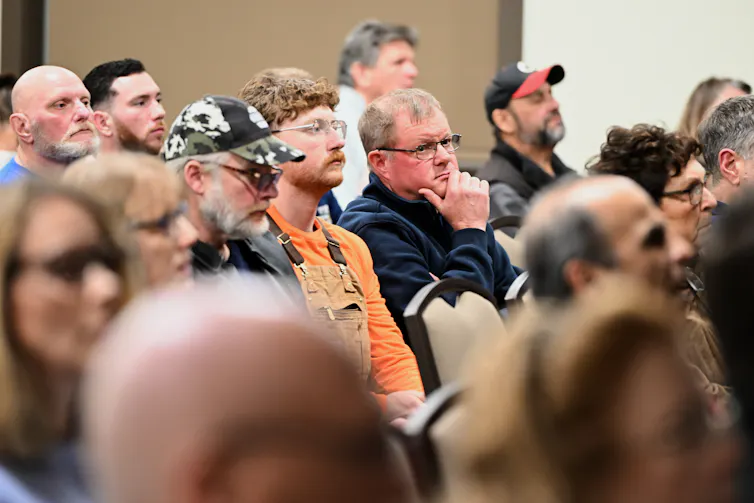
  •  

James Comey’s Instagram seashell post sits in a murky legal zone between protected political speech and criminal threat

Did James Comey, former FBI director, 'knowingly and willfully' threaten, kidnap or 'inflict bodily injury upon the President of the United States'? Samuel Corum/Anadolu Agency/Getty Images

In the case of United States v. James Brien Comey Jr., the U.S. president’s security is pitted against the bedrock right to free speech enjoyed by Americans.

Two federal charges have been lodged against former FBI Director James Comey and are based on his Instagram post that depicted seashells spelling out “86 47.”

Comey’s post was interpreted by the U.S. Department of Justice as a threat to harm President Donald Trump. The indictment, obtained by the DOJ, alleges Comey violated two federal laws: 18 U.S.C. § 871, which makes it a crime to “knowingly and willfully” threaten, kidnap or “inflict bodily injury upon the President of the United States,” and 18 U.S.C. § 875, which criminalizes “communication containing any threat to kidnap any person or any threat to injure the person of another.”

Comey’s argument against the charges is likely to be twofold: (1) He lacked the requisite intent that the prosecutor needs to prove his case, and (2) even if he had the intent required by the statute, his speech is protected by the First Amendment. U.S. District Judge Louise Flanagan set Oct. 21 as the Comey case trial date.

I’m a scholar of constitutional and criminal law as well as the First Amendment. The charges against Comey exist in a legal gray area that includes the First Amendment and a series of court decisions over five decades that have gone back and forth over what dangers constitute speech that can be punished.

Three men standing in front of a curtain, flags and some official seals while one speaks at a lectern.
Ellis Boyle, U.S. attorney for the Eastern District of North Carolina, is flanked by acting Attorney General Todd Blanche, left, and FBI Director Kash Patel at a press conference on April 28, 2026, concerning charges against James Comey. Tasos Katopodis/Getty Images

Parsing the charges

In criminal law, there are generally two parts to most crimes – the criminal act and the criminal intent. The criminal act is referred to as the “actus reus.” The criminal intent is known as the “mens rea.”

Some crimes also require a particular result. For instance, murder requires a death of a person. A defendant can neither be charged with nor convicted of murder unless and until the victim dies. If the victim doesn’t die, then at most the defendant can be convicted of only attempted murder.

The criminal charges alleged in Comey’s case don’t require a result, however. The president need not be kidnapped or injured for someone to be charged with violating either of them.

But the prosecutor must still prove the criminal intent and the criminal act for both charges to stick in Comey’s case. In my view, the Justice Department will have a difficult time proving the mens rea against him.

Comey has consistently maintained that he didn’t know “86 47” implied violence against the president.

Meaning and purpose

Comey has stated he came across the shells that spelled out “86 47” while walking on a beach in North Carolina, took a picture and posted it on Instagram.

The term “86” is commonly used to mean “to throw out” or “to get rid of” in American slang. According to Merriam-Webster, the term “comes from 1930s soda-counter slang meaning that an item was sold out.”

Comey later removed the image from Instagram and posted a statement that read, “I posted earlier a picture of some shells I saw today on a beach walk, which I assumed were a political message. I didn’t realize some folks associate those numbers with violence. It never occurred to me but I oppose violence of any kind so I took the post down.”

Even though Comey has insisted that he thought it was a silly picture of shells arranged in a clever way to express a political viewpoint, the Trump administration argues that Comey not only knew the meaning of “86 47” but that he purposefully threatened the president.

What’s plausible?

The first crime charged in the indictment, 18 U.S.C. §871, requires the defendant to have “knowingly and willfully” threatened to kidnap or inflict bodily injury upon the president. This is the statute’s mens rea; the defendant must have known that he was threatening the president of the United States.

Comey’s statements suggest that he didn’t know the threatening nature of his Instagram post. Thus, he cannot be convicted of “knowingly” threatening the president if he didn’t know its meaning.

To convict Comey, the prosecutor must prove that he did, in fact, know the meaning of “86 47” when he posted it.

Comey’s career as a federal prosecutor and his tenure as the FBI director may work against him here. In my view, it’s more than plausible that Comey encountered the threatening version of the term “86” in his career. It’s also more than plausible that the term appears in documents, records and court filings that Comey has drafted and signed over his career, all of which could be used against him at trial.

But even if the Justice Department can prove Comey did, in fact, know the threatening nature of “86 47,” its case against him is not a slam dunk.

And that’s because of the First Amendment.

Testing what’s protected speech

A balding man stands in front of a soldier who is wearing a helmet.
A draft protester was convicted after declaring in 1966, ‘If they ever make me carry a rifle, the first man I want to get in my sights is L.B.J.’ His conviction was overturned by the Supreme Court. Yoichi Okamoto/PhotoQuest/Getty Images

As a constitutional law scholar, I’d expect Comey to argue that his Instagram post was protected speech.

Even though the laws charged in Comey’s case are generally valid and constitutional, criminal defendants can always argue that otherwise valid and constitutional laws are unconstitutional as applied to them and their particular case. Comey is likely to argue this in his defense, but it won’t be as straightforward as one might think.

The First Amendment is not absolute – not all speech and expression is protected by the Constitution.

In Chaplinsky v. New Hampshire from 1942, Justice Frank Murphy wrote that it’s “well understood that the right to free speech is not absolute at all times and under all circumstances.”

In 1969, the U.S. Supreme Court held in Watts v. United States that while “true threats” are not protected by the First Amendment, political hyperbole remains protected speech. The Supreme Court defines true threats as statements where the speaker means to communicate a serious expression of intent to commit an act of unlawful violence against a particular individual or group of individuals, but the speaker need not actually intend to carry out the threat.

Watts v. United States involved a threat against the sitting president of the United States, Lyndon B. Johnson. In that case, Robert Watts expressed his strong opposition to the military draft at a public rally, saying, “If they ever make me carry a rifle, the first man I want to get in my sights is L.B.J.” He was subsequently charged and convicted under the same statute, 18 U.S.C. § 871, used in Comey’s case.

The Supreme Court reversed the conviction, ultimately agreeing with Watts, who had maintained that his statement was “a kind of very crude offensive method of stating a political opposition to the President.”

As the court explained, quoting an earlier decision on press freedom, “For we must interpret the language Congress chose ‘against the background of a profound national commitment to the principle that debate on public issues should be uninhibited, robust, and wideopen, and that it may well include vehement, caustic, and sometimes unpleasantly sharp attacks on government and public officials.’”

Since Watts, countless defendants have faced similar charges for threatening the president. Many have been convicted.

In the 1970s, Eugene Hart was convicted of threatening the president after his brother reported Hart’s plan to assassinate President Richard Nixon. An appellate court affirmed his conviction, concluding that Hart’s verbal threat coupled with his detailed assassination plan couldn’t have been “uttered in jest or in the nature of a hyperbole.”

In the 1980s, David Hoffman was convicted of threatening President Ronald Reagan when he mailed a letter to the White House stating, “Ronnie, Listen Chump! Resign or You’ll Get Your Brains Blown Out.” And in 1999, Donald Adams was convicted of threatening the president when he approached the White House gates telling Secret Service officers, “I want to kill the president.”

But in those cases and others, the defendants took concrete steps that demonstrated their sincerity and conscious awareness of the threatening nature of their speech. In my estimation, both are absent in Comey’s case.

The Conversation

Wayne Unger does not work for, consult, own shares in or receive funding from any company or organization that would benefit from this article, and has disclosed no relevant affiliations beyond their academic appointment.

  •  

Education Department is investigating whether Smith College’s admissions violate Title IX – but this law doesn’t actually apply to the case

Smith College is one of the 30 all-women's colleges in the U.S. Jonathan Wiggs/The Boston Globe via Getty Images

Since 2015, Smith College, one of the largest and most prestigious women’s liberal arts colleges in the United States, has allowed any student who identifies as female to apply to and attend the school.

Over the past decade or so, most other women’s colleges in the U.S. have taken similar steps, permitting transgender female students to apply.

The Trump administration is trying to end that practice. The Department of Education announced on May 4, 2026, that it had opened a Title IX investigation into Smith for admitting transgender students.

“Allowing biological males into spaces designed for women raises serious concerns about privacy, fairness, and compliance under federal law,” Kimberly Richey, the assistant secretary for civil rights at the Department of Education, explained in a statement.

The Education Department’s announcement signals a new front for the Trump administration. Until now, the administration’s battles over transgender students have largely focused on restricting their participation in team sports and preventing them from using bathrooms based on their gender identity.

As a legal scholar who has written extensively on gender identity nondiscrimination laws, I find it notable that the administration invokes Title IX of the Civil Rights Act, a 1972 law that prohibits sex discrimination in any educational program that receives federal funding.

What is striking is that this law does not, under any circumstance, apply to Smith’s admissions decisions. Title IX’s language is clear that law does not cover the admissions decisions that private colleges and universities make.

At the same time, the investigation adds to the mounting pressure colleges and universities have faced since President Donald Trump returned to office in 2025. So, even if the investigation ultimately does not result in a lawsuit or court case, the probe still has high stakes for schools around the country.

A few young women stand together in front of a red brick building on a green lawn.
Smith College, in Northampton, Mass., began allowing all students who identify as female to apply starting in 2015. Jonathan Wiggs/The Boston Globe via Getty Images

What Title IX says – and leaves out

Title IX protects against sex-based discrimination in any educational program or activity that receives federal financial assistance.

The law’s scope is broad: It guarantees equal opportunity in all aspects of education. That includes academics, athletics, events, extracurricular activities and financial aid. The law also requires schools to address sexual violence, sexual harassment and stalking. These safeguards extend beyond students, protecting faculty and staff at schools.
Since the law applies to all educational settings that receive federal financial assistance, it reaches nearly all public and private schools, from elementary schools through universities.

But Title IX still has limits. For example, it allows single-sex schools, like Smith, to exist.

Smith is one of 30 women’s colleges in the U.S. There are also four men’s colleges in the country.

Additionally – and crucially for the Education Department’s investigation – Title IX is clear that it does not apply to the admissions decisions that private undergraduate institutions make.

Title IX states that the law applies to the admissions decisions of “only institutions of vocational education, professional education, and graduate higher education, and to public institutions of undergraduate higher education.”

Private undergraduate colleges, like Smith, are not on the list.

The Trump administration’s use of Title IX

There is no legal basis for the Education Department’s decision to investigate Smith “for admitting biological men.” Nevertheless, the investigation could still spell trouble for the college – and other colleges and universities.

The second Trump administration has repeatedly targeted schools with transgender-inclusive policies.

In March 2025, the White House froze US$175 million in federal funding to the University of Pennsylvania because the school allowed transgender women to compete in female team sports.

It released the funding after Penn reversed its policy on transgender athletes.

In early 2026, the Education Department also announced Title IX investigations into 18 universities and colleges because they allowed transgender students to participate in women’s team sports.

The Education Department has additionally launched Title IX investigations into K-12 schools based on their bathroom policies. In August 2025, for example, it determined that Denver Public Schools were in violation of Title IX for allowing transgender students to use the restrooms that align with their gender identity.

Title IX battles

The Education Department appears to be basing its investigation into Smith on the fact that Title IX permits educational institutions to maintain some sex-segregated spaces. These include sports teams and bathrooms. But how transgender students fit within the statute’s framework is an open question.

In 2024, the Education Department under the Biden administration determined that Title IX protects the rights of transgender students to live according to their gender identity. It produced regulations requiring schools to comply with this interpretation of the law.

This followed a 2019 Supreme Court ruling, Bostock v. Clayton County. In that case, the court determined that Title VII of the Civil Rights Act, another law that prohibits sex-based discrimination in workplaces, protected against gender identity discrimination.

In January 2025, however, a federal district court in Kentucky ruled that the Biden administration’s regulations were invalid. Since then, the Trump administration has taken the position that sex is assigned at birth and unchangeable.

Because of this back-and-forth, Title IX’s protections for transgender students have depended on who is in the White House.

A large government building says U.S. Department of Education, with the r from department misisng.
Smith College is the latest school that the Education Department under the Trump administration has challenged over policies for transgender students. Allison Robbert/Associated Press

The investigation’s broader implications

Title IX does not reach Smith’s admissions decisions, based on the plain language of the law. However, the law does affect the school’s other policies, such as restroom access. As a result, the investigation will likely embroil the college in a lengthy legal battle.

Smith has not commented on the government investigation, other than to say the school is “fully committed to its institutional values, including compliance with civil rights laws.”

As the Education Department’s process unfolds, Smith will face a crucial choice. It could accede to the Trump administration’s demands. Alternatively, it could fight for transgender student rights. In the process, it could set precedent on what Title IX requires, thereby protecting transgender people around the country.

The decision will not be easy. Smith receives limited federal grants, but battling the Education Department requires expending time, attention and money to a lawsuit rather than devoting those resources to student education.

At a time when higher education is feeling the strain of the Trump administration in the form of funding freezes, student loan limitations and civil rights investigations, it is difficult for colleges and universities to resist federal demands.

Smith is better positioned than most, given its prestigious rank, extensive alumni network and sizable endowment.

How the college responds could be a test of higher education’s wherewithal to withstand a hostile executive branch. Where Smith goes, others will likely follow.

The Conversation

Marie-Amelie George does not work for, consult, own shares in or receive funding from any company or organization that would benefit from this article, and has disclosed no relevant affiliations beyond their academic appointment.

  •  
❌