❌

Reading view

The Reason Your Marketing Feels Broken (And Why More Tactics Won’t Fix It)

The Reason Your Marketing Feels Broken (And Why More Tactics Won’t Fix It) written by John Jantsch read more at Duct Tape Marketing

I’ve given this diagnosis so many times it has a name: Random Acts of Marketing.SEO aimed at one audience. Paid ads targeting another. The website describes the business differently than the founder does in a sales call. The content sounds like it came from a different company than the pitch deck. Everything is technically running. Nothing is working together.

This is the most common condition in small business marketing. And it’s almost never caused by lack of effort or thin budgets. It’s caused by the absence of a strategic foundation the tactics can actually build on.

What founders mistake for strategy

Most founders with a tactics problem think they have a strategy. They almost never do.

What they have is a list of tactics they’re running, opinions about each one, and a history of what did and didn’t work. That’s not a strategy. A strategy is a coherent answer to three questions:

Who exactly are we for? What do we do that the alternatives don’t? What’s the one sentence that ties those two things together?

Without those answers, the tactics underneath can’t compound. They just take turns failing.

Strategy First: the three pieces

The strategic foundation has three parts. All three have to exist. Any one of them alone isn’t enough.

The ideal client

A persona isn’t an ideal client. A demographic isn’t an ideal client. β€œSmall business owners between 35 and 55 who value quality” is a description, not a strategy.

An ideal client is a specific type of customer, in a specific situation, whose problem you’re uniquely positioned to solve better than the real alternatives they’re actually considering.

Here’s what specificity looks like in practice: a home services company whose ideal client is β€œowners of 20-plus-year-old homes in zip codes where houses sell for over $800,000, who’ve lived there more than 3 years and are thinking about aging in place.” That’s a strategy. Every downstream decision, where they advertise, what their photos show, how they price, what they stop offering, can align to that specific person.

The riches are in the niches. That was true when I wrote the original Duct Tape Marketing. It’s more true now. In a market where AI makes it trivially easy to produce generic content for generic audiences, the only marketing that gets through is the marketing clearly made for someone specific.

Differentiation

Two mistakes come up constantly. Claiming differentiation that isn’t actually different (quality, service, experience: every business claims these). And describing differentiation against the wrong competitor.

Your customer is rarely choosing between you and the obvious direct competitor. They’re choosing between you and doing nothing, a different category of solution, or doing it themselves. Your differentiation has to land against that actual set of alternatives.

Differentiation is also a commitment. If you claim to be the firm that does the deepest strategic work before any execution, you can’t also take an emergency project on Monday and deliver by Friday. The claim requires you to turn down certain work. That’s the real test: does your differentiation require you to say no to something?

The core message

One sentence. In the customer’s language. Describes who you’re for and why they’re in the right place.

It has to pass 3 tests. Clear (a smart 12-year-old should understand who you serve and what you do). Different (it can’t be lifted and pasted onto a competitor’s site without anyone noticing). Credible (the customer believes it).

Clever is a tagline. The core message is clear. They can be the same thing. They usually aren’t.

The Marketing Hourglass

Strategy First also gives you the diagnostic lens you’ll use for everything that comes next: the Marketing Hourglass.

Most people were taught to think about the customer journey as a funnel. Leads in the top, customers out the bottom. It’s useful for a narrow slice of the work and dangerously incomplete for the whole picture.

Real growth for small businesses happens inside an hourglass, because the most valuable customer activity happens after the sale. The 7 stages: Know, Like, Trust, Try, Buy, Repeat, Refer. The hourglass widens again after Buy. That’s the part most small businesses ignore, and it’s where the highest-value growth actually lives.

The diagnostic is simple: find the stage where things are leaking and fix it before you build anything new on top.

One thing to do this week

Write your core message. One sentence. Customer’s language. Run it through the 3 tests: clear, different, credible.

If it can’t pass all three, that’s the strategy work. Everything else waits until it does.


This is step two of a seven-step system I’ve been refining for over 20 years. The full framework is in my new ebook, β€œ7 Steps to Small Business Marketing Success.” Get it at dtm.world/7steps.

  •  

Why Producing More Content Is Making Some Businesses Invisible

Why Producing More Content Is Making Some Businesses Invisible written by John Jantsch read more at Duct Tape Marketing

An accounting firm at about $2.5 million in revenue came to me after publishing a monthly blog post for 3 years. Mostly tax updates and compliance news. Traffic was flat. Inbound inquiries were rare. They were thinking about hiring an agency to triple their output.

The right move was the opposite: publish less, go deeper, commit to 3 content pillars.

I see this pattern constantly. Founders who aren’t getting results from content assume the problem is volume. So they add more posts, more channels, more tools. And they get the same results, faster.

Producing more generic content doesn’t fix a content problem. It amplifies it.

The actual problem

Most small business content doesn’t have a job. It’s a series of posts with no spine underneath. Topics that seemed interesting that week. Updates that felt like they should be covered. Technically useful stuff that adds up to nothing.

In a market where AI is generating generic content at industrial scale, being part of the noise layer is bad for your brand. The customers worth winning have started to recognize it and tune out.

Content that actually works does one thing: it earns trust before the customer has to talk to you. It signals that you understand their situation, you’ve thought about it seriously, and you have something specific to say.

Pillars, not posts

Pick 3 content pillars anchored to your ideal client’s real problems. Every piece of content you publish goes to one of them.

I know how this sounds. Organization. A content calendar thing. It’s actually the hardest strategic decision most founders avoid making.

Most businesses publish what the founder was thinking about that week. After a few years you have a body of work with no accumulated weight. A prospect can’t tell what you’re actually expert in.

Three pillars held over 2 or 3 years produces a different result. The body of work has shape. The depth on each pillar becomes visible, and that visibility is what earns trust.

Three is the right number. Two is too narrow. Four dilutes. Three works.

Each pillar has to pass 3 tests: anchored to a real customer problem, an area where you have genuine depth, and one you can publish against for 3 years without getting bored. If it won’t survive that last test, it’s a topic, not a pillar.

Hubs, not archives

Content organized under hub pages compounds over time. Content organized as a reverse-chronological blog buries your best work within weeks.

The reverse-chronological blog is an artifact from when blogs were journals. It made sense then. When content is meant to be a long-term asset serving both readers and AI retrieval systems, it doesn’t.

Under hub pages, your best work stays discoverable and accumulates authority. When you publish something new, link it to the appropriate hub and update the hub to reference it. Over time the hub becomes a genuine knowledge center. The blog archive becomes a graveyard.

Repurposing, not more production

The founders who win on content get maximum leverage out of each substantial piece. Volume isn’t the advantage.

The model: one substantial piece per week or two, repurposed into 8 to 10 smaller assets. A podcast episode becomes a hub page article, a few LinkedIn posts, one email to the list, a short video. A long article becomes an email series, a handful of social posts, eventually a book chapter.

This is where AI actually earns its keep. Taking original thinking and adapting it across formats is something AI does well. Producing original thinking from scratch isn’t. Keep the thinking yours. Use AI for the reformatting.

The point of view problem

The market is full of AI-produced content that reads like AI-produced content. Generic, balanced, readable, forgettable.

The content that still earns attention, gets remembered, and gets shared has a point of view. It takes a position. It says something the customer hasn’t heard, or says something familiar in a way that makes it land differently.

AI can’t produce a real point of view because it’s averaging the existing corpus. Your specific perspective isn’t in there.

Use AI to produce. The thinking is still your job.

Content without a point of view was dismissible in 2020. It’s invisible in 2026.

One thing to do this week

Name your 3 content pillars on one page. If you can’t narrow to 3, the narrowing is the work. Three is not a formatting choice. It’s the strategic constraint that forces real decisions.


Content strategy is step 4 of a seven-step system I’ve been refining for over 20 years. The full framework is in my new ebook, β€œ7 Steps to Small Business Marketing Success.” Get it at dtm.world/7steps.

  •  

The Role of AI in Modern Copywriting

The Role of AI in Modern Copywriting written by John Jantsch read more at Duct Tape Marketing

Catch the Full Episode:

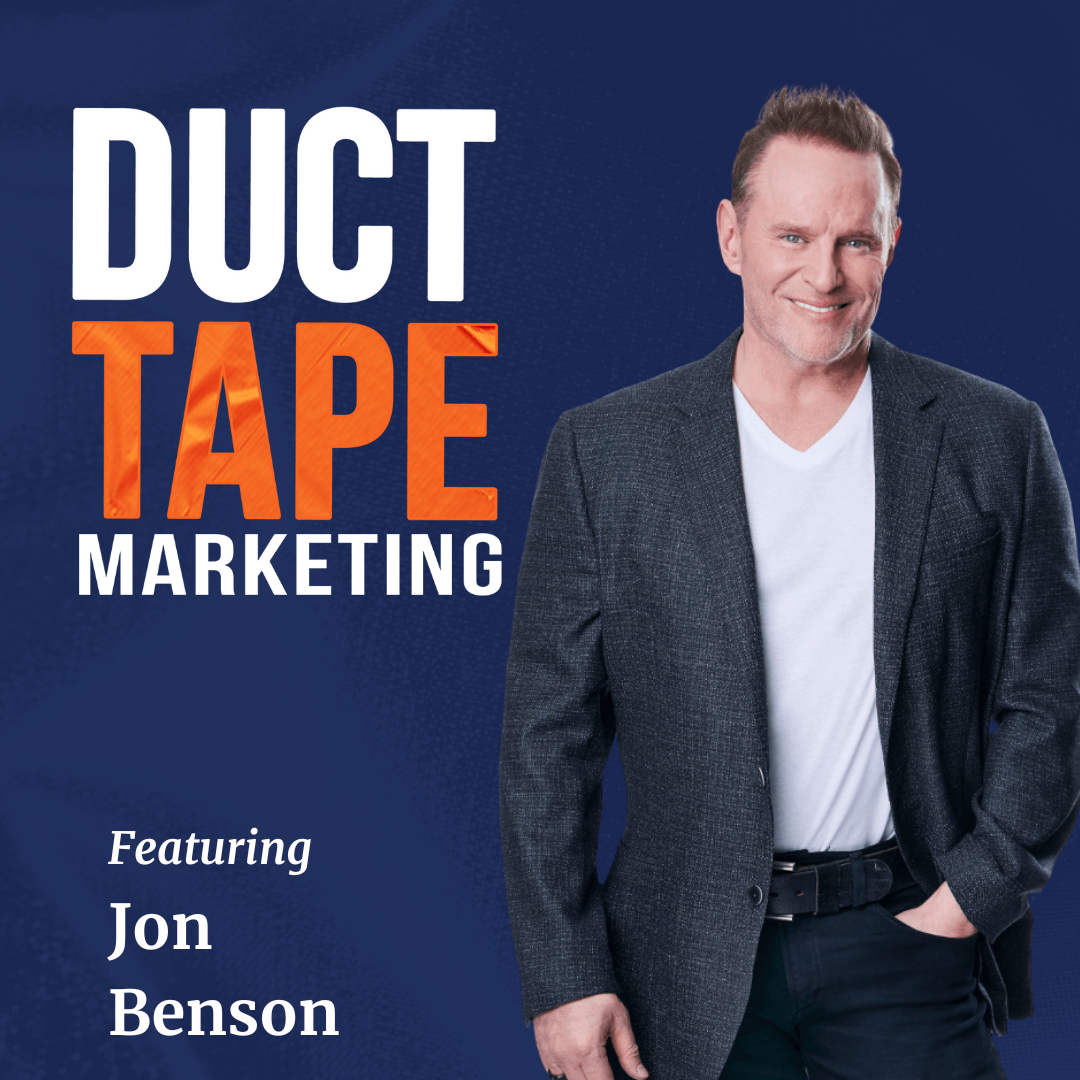
jon bensonOverview

In this episode of the Duct Tape Marketing Podcast, John Jantsch sits down with Jon Benson, creator of the Video Sales Letter (VSL) and founder of the AI platform Benson. Jon shares how AI is reshaping the world of copywriting, not by replacing human creativity, but by amplifying it.

The conversation explores the evolution of VSLs, why they continue to outperform despite industry skepticism, and how AI is changing the way marketers create, test, and optimize content at scale. Jon also dives into the importance of maintaining a human voice, building ethical persuasion frameworks, and avoiding the trap of generic AI-generated content.

Guest Bio

Jon Benson is a copywriter, entrepreneur, and AI innovator best known for creating the Video Sales Letter (VSL), a format that revolutionized digital marketing. With a background in persuasion and behavioral psychology, Jon has spent decades refining ethical copywriting techniques. He is the founder of Benson, an AI platform trained on high-converting campaigns designed to help businesses create more effective, human-centered marketing.

Key Takeaways

1. AI Should Amplify Creativity, Not Replace It

The real opportunity with AI is turning marketers into better editors, strategists, and decision-makers, not eliminating the human role.

2. VSLs Still Work After 20 Years

Despite claims that they’re outdated, VSLs continue to drive strong results when built on solid messaging and persuasive structure.

3. Words Matter More Than Format

Whether it’s video, text, or ads, the effectiveness of marketing still comes down to the quality of the words and messaging.

4. Most AI Content Fails Due to Lack of Input

Generic prompts produce generic results. AI needs context, personality, and values to generate effective copy.

5. Personality and Values Drive Connection

Great marketing aligns with what customers already believe and value, rather than trying to force persuasion.

6. AI Enables Massive Scale in Testing

Top marketers run hundreds of variations simultaneously, something only possible at scale with AI.

7. Ethical Persuasion Requires Guardrails

Without clear boundaries, AI can drift into manipulative messaging. Defining what to say and what not to say is critical.

8. AI Is a Power Tool, Not a Replacement

Like upgrading from a hammer to a power tool, AI removes manual effort so humans can focus on higher-level creativity.

9. Training AI Is Essential

To get quality output, users must teach AI their voice, values, and audience rather than relying on default behavior.

10. Copywriting Still Requires Strategy

Even with AI, understanding persuasion fundamentals and customer psychology remains essential.

Great Moments

00:01 – AI as a Creative Multiplier
John introduces the idea that AI enhances, not replaces, human creativity.

01:16 – The Birth of the VSL
Jon shares how Video Sales Letters transformed his career and the marketing landscape.

04:08 – Early Adoption of AI in Copywriting
Jon explains his long-term vision for AI-powered copy tools.

06:21 – Are VSLs Overused?
Why VSLs continue to perform despite years of skepticism.

08:46 – Why Words Still Win
The importance of messaging over format in marketing success.

09:11 – The Problem with Generic AI Content
Why most AI-generated content feels robotic and ineffective.

11:40 – The Role of Personality in Copy
How values and voice shape better marketing outcomes.

14:26 – AI as a Creative Partner
Using AI to enhance, not replace, human creativity.

16:37 – The Power of Testing at Scale
How AI enables massive experimentation and optimization.

18:23 – Ethical Guardrails in AI Marketing
Why defining boundaries is essential for responsible persuasion.

Memorable Quotes

β€œThe words are the consistent thing. If the words don’t reflect a human, people sense it immediately.”

β€œAI isn’t the answer, it’s a tool. You still need to bring strategy and voice to it.”

β€œYou’re not trying to convince people, you’re aligning with what they already value.”

β€œThink of AI as a power tool, it removes the grunt work so you can focus on creativity.”

Duct Tape Transcript

John Jantsch (00:01.651)

So what if the real opportunity with AI is not replacing human creativity but expanding it by turning entrepreneurs into better editors, directors, and decision makers? Hello and welcome to another episode of the Duck Tape Marketing Podcast. This is John Jantsch. My guest today is Jon Benson. He's a copywriter, entrepreneur, and AI pioneer best known for creating the video sales letter, one of those terms that people just use like it's been around forever.

A format that shapes modern digital marketing. is long centered on ethical persuasion and authentic connection. And more recently, he developed BNSN, an AI platform trained on high converting campaigns for small businesses. So John, welcome to the show.

Jon Benson (00:29.9)

Yeah.

Jon Benson (00:47.212)

Hey, John. Thanks for having me.

John Jantsch (00:49.585)

So let's, I assume you have to do this a little bit of your time when you go on shows like this, but the term VSL, you know, is kind of entered the, the marketing vernacular. Talk to me a little bit about, I've been doing this for 30 years. That was probably 12, 15 years ago, really, when that kind of burst on the scene as an innovation. You want to talk a little bit about what that's done to your trajectory, I suppose.

Jon Benson (00:55.202)

Mm-hmm. Yeah. yeah.

Jon Benson (01:02.04)

Mm-hmm.

Jon Benson (01:16.216)

Yeah, believe it or not, it's 20 years old this year. So 2006. Yeah. Yeah. Crazy. It's, mean, it was, it, yeah, everything changed that the, day that happened, the 30 days later, everything changed from my offer that I did it for, you know, we went from like struggling onto my second book that I wrote in, in fitness and then went to a million dollars.

John Jantsch (01:18.537)

20 years, okay.

Jon Benson (01:39.886)

a week and a month rather in traffic cost, you people buying that kind of money and going up to even higher than that. So it was crazy. And then, and then all of people started calling me and asking me to write VSLs for them. And I'm not, I wasn't a copywriter. that's not, never been my claim to fame until after this happened. And then I had to get good at writing copy. So that's what happened.

John Jantsch (02:01.939)

That's funny. So you said you had written a book about gym ownership? Is that what you said?

Jon Benson (02:10.663)

I've written six books in fitness, so weight loss, fitness, bodybuilding, yeah, so that whole thing has been a passion.

John Jantsch (02:12.947)

Fitness, fitness, okay. Okay, so are you one of those people that that was your passion and you just had to learn how to do marketing? And so this whole idea of studying persuasion and conversion and innovation, is that something that was really just picked up because you're like, I better get good at that?

Jon Benson (02:24.748)

Yeah.

Jon Benson (02:34.478)

It was picked up specifically for copywriting, yes, but I studied persuasion in college. Actually, I was studying MLP in college. I was fascinated by how you can basically get people to listen to you and hear what you're actually trying to communicate and motivate them to make changes based on things that you believe at least are good for them. So you're not trying to manipulate them. You're just trying to motivate them. And I was always into like, how can I motivate and connect with people deeper? So I studied the MLP back then, way back then.

John Jantsch (02:39.731)

Mm.

Jon Benson (03:03.22)

and mail order course from, from Bandler. And that got me into Tony Robbins and that led me into even deeper persuasion issues. And, and just was always really fascinated by it. And that led to me being into the advertising world. And that would, that led eventually to writing a book with it. Yeah. I actually would have the book thing came about because I'd always been passionate about, bodybuilding and fitness and things like that growing up and athlete. I was an athlete most of my life. And then

ended up sedentary and got ended up obese in my late 20s and early 30s. I had 50 inch waist and had a heart attack at 38. So I was like, it was like a train wreck of health. And that got me back into it. So that's the Fit Over 40 book was written based on that, on turning that around. And then I interviewed a bunch of other people because I didn't think I was enough for a book. So I did 52 people that did the same.

John Jantsch (03:55.283)

So I'm curious, this is a question, unfortunately, I feel like I'm asking almost every guest these days, but how has AI changed that element of copywriting for good or bad?

Jon Benson (04:00.942)

It's

Jon Benson (04:08.494)

So my goal with AI and copywriting, I've been doing copywriting software since 2010. So this is going to date me a lot, but in AI, in early nascent AI in 2017 and working with early LLMs in 2019. So very, very, very early into this thing and trying to convince everybody, this was the thing that we wanted to do. And the reason why is because I was, I had these courses that I would teach people how to write VSOs and I knew how hard it was for me to learn all the copywriting in and outs and

and develop my own style, which I did. And I said, well, what, what if I could have software that would do it for them? And the average business owner doesn't have time to do that. They just want the copy that converts. So I've seen it from 15 years away going, I know this is going to happen eventually. And so we decided that the software is pronounced Benson. That's not my last name. It's just my last name without the vowels. And, and yeah, yeah, but it's, cool that you can spell it out. That's all right. and so we did Benson originally, it was going to be called,

John Jantsch (04:56.529)

okay. Not BNSM like I butchered it, okay?

Jon Benson (05:06.35)

It was going to, because it was the first AI to actually write a long form VSL. And I was working with, with Jasper at the time they were called Jarvis, but I was the first guy in the copywriter to train anything on an LLM. And they ended up with a 62nd VSL out of all the training. I think, yeah, I think we can do this in a different way. And we ended up being, you know, having a 7,000 word VSL come out of our AI and it sounded like a real VSL.

John Jantsch (05:14.729)

Sure, yeah.

Jon Benson (05:32.663)

It didn't sound like chat, GBT, it didn't sound like Claude, it sounded like a real VSL. And so that was our claim to fame. And since then we just, of course got, we were very early into the agentic phase. So we've just gotten better and better at that. And so my goal was to replace myself. That's what I wanted to do. I wanted to say, if I can, if I can use this to write a VSL, which I have, sells pages for my own stuff, which I have, then I know that it's going to be good enough to, for prime time. And that was the, that was the goal to do. yeah.

John Jantsch (06:02.549)

So talk to, obviously we've got more to explore in AI, but talk to me a little bit about the VSL itself. mean, it has become very mainstream. I mean, you hear people talk about it, whether they know what it is or not. They talk about it as part of their funnel, you know, today. So is it overdone? I mean, is it over?

Jon Benson (06:06.094)

Mm-hmm.

Jon Benson (06:10.316)

Mm. Yep.

yeah.

Jon Benson (06:21.806)

Yeah, every year I hear that I've heard that for 20 years. So it literally 20 years. So the first year I came out with it and said, Oh, it's already and then Ryan Dias, who's a good friend of mine made the mistake of saying when he came out and promoted his own little mini VSO course and he later gave me credit for which was really nice of him and everything. But he said, Oh, sales letters are dead. You'll never do another sales. And I'm like, dude, I've never said that, you know, I think everything works if you let it and VSO is just happened to keep on working and they just ask, ask Agora.

John Jantsch (06:24.157)

Yeah. Yeah. Yeah.

Jon Benson (06:51.022)

They work. I mean, yeah, they work. They work really well and now people are using BSLs in feed So you've got the meta ads that are basically short BSLs that use the same psychology Just compressed into five two to five minutes. So we've been doing that for 15 years as well So yeah, and then they go to a longer BSL So they they still work just as sales pages work just as webinars can work everything can work It just depends on what you're wanting to sell and how you're and how you approach it But the words are the consistent thing

So if the words aren't there, if the words don't reflect an actual human underneath it, people sense it a mile away, which was our goal with Benson was to create humanized AI. How do we do this? How do we create AI that doesn't sound robotic? It doesn't sound like, you know, chat GPT writing an email, it's asking a rhetorical question. And the very first sentence, you know, this kind of really bad AI copy that we see all the time. How do we do this and actually sound like a real A-list copywriter? And that was, that's been our focus for three and a half years now.

John Jantsch (07:20.456)

Yeah.

John Jantsch (07:48.413)

You know, initially the large innovation was that it was not a talking head on video. It was the words. Is that a key component of it?

Jon Benson (07:56.174)

Mm-hmm.

Jon Benson (08:01.113)

You know, it depends on what you're trying to sell. We have seen split tests with video beating words only, and we've seen words only beat video. It really depends on what it is. And what works today, a year from now, will be something you want to reverse. So for a while there was like my friend Craig who writes for Golden Hippo, and he's done amazingly well building a billion dollar company from, he's an amazing writer. But he was one of the first guys working with Gundry to do a lot of video.

on the front end of a VSL, but talking to him behind the scenes, so to say, we know that it's still like a Google Doc and the words are everything. So he slaves over the words, man, getting the words just right. So all the video in the world is not gonna save you if your words suck. It just isn't gonna happen. So the words are still the most important.

John Jantsch (08:46.077)

Yeah, yeah, yeah.

So one of the knocks on AI, of course, is it's made it very easy for people to create really crappy content. you see it all the time now, right? It's like volumes of really bad content. So why can't people create better content? What's the mistake they're making? Is it simply just a matter of being lazy?

Jon Benson (08:54.831)

Yeah, yeah.

Yeah.

Yeah.

Jon Benson (09:11.983)

No, it's the matter of the LLMs or the in our case, it's the agents not knowing you. And this is where it gets a little bit a little bit hairy for people, because there has to be an element of your personality that's OK to be known. as the same thing would be true if you went and hired me as a copywriter. Like I would ask you if you had an offer and you wanted to whatever your offer would be. I would start asking you lots of questions that you probably don't think is related to your offer.

John Jantsch (09:19.719)

Yeah, yeah,

Jon Benson (09:40.336)

Now I'm not talking about like when asking all these really intensive personal questions, but I want to know what your values are. I want to know where you stand. Who do you want to attract as customers? What are you against? What are you not just what the, what the product does? Cause the product or the offer, whatever it does, I that's, that's not that difficult. Um, what's difficult is to make that story resonate with people that will automatically hear and go, Oh, that sounds like something that I can automatically relate to. And that's what a really good copy. does. We don't try to sell people that are

not interested or just completely need to go from a level one to a level five awareness, that's really not what we wanna do. We wanna target people that are already there, because you got plenty of people like that, but if you write, if you go into a chat or clod or whatever and you say, write me an email or write me an ad or rep me a VSO, and they don't know who you are, they don't have a good feel of your words, feel of your personality, it's gonna write stuff that's schlocky, because it's trained on the internet. So if you just think about this for a moment, and everyone listening to me will get this,

John Jantsch (10:35.294)

Yeah, yeah.

Jon Benson (10:39.043)

It's like, can you imagine training anyone to do anything by telling them, go read the internet and get back to me tomorrow? That's what we've done with LLMs, right? It's like, well, that's going to give you a lot of knowledge, but most of it sucks. mean, so most of what's out there in copy is terrible. So it's learning models have been terrible. So that's why specialty AI is like ours and in our, in our industry, you have to have it to where the people that know what they're doing actually trained individual.

John Jantsch (10:46.665)

Right.

Jon Benson (11:06.487)

in our cases, agents that use not one LLM, but a dozen, you know, can use as many as we need one model rather, but you know, doesn't whatever models are we know are going to be the best ones for the right tasks. So that takes that. And then what we do is a little different. We ask people to go through an assessment to figure out what are their values? Where do they stand? Who are the people they want to attract? And how do they want their their words to appear? So we take care of the persuasion element, but also we see that with the words and phrases that

John Jantsch (11:14.739)

Yeah, yeah.

John Jantsch (11:25.885)

Mm.

Jon Benson (11:35.681)

are closer to who they are as a person. So it starts feeling more human. It's important.

John Jantsch (11:40.457)

Yeah, it's interesting. know as we've worked with clients, you know, a lot of them have a fairly large body of work of them talking about things, explaining their products, being who they are. And that element, you know, allows you to build that voice or that brand. But then there is a technical framework element to it as well, isn't it?

Jon Benson (11:58.348)

yeah, totally. mean, if you go too far outside that framework, you're going to lose a lot of the things that we already know work so well, persuasion wise. So the goal is not to try to convince somebody of something, it's to compel them to take action on what they already hold valuable. So all you're doing is aligning your offer with what they already hold to be valuable. And that's the skill of copywriting. that's something that AI is, I think, obviously I'm biased.

John Jantsch (12:05.639)

Yeah. Yeah.

Jon Benson (12:27.481)

So I'm gonna say we're kind of the exception, but AI in general has gotten a little better at this. I'd like to think we've led some of the way in that, to getting to where there's more of that human element involved.

John Jantsch (12:39.091)

So talk a little bit about that because there's certainly a lot of people, creatives in particular, that have felt like they have this special sauce, this special talent to create that content, to create beauty, to create things. And maybe AI has kind of taken that. I mean, it's eventually going to get good at doing video and graphics and things. So where is the human element, know, remain?

Jon Benson (12:57.314)

Mm-hmm.

Yeah, yeah.

So think of it as like, I look at it as the difference between using a hammer and using a jackhammer or something that's a powered hammer, right? It's a pneumonic hammer or whatever they call those automatic hammers. So you've got an automatic hammer and there's a skill to hitting a nail with a hammer, right? The question is, as a carpenter, is that really what you want to be known for is I strike a nail head perfectly with a hammer every single time.

Or if you could have that done for you instantaneously with something that just tapped it in, what would you do with the time that you have left now? You would probably spend that doing the creative portion of things and like, I can do this, I can build this. And this is what the same thing is true of AI and copywriters. It's like, we're not trying to put people out of business. We're giving them the ultimate power tools. So a lot of the grunt work, a lot of the research, a lot of the structure you don't have to worry about. Then you can go in and finesse it.

and everything sounds so much better when you do that. We want people to do that. there's still a knowledge factor that I think that copywriters need to have. And sure, some people do use tools like Vinson. They just don't think about it. They click a few buttons and they go, because it works. But the copywriters, they want to put their signature on it. And this just gives you the ultimate way of doing that. It's like hiring the best ghostwriter you can think of. So if I hired a copywriter to write something for me and they sent it back and I read it, went, wow, that's just freaking fantastic.

Jon Benson (14:26.768)

then I could find these little bitty things in there that I only know or that I primarily know. And then I'm gonna go, oh, you I'm gonna change this over here. And then I might find a creative thing that he said or she said that I wouldn't have thought of. And that now becomes a campaign. My mind goes, oh, wow, I didn't think about that. I can turn this into a campaign. Well, that's not AI, that's me, right? So if the AI wrote it or a human wrote it, wouldn't matter. And so that's what we do that's a little different because we coach people live once a week so that we can help inspire them to.

Use the words that are coming out and how can we use it to help market their business more effectively.

John Jantsch (15:01.011)

So I think one of the areas that obviously is a breakthrough is in testing. Obviously, any copywriter worth their salt is like, I think this is good, but let's test it, right? And now we can test 200 versions for not much more time than it took us to create that one beautiful one. What do you think that that is going to ultimately do in terms of people's effectiveness?

Jon Benson (15:07.088)

Mm-hmm.

Jon Benson (15:15.087)

Right.

Jon Benson (15:26.992)

If people knew what the guys that are making hundreds of millions of dollars at this stuff do, if you knew the amount of testing that went into it, most people would just give up. would stop. I'll give you an example. I have a good friend of mine that is the top of their industry on meta and they flew out to meet the actual real meta heads of ads because there's the ones that they give people and there were ones that give these people.

You know, they give them $100,000 to spend just to play with just because we want to see what your new creative team can do. They will run 800 ads at a time in any given month. They're running 800 versions of an ad. So there's just no way to do that effectively without AI. that's when they were the early adopters to this. Now they can run those kinds of things. And it's like, they can figure out what works and guess what? One or two might scale or three. It's, it's, doesn't matter how good the writers are.

It's like some hook, some angle may work and that angle if it works can just skyrocket a business. So I think it's one of the best things about AI is the ability to split test leads of a sales letter or VSL, the split test, obviously campaigns and then add campaigns and things like that. It's very helpful.

John Jantsch (16:37.907)

So you've spent a lot of time building a reputation about ethical persuasion, but it's not a very far leap to go to things that are maybe not that ethical, right? To go from just what you talked about as getting people to do something that they want to do or that's good for them and they just, they need to hear it, to manipulation. So, and I feel like

Jon Benson (16:43.12)

Mm-hmm.

Jon Benson (16:55.346)

yeah.

Jon Benson (17:01.796)

Right.

Right.

John Jantsch (17:07.503)

AI doesn't really care in some cases. how do you, what are the guard rails that you really use to kind of stay within what, you you talked about beliefs, your beliefs.

Jon Benson (17:10.072)

Mm-mm. Mm-hmm.

Jon Benson (17:20.24)

Yeah, well the guardrails I use that we actually that's a technical term and we use specific guardrails in our agents that are that when somebody sets up Benson correctly, we use it's called a buyer alignment profile that we have people go through. In fact, I'm going to give it to your listeners for free that could go through that and get their buyer alignment, which is a 15 page report of the words and phrases you should use and not use. And that exactly fits that bill of that sets up guardrails. It's like use this because I value X, Y and Z. What do the words of I

value X, Y, and Z translate to in copywriting lingo? Because it doesn't mean like if I value freedom, you don't want to use like, hey, since you love freedom as much as I do, then you're going to love so and so shoes. That doesn't make any sense, right? And so it's just too hamfisted and heavy handed and all that stuff. So what phrases do people that love freedom as a core value? What usage would they use and what would they never say? And it's what they would never say that the Garbrills of that. So in other words, that prevents the

John Jantsch (17:58.441)

All right.

Jon Benson (18:16.913)

AI from going over the balcony, so to say, when it comes down to overly persuasive language.

John Jantsch (18:23.251)

So for some of the folks that you've worked with, you've probably started to catalog kind some of the biggest mistakes people are doing, making right now using AI. Where do you see people really need to make a shift to make AI more effective for them?

Jon Benson (18:40.579)

it's it to stop thinking of AI as the answer and start thinking of it as a tool is a huge step in the right direction. Also to train whatever AI you're using. Ours is built to be trained, so it's copy paste kind of thing. But if you're going to use Claude or chat GPT or whatever, you need to be able to train it with who you are, what your values are, how what words or phrases to use, what not to use. And you'll find that the memory on this is pretty short. So.

unless you know what you're doing and then we can get into things like instances of open claw and the clawed code and all that stuff. That's very technical and most people don't want to go down that rabbit hole. mean, our guys go down that rabbit hole because we're kind of geeky when it comes to that. But most people want just the best answers that they can without having to become a software engineer. so to do that, yeah, it's a lot of knowledge. It's a lot of like time to say, here's who I am.

John Jantsch (19:08.713)

Mm.

John Jantsch (19:15.774)

Yeah.

John Jantsch (19:29.822)

me

Jon Benson (19:33.774)

And here's what I want you to do. Now, you can do that to a limited degree in chat and cloud and tools like that. You can do it to a huge degree in our tool because we built it to do that. And that's super important to get the language patterns down. But also, and this is the last thing I'll say, but this is true of copywriting in general. So when people used to hire me, because I don't write copy anymore. I'm solely focused on Benson. when people used to hire me, it was very expensive. I was like.

the probably the most expensive guy in the world for like five or 10 years. And they're certainly one of the most expensive guys in the world. And they would hire me and I would give them a first draft of something like usually a BSL or a sales letter. And they would say, this doesn't sound like me. go, yeah, I know. It's because you suck. Yeah, you don't want to sound like yourself, man. You really don't. it's and it's like, I, I mean, that in kind of a funny way. It's like you're the copy they were writing was just terrible.

And so they were trying to make their terrible copy kind of polish, you know, a poly put, put lipstick on a pig's episode. So you can't do that. You have to like be able to understand some basic persuasion and then work in. And this is what I didn't do when I was a pro when I was writing early days of copywriting work in their values. I figured this out later in my career. It's like, I can work in their value statements and figure out what the words are. But that was just tons of research. We'd charge like 15, 20 grand just to do the research to figure out like

John Jantsch (20:33.415)

Mm-hmm.

Jon Benson (20:58.491)

What are the words we should use and shouldn't use and phrases and all that stuff. And unless somebody came along that was like an identical client, we'd have to do that all the time. Now it's automatic, which is fantastic.

John Jantsch (21:06.473)

Yeah. Yeah. Yeah. Well, John, I appreciate you dropping by the duct tape marketing podcast. Is there someplace you mentioned that you had a gift you wanted to invite people? And obviously I'd love to know where they can find out more about Benson.

Jon Benson (21:15.471)

Yeah. Yeah. Sure. If you go to free buyer profile.com, that's free buyer profile.com. You can take our buyer alignment profile, which will test to figure out your core values, help you figure them out. We use a lot of different standardized testing models in these questions. And in about 10 to 15 minutes, we'll get you a report.

that you can use in your marketing that will tell you words and phrases that you should think about using and words and phrases you should definitely avoid. will give you all the NLP, all the magic sauce while still sounding like you and will also help elucidate what you already hold valuable and the people that

John Jantsch (21:53.481)

Great tool for training any AI tool, suspect, that you're going to use. Awesome. Well, again, I appreciate you dropping by. It's freebuyerprofile.com and hopefully we'll run into you one of these days out there on the road,

Jon Benson (21:57.125)

Yeah, definitely. Yeah.

Hmm.

Mm-hmm.

Thank you, John. I appreciate the time.

Sign up to receive email updates

Enter your name and email address below and I'll send you periodic updates about the podcast.

powered by

  •  

The Money Habit: Why Financial Stress Isn’t About Math

The Money Habit: Why Financial Stress Isn’t About Math written by John Jantsch read more at Duct Tape Marketing

Mike MichalowiczEpisode Overview

In this episode of the Duct Tape Marketing Podcast, John Jantsch sits down with bestselling author Mike Michalowicz to discuss his latest book, The Money Habit: The Worry-Free Way to Financial Independence.

While Mike’s previous work (Profit First) revolutionized how entrepreneurs manage business finances, this conversation shifts focus to personal money managementβ€”and why so many people still feel anxious about money despite earning more.

Mike reveals that financial stress isn’t primarily about income or mathβ€”it’s about behavior, habits, and lack of control. He introduces a system rooted in behavioral psychology that helps individuals take authority over their money without relying on strict discipline or deprivation.

The discussion explores the connection between business and personal finances, the flaws of traditional budgeting, and how simple structural changesβ€”like separating money by purposeβ€”can create clarity, reduce anxiety, and build long-term financial independence.

Guest Bio

Mike Michalowicz is a bestselling author, entrepreneur, and financial systems expert dedicated to helping business owners and individuals gain control over their finances.

He is the author of multiple influential books including Profit First, Clockwork, Fix This Next, and All In. His work has been adopted by over a million businesses worldwide.

Through his latest book, The Money Habit, Mike expands his methodology into personal finance, focusing on behavioral systems that reduce financial stress and create sustainable wealth habits.

Key Takeaways

1. Financial Stress Is Behavioral, Not Mathematical

Most people assume more income will solve financial problems. Mike argues the oppositeβ€”financial stability comes from gaining control over money first, then increasing income.

2. More Money Doesn’t Fix Poor Money Habits

Without systems in place, both businesses and households can β€œleech” from each other, leading to financial instability even when income is high.

3. Discipline Often Backfires

Strict budgeting and deprivation can lead to two outcomes:

  • Rebellion (overspending)
  • Scarcity mindset (hoarding money without enjoying it)

4. Systems Beat Willpower

Instead of changing behavior, Mike advocates for β€œbehavioral intercepts”—systems that guide natural behavior toward better outcomes.

5. Your Bank Account Is Your Most-Used Financial Tool

Rather than relying on apps or spreadsheets, Mike suggests structuring multiple bank accounts to reflect spending categories, making financial awareness automatic.

6. Real-Time Budgeting Creates Immediate Awareness

When money is separated into purpose-driven accounts, every purchase reflects instantly, helping people make better decisions in real time.

7. Start Small to Build Confidence

Begin with one account tied to your biggest financial worry (e.g., rent, groceries, retirement), then expand gradually.

8. Clarity Reduces Financial Anxiety

Financial stress often comes from uncertainty. Clear allocation of money creates confidence and reduces emotional strain.

9. Entrepreneurs Must Manage Both Business and Personal Finances

Success in business doesn’t guarantee personal financial healthβ€”and neglecting one can undermine the other.

10. β€œIf in Doubt, Add an Account”

Creating a dedicated account for a specific concern (like emergency funds or runway) can immediately reduce stress and improve decision-making.

Great Moments (Timestamps)

00:01 – The Real Cause of Financial Anxiety
Mike challenges the idea that money stress is about math, pointing instead to habits and behavior.

01:24 – When Business Success Hurts Personal Finances
How profitable businesses can still fail due to poor personal money management.

02:45 – Generational Money Trauma
Why many people develop unhealthy relationships with money early in life.

03:54 – Financial Worry as a β€œPart-Time Job”
The hidden cost of constantly thinking about money.

04:29 – Why This Book Is Different from Profit First
Key differences between managing business vs. personal finances.

06:46 – Why Discipline and Budgeting Fail
The psychological pitfalls of deprivation-based financial systems.

08:54 – The Power of Habit-Based Systems
How structured systems outperform willpower.

10:32 – Why Traditional Budgeting Doesn’t Work
Introducing the concept of real-time budgeting through bank accounts.

13:27 – Start with One Account
A simple entry point to building the money habit.

16:20 – Systems Make You β€œGood with Money”
Why success isn’t about skillβ€”it’s about structure.

18:54 – β€œIf in Doubt, Add an Account”
A practical mantra for reducing financial uncertainty.

Memorable Quotes

β€œThe solution to financial struggle is not more moneyβ€”it’s authority and control over money.”

β€œI’ve never been good with money. I’ve found systems that are good with money.”

Resources & Links

Duct Tape Transcript

John Jantsch (00:01.39)

So what if the reason smart entrepreneurs still feel anxious about money has less to do with math and more to do with the habits quietly running their lives? Hello and welcome to another episode of the Duct Tape Marketing Podcast. This is John Jantsch. My guest today is Mike Michalowicz. He's a bestselling author, entrepreneur, and long time champion for helping business owners take back control of their time, money, and energy. He's the author of many books, Profit First, Clockwork,

fix this next all in, but today we're gonna talk about his latest, the money habit, the worry-free way to financial independence. So Mike, welcome back to the show.

Mike Michalowicz (00:41.31)

John is amazing. You know, we've known each other, I think, 17 years. We're almost approaching 20 years of knowing each other. Isn't that amazing? Yeah.

John Jantsch (00:47.586)

Wow, dang. I got sneakers older than that though. That's nothing.

Mike Michalowicz (00:53.29)

Those Chuck E. T's that you wear. I love those things.

John Jantsch (00:55.854)

So, all right, you're back with another book about money. The Profit First book is pretty much legendary. mean, you've sold six gazillion and have lots of people practicing that. And you brought that to a lot of entrepreneurs. But why are you going back to the well on a more personal book now to help individuals? And I'm assuming there's a lot of cross-ups.

Mike Michalowicz (01:24.618)

There's a lot crossover and it originally started off with helping the entrepreneur, but there's another larger community that it's now serving and I'm focusing on or paying more attention to. But the entrepreneur, I found John is some folks deployed profit first or in some other ways move their business forward so that the business was highly profitable. But their lifestyle started gobbling away at the business and they weren't managing the numbers at home. And therefore, the home leached off the business.

And I also saw the reverse. I've seen some people prepare for retirement, future, and then they start an entrepreneurial endeavor and it doesn't do well. It struggles and leeches off the home and both collapse. So I had the awareness like, if you're not nailing numbers at both sides, the business and the home front, you're screwed. And then I realized this was the biggest aha. I got a call from a business owner that was doing profit first.

And he said his employees are coming to him asking for raises, seeing if they can get in advance. And he goes, I want to accommodate that. By a certain point, the business will no longer be sustainable. They need help managing their money because most people believe that the solution to financial struggle is more money. And the reality is the solution of financial struggle is authority and control over money. And then more money helps, but you need to assert that control first. And that's why I the book.

John Jantsch (02:45.794)

Yeah, and it's interesting, but I mean, you even in the subtitle, have worry free. mean, so there's stress and behavior issues. people grow up with real, you know, I grew up not wealthy at all, lower middle class. I have nine siblings and so money was always an issue. so I kept, you know, my parents really struggled to spend any money because it was like, we got to buy milk or we're going to do this.

And so I think a lot of people like that kind of grow up almost with a unhealthy relationship with money. I mean, it's like the last thing they want to even talk about.

Mike Michalowicz (03:25.706)

There's no question there's generational financial trauma and we are programmed. There was an article that broke from USA Today. I think it was in August of 2025 that really shocked me awake and it said financial worry has become a part time job. And it went on to explain that for the typical American that we are worrying about some kind of financial consequence for hours a day on average.

John Jantsch (03:29.475)

Yeah.

Mike Michalowicz (03:54.618)

And that's devastating because it eats away at us, not just emotionally, but physically. mostly, yeah, you're distracted at work. So your productivity declines. It becomes to some degree a vicious cycle. So what we have to do is we have to learn to make not make do with what we got. We have to assert control over what we've currently got first. And then we start building from there.

John Jantsch (04:01.09)

Yeah, you don't sleep. mean, yeah, yeah, yeah.

John Jantsch (04:21.654)

Would it be safe to just call the money habit basically profit first for personal finances or am I missing something?

Mike Michalowicz (04:29.49)

I was missing something actually, because originally that's what I wanted to call it. was profit first personal. And then I realized this is a radically different book. So when I started interviewing people, the biggest difference is that the majority of income earners or not entrepreneurs have a predictable income or no income. So you're humming along and maybe get a little raises over time incrementally. And then someone else can turn off the switch and all of a it stops and you start up again.

John Jantsch (04:32.577)

Yeah. Yeah.

Mike Michalowicz (04:55.698)

an entrepreneur's trajectory is much more volatile up and down. You have a banner year and you're walking on water and then you have a devastating period after that. Prop first was designed to work for volatility. The money habit is designed to work with potential predict more predictability, but also understanding that the climb won't be as fast and hopefully the decline won't be as fast either as entrepreneurs expect. So I had to integrate that.

and how to work with different income levels. The average American earns $50,000 a year. So this book is designed to work on the average or serve the average income earner and people can earn more and people can earn less. And why designed is as your income changes, we need to change ratios for what we're addressing. If you own less than the average earner in the US,

You're going to focus more on the essentials of living food shelter. If you are earning more than the average, you may be able to orient more toward future dreams, some aspirational things you have.

But the other thing is a lot of people come in with different mindsets. Some people are recovering from debt. Other people are preparing for future events. Classically was retirement, but now it could be just activating funds like taking the family on a two year sabbatical. That that is like a mini retirement before you officially retire. And there's other goals. So I call these seasons. And so the book speaks to.

John Jantsch (06:14.147)

Yeah.

John Jantsch (06:19.084)

Hmm.

Mike Michalowicz (06:20.744)

tiered income levels, more predictable income levels, but what to do when you lose your income. And it speaks to the season that you are in currently. And that's not in profit first.

John Jantsch (06:32.78)

So there are other mentors books out there, Dave Ramsey comes to mind and it's like, pay off your debt. Don't get a latte, just have discipline. mean, are you essentially saying that but just in a nicer way?

Mike Michalowicz (06:40.958)

Yeah. Yeah.

Mike Michalowicz (06:46.57)

No, I first let me start by saying Dave Ramsey's work has been personally transformative for me. I love it. Yet this is not a translation of that or an expansion of it. It's a different perspective. For most people, discipline becomes a form of one of two things will trigger retaliation. So depravation discipline becomes deprivation. Deprivation becomes retaliation.

It's classic in diets, like don't eat anything with sugar and we don't until it's all you think about, right? And you retaliate. The other scenario, which is far less frequent is the Scrooge mentality. When you go into deprivation, there's a certain point that says that your identity shifts enough you say, I will never spend money. Then why are you earning money? And so there's people who have accumulated a lot of money and it's all about the fear of losing that money. So they live like paupers. So I found deprivation works for very few.

John Jantsch (07:14.584)

Yeah, that's all you can think about.

John Jantsch (07:36.046)

Yeah.

Mike Michalowicz (07:40.712)

So this system is nothing like, in this case, Dave Ramsey system. What it does is it's based upon what I call behavioral intercepts. Commitment devices is the technical term in behavioral psychology. Understand your current natural path of behavior instead of trying to change how you behave, deprivation, these external spreadsheets or apps or whatever. Instead, look at what you're naturally doing and put commitment devices in that pathway that assure that you will get what you want. And the beautiful part is

You don't need to change yourself. Just keep doing what you're doing with a system that directs the outcome that you desire.

John Jantsch (08:16.974)

So in Profit First, to be one of the things that you introduced that, you know, I hate to like go, well, duh. But for a lot of people, you know, everybody goes like, pay yourself first, have, you know, put away for taxes. I mean, everybody gets that, but you created the bucket or envelope system for that, which was basically just what they should be doing, but you kind of enabled it and put it in front of them. And all of a it was like, no, it became a habit. Is that...

Mike Michalowicz (08:28.018)

Yeah. Yeah.

Mike Michalowicz (08:39.39)

Correct.

John Jantsch (08:45.134)

The same thing that you're talking about in a lot of ways that that that it's habits It's not like I'm never gonna spend this it's I'm gonna have a set of habits that are gonna serve my objective

Mike Michalowicz (08:54.984)

Yeah, so I've deployed established systems. In fact, the envelope system goes back to biblical times. It's in actually all the religious, significant religious books and manuals. Tithing is a concept or prepaying and allocating for an intention before you quote benefit from it. And other systems like pay yourself first. That's the same idea is reserving money for an intention first. The envelope system is carving money up.

What I did was I modernized it by realizing the path that most people follow. So it's funny. I just did a presentation to a large group and I surveyed the audience. said, what's the most common money app today? And I heard rocket money because it's advertised so aggressively. heard, it's spreadsheet. I heard why NAB you need a budget, which is a great system.

John Jantsch (09:40.302)

Yeah.

Mike Michalowicz (09:45.226)

I okay, I said, what do you log into most to manage your money? And the response was my bank. said, your bank then is your app. The most used app in the world is our bank account. And for many people in that room, they were logging in daily or multiple times a day to see how much money you have.

John Jantsch (09:55.266)

Yeah.

Mike Michalowicz (10:04.456)

So what I did was I said, okay, there's established systems out there that work, but why aren't we all using them? Because we know they work because they don't, we don't stumble over them. They're not forced down our gullet. So that's I realized this needs to be done at the bank level. And that's why it's there.

John Jantsch (10:19.662)

So you mentioned the word budget in talking about one of the apps, but you, you, you kind of take it to task a little bit, right? I mean, that as, as far as why budgeting failed for the traditional person.

Mike Michalowicz (10:32.947)

Yeah, yeah.

This is the money habit is a real time budget. So when you spend a dollar from an account, so let me just kind of set the stage. We understand we have multiple accounts at our bank and ultimately you can get very specific, but you could have more generic ones like my essentials needs my my lattes out or whatever people like to talk about. And that's the wants. These are the mean luxuries and so forth. But you can be very specific. My wife and I have a mortgage account, for example, and we allocate money to that account every day.

John Jantsch (11:00.578)

Yeah. Yeah.

Mike Michalowicz (11:04.584)

Well, what happens is it's a real time budget. So when I log into my bank account, if the money is there, I know exactly how much is there. Once the money gets transferred over to pay my mortgage or I go out and have that latte or whatever it is, I only use debit cards. I will see that money instantly withdrawn and next time I log in, I know what's truly available. So it's living with you at a real time. I do want to add one little asterisk. I say I only use debit cards. I only use debit cards linked to those accounts.

I do still use credit cards. think credit cards can be a valuable tool when managed right. So I'm not rejecting.

John Jantsch (11:32.44)

Yeah.

John Jantsch (11:39.086)

Yeah, those airline points. mean, I love them. All right. So, talk a little bit about that idea. You hinted at it, but first people don't know the idea of separating money by purpose. know, instead of, so you are literally talking about, instead of like, here's my checking account, it's here's my aid accounts that are separated by purpose and I'm making allocations, which probably freaks some banks out. I mean, it's hard to open an account in some banks.

Mike Michalowicz (11:41.438)

Yeah.

John Jantsch (12:08.302)

So I know you've also developed some banking relationships too.

Mike Michalowicz (12:12.828)

I do. And we have a website called money habit bank calm. So you can find a

banks that support this. There's one bank in particular that's really aggressive. It's called Dream First. And when I say aggressive, they're actively supporting this and love it. And they focus on personal finances. But if you go to moneyhabitbank.com, that's the site. Yeah, some banks will resist it. Here's the irony is when people use Profit First, and this is a derivative of Profit First, it's not total.

Totally new. Prefers, we have over 1.1 million deployments of it. So we have a lot of case studies under our belt. Money habit is now starting to get some serious momentum. have, we think about 10,000 books in circulation. It's kind of hard to measure, but so the deployments are coming in, actually the emails are coming in actively of what we ask people, when did you set it up? us, tell me. And what we're finding is,

Some banks say, why are you saying all these accounts when you do in person, but when you're online, that friction's gone away. You just click and you click and you click and click. And it's surprising how many banks, particularly regional small banks, will do no fee, no balance necessary accounts. So do it online. You won't experience that.

John Jantsch (13:14.51)

That's true.

Mike Michalowicz (13:27.114)

But I also suggest you start off slow. think setting up eight accounts or five or ten, whatever you want, is a little overwhelming. You can actually start the money habit with just one account. And I call it the worry or wonder account. And it's real simple. Whatever is the most frequent financial concern that you have for some people, it's like

Can I cover the rent or the mortgage for other people's like, Hey, can I pay groceries today? Can I afford that? And for some people, and it seems pretty common is retirement. Like do I have enough money to retire? Whatever is the thing that comes to you most frequently or the first thing that pops your mind, set that account. And let's just for easy sake, say it's mortgage. And let's just say is $4,000 a month, which ironically is pretty close to my darn mortgage, but it's 4,000 bucks and say I get paid once a week.

John Jantsch (13:50.007)

Mm-hmm.

John Jantsch (14:06.862)

You

Mike Michalowicz (14:10.758)

Every week I'm going to allocate $1,000 to the mortgage account to assure I cover the nut. Now what's interesting is that starts alleviating some of worry because I'm always worried if I can pay the mortgage. Now I know with confidence, but the magic isn't there. The magic's in the remainder because what you start seeing is, I only have XYZ available for the rest of my lifestyle. It starts bringing subconscious kind of

John Jantsch (14:29.827)

Yeah, right.

Mike Michalowicz (14:34.94)

reaction to conscious consideration. And that's the goal of the money habit. And that's where financial independence happens. When you assert authority and control over money as opposed to it having control over you.

John Jantsch (14:45.912)

So we've kind of touched on this, but how do you begin repairing people's, you know, that have kind of this guilt and this fear and avoidance over money? Do you feel like just equipping them with this tools enough or is that going to take some deeper work?

Mike Michalowicz (15:03.742)

Yeah, for me, my wife and I took some deeper work, we came from very different perspectives. She grew up in absolute abject poverty. I grew up in middle middle middle class to upper middle class. So the whole perception was radically different. And it would cause

frustration and arguments between us. What happened was I asserted the control over money and my wife would then ask me, hey, Mike, can I go out with my friends or do I this available? And I either say yes or no, almost like a parent child relationship. The beauty of the system is it's just numbers, man, they're in front of you, you face it and you have to consider it. So when you do this by yourself, or you do it with a partner, which many people do, it gives you absolute clarity and you start teeming against it or with it.

The other thing is to start slow because if you come from a money trauma situation, it's quite appropriate to be very skeptical if this is going to work. So just start with that one account. See how it serves you. See the emotions it brings about with the awareness it brings about. Then try another account and then another account. But it's so interesting with this absolute clarity. I often find out that people are very capable because of the system. The last thing I want to share on the subject is I was at this event

And someone's like, yeah, it was like 700 people in the room. There's one guy, he grabs a microphone and goes, yeah. He goes, really interesting system. He goes like, you're already good with money because I suck with money. I'm not good with money. This isn't going to work for me. I said, hold on. In that question, you said something that's not true. I'm not good with money. I've never been good with money. I found systems that are really good with money. And so I'm perceived to be good with money, but it's because of the system. So it's very capable of working with people that aren't good with money. That's not the goal.

John Jantsch (16:29.613)

Ha!

John Jantsch (16:48.91)

I'm going to allow you to be very self-serving with this question. If somebody's got profit first, heck, maybe they're even a quasi-practitioner, do they need this book too to apply to their personal situation?

Mike Michalowicz (16:55.422)

Can you borrow a few bucks you won't borrow $1,000.

Mike Michalowicz (17:11.338)

The big question is maybe, or the answer is maybe I should say, I'm surprised how many people struggle to translate profit first to another application because a lot of us just want to follow the script. And if you're the type of person, and most of us are, I'm that type of person, I want to the prescription, then the money habit will help you because it addresses the nuances of lifestyle and income in a home, which is different than a business.

At the same time is some people have translated this on their own. That's actually how this kind of came about. I got a call from an entrepreneur who said, hey, I'm doing this in my house and it's working for me, but my employees are struggling. Can you help my employees? And that's when I realized I needed to adjust the book a little bit. for in John, in your case to support me, get the book. Just get the book.

John Jantsch (18:00.11)

That's really all I wanted you to say, So, all right, for the business owner listening right now, feels very profitable on paper, but maybe anxious in real life because that's a little bit of what you're describing. And maybe that's just the common state for entrepreneurs, right? You're always like, when's the shoe going to drop? You know, no matter how good it's going, right? Or how well it's going. So, where should they start?

Mike Michalowicz (18:03.37)

You

Mike Michalowicz (18:22.376)

Yeah, my god. Yeah.

John Jantsch (18:29.031)

Because probably the first step is like, how do we relieve some of that anxiety? So where should they start?

Mike Michalowicz (18:36.535)

with their business? Yeah.

John Jantsch (18:38.092)

Yeah, or really with this concept and you know, this week, like, you know, I've got this like anxiety in my business. Or, I mean, I feel pretty good about my business. It's going pretty well, but I've got this anxiety on the other side of my life. Where should I start?

Mike Michalowicz (18:41.086)

This concept, yeah.

Mike Michalowicz (18:49.257)

Yeah.

Mike Michalowicz (18:54.844)

One of my colleagues, name's Erin Moser, said something great. We had an event and we're on stage and someone asked a similar question and she said, she looked around, she goes, if in doubt, add an account. And that's become like a mantra. And when there's concern about something, create an account that addresses that concern. For many business owners that don't have profit first in their business or they're not using the money habit at their home,

John Jantsch (19:06.986)

funny.

Mike Michalowicz (19:19.812)

it's runway is the biggest concern. Like I don't know if the other shoe is going to drop and what to do. So in that case, we often set up a profit account to ensure they're profitable. We also set up an account we call it the vault and the vault is a reserve to cover expenses for your business. Should the other shoe drop for an extended period of time months. So in our case, it's a year. That's how vaulty I am. We've ensured that our salary for every employee is covered for one year in a specific account. and the other shoe has dropped.

So, it was so interesting is when the shoe drops for us, there was a lawsuit that was ridiculous and cause off guard. there was a slowdown in business. You know, there's all these things that happen when those things happen, without having some kind of cushion or runway, we become highly reactive. That's where people do desperate things. But since we had that, we were able to move through those steps very methodically and recover to an amplitude.

John Jantsch (20:10.734)

Sure.

John Jantsch (20:18.207)

I'm curious, in some of your other work you have created a licensing or a network of folks that are practitioners of what the book preaches. Is that in the works for this on a personal level?

Mike Michalowicz (20:29.898)

It is it is money habit mentors and we have 40 certified mentors already. so money habit mentors dot coms, the website is actually part of our profit first professionals because these these programs, the money habit and profit first run so in parallel. That's the umbrella organization managing it.

John Jantsch (20:42.563)

Yeah, yeah.

John Jantsch (20:48.118)

Nice. Awesome. Well, Mike, I appreciate you taking a moment to stop by. Is there any place in particular you invite people to learn more about the money habit and connect with you?

Mike Michalowicz (20:56.168)

Yeah, if you if you want to learn about the book and learn about me, it's Mike motorbike dot com. No one gets public. How low it's got to be clear motorbike like the motorcycle. Some people confuse it with some other stuff. But Mike motorbike dot com. All the resources, the books, even pictures of me and you together at events are on that site.

John Jantsch (21:12.972)

No way. Awesome. Mike again, it's always great to catch up with you and hopefully we'll run into you one of these days soon out there on the road.

Mike Michalowicz (21:19.839)

That would be good. Thanks, John.

Sign up to receive email updates

Enter your name and email address below and I'll send you periodic updates about the podcast.

powered by

  •  

Breaking Ground: How to Build a Thriving Practice Without Feeling β€œSalesy”

Breaking Ground: How to Build a Thriving Practice Without Feeling β€œSalesy” written by John Jantsch read more at Duct Tape Marketing

Deborah FaroneEpisode Overview

In this episode of the Duct Tape Marketing Podcast, John Jantsch interviews Deborah Farone, founder of Farone Advisors and author of Breaking Ground: How Successful Women Lawyers Build Thriving Practices.

The conversation explores why traditional approaches to business development often failβ€”especially in professional servicesβ€”and how authenticity, relationships, and strategic positioning can lead to sustainable success.

Deborah Farone shares insights from her work with top-performing professionals and highlights how business development is less about selling and more about building trust, creating meaningful connections, and developing a niche. While her research focuses on women in law, the lessons apply broadly to consultants, agency owners, and service-based professionals.

Guest Bio

Deborah Farone is the founder of Farone Advisors and a leading expert in legal business development and marketing. She has held senior business development roles at major law firms and has spent her career helping professionals grow their practices through strategic relationship-building.

Her book, Breaking Ground, draws on interviews with successful women lawyers around the world to uncover practical strategies for building a thriving, authentic practice.

Key Takeaways

1. Business Development Isn’t About β€œSelling”

Most professionals resist sales because it feels inauthentic. The most successful practitioners focus on helping, supporting, and providing value rather than asking for business directly.

2. Relationships Are the Foundation of Growth

Strong networksβ€”not just direct prospectsβ€”drive opportunities. Often, the people who refer or connect you matter more than immediate buyers.

3. Authenticity Outperforms Scripts

There is no one-size-fits-all approach. The best strategy is one aligned with your personality and interests, making it sustainable and repeatable.

4. Trust Is Built on Three Core Elements

  • Expertise
  • Authenticity
  • Empathy

These elements consistently show up in successful business development strategies.

5. You Don’t Have to Be Outgoing to Succeed

Introverts can excel by choosing methods that feel naturalβ€”like small meetings, coffee chats, or shared-interest activities.

6. Start Small and Build Confidence

Business development is a skill that improves over time. Begin with low-pressure conversations and gradually expand your comfort zone.

7. Your Network Is Bigger Than You Think

Connections from school, early jobs, and indirect relationships often become valuable sources of opportunity later in your career.

8. Develop a Clear Niche

Success comes from identifying the intersection of:

  • What you enjoy
  • What you’re good at
  • What the market values

Then going deep to become known for that expertise.

9. Strategy Before Tactics

Many professionals jump into tactics (events, speaking, outreach) before defining their positioning. Clear strategy must come first.

10. Firms Must Train Early

Waiting until professionals reach senior levels to develop business skills is too late. Early training builds habits and networks that compound over time.

Great Moments (Timestamps)

00:02 – The Real Barrier to Growth
Why outdated rulesβ€”not lack of talentβ€”hold professionals back.

01:08 – Why Deborah Farone Wrote This Book
The gap in role models and business development training.

02:15 – Why Professionals Resist Sales
Reframing sales as helping rather than pitching.

03:36 – The Power of Relationships and Networks
Why your broader network is more valuable than you think.

05:28 – Authenticity as a Competitive Advantage
Why personalized approaches outperform standardized methods.

06:02 – Creative Ways to Build Client Relationships
Examples of professionals using personal interests to connect with clients.

08:13 – How Introverts Can Succeed in Business Development
Practical ways to start small and build confidence.

10:00 – The Leadership Gap in Law Firms
Why lack of representation impacts growth and mentorship.

11:53 – The Three Elements of Trust
Expertise, authenticity, and empathy as core drivers.

13:15 – Why Niche Matters
The importance of strategic positioning before tactics.

13:56 – Where Firms Get It Wrong
The cost of delaying business development training.

17:04 – Internal Networking Matters First
Building relationships inside your organization as a foundation.

Memorable Quotes

β€œThe most successful professionals don’t ask for businessβ€”they show how they can help.”

β€œThere is no one-size-fits-all approach to business development. You have to find what works for you.”

Resources & Links

Duct Tape Transcript

John Jantsch (00:02.104)

What if the real barrier to building a thriving practice is not just talent or expertise, but the outdated rules we've accepted about how business development is supposed to work. Hello and welcome to another episode of the Duct Tape Marketing Podcast. This is John Jantsch. My guest today is Deborah Farone. She's a founder of Farone Advisors and a longtime leader in legal business development and marketing. She previously held senior business development roles at major law firms and her new book.

Deborah Farone (00:13.368)

Thank you.

Deborah Farone (00:30.586)

you

John Jantsch (00:30.84)

breaking ground how successful women lawyers build thriving practices. That's what we're going to talk about today. Welcome, Debra.

Deborah Farone (00:36.858)

Thank you for having me, John.

John Jantsch (00:40.398)

So for listeners, we're not going to talk about legal stuff. We're not going to necessarily. I think a lot of the things that I was going to share today will apply to anybody, particularly in professional services, because really the business development is very, very similar. So you've spent many years, I suspect, helping firms think about business development. This book focuses specifically on women. Is there a gap that you saw that you think made this book necessary?

Deborah Farone (00:44.852)

Thank

Deborah Farone (01:08.794)

There was, you know, I think that most lawyers and most professionals develop business in very similar ways, but I felt that there were some women out there who either didn't have the role models because there are fewer women at the top of the organizations and law firms, or they didn't know how to have the skills to develop business. So that's why I really wanted to help them. But in doing the book, I realized that so much of what I was learning was applicable.

John Jantsch (01:15.746)

Right.

Deborah Farone (01:37.7)

to anyone who wanted to develop business. It's just my sample set happened to be women.

John Jantsch (01:43.214)

Yeah. So I think many people suffer from this, regardless of the industry, but certainly in professional services, I think it is more so. that people, don't even like the term sales, right? I mean, it feels salesy. It's all the bad things they associate with what they see it. But you certainly talk about, and I know that this is a thread running through the book, that it doesn't have to feel salesy. Why do you think so many...

Business professionals, sales professionals really resist this.

Deborah Farone (02:15.674)

think most of them went to school to learn a profession, whether it was to learn to be an accountant or a consultant. No one ever said you were going to have to go into sales. So it sounds like all of a sudden they have to have this new way of thinking. I really don't think that's the case. In fact, most of the successful people that I've worked with, whether they're consultants or lawyers, don't find themselves asking for the business. They never really say, can I have that business from you? They very often

John Jantsch (02:19.608)

Yeah, you're right.

Deborah Farone (02:44.492)

let people know what they've done. They offer to help. They use words like, I support you? But they're not in sales mode. I think they really do want to help these potential clients. And so that comes through. And I believe you need to be more authentic than you do a salesperson when you're trying to build a practice.

John Jantsch (03:08.238)

Well, think there's a lot of things that certainly I've learned in selling professional services. That idea of give value, provide value, provide support, and eventually that business will come around. But when you tell that person that is just getting started out there and they're like, that's great. I'm all for the long game and for investing, but I need to eat. So how do you kind of thread that?

Deborah Farone (03:36.206)

think it's important to have relationships and I really try to get young professionals to concentrate on that. And even if they don't have a big budget in a firm, get your senior people to come and train the younger ones. Give them the war stories of how you've won clients or how you've met people that have developed business. think that that's very important. And I think even for people that are still in school to start thinking about your network and your network isn't just

John Jantsch (03:50.21)

Yeah.

Deborah Farone (04:05.486)

the people that you go to class with. It's who you met at your summer jobs, right? It's the people in your first job who work in ancillary positions. They might not be a consultant if you're a consultant or an accountant if you're an accountant, but they're the people that you've met. And those folks become part of your network. And I think we're seeing with sales what we often see with job hunting that those contacts that end up hiring us are not necessarily that

first degree circle of people we know, but very often it's the people that they know. So it's important to have a large diverse network of contacts out there.

John Jantsch (04:46.424)

Yeah, I tell, I wrote a book on referrals actually. And I always tell people, you know, not everybody's your prospect, but everybody knows your prospect. You know, at least one of them, right? Yeah. So you did a lot of conversations, had a lot of interviews, focused on a lot of successful women rainmakers. Did you see that there are patterns that show up that are maybe different in how men and women build trust, visibility, and opportunity?

Deborah Farone (04:49.338)

Thanks.

Deborah Farone (04:55.29)

It's true.

John Jantsch (05:16.684)

A follow-up question you can answer, is one better at it? Are those different approaches serve one? So let's go back to the first question, since I butchered that. What patterns did you see showing up in particularly how women build trust, visibility, and opportunity?

Deborah Farone (05:24.346)

You

Deborah Farone (05:28.058)

Thank you.

Well, I wasn't so much studying men versus women as I was just looking at this group of women, but I do find that they like relationship building, that that's something that comes naturally to them. And what I did find that is maybe true with men as well is that you need to be authentic in your marketing approach and how you develop business, that there is not a one size fits all. Not everyone fits into one of four categories.

John Jantsch (05:36.238)

Right, right.

Deborah Farone (06:02.52)

I think we all find our own way of doing it based on our personality, what works for us. And so people like Susan, I and D Baker McKenzie, who I spoke to for the book, loves exercise. She loves being outdoors. And so she invites her clients and her colleagues and contacts whenever they're in town to go with her on a hike. That's not going to work for everyone. But she doesn't like this idea of having the formal cocktail party and inviting people she knows. So.

John Jantsch (06:17.998)

Mm-hmm.

Deborah Farone (06:31.393)

I think it's a matter of finding what works for you because that's going to be what you want to repeat. And also that's what your clients are going to see that you enjoy. And clients can tell if you're taking them golfing, but you really don't like golf.

John Jantsch (06:45.506)

Yeah. So I think that you just hit on really the secret is finding what works for you and being yourself rather than looking at like, this is how everybody in our industry does it, or this is how everybody in our firm does it. You really will be more successful doing something that works for you, which is probably going to be something that you also enjoy. Would that be, yeah.

Deborah Farone (07:06.903)

Yes, and I try with the people that I know and I'm sure you do too. You know, want to really get to know them and figure out what are their proclivities? You what are they like? I worked with someone who was a classical musician and she loves the opera. And so she lives in Milan and what she does is she takes her clients and their spouses and families to see a short opera and then for a wonderful dinner.

because she enjoys it and they can tell they know that when she's taking them that they're having a good time and so is she. And so I think that that's really important is figuring out what it is that you enjoy. What's the best way for you to develop business and it might not be the same way as the person next door.

John Jantsch (07:35.927)

Yeah, right.

John Jantsch (07:53.358)

So what do you say to that client maybe that you're working with that, you know, I think a lot of people think in terms of to be successful business development, you have to be that outgoing, charismatic, you know, networking, you know, kind of person. What do you tell that person who's like, that's just not me? You know, I don't feel comfortable doing that. You know, how am I going to succeed?

Deborah Farone (08:09.688)

Yeah.

Deborah Farone (08:13.923)

Right, think, know, well, first of all, I tell people don't take giant leaps, take baby steps. And that's the best thing to do so that if you're not used to talking about yourself and your practice, do it with a family member, you know, then do it with a colleague, then do it with an associate at your firm, and then eventually you can do it with the client. So I think, you know, Jeff Klein, who's a well-known lawyer in New York said marketing is muscle. And I think it's true, you get better and better at it.

John Jantsch (08:19.362)

Nice.

John Jantsch (08:25.368)

me.

John Jantsch (08:40.952)

Yes.

Deborah Farone (08:42.393)

But I also don't think that you need to be out having lunch every day with people if that's not your thing. You know, I love coffee. I mean, I love any kind of coffee, right? So I love meeting people for coffee. It's perfect. I don't have to think about what I'm eating. I don't have to think about any variables. I'm happy at a Starbucks or a fancy hotel for coffee. And that's what I love. You know, so I do coffee meetings.

John Jantsch (08:53.016)

Thank

Deborah Farone (09:09.677)

But other people find their ways. And I think you have to do what feels authentic to you.

John Jantsch (09:16.91)

So what, and maybe you don't keep track of this kind of thing, circling back a little bit to the gender aspect of your work, what's the percentage of women in leadership in the legal industry, you think?

Deborah Farone (09:31.129)

It's very low. mean, we have less than I think 30 % or maybe around 30 % that are actually partners. And if you look at the American Lawyer 100, the top firms, fewer than 25 % are being led by women. And so you have a real issue with diversity on all levels, and even fewer are women or people of color. And so it's a real issue when you talk about looking for role models.

John Jantsch (09:32.547)

Yeah.

John Jantsch (10:00.588)

Yeah.

Deborah Farone (10:00.91)

I think professionals, particularly lawyers, like to look at role models because they're interested in precedent. They want to know what has the other person done that's been successful. And if they don't see people who look like them in those roles, it's a lot harder to figure out how they're going to get there.

John Jantsch (10:09.614)

Yeah.

John Jantsch (10:18.734)

Do you feel like that system, if you will, still quietly works against women then? When it comes to business development, mean, particularly.

Deborah Farone (10:26.033)

I do. Yeah, I think women and minorities have a tougher time because there are not those role models. I think there are other issues at play like unconscious bias. But, you know, my focus really is on business development. And I feel that, you know, if we can teach people how to develop business, whether they're in the professions or even if they're in something like advertising.

If you have the ability to sell yourself and to develop business, it gives you so much more ability to write your own script and to do what you want because you're going to have more advantages as far as rising within an organization if you're a business developer that we've seen. And you can also kind of develop the clients that you want to develop and develop the practice that appeals to you. And that's great. That gives you a sense of independence that you wouldn't have otherwise.

John Jantsch (11:08.491)

Yes, yes.

Deborah Farone (11:21.483)

So that's really what I want to encourage people to do.

John Jantsch (11:24.846)

You can probably take that on the road to another firm as well as within your own firm.

Deborah Farone (11:27.449)

You can. Absolutely. It allows you freedom. It's a type of currency, isn't it? You know, that you have that capability.

John Jantsch (11:34.892)

Yeah. Yeah.

So we've been talking about applying this to law, but for consultants, agency owners, other experts, what do you think your book could teach them about building practice around relationships rather than self-promotion?

Deborah Farone (11:53.405)

well, I think the authenticity issue is very big. Also trust, I cover how you build trust. And it seems to be three elements. It's expertise, it's the authenticity piece, and it's empathy. And I go into a lot of detail about that because I think being yourself amongst your clients is not something we're trained to do necessarily. But I try to show people examples of folks who have done that.

and why they've been successful. And clients want to work with people who are believable, who come across as humans. I told you when we got on the call that I might have a coughing attack. I don't pretend to be perfect. And I think people like people more when they are themselves and they admit that they're fallible. And so there are lots of different things for other professionals, I think, to learn from these lessons.

And the other really is to develop a niche. think developing a niche is so vital regardless of what you're doing in the world because figuring out what you really enjoy and then figuring out if you think of it as a Venn diagram, what makes economic sense or sense for the firm that you're with. Finding where those overlap is just a vital part of being able to market yourself.

John Jantsch (12:54.679)

Hmm.

John Jantsch (13:15.662)

And then going very good and deep and becoming an expert at that thing, right?

Deborah Farone (13:20.632)

Right, absolutely. But I think we all have a tendency to jump into the tactics before we do the strategy. And I really would recommend that people think about the strategy and how they want to be known and what they want to do before they take an immediate jump into giving lots of speaking engagements or marketing themselves.

John Jantsch (13:27.779)

Yes.

John Jantsch (13:40.15)

Yeah. So most professional service firms expect partners to grow the practice. So where do you see the firms themselves getting it wrong in terms of not really equipping those, you know, just saying, go out there and do it.

Deborah Farone (13:56.131)

Yeah, I think they need to train people. I think training has to start when someone is very young in business. I think you can train an older person. You can teach them new tricks. But what happens is, and we see this in so many professions, if you're not training them when they're associates or when they just start, not only are they losing whatever seven or eight years of building good habits about business development and marketing and relationship building,

But they're losing those contacts that they could have made. So they've not been trained, they don't have the contacts. All of sudden you make them partner and you say, okay, it's time, go develop business. And it's much harder at that point.

John Jantsch (14:37.998)

All right.

Yeah. Yeah. Makes sense. So is there anything in the interviews that you did, particularly with the women, that kind of challenged some of your own assumptions about business development, even about leadership?

Deborah Farone (14:57.728)

think finding that there were cultural differences, there were more cultural differences than I thought there would be around the world. So I spoke with women in Botswana. I spoke with women in Milan and Paris and Asia. And there are differences that I think I just see generally as a difference with culture, whether it's men or women. But in parts of Asia, you would never be direct and say, I want to do

Business with you I want to work with you unless if you really do know someone very well and the same is true with even portions of Italy and Europe. You know London is more like America as far as you can be a little bit more direct. But Latin America is also different and that they want to take time and get to know you and so I think the cultural differences were were really interesting I was aware that there might be some but.

John Jantsch (15:49.006)

Mm-hmm.

Deborah Farone (15:55.657)

the ones that I heard about just reinforced how important it is, especially if you're going to another country, that there are to be cultural differences. And even if you're going to another firm, another company that you're trying to sell, you have to just be very empathetic and really understand the culture of that company. So that was reinforced.

John Jantsch (16:19.864)

So if, and I'm sure you've been brought in from time to time to work with somebody who's really good at what they do, sort of hesitant to put themselves out there. Do you always, I mean, is there a first step that you say, well, just do this, it won't kill you, this'll get you started?

Deborah Farone (16:35.352)

I think so much of it is getting to know someone because everyone's going to have their quirks. And so while I do work for large companies and large firms, I will take on about eight coaching clients a year. And I really need to start with getting to know what they do, what they love, what they hate about work, all of those things. And then we can figure out where they want to go. But I really do believe that that's strategic.

John Jantsch (16:39.726)

Yeah.

Deborah Farone (17:04.344)

part has to come before they start selling themselves. And very often the selling themselves part starts with how they sell themselves internally at their company. Are they making the right contacts? And are they helping other people? And are they creating a good reputation for themselves? Those things matter so much and they're so easy to overlook.

John Jantsch (17:15.278)

That's a point,

John Jantsch (17:30.722)

Yeah, that's interesting point. I'm sure that when people, especially young associates inside of professional service firm, especially a larger firm, part of the job is start your networking here, right? mean, go meet these partners or go ask somebody how they got to where they got and find a mentor maybe even. that's all part of that's business development, frankly, isn't it?

Deborah Farone (17:54.648)

It is and you know I spoke I guess maybe two or three weeks ago at Columbia Law School and I said to the law students it's really important that you know everyone in this room because one of you is going to be the next Sam Altman or one of you might be the head of an architecture firm or a law firm you just don't know and so it really needs to start at that level it needs to kind of

John Jantsch (18:00.92)

Thanks.

John Jantsch (18:07.276)

Yeah.

Deborah Farone (18:21.451)

reach people who are still trying to figure out what they want to do. Develop a network, think about who is in your network, and make sure that you're empathetic to what they're going through.

John Jantsch (18:28.781)

Yes.

John Jantsch (18:33.294)

It's funny, when I started my business some 30 years ago, all my first clients were people I went to high school and college with. So, all right, you wrote Breaking Ground. What do you hope firms and individuals, professionals will do differently as a result of reading?

Deborah Farone (18:40.573)

I'm not surprised. That's great.

Deborah Farone (18:51.029)

I think one, start training people early. Don't wait until they become a partner at their firm. And also realize that everyone develops business in a different way and can develop business in a different way. So have room for people to do it authentically. Give them a budget, give them some guardrails of what they can and can't do if you need to, but allow them to find a way to develop business that's right for them.

So I think those are two things that I would start with.

John Jantsch (19:24.014)

Well, Deborah, I appreciate you saying that by the DuckTait marketing podcast. Is there somewhere you'd invite people to find out more about breaking ground and certainly to connect with you?

Deborah Farone (19:25.833)

It's particularly.

Deborah Farone (19:32.865)

Absolutely. Well, breaking ground, they can easily order through Amazon or through my website. There's some links for discount codes and things like that. And my website is deborahferrone.com. And most of the time I live on LinkedIn. I guess if you can say, where do you live as far as social media, I'm on LinkedIn at Deborah Breitman-Ferrone.

John Jantsch (19:50.19)

Great.

John Jantsch (19:55.694)

Again, I appreciate you stop by and maybe we'll run into you one of these days out there on the road.

Deborah Farone (20:01.053)

John, thank you so much. It was fun speaking with you.

Sign up to receive email updates

Enter your name and email address below and I'll send you periodic updates about the podcast.

powered by

  •  

Stop Solving the Wrong Problems in Your Business

Stop Solving the Wrong Problems in Your Business written by John Jantsch read more at Duct Tape Marketing

Catch the Full Episode:

Episode Overview

In this episode of the Duct Tape Marketing Podcast, John Jantsch sits down with entrepreneur, author, and business coach Kevin St.Clergy to unpack the concept of β€œblind blaming”—a hidden pattern that causes leaders to misdiagnose problems and stall growth.

Kevin shares a powerful personal story that led to the discovery of blind blaming and explains how this phenomenon shows up in business, particularly when leaders default to blaming marketing, teams, or external factors instead of identifying root causes. The conversation dives into cognitive biases, the importance of reflection, and why many entrepreneurs stay stuck despite working harder than ever.

Listeners will learn Kevin’s RCD Method (Reflect, Connect, Decide), how to uncover hidden bottlenecks, and why transformationβ€”not tacticsβ€”is the future of business growth. This episode is especially valuable for entrepreneurs, agency owners, and leaders who feel stuck despite putting in significant effort.

Guest Bio: Kevin St.Clergy

Kevin D. St.Clergy is an entrepreneur, speaker, mentor, and author of Beyond Blind Blaming: Stop Solving the Wrong Problems and Instantly Unlock Results. After successfully building and exiting his own marketing agency, Kevin now helps business owners and leaders identify hidden assumptions, mindset blocks, and misdiagnosed problems that limit growth. His work focuses on transforming leaders by addressing root causes rather than surface-level symptoms.

Key Takeaways

1. Most Leaders Are Solving the Wrong Problems

Blind blaming occurs when individuals assign fault to the most obvious or convenient causeβ€”often without verifying if it’s accurate. This leads to repeated failure despite increased effort.

2. Cognitive Biases Drive Misdiagnosis

  • Availability Bias: The first explanation that comes to mind becomes the assumed truth.
  • Confirmation Bias: Leaders then seek evidence to prove that assumption correct.
  • Result: Time and energy are wasted on the wrong solutions.

3. The RCD Method for Breakthroughs

  • Reflect: Ask, β€œIs there something I’m not seeing?”
  • Connect: Seek outside perspectives (coaches, mentors, masterminds).
  • Decide: Take decisive action once clarity is reached.

4. More Leads Isn’t Always the Problem

Many businesses blame marketing when the real issue lies in:

  • Poor sales processes
  • Missed calls
  • Weak customer experience

5. Transformation Beats Transaction

Modern clients don’t want more servicesβ€”they want outcomes. Businesses that shift from transactional services to transformational partnerships see higher retention and growth.

6. Mindset Shapes Business Outcomes

Limiting beliefs (e.g., β€œI’ll never be that successful”) directly impact business performance. Growth often starts with expanding what leaders believe is possible.

7. Slowing Down Is a Growth Strategy

High-performing entrepreneurs often avoid reflection. Scheduling dedicated thinking time is essential for identifying root problems and making better decisions.

Great Moments (Timestamps)

00:01 – Introduction to β€œblind blaming” and why leaders get stuck
01:08 – Kevin’s baseball story that inspired the concept
02:44 – Real-world example: businesses blaming marketing incorrectly
03:36 – Introduction to the RCD Method
05:12 – Why outside perspectives are critical for growth
06:18 – The power of making decisive choices (MFD concept)
06:55 – Why slowing down leads to better results
09:25 – Recognizing blind blaming through language and mindset
11:39 – The three fatal flaws: availability, confirmation, and misdirected focus
13:47 – Transitioning from marketing agency to business growth partner
15:01 – Strategy-first approach and becoming a trusted advisor
17:18 – Diagnosing real business problems beyond surface assumptions
18:58 – Why clients crave transformation, not services
20:16 – Hidden personal factors (like health) impacting business performance

Notable Quotes

β€œBlind blaming is when we blame something completely out of our controlβ€”or something that isn’t even the real problem.”

β€œIf you keep solving the same problem over and over again and getting the same results, you’re probably solving the wrong problem.”

β€œPeople don’t want more marketingβ€”they want more money, more growth, and more impact.”

β€œBuild the business owner that builds the business.”

β€œTransformation beats transaction every time.”

Duct Tape Transcript

John Jantsch (00:01.668)

So what if the reason so many leaders stay stuck is not that they're not working hard enough, but that they keep getting very good at solving the wrong problems. Hello and welcome to another episode of the Duct Tape Marketing Podcast. This is John Jantsch. My guest today is Kevin D. St. Clergy. He's an entrepreneur, speaker, mentor, and author of Beyond Blind Blaming. Stop solving the wrong problems and instantly unlock results. After building and exiting his own company,

Kevin's focus is work on helping entrepreneurs and leaders uncover the hidden assumptions, mindset blocks, and false diagnoses that keep them stuck. So, Kevin, welcome to the show.

Kevin D. St.Clergy (00:42.382)

Thanks, John. Appreciate you having me.

John Jantsch (00:44.122)

So the term, I want to start with, as I often do, words out of the title, the term blind blaming is, doing a lot of work here. How would you define it? You know, I'm imagining one of my business owners listening to this, sitting at a stoplight right now, wondering why their numbers are flat. So for them, how would you define the term blind blaming?

Kevin D. St.Clergy (01:08.834)

Now I'll start with the story. It's the origin story that everybody likes. I'll be quick. But when I was 10 years old, I was a phenomenal baseball player at a batting average of five 50. And for those of you listening, five 50 is epic. It's great. and people noticed I was going to bat every other time I went to bat Babe Ruth and his hayday three 94, just to give you an example.

so my dad and I went to work. worked with me on my mindset. I mean, I was young, but I love baseball and, we had a buddy who was actually used to coach for the Dodgers who was helping me with my swing in the off season. We practiced every day. And the next season I stood up and I was ready, but something was different because I started swinging and missing. In fact, I missed every time I went to bat for the entire next season. I literally went from here to zero and you probably guess what I heard from the stands. Come on, kid, keep your head in the game, play to win this time. And then can probably really imagine what my dad would give me lectures on on the way home.

John Jantsch (01:50.298)

Yeah.

Kevin D. St.Clergy (01:56.552)

about how bad my attitude was and that's the biggest problem who by the way still thinks that's what it was back then even though he's read the book. But what we found was two weeks after I quit because I'd had enough of the abuse and eventually started blaming myself thinking I'm just not right for this game I quit baseball and I went to a fluke eye exam we figure out what the real problem was I just couldn't see the ball.

Doctor said, sorry, kids practically blind without glasses. And here's the real problem, the adults in my life for that two year stint never stopped blaming me for something that was completely out of my control. And that's what we call blind blaming. And I see it in business, I see it in relationships, I see it everywhere. We all go through it. So for people that are down on their business, they immediately start thinking of things like, well, it must be my marketing, which I know you've taught for years. And a lot of times it's not their marketing, they're just not answering the damn phone when people call.

John Jantsch (02:44.058)

Yeah. It's interesting how many times I've run into that, you know, that exact scenario. It's like, you know, we're just not getting enough leads and, we do call tracking and things like that. And we were like, yeah, you are. We've listened to the phone calls. You know, that's not really the issue, so how does, let's start there. Well, there's, mean, I can go a lot of directions, but since we went there, how like,

Kevin D. St.Clergy (02:56.929)

Yep.

Yeah.

John Jantsch (03:11.938)

If you're working with a client, you're working with a business and you can clearly see that they're blaming the wrong things for the results that you're bringing. mean, how do you circumvent that? How do you change direction with that? How do you help them recognize that they're looking at the wrong? And it's rampant. mean, perfectionism is an example of blind blaming, I think, a lot of times.

Kevin D. St.Clergy (03:31.766)

It's rampant. yeah.

Kevin D. St.Clergy (03:36.812)

Yeah. Well, the book's broken into three sections on purpose. It's awareness. So I'm finding that once people start reading about blind blaming, and they're more aware of it, then it starts to make sense.

John Jantsch (03:42.883)

Mm-hmm.

John Jantsch (03:46.383)

Yeah.

Kevin D. St.Clergy (03:48.342)

Then we teach them the RCD method, which is how they get past blind blaming. It's very simple, but remember simple doesn't always mean easy, but it's simply reflect. RCD stands for reflect. Is there something else going on that I can't see? You've got to learn to ask yourself that question because if you keep solving the same problem over and over again and you're not getting any different results, that's where we lead to insanity. But that's what we go through as small business owners. And even when you get really big like we did with our agency, we had 450 clients with 900 locations, Sean. So I have plenty of scars of people like

I don't think your service is working. I'm really I'm showing 22 leads last month from your call tracking number Yeah, but we only scheduled two. I was like, well, that's not my fault That's blind blaming so But here's where I think people fall down because they'll get their team together and say what do you guys think it is? And they're all in that sphere of influence and everybody else says what must be marketing. It's certainly not us as salespeople It's got to be the marketing. I just don't have enough leads and the leads are generating their crap

So connect is the C stage. You have to connect with an outside source, a mentor, a coach. I like paid coaches. I've had one for 20 years. Just got a new one that's kind of up in the next level because I want to get the nine figures here pretty quick. So I've just needed a coach that's already there. And then I also have mastermind groups. Those are some of my favorite ways to learn. I know you've been part of them. I think you've led them in the past. And I think when you do that, these people can see what you can't see because they're outside of that sphere of influence. You're not tied down with your successes and your failures.

John Jantsch (05:11.29)

Yes, yes.

Kevin D. St.Clergy (05:12.181)

And finally, once you know what it is, this is where D comes in. You got to decide to do something different. In fact, it was pretty cool because.

I was a little worried about this in the chapter because it does use the F word and even Jack Canfield, he's only the second guy I read the book. He's like, man, I even love your effing part. And I'm like, my God, I just got Jack Canfield to say the F word on video, but it's MFD make an effing decision. Because once you know what it is, I see a lot of people are like, no, maybe not. Let's go back and review this again. Do something. And that's a great story. Cause when we came up with this, it was actually one of my clients. She was debating on whether to go with one or two loans to double her business. And she's like, Kevin, what do you think I should do? And I just told her straight up.

up, Kayla, I think you need to make an effing decision. But I didn't say effing. I've known her well enough. I helped her start a business seven years ago. And she's like, okay, okay, she comes back a month later. And I always like to start coaching calls off these days with what's going well. And she's like, Kevin, I'm MFDing all over the place. You changed my life. Even my husband's noticed and we're doing things. We got the loan. We bought the business. We've doubled the size. We're doing great. I'm like, MFD, what are you talking about? She's like, make an effing decision. What you told me to do on the last call. I'm doing it. And I was like, Kayla, do you mind if I use that in my book? Because I love that.

John Jantsch (06:16.378)

Hmm.

Kevin D. St.Clergy (06:18.018)

And that has turned out to be the biggest thing I was worried about has turned out to be the thing that people mentioned or remember the most. Cause they'll come up to my booth after a talk and say, man, I love the MFD part. You're right. I've got to make some decisions and make some mistakes.

John Jantsch (06:30.276)

So how you think about the entrepreneur, mean, there's more to get done in a day, every day, seemingly than they possibly can. So, you know, they get really wired for go, go, go, go. In some ways you're saying, wait a minute, slowing down is actually a more aggressive approach than, just constantly going at full tilt. How do you get people who recognize that, you know, that our part? Yeah. Yeah.

Kevin D. St.Clergy (06:55.968)

I do a schedule audit and I see do they like for me 5 to 5 30 a.m. I get up early I didn't used to because I worked in a bar all through grad school but now I get up and from 5 to 5 30 is my quiet time I grab a cup of coffee I do not look at a screen and I just journal and try to come up with ideas and I can see it on their calendar when they're working six days a week and trying to see customers or patients whoever you're working with because they keep losing people and they don't give them some they don't give themselves time to think

John Jantsch (07:16.312)

Yes.

Mm-hmm.

John Jantsch (07:24.78)

Right. How do you get them to do that? How do you get them to do that? That's... Yeah, yeah, yeah, yeah.

Kevin D. St.Clergy (07:25.87)

And so I make them, well, I make them schedule the time. Just like yesterday, we had a client, I'm like, where's your admin time? He's like, well, I've got administrative assistant. I didn't mean for her, when are you working on your marketing? She's like, what do you mean? I'm like, wrong answer.

John Jantsch (07:39.226)

Yeah, yeah.

Kevin D. St.Clergy (07:41.934)

So at the end of the call, we had her physically book these two Fridays in a row that she was gonna take four hours to work on this. And she's so excited, because then she's like, well, what do I do? So we had to actually lay out what she needs to do. So first you gotta schedule the time. What gets scheduled gets done. Then you need a personal assistant to protect you from yourself, John. This is like Christina Cann, who I think you interacted with, she booked this.

John Jantsch (07:57.988)

day.

Kevin D. St.Clergy (08:04.909)

Christina's constantly protective for myself because I say hey booker there. No, that's your time to work on marketing for us to keep the company going I'll find another space for that person So a lot of times I'll find entrepreneurs who are just GSD getting us done and they're not focusing on time for themselves nor do they have a personal assistant and that's usually one of the first hires that I have people do when they're a solopreneur

John Jantsch (08:27.268)

Yeah. And, know, for years I've, I actually just blocked that time out every week, that I'm going to do, you know, cause there's a lot of things that you actually, you can't get done between, you know, podcast calls, right? I mean, there's, need that three hour ramp, if you're going to do it. And so I've, I've just had that on my calendar and, know, the nice thing is you can't schedule over it. You know, other people can't schedule over it.

Kevin D. St.Clergy (08:29.357)

.

Kevin D. St.Clergy (08:41.355)

Right. Yeah.

Kevin D. St.Clergy (08:51.757)

No, and I like, yeah, I agree. And I like having breaks. mean, Christina is really good about a 10 a.m. break from 10 to 10 30. That's my walk and my snack from 12 to one. I do take a lunch. I didn't used to take lunches. I worked through it. Just power through as a mistake. 30 minutes at three o'clock to three 30. And I usually wrap up my day between two and two and three o'clock these days because I start pretty early.

John Jantsch (09:06.967)

Yes.

John Jantsch (09:13.427)

Yeah, same here. So when you're working with a client, have you started to recognize specific patterns of language particularly that kind of tip you off that like, this one's in blind blaming mode?

Kevin D. St.Clergy (09:16.077)

.

Kevin D. St.Clergy (09:25.613)

Yeah, it's the stories they're telling themselves. And I'll give you a great example of somebody recently. She's like, I can't wait to work with you. She was really excited. It our first call. We had a great interview. And she's like, was like, what do you think your biggest challenge is? When we got to that point, she says, well, I'll never be as big as you, but my biggest problem is marketing. And I said, wait a minute, let's stop. Let's go back. It's not your marketing.

John Jantsch (09:27.45)

Yeah.

John Jantsch (09:43.988)

Hehehehehe

Kevin D. St.Clergy (09:50.036)

Why did you say you'll never be as big as me? She goes, because I just know it. I know I'm not going to be as big as you, you know, I'm like, okay, well, let's work on that. So we spent the first call working on mindset because our coaching program we called M3 mastery. It's mindset, margins, momentum. I just find if we build the business owner that builds the business, we've had a lot of success with that over the years. And a lot of times just giving them a way.

to dream bigger and think big makes a huge difference. We were at dinner a couple nights ago. I was on a big podcast, live podcast here in Austin with a bunch of people and one of the people was one of my customers and she had been invited too. And she's like, you know, before I met you, I just thought I'd be happy with just a million dollar a year business working, know, Monday through Friday, eight to five. And I never thought that I'd have a $3 million a year business working Monday, Tuesday and Wednesday and taking Thursdays and Fridays completely off.

It wasn't until you taught me how to think bigger that made the big difference for me. So build the business owner that builds the business and start thinking big. I mean, that's why we're, you know, we had an eight figure exit. I want a hundred million dollar exit next. That's my next thing. So the bigger you think, the bigger you'll get.

John Jantsch (10:51.417)

if

John Jantsch (10:59.354)

So, let's go back to that marketing example. I totally agree with you. Walking that back to mindset certainly was the place to go. But we work with a lot of agencies and I mean, so I hear this story all the time. You deliver, results are still flat, everyone blames the agency. So you've probably heard that exact situation. How do you get people to walk that back? Because they're basically making that

Kevin D. St.Clergy (11:01.933)

you

Kevin D. St.Clergy (11:22.285)

.

John Jantsch (11:28.686)

decision, if you will, that blame based on what data they can see or what data they think they have and that data is we're not growing.

Kevin D. St.Clergy (11:32.066)

Yeah.

Kevin D. St.Clergy (11:39.342)

Yeah, so they, I mean, we call it the three fatal falls of blind blaming. So the first one, we have these cognitive biases, John, that you're well aware of, because I've been following you for years, and you've helped me a lot over my career, so I could say thank you in person, by the way. But.

John Jantsch (11:51.799)

You

Kevin D. St.Clergy (11:53.838)

I think the first fatal flaw is there's this thing called availability bias. And these cognitive biases are there to help us make decisions quicker and do things better and faster, but they can be getting away and hinder our success as well. And the first one is called availability bias, which means the first thing that pops into an entrepreneur's head about what's wrong with their marketing, that's it. It's got to be their agency and the people that have agencies that are working with customers. Cause I had a marketing agency for 17 years. I know the scars. I've got the deep wounds. For those of you who do choose to read the book, you'll see those wounds in the, in the book with some of my

examples. But once they do that then the next fatal flaw comes into play where it's confirmation bias. They become a treasure hunter to prove themselves right and they start looking for data to back that up. Well I'm definitely slow. It was my slowest month ever and I wasn't slow before I hired you guys so it's your fault.

And so then finally, you're too busy looking at the wrong problem, you can't focus on the right solutions. So that's the third fatal flaw. So what we do though is, especially for like agencies, when working with agencies, I just share with them what we did when we changed our whole model from just providing digital marketing services to a business growth company and started including coaching, because I was getting so frustrated and so angry of generating leads and then them not converting those leads to appointments. And so we created Front Desk Academy.

Then I was getting really frustrated because we were putting the leads in front of them and then they weren't closing them. And of course it's still our fault. Couldn't be them, it's not their sales process, not another sales training. I had a recent customer and she said this online out loud to everyone that when I mentioned that we really need to work on your sales process, she started crying. So it was, I was like, I didn't want to make you cry. I said, no, it's not you, you're right, I need to fix this. So.

I think what agencies need to do is they need to pivot a little bit and they need to start looking at the results that they get and what it really does. Because people, don't think people want to sign up for more marketing. They don't want to spend money on marketing. What they want is to make more money, grow their business and have more of an impact.

Kevin D. St.Clergy (13:47.534)

And that's the change we made in 2018. When we became a business development company that provided digital marketing services, and no matter what they did with us, we would help them grow. Because let's face it, you've done this, John, some marketing works, some doesn't. Some digital marketing takes months to get going. But what we did is we developed a business assessment to help them identify holes in their bucket, and then we helped them fill it. So weekly, we were coaching them for the first eight to 10 weeks they were on board with us, where a lot of people got a return on their investment before we even started their marketing, before it got going.

John Jantsch (14:17.412)

Yes.

Kevin D. St.Clergy (14:17.665)

That's when we quadrupled the size of our company. We did really well. We weren't even looking to sell. Our broker came to us and said, look, I think your business is worth this. And we started laughing. And then he got that. So it was kind of a blessed day. Anyway, I hope that answers your question in a good way.

John Jantsch (14:21.924)

Yes.

John Jantsch (14:29.242)

Yeah, no, absolutely. That's really where we've been for years. mean, the only thing when people engage us, it's not to do their marketing, it's to do what we call strategy first, which is a very set engagement that has set deliverables that we work on their business objectives first. We work on the founder and finding where they're getting in the way. and I tell you from a marketing standpoint, it changes the whole relationship too.

in day one not seen as a vendor. We're seen as a trusted advisor and all the other stuff we want to recommend, they're like bring it on because you've changed the relationship.

Kevin D. St.Clergy (15:01.046)

Yeah.

Kevin D. St.Clergy (15:09.279)

Yeah, and I love it. Yeah, because you've become a partner and when somebody comes in with a lower price, they're like, yeah, but I lose John and his team. That's what we learned. We just did it. The story is in my book as well. But yeah, I agree. And I love that you're doing that.

John Jantsch (15:13.433)

Yes.

John Jantsch (15:16.761)

Yeah.

John Jantsch (15:23.62)

So symptom fixing versus root cause thinking. How do you get people, most people are in symptom, you know, this hurts, you know, how do I fix it? How do you get people to start thinking way beyond the symptom to, you know, wellness, if you will, if we're going to use the analogy.

Kevin D. St.Clergy (15:41.174)

Yeah, so back to that. We teach them the process. We teach them how to move beyond blind blaming with making them aware that blind blaming exists and they're suffering from it. Then we take them through the RCD method, but a lot of times they don't really know how to dig a little deeper. So we've been really big on if we're working with coaches or agencies, helping them develop an assessment that does go deeper.

And then that's how we identify things. We have them take a small assessment that helps them step out of the box and take a look at the way they're doing things. For some reason, I mean, when I used to do it in person, it worked okay, but when they have them do the assessment and they see the results with the AI stuff we have today, it's made a huge difference. And they're like, man, I knew exactly when I went through this assessment what's really going on.

And now it just helps my coaching go a lot faster. Don't know why I'm not, I don't, it was just something that I learned to do at a conference and we started using it and then we started teaching our clients to do the same and they're seeing the same thing. So having an assessment that helps them step out of the box and look at the way they're doing things to identify some other things it can be is one of the first things. But a lot of times just if you're working with a good coach like yourself, who's got a lot of experience and you've seen the same mistakes that entrepreneurs make every other day when it comes to their marketing, we know.

Cause I love it when people tell me like, well, I definitely need to rebuild my website. And I always ask why. Look, I had a digital marketing. My company's job was to produce some doubt so that you would switch to us. But I always instructed our practice advisors as we called them, cause we were in the medical field to ask them how many leads a month before you switch and come to us, how many leads a month are you going? And you can probably guess what we got, John. What do you mean?

John Jantsch (17:16.922)

One, two, yeah. Yeah, well, that's true.

Kevin D. St.Clergy (17:18.253)

I have no idea. No, most of time it was like, I don't know. I just know I need to switch because my business is down. And then sometimes we wouldn't let people come on board. like, listen, no offense. I'd love to earn your business, but you're getting like 30 leads a month from your current marketing company. I don't think you have a problem with this. And we used to secret shop their clinics before we'd get on the phone with them. I like, listen, your problem is your front desk. In fact, you know, when we said how much are your hearing aids, she said they can be as much as $7,000, but you probably won't need those. Great script.

No, they would hang up and go away. And I said, guess who scored worse on these secret shopper calls? Do you think it was the front desk or the owner? The owner. They're the worst. So anyway, that's, that's some of the things that we do is help them step out of the box and take a look at other things.

John Jantsch (17:52.922)

Yeah.

John Jantsch (18:00.1)

So, I mean, you're in the personal coaching mindset space. So you probably quite naturally get, mean, some of your engagements probably get personal pretty fast. and I think, what I think is interesting about that and where there's, see a lot of resistance, particularly from service providers. It's like, I'm just here to do this, you know? but what I've seen is that I think what people are craving now, just what you said, they don't want.

more marketing stuff. They don't, you know, they don't want to basically go, I mean, I can't tell you how many times I've talked to somebody and they've had like five agencies and they've all done the same thing. You know, it's like you're hiring them to do the same thing. You know, what did you, what did you expect? And, and what I think people are craving today more than ever is transformation. Um, and I think that we have a real opportunity as service providers or whatever we want to call it to actually go so much deeper and help them evolve.

Kevin D. St.Clergy (18:39.021)

yeah.

Kevin D. St.Clergy (18:42.519)

Yeah.

John Jantsch (18:58.552)

not just as a business, but as a person. And that's a space that I think is wide open, quite frankly, in the marketing world.

Kevin D. St.Clergy (19:05.229)

Yeah, I agree because we, as I said, we found that we in our big masterminds where we charge 25 and 50 grand a year. It's very interesting to me to go from a digital marketing company charge of $900 a month.

John Jantsch (19:15.63)

Yeah, right.

Kevin D. St.Clergy (19:17.549)

and having this, have you done for me today to 25 and 50 and then soon to be $100,000 level and have people go, I can't believe this, you changed my life. I can't wait for next year. Let's, they're re-upping. We have a 90 % up rate, re-up rate at the end of the year. It's fascinating to me because we changed the way we focus. We talked about that transformation and what's happened with other clients. So yeah, totally with you. And it's, it's just amazing to me. If we can get more agencies to focus on that transformation, John, uh, cause that's what we just trademarked heck out of this, but we call our program M3 Mastery from Trans

John Jantsch (19:34.852)

Yeah.

John Jantsch (19:39.46)

Peace.

Kevin D. St.Clergy (19:47.456)

transactional to transformational and that was my big lesson when we really focused on Getting some transformation in their business not just what we did or the service provide That would that made a huge difference and sometimes as you said We'd find that the owner has a health problem that when I am diagnosed for years Like just recently we had somebody who has a very large eight figure a year of business, but she was miserable I was like, long has it she been to the doctor? She's about 43. So she's getting up to you know in that age She's like, you know, I read your book and I've got an appointment

John Jantsch (19:49.38)

Nice.

John Jantsch (20:13.742)

Yeah, yeah.

Kevin D. St.Clergy (20:16.981)

And so she came back and she's like, my God, my testosterone is low and I had no idea. It's been that way for years. My doctor never run the test. And once we got that fixed, she exploded. Her team culture completely changed. Everything came into place where the coaching finally started working. Cause she was getting frustrated with me and I'm like, look, I think there's something else going on that you're missing. Let's go back to that assessment. Cause we look at five different areas. We look at their health, we look at their purpose. We look at their relationships, not necessarily their personal relationships with the people, how they react with people.

John Jantsch (20:22.468)

Hmm.

John Jantsch (20:32.985)

Hmph.

Kevin D. St.Clergy (20:46.895)

people at work and a few other things like a growth mindset versus a fixed mindset and then we make sure they have the right resources and usually in those five areas it's not about finding one thing in each area John it's about finding that one thing and for her it was low testosterone which is something that I went through a couple years ago so I put in the book.

John Jantsch (20:46.906)

Sure.

John Jantsch (21:00.396)

Yeah. Yeah, that's funny. Well, Kevin, I appreciate you taking a moment, a few moments to share with our audience. Is there someplace you'd invite people to find out more about your work and certainly get a copy of the book?

Kevin D. St.Clergy (21:12.011)

Yeah, you bet. Yes, sir. I always recommend people go to the website blindblaming.com.

We have for 15 bucks, have all four copies of the book that you can get plus a bunch of bonuses. It's just a great way to get in our funnel and you'll get invites to some of the challenges and things like that that we do as well. So blindblaming.com is the best place to go and just from the feedback I've got the last couple of years on the book, the book. You can listen to it whether it's audio, PDF, or if you're a book book person like I am because I'm older, you can get all four copies and I think it'll change your life.

John Jantsch (21:42.854)

I appreciate it. And again, hopefully we'll run into one of these days when we're out there on the road. In fact, I'm going to be in Austin.

Kevin D. St.Clergy (21:51.38)

great, I'd love to see you. Yeah, come up to the compound. We'd love to have you. So we got indoor golf, we got a garage, Mahal, we got a casino, we got a wine cellar. So we got some fun up here. Come see me.

John Jantsch (21:51.537)

maybe I'll stop by.

Sign up to receive email updates

Enter your name and email address below and I'll send you periodic updates about the podcast.

powered by

  •  

Most Businesses Fail Because Founders Can’t Sell

Most Businesses Fail Because Founders Can’t Sell written by John Jantsch read more at Duct Tape Marketing

Catch the Full Episode

Episode Overview

In this episode of the Duct Tape Marketing Podcast, host John Jantsch sits down with serial entrepreneur Brian Will to unpack the real reasons most businesses fail and why it has little to do with product, market, or funding. Drawing from his experience building 10 companies worth over half a billion dollars, Brian explains how sales, not technical skill, is the true driver of business success.

The conversation explores practical sales psychology, common mistakes founders make, and actionable strategies to improve closing rates. Brian also shares his unconventional journey from high school dropout to successful entrepreneur and breaks down why mastering communication, negotiation, and human behavior is essential for any business owner.

Guest Bio

Brian Will is a serial entrepreneur who has built or co-built 10 companies across five industries, collectively valued at over $500 million at their peak. A high school dropout turned business leader, Brian specializes in sales systems, negotiation strategies, and business growth. He is the author of multiple books, including The Dropout Multi-Millionaire and The Psychology of Sales and Negotiations, where he shares proven frameworks for scaling businesses and improving sales performance.

Key Takeaways

1. Most Businesses Fail Because Founders Can’t Sell

  • Failure is rarely about product or market. It is about lack of sales ability.
  • Many founders are technicians who lack skills in selling and management.

2. The Biggest Sales Mistakes

  • Talking too much
  • Sounding like a stereotypical salesperson
  • Overloading prospects with technical details

3. Sales Is a Conversation, Not a Pitch

  • Asking the right questions is more powerful than presenting features.
  • Customers will tell you how to close them if you listen carefully.

4. Simplicity Wins

  • Communicate at a basic, clear level, around a fifth grade level.
  • The more complex your explanation, the less your customer retains.

5. β€œNo” Is the Most Powerful Word in Sales

  • Every negotiation starts with β€œno.”
  • Setting expectations and anchoring price ranges improves outcomes.

6. Never Ask for a Budget

  • Customers will often mislead you.
  • Instead, provide a price range and let them choose within it.

7. Match Your Sales Style to the Buyer

  • Emotional buyers respond to feelings.
  • Analytical buyers want data.
  • Adjust your approach quickly based on cues.

8. Founders Must Build Around Their Weaknesses

  • If you are not a salesperson, hire or partner with one.
  • Success requires entrepreneur, technician, manager, and salesperson roles.

9. Listening Is a Competitive Advantage

  • Knowing when to stop talking dramatically improves close rates.

10. Growth Comes From Letting Go of Control

  • Brian’s biggest lesson is that success accelerated when he stopped trying to do everything himself and trusted more experienced partners.

Great Moments

00:02 – Why Businesses Really Fail
Brian explains that failure is usually due to lack of sales skills, not product or funding.

00:54 – Discovering a Natural Talent for Sales
Brian shares how he accidentally discovered his ability to sell insurance.

03:52 – The Three Core Sales Mistakes
Talking too much, sounding like a salesperson, and being overly technical.

05:35 – Talking Yourself Out of the Sale
A story illustrating how over explaining can lose deals.

07:04 – The Power of β€œNo” in Negotiation
Why every negotiation starts with rejection.

09:57 – Why Technicians Fail as Business Owners
The Joe the plumber example highlights missing business skills.

12:29 – Ask Questions, Don’t Pitch
How questions reveal exactly how to close a deal.

14:47 – Practical Sales Example (Windows)
A real world walkthrough of effective sales questioning and pricing.

16:40 – Why You Should Never Ask for a Budget
Customers will mislead. Set ranges instead.

18:13 – The Lesson Brian Wishes He Learned Earlier
Success came when he stopped trying to do everything himself.

Memorable Quotes

β€œMost salespeople fail for exactly the same reasons. They talk too much and act like a salesperson.”

β€œIf I can get you to have a conversation instead of selling, your closing rates will go through the roof.”

β€œEvery single negotiation starts with no.”

β€œIf your business fails, it won’t be because you’re bad at your craft. It will be because you can’t sell or manage.”

β€œThe more you talk, the less they hear.”

Duct Tape Transcript

John Jantsch (00:02.122)

What are the reasons most businesses fail has nothing to do with their product, their market, or even funding and everything to do with the fact that the founder never learned how to Hello and welcome to another episode of the Duct Tape Marketing Podcast. This is John Jantsch. My guest today is Brian Will. He's a serial entrepreneur dropped out of high school, went on to build or co-build 10 companies across five different industries collectively worth over half a billion dollars at their peak.

He's the author of three books, including one we're going to talk about today. No, the psychology of sales and negotiations. So Brian, welcome to the show.

Brian (00:40.654)

John, I appreciate you having me today. It's gonna be fun.

John Jantsch (00:43.348)

So, start with the fact you dropped out of high school, built 10 companies. At what point did you realize that maybe this selling thing has a lot to do with my success?

Brian (00:54.648)

You know, it's funny, John, the first company I did was landscaping and I only did it because I basically had no education and no job skills and I thought anybody could dig a hole and mow grass. Right. So that's what I did. And I did that for 10 years and that company did well until it didn't. That's my one of my favorite things and ended up losing everything. Almost went bankrupt, lost the house, the cars, made a couple of critical errors in business that I carried with me for the rest of my life.

John Jantsch (01:05.683)

Yeah, right.

Brian (01:23.81)

But what was interesting when I got out of the landscaping business is a buddy of mine, he said, hey, you should come sell insurance with me. Now, mind you, I'm thinking, you remember the movie Groundhog Day with Bill Murray? And you remember Ned, needle nose Ned, and every day he tries to get Bill and one day Bill just knocks him out in the street. That was my internal picture of an insurance salesman. And I did not see myself walking around with a briefcase and a hat, know, chasing people down on the street.

John Jantsch (01:34.856)

yeah. One of my, one of my favorites. Yeah. Yeah.

John Jantsch (01:46.048)

Yeah.

Brian (01:51.022)

And I told my friend, no, I'm not selling insurance. Never. I'm a landscaper to start with. So he bugged me and bugged me and six months goes by and he kept showing me big checks. And finally I said, all right, how do I sell insurance? And he said, give me $500. I'll give you some leads. I'll take you on one appointment and then I'll turn you loose. That's the worst way to train a salesperson. I got to tell you.

John Jantsch (02:13.642)

you

Brian (02:15.061)

So that's what we We went on one appointment. We went into this house. We came out. He goes, I just made $500. And I was like, my gosh, that's incredible. So I took these 20 leads and a week later I showed up at the office and I had sold 12 insurance policies. And the guy that owned the agency, I walked in, I put him on the table and he goes, what's that? I said, those are the insurance policies I sold this week. And he goes, how many leads did you get? And I said, I had 20. I said, is that not good enough? He goes, my God.

That's like top 1 % in the country. What did you do to sell those? I remember saying, I don't know. I just sold them. I had no idea, John, I could sell. I tell my kids all the time, you probably have talents you don't know yet. And one of the talents I did not know at the time was apparently I could sell. And within six weeks, I was producing 50 % of the revenue in this agency.

John Jantsch (02:58.421)

Mm.

Brian (03:08.587)

Six months later, I broke off. started my own agency. A year and a half later, I sold it to a venture capital firm. It was my first sale. And we turned it into a company that went public. I didn't know I could sell. I just could, and I don't know why. But then I turned it into a system of selling and sales management and training and wrote the book. And, you know, that's what I do.

John Jantsch (03:30.474)

Well, a lot of people suggest sales can be taught, but it's not a skill necessarily. But you kind of backed into it as like, had that skill. I don't even know what I was doing. So how do you kind of reconcile that with the idea that you're now taking people who maybe say, I don't have that skill and you're teaching them.

Brian (03:44.813)

I

Brian (03:52.654)

You know, it's interesting. Most salespeople fail for exactly the same reasons every single time. Number one, they talk too much. Number two, they act like a salesperson. If I can just get you to learn how to have a conversation with somebody and not act and sound like a salesperson. You know, a salesperson's their voice.

John Jantsch (04:02.442)

Yeah.

Brian (04:15.854)

goes up like an octave and they talk really fast and they're excited. Like, hey, John, how are you, man? I'm glad you came in today. And you're like, dude, you're a salesperson. Stop doing that. Right. And then if I asked you about a product, you have to give me a 20 minute dissertation on everything there is to know about everything about this product. And I don't care because we know that psychologically people only remember 30 % of what they hear anyway. So the more you talk, the less they hear. And then the more you talk, the less they want to listen to you. And now they just want to leave.

So if I can get you to number one, have a conversation instead of sell and number two, learn when to shut up, your safe's closing rates will go through the roof right out of the gate.

John Jantsch (04:55.776)

My father was kind of an old time salesperson. was a manufacturer's rep and he'd go into these towns and go around the square to the stores that were there. I used to go with him every now and then. I remember he was like, really, we got this great new product. I'm going to show this person today. He walks in and he's like, hey, we got this great new product. The guy's like, that is nice. Can I get 10 cases? Got out his pad, sat it down, came to pen.

and left. was like, well, you didn't even tell me about it. He was like, I took the order. And it just lasted with me forever. A lot of people talk themselves out of orders.

Brian (05:35.663)

Oh yeah. And the third thing is they talk too technical, right? I remember I was doing a project out in Seattle a year or so ago and I always, if it's a small sales team, I like to go out with the salespeople and listen. And I out with their top salesperson and he went in to see this customer and they were selling windows and he's like, yeah, and these windows have...

The Belgian slash and the six inch nails and they do this and this and the customers nod their head. And I stopped, said, hey John, can I ask you something? What is a Belgian slash and a six inch nails? That sounds like a band. And he goes, I don't know, I said, and he said something different. And I looked at the customer and I said, did you hear six inch nails? And they go, yeah, that's what we heard too. And if I hadn't stopped John and asked the question, they would have the whole time never known what he said, right?

John Jantsch (06:12.946)

You

John Jantsch (06:27.21)

Yeah, yeah, yeah.

Brian (06:28.622)

So you can get too complicated and lose your client so easily. And I tell people, don't use tech talk. Talk at a fifth grade level. Stop due check-ins, know, pause for effect, just like I did right there. And, you know, there are a few things we can teach you to make you better. We may not be able to make you the best, but we can make you better.

John Jantsch (06:54.314)

So you start your, I think this is not your first book with this, the word no. Is there a story behind why you've kind of latched onto that?

Brian (07:04.874)

Yeah, because the most powerful word in the English language is no. Without a doubt. And that's on both sides of the sales process. can't tell. I've got so many stories about the word no. And the Genesis literally, believe it not, comes from Richard Branson. And he wrote a book. And one of the things in his book, he says, is if your first offer doesn't insult them, you've offered too much.

And no matter what, because if you're talking to somebody who's a negotiator, they're never going to offer you what you want. And if you're selling something, you're never going to sell it for, you know, never going to offer it for sale for what you actually want. So we already know right out of the gate, both sides are going to say no. Right. So we start with no. That's what we always start with. And every single negotiation starts with no. I'll give you a, I'll give you a funny example. I own some restaurants. I have a manager that works for me.

John Jantsch (07:36.629)

Mm-hmm.

John Jantsch (07:54.186)

Thanks.

Brian (07:59.791)

And I was sitting in there with a general contractor one day and the manager comes up and he said, Hey, the electrician's here and he wants to fix the outlet and the lamp and he wants $1,200. I said, offer him 600. And the manager looked at me and goes, what do you mean? I said, go back. He's already here. He's either going to take my 600. He's going to go home. He goes, but it's 1200. said, listen to me, just go offer 600 and come back. He comes back. goes.

He'll do it for nine. I said, take the deal. Right. And the manager was like, I don't understand what just happened. And the person at the table goes, do you do all your negotiations that way? I said, yes, I do. Whatever you tell me, it's no.

John Jantsch (08:40.96)

Well, that's an interesting point because the word negotiation is in the title, but I think a lot of people think selling is, have this offer, I give it to you, you pay me or you don't pay me. That negotiation is really not even a part of the deal. It's like, do you want it or not? So, and what you're suggesting is it should be a part of every conversation or at least every transaction.

Brian (08:56.419)

Yes.

Brian (09:04.536)

So you've been to the mall, right, John? To a store, to buy a suit or pants or... Those people are technically salespeople, but they're not selling you anything. That's retail, right? Salespeople are true salespeople that are going out and trying to sell a product or a service, and those things are negotiable, period.

John Jantsch (09:13.524)

No, no.

John Jantsch (09:24.234)

So what do you say to that? A lot of times, mean, a lot of my listeners are, you know, they don't have sales teams. mean, the founder is selling out there. And a lot of times they got into the business because they were good at doing something like landscaping, for example. Right. So how do you turn that person, especially the person is like, I hate selling. How do you turn that person? mean, obviously one of the pieces of leverage you have is the fact that, well, if you don't sell, you're going to be out of business. But how do you turn that person into

Brian (09:43.672)

Yes.

John Jantsch (09:54.519)

you know, somebody who could successfully sell.

Brian (09:57.423)

So my first book, John, is called The Dropout Multi-Millionaire. And I talk a lot about this in that book. And we like to say that every successful company has four personalities. And I don't care if it's Apple Computer all the way down to the guy who just started his own business. You have an entrepreneur who's a big thinker, who's also usually a salesperson, but not always. You have the entrepreneur, you have the technician, you have the manager, and you have the salesperson, right? Most businesses...

John Jantsch (10:01.311)

Mm-hmm.

Brian (10:26.572)

are started by technicians and they're not salespeople. And as I like to say, my books are famous for Joe the plumber, right? Joe's a plumber, he works for XYZ Plumbing for 20 years. He goes out every day, they're paying him 50 bucks an hour. One morning, Joe wakes up and says, why am I charging 150 an hour? I'm only getting 50. I'm gonna start my own business and we're gonna call it Joe's Plumbing. So Joe starts Joe's Plumbing.

If Joe's plumbing fails, it will not be because Joe is not a good plumber. It will be because Joe is not a good salesperson or a manager, one of the two. But Joe thinks that all there is to business is the technician part, not understanding that he doesn't understand how business works. He doesn't understand how insurance works and payroll works and sales work and, you know, managing people. None of that. He doesn't get that. And so that's why most businesses fail is because they're started by technicians.

If you are a technician, understand that you don't know how to do sales, bring somebody in who does.

John Jantsch (11:28.938)

Yeah. No, no, no question. I think a lot of people jump out of, out of work and, decide to start a business and don't realize just there's a lot of moving parts. So, if somebody came to you, they were a newbie in, like a class or coaching or something you were doing, what, would be the basic principles kind of map out the basic principles that you would teach or that have really worked for you over the years?

Brian (11:39.33)

Yes.

Brian (11:55.342)

You mean a new business owner?

John Jantsch (11:56.754)

Yeah, who wants to get better at selling? Yeah, yeah, yeah, yeah.

Brian (12:00.374)

better at selling. Okay. So the first thing we're going to do is we're going to, and I hate to say this, but I'm going to go out with you on a couple of sales calls to find out what you're doing right and what you're doing wrong. And then we're going to develop a system for you to learn how to sell. So there in my book, we lay all these things out, but it's sick. It literally gets into the things we've already talked about, which is you need to bring your presentation down to a few words, not a five minute dissertation.

John Jantsch (12:27.114)

Hmm.

Brian (12:29.934)

You need to quit selling and just ask questions. That's one of the most powerful sales tools there is. If I can find out what you want, why you want it, when you want it, who else you've looked at buying it from and why you didn't buy it from them, you will tell me exactly how to close you. But that's a series of questions. If we want to get into, you know, high level sales, then we'll start talking about

learning who the other person is. You know, some people give and receive information differently, as I like to say. John, if you're an emotional person and you like you live on your emotions and what's going to feel good and do good. And I try to give you a bunch of data. You're going to your eyes are going to roll back in your head. If you're a data person and I can tell that very quickly when I first start talking to you and I start giving you all the emotional reasons why you should do something and you keep going, no, just give me the numbers. Right.

how you receive information, how you give information is how you receive it. I need to pick up that small thing and my sales tactic has to match how you receive information. And then my close ratios will go up. Matching that with not talking too much, asking a ton of questions and letting the person close themselves. These are things we teach that I would try to teach somebody. And then it's learning when to shut up. Like that's the huge one. Just stop talking.

John Jantsch (13:58.314)

So the point you make about reading, you know, how somebody wants to be sold, how they process information, how they learn. Doesn't that take a long time to really get good at? I know one of the things that they teach all the time is just what you talked about. Go in and probe, right? Ask questions, ask questions, ask questions. I don't really like that when somebody comes in and I feel like I'm being interviewed because I'm like, I don't really know you that well yet. I don't trust you necessarily. I'm not going to give you, you know, all this information you're asking me for. how do you...

How do you deal with kind of, I mean, how do you teach people to do that reading, you know, how somebody needs to be, and again, I'm, you know, years of experience, you probably learned it because you've seen everything, but how does that newer person who is really maybe feeling a little uncomfortable with this, like this new approach that they've been taught?

Brian (14:47.982)

Well, these things are gonna all be product specific. So let me just, let me give you one, right? I have a company that does window and door replacement. Okay? So when I walk up to the door, I'm like, hey John, how are you doing? I understand that you're looking to replace some windows today. Is that right? Yeah. But which ones are you looking to replace? Well, I'm thinking the ones on the front of the house. Why do you wanna replace those? I mean, why not all of them? Why just these? And you're gonna say, well, because...

John Jantsch (14:52.382)

Yeah. Right.

Brian (15:16.526)

I either want a bigger window or this one's fogging up or I need a double pane window. So these questions aren't really interviewing you as much as why are you wanting to replace these windows. And when you say, this one's leaking and this one's leaking and I don't want a double pane here or I want a bigger window, I'm like, okay, great. So you're looking at a double pane window, you want to do this and this. Have you shopped with anybody else? And you'll say yes or no. Do you have any idea what windows like this cost? And you're going to say, well, not really.

John Jantsch (15:19.786)

It's all the sun all day. Yeah.

John Jantsch (15:30.453)

Mm-hmm.

Brian (15:46.061)

And then I do what we call, we set the Delta, right? And I'll say, well, just to let you know up in advance, Windows costs, and I know this because I did this with a window company, Windows costs between 300 and a thousand dollars a piece to replace. 300 is going to get you a base level, a thousand is going to get you the Mac daddy. What range are you going to be in? I'm going to set the range. And the reason I set the range is because I don't want you to come in and say, I thought they were a hundred bucks and I just spent a half a day with you.

John Jantsch (16:08.874)

Mm-hmm.

John Jantsch (16:14.922)

Yeah. All right.

Brian (16:16.27)

Right. I also want to try to I don't want to pitch you a thousand dollar window when you say my budget's 200 or if it's in my I never asked somebody a budget. I always give them a range. let them pick in the range. You want the cheapest at 300. You want me to talk about the thousand. Let's go in the middle. OK.

John Jantsch (16:23.882)

Mm-hmm. Yeah.

John Jantsch (16:31.508)

Yeah, you know, people ask the budget question. I'm always, you know, what are you looking to spend? That's my favorite question. And I'm like, as little as possible. mean, I'm just trying. It is.

Brian (16:40.174)

Yeah, that's a terrible people don't ever ever ever ask somebody what their budget is and they go why I'm saying because they'll lie to you. They want I don't go into the car lot and say I'm really looking to spend $52,560. Right? I'm gonna lie to you because I think you're to take advantage of me. Now, if that same person says Windows costs between 300 and $800 a piece.

John Jantsch (16:54.898)

Right?

Brian (17:05.646)

Now you know you're not getting it for 200 bucks. You're gonna give me at least, you want me to start at 300, 500, 800, where do you wanna go? Because I could spend all day talking about Windows, but let's talk about what's important to you. And by the way, if we're gonna get into super high level sales, John, if they pick the 500 and we get to the end and they're not willing to commit, this is what we call the drop back and punt. I'll say, well, let me ask you something. To be very fair, I just told you all about the $500 Windows, and those may be what you want.

Would you have any interest in hearing about the $300 window? Because if you say yes, you could never afford the 500 in the first place.

John Jantsch (17:42.504)

Ha

So do you find that these principles that you teach doesn't really matter? The industry, B2B, B2C, doesn't really matter?

Brian (17:52.855)

It is what, look, people are people. I don't care if you are the CEO of IBM, you still go home and fight with your wife and your kids are throwing up on you and you know, you're just a person.

John Jantsch (18:03.914)

So you also wrote the Dropout Multi-Millionaire. What lesson from that book do you wish you'd learned 10 years earlier?

Brian (18:13.55)

You know, I spent my first 10, 15 years in business trying to do everything myself, trying to be the smartest guy in the room. Particularly when you get under pressure, too many entrepreneurs fall back into the red personality zone where they get very autocratic and you will do it my way and blah, blah, And it wasn't until I met my business partner, Steve, who was way more successful than me.

And that even took a year before I broke down and I said, you know what? I'm going to listen to you. And when I did that, we went from zero to we sold our company for $80 million three years later. You know, at some point you have to understand that there are smarter people than you as smart as you think you are. There are people that know more about certain things that you need to listen to.

Finding somebody who's been there and done that, who's willing to come in and help you and tell you, and then your ability to take that advice and listen to it is the difference between your success today or your failure tomorrow, 100%. And I didn't know that when I was young.

John Jantsch (19:28.126)

I think that's a great place to end it today. Brian, I appreciate you taking a moment to stop by the Duct Tape Marketing Podcast. Is there anywhere you invite people to connect with you and find out more about your work?

Brian (19:37.484)

Yeah, BrianWillMedia.com. BrianWillMedia.com. My books, my training, everything's on there. You can find everything you want to know.

John Jantsch (19:43.816)

Awesome. Well, again, I appreciate you stopping by and hopefully we'll run into you one of these days out there on the road.

Brian (19:48.943)

Appreciate it, John. Thanks for having me.

Sign up to receive email updates

Enter your name and email address below and I'll send you periodic updates about the podcast.

powered by

  •  

Why Trust Matters More Than Marketing Now

Why Trust Matters More Than Marketing Now written by John Jantsch read more at Duct Tape Marketing

Catch the Full Episode

Β 

Overview

Most law firms are invisible online. Not because they lack credentials, but because they have confused looking professional with being trustworthy. In this episode of the Duct Tape Marketing Podcast, John Jantsch sits down with Megan Hargroder, founder and CEO of Legends Legal Marketing, to dig into what actually builds client trust for solo and small law firms in a world where AI is now making referral decisions.

Hargroder shares how she niched her agency down to lawyers over 15 years ago and never looked back, and what that decision taught her about marketing focus, client relationships, and the math behind sustainable growth. The conversation covers why generic β€œprofessional” content actively hurts law firms, how Google reviews are being read (not just counted) by LLMs, and what firms can do right now to show up in AI-generated recommendations.

Whether you run a law firm, a small agency, or any service business trying to build trust online, this episode delivers actionable insight on SEO, content strategy, and the human element that no AI can manufacture for you.

Guest Bio: Megan Hargroder

Megan Hargroder is the founder and CEO of Legends Legal Marketing, an agency that works exclusively with solo and small law firms. She launched the agency in 2011 from a New Orleans studio apartment with four clients and $2,000 a month in revenue. Over 15 years, she built it into a specialized firm by going deep on one vertical and mastering what actually moves the needle for lawyers. She is the author of Trust Is the Strategy, a framework for law firm marketing in the age of AI-driven search and online reviews.

Key Takeaways

  • Niching works best when it finds you. The most durable niches come from noticing where you produce the best results, not from scanning for market gaps.
  • Polish is not trust. Generic β€œprofessional” copy on a law firm website signals nothing to potential clients and ranks for nothing in search.
  • Your homepage should tell the client’s story, not the firm’s story. If a potential client cannot see themselves in the first paragraph, you have already lost them.
  • Attorney bios that lead with credentials are missed opportunities. Vulnerability about why you chose this work and what you have experienced is what converts.
  • LLMs are reading your Google reviews, not just counting stars. Detailed, keyword-rich reviews that describe a solved problem are your most valuable AI-era content asset.
  • Google reviews are the top trust signal for local businesses. When possible, ask clients to duplicate reviews on Yelp for second-tier coverage.
  • Hyper-niche content wins in AI recommendations. Firms that publish deeply specific content on narrow practice areas are showing up where broad firms are not.
  • LinkedIn videos are currently performing well in LLM recommendation signals, an underused channel for attorneys targeting consumers rather than B2B audiences.
  • Claiming and completing directory profiles (Avvo, Super Lawyers, BBB) once a week compounds over time and costs nothing but consistency.
  • Guest podcast appearances are high-authority backlinks, shareable content, and trusted signals. One of the highest-ROI tactics available to any small business owner.

Great Moments (Timestamps)

[00:01]Β John opens with the central tension: is professional polish actually a liability in the age of AI recommendations?

[01:37]Β Megan explains the 80/20 math behind her decision to niche exclusively into law firms.

[04:20]Β The β€œprofessional obituary” problem and why law firm bios fail.

[06:37]Β How to build trust through storytelling: the homepage tells the client’s story, the bio tells the attorney’s.

[09:01]Β Why Google review quality (not quantity) is the single biggest trust-builder for local businesses right now.

[12:44]Β What Legends Legal is doing and testing to get law firms recommended by LLMs.

[15:14]Β What separates firms that grow steadily from ones that plateau, and the cautionary tale of the traffic ticket lawyer.

[17:47]Β Megan’s top weekly activity for compounding visibility: claim one directory profile.

[18:13]Β John’s top tactic: guesting on podcasts for backlinks, content, and trust signals.

Memorable Quotes

β€œPolish is part of the mask they wear, and all it translates to is generic content, generic messaging. It is not making anyone love you.” β€” Megan Hargroder

β€œYour homepage should not be your story. It should be their story. If I am facing chapter seven bankruptcy, that is the story the homepage should tell.” β€” Megan Hargroder

β€œLLMs are reading reviews. They are not just quantifying the five stars. They are looking for a detailed example of a problem that was solved.” β€” Megan Hargroder

β€œOnce I felt like I cracked the code on that, I just went all in with lawyers and never looked back.” β€” Megan Hargroder

β€œThe riskiest thing a lawyer can do right now is keep playing it safe.” β€” John Jantsch

Duct Tape Transcript

John Jantsch (00:01.55)

So what if the real risk for small business owners right now is hiding behind professional polish as a brand, while AI research decides which firms it trusts enough to recommend. Hello and welcome to another episode of the Duck Tape Marketing Podcast. This is John Jantsch and my guest today is Megan Hargroder. She is the founder and CEO of Legends Legal Marketing, an agency that works exclusively with solo and small law firms.

She started in 2011 in a New Orleans studio apartment with four clients paying $500 a month and niched your way all the way down to lawyers and never looked back again. We're going to talk about her new book, Trust Is The Strategy. So, Megan, welcome to the show. So let's start with niching. Well, maybe we need to start with how you say it. Because you hear all kinds. Exactly.

Megan (00:45.785)

Thank you, John.

Megan (00:53.987)

That's Prince on the Rack.

John Jantsch (00:59.438)

You know, there's a lot of pundits out there certainly saying you've got to do it. And then there's others and I have a view probably slightly towards the other because I've seen a lot of people say, I think law firms would be awesome. I'm going to like go to that vertical. And then they work with two law firms and they realize maybe that's not who they want to work with. Just this example, obviously that doesn't apply to you, but then they have to start over again. So I'm curious.

Talk a little bit about the math of niching in your case and like what made you go that route, but then also what changed in your agency.

Megan (01:37.621)

It truly just really deep diving into the 80-20 rule and looking at my clients and seeing like, where was my least effort for my biggest profit? And then I layered on top of that, where am I feeling the most successful? And for me, that's where my feeling I can be the most successful for my clients. And when I started, no one was doing a good job at law firm marketing. Fine Law was the only company on the market. And so

John Jantsch (01:42.862)

Right.

John Jantsch (02:02.988)

Yeah.

Megan (02:07.169)

just doing an okay job meant that you were already ahead of the game. So I liked the idea of being able to definitively guarantee success, whereas other types of, I think people think it's more fun to work with like a boutique or a restaurant, you know, or I had a national candy brand at one point.

John Jantsch (02:10.478)

Yeah, yeah, yeah.

Megan (02:29.965)

I guess it's how you define fun. For me, fun is that I'm not working on the weekends or on the evenings and that I'm not doing an endless display of branding that someone's just unhappy with no matter what, right? Lawyers are not that picky. They care about one thing and one thing only, our client's calling me. And so once I felt like I cracked the code on that, I just went all in with lawyers and never looked back.

John Jantsch (02:35.074)

Yeah.

John Jantsch (02:42.754)

All right.

John Jantsch (02:57.454)

See, and that's the approach I tell people too. In a lot of ways, you didn't just go pick a niche, the niche found you, right? Because you had been working in it, you decided, hey, I can get a lot of results for I can provide a lot of value. It's another way of saying that for these folks and I enjoy doing it. So that to me is the proper way to do it. I just, I see a lot of people really just kind of go, where's the opportunity as opposed to what you experienced. So.

Megan (03:23.151)

Yeah, and I see my clients do that too with when they're choosing their niche for law, they'll be like, where's the, think this is the best opportunity. Then they'll go all in and they'll be like, I actually really hate doing criminal defense or I really hate, you know, expungements or whatever the thing is. So I do agree with you. It's better to start general and try a whole bunch of things and then just pick your path going from there.

John Jantsch (03:34.83)

Right? Right?

John Jantsch (03:46.382)

Yeah. Yeah. So, uh, I started in, the, uh, kind the initial question to open the show, talking about this idea of, you know, polish, you know, being, um, you know, something. And in fact, you, you actually tell lawyers the riskiest thing they can do right now is to keep playing it safe. Um, and I completely agree with you, you know, the human element is, is more important than ever. Um, however, I've also worked with a lot of attorneys over the year and

polish is like a big part of their mask. So how do you kind of balance that?

Megan (04:20.364)

Well, you use the right word. Polish is part of the mask that they wear, right? And it's not just for clients, it's for their peers. Lawyers are very concerned what their peers think of them. And so what you end up getting is polished and professional, which I'm going to use quotation marks around, because all that that actually translates to is generic content, generic messaging. So.

John Jantsch (04:24.715)

Yeah

Megan (04:44.3)

So it's not resonating with anyone, right? Maybe it's not turning anyone off or offending anyone, but it's also not making anyone love you. And that happens a lot on your website homepage, but like the big spot that I see it be really problematic for lawyers is their biographies. And so they'll have this really safe, I call it a professional obituary that lists their accomplishments, where they went to law school, all the things that people don't actually care about.

John Jantsch (05:01.614)

You

John Jantsch (05:07.278)

You

Yeah, yeah.

Megan (05:13.538)

when they hire lawyers.

John Jantsch (05:15.95)

Yeah, the, um, I, something I used to do when I first got started at trying to make this point, uh, regardless of the type of business. So let's say it was a remodeling contractor. I would just go find 10 remodeling contractor websites, copy the first thing that I saw on their website. And then I'd show it to the client and say, first off, do you know who any of these people are? And by the way, you're on here too. Do know who you are? And it was so easy for them to go, Oh crap, we're all saying the same thing, which is sort of nothing.

Megan (05:45.103)

And that's the whole thing. If you're not saying anything. And so a lot of like what I try to push my clients to do is, well, first of all, you want to build authority. They love that. Everyone's on board with building authority. We've got our awards. We've got our badges. We've got our testimonials. Great. We're on board with that. But the next part is that you have to build a component of empathy with.

John Jantsch (05:46.69)

Yeah.

Megan (06:09.484)

these people who don't know you, right? If you're hiring a lawyer, you have a problem that you need a professional to solve for you. You don't know this person, you don't trust, people don't trust lawyers. Building trust online is like the hardest thing you can do. So you have to give people something. You have to let them know you understand their problem. And you also have to share something about yourself so that they feel like, this is a human, again, that I can connect with.

John Jantsch (06:20.739)

Yeah.

John Jantsch (06:37.09)

So trust is in actually in the title of the book. Do you, I don't think anybody would argue that that's an important ingredient. The harder part is defined like how do you build that? You know, you can't just write, trust me, you know, on your website, right? So how do you get people to start saying, these are the things that build trust.

Megan (06:58.626)

think telling a story first and foremost. So using your website to tell someone a story and your homepage should actually not be your story. It should be their story. Right? So if I'm facing chapter seven bankruptcy, what am I going through right now? That's the story that the homepage should say and I should be able to see myself in there if I'm a client. And then the biography telling the story of the actual attorney. Why are you doing this? You know, aside from money? What made you pick

John Jantsch (07:11.178)

Mm-hmm. Mm-hmm.

Megan (07:28.206)

Chapter seven bankruptcy as your niche that you want to help people through. How can I trust you to do this? And so there's elements within the story where you want to show examples of how you've solved the problem before outlining people you've helped outlining, you know, using a story within story component and then maybe even your own story. So like we have criminal defense lawyers who at one point in their lives had found themselves on the wrong side of the law, right? And

It's really hard to get people to open up about that when they're trying to look super polished and professional. But guess what? Those are the stories that get them clients. And once they actually take the leap of like putting that vulnerability out there, people call and they say, I'm hiring you because you, don't feel like you're going to judge me because you were in my shoes once before.

John Jantsch (07:57.56)

Yeah.

Yeah, right.

Yeah, right.

John Jantsch (08:08.301)

Yeah.

John Jantsch (08:17.612)

Yeah, yeah, yeah. So I would guess that in some cases you can have quick wins, but you know, the trust game is also a long-term game. So how do you get people on board with that who are saying, hey, Megan, make the phone.

Megan (08:34.616)

Well, the phone will ring through other methods as well. You've got your search strategy, your paid search strategy, you've got your LLM strategy, and then you can do organic and paid search work. So that's the component. But the foundation has to be there. The website itself has to build trust, or you're paying for traffic to go there, and it's not doing anything. And really, the big hurdle for newer

John Jantsch (08:35.704)

BLEH

Gosh.

John Jantsch (08:48.216)

Yeah.

Megan (09:01.858)

businesses is building up those reviews because nothing builds trust like reviews and not just any review, not just a five star review, not just highly recommend did a great job because LLMs are reading reviews, but they're reading them. They're not just quantifying the five stars. They're reading them and they're seeing the keywords used within that. And they're seeing, this is a detailed.

John Jantsch (09:05.016)

Yes.

John Jantsch (09:17.954)

Yeah.

Megan (09:28.974)

example of a problem that was solved by this person and that's the same problem this person is talking to me about so I'm gonna match them with that so the actual skipping ahead the actual like quality of the Google reviews is the biggest thing that we work with our clients to build up and it's not easy right especially in in cases with like criminal defense where clients don't want to leave a review about

John Jantsch (09:45.56)

Mm-hmm.

John Jantsch (09:51.522)

Yeah.

Right. Yeah. Yeah. Yeah. Yeah.

Megan (09:57.219)

how you helped them get out of their DUI. So that's, to me, the hardest part is building substantial reviews. It's doable, but it's difficult. The organic SEO is a waiting game and the paid search is a fast game.

John Jantsch (10:13.51)

yeah, you know, probably the first hurdle you're experiencing is a lot of lawyers don't want to ask for reviews, right? I mean, it's like, no, we did what they pay this for. You know, that should be enough. Right. I mean, so, so that's probably the first hurdle. you know, it's interesting. You mentioned that about Google reviews. We have been doing it for years, but AI let's face it has made it easier, you know, to take seven, 800 reviews, dump them into a tool to analyze them. And all of a sudden, you know, the, the, the, law, the lawyer is saying, you know, we have.

X amount of credentials or whatever they say. And the reviews repeatedly say, know what? They call us back immediately. Right. And that's like the message. And it is amazing that when, as a marketer, when I can show a client that says, this is not me making this up. You know, this is your actual customers talking. You know, it's a much easier sell.

Megan (11:05.07)

And the LLMs are making that faster, right? So people aren't having to go through all of those reviews. And some people will still go to the Google reviews and go through all of them themselves. But that really is one of the biggest definers of trust for any local business really is gonna see that as their biggest definition of trust is going to be their actual online reviews. And Google reviews are the most important. I know people...

John Jantsch (11:13.408)

Yeah, yeah.

John Jantsch (11:20.718)

Yeah. Yeah, yeah it is.

John Jantsch (11:32.782)

Three.

Megan (11:33.431)

is on Facebook, people still use Yelp. So those things are still factors and get pulled in. know the Amazon Alexa, for example, is connecting Yelp. yes. Exactly. Yeah. So yeah, so so those are still really important too. And I feel like Yelp gets overlooked a lot because Google is still going to be your most valuable. So if you could only get one review, you get it on Google.

John Jantsch (11:43.262)

Mm-hmm. Yeah, yeah, and Microsoft uses BitFerBing. Yeah, yeah.

John Jantsch (11:54.722)

Yeah, yeah.

Megan (12:00.291)

but then if you can layer in that second tier where you ask someone, hey, can you please also just copy paste this on the Yelp page? Here's the link and make it really, really easy for them to duplicate that in another spot, then you're really winning.

John Jantsch (12:00.643)

Yeah.

John Jantsch (12:15.35)

So where we stand today, this will change certainly, but people still have a very, or I think have a higher level trust, whether they should or not, of those three AI recommendations than they do or did of all the ads and everything else that showed up on the homepage. So what are you doing or how are you helping your law firms get recommended directly in that space that is right now, at least, very highly trusted?

Megan (12:44.271)

Okay, well, the biggest way that we're doing it is a secret, but I'll tell you some other ways that are not secrets. Because everyone's trying to crack this code right now, right? And there's not definitive things. Eventually there will be a little bit more information, like when Google does its algorithm changes and we can do all this, but there's not that transparency yet with LLM. So we're kind of all trying little things to see what works. But.

John Jantsch (12:51.288)

Okay.

Sure. Right, right.

Megan (13:13.045)

I would say for law firms specifically, the more niche your website and your content, the better because people are asking specifically, people are not just saying, I need a lawyer, right? They're saying, I need a lawyer who does this, right? And we're not seeing the same success with, for example, the high volume, like personal injury lawyers, right?

John Jantsch (13:26.67)

They're explaining their entire situation, right? Yeah. Right, right.

John Jantsch (13:39.584)

Mm-hmm.

Megan (13:40.815)

because most solo and small firms have been priced out of that bracket already. And so the authority has been built up. I think we'll start to see a little bit of a shift there away from the larger firms as far as recommendations. But things like divorce, child custody, bankruptcy, expungements, DUIs, those types of things.

John Jantsch (13:46.414)

Yeah. Yeah.

Megan (14:09.684)

If you go in really, really specific and you're hyper-targeting and those are the articles you're publishing, and then you're also posting the social media content, it's looking at LinkedIn, it's looking at... One tip I would say too is using videos on LinkedIn. Videos on LinkedIn is playing really nicely into LLM recommendations is one thing that we've noticed. So I would say building as a business, building your authority.

John Jantsch (14:34.702)

Hmm.

Megan (14:39.394)

through LinkedIn is really good. Most people overlook that as a marketing tool because they think of it more like a B2B kind of thing. And a lot of lawyers are targeting people, but the LLMs are paying attention to what you post on LinkedIn.

John Jantsch (14:55.426)

So you've worked with a lot of firms over 15 years. Some have been very successful. I'm sure some have not seen the light and grown the way they'd like to. What would you say, what are some of the core differences of those firms that make steady progress versus ones that just kind of either plateau or burn out?

Megan (15:14.434)

The ones that are the most successful are the ones that stay the course with starting niche and then building. The places we've seen problems happen and where we've seen things tank out is when someone starts in one place and they wanna make a strong pivot. So we built up a really successful traffic ticket lawyer, for example. And then he decided, let's add on criminal defense. Okay, that's relevant, we can add that on.

John Jantsch (15:20.312)

Yes.

Megan (15:43.012)

And then he decided, let's change the whole website and turn it into personal injury and let's remove all of these practice areas. And I was like, your search will tank, right? You are the go-to guy for these things already. You can't play this PI ball game that everyone has already invested so much in right now without paid search, just organically. And he's like, I don't care. Like make the switch. It's going to work out.

John Jantsch (15:48.29)

No.

Yeah, yeah.

Megan (16:13.229)

And then three months later, he's like, why are my numbers down? And I'm like, are you kidding me? Are you kidding me right now? This is not gonna work out between us. I think we need to break up. So that's kind of the example of just like, I always tell people if you're gonna hire marketers, make sure you hire marketers you trust and then trust them, right? Because at the end of the day, like my job is to make your goals a reality and to hit your bottom.

John Jantsch (16:31.714)

Yeah. Yeah, yeah, yeah, yeah.

Megan (16:40.783)

So I'm not steering you in a direction away from making money. That's not beneficial towards me. So when you get to a place where you're not trusting your marketing team and you're fighting against them, that's a sign that things are gonna probably break down pretty soon.

John Jantsch (16:55.47)

Yeah. You know, I can't tell you how many business owners that I've worked with over the years that I've had to tell them, you know, the problem's not your marketing issue. And believe it or not, some of them know it and some of them actually appreciate that message. And so they're like, what do do about that? it's, yeah, exactly. So if.

Megan (17:03.919)

Mm-hmm.

Megan (17:14.113)

Yeah, it takes a third party often to hop in there and be like, bro, listen.

John Jantsch (17:24.064)

If somebody's listening right now, small firm runs a small business. Maybe they're not going to write a book this year, but what's a couple of things that they could do that you think they could see kind of immediate process progress if they did it once a week, know, twice a week, whatever. What are some activities you've seen that have really compounded?

Megan (17:47.248)

I would say once a week, go online and claim a profile on some kind of directory. Hit the big ones first, get AVO, get your super lawyers, all those kinds of things, Better Business Bureau, anywhere online that lists professionals, make sure you have a profile and fill it out completely. And if you do that once a week, you will see impact from it. That would be my top.

John Jantsch (17:51.182)

Yeah, yeah, yeah.

John Jantsch (18:13.938)

I'll give you my top one that I tell a lot of business owners is go out and get on other people's podcasts. Quite frankly, because, you know, talk about trust signals and great links and great SEO and great content that you can share and cut up and do things with. I think it's, to me, it's the perfect, it's really the perfect sort of marketing tactic that a lot of people can do pretty easily in a lot of cases.

Megan (18:36.035)

And it takes pushing though. Like I'm doing this right now because my PR person, Paige has set me up on all of these podcasts. Cause she's like, you have to do it. Like even as a marketer, I'm like, I don't do I, do I really? But again, now, now I'm flooding the internet when you Google my name, there's all of this content now. So she was right. So I think that's a really good tip too.

John Jantsch (18:38.412)

Yeah.

John Jantsch (18:45.976)

Yeah, yeah.

John Jantsch (18:49.94)

Yeah.

John Jantsch (18:55.67)

Yeah. Yeah. It's, it's, you know, the, thing that I tell people all the time is it's an amazing backlink. mean, I, you know, I have a very high authority backlink that you're going to get, but also I'm very incentivized to promote this show. and so that's the other thing, you know, a lot of guest posts and things, they just get buried in things, but you most podcasts hosts are promoting their shows. So, I tell people all the time, just go out and do it. There's so many ways that you can reuse that content too.

Megan (19:24.131)

Yep.

John Jantsch (19:25.262)

All right. So Megan, I appreciate you stopping by the Duct Tape Marketing Podcast. Can you give me your best news anchor voice?

Megan (19:37.827)

to close it out.

John Jantsch (19:37.934)

to close this out and to tell people where they can find out more about your work and maybe pick up your book.

Megan (19:47.085)

Okay, well, reporting live from Duct Tape Podcast, this is Megan Hargirter with Legends Legal Marketing. You can find me at legendslegalmarketing.com. You can also shoot me an email at meganatlegendslegalmarketing.com. If you wanna chat or if you wanna copy of my book, I'll just mail you one. Send me an email.

John Jantsch (20:06.72)

Awesome. I didn't tell you guys, the, as a past career for Megan that I read in her bio. So I had to set her up there again. I appreciate you taking a moment to stop by and hopefully we'll run into you one of these days out there on the road.

Megan (20:14.767)

you

Megan (20:20.942)

Absolutely. Thank you, John.

Sign up to receive email updates

Enter your name and email address below and I'll send you periodic updates about the podcast.

powered by

  •  

Your Team Reflects Your Leadership Values

Your Team Reflects Your Leadership Values written by John Jantsch read more at Duct Tape Marketing

Catch the Full Episode:

Episode Overview

In this episode of the Duct Tape Marketing Podcast, host John Jantsch sits down with executive coach and author Aiko Bethea to explore the deeper reasons why teams struggle with communication, trust, and accountability. Drawing from her book Anchored, Aligned, Accountable, Aiko introduces a powerful framework for self-leadership that goes beyond surface-level tactics and addresses the internal beliefs and patternsβ€”what she calls β€œBS”—that derail effective leadership.

The conversation unpacks how leaders can move from reactive behaviors driven by external validation to intentional actions grounded in core values. Aiko shares practical insights on navigating difficult conversations, fostering psychological safety, and recognizing the β€œshadow side” of values that can unintentionally hinder growth.

This episode is a must-listen for leaders seeking to build stronger relationships, create healthier team dynamics, and lead with clarity and accountability.

Guest Bio

Aiko Bethea is the founder and CEO of Rare Coaching & Consulting, where she serves as an executive coach to Fortune 100 companies and nonprofit organizations. She is the author of Anchored, Aligned, Accountable: A Framework for Transcending BS and Transforming Our Lives and Work, with a foreword by BrenΓ© Brown.

Aiko is a former director at the Bill & Melinda Gates Foundation and a Dare to Leadβ„’ Certified Facilitator. Her work focuses on helping leaders build self-awareness, navigate complexity, and create cultures rooted in trust and accountability.


Key Takeaways

1. Leadership Problems Are Often Values Problems

What appears as a communication breakdown is often rooted in misalignment with personal values. Leaders must identify and consistently act from their core values to build trust and clarity.

2. The β€œAnchored, Aligned, Accountable” Framework

  • Anchored: Know your core values
  • Aligned: Ensure your actions reflect those values
  • Accountable: Take responsibility for the impact of your actions

3. The Hidden β€œBS” That Derails Leaders

Limiting beliefsβ€”such as scarcity, perfectionism, or the need for external validationβ€”prevent leaders from operating authentically and confidently.

4. Values Have a Shadow Side

Even positive values like kindness can backfire. Avoiding difficult conversations in the name of kindness can lead to poor performance and misalignment.

5. Self-Awareness Is the Foundation of Leadership

Leaders must recognize how their behaviors impact others, especially when the outcomes don’t match their intentions.

6. Psychological Safety Starts with the Leader

Creating a safe environment requires modeling openness, inviting feedback, and responding constructively when challenged.

7. Accountability Goes Beyond Metrics

True accountability includes how results are achieved, not just whether targets are met. It’s about behaviors, relationships, and long-term impact.

Great Moments (Timestamps)

  • 00:01 – The real reason teams struggle with hard conversations
  • 01:46 – Why self-leadership is missing in organizations
  • 02:56 – Defining the β€œBS” that blocks effective leadership
  • 05:25 – The difference between having values and being anchored in them
  • 07:04 – The β€œshadow side” of positive values like kindness
  • 10:10 – Why self-awareness is essential for leadership success
  • 13:01 – Rethinking accountability beyond numbers
  • 15:17 – Navigating leadership as a woman of color
  • 17:38 – Practical ways to build psychological safety
  • 20:19 – Diagnosing when something feels β€œoff” in relationships

Memorable Quotes

β€œWhat looks like a communication problem is often a values problem hiding underneath.”

β€œYour values have a shadow sideβ€”when overused, they can actually pull you out of alignment.”

β€œAccountability isn’t just about resultsβ€”it’s about the impact of how you show up.”

Where to Connect with Aiko Bethea

Duct Tape Transcript

John Jantsch (00:01.848)

What if the reason your team can't have hard conversations with you, with each other, with clients isn't a communication problem, but a values problem hiding underneath one? Hello and welcome to another episode of the Duck Tape Marketing Podcast. This is John Jantsch. My guest today is Aiko Bethea. She's the founder and CEO of Rare Coaching and Consulting, an executive coach to Fortune 100 companies and nonprofits and the author.

of a book we're going to talk about today, Anchored, Aligned, Accountable, a framework for transcending bullshit and transforming our lives and work with a forward by Brene Brown. She's a former director of at the Bill and Melinda Gates Foundation and a Dare to Lead certified facilitator. So Iko, welcome to the show.

Aiko (00:50.733)

Hi, thanks for having me, John.

John Jantsch (00:52.352)

So, you know, these books, they've become really popular now that have curse words in the title. You know, that's kind of a new thing. And then you put these, you know, you don't want to have the full word. So you put the little aster, or the, what do we call that? An asterisk in there. So how are we supposed to pronounce that when it has the asterisk in it? I just went, blew through it and said the real word, but I always find that funny.

Aiko (00:56.995)

Ha ha ha!

Aiko (01:05.953)

Asterisk. huh. You're right.

Aiko (01:15.257)

Well, one, I think you said it perfectly. When I'm with audiences, oftentimes maybe I'll say BS instead, but you were perfect.

John Jantsch (01:17.006)

Hahaha

John Jantsch (01:21.678)

Yeah, yeah, yeah, yeah. So you have worked with major institutions, Fortune 500 companies mentioned earlier, the Gates Foundation. Now you're working with businesses of all sizes, really. What did you see inside those bigger organizations that made you want to build a framework for something, I don't know, some people might see as unglamorous, like self leadership?

Aiko (01:46.979)

Yeah, I would say that the same thing I saw within organizations when I was supporting them with their culture reflected what I saw in the leaders at all levels. So not just the C-suite that I work with, but also folks who might be entry level. And it was this, what could have been built for them is knowing who they are and who they want to be as a leader.

versus always looking for external validation, second guessing themselves based on whichever way the wind was blowing. Is my boss glad today? Are they in a bad mood? Who do I need to be? Did I get an argument with my partner today? What is the news saying? I remember that voice of my grandmother that was saying X, and Z, but supporting them and getting right back to their own grounding of who is it that they want to be and to have that intrinsic motivation.

versus going any way which the wind blows and feeling insecure or unsupported.

John Jantsch (02:46.158)

When you, we already mentioned the BS in the subtitle, was there a pattern that you were actually naming when you chose that for your framing?

Aiko (02:56.341)

Absolutely. We say the framework itself is very simplistic. The framework for self leadership at home or at work is being anchored into your values, aligned in terms of your actions, aligning with those values, and then being accountable for whatever that impact might be as well. And I would say that just with that alone, it helps people to come back to the forefront. And I had to think about what gets in the way of somebody actually practicing this framework.

And it's what I call the BS. So they could be the things in terms of we all have a community or family of origin, this belief that you need to always be producing to earn your worth, a belief of perfectionism or scarcity, which is like, hey, there's only enough of juice to go around, right? Or here comes John being hired, so I need to either sabotage him or keep one upping him versus thinking there's enough of space for everyone.

And once I go into scarcity, it completely goes, it's like the cousin of catastrophizing. Because once I realize, man, John's a new guy on the block, he's gonna, there's only space for one of us. And I think, wow, you're doing so well and you're outshining me. Next thing I do is I see that I'm gonna be fired. I'm not gonna be able to pay my bills. We're gonna be homeless. It happens like in a second. So the BS is really all of these things that...

we default to and may not always even recognize where they're coming from, but they stop us from being able to be anchored, aligned, and accountable.

John Jantsch (04:28.718)

I love that talking about that because so many people, it's it's cliche, but it's from childhood, right? A lot of the stuff that we carry around. I have nine siblings, so there were 10 children in my family. And so I should have a scarcity mentality, right? But my mom was always, her big thing was up, there's always room for one more. There's always room for one more.

Aiko (04:40.126)

woah.

Aiko (04:48.471)

I love that, yes.

John Jantsch (04:49.0)

And, and, and I think that that just really, you know, I feel like I do have that, like, Hey, I have no competitors. There's like the world's this big place, you know? And so, so it is funny that we do carry that into however we show up.

Aiko (05:02.095)

And that's a beautiful gift that your mom gave you. That's a great gift.

John Jantsch (05:03.662)

So there's a, mean, you're talking about being anchored in values. think a lot of business owners would say, well, yeah, I bring my values to it. My business is all about what I believe and what I value. So what's the difference between having those values and actually, in your words, being anchored in?

Aiko (05:25.155)

Yeah, so I could probably show you better than I could tell you. So I start off with asking people just top two values, because once you get to four, five, and six, it's just dilution. So John, what would you say one of your top values is? What is your top two?

John Jantsch (05:38.51)

top values? Well, I kind of shared one of them, I think that abundance, you know, is that the world's an abundant place is certainly one of them. And then I would like to say also kindness that, you know, that that that's something that's hard to in practice when you're especially as a business owner, when you're forced with like people punching you, or it feels like it. But I would say those those are pretty high.

Aiko (06:04.269)

Yeah, yes. So when you're in an abundance in that value, what are you doing? You kind of told us a little bit, but just say a couple of actions.

John Jantsch (06:15.086)

One, as I said, know, really certainly not viewing in the business context, not viewing people as competitors, but really viewing people as as collaborators, know, partners more often, regardless of how the world might label them.

Aiko (06:30.957)

Lovely and then kindness. What does that look like? What are you doing?

John Jantsch (06:34.774)

Well, probably starts with words, know, really choosing words carefully and not, you know, not letting like the fact that I'm stressed out about a deadline or something of impact, how I maybe show up in a meeting before that or something.

Aiko (06:49.495)

Yes, so have this degree of intentionality about what you say and maybe there are these behaviors that sounds like you maybe even pause before you say or do something. So one of your. You do I want to let you know.

John Jantsch (06:58.582)

I sound like a really good person, don't I?

Aiko (07:04.597)

And if we go back to your question that you asked, you said, why does it get in the way in terms of people being able to be anchored in their values? And because your values are so lovely, I'm going to take a different turn on this of what could get in the way of that is that our values also have a shadow side, like when we over index on them. And so it might be, John, that there's somebody who, let's just say your business, you have somebody who is, you know, perpetually coming in late, leaving early.

John Jantsch (07:09.272)

Yeah.

John Jantsch (07:20.642)

Hmm.

Aiko (07:34.64)

something and your value is kindness so you want to you know you want to be able to not like be yelling you're being very intentional about the words you use etc and this is not the case for you because I know that you're a mature leader period but what might get in the way of somebody really being in that anchored in that value of kindness might be the shadow side where I'm not gonna give Bob the feedback might land really

John Jantsch (08:01.966)

Mm-hmm.

Aiko (08:03.821)

in a hard place because my value is kindness. And so I don't want to hurt him. I also don't want him to feel like there's not enough space or room at the table for him. So I might not live into truly what that value of kindness is, which you'll go to the impact. Your impact isn't likely that you want Bob to keep underperforming. And if you keep thinking about you'd be like, the impact is I want Bob to be able to do his best.

And so we would have to look at the impact, and you're like, well, if I don't say anything, I'm actually not moving into my value. So that critical self-awareness and curiosity would take you to, wow, actually my value would tell me that I need to give him this feedback. And that's the kindest I could be. Because I want the impact to be that he is able to show up and do his best work. But that shadow side can sometimes deter us from truly being in that value. And instead, we're deflecting

John Jantsch (08:36.493)

Yeah.

Aiko (09:01.101)

or going over indexing in other ways. So that's the other side of it.

John Jantsch (09:06.552)

Well, that's really interesting. talk about that kind of flip side of it, because I will say that I've learned through trial and error that sometimes that kindness can show up in the negative and that I hate confrontation. And sometimes confrontation is necessary, but I avoid confrontation sometimes. that's an instance where it actually having maybe that self-awareness is

Really an important understanding, isn't

Aiko (09:37.968)

Absolutely and you're drilling and peeling back on that value. It's still the value of kindness, but you realize wow kindness means being able to have this impact. Helping Bob to be the best he can and helping you to be able to be honest and authentic versus just sparing somebody's feeling and actually I'm trying to avoid conflict. So that's how values we can live into them by being so clear about it and being clear of the impact.

John Jantsch (09:46.914)

Yeah, yeah.

Aiko (10:04.267)

Usually people don't get to that next point of the check and balance, is, but am I having the impact I want? Wait, I'm not in alignment.

John Jantsch (10:10.413)

Yeah. Yeah. Yeah. Yeah. So I already let the self-awareness term out of the bag. I swear every leadership book that's ever been written, I've had a lot of leadership authors on here. I mean, I can't think of one leadership book that didn't start with the need for self-awareness. If you're going to be a leader, you have to realize all the ways that you're sabotaging yourself or all the behaviors that aren't coming across like you think they are. So how...

I mean, when you work with somebody who is clearly not seeing what's obvious, you know, in a lot of cases, I mean, how do you get a business owner who believes they're in alignment to actually see where the gap is?

Aiko (10:53.551)

Yeah, usually, and there are my coaching practices, I really do go in knowing that and believing that my clients are completely resourceful. I don't need to tell them or direct them what to do. As a matter of fact, me telling them isn't going to help them. Otherwise, they just read an HBR article and do what it says, right? So the idea is that intrinsic innovation so that they are living into who they want to be. So first we'd start with what impact do they want to have?

And what does that impact look like? And if the impact is not correlating, we know there's this motivation now like, well, we've got to do something different. So they can notice what is actually happening in real time and name it. People don't give me feedback. When I ask for ideas, they don't give them to me.

When I actually try to have transparent conversations, people are quiet in the room. They always agree with me. And they're like, but I want people to bring some tension and to be able to give me certain feedback. OK, so you're not getting the behavior you want or the impact. What are you actually doing? How do you want it to be? How are you going to actually get that from people? What could be getting in the way? And then they might learn, wow, I found out in practically getting feedback or observing what I do is that

when you know Beth actually tries to raise her hand or say something I talk over her or I say my idea first and everyone kind of falls in. All I help them to pause to note what are they noticing how do they want it to be and now what do you need to do to get there and why is this even important to you and that's usually when it goes to not only desired impact but what are your values and who do you want to be right.

John Jantsch (12:38.69)

Yeah, and I do think sometimes people, they can identify is the symptoms, so to speak, and not necessarily the root cause, right?

Aiko (12:46.223)

Absolutely, and that's why that working backwards is so important because sometimes just like when you say people to ask people how do you want it to be? They may not even be able to tell you but they're able to say this is what I don't like and this is what I don't want and we can work from there.

John Jantsch (13:01.688)

So one of the true, I think, challenges, but also I think necessary skills for leaders that manage individuals is accountability. In other words, somebody knowing what's expected of them, but then you're holding them to that. But unfortunately, I see it turns a lot of times into like, did you meet your numbers? Like that's the old accountability measure. How do you get people to take it kind of beyond that or actually turn it into what it should be?

Aiko (13:31.0)

Yeah, we asked them, there's a lot of different techniques we use and oftentimes in the book I talk about this thing about looking forward, looking back, looking around, and I use the example of parenting. I think about how do I want it to be and so with my kids I think about what's the relationship I want to have with them 20 years from now, 30 years from now, and am I actually nurturing and exuding the behaviors that would lead to that.

John Jantsch (13:44.333)

Mm-hmm.

Aiko (13:56.836)

where I'm not having kids who are estranged from me, but they actually want me to be around them. And I've curved a lot of things I do in raising my voice to make sure that one, I'm a soft place to land. I'm a transparent, honest place to land. And I'm accountable for.

the ways that I am communicating with them or the impact I have with them. And I'm listening, et cetera. So with a business owner or something, I would want them to think about how do you want it to be X number of years from now? And it's not going to just be, oh, I want my numbers to be here, X, Y, and Z. They want to have some type of impact in their personal life, with their employees. What type of culture do you want? And all of those things go to the how and not just the what. Not just the numbers.

but also how do I want it to be in the organization? How do I even want to feel every morning when I know I'm going into X place? And that helps them to think about behaviors and not just this transactional component of the bottom line and the numbers.

John Jantsch (14:57.326)

You have likely had to navigate some rooms differently than me. You're an attorney, you're a senior leader, you are a woman, you're a woman of color. What did navigating in that way, the challenges that you uniquely faced, what did that bring you to today?

Aiko (15:17.251)

Well, a couple of things. One, and thank you for asking that question, John. It helps me to notice people in the room who might normally be treated as invisible or not seen because I've been on that receiving side going to argue a case as a first year attorney and people presuming that I'm the paralegal. And so I know what some of the assumptions can be and how we can jump to conclusions and it can be demoralizing for people.

John Jantsch (15:36.009)

Yeah.

Aiko (15:43.16)

And it also makes us lose a degree of connection. And that means when I go into a room, can often, I'm often thinking about who has the least amount of power in this room and how could I actually have an impact on people that I don't want to have. So I check my stories. I check, you know, what in the room is going to accommodate people. I realized that me just coming into the room and saying, Hey Beth, team, I want you all to be fully honest with me and transparent.

without me actually naming also that I understand what the risks could be and why that might be scary for you. But I want you to trust that because of X, Y, and Z, this is what I'll do instead. So I might tell somebody, I know that you may feel like you're the only person who X, but I need to hear your voice. And I tell them what that value proposition is and getting this different innovation or different rigor, how it serves all of us and that I will not be throwing you under the bus for X, and Z and recognizing that vulnerability.

John Jantsch (16:12.535)

Thanks

Aiko (16:42.353)

is different for everyone. That also means when you're on a team full of women. So one of the examples I give in the book is about a PTA meeting and there's only one male father who comes to the meeting and they're all women and there's like you know 60 women and they start with the PTA president actually saying well as always there are no dads here no men and it's the women leading the work and where does that leave him? He knows now his voice probably isn't gonna matter. I need to tiptoe.

John Jantsch (16:56.014)

You

Aiko (17:11.617)

and somebody else, another mother comes and apologizes and says, you know what, that shouldn't have been said. I want you to understand the context of why that was said, but it shouldn't have been. And you have as much to add here as everybody else. And I want to hear your voice. So that proactive closing the gap when you recognize who might have more to lose or a larger risk in the room and proactively addressing it.

John Jantsch (17:38.744)

So the term psychological safety seems to be one of those that is really in the boardrooms or in the leadership circles, certainly as part of culture. A lot of my listeners, five and six person organizations, how do they kind of practically teach that to their leaders? What is a version of that look like for them?

Aiko (18:02.755)

Yeah, think probably often modeling it. And when I talk about the terms of safe space, brave space, and psychologically safe space, I say that none of those actually own the idea of power and identity, et cetera. So I'm also a business owner.

I am aware that, wow, they feel like they're talking to the CEO. And this is somebody who who hires and fires. So this idea of one inviting not only critical thoughts or feedbacks that is critical of me in my decisions, but then when people give it to me, that's what's most important is how do I respond? So the idea of just the spirit of gratitude, recognizing, I know that may have felt risky for you to share that with me, but it was so important that I hear that because of X, Y, and Z.

So holding myself, one, as somebody who's going to invite it, and then holding myself accountable when someone says, hey, that didn't land, blah, blah, blah, blah, and saying, man, you know what? Even if I don't agree, I'll say, let me think about it, because I might be missing something. And I'm going to come back, and can we talk about it again?

So they know I've thought with it, I get a chance to sit with it and I can circle back and say, you know what, I got that wrong. And I'm so glad that you told me that. Or I might say, I'm really glad you told me that, but I don't know if I completely agree. So let's talk about this a little bit more. But I want them to feel heard, not to have punishment or judgment because they've said something that brings some tension or rigor. And to hold myself accountable first and foremost in the moment.

John Jantsch (19:40.366)

Yeah, I've actually heard many times that some of the healthiest teams are teams that actually can have healthy arguments or healthy conflict. It's not personal. It's just like, I know I have permission to say that's BS, right? So for a person listening to this, and we've been primarily focused on teams, but there's certainly client relationships that a lot of people have that this applies to. So for the person listening to this and they think, something's really off with that, can't really name it.

Where would you point that person first if they came to you and just with that sort of said something's off with my relationships. I can't really name it. What should I do first?

Aiko (20:19.575)

with my relationships with my clients.

John Jantsch (20:21.786)

clients with my team, maybe, you know, again, lot of it, I mean, parenting, you know, we've been talking about that. I mean, a lot of times it really all applies.

Aiko (20:31.001)

Yeah, so we dig in at that point and we ask, you know, what is it that you're noticing or you're feeling? And sometimes people say, I don't even know, I just feel like the vibe is off. And yeah, so I'll say, well, how do you want to feel? And then they can go back to whatever the moment is. I want to feel like, I don't know, lighter. I want to feel like they can talk to me and I can talk to them. Whatever it is, they can start envisioning that.

John Jantsch (20:40.642)

Right, right, right. That's what mean. I can't name it.

Mm-hmm.

Aiko (21:00.719)

And then I might say, well, what do you feel is getting in the way of that now? Now they're starting to diagnose what it could be. They may be like, I don't know. Well, actually, X, Y, and Z, there was this weird moment where blah, blah, blah. And then we start seeing behaviors and moments. And what were you doing? What was happening? If you wanted to get to X, this delta of I want to feel lighter, I want to feel, what does that mean you might need to do differently?

And sometimes it may not be in that scenario with that person. And we go all the way back and say, tell me about a relationship that you feel like you're in flow with and in sync and you love this relationship. And we go through where the components and characteristics of it. What do you all do? What do you not do? And then we can go back to this other one as a delta and say, OK, is any of that replicated here?

You know what, as a matter of fact, we don't. When I see John, it's high and by and there's nothing else. And then we realize, wow, having that interpersonal connection is important. Or John has never told me anything that was critical of me. It's like he always agrees. So now I realize I have to go and have a conversation and say, hey, I really want you to be able to tell me things that are difficult so I can be better. But those are ways you can diagnose it by contrast and compare.

John Jantsch (22:17.128)

Awesome. Well, I appreciate you taking a few moments to stop by the Duct Tape Marketing Podcast. Is there anywhere you would invite people to connect with you and find out more about your work as well as pick up a copy of Anchored, Aligned, and Accountable?

Aiko (22:29.837)

Yeah, there's a few places on Instagram they can find us on at rare rare underscore coach or on LinkedIn under my name. I go with the and also our website rare coaching net.

John Jantsch (22:43.286)

Well, again, I appreciate you stopping by and hopefully we'll run into you one of these days out there on the road.

Aiko (22:48.506)

Thank you for having me, John.

Sign up to receive email updates

Enter your name and email address below and I'll send you periodic updates about the podcast.

powered by

  •  

Why Some Entrepreneurs Keep Growing While Others Stall

Why Some Entrepreneurs Keep Growing While Others Stall written by John Jantsch read more at Duct Tape Marketing

Catch the Full Episode:

Overview

Most business owners are not failing because they lack ambition. They are failing because the daily practices that drive performance quietly erode under pressure, and nobody notices until the stall is already underway. In this episode of the Duct Tape Marketing Podcast, John Jantsch sits down with Jon Gordon, bestselling author of The Energy Bus and his latest release, The Power of Positive Habits, to talk about the micro-practices that separate leaders who keep growing from those who plateau.

Gordon has spent two decades working with organizations including the LA Dodgers, Miami Heat, Clemson football, Southwest Airlines, and Dell. His work is grounded in a simple premise: habits are not just personal development tools. They are leadership infrastructure. Without them, you cannot show up consistently for your team, your clients, or your business.

This episode is for entrepreneurs and small business owners who feel like they are already working as hard as they can and still losing ground. Gordon walks through specific, actionable habits around mindset, leadership, health, and relationships, and explains why simplicity and practicality are the only things that make habits stick long-term.

Guest Bio

Jon Gordon is a bestselling author of more than 30 books, including The Energy Bus, which has sold over 4 million copies worldwide. He is a sought-after keynote speaker and consultant whose clients include professional sports franchises, Fortune 500 companies, and leadership teams across industries. His work focuses on how positive habits, energy, and mindset drive individual and organizational performance. His latest book, The Power of Positive Habits, compiles 93 proven practices into a practical framework leaders can start using immediately.

Key Takeaways

  • Habits are not just personal development. They are leadership tools. If you are not showing up with the right energy and mindset, your team cannot perform at their best.
  • The thank you walk, taking a morning walk while practicing gratitude, floods the brain with positive emotions that build resilience over time. It is one of the highest-leverage single habits in the book.
  • Connect before you correct. Building genuine relationships with your team is not a soft skill. It is the prerequisite to feedback that actually lands and performance that actually improves.
  • Do not try to build 93 habits at once. Start with one. Master it. Then add a second. The compounding effect of three solid habits will outpace the chaos of chasing all of them simultaneously.
  • Good habits are the first thing to go during stressful times, but they are exactly what you need most when things get hard. Your habits are your foundation, not a reward for when things calm down.
  • Positive thinking is not about ignoring reality. It is about maintaining the belief and optimism necessary to navigate challenges and find a path forward. Pessimists do not build businesses.
  • Most plateaus are caused by a leadership gap or an unresolved wound that is quietly constraining growth. Identifying and working through it is how leaders move to the next level.
  • Mastering the morning, reading, thinking, and doing something positive before the day begins, creates a success anchor. You start the day already winning, which makes you more resilient when the punches come.
  • Principles inform, practices transform. Knowing what you should do is not enough. The habits you actually put into practice are the only thing that changes your life.
  • Jon Gordon was not naturally positive. His habits are the result of deliberate, consistent work over 20 years, not personality. That means these habits are available to anyone willing to practice them.

Great Moments (Timestamps)

[00:01] β€” The owners losing ground without knowing it, and why habits are the hidden culprit

[01:17] β€” Why Jon wrote this book for leaders specifically, and what makes it different from other habit books

[02:18] β€” The comparison to Atomic Habits: what ChatGPT said, and why it is worth hearing

[03:26] β€” The thank you walk explained, and the research behind why gratitude in the morning changes your brain chemistry

[04:43] β€” How these habits apply to small business owners and entrepreneurs, not just corporate teams

[06:42] β€” The one thing that makes habits stick long-term, and why complexity is the enemy

[09:07] β€” What happens when someone tries to do all 93 habits, and what Jon recommends instead

[12:23] β€” The honest answer to β€œcan you be positive and still face hard realities?” Jon’s response is worth the whole episode

[14:22] β€” Why plateaus happen, what is really holding people back, and how to move through it

[17:16] β€” Jon’s personal story: how a failing marriage and a naturally negative mindset led him to build the habits he now teaches

Memorable Quotes

β€œPrinciples inform, practices transform. It’s going to be the practices that transform you.” β€” Jon Gordon

β€œBeing positive doesn’t mean you ignore reality. It means you maintain optimism, belief, and faith in order to create a better reality.” β€” Jon Gordon

β€œIf you grow your capacity for leadership, you will become greater than your problems.” β€” Jon Gordon

β€œGood habits go out the window during stressful times, and they actually need to be our foundation during those stressful times so we stay strong in the storm.” β€” Jon Gordon

β€œI’m not naturally positive. And so I have all these positive mindset tips in the book because thinking is a habit.” β€” Jon Gordon

  •  

Why the Smartest Leader Usually Fails

Why the Smartest Leader Usually Fails written by John Jantsch read more at Duct Tape Marketing

Catch the full episode:

Overview

Most companies hit a ceiling not because of strategy or market conditions, but because the leader is still trying to be the smartest person in the room. In this episode, John Jantsch sits down with Jason Wild, executive advisor and co-author of Genius at Scale, published by HBR Press, to make the case that the lone genius model of leadership is not just outdated. It is actively holding companies back.

Jason spent more than 20 years in senior roles at Microsoft, IBM, and Salesforce, leading projects across 40 countries. He watched brilliant people pour their careers into innovation efforts that succeeded at rates of five to fifteen percent, not because the ideas were bad, but because the conditions around those ideas were never built to support them. Genius at Scale is his answer to that problem.

This episode covers the shift from pathfinding to wayfinding, the three leadership roles that drive repeatable innovation, why most good ideas die in integration rather than ideation, and what small business owners can do right now to build a team that does not need them to be the source of every good idea.

About Jason Wild

Jason Wild is an executive advisor, co-founder of Wild Innovation Consulting, and co-author of Genius at Scale: How Great Leaders Drive Innovation, published by HBR Press. He spent more than two decades in senior leadership roles at IBM, Microsoft, and Salesforce and has led projects in 40 countries. Earlier in his career he had television and film credits, including a co-starring role opposite Mr. T in a CBS movie. Learn more at geniusatscale.com.

Key Takeaways

  • Stop hiring for the A player. Build the A team. The distinction sounds small but it changes everything about how you lead, hire, and structure work.
  • Innovation is a social process. You cannot mandate it. You have to create the conditions where people feel safe enough and inspired enough to want to co-create the future with you.
  • Most innovation stalls at integration, not ideation. Good ideas are not the bottleneck. Getting them through the seams between people, systems, and teams is where everything falls apart.
  • Language shapes culture more than most leaders realize. The Pfizer VP who banned the word change and replaced it with evolve saw an immediate shift in how his skeptical team responded to new initiatives.
  • The most dangerous place to make decisions is your office. Getting out and experiencing what your customers actually experience is not a nice-to-have. It is a leadership practice.
  • Celebrating individual achievement sends the wrong signal. If you want collaboration to be the norm, recognize teams, not heroes.
  • Wayfinding is replacing pathfinding. In a world changing this fast, the job of a leader is not to set a fixed destination and remove barriers. It is to figure out where you are going while you are already moving.
  • Self-awareness is an underrated leadership skill. How you make people feel when you give feedback shapes whether they will ever bring you their best thinking again.
  • Small business owners are better positioned for this than they think. Smaller teams, less bureaucracy, and closer proximity to customers are advantages in building cultures of repeatable innovation.

Timestamps

[00:02] Opening hook: the reason your company hits a ceiling might have nothing to do with strategy.

[00:53] Jason’s first career in Hollywood and co-starring with Mr. T in a CBS movie of the week.

[01:44] The core premise: why the lone genius model of leadership fails and what replaces it.

[03:33] What Jason saw at IBM that shaped his thinking about why smart people accept such low innovation success rates.

[06:37] Why small business founders are wired to be the genius in the room and why that eventually becomes the ceiling.

[07:19] The ABC framework: architect, bridger, and catalyst unpacked.

[10:07] Why the architect role is really about culture and psychological safety.

[11:03] The bridger as the unsung hero of innovation and why Death Valley is where most good ideas go to die.

[13:04] The role outside consultants and third parties play in bridging across boundaries.

[14:03] What catalysts do differently and how movements start with people and ideas, not companies.

[16:35] The Pfizer story: how banning the word change helped get a vaccine out in 266 days instead of eight to ten years.

[18:25] What we typically celebrate about leadership that the research says is actually wrong.

[20:31] How writing the book as a collaborative team proved its own thesis.

Memorable Quotes

β€œStop trying to hire the A player. Focus on building the A team. It sounds subtle but it is a fundamentally different way to lead.”

β€œInnovation is not about coming up with the best idea. The organizations that innovate time and time again focus on the conditions and the environment around the idea.”

β€œMost innovation stalls not at the ideation phase but the integration phase. That is where good ideas go off to die.”

β€œSelf-awareness is one of the most undervalued skills in leadership. How you make people feel when you give them feedback determines whether they will ever bring you their real thinking.”

β€œIf the billionaire founder can make time to stand in line at a bank branch, everyone else can practice empathy too.”


Learn more at geniusatscale.com.

Duct Tape Transcript

John Jantsch (00:02.083)

So what if the reason your company hits a ceiling has nothing to do with strategy, funding or market conditions and everything to do with who you think the genius in the room is supposed to be? Hello and welcome to another episode of the Duct Tape Marketing Podcast. This is John Jantsch and my guest today is Jason Wilde. He's an executive advisor and co-author of a book we're going to talk about today, Genius at Scale, How Great Leaders Drive Innovation. was published by HBR Press.

Jason spent more than 20 years in senior roles at Microsoft, IBM, and Salesforce and led projects in 40 countries and co-founded Wild Innovation Consulting. And this wasn't in your bio, I don't think, but I found you had some television credits, movie credits. So can we start there?

Jason Wild (00:53.47)

We can start wherever you want, John. It's great to on your show, yes. My first career was Hollywood. My mom was the classic stage actor, stage mom, trying to get me and my brother to be famous. So yes, believe it or not.

John Jantsch (01:09.562)

That's awesome. So you started with Mr. T in something? Is that one I found maybe? Was he? Yeah.

Jason Wild (01:16.238)

I did. did. It's, yeah, going back to the eighties, but at the peak of his his fame in the 18, I did co-starred a movie was the CBS movie of week called The Toughest Man in the World that you can find on Amazon or YouTube. I think actually a few years ago, I found a YouTube clip where whoever uploaded the clips said it was the worst fight scene in Hollywood history. And I agree.

John Jantsch (01:43.081)

Well, you have that permanent record for you. All right, so let's dive into the book. The core idea is that the idea of the genius at the top, the boss, is really now out of date and what's needed now is genius at scale. Can you make that concrete really for a business owner, say, running a team of 10, 20 people?

Jason Wild (02:08.046)

Yeah, absolutely. this is a book that when my co-author invited me to write the book almost 10 years ago, I kind of thought it would be the book writing version of the Gilligan's Island, right? It'd be maybe a two, three year tour. And here we are, believe it or not, almost 10 years later and thousands and thousands of hours and worth every minute. So basic premise was I was not interested. I'm a practitioner. You know, I've been leading projects in teams.

trying to do meaningful work around technology, digital transformation, cultures of innovation around the world with large companies as well as startups. honestly, at this point in my career, John, I was not interested in just writing a book to write a book. But I was really lucky to start my career at IBM when Lou Gerstner was still CEO there and got to interact with Lou a little bit and

And it was a really important moment, I think, for me at that part of my career, because IBM was very client focused, very customer centric. And that was ingrained deeply in my brain. I was surrounded literally by geniuses. I was there when IBM did Watson on Jeopardy. I got to know the guy who invented the relational database, eventually a small company called Oracle monetized and created a nice little business around.

John Jantsch (03:30.042)

You

Jason Wild (03:33.711)

You know, as I was working on these projects, long story short, I was seeing these incredibly talented people literally pour their life into these projects or whatever it is they were working on, but accepting very low success rates, 5%, 10%, 15%. And, you know, I bought into the same notion that innovation was all about coming up with the best idea, that it was about the lone genius.

John Jantsch (03:58.329)

you

Jason Wild (04:01.672)

I'm the person with the biggest title and power. But over time, I became really curious about what really did set out in a small company or a big company. You why did some ideas, you know, go far enough along to actually change the way that we live or work or change the system? And others didn't. And it kind of became a little bit of my career and life passion. And I saw so many of these people that I really looked up to just approaching it kind of the wrong way.

falling in love with the ideas, focusing on the world of innovation. And maybe they get lucky or there's some heroic result, but the real organizations or teams that were great at innovating time and time again, were the ones that really focused more on the conditions and the environment around them. And so, we started talking about Mr. T, it took me 40 years for my life to come full circle away.

But, know, genius at scale in some ways is meant to kind of put down this notion of, you know, senior leaders stop looking to hire that A-Team player and instead focus on building an A-Team. And I think it sounds very small and subtle, but it's a big part of the difference. And then when I looked at it, there are lots of books on innovation, of course, and lots of books on leadership, but there are no books about how do you actually lead innovation.

John Jantsch (05:25.433)

Yes.

Jason Wild (05:25.486)

which to me was really really fascinating because it's one of those words or topics that lots of people lean forward, they're interested, they're curious, but there was a lot more opinions than actual science around how do you actually create those conditions as a leader for people to be willing and able to want to innovate. In my co-author's last book that was published about 12 years ago, focused a lot on companies like Pixar and eBay.

right, super creative, know, digital native companies where innovating is not easy, but it's certainly easier than being, you know, a mom and pop small company, right, or a legacy company that, you know, was founded 80 years ago. So in Geniuses Scale, the book that we wrote, we, you know, we focused on companies in regulated environments, healthcare, banking, you know, as well as startups, startups in Africa and Japan to really shine a light on, you know,

Everyone's context is different, but really the role of leaders is to create the environment where innovation organically thrives as a result of the community versus constantly trying to chase the next shiny object.

John Jantsch (06:37.322)

So, a lot of my listeners are small business owners, mid-size business owners, founders. And I think the very nature of that is like, I created this thing, I'm the genius, it starts there. And so then I'm going to build a team and everybody looks to me to continue to say, what's next? And you really introduce the evolution, I guess, that that leader needs to go through and even some roles that they need to take on. You're ABC, you've got a good, like all consultants, you have a...

a good framework there for architect, bridger, and catalyst. Walk me through a little bit of what those roles are and maybe the challenges for lot of business owners to step into those roles.

Jason Wild (07:19.446)

Yeah, no, absolutely. I think, you know, for small businesses, you know, even large businesses these days, you know, doing business in the past was, don't think it was ever easy, but it was, it was, it was easier. And, you know, and literally the world is shifting two or three feet underneath our feet, you know, every single week. So there's so much to keep up with and

Yeah, you know, so legacy leadership was, you know, some would call kind of pathfinding to your point, whether you're, you know, the owner of a small business or a 4,200, 500 company, right? And that legacy kind of leadership is change management, setting the direction, right? Articulating the vision, hopefully very, very clearly, and then convincing as many people as quickly as possible to get in the car and follow you to that, to that destination. And maybe that was okay, right? When you had the luxury of time.

But the world is changing really quickly and you could argue that it's never going to be as slow as it is right now. It's only going to accelerate. So part of what the book is about is this what we're calling wayfinding. If classic leadership was pathfinding, setting that direction and trying to remove those inhibitors and barriers, which is even more important as a small business owner because your margin of error is even less than a large company.

It's very uncomfortable for many leaders, regardless of your pedigree and your background. But I do think that small business owners are going to be more ready and in a better position to be able to pursue this. And what we talk about is more wayfinding. And part of the uncomfort is, how do you lead when we're surrounded by fog? Because it's not just artificial intelligence that's changing the world. There's geopolitical aspects, there's supply chain.

There's other technologies, quantum, 5G, blockchain, all of these things are like feeding off of each other that makes predicting the future even more difficult than it was before. So this notion of wayfinding is figuring out what the destination is while you're on the path. And to your point, we identified common patterns and three very distinct roles that leaders play.

Jason Wild (09:39.119)

in cultures that have proven that they can innovate routinely in time and time again, and not just get lucky once or in the right place at the right time. So the ABCs, which yes, are convenient and memorable, but did kind of like surface naturally, you know, out of our research and work. So first and foremost, the foundation is the architect. And the architect's job is really about building community. And what I touched on a little bit earlier,

John Jantsch (09:52.218)

you

Jason Wild (10:07.118)

it recognizes that innovation is a social process. And especially in small companies, you can't mandate innovation. You have to invite people to want to co-create the future with you. And we define innovation very broadly, not just disruptive innovation, but anything that's new and useful, which I think makes it even more applicable to the world of small business. So architects do a good job of creating environments where people are both willing and able.

to want to contribute, there's a psychological safety. They don't feel like there's going to be a negative reaction when you challenge, right, or come up with a new idea. So that's why that's the foundation. And it is, it's a lot about culture. It is totally about culture. And I think in a way where the culture is continuously learning and experimenting too. And I think especially for small business owners,

John Jantsch (10:47.064)

That sounds like culture to me.

Yeah.

Jason Wild (11:03.5)

Right, your business is not too big or too small to at least have a couple of working hypotheses. And I think that's what great architects do is they have working hypotheses and they encourage and empower others to have working hypotheses of at least one or two big questions this calendar year that we want to get smarter about. And those questions will lead us to better questions. So architect is a foundation and I think we realize that

You know, that's important, but it's not enough. And then the next one is the Bridger B. Bridger is really about focusing on building partnerships and Bridgers, you know, tend to be more junior people in the organization. And I really feel having been a practitioner and out there like doing the work, the Bridger is the unsung hero of innovation where the architects maybe get, you know, the award and the Steven Spielberg and the Oscar.

And then we'll get to the catalyst, which is about igniting movements that literally change the world. The bridgers are usually behind the scenes doing really tough work and recognize that, recognizing that most innovation stalls, not at the ideation phase of coming up with the ideas, but the integration phase, human integration, system integration, integration with partners. So these bridges are, you know, focus on these boundaries or these seams.

where lots of good ideas go off to die. And one of my previous employers actually called this area Death Valley, as if it was a place that was a badge of honor if you survived it. So great architects and bridgers kind of flip the lens and create environments where it's not about surviving Death Valley, but it's about creating conditions.

John Jantsch (12:32.09)

Yeah.

John Jantsch (12:46.03)

Well, so what role then does like outside consultants and third parties play in that too? I've said, when you talk about partnerships, you're kind of focusing on internally, but bringing in great talent from the outside is probably a part of that bridge, isn't it?

Jason Wild (13:04.994)

Yeah, it is. It can be internal and external. can be sales and marketing, business and tech, right? A lot of it is people who speak different languages, have different objectives, feel that they're part of a different community. And, but you got to get them to kind of work together. They may not want to like hang out together at the end of the day and be best friends, but you know, the role of that leader and that bridger is getting the collective value out of them that individually never would have happened. So.

Absolutely, there's a lot of focus on partnering externally. And I think what Bridges, Bridges are good at many things, but one of things that really good at John is building trust in low trust environments, being proactive at mapping the ecosystem and places where, hey, if this goes well or not well, we think we're going to need some solutions or partners here and not waiting until it's a five alarm fire. And they give credit to others and go out of their way.

John Jantsch (13:45.338)

Mm-hmm.

Jason Wild (14:03.192)

to make others the hero and not about themselves. And then C is the catalyst, C is about really igniting movements, movements that become bigger than the individuals. And I think this is where it's not every day where people wake up and say, hey, John, I want to ignite a global movement, right? Because it just seems so far away.

And, but you look, I I worked at Salesforce for many years, which is one of the CRM platforms for small business. And, you know, what's interesting about a place like Salesforce is it's become kind of the de facto movement for CRM and cloud computing. So a lot of people associate the companies with those movements, but movements are really started by people and ideas. And so part of the reason of the book is to give hope.

to people that it may seem very difficult or impossible, but anybody can ignite a movement that changes how we work and live with the right focus and other best practices that obviously we would love for you and people to read the book and learn about.

John Jantsch (15:13.478)

Well, so the ABCs basically add up to what you're saying is we need to have collective genius in order to have innovation. how do, I mean, do people resist or maybe misunderstand that idea?

Jason Wild (15:29.656)

Yeah, think there's resistance everywhere. one of the things that I think in writing the book, we wanted to write a book that is educational and inspiring, but also a business book that doesn't put you to sleep and has an element of entertainment because we're so fortunate and privileged, John, to be able to have studied for years some of these leaders and be a fly on the wall.

And one of them was the leader of clinical supply chain at Pfizer, who was a relatively new executive. And it's the story behind what he and his team did to get the vaccine out there in 266 days, in usually what would take eight to 10 years. And one of the things that they did was a real focus on language. And it's a reminder that every detail matters if you want it to.

And Michael Koo, this Pfizer VP, he inherited the team that was skeptical of almost everything, just because of past failures and attempts and other leaders and the usual stuff inside of a big company. And one of the things that Michael decided in his first few months of joining Pfizer was he banned the word change. And it sounds very petty, but...

John Jantsch (16:52.346)

Hmm.

Jason Wild (16:56.386)

I think it represents a bit of the genius of him understanding the environment that he was parachuting into. And instead he said, let's talk about evolve. Cause when people would talk about change, immediately it would be a negative reaction, more change. We went through a change management program last year. I'm tired of change, but who doesn't want to evolve, right? Who doesn't want to keep up with the Joneses? And so there was something psychological there about

You know, everyone should want to get better, better, better at their craft. And if you don't, why are you here? And I think you again have less luxury in a small business. So language matters. And I think self-awareness is one of the most undervalued skills of leadership. How you make people feel when you give them feedback.

And these soft skills now with the arrival of AI, you you hear lots of people saying they're not soft skills anymore, right? Because, you know, getting the most out of people and tapping into as Pixar would say, everyone has their slice of genius is not the responsibility of the individual worker. It's of the leader to activate that and figure out what it is individually.

John Jantsch (17:58.614)

You

John Jantsch (18:11.918)

Yeah, I'm curious because you studied so many exceptional leaders, are there things that we typically celebrate that are wrong about leadership and leadership culture that your research found?

Jason Wild (18:25.294)

Oh yeah, know lots of things. One of the things that's a pet peeve of mine is celebrating like individual awards. And I mean, even like Thomas Edison said, it's like, nobody did anything alone. And whether it's intentional or not, just putting someone up on stage as an individual, it sends their own signals of, right, be an individual hero and be like this person, right? And you'll get to lift the trophy too.

and instead recognize teams. And that might mean that sometimes you're recognizing people who, you know, aren't pulling their own weight. But the real message you're trying to send to the organization is collaboration is not optional. And even better, get great at collaboration because that's how like meaningful value creation happens. I think the second thing is, that back to stop trying to be the smartest person in the room. And instead,

try to activate that collective intelligence of the entire team. And I think the third one, and I'm not as worried about this small business, but I'll say it anyway, is what do you think is the most dangerous place to make a decision,

John Jantsch (19:39.81)

in a meeting.

Jason Wild (19:41.635)

Yeah, in the office, right? In the comfort of your office. So I'm a big believer in getting out there and walking a mile in the shoes of your customers. Do it sometimes with purpose. Do it sometimes with a blank sheet of paper. I worked at Salesforce. Mark Benioff, the founder, co-founder of Salesforce, is a billionaire. know, famously ahead of a big meeting with one of the big American banks.

John Jantsch (19:52.792)

This is

Jason Wild (20:08.77)

He wanted to go to a local branch, wait in line, to see the experience. And Yad helped him prepare for the meeting, but it was more about sending a signal to the whole organization that if the billionaire founder can care about time to do it, then everyone else can practice and develop empathy. So those are a few things off the top of my head.

John Jantsch (20:31.406)

So this book, you had a co-writer, so this book in some ways was collective genius. Do you think that that collaboration itself made for a better book or at least a different experience than writing a solo book?

Jason Wild (20:45.442)

I think so, for sure. And we're still friends, thankfully. so yeah, it's a multi-generational team. I'm in the middle. know, two academics with me as a practitioner. And yeah, I think it was just a phenomenal experience that I think we all agree that there's no way we would have ended up where we got to if we tried to do this alone.

And I think the most important thing is that, you you write a book, but you never know how the world is going to respond. And, you know, I think some of the things like wayfinding is in the epilogue. And we wanted to write a book that was meant to be timeless, because I have some friends writing books about AI. You know, one was the former chief AI officer at NASA. And like tongue in cheek, I tell them like, good luck, hopefully it's still relevant by the time it's published. And

John Jantsch (21:40.806)

Yeah, no kidding.

Jason Wild (21:42.286)

So it's interesting that we didn't write a book about AI, but a lot of people serendipitously are saying that the ABCs represent a really interesting operating system, right? Because organizations, you need some structure and predictability, but again, you need to adapt and flex and morph your value proposition like great startups do. And so I don't think we would have landed there without this,

two exceptional co-authors that I've had the privilege of working

John Jantsch (22:15.578)

Well, and I think you also surfaced in this day and age, what are probably going to be the human skills that are going to remain the most valuable, I think, in the long run as well. Well, Jason, I appreciate you taking a few moments to stop by the Duct Tape Marketing Podcast. Is there a place you'd invite people to connect with you and certainly learn more about Genius at Scale?

Jason Wild (22:35.756)

Yes, thanks for asking. yeah, it was just published a couple of months ago. We've got a wonderful website in multiple languages, genius at scale.com, genius at scale all one.

John Jantsch (22:49.144)

Awesome. Well, again, I appreciate you stopping by and hopefully we'll run into you one of these days out there on the road.

Jason Wild (22:53.977)

Sounds great. Thank you so much, John.

Sign up to receive email updates

Enter your name and email address below and I'll send you periodic updates about the podcast.

powered by

  •  

Tom Rath on Purpose, Meaning, and the Question Every Business Owner Needs to Answer

Tom Rath on Purpose, Meaning, and the Question Every Business Owner Needs to Answer written by John Jantsch read more at Duct Tape Marketing

Catch the Full Episode:

Β 

Β 

Overview

Most small business owners are not stuck because of strategy. They are stuck because they have drifted away from a clear answer to one question: what is the point? In this episode, John Jantsch sits down with Tom Rath, bestselling author of StrengthsFinder 2.0 and Eat Move Sleep, to explore why purpose is not a grand philosophical destination but a practical tool you use every hour of every day.

Tom draws on decades of research at Gallup and his own experience navigating a life-threatening genetic condition to make the case that meaning is not optional. It is the thing that separates people who build something lasting from people who are simply going through the motions. And with AI accelerating fast, the motions are exactly what will be automated first.

This episode is for business owners who feel quietly stuck, leaders who want to build teams that actually care, and anyone who suspects that the way they are spending their days does not quite match what they would say matters most.

About Tom Rath

Tom Rath is a number one New York Times bestselling author whose books on strengths, wellbeing, and contribution have sold more than 10 million copies worldwide. He began his career at Gallup, where he helped develop the strengths-based tools used by millions of people globally. He is the co-founder and CEO of CareerSight and the author of What’s the Point, out now. His other titles include StrengthsFinder 2.0, Eat Move Sleep, and Life’s Great Question. Learn more at tomrath.org.

Key Takeaways

  • Purpose is not a destination. It is a tool. Stop treating it as a big existential question you answer once and start using it to prioritize every hour of every day.
  • AI will replace the people going through the motions first. Routine, responsive, eyes-down task work is exactly what large language models do well. Builders, initiators, and creative thinkers are far harder to automate.
  • Reserve at least 20 to 30 percent of your day for work that will matter a week, a month, or a year from now. If you cannot point to any of it at the end of the day, something needs to change.
  • Financial outcomes are a poor north star. The research on wellbeing is consistent: the more you treat income or status as the primary measure of success, the less satisfied you are likely to be over time.
  • Do the meaningful work first. If you save it for later, it will not happen. Protect your best hours for the things that matter most, and push responsive work toward the end of the day.
  • Your energy is a business asset. Small business owners are often the worst at protecting their own wellbeing. The tone you set becomes the norm for everyone around you.
  • Turn purpose outward. One of the most effective habits is spotting what someone else is doing well and telling them where they made a difference. It helps them and tends to come back to you.
  • Young workers are not entitled. They want meaningful work. That is a healthy evolution from the industrial era model of work as a means to an end, and smart leaders will build for it rather than resist it.
  • Start with what the world needs, then map back to who you are. Self-awareness matters, but it only gets you so far without understanding what your clients, your community, and your market actually need from you.

Timestamps

[00:01] Opening hook: the quiet drift away from one simple question is what keeps most business owners stuck.

[00:57] How everything Tom has written about strengths and wellbeing led him to write a book about purpose.

[03:47] Tom’s personal health journey and why a life-threatening diagnosis at 15 shaped how he thinks about time.

[05:33] Why he almost titled the book around the word purpose and what stopped him.

[06:32] How this connects to small business owners specifically, and why the question is more urgent now than a year ago.

[08:39] What the research actually says about chasing income and status as primary outcomes.

[10:18] The relationship between asking what is the point and employee engagement.

[13:57] How to actually get to it: practical steps for building purpose into a workday.

[16:09] The counterintuitive first habit: sleep as the reset button for everything else.

[18:13] Why unlimited vacation policies often produce no vacation at all.

[19:08] How younger generations entering the workforce are changing what meaningful work looks like.

[21:25] How strengths shift as people advance in role and responsibility, and what that reveals about how we develop.

Memorable Quotes

β€œWe always say we’ll have tomorrow. Take it from somebody with life-threatening conditions: you don’t. You never do the stuff you put off till tomorrow.”

β€œIf you’re just the responder, there’s a cloud update coming for you.”

β€œPurpose unlocked was the working title. I realized we have a semantic challenge. When most of us hear the word purpose, we think of some big grand thing that’s almost intimidating.”

β€œIt’s not like my grandfather’s generation where the job was just a means to an end. People who are 25 expect to have a job that makes a difference in the world. I think that’s good.”

β€œStart with what the world needs, what your community needs, what your clients need, and then map back to how you can do that well based on who you are.”


Learn more about Tom Rath and his work at tomrath.org.

Duct Tape Transcript

John Jantsch (00:01.249)

So what if the reason so many small business owners feel quietly stuck, even when the numbers look fine, is not burnout or strategy, but the slow drift away from a clear answer to one question, what's the point? Hello and welcome to another episode of the Duct Tape Marketing Podcast. This is John Jantsch and my guest today is Tom Rath. He's the number one New York Times bestselling author whose books on strength, wellbeing, and contribution have sold more than 10,

million copies worldwide, including Strength Finders 2.0, Eat, Move, Sleep, which we did an episode on this show. Tom started his career at Gallup where he helped build the strengths-based tools used by millions of people. He's now the co-founder and CEO of CareerSight and his new book, What's the Point, is out now. And we're going to dig into why that question matters more than most of us want to admit. So Tom, welcome back to the show.

Tom Rath (00:55.406)

Good to see you again, John.

John Jantsch (00:57.215)

So how is everything that you've written about strengths and wellbeing and contribution kind of made this question, what's the point, something you need to spend a whole book on?

Tom Rath (01:08.758)

Yeah, you know, it's interesting. I realized in my own life and in teams and leaders and people that I'm working with that it's gotten so easy to just go through the motions in a given day because it's I mean, it's almost easier to just feel like you get to inbox zero and you respond to the things you're supposed to respond to your finish your day's tasks. You do your expense reports, you get home and then you catch up with some of your family members. You let a show play on Netflix, let the next one go and you just kind of

become a little more passive in terms of the way you're kind of going through days in life. And that's almost more enjoyable and easier to do sometimes. And so I think we need to, especially with all the automation and everything coming our way right now, we need to do a little bit better job. And at least I realized that I did of kind of shaking myself out of that routine and saying, are you dedicating some time to more creative pursuits? Are you building things? Are you investing more?

deliberate time in relationships and conversations with people that matter so that at the end of the day, you make sure that you reserved at least, I don't know, 20, 30 percent of your time at a minimum for doing things that might really matter a week from now or a year from now or maybe even a decade from now. asking what's the point, not as some broad philosophical sunny day once in a lifetime question, but more as a light for how you prioritize every hour within a day.

is what caught me and has really helped and worked pretty well.

John Jantsch (02:38.359)

Yeah, and I think that's true of many small business owners. mean, the crushing noise seems to take over. if you can, see lots of people advise this, if you can get in the habit of saying, what's like the one thing that if I did that today, that would move the needle instead of all this other garbage, which 80 % of is probably just busy work. So it's not, like you said, it's not just self-development. I mean, it's a very practical business tool, isn't

Tom Rath (03:06.338)

Yeah, and I think that one of the very just I'm always looking for those practical tips and tools from the research. But what I figured out is if you can try and restructure or reprioritize the order in which you do things in a given day so that you ensure that you're not going to go a day without working on some meaningful purposeful items that and that can just be having a 15 minute conversation with someone who works for you and really listening and closing your mouth and giving your device stowed away and investing in someone's development and then realizing that

That kind of is the point and that is the purpose. And that's not a waste of time because it's it's those kind of trust and relationships that really build speed and efficiency and creativity and innovation over time.

John Jantsch (03:47.447)

So many people, there's lots of stories of people being kind of woken up to this idea by something that happened. You've been very open about your own health journey. How is that, in fact, you're one of your last books. We talked about that on the show, but how much has your personal experience sit underneath this new book, you think?

Tom Rath (04:08.33)

It sits under this new book to a degree where, I mean, I probably realized much earlier on because I was told I had a debilitating genetic cancer syndrome when I was 15 that I needed to try and pack more life into those years than a lot of people think about pretty early on. But one of the things I realized when I worked on the book about health, Eat, Move, Sleep, that you mentioned was that even with all those big threats to my health and I had active tumors in my kidneys and pancreas and spine and all over,

That wasn't a very good motivator to skip the cheeseburger and french fries at lunch and to get a salad instead. that research I did on health kind of taught me that we all need better ways to just give ourselves short-term incentives throughout the day to do things that matter and that make a difference because just knowing that in the end the eulogy virtues will matter more than the resume virtues as David Brooks described it, that doesn't stick with me at least.

to change the priorities of what I'm doing within eight hours that I'm working in a day. But what can shift that is when I'm able to connect back an hour that I spend editing a draft with the difference that will make for someone who can read something faster without all the kind of extra bloated sentences and fluff and all the things around it and realizing that that is a part of why I'm doing what I'm doing. And so I think...

You know, one of the things is I started to work on this book that hit me. I hope at the right time is I was going to title the book around the word purpose. I think it was purpose unlocked or something like that. And I realized that right now we have a semantic challenge where when most of us hear the word purpose, we think of some big grand thing that's almost intimidating and it gives us anxiety when in reality we kind of need to learn to just make purpose a part of our toolbox that we.

John Jantsch (05:43.693)

Mm.

John Jantsch (05:53.675)

Right.

Tom Rath (06:02.904)

tap into and use every hour throughout a day essentially. And it can be something pretty pragmatic.

John Jantsch (06:08.661)

It's funny as I listen to you talk about the editing of the draft. had an editor that, that used to tell me, why are you doing all this throat clearing? You know, like get to the point. that's always stuck with me anytime I find myself running on. so you've spent a ton of time in, very large companies, lot of the research and, done at Gallup. I would say that.

Tom Rath (06:22.392)

Yeah.

John Jantsch (06:32.641)

this idea of what's the point. I'm not saying it's exclusive to small business owners, but I've worked with a lot of entrepreneurs. And I think that that question just almost haunts them a lot of times. Do you find that this work is maybe more appropriate for one audience or another?

Tom Rath (06:42.03)

Mm-hmm.

Tom Rath (06:50.594)

I think in smaller businesses that I've been a part of and startups, there's more of a natural and healthy tendency to be asking that question to say, well, what's the point of doing this or we're wasting time doing this. And as you get bigger and as more layers come in, it's a lot easier to have larger groups of people or teams or people on a team who are essentially sleepwalking through a lot of their days. And I think whether you're in a business, large or small,

One thing that's hit me as I've started to have more conversations about what's the point is that I really do think when you look at what AI and automation can and will do not three years from now, but six to 12 months from now, it's the places where people are just going through the motions and responding and doing routine eyes tasks that can easily be done by a machine that will be taken out most rapidly. So I, I've

I've learned more urgency about this question in the last six or 12 months is the tools that I use have gotten so much better. So I think it's going to become maybe a more qualifying and pressing question as well, because I would have been hesitant a year ago to tell people that they need to be builders or they need to be creative or they need to be initiating instead of responding, because I kind of saw that as the purview of some people and not others in my traditional world. But I don't...

John Jantsch (07:54.37)

Yeah.

John Jantsch (08:09.101)

Mm-hmm.

John Jantsch (08:14.295)

Yeah.

Tom Rath (08:17.868)

I don't think that can be the case anymore because if you're just the responder, there's a cloud update coming for you.

John Jantsch (08:25.697)

that's going to do it better than you. That part of it, yeah.

Tom Rath (08:27.682)

Right. I I looked at when I got out of college, I was trying to be a McKinsey consultant or an Accenture consultant. And 99 % of what I was aspiring to do could be done better today by one of by a large language model. Right. It's wild.

John Jantsch (08:39.937)

Yeah. Yeah, absolutely. I mean, I think AI is going to force the point of what's the point might be the only point, you know, really for people that can actually address that. You know, if you ask a lot of people starting a business, they would say the point is, well, make money to have status or the big one to have freedom. You know, the joke's on them on that one. But does your research suggest that the real answer is different?

Tom Rath (08:48.355)

Yeah.

Tom Rath (09:10.112)

Yes, all of the research that I've studied on well-being and positive psychology and kind of workplaces and life satisfaction over time would suggest that the more you treat and put financial status or raw income as kind of the outcome or dependent variable that matters in your life, the less likely you are to be satisfied in terms of where things come out at the end of your life because

There's that kind of hedonic treadmill that researchers talk about where you're always chasing another, whether it's you think another doubling income might make you twice as happy, but in reality that might get you 5 % and you spent twice as much time chasing it.

John Jantsch (09:53.453)

So we've spent a lot of years, last 10, 15 years, where engagement, employee engagement in particular, was a real big metric for employers to say, I'm being successful. Is there a gap between people who are addressing this, what's the point? Do they tend to be more engaged or do they tend to be less engaged or is there a gap that you can actually identify and measure?

Tom Rath (10:01.869)

Right.

Tom Rath (10:18.648)

I think it's kind of asking what's the point in moving with purpose is kind of a definitional component of engagement to me because it means that you're in tune with why you're doing what you're doing throughout the day. I think disengagement to just broadly kind of stereotype what that is, especially that active disengagement people talk about, is when you're either actively frustrated with your job or you're just kind of letting it pass by.

I'm more concerned about people in that sort of neutral state being blindsided as innovation starts to move at the clip it's moving at right now. So I mean, I hope that for friends and family members and people that I care about that we can kind of find ways to snap ourselves out of that and do things with a little bit more intent and purpose in a given day.

John Jantsch (11:12.823)

So many people spend a, I mean, if you throw out sleep, the time they spend at work certainly dominates a lot of how they spend their time. Is it important, do you believe, to have some connection to meaning? Like I'm making a difference, what I'm doing is making a difference in your work for you to really kind of have that what's the point answer?

Tom Rath (11:37.772)

I think so. don't, if there are things that you're doing in the span of a given day that when you really think about it, don't improve the lot in life of another human being or make them a little bit better off. So if you're working as a barista at Starbucks and you have a customer that comes in and she's having a real tough day or kids are dragging on or asking her questions and you take her from a day that's a negative five to neutral, that's a...

pretty big contribution that makes a difference and you need to step back and acknowledge that in the moment or ideally have a manager that acknowledges that and helps you to see it too, right? So I think that is if you're not making those connections and you're like if I'm spending an hour of my day responding to cold emails from people I don't even know or it's not making a difference, that's an hour that's taken away from a good conversation with someone who works for me.

or one of my kids at the end of the day that could be pretty meaningful. And so I think to kind of think about that trade-off in terms of how you allocate your hours has been really helpful too.

John Jantsch (12:40.223)

Yeah, so the message is don't reply to email. Just let it pile up. That's... There you go.

Tom Rath (12:43.768)

Don't reply to pointless emails. And I would say save the responsive stuff for the end of the day if you can, or later in the day where make sure you pump the meaningful stuff in early on or it's gonna get away. We always say we'll have tomorrow and kind of take it from somebody with me with all these life threatening conditions, you don't. You never do the stuff you put off till tomorrow.

John Jantsch (12:50.529)

Yeah, Yeah, right.

John Jantsch (12:56.247)

Yeah.

John Jantsch (13:02.764)

Yeah.

You wrote a book called Life's Great Question. Is this an extension or does this push up against that idea?

Tom Rath (13:12.024)

Well, you know, it's interesting life's great question was kind of about the contribution and other orientation at a pretty high level. so, you know, as I tried to the first book I wrote 25 years ago was called How Full Is Your Bucket? And that was the most kind of just dead simple pragmatic thing, because you get the whole thing in the book's title. Every time you talk to somebody, it either fills their bucket or it takes from it. There's no neutral in between. And you can kind of apply the concept if you don't even read the book description.

Right? And that's, so that's what I was trying to get to with bringing some practice to purpose and meaning and these things that we all want and we think we want to get to in life. But how do you just do it in the next hour or on a Wednesday morning? Right.

John Jantsch (13:57.613)

Okay, so I don't think there's too many people listening, at least listening this long today, that would argue that this is a very important step, a meaningful step, and makes total sense. But how do get to it?

Tom Rath (14:11.79)

Well, I think you get to it by saying, when you step back and look at what we all do for a living, that you mentioned like kind of outcome. if I would argue the outcome is not making more money and the outcome is not more titles or a better title and the outcome is not more followers and some of those kinds of superficial things that you can chase endlessly forever, even if you have a billion dollars. So if you agree with that.

John Jantsch (14:35.2)

Mm-hmm.

Tom Rath (14:40.918)

And you say at the end of your life, I'd rather be a good dad, a good spouse, a good member of my community, someone who ran a business that mattered and a good manager and a good leader and a good mentor. If those are the things that matter, then you almost have an obligation to figure out how you build that into the way you execute your job and the way you lead people and what you're doing in life. And that's not something that you can just say. And it is because it is.

It's something that you have to pump into the conversations you have with the people who work for you, the people who look to you for leadership to spot what they're doing, to tell them where they make a difference. And that's been one of the most powerful strategies I've seen work in this regard is where you can turn that outward and help spot someone else doing something that's meaningful, spot one of their talents that they hadn't noticed. And if you just work on doing that in an outward manner, that's, it makes an immeasurable difference for other people and you kind of pick it up.

in the process as well.

John Jantsch (15:41.111)

So do you have, in this work, do you have a series of, know, sometimes it just takes exercises, you know, to form habits, because I do think a lot of this work is habit, just like you get into busy work and having too much to do is somewhat a habit. Do you have some techniques or practices that you've used to help people break those bad habits and maybe establish a habit that centers them back into this important question?

Tom Rath (16:09.74)

Yeah, you know, I think this is going to sound a little counterintuitive based on what we've been talking about, but I would say the first anchoring habit that I would recommend for anyone listening is to make sure that based on what time you need to wake up tomorrow morning, that you work back from that by eight or nine hours or how many hours you need in bed to get a good night's sleep. And you make sure you get a solid seven or eight, because that's the reset button on the video game that's our life. And then you get up the next morning.

John Jantsch (16:31.958)

Mm-hmm.

Tom Rath (16:37.408)

And you're going to have a lot more energy to say, how do I wake up and tackle things that are more meaningful and more purposeful early on and structure my day so that by 10 o'clock by noon, you ensure that you've had some of those meaningful conversations. You've worked on a project that might continue to make a difference for someone a year from now, or at least a week from now. And to structure your day so you kind of have the ebb and flow of energy and you're more active.

You get things done. have energizing conversations with people and to think about it that tactically. So how do I build the cadence and momentum of that of my day so that I have the opportunity to be my best? And then you allude to this too, where small business owners and leaders are often the very worst at making sure they put their own energy at the forefront and they end up kind of burning out, working longer hours than they probably should.

The small business owners, and I'm one of them, that have done that, I mean, there's this tendency to say, it's okay for me, even though I want my people to have wellbeing and to take a vacation where they're not responding and all that. That's not realistic. If you're doing that as a leader, it sets a tone that it's not socially acceptable for everyone else. So I think we all have to do a little evaluation in the mirror about...

John Jantsch (17:45.463)

Yeah

Tom Rath (18:01.836)

the expectation we're setting for the people in our business, the people we lead, and then do better job of modeling that as leaders as well. So that's another piece of the kind of practical step I'd encourage people to think about.

John Jantsch (18:13.995)

Yeah, I have kids that have worked in large corporations. It was kind of trendy a few years ago to have the unlimited vacation. Like, you don't have three weeks off vacation. And so consequently, nobody took vacation.

Tom Rath (18:25.09)

Yep. I've worked in places where it's unlimited vacation is no vacation and no time off. Yeah.

John Jantsch (18:30.477)

It's funny. So I don't know how much access you have to Gallup data anymore, but I'm sure at some point you had a lot of access to it. Would you, if you had to predict or maybe again, as I said, you've seen the data have the strengths finders outcomes changed dramatically as you people view work differently than maybe they did 15, 20 years ago. Do you, do you think that that like

what people value and even the traits that come up as their strengths would change based on this idea of focusing on the point.

Tom Rath (19:08.206)

You know, I never, in the time I was working on that, I never really saw a lot of variability in the actual traits or talents that were measured there because those were meant to kind of find things that were more enduring or consistent over time. But what I have seen in just longitudinal data and surveys of different generations and cohorts is that the generation entering the workforce today, they have a much higher want and need and threshold for

John Jantsch (19:14.899)

yeah.

Tom Rath (19:38.028)

doing work that they see as meaningful and serving a purpose and making a difference in their community. And to a lot of managers and leaders of my generation, they complained to me like, we have these very, they use the word needy. So sometimes there's a mismatch, right? Yeah, so it looks differently, but I think what you see traces of there is actually good and productive for society, in my opinion, where I think it's a good thing that

John Jantsch (19:52.299)

Yeah, entitled, that's another one.

Tom Rath (20:07.224)

people who are 25 expect to have a job that makes a difference in the world. And it's not like my grandfather or great grandfather's generation where the job was just a means to an end and it was okay if you didn't like it. And there was a whole different expectation there. And so I think that's, I'm surprised it's taken that long to evolve frankly from the industrial era. And we're still kind of coming, we're still recovering from that bad relationship or expectation.

to a degree, I think that's something that we can look forward to. I mean, it's, and people of that generation, they don't want to go be managers at a tobacco manufacturing company or whatever. I think that's good.

John Jantsch (20:48.981)

Yeah, yeah. You know, it's interesting. We use Strength Finder with all of...

We don't just do it once and say, check a box. We do it over a period of time. And one of things I will tell you that I have recognized is that people's, as they advance in maybe position or responsibility, their strengths change. And I think it has a lot to do with what they believe is their strength changes because their role changes. I know that doesn't have much to do with this book.

But I'm curious if you saw or have some insight about that idea.

Tom Rath (21:25.846)

No, it does. a big part of what I've been working on lately is trying to younger people in particular to see a much broader range of what's possible and what's out there in careers. Because by my estimation, most young people when they're asked to choose a major or spend four years studying something or pick a job, they've seen somewhere between two and five possible careers. And you'd need to see 50 just have a broad view of 50 % of the U.S. workforce. I've done the math on this. And so

John Jantsch (21:47.33)

Yeah.

Tom Rath (21:53.494)

we're kind of making huge life decisions with about 5 % aperture in our lens for what we can see out there. And so, I mean, as I get into this, it sounds really boring to say, but we don't know what we don't know. So if you haven't seen these things or you haven't seen these possibilities, it's really hard to answer an interest inventory or a personality assessment or a survey or anything else at all. I think a real fun part of life as we get older is

John Jantsch (22:06.935)

Yeah, yeah.

Tom Rath (22:23.404)

you get to bring in more experiences and have more inputs. And then you're better off at connecting some of those dots and saying, how can I take who I am and meet some new needs there in the world? And that's that's one thing I did write about in this current book is I think we've got to do a better job of not just saying here's who I am as a person, my self-awareness, but saying start with what the world needs, what your community needs, what your clients need, what your customers need, and then map back to how you can do that well based on who you are with your

personality traits and dispositions and interests and all that stuff.

John Jantsch (22:54.797)

Well, Tom, again, was a pleasure having you stop by the Duct Tape Marketing podcast. I wonder if there's some place you'd invite people to learn about your work, obviously pick up a copy of what's

Tom Rath (23:08.898)

Yeah, they can learn about all this stuff at tomrath.org. Thank you, John. I appreciate it.

John Jantsch (23:12.941)

All right, again, appreciate you stopping by me. We'll see you one of these days out there on the road.

Tom Rath (23:17.198)

All right.

Sign up to receive email updates

Enter your name and email address below and I'll send you periodic updates about the podcast.

powered by

  •  
❌