The US president has put his Project Freedom operation on hold after just two days
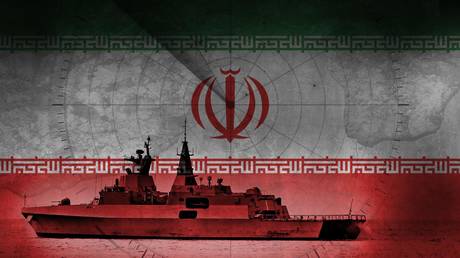
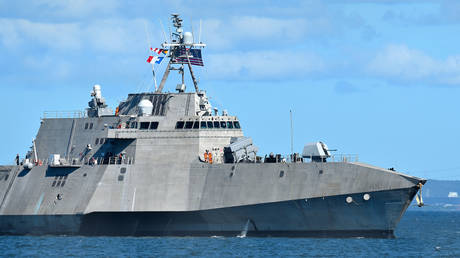
President Donald Trump has temporarily paused a US military operation to escort ships through the Strait of Hormuz, but said the blockade of Iranian ports would “remain in full force and effect” until a final agreement with Tehran is reached.
The so-called Project Freedom operation was launched to guide tankers and other commercial vessels through the key energy chokepoint, which accounts for roughly one-fifth of global oil flows. Announcing the mission on Sunday, Trump described it as a humanitarian effort rather than an offensive operation.
“Based on the request of Pakistan and other countries,” as well as “great progress” in talks with Iranian representatives, Washington and Tehran have “mutually agreed” to put the ship-movement operation on hold “for a short period,” Trump abruptly announced on Truth Social two days later.
Just hours earlier, Secretary of State Marco Rubio told journalists that the original offensive operation, Epic Fury, was “over,” adding: “We’re now on to this Project Freedom.”
The operation quickly became the latest flashpoint between Washington and Tehran. Iran’s military warned that any foreign armed force entering the strait would be targeted, insisting that safe passage through the waterway had to be coordinated with Iranian forces.
US Central Command claimed on Monday that American forces had destroyed several small Iranian boats that had allegedly tried to interfere with the mission. Tehran rejected the claim as “lies,” while Iranian media separately reported that Iranian forces had fired warning shots near US naval vessels.
US officials said the first phase of Project Freedom allowed “several” vessels to pass through the strait, with the New York Post reporting that 11 ships transited the waterway within 24 hours of the operation beginning.
“Project Freedom is Project Deadlock,” Iranian Foreign Minister Abbas Araghchi said in a post on X, warning the US to “be wary of being dragged back into a quagmire by ill-wishers.”
The Strait of Hormuz has been at the center of the crisis since the US and Israel launched attacks on Iran in late February. The US and Iran reached a fragile ceasefire in early April, but tensions have continued over maritime access, with Tehran calling Washington’s naval blockade an “act of war” and a violation of the truce.
US Secretary of War Pete Hegseth said on Tuesday that the ceasefire was “not over” despite the clashes in the strait. Trump claimed the temporary pause in escorts was intended to give negotiators time to see whether a “complete and final agreement” could be finalized.
Continued silence could pose serious risks of escalation in the ongoing conflict with Iran, a group of 30 Congressmen has said
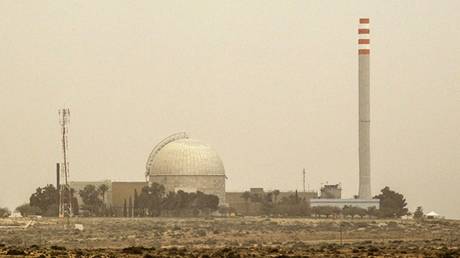
A group of 30 Democrats in the US House of Representatives have demanded that the administration of President Donald Trump disclose information about Israel’s nuclear arsenal and relevant policies. The lack of transparency threatens the entire Middle East, the lawmakers have argued.
West Jerusalem has neither confirmed nor denied possessing nuclear weapons, nor has it publicly presented any doctrine outlining the potential use of such weapons or its possible “red lines.” The US, which has been aware of the Israeli nuclear program at least since the early 1960s, has remained silent on the issue.
Washington is fighting “side by side with a country whose potential nuclear weapons program the United States government officially refuses to acknowledge,” congressmen led by Representative Joaquin Castro (D-TX) said in a letter to Secretary of State Marco Rubio.
“The risks of miscalculation, escalation, and nuclear use in this environment are not theoretical,” the letter stated.
The group has demanded that the US hold Israel to the same standard of transparency as other countries, adding that a “coherent nonproliferation policy for the Middle East,” including on Iran’s nuclear program and Saudi nuclear ambitions, would otherwise be impossible.
Under new agreements between the United States and Venezuela, revenues from the sale of Venezuelan oil are accumulated in accounts controlled by Washington
The peninsula came under a massive attack on Tuesday evening, according to Sergey Aksyonov
Five civilians have been killed in a Ukrainian drone strike on the northern Crimean city of Dzhankoy, Governor Sergey Aksyonov has said.
Shortly before reporting the fatalities, Aksyonov warned that Crimea was under attack by Ukrainian drones. He said air defenses and mobile fire teams were engaging the incoming threats and had intercepted at least 12 UAVs.
“Unfortunately, as a result of an enemy UAV strike on Dzhankoy, there are casualties among the civilian population – five people have died,” Aksyonov wrote. He expressed condolences to the victims’ families and said the authorities would provide them with all necessary assistance.
The governor said emergency and other relevant services were working at the scene, adding that he was personally monitoring the situation. He urged residents to remain calm and rely only on official information.
The strike came after Russia’s Defense Ministry said air defenses had downed 289 Ukrainian drones over Russian territory and the Azov Sea the night before. According to the ministry, the raid targeted 19 regions in western and southern Russia. Regional officials reported damage and injuries in several areas.
Ukrainian drone raids on Russian territory have intensified in recent months, with Kiev increasingly deploying large numbers of fixed-wing UAVs against infrastructure, industrial facilities, and residential areas. Moscow has described the strikes as desperate “terrorist attacks” meant to compensate for the setbacks Kiev’s military has been suffering on the battlefield.
The latest attack also comes days before Russia’s planned two-day ceasefire on May 8-9 to mark Victory Day, which commemorates the defeat of Nazi Germany in World War II. Moscow has said it will pause hostilities during the holiday and urged Kiev to do the same, while warning that any attempt to disrupt the celebrations, including attacks on Moscow, would be met with a major retaliatory strike on Kiev.
 Login
Login