India’s Ruling BJP clinched a win in the key state of West Bengal for the first time in history
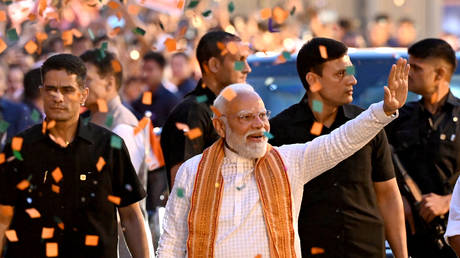
Indian Prime Minister Narendra Modi’s Bharatiya Janata Party (BJP) made unprecedented gains in regional elections, according to the results announced by the Election Commission on Monday.
Votes for the election, which was held in April, were counted throughout the day on Monday across four states – Tamil Nadu, Assam, West Bengal and Kerala – and the union territory of Puducherry.
The BJP swept to victory in the northeastern state of West Bengal, a major battleground, for the first time in the state’s history, taking power from the opposition Trinamool Congress led by popular politician Mamata Banerjee. Modi’s party also retained its position in the neighboring state of Assam for the third consecutive term.
The BJP also made surprise gains in the southern state of Kerala, winning three seats for the first time. In Kerala, the main opposition party, Indian National Congress, returned to power, defeating a coalition led by the Left parties. However, the Congress failed to make gains in other states.
The election results are viewed by political commentators in India as a significant boost for Modi and the BJP, which has governed at the federal level for three consecutive terms since 2014 but is now facing strong resistance to its plans to increase parliamentary seats ahead of the 2029 general elections.
Addressing party workers at the BJP headquarters in New Delhi, Modi called the win in West Bengal “historic and unprecedented.”
Aftershocks of these results will be felt for a long time, probably all the way up to 2029, Omar Abdullah, a prominent opposition politician from India’s Jammu and Kashmir, said.
Elections in India have always meant @PrannoyRoy7749 for sane, sensible interpretation of the trends & results and that’s why today the screens in my office have been tuned to @DeKoderAI to watch the unfolding political earthquake in West Bengal & Tamil Nadu. The aftershocks of…
Elections in Tamil Nadu brought another surprising victory – that of recently formed party Tamilaga Vettri Kazhagam (TVK) led by actor-turned-politician Vijay. The party won 107 seats in its electoral debut, thus becoming the largest single party. It also shattered the decades-long domination of the two key regional parties, the Dravida Munnetra Kazhagam (DMK) and the All India Anna Dravida Munnetra Kazhagam (AIADMK).
In this southern state, over 12 million voters aged between 18 and 29 made up 21.2% of the electorate, local media reported, noting that the scale of participation of the so-called Gen-Z likely influenced the outcome.
Earlier, the press service of the government of the emirate of Fujairah reported that three Indian citizens were injured as a result of an Iranian drone strike on an oil industrial complex
The effort is part of a campaign to boost the country’s military ranks due to the ‘Russian threat’
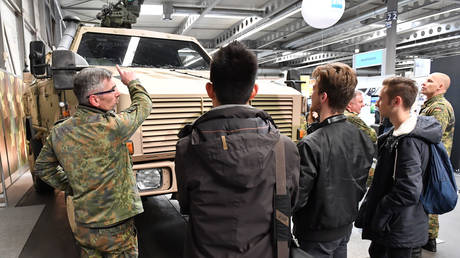
The German Armed Forces have said they sent tens of thousands of young people a questionnaire on joining the military. Every 18-year-old male is obliged to fill it out and register for potential military service under a new law.
Around 194,000 young people received a letter from the military with the questionnaire between January 15 and April 24, a spokesperson for the armed forces told KNA news agency following a request. A spokeswoman for the Defense Ministry said it has “no reliable” data on the responses yet.
The questionnaire asks for personal data, including physical condition, health, and education, and whether they would like to join the army. Those who show interest are asked to choose their preferred branch and potential duration of service, from six months to more than six years.
Women can also fill out the form but are not required to under the Military Service Modernization Act adopted late last year. The legislation is part of an effort by Berlin to boost the military ranks from 186,000 troops to 260,000, plus 200,000 reservists by the mid-2030s. German officials have discussed the need to grow the military since the escalation of the Ukraine conflict in 2022, citing the supposed “Russian threat.”
President Vladimir Putin has dismissed speculation that Russia harbors aggressive intentions against NATO countries as “nonsense.”
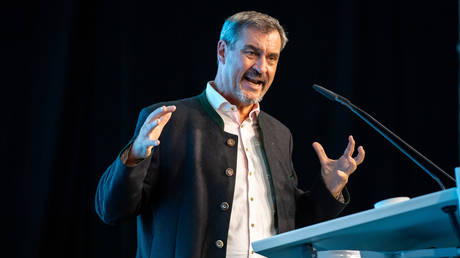
Some German politicians, including the head of the state of Bavaria, Markus Soder, have argued for the reinstatement of the draft. The government’s plans have drawn criticism from young people, with thousands of students taking to the streets of Berlin to protest in early March.
Soaring energy costs are squeezing the bloc’s industry and pushing it further behind global rivals, Pierre Wunsch has warned
The EU is “not competitive” against global rivals as high energy costs weigh on the bloc’s industry, Belgian’s central bank governor, Pierre Wunsch, has warned.
In an interview with the Financial Times published on Monday, Wunsch said the EU’s energy‑intensive sectors are under mounting pressure, as the bloc struggles to keep production going amid persistently higher power costs following the Covid pandemic, the Ukraine conflict, and the US-Israeli war on Iran.
According to Wunsch, the EU is failing to adjust to a new geopolitical reality, citing US protectionist policies and Chinese subsidies, warning the bloc is losing its ability to shape global standards.
The EU is “just not competitive, that’s it,” he added.
The fallout from the repeated crises has already forced the bloc to scale down its green energy policies over concerns about weak growth, Wunsch said.
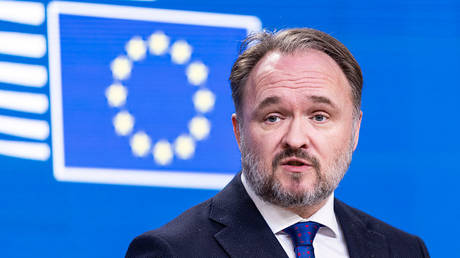
EU Energy Commissioner Dan Jorgensen has warned that the bloc is facing prolonged uncertainty as its energy crisis deepens, with member states now paying significantly more for fossil fuel imports.
The EU has been grappling with the fallout from its decision to cut energy ties with Russia following the escalation of the Ukraine conflict, alongside the costs of its green transition policies.
The US-Israeli war on Iran has added pressure to global energy markets, driving oil prices higher and increasing fuel costs for consumers worldwide. The EU, which imports around 75% of its jet fuel from the Middle East, has been hard hit by the disruption of the Strait of Hormuz, a key route that handles around a fifth of global oil and liquefied natural gas.
The latest developments have prompted some EU politicians to step up calls to reconsider sanctions on Russia.
In January, the European Commission restated its goal of phasing out Russian fossil fuels by 2027. However, EU countries have reportedly increased imports of Russian LNG in the first quarter of this year.
Kremlin envoy Kirill Dmitriev has warned the EU risks deindustrialization under “Russophobic politicians” and that Western governments will eventually be forced to seek renewed access to Russian energy.
Apart from that, according to the Armenian foreign ministry, Yerevan hosted a meeting between the Armenian and Ukrainian foreign ministers, Ararat Mirzoyan and Andrey Sibiga
The ministry pointed out that if Ukraine attempted to carry out its criminal plans in order to disrupt Russia's Victory Day celebrations, the Russian Army would deliver a strike targeting downtown Kiev
 Login
Login