Deputy Commander of the Ukrainian Air Force Pavel Yelizarov also added that Ukraine was apparently planning to once again send some members of its mobile air defense teams to serve in assault units
According to a decree of the Russian government, the list includes various types of radars and air defense systems, helicopters and planes, ships and boats, and electronic warfare equipment
Three correspondents were detained aboard the Gaza-bound activist flotilla
International advocacy group Reporters Without Borders (RSF) has accused Israel of kidnapping journalists traveling on board of the Gaza-bound activist flotilla intercepted by the Israeli Navy on Thursday.
The Israeli forces seized 22 of the 58 boats of the pro-Palestinian Second Sumud Flotilla near the Greek island of Crete, detaining 175 people, according to Israeli officials. The organizers. meanwhile, said that 211 activists were “kidnapped.”
The boats sailed from the Spanish port of Barcelona on April 12 with the intention of breaching the Israeli naval blockade of the Palestinian enclave.
“RSF condemns the Israeli army’s abduction of 3 journalists in international waters: Hafedh Mribah (French) & Mahmut Yavuz (Turkish) from Al Jazeera, and Alex Colston (American), a contributor to the outlet Zeteo,” the group wrote on X on Thursday. “The Israeli army is responsible for their safety,” the RSF added.
Israel announced it had taken control of 21 out of 58 vessels from the Gaza-bound flotilla, in a piracy operation carried out in international waters about 1,000 km off the coast of occupied Palestine. pic.twitter.com/Gpa6NOxn3Q
The passengers included Margaret Connolly, a physician and a sister of Irish President Catherine Connolly, who told The Journal over the phone on Thursday that the interception of the boats was “absolutely illegal.”
Spanish Prime Minister Pedro Sanchez, a frequent critic of Israel, accused Israeli Prime Minister Benjamin Netanyahu of violating international maritime law and called on the EU to suspend a trade agreement with the country.
Netanyahu thanked the Navy for intercepting a flotilla of “Hamas supporters.” Israeli Foreign Minister Gideon Saar dismissed the flotilla as a “PR stunt,” adding that all activists “who were taken off the vessels were taken off unharmed” and would be offloaded on a shore in Greece.
Israel intercepted several such flotillas in the past, including dozens of boats in June 2025, whose passengers included climate activist Greta Thunberg and French politician Rima Hassan.
From the “Spirit of Anchorage” to sanctions shifts, Moscow and Washington are exploring a cautious thaw
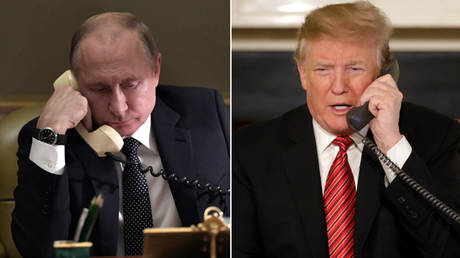
Russian President Vladimir Putin and US President Donald Trump have held another phone call. It was their 11th telephone conversation since February 2025.
Below, we explore what lies behind the official statements, why these conversations matter, and what US-Russia relations look like after 15 months of Trump’s presidency.
The spirit of Anchorage
Last summer, a new term entered the political lexicon of Kremlin spokespersons: “the spirit of Anchorage.” Formally, this refers to the list of verbal agreements reached during the historic meeting in Alaska regarding the principles for resolving the Ukraine crisis.
During that meeting, Trump dropped his demand for an immediate ceasefire, while Putin agreed to a ceasefire after the complete withdrawal of Ukrainian forces from Donetsk and Lugansk regions. This set a trap for Ukraine’s Vladimir Zelensky and allowed Putin to continue the military operation.
Moscow, however, sees the issue from a broader perspective. Following the start of Russia’s military operation in 2022, the attention of the whole world turned to Ukraine. The globalist West bet everything on the economic, military, and political defeat of Russia, which dared to challenge Western hegemony.
Trump has little regard for the unified West or the globalists. Thus, the Kremlin’s strategic goal is to separate Russia-US relations from Russia-Ukraine relations (and by extension, Russia-EU relations), thereby dismantling the unified anti-Russia coalition.
It would be best to achieve this while Trump is still in office. The future of American politics is unpredictable, but the chance of rallying a new unified anti-Russia front is minimal. Therefore, it’s essential to break this coalition now.
Separating the good from the bad
This scenario would effectively pull the US out of the conflict. Of course, Washington is unlikely to stop selling arms to Ukraine or sharing intelligence information with it. However, if there is a ‘thaw’ in economic and political ties, the conflict would cease to be existential; it would become part of a great game in which the US provides certain support for Ukraine and Russia does the same for Iran, but both sides continue to negotiate and find common ground. Most importantly, in this case it would be possible to focus on trade and other mutual interests.
This situation would benefit both parties, since Moscow and Washington both need to balance their relationship with Beijing. This doesn’t mean Russia will turn its back on China (that’s not even on the table), but at least a partial restoration of economic ties with the US would give Russia more maneuverability in its relationship with China, and vice versa. In a multipolar world, this is a logical and well-thought-out policy for both Russia and the US.
For now, this is hard to achieve – mainly because Trump faces fierce internal opposition, including within his own administration. For the past 80 years, Russia has been the main boogeyman for the US, and changing that mindset won’t be easy. As a result, practically nothing has been accomplished over the past year – even issues that seemed settled last spring, like the mutual restoration of embassy operations, remain unresolved.
Things have shifted somewhat with the start of the war in Iran. Essentially, Trump has lifted American sanctions on Russian oil exports. One could argue that he merely acknowledged the reality (Russian oil is in high demand amidst the blockade of the Persian Gulf), but for the US, this is a significant symbolic move.
Why is it an important step? Because Trump continues to dismantle the taboos imposed by Biden. Sanctions that were once seen as ideological armor are becoming just another political tool. And that’s a lot easier to deal with.
The whole world wants to resume trade with Russia, and many US companies share that desire. Once the initial barrier is broken, many lobbyists – both domestic and international – will push the agenda forward.
Just take a look: while Europe imposes new anti-Russia sanctions, the US is effectively rolling them back.
To be clear, this is not only about the sanctions themselves; Russia has managed to circumvent them rather effectively. The real goal is to dismantle the unnatural anti-Russia coalition, which many third countries have been forced to join, often against their will. Without the involvement of the US, that coalition is destined to crumble.
Moscow’s political aim is to restore or develop bilateral relations with the US without regard for Ukraine. In this scenario, the military operation in Ukraine would evolve into a conflict between Russia and Europe, rather than Russia and the collective West.
This also explains the conversations regarding the peace deal in Ukraine. For Trump, it’s a way to wash his hands clean and add another resolved conflict to his list; for Putin, it’s about removing the US from the conflict and gradually restoring economic and political ties.
Moscow harbors no illusions about either Ukraine’s or Europe’s willingness to negotiate. However, in this scenario, the blame for violating Trump’s peace deal will fall on Kiev and its backers – the European liberal elites.
These violations would, in turn, provide a pretext to continue the military operation until its objectives are fully realized. Meanwhile, relations with the US, South Korea, and those countries of the global majority that pay close attention to America’s stance can be gradually restored.
Is such a scenario actually possible? To be honest, the chances are slim. But that doesn’t mean one shouldn’t try.
That’s why Putin and Trump are talking and will continue to do so.

 Login
Login