Reading view

Nine (Lives) Is Enough: The Dreadful Sequel To “Fritz The Cat”

This entry continues my well-deserved punishment for offering to detail two of the worst animated cat films ever inflicted upon audiences. Last time out, it was Felix the Cat: The Movie. This time, I’ll take the blame for detailing the R-rated 1974 abomination called The Nine Lives of Fritz the Cat.

The 1972 film Fritz the Cat, directed by Ralph Bakshi, made dubious history by earning the first X rating for a wide-release animated film. While the movie had many flaws and was obviously the work of a first-time director (Bakshi began with shorts for Terrytoons), it is a masterwork compared to its sequel.

There are only so many ways The Nine Lives of Fritz the Cat can be worse than its predecessor, and the movie manages to hit them all. Ralph Bakshi and Steve Krantz, the producer of Fritz, had a falling-out, and Bakshi had nothing to do with the sequel. Robert Crumb, who created the character of Fritz, ignored the film completely and was so disdainful of the first film that he had Fritz murdered in his final comic appearance in 1972.

Krantz hired Robert Taylor (an assistant animator on the first Fritz film and collaborator with Bakshi on The Mighty Heroes TV show) to helm the project. Fred Halliday and Eric Monte assisted on the disjointed screenplay. There is a loose theme of Fritz, a stoned, unemployed, and heckled husband, imagining himself in different life scenarios, each one ending badly for the titular cat.

Before addressing that, the differences between the Bakshi and Taylor films merit some discussion. First, Bakshi’s film is linear, whereas Taylor’s film is hallucinatory and less concerned with narrative cohesion. Bakshi tended to treat racism and class warfare with sharp, sometimes nasty satiric humor. Taylor treats these issues gratuitously and with a clumsy hand, edging close to and often erupting into actual racism.

One example is when Fritz imagines he is sent to deliver a message into “New Africa” (formerly New Jersey), run by stereotypical blacks (again depicted as crows), all of whom seem to embody the worst stereotypes of blacks as violent, switchblade-wielding thugs and prostitutes incapable of governing themselves save through acts of violence and assassinations.

Bakshi’s Fritz film is far more sophisticated in its approach to social commentary, depicting urban life as a decaying corpse of a lost American Dream. Taylor’s film is a copy of Bakshi’s, even using the dirty watercolors, canted angles, and extreme down shots evident in the first film. Taylor’s environment, however, does not convey the same utter hopelessness as Bakshi’s, possibly because the scenarios change too often. Taylor’s landscape is dirty and gritty enough, but Bakshi’s (he did grow up in a gang-ridden slum) is more authentic.

Bakshi’s Fritz is much more economical than Taylor’s. Bakshi’s Fritz the Cat runs for 77 (or 78 minutes, depending on the source), and so does the sequel. However, considerable filler mars the sequel’s narrative: Fritz’s fantasy of high life in the 1930’s consists largely of photographic montages and an endless repeating pattern of lights. A scene representing a mutually destructive war between blacks and whites (a crow and a pig, respectively) is one of the few scenes that makes its point, but the exchange of fire goes on for far too long.

Some other differences: Bakshi and Taylor both depict blacks as crows, but while Bakshi depicted Jews as lions, Taylor uses a Jewish lizard. Adolph Hitler appears to be a scrawny lion (he rather looks like Itchy Brother in the Linus the Lionhearted cartoon, disguised as Hitler). There’s a twist!

Oh, the movie: As we open, Fritz (voiced again by Skip Hinnant) is unemployed, perpetually stoned, married to nagging harridan Gabrielle (shout out to Reva Rose), and is burdened with a masturbating, chain-smoking toddler named Ralphie (a dig from Steve Krantz?). Fritz escapes by sending his incorporeal self out into the street while Gabrille rants on.

From here, we follow Fritz into nine imagined lives (the transitions are not always clear, or whether imagined or not). In Life One, Fritz seduces the sister of his Puerto Rican pal Chita (a camel?) with pot; her hallucinatory high is one of the better scenes in the film. Chita’s father shoots Fritz to death.

Life Two sees Fritz encounter a drunken bum who says he is God. This scene is exceedingly gross and unpleasant, but that’s where Taylor shows his weaknesses. Life Three finds Fritz in Nazi Germany as Hitler’s horny orderly and psychotherapist. Hitler attempts to rape Fritz before having his sole testicle (the major joke in the segment) blown off. American tanks kill Fritz.

Life Four has Fritz trying to sell a used condom to a bartender, whose wife caught gonorrhea from Fritz. Bakshi would never have used this gratuitous scene. Life Five, the flashback to the 1930s referred to above, is nothing but filler. It ends with Fritz broke and despondent.

Are we up to life Six? Fritz trades a toilet to the stereotypical Jewish pawnshop owner, Morris, for a space helmet after the lizard refuses to cash Fritz’s welfare check. We go into Life Seven, where astronaut Fritz bangs a black female reporter in space until the rocket explodes.

In Life Eight, the ghost of Fritz’s buddy from the first film, Duke, leads the cat into the future, where President Kissinger (depicted as a rat) has him deliver a message to President Jackson of New Africa (formerly New Jersey). The dark racism of this segment, discussed above, is barely even satirical. It ends with Fritz framed for Jackson’s assassination and executed.

Now relaxing in the underground sewers of New York, Fritz encounters the characters of his final life, an incomprehensible Indian guru, and an effeminate Lucifer (Lucifer is a faggot!) before we see Fritz at home once more, shortly before Gabriella throws him out into the street. Fritz declares that this current life is the worst of all of them before strutting down the street into the coda.

The Nine Lives of Fritz the Cat is, overall, a tasteless and unimaginative follow-up to Ralph Bakshi’s take on the character. The movie was universally panned, and Fritz was never seen again. Was anything about this woebegone sequel worthwhile?

Well, there was a great cast of notable animators toiling in vain. Cosmo Anzilloti, Milton Gray, Jim Davis (no, not THAT Jim Davis), John Gentilella, Volus Jones, Martin Taras, and Manny Perez returned from the first Fritz movie and worked with newcomers to approximate the feel of the first film.

Complete voice credits are hard to come by: Certain roles, such as Fritz (Skip Hinnant) and Gabrielle (Reva Rosa), are credited, but only a few of the listed voice artists correspond to characters in the movie. In fairness, this episodic film has many secondary and one-shot characters. We do know that Robert Ridgely, Pat Harrington Jr., and other notables appear (Side note: Skip Hinnant voiced the Easter Bunny for Rankin-Bass and was also a fixture on the kids’ show The Electric Company. He was also the star of the first X-rated AND R-rated animated films produced! It has been said that The Nine Lives of Fritz the Cat has now become a “cult classic.” I suppose that’s a matter of taste.

  •  

“Felix The Cat – The Movie” (1989)

It took Felix the Cat 72 years to star in his only feature film. His creator (and, at times, sole animator), Otto Mesmer, did not live to see this event, nor did anyone else who brought various incarnations of Felix to animated life over the decades. However, the last person to usher Felix to reasonable success in 1958, Joe Oriolo, passed the reins on to his son Don, who paid tribute to Dad with Felix the Cat: The Movie.

If there was ever a labor of love, this 1989 animated film is it. Don Oriolo wrote the script, did some voice work, served as one of the producers, and, if the end credits are correct, even performed some of the music. Wow. The direction was by Tibor Hernadi (“Animation director” on The Time Masters). No less than six nations (primarily Hungary) contributed to the production.

Yet, the film had but one US theatrical showing (as the opening selection of the third Los Angeles Animation Celebration), and plans for a wider release ended when the movie’s distributor, New World Pictures, went belly-up. The picture went unseen until it appeared on DVD on August 29, 2002.

Felix is, alas, not a very good film, and most critics have been considerably harsher than that. The story, involving Felix’s adventures in an alternate dimension where he battles on the side of a beautiful princess against her evil uncle, the Duke of Zill, is disjointed and plagued by unnecessary scenes that push the plot aside. In one of them, we watch foxes (who get their own song!) prepare to urinate on Felix’s bag. They disappear after that. An interlude with tap-dancing mice goes on far too long. And how about the one-time appearance of a dragon that silently impersonates (I think) Marlon Brando?

The animation reflects the $9M budget and is almost universally floppy and choppy: mouth movements rarely match the dialogue, and facial expressions often do not correspond to what the characters are experiencing. The editing is atrocious. There are some very primitive CGI sequences of Felix’s head bookending the film. Most of Felix’s lines are like “Dad jokes” that would embarrass Dad. Some of the characters (particularly Madame Pearl and Pim) look like they came from different films.

The picture strongly reminded me of the 1986 film Cat City (another very bad Hungarian film) in its flawed design and execution, and I would not be surprised if Felix employed many of the same animators. However, Felix is the better film, and this leads us to why this movie is merely a semi-total disaster. Some redemptive comments are due here:

To begin with, the film harkens back to the 1958 TV version of the fabulous feline, and this is rather welcome. Felix has a magical bag of tricks that comes in quite handy. Series stalwarts The Professor and his brilliant nephew Poindexter are along for the ride (Rock Bottom must still be serving time). The Master Cylinder gets a cameo (on paper). The picture even ends with Felix signing off with “Right-e-o!” The closing theme (by Winston Sharples) is the same one featuring Ann Bennett’s singing. David Kolin, replacing the immortal Jack Mercer, does a credible job voicing Felix.

The main villain, the Duke of Zill, is perhaps the best-designed character the crew came up with, and he gets a fitting backstory. The Duke resembles a tricked-up version of Spider-Man villain Mysterio, and Peter Newman lends the bad guy a great voice.

But what are the real reasons to buy/rent/stream this Felix movie besides Boomer nostalgia? One, it’s a surreal, loopy ride featuring acid-trip design, hallucinatory color, and bonkers secondary character designs (especially in the land of Zill) that must have existed in the animators’ nightmares. This messed-up menagerie is even weirder than the nutty backgrounds and layouts in this picture.

Secondly, if seeing this movie piques anyone’s curiosity about Felix the Cat, it is worth sitting through. Whether they explore the 1958 series, the three 1936 shorts from Van Bueren Studios, or take a deep dive into the iconic black-and-white Felix cartoons from his heyday during the 1920s, rediscovering this animated idol is a worthy cause. Felix the Cat: The Movie may not have been the cat’s crowning glory, but at least it kept a legend alive.

  •  

Therefore Art Thou, Conrad?

Does anyone (besides us geeks at Cartoon Research) really miss or even care about Conrad the Cat?

After all, he only appeared in three cartoons, all in 1942, and in two of them he was a mere co-star. Chuck Jones created the character, then abandoned him after that trifecta. A doughy yellow cat specializing in physical comedy, viewers remember Conrad as a knockoff of Disney’s Goofy, especially when Pinto Colvig voiced him in Conrad the Sailor. (Side note: Ink and Paint veteran Martha Sigall related that the I&P department thought that Conrad was a caricature of Jones himself).

Conrad, however, can be seen as a transitional figure in Chuck Jones’ development as a Warner animator and director. From the bones of Conrad would arise a snappier and more cosmopolitan Jones, one capable of perhaps more nuance than any of his contemporaries. Let’s examine this thesis.

Chuck Jones became a Warner director in 1938. His first cartoon, starring an unnamed kitten in The Night Watchman, featured a cute character that very much resembled his next “star’ Sniffles the mouse, whom Jones created and first directed in 1939 (Naughty but Mice). Siffles was childlike and super-cute. His gabby voice, provided by Margaret Hill-Talbot (later by Marjorie Tarlton), reinforced this take on the character. Sniffles went on to headline a dozen cartoons between 1939 and 1946, showing little evolution.

During those years, Jones was obsessed with laborious drawings and layouts, lighting effects, and showed a strong predilection for Disney-flavored action. Conflict tended to be character-versus-object (or self), a far cry from the later interplay between Bugs and Daffy, for example.

Jones’ cartoons tended to be gentle, with visual references to Disney’s Silly Symphony period. Nowhere is this more evident than in the 1940 cartoon Tom Thumb in Trouble. His characters were adorable and mild, and until Jones found a more individual voice, they seemed most anchored in Pluto Pup. The Jones unit at this time had some outstanding talent: animators Robert Cannon, Ken Harris, Robert McKimson, Ben Washam, and background artist Paul Julian. Yet the best this group could achieve was shorts that recalled Disney but could not be confused with its output.

By the time Conrad Cat appeared in The Bird Came C.O.D. (1942), there were signs of Jones transitioning to a different comic style. Although Conrad strongly recalled Goofy (minimal vocals by Mel Blanc), especially when wrestling with a palm tree, there are glimpses of Jones’ future work; in one scene, while watering the tree, Conrad mugs to the camera. After smacking into a door for the second time, he gives the audience a frustrated side glance. After finally getting the plant through the door, more fourth-wall facial expressions are seen.

Skip ahead to Conrad’s encounter with the bird(s) in a magician’s hat. The bird (a visual predecessor to Henery Hawk) treats Conrad with far more violence than could be imagined in a Sniffles cartoon. Notably, the bird recalls Jones’ Minah Bird (first appearing in 1939) in that he marches to a distinct musical theme. Jones is clearly using comedy differently in this short.

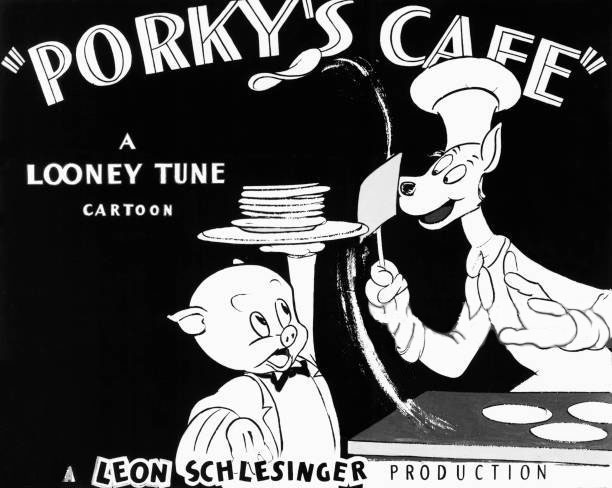
In his final two cartoons, both in 1942, Conrad was a co-star, paired with two of Warner’s biggest stars. Such pairings are likely as good as they could be for the goofy yellow cat, since he was far too weak to be a stand-alone character. In Porky’s Café, Conrad is a short-order cook who still manages to show glimpses of Jones’ future work; there are more gags and more telling reaction shots from Conrad. Jones was to become a master of expressing emotion through the twitch of an eye or a tiny movement of the mouth. These precursors can be glimpsed in the scene where Conrad attempts to beckon a recalcitrant pancake.

Conrad’s final cartoon was Conrad the Sailor, in which Daffy Duck harassed the poor cat in a total mismatch. Not only was Conrad constantly defeated by Daffy (who was far more like Bob Clampett’s duck than the egotist Jones would later fashion him into). As related earlier, Conrad’s voice was unfortunately provided by Pinto Colvig, the longtime portrayer of Disney’s Goofy, with no tweaking of the Goofy vocalization. Fairly or not, Colvig’s dialogue and singing reinforced the observation that Jones had not quite abandoned his Disneyesque tendencies.

As stated, while Conrad was not a character that could ever be featured independently, Conrad did offer occasional glimpses of Chuck Jones’ evolving style. Conrad was better built for comedy than Sniffles was, and he worked far better in gag situations than, say, the childlike Porky Pig in Old Glory (1939) or Tom Thumb. Conrad at least suggested an adult figure, and that represented a step forward.

Later, with writers such as Michael Maltese and a more developed sense of how to underplay a gag, Jones would blossom into one of Warners most sophisticated directors. If Jones reshaped the personalities of the studio’s stars during his heyday, it still started with a single step. Conrad the Cat may not stir many fond memories, but his three cartoons during 1942 just might have been that step.

  •  

“The Man From Button Willow” 61 Years Later

On April 3, 1965, a low point in American animated films hit the theaters. Advertised on its poster was the tagline, “The Most Delightful Animated Adventure Since Snow White.” This audacious claim would have been more truthful if it had been a comparison between a third-grader’s crayon art and a Picasso, but hey, it did have one honest word: it was animated.

The Man From Buttton Willow, produced by film and TV cowboy star Dale Robertson, left itself wide open with that tagline, and it gets everything it deserves. Neither delightful nor adventurous, this disaster takes its place beside Foodfight, Arctic Dogs, and that great animated epic, Happily Ever After, which spelled the end for Filmation. Button Willow is 81 minutes of boring, poorly produced animation that might have an actual running time of 45 minutes if one were to edit out all the folderol involving humanized animals, the terrible “musical numbers,” and the reused animation cycles.

Let’s get down to business. The story involves Justin Eagle, (Dale Robertson) purportedly the very first “U.S. Agent”, investigating the machinations of the evil Montgomery Blaine and his accomplice, The Whip. These two, readily identifiable by their Scooby Doo – type evil visages, have been buying up the route for the transcontinental railroad and overcharging the government for the land. Oh yeah, they have been driving settlers off and burning their homes, a terrible thing to do since the inhabitants of Button Willow do nothing except walk down an idealized Western street and attend church. We know that Blaine is a scoundrel because he blows smoke rings from his cigar into our faces.

Aha! The good Senator Freeman has evidence of Blaine’s misdeeds! Before he can warn the Senate, the bad dudes kidnap Freeman in San Francisco, which is on the other side of the country from Washington, where the Senate is, but hey. They dump him onto a ship, although nobody knows which one, planning to permanently silence him eventually.

It’s Justin Eagle to the rescue, or at least after a stultifying, absolutely deadly period of doing farm chores and relating to his ranch animals and being attentive to his Japanese adopted little girl Stormy, who speaks in malformed English and attaches the suffix – “san” to everyone’s name. We learn in an awful song whose lyrics consist mostly of “Pardon Me, Ma’am” why Justin’s loyal ranch hand, Jeremiah “Sorry” Baker, never married, which is irrelevant to anything in the plot.

Jeremiah and Justin are both incredibly stupid; when one of their mares, Savannah, is about to foal, they believe she is sick, panic, call the vet, and wait worriedly outside the stall until they get the good news and celebrate! You dunderheads! You own a freakin’ ranch, and you couldn’t figure out that one of your mares was preggers? Anyway, this segues into a lengthy scene of the cutie foal. The dreadful soundtrack launches into the praiseful song, “Savannah,” which consists of that single name repeated endlessly.

Of course, the foal runs away into the mountains, pursued by Savannah’s stud Rebel, Justin’s dog Shady, and pet skunk Alfie. A cougar attacks, and Shady is knocked off a cliff in a fall that Wile E. Coyote might have envied, but of course the kindly vet resurrects him as Stormy prays. We are now at least 100,000 miles off the alleged plot of this tale.

Oh, yeah, Justin is in San Francisco, where he gets shanghaied and ends up on the same boat as Senator Freeman (remember him?) With the help of fellow prisoner Andy (Ross Martin), who boasts the worst Swedish accent since Pat Harrington Jr. voiced Lars in the Filmation series Journey to the Center of the Earth, Justin defeats the entire crew in the only noticeable “action/adventure” sequence in the film. They sail back to San Francisco. Justin goes home. Blaine and the Whip go to jail. Das Ende.

We’ve been over the music. Henry Mancini was allegedly a contributor to George Stoll and Robert Van Epps score, perhaps on a day when Mancini was cleaning out his trash bucket. The animation is abominable. Justin does resemble Dale Robertson when his features aren’t drifting over his face. The characters are stiff and rigid, and I spotted several scenes in which body movements are oddly out of synch. The animation crew seems to be a mixture of the unemployed and the third-stringers left after the death of theatrical shorts. Among the more recognizable are John Dunn, Don Lusk, John Sparey (who did some good work for Ralph Bakshi), Ben Washam, Les Clark, and Marc Davis (uncredited).

There is a horrid animated sequence in which Justin is pitched woo by the local spinster, Ms. Pomeroy; her entire face appears to be a repeating animation cycle, with several of her facial expressions physically and emotionally inappropriate for her dialogue. It’s scary. The only passable animation is that of the ranch hand, Sorry, who looks as if he belongs in a different movie. Since he seems to be a thinly disguised version of Johnny Appleseed’s guardian angel from Melody Time, perhaps he does.

I remain amazed at the vocal cast that Button Willow mustered. Cliff Edwards, Clarence Nash, and Verna Felton, late of Disney. Add Pinto Colvig, Herschel Bernardi, Shep Menken, and Thurl Ravenscroft, most of them playing multiple parts. Give ‘em all credit.

Poor Dale Robertson! This handsome cowboy star founded United Screen Arts in 1964, with Button Willow being its first feature. The now-defunct company produced seven films, the last one in 1968. The only legacy truly remaining is giving Raquel Welch her first film role and producing an animated feature that made Filmation look like Disney.

Lest we forget, Button Willow had David Detiege as director. His most notable prior credits were The New 3 Stooges and the abysmal Syncro-Vox cartoon Captain Fathom. After Button Willow, Detiege went on to a passable career at various studios until he died in 1984.

  •  
❌