Login
Login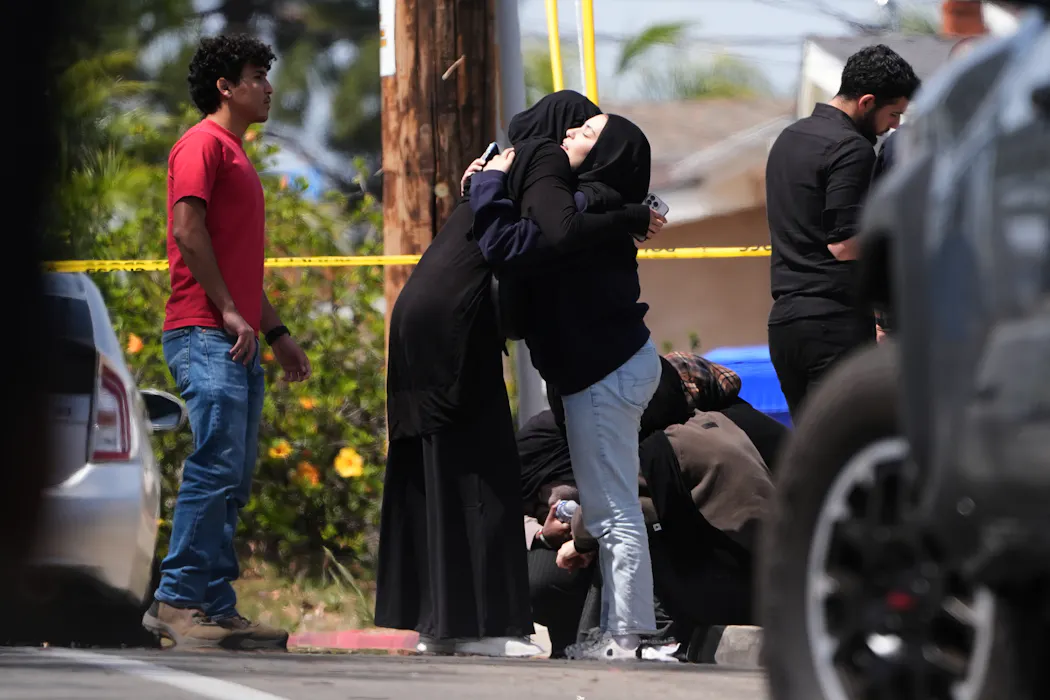


San Diego mosque shooting reflects how online rhetoric, media depictions and political discourse contribute to increased Islamophobia

Many Muslim Americans are fearful following a shooting at the Islamic Center of San Diego that left three worshipers dead. Investigators reportedly found hate speech and anti-Islamic writing inside the vehicle of the suspected shooters, who killed themselves soon after the attack.
The director of the Islamic Center, Taha Hassane, condemned the attack while also encouraging individuals to respond with tolerance and love. “All of us are responsible for spreading the culture of tolerance, the culture of love,” he said, while lamenting the conditions that had led to such violence.
The attack comes just one week before the celebration of Eid al-Adha, an annual festival celebrating the Prophet Abraham’s – Ibrahim in Arabic – willingness to sacrifice his son in obedience to God, and the conclusion of the annual Hajj – the pilgrimage to Mecca, one of the five pillars of Islam.
It also comes on the heels of ongoing tensions in the Middle East and increasing political rhetoric in the United States. Republicans in Congress held hearings during the week of May 13, 2026 titled “Sharia-Free America.” This reflects a long-standing anti-Muslim trope that portrays Muslims as invaders who want to impose sharia – Islamic religious law – on all Americans. Many Muslim Americans are concerned because the rise of anti-Muslim bigotry among politicians has been mostly met with silence.
Muslim Americans have been warning that the increased rhetoric targeting Islam and Muslims endangers their community. As a scholar who studies Islamophobia and its impact on Muslim Americans, I have observed how the war with Iran intensified anti-Muslim sentiment online. A study by the Center for the Study of Organized Hate found that in the first six days of the conflict, the average number of Islamophobic posts on X jumped from an average of 2,000 posts daily to 6,000.
Research consistently shows that negative portrayals of Muslims shape public attitudes toward them and can lead to increased discrimination, psychological harm and hate crimes like the shooting in San Diego.
Increase in Islamophobia
Islamophobia in the United States tends to surge during global conflicts, political campaigns and terrorist attacks. Human Rights First, an organization that works to promote human rights in the U.S. and abroad, documented surges in Islamophobia in 2015 following the Syrian refugee crisis, when a large number of people were displaced. That same year the 2015 attacks in Paris and shooting in San Bernardino, California, intensified public anxiety about terrorism. A surge in crimes against Muslims followed.
Islamophobic rhetoric in the U.S., in which Muslims were often framed as a security threat, intensified during Donald Trump’s 2016 presidential campaign and continued into his first presidency. Burton Speakman, a scholar of digital media, and I found an increasing acceptance of such rhetoric among the political right in social media posts from 2016-19.
Social media posts and comments showed an increasing use of dehumanizing language toward Muslims. In a study I conducted in 2020, a majority of 830 Muslim Americans reported encountering the most Islamophobic content on Facebook, followed by Twitter and Instagram. This shift was also reflected in the language and coverage of Islam in right-wing media, which often portrayed Muslims as invaders wanting to impose sharia and as a drain on social welfare.
Mainstream media can also amplify negative depictions of Muslims by often discussing Islam within the context of terrorism and portraying Muslims more negatively than other racial, ethnic or religious minority groups.
Hate crimes tend to increase alongside Islamophobic rhetoric. During 2016, a period with high rates of Islamophobic rhetoric, there were 307 reported incidents – the highest recorded number since immediately following 9/11. The numbers dropped in 2017 but were followed by an increase in 2024 with the start of the Israel-Hamas war. That year, 288 anti-Muslim hate crimes were reported.
A 2025 poll found that 63% of American Muslims reported experiencing religious discrimination, with many reporting at least one such incident every year since 2016.
Mental health of Muslim Americans
The cumulative effects of Islamophobia have an impact an American Muslims’ mental health and access to care.

Numerous studies since 9/11 link the high rates of discrimination experienced by the Muslim American community to higher rates of depression. Experiences of discrimination also lead some Muslim Americans to believe they are not viewed as being American.
Thirty-one percent of participants in my 2020 study described the impact of social media on their mental health. Many said they avoided displaying their Muslim identity in social media posts, supporting a Muslim political candidate on social media, or even sharing religious content or videos. Some just withdrew – 27% deactivated or deleted their social media accounts.
In addition, many Muslims reported feeling discouraged from seeking both physical and psychological treatment from non-Muslim providers. This leads Muslim Americans to significantly underutilize available services compared to other ethnic and religious minority groups.
A 2015 study found that nearly one-third of Muslim Americans reported experiencing discrimination in health care settings, which has an impact on their trust in providers. The majority reported rude treatment by providers, insensitivity regarding modesty requirements, or having their pain disregarded. One participant in that study said: “Going into a surgery, health care providers didn’t recognize the importance of me keeping my hijab on and wanting most of my body covered.”
In my 2023 study, a number of participants described personal experiences with mental health professionals who seemed not to see them as individuals beyond their religious affiliation. One participant described a provider as being “quick to attribute problems” to religion or culture. “I worry about them stereotyping and end up feeling as if I’m on the defense,” this participant said.
My most recent study, conducted in 2024, which is currently under review, asked 325 Muslim Americans who had used any psychological services about their health-seeking behavior: 56% said they were worried about provider bias; 57% were worried about being misunderstood.
Following Trump’s travel ban targeting several Muslim countries in 2017, a study conducted by researchers at the Yale School of Public Health found that many Muslim Americans skipped their primary care appointments. At the same time, their visits to the emergency room went up.
Addressing the challenges
In response, a number of initiatives have emerged at the local and national levels.
One approach involves increasing mental health literacy within Muslim communities and creating networks of mental health professionals working with Muslim clients.
For example, mental health professionals and community leaders are working to increase mental health literacy both digitally and through in-person education. Muslim community members learn about symptoms of mental health disorders through training, such as Mental Health First Aid. Online directories of Muslim mental health providers have also been created.
Another approach involves training mental health professionals. A team at Stanford University has created a six-part training module that provides therapists with knowledge of religious norms and an opportunity to reflect on their own possible biases.
Finally, Muslim researchers and providers have begun to develop therapies and resources that integrate Muslim beliefs and spiritual approaches with treatment. These include psychotherapy that is inspired by the Quran, the teachings of the prophet and spiritual practices such as self-reflection, prayer and mindfulness.
A vulnerable community
The war with Iran has fueled an increase in anti-Muslim rhetoric that has increasingly spilled into political discourse. In February 2026, for example, U.S. Rep. Randy Fine of Florida posted on X that “the choice between dogs and Muslims is not a difficult one.” In another post he wrote, “We need more Islamophobia, not less.” Similarly, U.S. Rep. Brandon Gill of Texas called for stopping the entry of “Muslims immigrating to America.”
The shooting at the Islamic Center of San Diego has deepened fear of harassment and violence among an already vulnerable community.
Muslim Americans can often feel powerless in the face of such hostility. Greater public awareness, stronger advocacy and efforts to address the mental health impacts of anti-Muslim hatred are critical for a community that already feels vulnerable.
This is an updated version of an article first published on April 17, 2026.
Anisah Bagasra receives funding from Meta for Content Policy research in 2019