Login
Login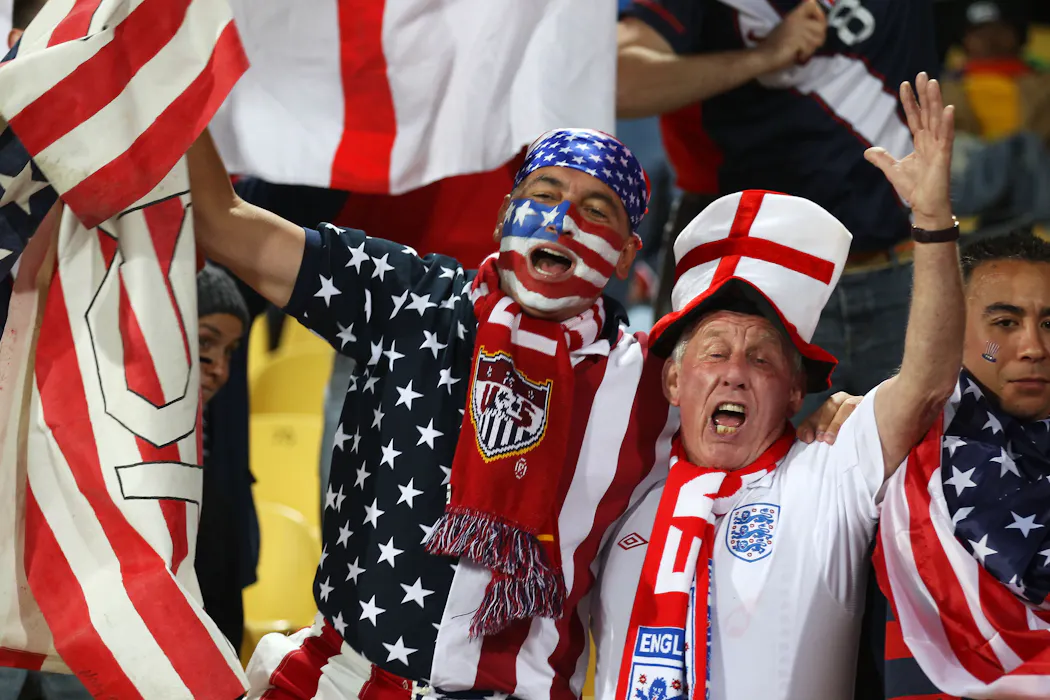


Is soccer taking over America … or are Americans taking over football?

Soccer purists have long feared the “Americanization” of the game. But in one key respect, it is already happening: ownership.
Americans now own more than 40 European soccer clubs, including current English Premier League champion Arsenal, Italian Serie A champion Inter Milan and storied teams such as Manchester United and Liverpool. Americans are also investing heavily in the lower leagues, taking ownership of two dozen clubs outside the top division, including Birmingham City, whose ownership group includes former NFL star Tom Brady, and Norwich City, purchased by Milwaukee Bucks owner Mark Attanasio in 2022.
And while global fans may carp at superficial changes that hint at the growing influence of American culture – halftime shows, cheerleaders and the use of “soccer” over “football – the reality is, it is at the level of ownership where Americans have the biggest capacity to change the game. It is a trend my colleagues and I have been charting for several years.
The yanks are coming, the yanks are coming!
U.S. sports ownership norms and rules differ greatly from the traditional European model: U.S. owners tend to operate like "emperors” who can move franchises from city to city in pursuit of bigger profits; European owners are more inclined to act as “caretakers” and traditionally come from the local business community. They see their teams as passion projects that they’re willing to sink money into.
But the global rise of soccer has seen wealthy Americans increasingly take an interest in European teams. It began in earnest in 2005 when American businessman Malcolm Glazer bought Manchester United. The Glazer-leveraged buyout sparked protest from the club’s supporters trust at the time and has grown as the owners sucked out more than 1 billion pounds from the club to pay back debt interest, repayments, dividends and fees.
But such opposition, which has only accelerated since 2018 with the entrance of U.S. private equity groups, has done little to put off American owners.
Today, there are 11 American ownership groups in the English Premier League – and they are more accustomed to the U.S. way of doing things. Combined, they own six NFL teams, four NBA teams, two MLB franchises and four NHL clubs. Stan Kroenke, the owner of English champion Arsenal, also owns the Los Angeles Rams, the NBA’s Denver Nuggets and the NHL’s Colorado Avalanche.
Ownership of these franchises has made some very rich men ever more wealthy as the value of top teams grew. But traditional soccer fans are increasingly concerned about this shift toward a profit-driven style of ownership.
The ups and downs of the pyramid system
But there is a potential barrier to these American owners making megabucks: the structure of soccer itself. It represents a battle between U.S. “closed” leagues – that is, with fixed franchises – and a European pyramid structure in which teams can drop down divisions, wiping millions of dollars off their valuation in the process.
To understand why U.S. and English leagues have these different models, you need to look back to how professional sports leagues in the two territories were originally designed. Until the late 19th century, sports in England and the U.S. followed similar trajectories, with the baseball teams in America and soccer teams in England playing in organized leagues with predictable schedules.
Then, in 1876, baseball’s National League was founded with territorial exclusivity for teams and, by 1891, a constitution that enshrined eight permanent members. New franchises were not absorbed into the National League but instead formed the American League. Underperforming professional baseball teams could not be ejected or relegated to a minor league even if they lost every game. Meanwhile, franchises could relocate to new cities at will.
Other U.S. sports adopted baseball’s monopolistic system of fixed teams with all-powerful owners – a system that, by the 21st century, produced regular profits, the world’s highest-valued sports teams and absolute power for owners.
In contrast, England’s Football League, which began life in 1888, had a fluid membership – exchanging its weakest teams with the strongest teams from the rival Football Alliance to create a two-tier system. The English pyramid system took shape after another rival league was absorbed in 1894 as the third tier.
From the outset there was the possibility of teams moving up – or being promoted – based on their performance on the pitch. Conversely, teams could be demoted if they played badly.
This pyramid structure quickly became the norm for soccer around the world and enshrined in FIFA statutes.
A fans’ revolt
Promotions and regulations create drama, romance, season-long tension and fan passion that help make soccer the most popular sport in the world.
But it also terrifies many American owners.
Burnley and West Ham, English clubs with significant American investment, were recently relegated to the second tier of the English pyramid – a move that will likely devastate their budgets and valuations. American-owned Hellas Verona and Pisa in Italy and Girona and Mallorca in Spain were likewise demoted to the second divisions.
Spooked U.S. owners have begun to lobby for change – and the safeguarding of their lucrative sporting investments. And it was little surprise that American fingerprints were all over the April 2021 announcement of the “closed” European Super League. The elite competition would have guaranteed permanent participation for 12 to 15 teams, plus a handful of rotating annual participants, in a new, multibillion-dollar continental competition.
The breakaway league was to be financed with $4 billion from U.S. banking giant JPMorgan. Four of the teams – AC Milan, Arsenal, Liverpool and Manchester United – are American-owned.
The European Super League would have Americanized elite European football in one fell swoop, with fixed franchises, no threat of relegation and league control by the owners or presidents of the permanent teams.
But fans, coaches and former players from the six English Premier League teams involved revolted against an elite competition without relegation, calling it an “ultimate betrayal.” All six formally withdrew within 72 hours of the league’s announcement, joining Germany’s two biggest teams, Bayern Munich and Borussia Dortmund, which refused from the outset to join. France’s Paris Saint-Germain also refused an invitation.
While the effort to create fixed franchises in Europe has, for now, been foiled, Americanization is still happening in smaller steps. Many of the changes are benign, such as cheerleaders and halftime entertainment. Other changes are more profound. American professional sports leagues often tweak rules to increase scoring, and FIFA is now experimenting with a new offside rule that would lead to more goals, reduce major upsets and benefit wealthier clubs.
Todd Boehly, co-owner of the Los Angeles Lakers and Los Angeles Dodgers, Strasbourg FC in France’s Ligue 1 and Chelsea in the U.K., is one of the American cheerleaders for this type of change.
He argues that the English Premier League should learn from American sports to increase revenue, including by introducing all-star games and postseason playoffs. Much of this is self-interest: Boehly’s Chelsea FC needs all the additional revenue it can find as the club announced record pre-tax losses of US$349 million for the 2024-25 season.
Welcome to … where now?
Some American franchise owners have given up on trying to change the European game and are looking elsewhere. U.S. capital is now being invested in a potential fixed-franchise league in Mexico. Mexico’s first division, Liga MX, whose television viewership in the United States exceeds that of the English Premier League and MLS combined, paused relegations for six seasons in 2020 due to the financial uncertainty brought on by COVID-19. Five of the 18 Liga MX clubs are now American-owned, and a return to relegations looks increasingly unlikely.
Hollywood actor Rob Mac (formerly McElhenney), who co-owns Wrexham FC in the U.K. with Ryan Reynolds, documented the romance of promotions in the TV documentary “Welcome to Wrexham.” But as a co-owner, with Eva Longoria, of Liga MX club Necaxa, Mac appears less enamored of the pyramid system in Mexico, pointing out “the potential value and devaluation of the clubs.”
Liga MX could soon become the first soccer league to fully transition from an established promotion and relegation system to a fixed-franchise model.
And that would be a significant step toward the global Americanization of the beautiful game.
Kirk Bowman does not work for, consult, own shares in or receive funding from any company or organization that would benefit from this article, and has disclosed no relevant affiliations beyond their academic appointment.